

The Turn Toward Knowing and Knowability at AHAA 2026





PDF: Smith, Turn Toward Knowing
If I heard the word once, I heard it a hundred times. Knowledge. But also: know-how. Knowing. Knowledges. Ways of knowing. Local knowledge. Relational knowledge. Ancestral knowledge. Place-based knowledge. Reciprocal knowledge. Knowledge-holders. Knowledge-sharing. To acknowledge. Embodied, tacit, and material knowledge. Crip knowledge. Unknowability. Once known. An outsider to the Ninth Biennial Symposium of the Association of Historians of American Art might have thought it strange, maybe even a little redundant. Isn’t a conference of academics and arts professionals supposed to be about the production of knowledge, art historical or otherwise? But the repetition suggested a deeper concern with art history’s habits of inquiry and the authority those habits confer.
Over three days in Maine at the Portland Museum of Art, Colby College, and Bowdoin College, thirty-eight papers, seven roundtables, twelve lightning talks, and five gallery talks offered what the organizing committee called “a timely snapshot of the state of the field.” Studies of craft and artistic labor treated making itself as a form of knowledge. Roundtables on Indigenous art and museum practice questioned who held authority over its interpretation, preservation, and circulation. Discussions of American exceptionalism challenged the historical assumptions embedded in the discipline’s own methods of inquiry. These were not equivalent projects, nor did they necessarily share a common theoretical vocabulary. Their convergence, however, was hardly a passing fashion. Questioning what counts as knowledge offered a means to consider the relationship between artistic production, historical evidence, and disciplinary authority.
In recent decades, “transnational,” “hemispheric,” and “transatlantic” turns have helped unsettle earlier conceptions of American art as a bounded national tradition, while an ongoing “material turn” has expanded the field’s purview beyond “things” to encompass the substances, makers, techniques, and systems behind them. More recently, scholars proposing the value of “local” or “place-based” approaches have argued that knowledge grounded in relationships with places and communities should be engaged on its own terms, rather than measured against established scholarly methods. Seen in this context, the symposium seemed less to inaugurate a new epistemological turn, or a turn toward “knowledge,” than to reveal how widely questions about knowledge have already circulated across the field. What might artifacts know, or make knowable? How does knowledge held by particular bodies and communities shape the making of art and material culture, and our understanding of them? And what happens when the knowledge encountered through art and material culture cannot be accommodated within the methodologies that distinguish our field, or is not ours to disclose?
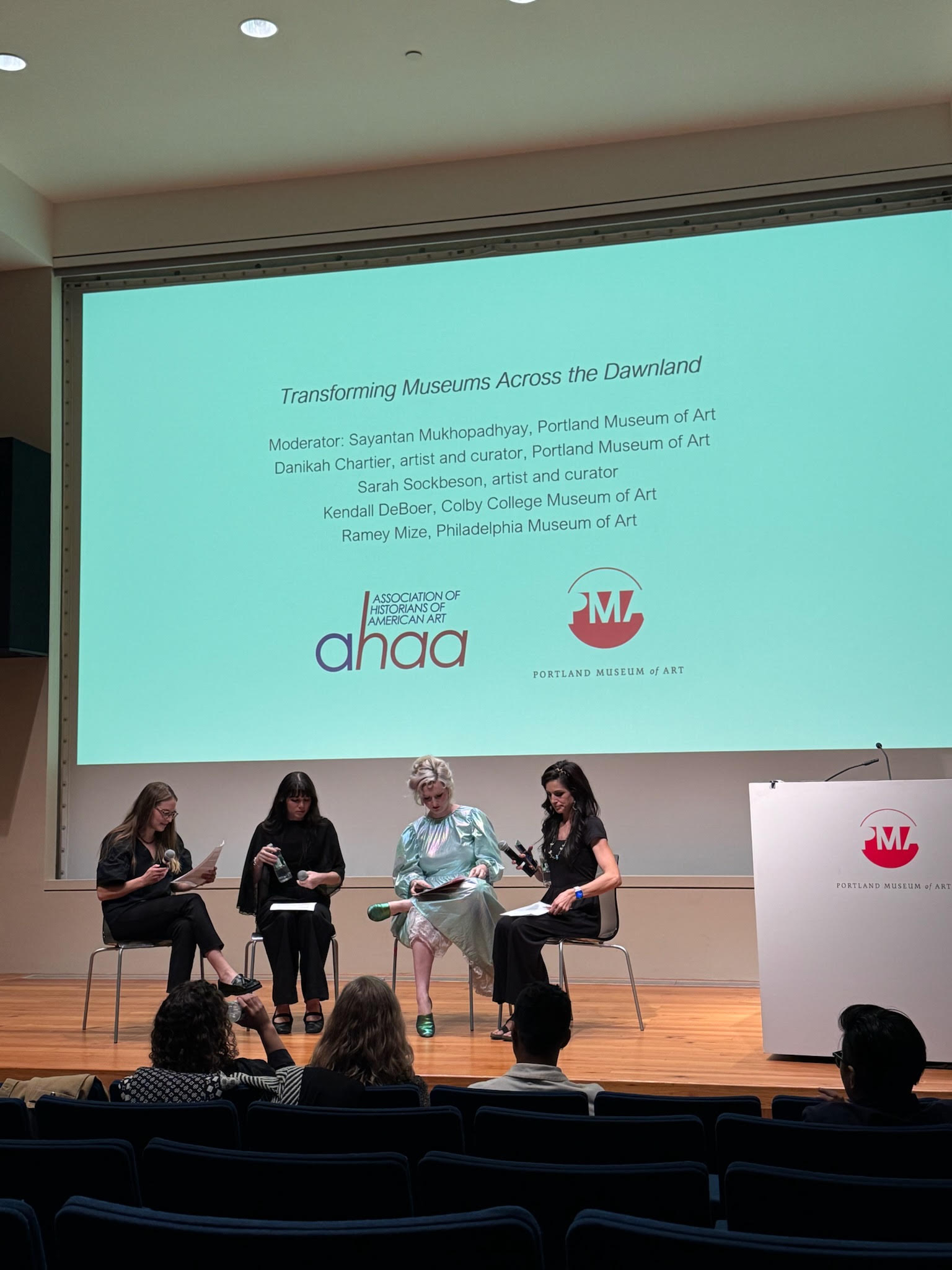
The opening roundtable, “Transforming Museums Across the Dawnland,” brought these questions of knowledge and authority to the fore by demonstrating the possibilities and challenges of making museums into spaces for Indigenous belonging (fig. X). Its participants, the Mi’kmaw photographer Danikah Chartier, the Penobscot basketmaker Sarah Sockbeson, and the curators Kendall DeBoer and Ramey Mize, moderated by Sayantan Mukhopadhyay, spoke from recent experience. At Colby, Sockbeson initiated Mαwte: Bound Together and co-created the show with roughly a dozen Indigenous artists, the Monacan designer Brian Johnson, and DeBoer. In Portland, Passages in American Art was codeveloped by curatorial staff and advisory partners such as Atlantic Black Box and the Akomawt Educational Initiative. The panelists spoke as much about how these exhibitions were made as about what they displayed, from the negotiation of loans and commissions to questions of compensation and ownership. At stake was whether Indigenous artists and knowledge-holders could determine an exhibition’s terms or merely supply its contents. Their accounts suggested a practice of relational curating, informed by Indigenous studies, in which curatorial decisions emerge through sustained relationships with artists and communities. There were, of course, limits. Building relationality requires resources, and the panelists were frank about what their time and budgets could sustain. The museum remained, as one panelist observed, a market whose inequalities no single exhibition could undo. Rather than declaring the museum “decolonized,” then, the panelists emphasized the ongoing work of Indigenizing its practices, without certainty about the outcome. What they offered was “knowing how” rather than “knowing that,” measured in years instead of openings. As one participant put it, “we’re playing the long game.”
If the roundtable considered how museums might share authority over the production of knowledge, one of Friday’s first panels, “Hot or Not: The Entwinements of Exceptionalism and US Art History at 250,” asked how Americanists have learned to approach their objects at all. There, Emily C. Burns questioned whether American art history had inherited the nation’s own mythology of youth and innocence, approaching artifacts as though their histories could begin anew. Burns located this habit in the methods Americanists had inherited for studying objects, particularly those of Jules David Prown. Prown’s “Mind in Matter” (1982) asks scholars to begin with description and to proceed through the senses of an embodied viewer. Yet, as Burns pointed out, not all embodied viewers are alike, nor are all equally implicated in an object’s history. Prown’s own description of early New England as a “stylistic tabula rasa” revealed the stakes of this presumed innocence: To approach a place as a blank slate is already to decide whose artistic histories count. What Kirsten Pai Buick calls “compulsory exceptionalism” could persist, in other words, even in the routine “close” analysis of a single object.
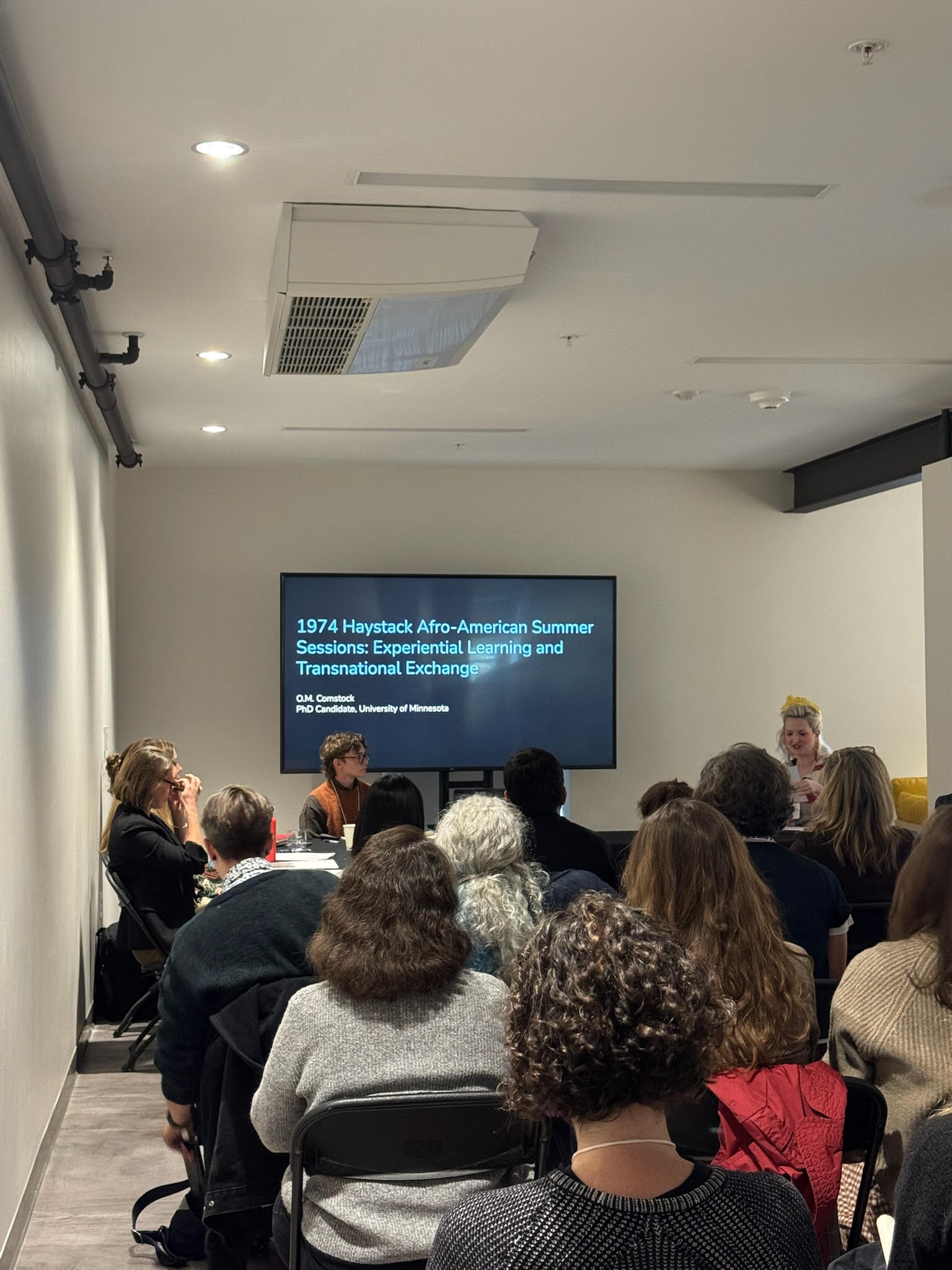
The critique felt particularly pointed in Maine, whose art colonies and craft schools have long invited artists to imagine the state as “Vacationland,” an exceptional place apart from ordinary life. From Prouts Neck and Monhegan to Skowhegan and Haystack, generations of artists have arrived in pursuit of inspiration and retreat, treating the Dawnland (often inadvertently, sometimes purposefully) as a landscape available for artistic discovery and extraction. O. M. Comstock’s paper on “experiential learning” at Haystack’s 1974 Afro-American Summer Sessions challenged that imagined separation, tracing Allen Fannin’s efforts to meet Black craftspeople’s “nitty-gritty needs” through workshops bringing African American and Nigerian makers together. The sessions offered opportunities for Black artistic self-determination and diasporic exchange, even as the participation of Nigerian instructors, facilitated by the US State Department, placed the program within the cultural diplomacy of the Cold War. Meanwhile, Diane Ahn’s study of Nikkei artists, caught between the Japanese and American empires as they visualized declarations of loyalty in American periodicals, extended the point toward a comparative, inter-imperial approach to American art. A related challenge to American art’s national geography emerged at Colby, where attendees visited Jessamine Batario’s exhibition Imagining an Archipelago: Art from Cuba, Guam, the Philippines, Puerto Rico, and Their Diasporas. Bringing together artworks from archipelagos shaped by distinct histories of American annexation, occupation, and imperial rule, the exhibition placed the consequences of US expansion at the center of a field that has too often treated them as peripheral.
Several papers examined how materials and techniques participated in the making of racial and colonial hierarchies, and how artists put their material knowledge to other ends. In “Racial Geographies and the American History of White Cultural Hegemony,” Manon Gaudet made gypsum the framework for understanding the racial geography of turn-of-the-century plantation economies. Spread as fertilizer, gypsum renewed soils exhausted by plantation tobacco and fed settler farms in an expanding empire. Cast as plaster, gypsum built the White City of the 1893 World’s Columbian Exposition, a celebration of the same empire’s fecundity. Where Gaudet showed how one material could serve both agriculture and art, Rachel M. Tang, in the “Anti-Colonial” session, treated a material and its manipulation as a means of understanding the Eastern Band Cherokee artist Shan Goshorn’s redress of colonial law. Goshorn cut reproductions of treaties and other legal instruments governing Cherokee land and sovereignty into splints and then wove them into baskets in Cherokee patterns, each with its own name and story. Only through both material and technique, in Tang’s account, could the colonial document be amended from within. In a similar vein, Jennifer Y. Chuong turned to labor, reading the burnishing and wiping of Dox Thrash’s prints through the work of ironing, done largely by Black women and seldom recognized as skill. Thrash ground carborundum into his copper plates with a heavy flatiron, bringing a tool of laundry work into printmaking. He named the process the Opheliagraph after his mother, Ophelia, a laundress, making attribution part of the invention itself and drawing attention to the ancillary labor of artistic production and maintenance.
Kinship and belonging occupied a cluster of papers, whether in John P. Bowles’s paper on “Black Migrant Mothers in the Art of Sargent Johnson,” crystal am nelson’s “A Tender Gaze: Reclaiming the Image of the Black Father,” or Corey Stout’s “Constructing Queer Space: Forrest Bess and ‘Tangy Air.’” Together, these papers raised the question: what might art teach us about how people come to know and belong to one another and their environments? Membership in a family or community promises neither care nor recognition, and the relationships sustaining what we colloquially call “a sense of belonging” are certainly not equally available to everyone. Across these papers, representations of kinship and space invited us to consider the knowledge acquired through relationships themselves: how care is given and recognized, how people make room for others, and how they learn to live together under unequal conditions. I could not help but think of the conference itself in these terms. Our profession often requires us to move between places and institutions, carrying out much of our work alone. For three days, however, the conference offered its own fleeting form of belonging, even as we would soon go our separate ways.
Relationships of every kind depend on infrastructure, as a third cluster of papers reminds us. Roads, archives, and agencies facilitate the circulation of people, images, and materials alike, often operating beyond the immediate frame of art-historical inquiry. How, then, might art historians look closely at systems whose operations ordinarily escape our attention until they fail us? Lee Ann Custer traced William Edmondson’s limestone to the wrecking companies and urban renewal projects of Nashville. Carved from the rubble of razed Black neighborhoods, Edmondson’s sculptures hold a geological, place-based knowledge of what the city destroyed, a reminder of a destruction the city recorded only as progress. Delaney Chieyen Holton spoke on Farm Security Administration photography without showing a single image, shifting attention from the culpability of individual photographs, and even photographers, to the federal apparatus deciding what could be seen and remembered of Black political life in the South. Michelle Donnelly showed how federal access to radioactive materials made Caroline Durieux’s electron prints possible, even as state oversight constrained her critique of the atomic age. Taken together, these papers made infrastructure more than a backdrop. They demonstrated how systems of demolition, documentation, and scientific access shaped not only the conditions of artistic production but also the histories that artworks could preserve or conceal. To study infrastructure, then, is to ask how the systems through which art and material culture circulate shape what becomes known.
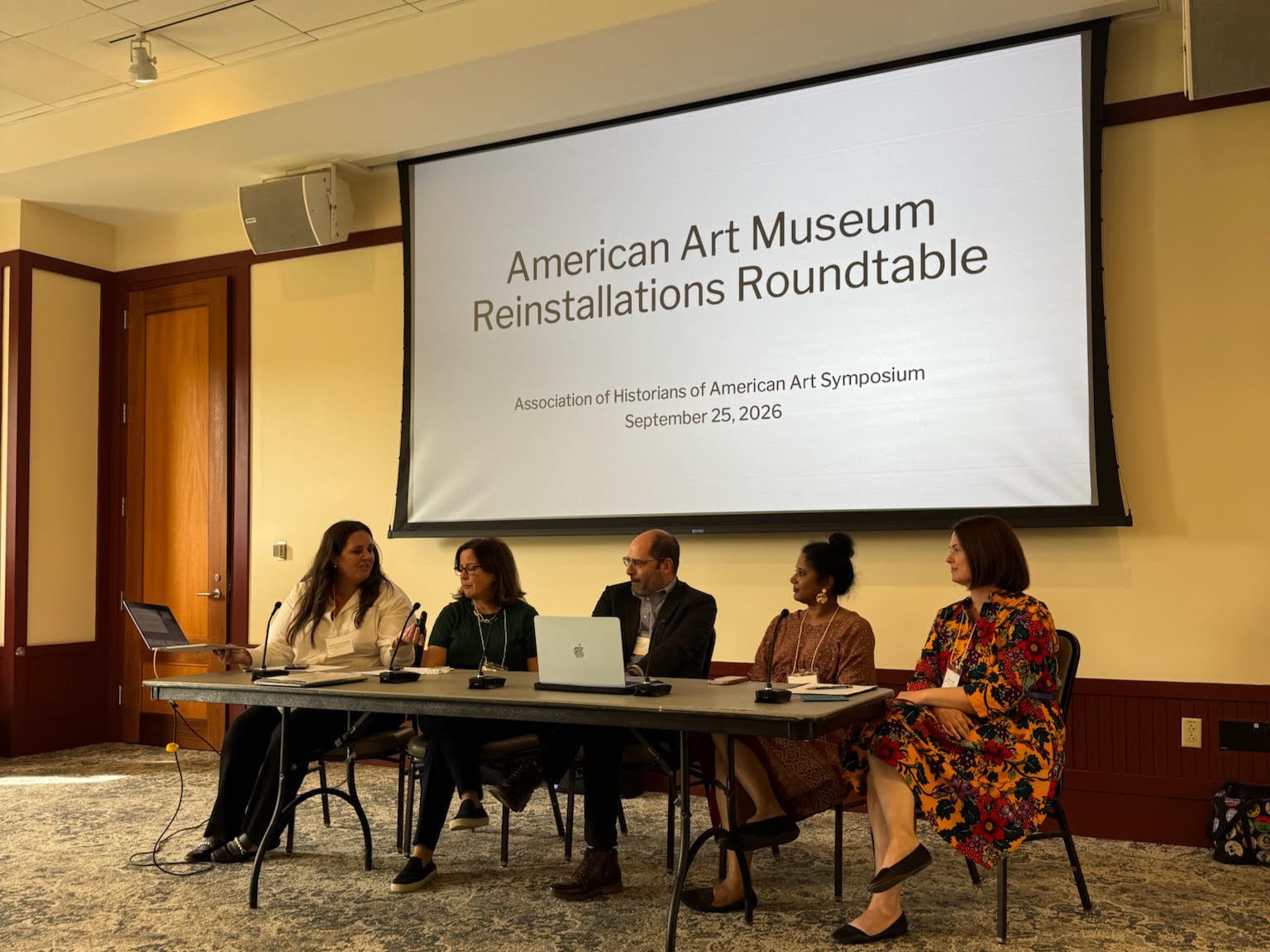
What the symposium itself left unknown was telling, too. For all its sustained attention to American exceptionalism, the symposium had remarkably little to say about the Revolutionary era. The organizing committee described the gathering as arriving “at a moment when cultural institutions across the United States are remaking their stories about American art, and many are planning to commemorate the anniversary of the signing of the US Declaration of Independence.” One panel carried the anniversary in its title, the roundtable on American art museum reinstallations addressed the narrative of the of the founding (fig. X), and Bowdoin’s USA @ 250 was on view. Yet only one paper, Judy Bullington’s “Revolutionary Era Women and ‘Botanical’ Agency,” took up the American Revolution itself, and almost none the centuries before the Revolution. A charitable reading would take the silence as a sign of consensus. Our field has absorbed the critique of the Revolution as a founding moment and sees no reason to celebrate the subject, least of all in an anniversary year. A less charitable reading would suggest there is something exceptional, in the worst sense, about our field’s ability to speak coherently about American art only from the moment of the Revolution onward. The omission matters because the histories of making and knowing in the Americas long precede the nation whose founding anniversary framed our gathering.
By the symposium’s end, I wondered whether our shared concern with knowledge reflected, at least in part, the anxieties of our epistemologically uncertain times. Amid climate crisis, political interference in museums, and profound changes in how information is produced and circulated, the impulse to affirm the value of art-historical inquiry is understandable. Across the symposium, questions about the plurality of knowledge became questions about the authority of art historians themselves and the responsibilities that accompany the production and interpretation of knowledge. The two Emerging Scholars Lightning Rounds amply and boisterously demonstrated how expansive and open to analysis the category of knowledge has become in the field. The presentations ranged from Carolyn Hauk’s watery American art history to Suiyi Tang’s cybernetic framing of Asian American design and Clea Massiani’s radical history of progressive art studios. These scholars already work as the symposium asked us to: plural and political, interdisciplinary by habit, and attentive to the relationships and infrastructures behind every object. Their approaches to objects, archives, and institutions promise new findings and, better still, new questions about how we know what we know.
Cite this article: Hampton Smith, “Knowledge and Knowability at AHAA 2026,” Panorama: Journal of the Association of Historians of American Art 12, no. 2 (Fall 2026), https://doi.org/10.24926/24716839.21639.
About the Author(s): Hampton Smith is assistant professor of craft history at the University of Arkansas.