

Call and Response: Facts and Fables in the Fundamentals of (American) Visual Formation





PDF: Navaroli and Simmons, Call and Response Part 2
Introduction
Contributors
Oluwatobiloba Ajayi, “Necessarily Panoramic: Unsettling Borders of Nation, Discipline, and Practice”
estefanía vallejo santiago, “Cómo se Aprende? (How do you learn?)”
The assembly . . . encompasses all of those individuals, both known and unknown, who enacted slave revolts, led the Underground Railroad, and participated in the abolitionist movement; it includes those who fought in American wars despite being second-class citizens in a segregated army, those who organized the Civil Rights and Black Power movements, who worked as sharecroppers for a pittance and who labored in Dixie’s mills and the industrial factories in the North; it includes those targeted by racial profiling, those subjected to extrajudicial killings, and the millions languishing in the prison-industrial complex.
—Adrienne Edwards (2018)
Where does the conceptualization of what it means to be American begin, and, more pointedly, where does it end? How can we critically engage with these ideological boundaries in examining local, national, and global identities in visual art? Beginning in issue 12.1, we posed these questions in anticipation of the 250th anniversary of the signing of the Declaration of Independence, the formalized foundation of the United States. Our responding contributors offered compelling meditations on legislative scrutiny, institutional decay, archival erasure, and public activism. As we read their poignant reflections, we considered not just what the semiquincentennial celebrates but also what it presumes. The Bill of Rights, for example, was signed into law on December 1, 1791, legalizing the right to assembly. In many ways, this legislation, which actualized the individual right to collectively express, promote, and defend one’s ideas, marks the moment when the nature of the collective becomes most salient to the themes of our present discourse. As a protective measure for the maintenance of civil liberty in the infancy of the nation, the Bill of Rights grants our opportunity to set or, as scholar Adriene Edwards’s opening quote suggests, to reset known and unknown histories. By building multiplicity, this Colloquium acknowledges the role of the assembly in both fostering solidarity and fracturing representation.
In the lead-up to the semiquincentennial, academic and cultural institutions located across the country announced special exhibitions and programs. As these events unfolded, we considered the multiplicities inherent in expressing the communal and the self. For whom do we move in service? What are the visual dialogues that inform our constructions of history, and how do these philosophies of thought and practice determine what we should maintain, protect, and preserve? This Colloquium’s essay contributions turn a self-critical lens on questions of lineage, legacy, and continuation in art-historical practice. In fact, as the essay from Oluwatobiloba Ajayi details, the conceptual foundation for this Colloquium stemmed from an editorial rejection—a collective decision based on subjective interpretations of how Panorama’s content might best address the goals of individual artistic practice, the prescribed boundaries of nationhood, and the mining of those identities/histories. The provocations put forth by Ajayi and fellow contributor estefanía vallejo santiago challenge us to consider the real and perceived boundaries of the Atlantic, recognizing the sociogeographic narratives that can police the discipline and its systems. Cultural institutions are grounded by the preservation of tradition, and although these communal roots are intended to hold us together, Ajayi argues that they often “deny the relationality . . . that lives and leaks from the margins.” This section therefore serves as a vehicle for elevating critical forms of correction and care—a call that focuses on acknowledging areas of fracture so that future Panorama scholarship can continue to thoughtfully sustain these dialogues.
Historians of American art must embrace opportunities that relocate and expand sites of memory and practice. We must also strive to combat the conjectures of canon that dictate what national identity should look like. As vallejo santiago argues, the use of terms associated with progress and development “obscure[s] how unevenly those assurances are enacted,” engendering a form of creative rage necessary to “unlearning” harmful narratives. Reflecting through practices based in Great Britain and Puerto Rico, respectively, Ajayi and vallejo santiago speak to the impacts of global positionality on embodiment, disassociation, and agency. Collectively, their scholarship suggests that now is the time to challenge industrial domination, to deny the purported universality of American hegemony, and to refuse the assumption that patriotic fanaticism fuels enterprise.
Unbound
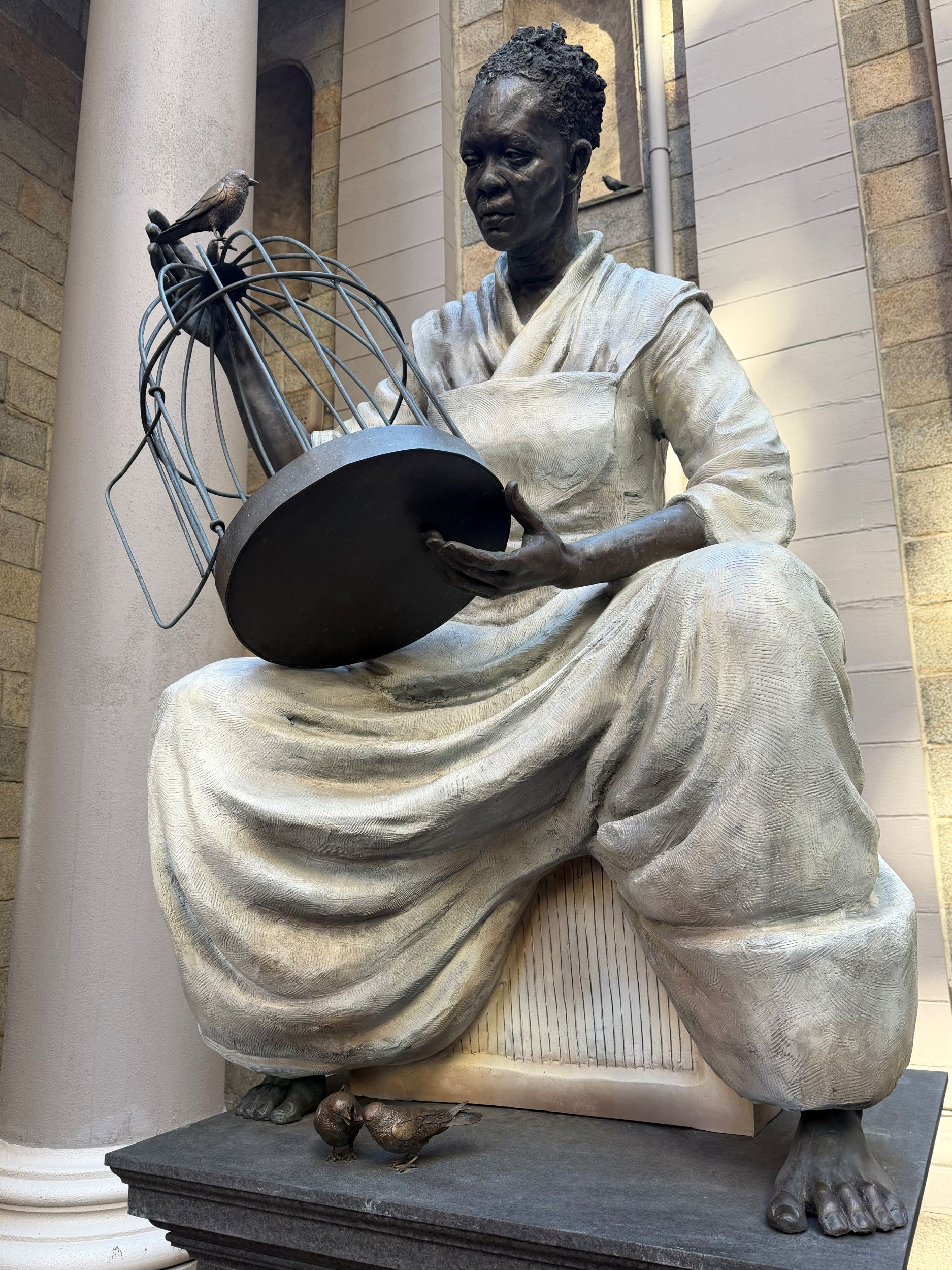
Fig. 1. Harmonia Rosales, Unbound, 2025. Bronze. Installation at King’s Chapel, Boston, Massachusetts. Photo by Frederica Simmons
Installed at the entrance to Boston’s historic King’s Chapel (founded in 1686), Harmonia Rosales’s (b. 1984) large-scale bronze Unbound is a site-specific acknowledgment of the United States’ complex legacy. The figurative work depicts a seated Black woman cradling an open birdcage. She stares contemplatively at the bars of the enclosure as the newly released birds sit perched at the top of the cage and in be-tween her feet. The sculpture—located along Boston’s Freedom Trail—was installed as a part of a larger commission meant to honor the strength and resilience of Africans enslaved by King Chapel’s administrators and congregation. As an American artist of Afro Cuban descent, Rosales celebrates the dignity and diversity of the African diaspora, using the Black body as a platform for exploring cultural heritage, collective remembrance, and social transformation. As a work that celebrates communal agency and resilience, Unbound sits at the heart of this Colloquium’s concerns, highlighting the intersections of freedom, assembly, and nationhood.
As historians of visual culture, we must remember that we cannot distinguish our humanity from the sociopolitical mechanisms through which the field of art history propagates itself. In retelling our stories, we must be willing to “loosen our grip,” to follow history back and forth across the continuum of time to acknowledge that which American hegemony benefits from decimating. This issue of Panorama concludes these critical dialogues, but notably, it does not end them. In fact, we hope that it makes the responsibilities demanded of our current moment clearer and more imperative: to activate artwork as a mode of production, to recognize alternative models for scholarship, to foster diverse networks of cultural development, and to suggest new possibilities for our fundamental right to assembly in scholarship and practice.
Epigraph: Adrienne Edwards, “The Struggle for Happiness, or What Is American about Black Dada,” Walker Reader, February 1, 2018, https://www.walkerart.org/reader/adam-pendleton-black-dada-reader-adrienne-edwards-excerpt.
Cite this article: Keidra Daniels Navaroli and Frederica Simmons, introduction to “Call and Response: Facts and Fables in the Fundamentals of (American) Visual Formation,” Colloquium, Panorama: Journal of the Association of Historians of American Art 12, no. 2 (Fall 2026), https://doi.org/10.24926/24716839.21440.
About the Author(s): Keidra Daniels Navaroli is Manager of Diversity, Equity, Inclusion and Digital Art History at Panorama. Frederica Simmons is an Exhibition Reviews editor at Panorama.