

Repetition, Resistance, and Remembering in the Prints of Elizabeth Catlett





PDF: Corlett, Repetition, Resistance, and Remembering
One of my aims, to bring art to my people in the museums, galleries or other centers, can be realized through prints. They are easy to transport and can be seen in numerous places at the same time. For me print-making is the real public art that can be taken easily to so many people.1
—Elizabeth Catlett
Elizabeth Catlett (1915–2012) centered her printmaking practice on social and political responsibility and a deep commitment to connection and communication with her audiences. More than any other medium, prints offer the advantage of increased visibility through the creation of multiples: Many impressions can be made from the same block or print, resulting in artwork that is much more widely available and affordable than a single painting or drawing. Certainly, Catlett intended that her prints reach a broad public and be meaningful to both the art world and everyday audiences: “I am inspired by black people and Mexican people, my two peoples. Neither the masses of black people nor Mexican people have the time or the money to develop formal aesthetic appreciation. And so I try to reach them intuitively because they have an intuitive appreciation.”2 Equally a sculptor and a printmaker, Catlett herself sometimes described her prints as sociopolitical and her sculpture as focused on form.3 Yet a sculpture such as Political Prisoner (1971) or a print such as Girls (1982; see fig. 13) complicate a strict dichotomy and invite a more nuanced interpretation.4
As a printmaker, Catlett worked masterfully in linocut, lithography, and screenprint, and these techniques guided her artistry in progressive ways that might be easy to overlook because she chose to “reach [her audiences] intuitively” through overt figuration.5 But print processes, strategies, and techniques were in fact the beating heart of her two-dimensional work and essential to her artistry. Printmaking processes, with repetition as their linchpin, offered Catlett the magic and the means by which she empowered her figures, animated her compositions, and furthered her activist and feminist vision.
Repetition, Multiplicity, and the Matrix
Printmaking involves the creation of a reusable matrix—a plate, stone, screen, or block that can be inked and printed multiple times—and Catlett took full advantage of this repeatability and the resulting capacity for producing multiple originals. Most important, it was as a printmaker and through print processes that Catlett asserted the expressive force of repetition as an artistic strategy.
In linocut, arguably her signature technique, Catlett employed a masterful versatility of mark making carved into a linoleum surface, with form and texture emerging from grooves and gouges, strokes and scrapes, that are variously delicate, aggressive, sinuous, or staccato. The act of carving a linocut block is sculptural in its own way, yet all printmaking processes require a certain amount of dimensional thinking on the part of the artist. The making of a print often involves building a composition in stages, with individual elements printed in layered succession from multiple matrices. Reversals, too, are intrinsic to most print processes, including linocut. Throughout the process of carving the image on the linoleum block, the artist must anticipate the effect of the reversal on the final printed image. In addition, linocut is a relief process, with the carved-out areas holding no ink and presenting as white when the block is printed. Thus, to produce the block, the artist must manipulate the negative space, another form of reversal. But in the end, the linocut technique yields a relatively inexpensive and easily printed matrix, which certainly remains part of its appeal. Once carved, linocut blocks provide great flexibility in the number of impressions made and can be conveniently reprinted days, weeks, or even years after the initial carving. In Catlett’s hands, linocut blocks were often repurposed, with new work created from previously carved blocks bearing witness to a valuable printed past.
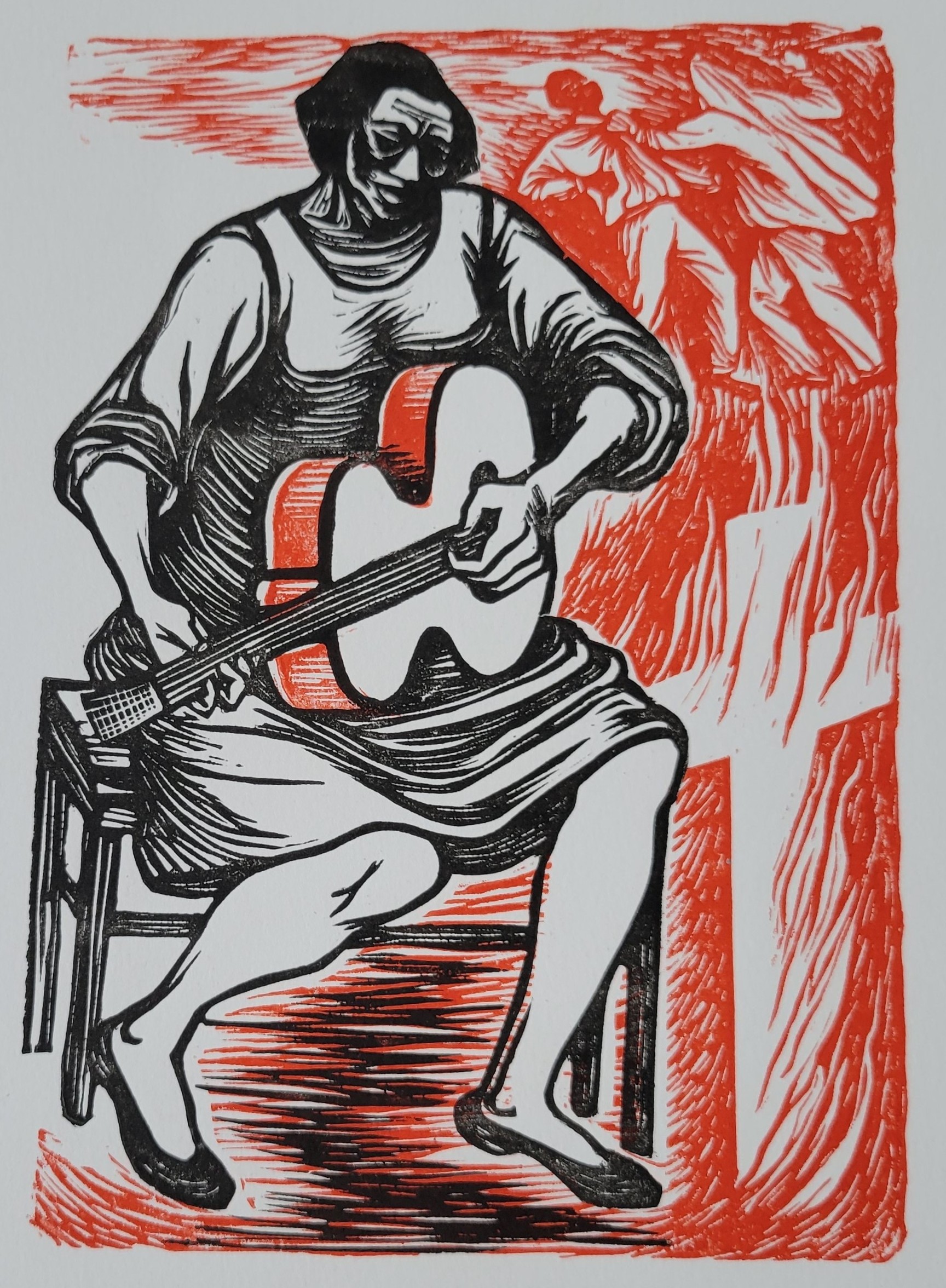
Printmaking is unlike any other art form in its capacity for controlled multiplicity, but Catlett was not particularly vested in creating fixed numbers of impressions in limited editions, as many printmakers do. In practice, her editions, both large and small, numbered and unnumbered, were frequently open ended, sometimes printed at intervals over many years. Often her decision to reprint provided a new opportunity to explore color variation. A vivid example is the portrait of a guitarist titled I have given the world my songs (1946/47), which was initially printed in black and blue but for which there are also a small number of blood-red proofs (fig. 1). Her later experimentation with color indicated an effort to visually and metaphorically amplify the implied subject of the guitarist’s song, namely the racial violence depicted in the background. In her final reprint of the linocut in 1989, however, she retained its original blue tonality, perhaps itself a reference to Blues music. This is but one example of the opportunities for experimentation and discovery that print processes facilitate. The repeatedly printable matrix created a framework through which Catlett could explore a variety of aesthetic possibilities.
Setting the Course
Catlett’s engagement with prints and printmaking began with her education at Howard University in Washington, DC, where she studied with James L. Wells (1902–1993) and was exposed to print history, including Japanese woodblock prints, and techniques, such as woodcut and linocut relief processes, which do not require a press for printing.6 But as Catlett told the artist Camille Billops (1933–2019), “With Mr. Wells I learned about elementary printmaking. I learned a lot more about printmaking at the Art Students League along with Bob Blackburn (1920–2003).”7 By the time Catlett studied lithography at the Art Students League in New York in October of 1945, she was fully engaged with the undertaking for which she received a Julius Rosenwald fellowship.8 In this groundbreaking project, focused on African American women, lithographs were an essential component, inextricably linked to her belief in the value of art as a cultural force that could be amplified by the portability of prints. In her 1945 fellowship application, Catlett expressed her goal of reaching wide audiences with a strong narrative centered on Black women, stating: “It is my earnest desire to portray this history of Negro womanhood in lithography, painting and sculpture, and to send these portrayals to Negro and white colleges so that young men and women, especially in the south, can get some idea of the contributions of Negro American women.”9
When she submitted her renewal application to the Rosenwald Fund in 1946, prints played an even greater role as she envisioned an additional, concomitant set of lithographs. The ability of prints to circulate widely remained their key appeal. She wrote:
In addition to circulating one exhibition of sculpture, painting, and lithographs, I would like to do a complete unit of lithographs alone. In this way I could reach people in many places where there are not facilities for handling the original exhibit. Churches, libraries, YW and YMCA’s could hang a show of prints that would be seen by many more average Americans. These are the people that are so often denied the art of contemporary America.10
The prints in the series, initially titled Negro Woman, were in the end executed as linocuts.11 The Rosenwald fellowship was transformative because, as Catlett later said, “It was a great opportunity for me to do that series on black women; it sort of set me on the whole idea of working with that subject.”12 The project also incentivized Catlett to begin a serious engagement with printmaking, while the fellowship provided the funds for her to travel to Mexico in 1946. At that time, the print workshop Taller de Gráfica Popular (TGP) in Mexico City was at the height of activity with Estampas de la Revolución Mexicana. Published in 1947, this ambitious portfolio of eighty-five prints by sixteen artists provided a rich retelling of Mexican history and the Mexican Revolution (1910–20). A project of such momentous scope surely played a role in inspiring Catlett’s thinking about her own historic print series, yet it is noteworthy that she had come to Mexico with the seeds for her groundbreaking project already sown, as evidenced by her statements in the Rosenwald applications.
At the TGP, Catlett executed lithographs at first but soon discovered the expressive potential of linocut as practiced by the workshop’s master printmakers. Particularly inspired by virtuoso TGP cofounder Leopoldo Méndez and fueled by the additional technical guidance offered by Ignacio Aguirre and Francisco Mora, she quickly perfected the linocut technique for which she is now best known.13 The fifteen linocuts of the Black Woman series, produced in 1946/47 in Mexico for her Rosenwald project, are the foundational underpinning of Catlett’s career as a printmaker.
Her first one-woman exhibition at the Barnett-Aden Gallery in Washington, DC, in December 1947, introduced the completed project, and as the exhibition brochure confirms, the full body of work included painting, sculpture, and prints.14 But the print series is arguably the project’s backbone, representing the lived experience of Black women as inextricably interwoven into the fabric of American history and life. In 1947 Catlett’s prioritization of this subject matter was unprecedented.15 It unfolded poetically as well as visually through the series’ interweaving of the literary and visual arts.16
When taken as a whole, the series entwines text and image into visual poetry.17 Arranged in order, the titles of the individual prints relay a narrative of Black women’s lives in poetic cadence:
I am the Negro woman
I have always worked hard in America . . .
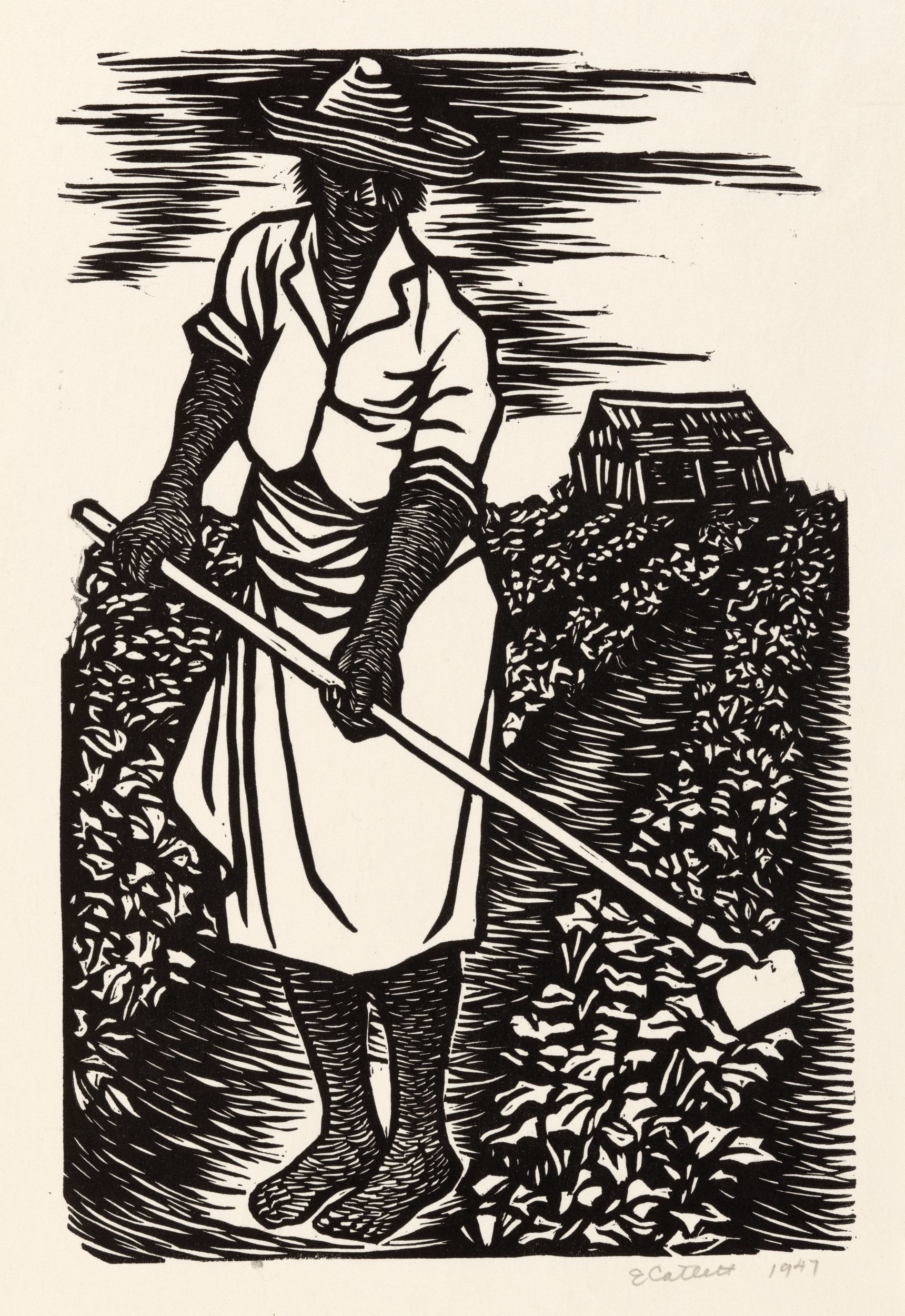
. . . In the fields [see fig. 3c]
. . . In other folks’ homes
I have given the world my songs
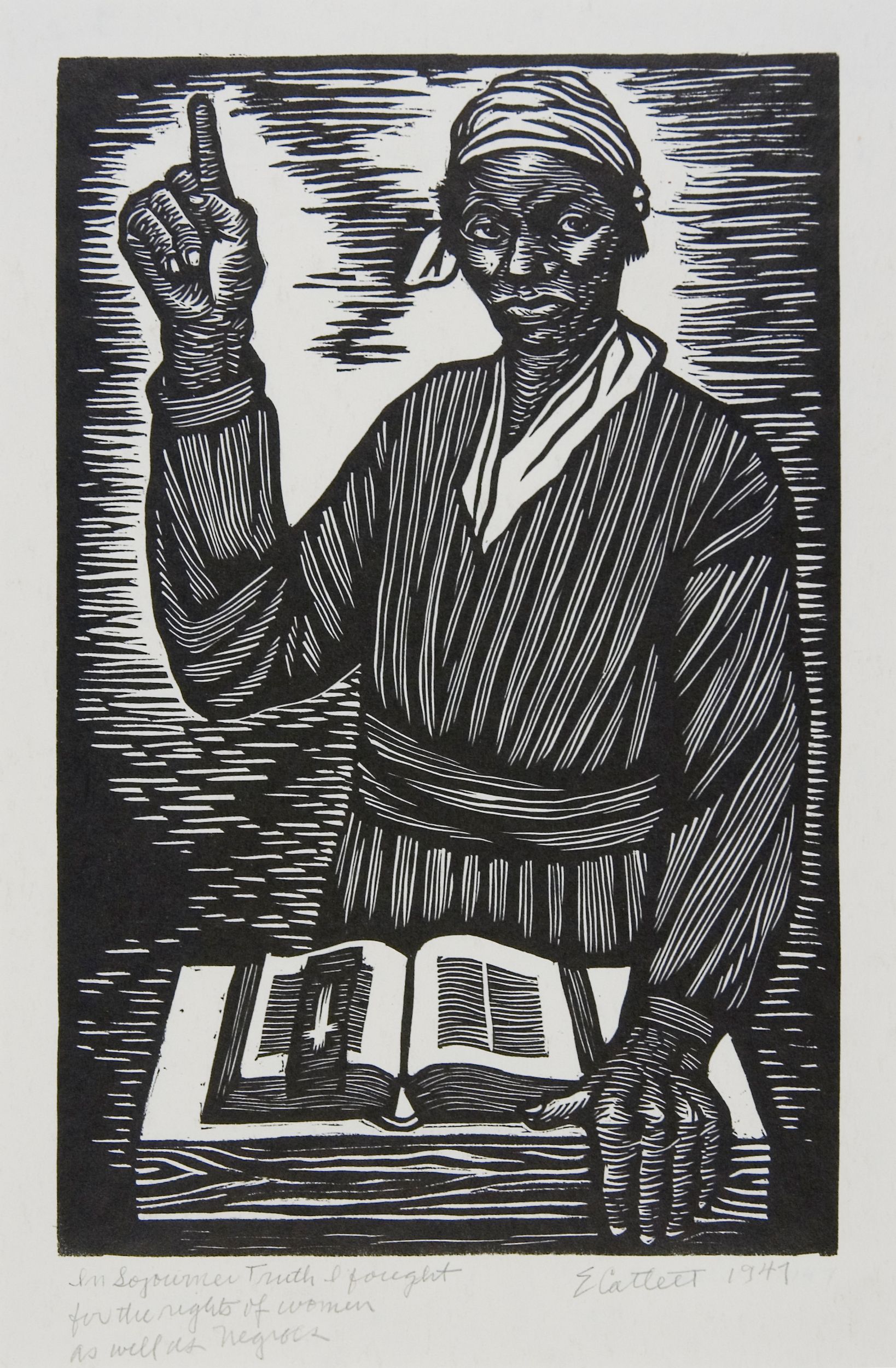
In Sojourner Truth I fought for the rights of women as well as Negroes [see fig. 3a]
In Harriet Tubman I helped hundreds to freedom [see fig. 3b]
In Phillis Wheatley I proved intellectual equality in the midst of slavery
My Role has been important in the struggle to organize the unorganized
I have studied in ever increasing numbers
My reward has been bars between me and the rest of the land
I have special reservations—
. . . Special houses
. . . And a special fear for my loved ones
My right is a future of equality with other Americans
“Language they will not ignore”
Catlett’s “Report of Progress and Plan of Work,” which she submitted in 1946 as part of her renewal application for the Rosenwald fellowship, revealed an evolving clarity of purpose. It is worth quoting at some length:
As I began work on the project I became very concerned with the effectiveness of my way of working in reaching my audiences. I found that I was following trends in modern art appreciated by an intellectual minority; and that millions of Americans, both Negro and white, were being offered and had grown to accept art of the Norman Rockwell–Saturday Evening Post variety. These millions contain the people I would like most to reach. If my work on this project was to have the desired effect, then it must be stated in language they will not ignore.18
Catlett was attuned to the growing influence of mass-media culture, as indicated by her specific mention of the Saturday Evening Post, and as a result, she identified an expressive tension between form and figuration in her painting, which was at the time her primary work in two dimensions:
I was trying to arrive at a means of expression that would reach the people for whom I was painting. My eventual (and partial) solution was not to adopt the naturalistic, sentimental approach of Norman Rockwell, but to try to combine elements of form recognizable to the majority of people, with principles of form based on the modern approach to art, and in which I firmly believe. I feel that my greatest contribution as a Negro artist must be made in terms that are the most effective.19
One of the means Catlett used to connect with community and “reach [her audiences] intuitively” was the appropriation of images from common literary sources, including books and magazines.20 This stuff of everyday life, “recognizable to the majority of people,” provided her with that indispensable gateway for communication. Familiar imagery offered both connection to community and an essential throughline to Black history.
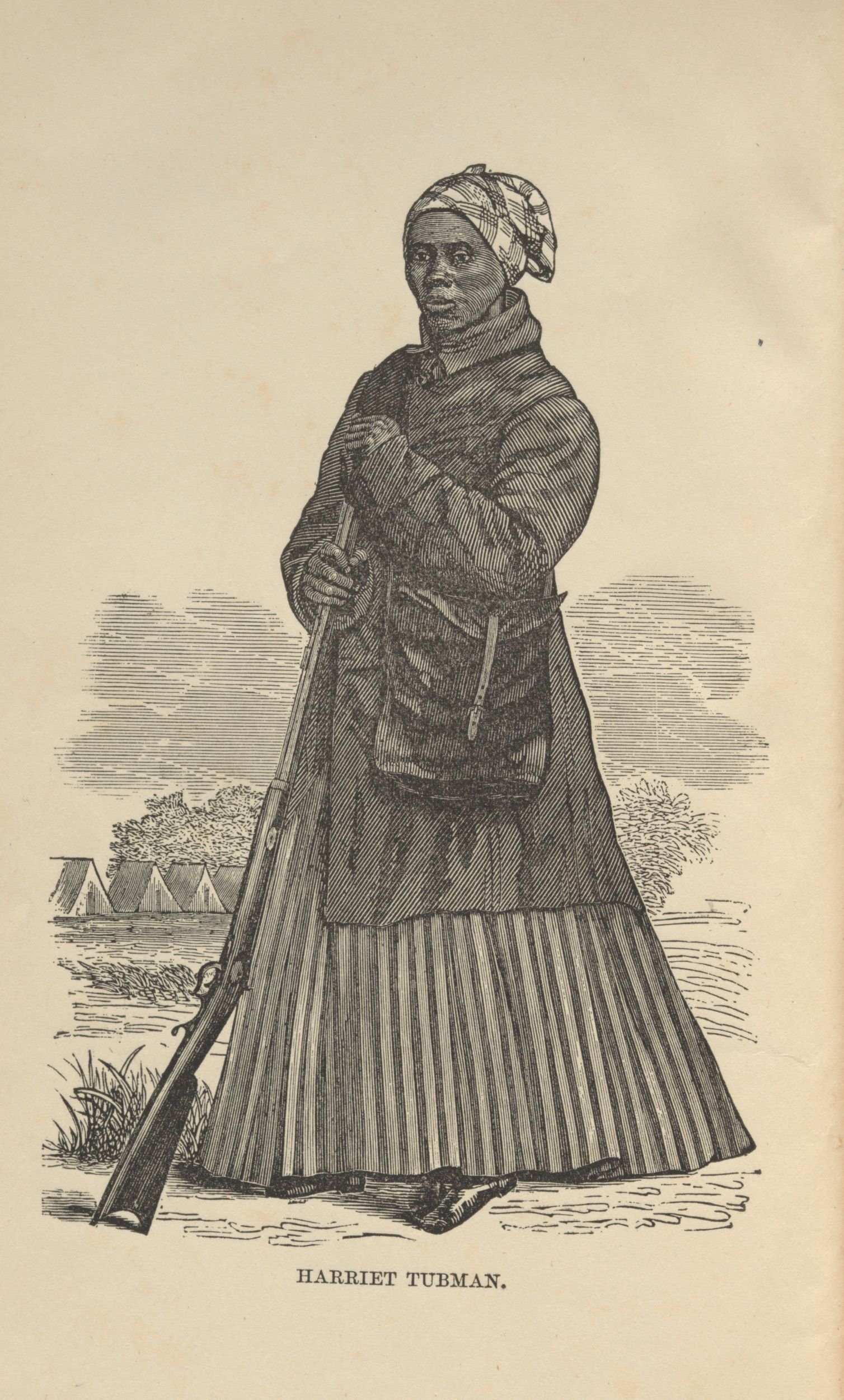
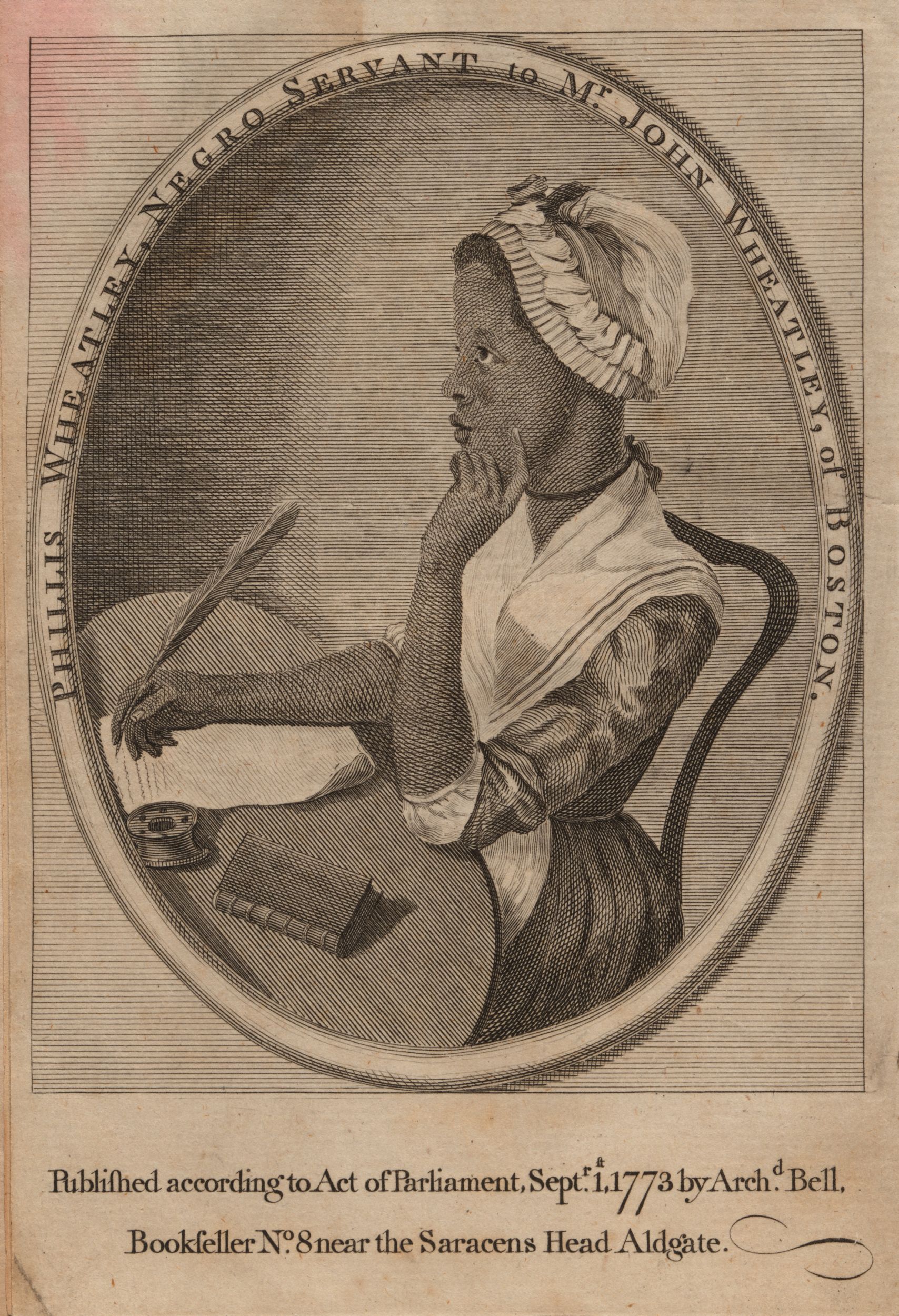
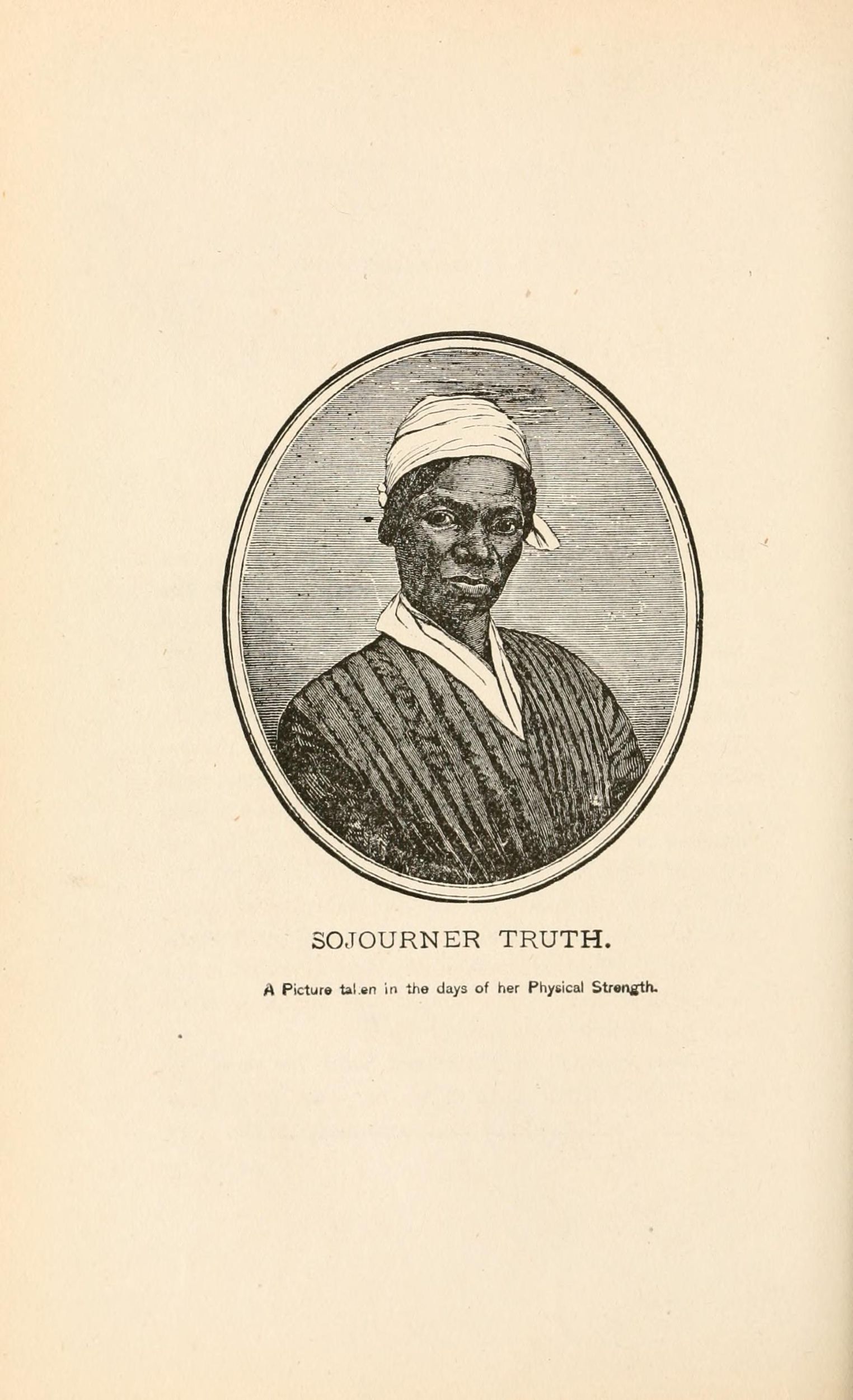
Portrait engravings published as frontispieces in historic volumes (figs. 2a–c) were the visual source for Catlett’s representations of all three of the named heroines in the Black Woman series: Sojourner Truth (fig. 3a), Phillis Wheatley, and Harriet Tubman (fig. 3b). These Black women forerunners were the fulcrum of the Black Woman series, and Catlett purposefully based the image of each heroine on a recognizable literary reference. The series was a crystallization of Catlett’s belief in the importance of identifying and remembering the rich history of Black women’s work, activism, leadership, and artistry.
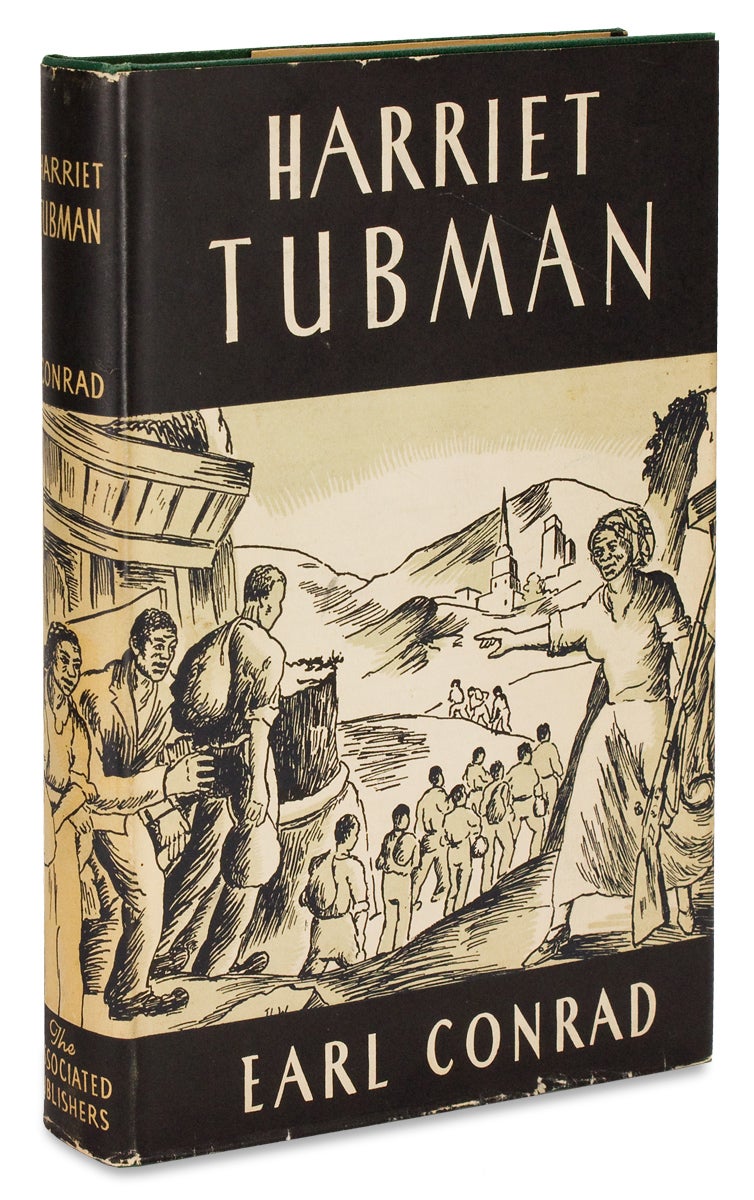
Harriet Tubman was a heroine of supreme importance to Catlett, and there may have been an additional literary volume on Catlett’s radar. In 1943, three years before Catlett made the Black Woman series, a new Tubman biography by Earl Conrad was published to much acclaim by Associated Publishers in Washington, DC (fig. 2d). The book played a critical role in the revitalization of Tubman’s legacy, which had been gradually fading from American memory even before her death in 1913. Tubman’s pointing gesture in Catlett’s portrayal is similar to the pose on the vintage jacket illustration for Conrad’s book, and if it had indeed served as a visual reference, then it would be another example of literary resonances in Catlett’s prints.21
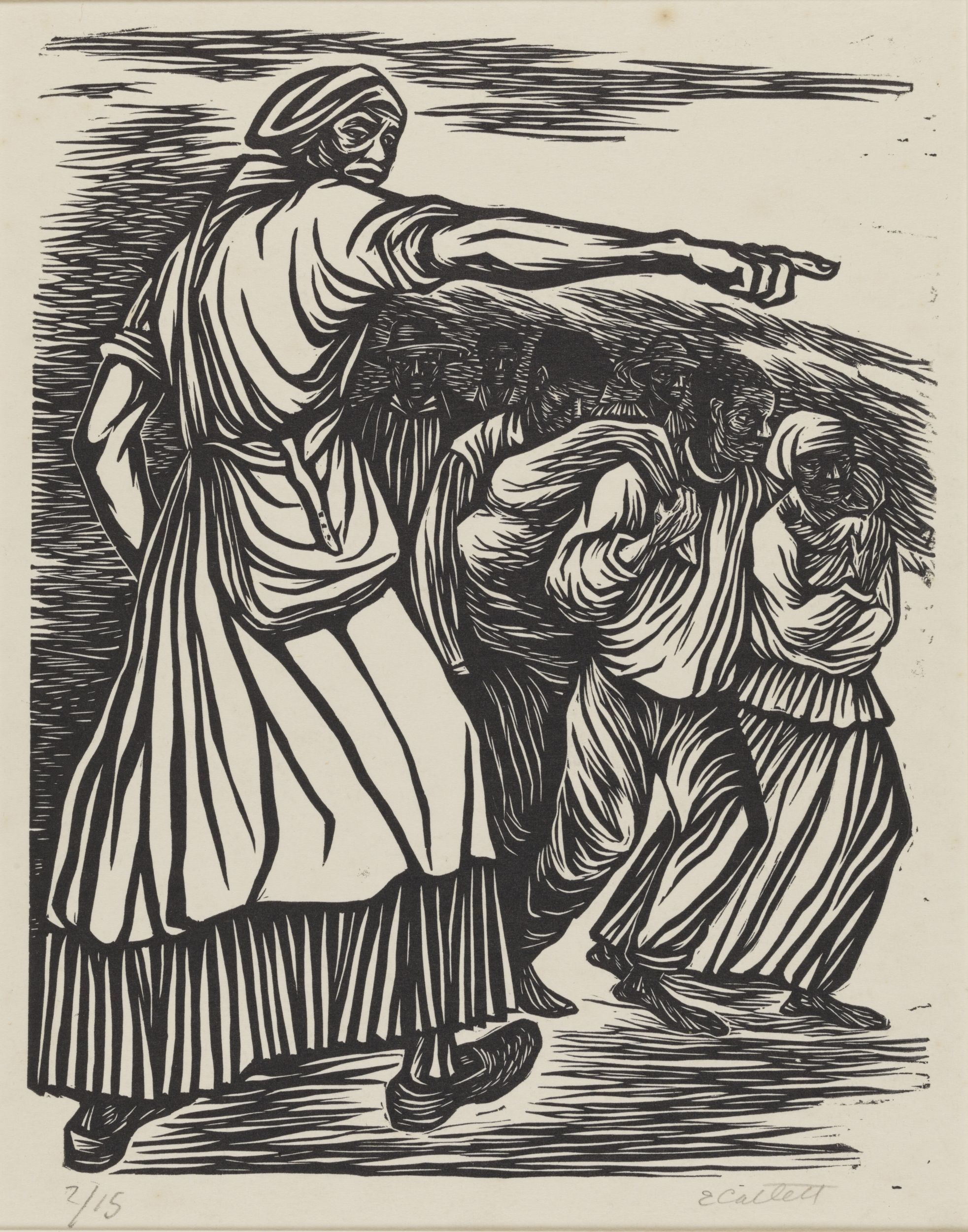
Catlett portrayed Tubman in linocut twice after the Rosenwald project: in 1953, as part of a print series by numerous artists of the TGP known as Against Discrimination in the United States, and again in 1975 (figs. 4–5). The use of linocut itself provides a throughline, connecting each portrayal of Tubman to the others, as well as to the revered Mexican printmaking legacy. In all three versions of the Tubman portrait, echoes of book illustration provide another throughline. Tubman’s facial features, dress, headscarf, and satchel in Catlett’s 1953 version most closely reflect the historic engraving (see fig. 2c). In the 1975 version, Tubman again holds the rifle that had been missing in the 1946/47 version, but the more dynamic forward-pointing gesture of the earliest print returns, along with the denser throng of followers, including the mother and babe.22 These elements establish a clear conversation between Catlett’s earliest depiction in the Black Woman series and this last one, carved nearly thirty years later. In each of the three iterations, resonances with book illustration reaffirm the importance of safeguarding that literary record, irrevocably claiming for Tubman the fullness of her historical narrative.
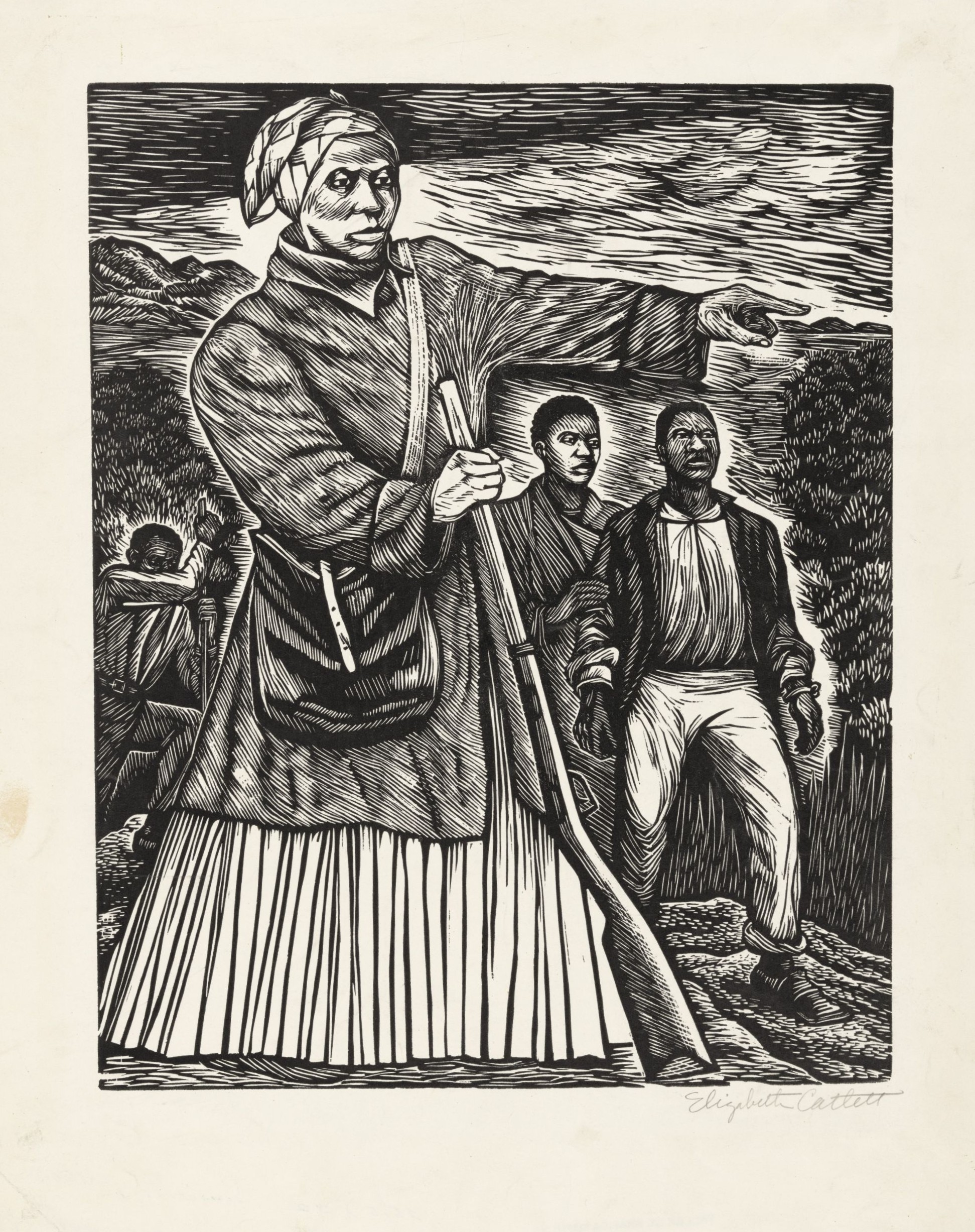
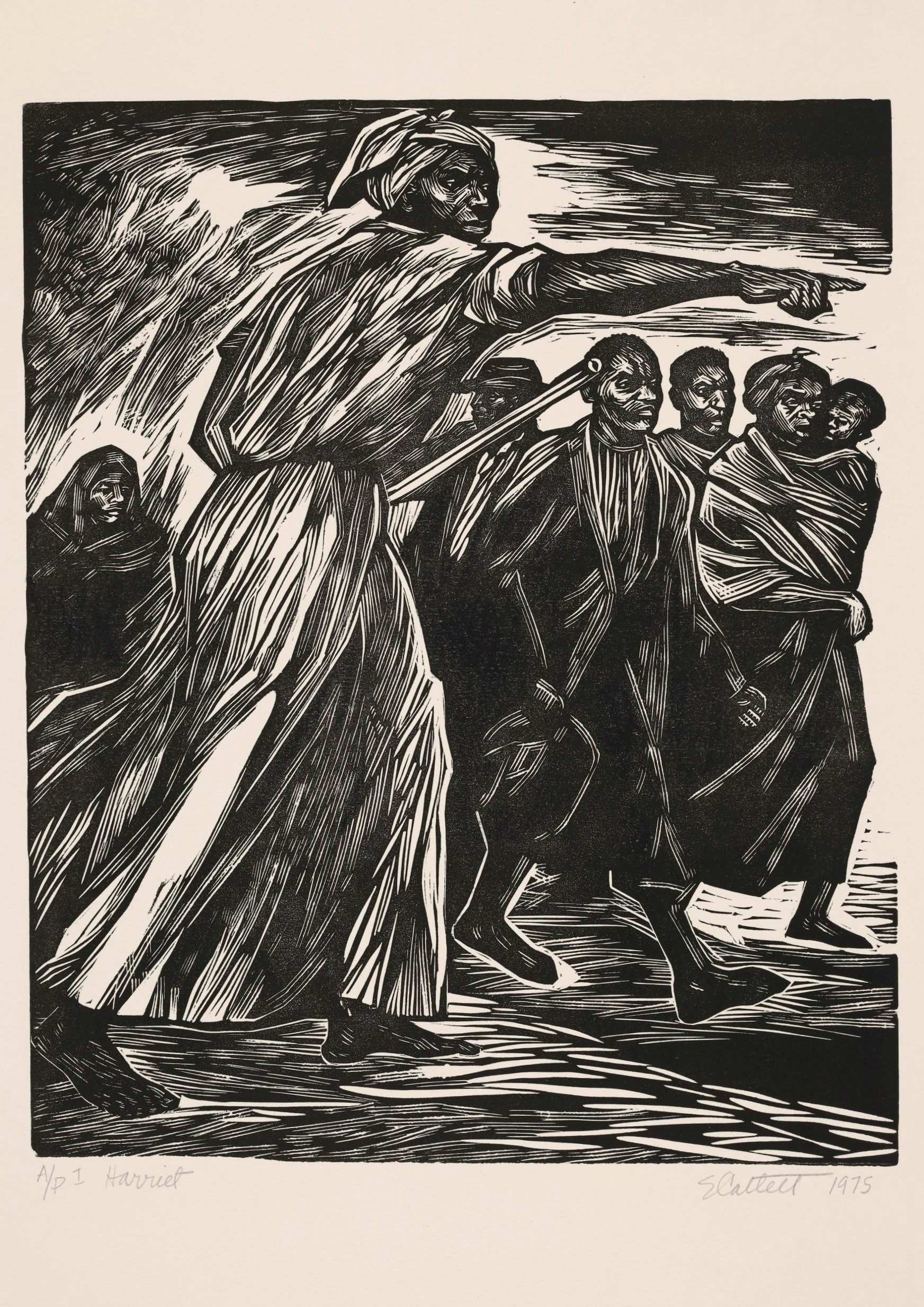
Through the intentional preservation of visual resonances with her earlier prints—self-appropriation—Catlett created another kind of continuum, augmenting meaning and summoning history by linking past and present through reverberating visual connections. The culmination came in 1975, at the peak of the Black Power movement, with Tubman as a supremely forceful affirmation of Black female power and a reminder of the need to persist. Through appropriation, the vitality of Black history, literature, and poetry—and the importance of preserving and propagating this legacy—are interwoven into Catlett’s imagery, serving as both an expression of resilience and a force for resistance.
Catlett’s literature-based representations of her heroines, which first appeared in the Black Woman series and were echoed in the two Harriet Tubman linocuts that followed, reflect a commitment to support, identify, and collect Black print culture that had been gaining both urgency and momentum in the early twentieth century, when Catlett was coming of age.23 Black print culture played a vital role in community self-education, irrefutably demonstrating Black accomplishment in literature and the arts and acting as a force for recognizing Black history as a cornerstone of American history.
Catlett was nurtured in a household that valued literacy and education, growing up in the 1920s, a period marked by an expanding American print culture empowered by advancements in technologies, such as photomechanical offset printing.24 Her early childhood was influenced by the rise of an increasingly pictorial press, which included a growing number of mass-market magazines. She recalls:
I remember as a child I was very good at drawing paper dolls. The ones you used to get out of the Ladies Home Journal. The ones that I drew were those little fat ones with curly hair. We kept them in cigar boxes. People would pay me [to make] them.25
Unsurprisingly, books also played a central part in Catlett’s childhood:
We always got books for Christmas. . . . But my mother . . . she gave us the “Book of Knowledge” and I remember I sat and read all the stories first and then I read all the poems. Then I read all the history. . . . She always gave us books for Christmas, and they were nice books to read. We read a lot.26
Each volume of the Book of Knowledge, a children’s encyclopedia, contained an abundance of photomechanical illustrations, interspersing graphics and photographs with texts in a variety of forms, including poetry, prose, short stories, printed music, craft and how-to activities, photo-essays, and more, designed to captivate childhood imagination and curiosity on topics exploring history and legend, nature and science, adventure and discovery. This dynamic relationship of imagery and text was boosted by new publishing capabilities and strategies that were reshaping modern visual storytelling.
Black print culture, too, was burgeoning, and Catlett’s hometown played a central role in the growth of Black publishers and publications that blended visual illustration and text, promoting both in the exchange of ideas that furthered the advancement of Black history and culture.27 It was in Washington, DC, where, in 1921, Carter G. Woodson (1875–1950) established Associated Publishers in the service of these goals. The press provided opportunities for Black writers and artists to have their work recognized, among them Loïs Mailou Jones (1905–1998) and James L. Wells, two of Catlett’s professors at Howard. As a student at Howard, Catlett chose to be a member of the Stylus Literary Society as well as the Dauber’s Art Club.28 And two decades after her 1935 graduation, Catlett would select Woodson as one of the Black heroes for her collaborative Against Discrimination series of 1953/54, for which she had produced her second Tubman linocut. The series itself is a testament to the strength of Catlett’s belief in the power of print culture.
The Power of Print Culture: Recognition and Remembering
In preparing for the Against Discrimination project, which she organized as a member of the TGP collective, Catlett researched and gathered photographic materials for TGP artists to consult as they created printed portraits of prominent Black Americans. This series was intended to be a monthly feature in Paul Robeson’s Freedom magazine.29 Photography and photojournalism routinely provided critical source material for the TGP, where artists regularly made use of published images of political leaders and events that would be easily recognized by the masses.30 But photographic imagery was also freely resourced by artists in Catlett’s circle for reasons outside of history and politics. David Alfaro Siqueiros (1896–1974), for example, appropriated a 1920s photograph by Hugo Brehme (1882–1954) for his painting Niña Madre (1936; Private collection). In a further layering of photography, painting, and printmaking, Catlett masterfully executed a lithograph based on Siqueiros’s painting in collaboration with Siqueiros and TGP printer José Sánchez (1921–?) in 1956.31
Catlett’s use of photography as a visual resource and a tool, in concert with the use of appropriated imagery for context and association, were practices with roots in her days of graduate study with Grant Wood (1891–1942). Catlett earned her MFA from the University of Iowa in 1940. In 2002 she noted how Wood unapologetically borrowed Gilbert Stuart’s (1755–1828) 1796 portrait of George Washington, which is likely best known as a print since it served as the source for the engraved portrait on the face of the one-dollar bill.32 Wood employed the image as an identifiable anachronism in order to ensure instant recognition of the cherry-tree chopping youth in his work Parson Weems’ Fable (1939; Amon Carter Museum, Fort Worth, TX). This painting was in progress while Catlett was a student at the University of Iowa. It was first exhibited in July 1940 during the university’s Fine Arts Festival, in which graduate student work, including Catlett’s, was also shown.33
Wood likewise taught the use of photography as a compositional tool, which Catlett described in 2002:
First, you picked something that . . . you know the most about. . . . you got an idea . . . and you took a photograph. . . . Well, I took a photograph of a girl ironing because my grandmother in the summers . . . taught me how to iron. . . . So I picked a girl ironing and I got a girl and took a picture of her. . . . then you did a dynamic symmetry plan which was a grid, . . . And, over the grid, . . . you did a drawing from the photograph and then you did a line drawing, then you worked it out over the grid so that you would have what [Wood] called dynamic symmetry . . . we made a tracing of the drawing . . . then transferred it to the Masonite.34
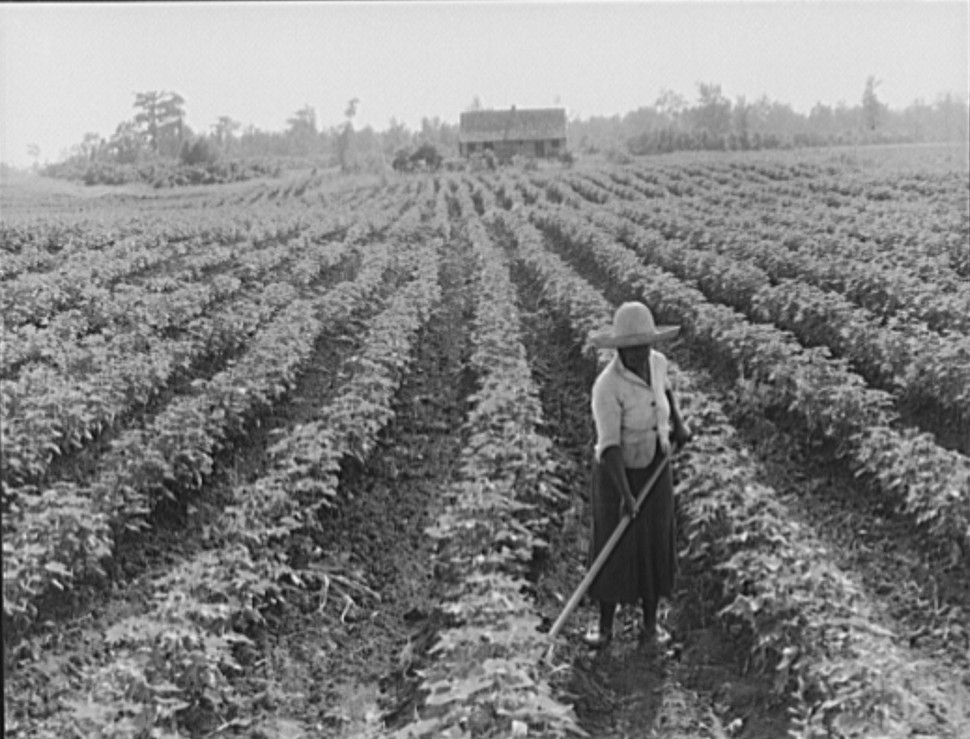
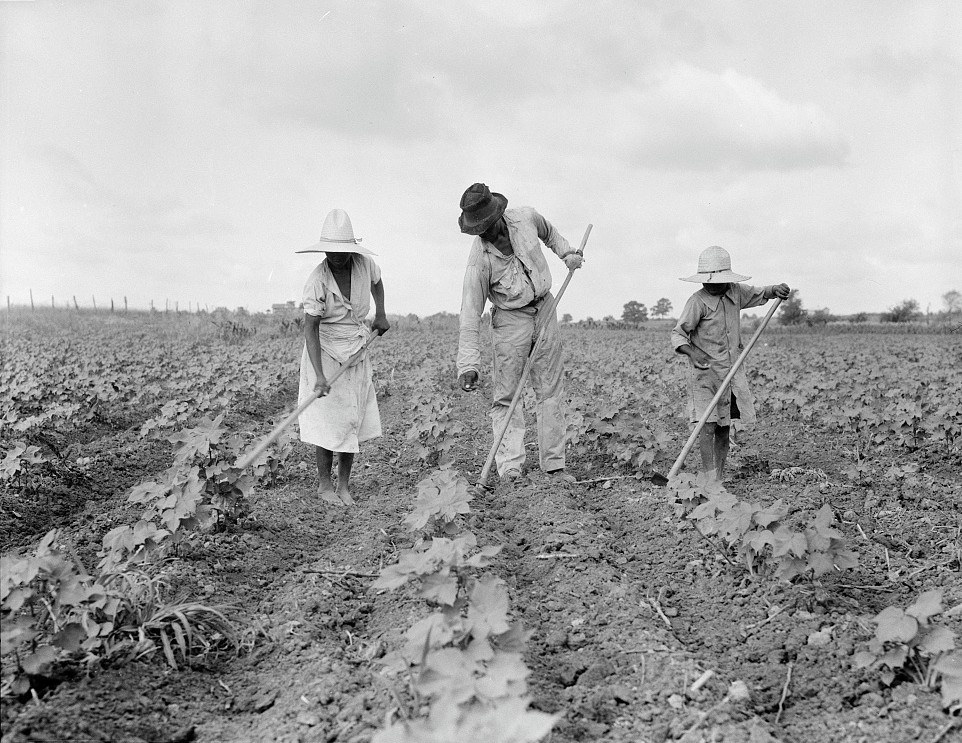
In 1946, in her groundbreaking Black Woman series, Catlett, for the first time, put into practice a fully realized strategy of employing the intentional appropriation of recognizable images to broaden meaning. In addition to literary sources for the series’ heroines, Catlett used published photography as obvious points of departure for other linocuts, mining the rich, publicly owned trove of photographic images funded by the US government through the Farm Security Administration and the Office of War Information (FSA/OWI). These photographs were frequently reproduced in publications such as Chandler Owen’s Negros and the War and Richard Wright’s 12 Million Black Voices. Dorothea Lange’s (1895–1965) work was included in both publications (figs. 6a–b) and her photographs provided a visual reference for Catlett’s linocut In the Fields, in the Black Women series (fig. 3c).35 These Lange photographs were not only familiar, but the fact of their publication and inclusion in official government records also provided a public affirmation of the vital presence of Black women in American life. Catlett’s appropriation of Lange’s well-known images was meant to be recognized, so that the associations and history they evoke could be woven into the intended narrative of her own work.
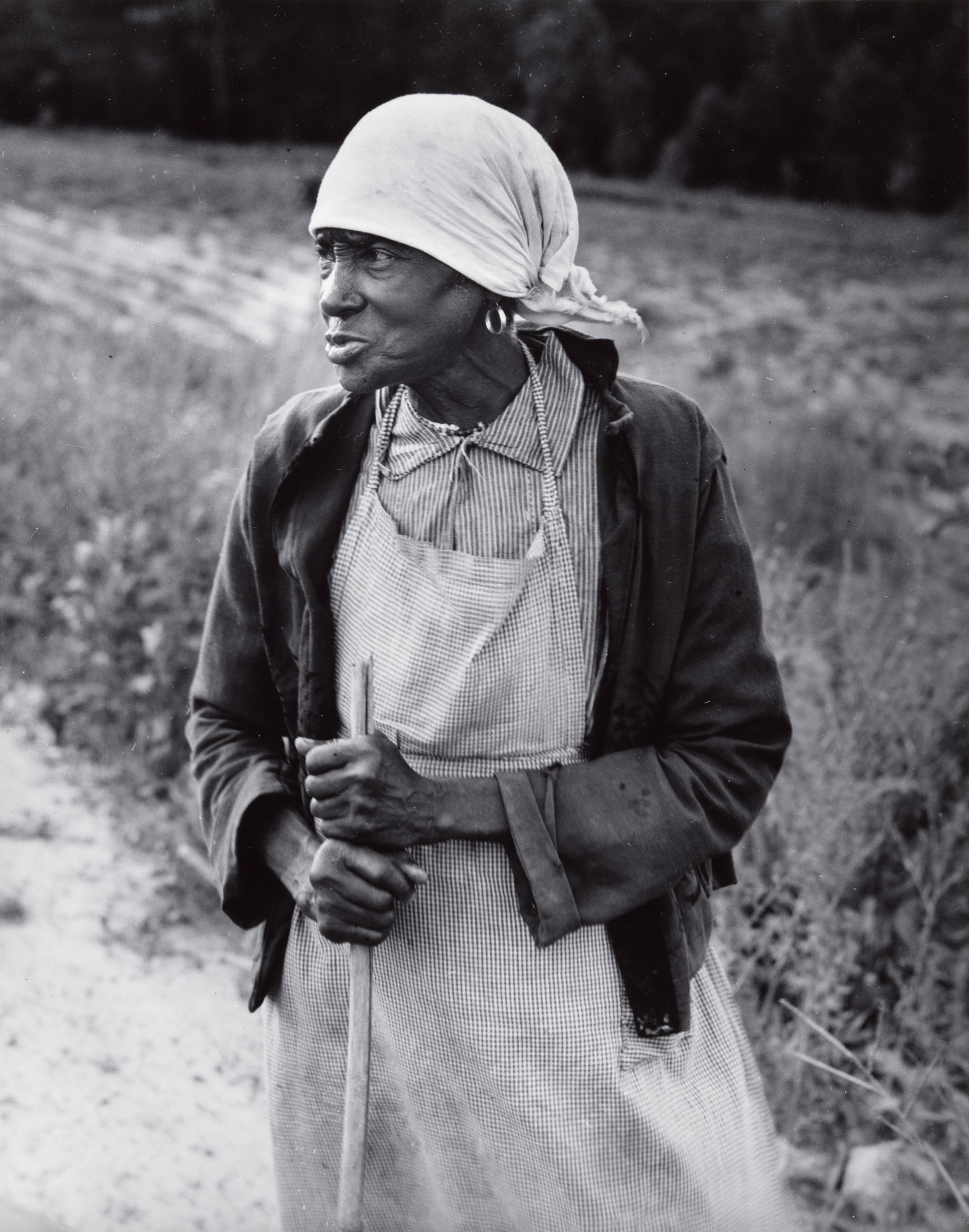
1938, printed c. 1955. Gelatin silver print, image: 9 7/16 x 7 1/2 in. National Gallery of Art, Washington, DC,
Gift of Daniel Greenberg and Susan Steinhauser, 2016.191.84. © The Dorothea Lange Collection,
the Oakland Museum of California, City of Oakland. Gift of Paul S. Taylor
Lange’s photography continued to resonate with Catlett as late as 1983, when the latter carved her linocut Survivor, unambiguously based on Lange’s 1938 photograph titled Formerly Enslaved Woman, Alabama, also known as Ex-Slave with a Long Memory, Alabama (fig. 6c).36 Catlett’s sensitive appropriation both respects and transforms her source. The linocut image is a reversal of the photograph, a flip that occurs when the relief carving on the block is printed. But Catlett minimizes the background and, through the vigor of her carved line, creates textures that emphasize her subject’s tenacity and endurance—from the firm set of her jaw and her powerful grip to the halo-like highlights that define her form. Catlett, herself a descendant of formerly enslaved grandparents, channels the pride and triumph of being a survivor into her work. Her choice of linocut links Survivor to the twin TGP legacies of technical excellence and sociopolitical exigency, while its resonance with the linocuts of the Black Women series is equally clear.
In Survivor, and similarly in her lithograph On the Subway (1986), based on a 1940s photograph by Joe Schwarz,37 Catlett’s appropriated images reclaim the dignity and identity of the Black women who served as subjects for white photographers. In both cases, Catlett’s appropriation was surgical, focusing only on the person, extracting her from the weight of her surroundings, thereby undermining the ability of that environment to define her while simultaneously accentuating her individuality, making her visible. “That’s what gave me some direction in art,” Catlett once said, “when I decided that I was going to work with the problems of Black women, when I was going to try to make people see them as beautiful, dignified, strong people instead of as Ralph Ellison says, invisible.”38
For Catlett, photography—or any visual resource appropriated with intentionality—was a means for shaping and amplifying her own unique perspective. Catlett strategically drew on print culture in many forms, from photojournalism in newspapers and magazines to engraved portraits or photographs reproduced as book illustration. When Catlett chose to appropriate, she relied on the familiarity of the images she adapted to carry resonances and associative meanings.
The power of appropriation in Catlett’s work is particularly potent in her lithograph The Torture of Mothers (fig. 7).39 While the subject of a mother and child is often dismissed as sentimental, it was never so for Catlett, as this print makes clear. The work earned Catlett an award for travel and study in Germany at the Intergrafik 70 exhibition, which opened in Berlin in December 1970.40 The theme of the show is summarized in its catalogue preface: “The INTERGRAFIK 70 is an eloquent expression of the growing number of artists participating in the social and national liberation struggle, in the democratic movements of their peoples.”41 Catlett mentioned the award in an interview in which she identified the literary source from which the title was taken:
The prize was for a lithograph that I did after reading a little booklet called “The Torture of Mothers” by Truman Nelson. It’s about an incident in Harlem. I did a head of a black woman with a dead child inside. After reading the book I felt that black women in the ghetto, their kids go out into the street and they don’t know what’s going to happen to them.42
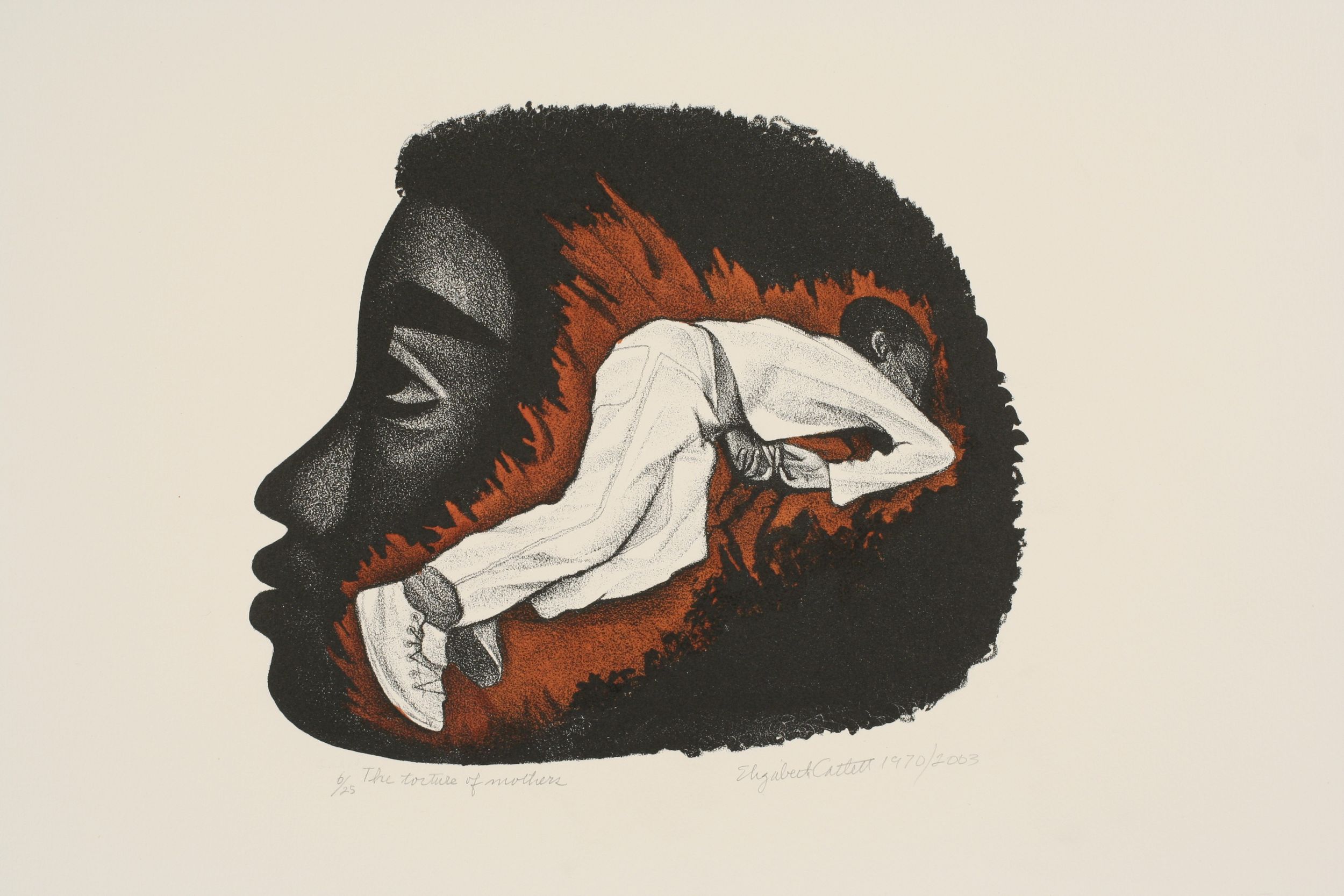
Sensitively drawn with lithographic crayon, with the red hand-coloring added after printing, Torture of Mothers is a graphic and painful image of a youthful victim of racial violence that asserts the all-consuming grief of the mother. The photographic source for Catlett’s lithograph was the July 28, 1967, cover of Life magazine, which showed a seriously wounded Black youth lying on pavement in a fetal position, a victim of racial violence on gruesome display for millions of people.43 Catlett places this image of the fallen body of twelve-year-old Joe Bass Jr. into the confines of an Olmec-inspired female head, where he is embraced by the tight space that envelops him. As she often did with her most powerful images, this lithograph, originally printed in 1970, was reprinted in 2003 with the Mexican printer Raul Cabello.44
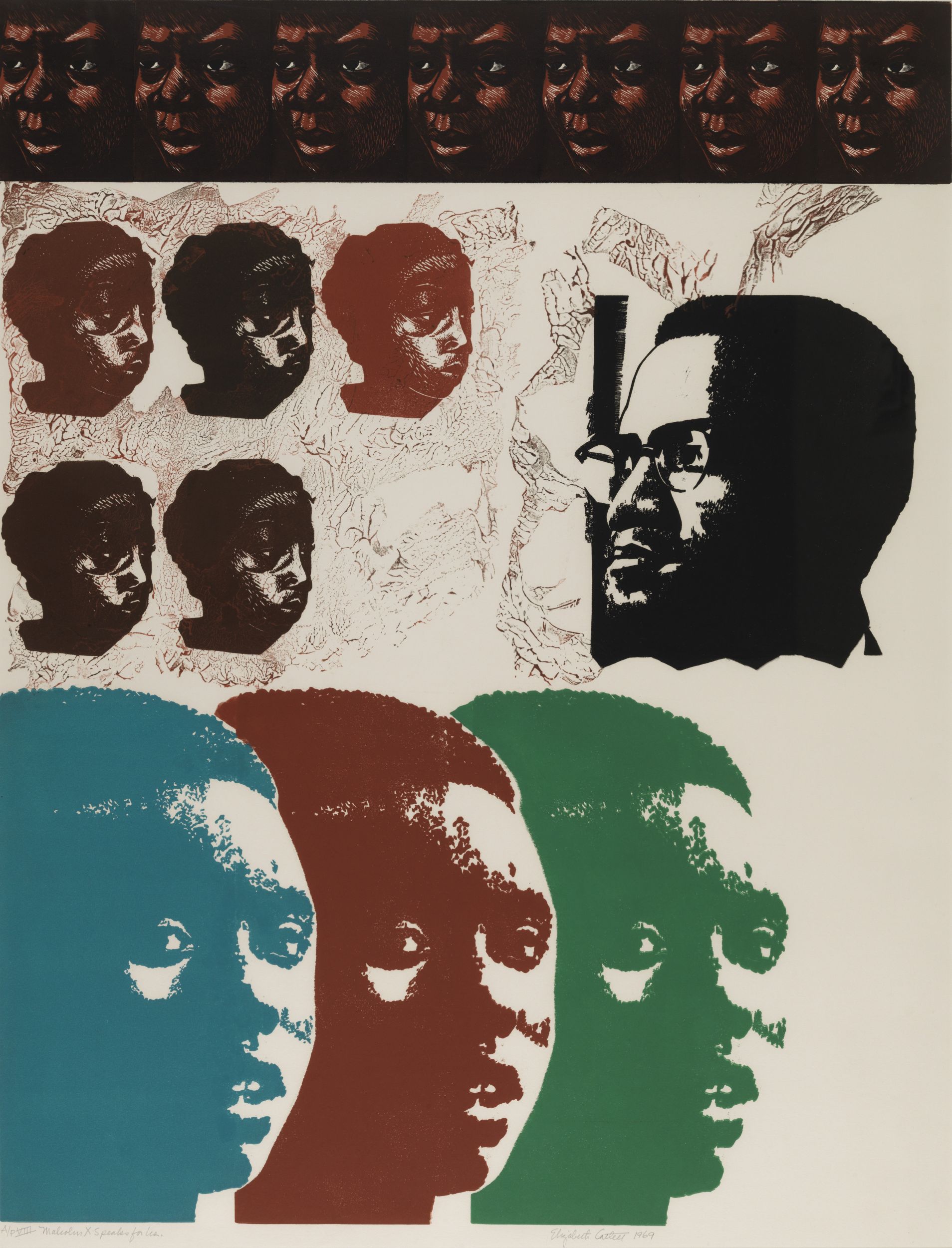
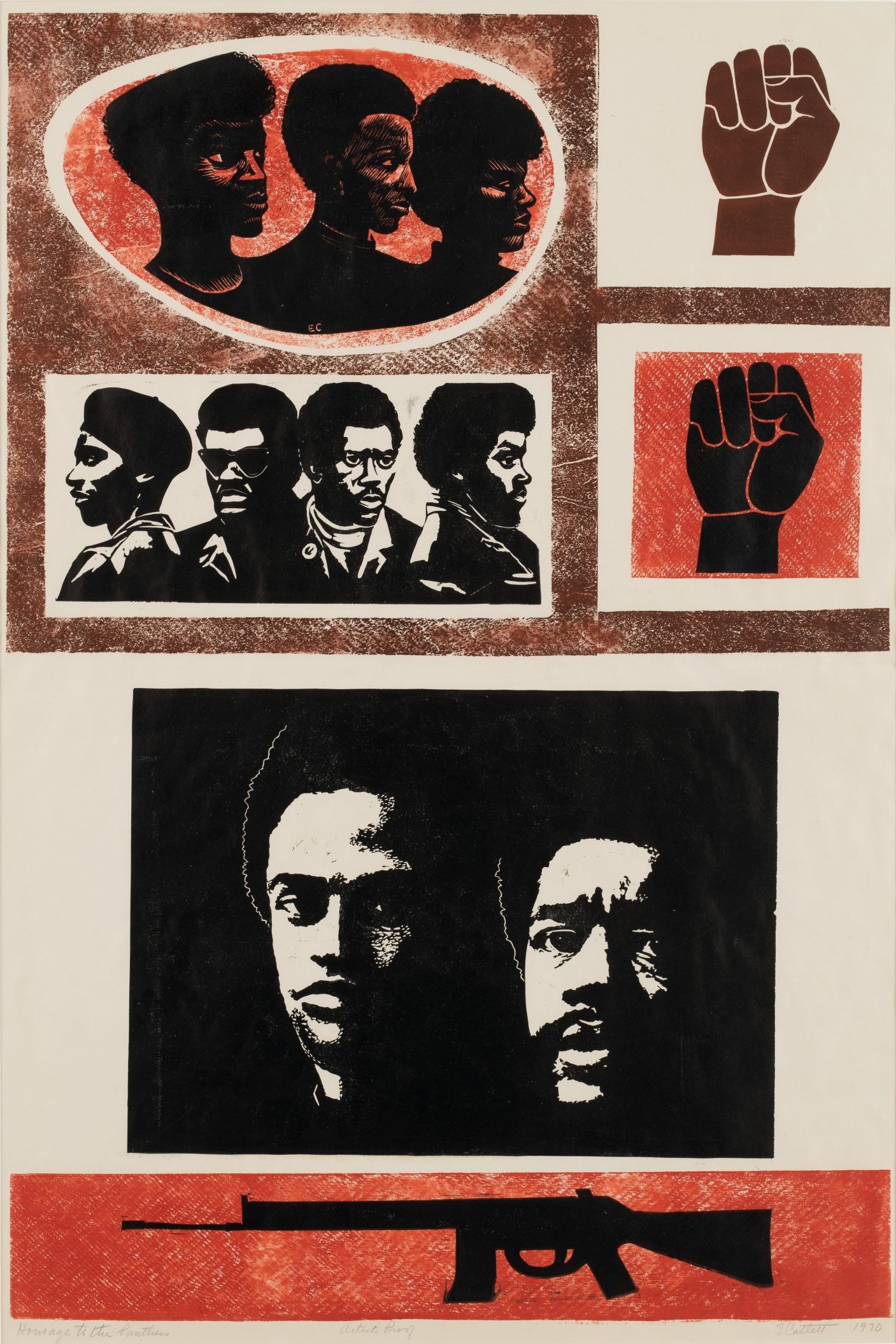
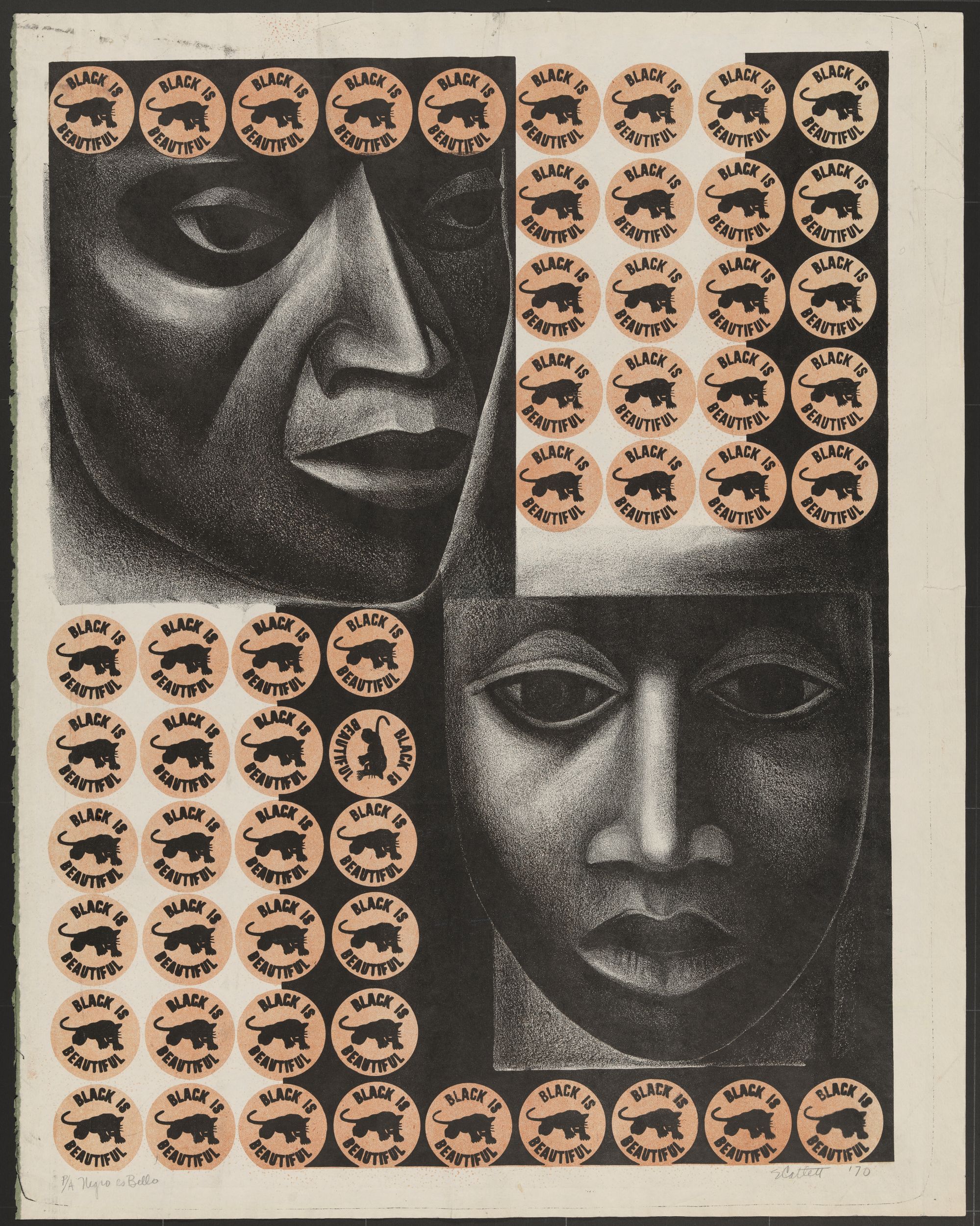
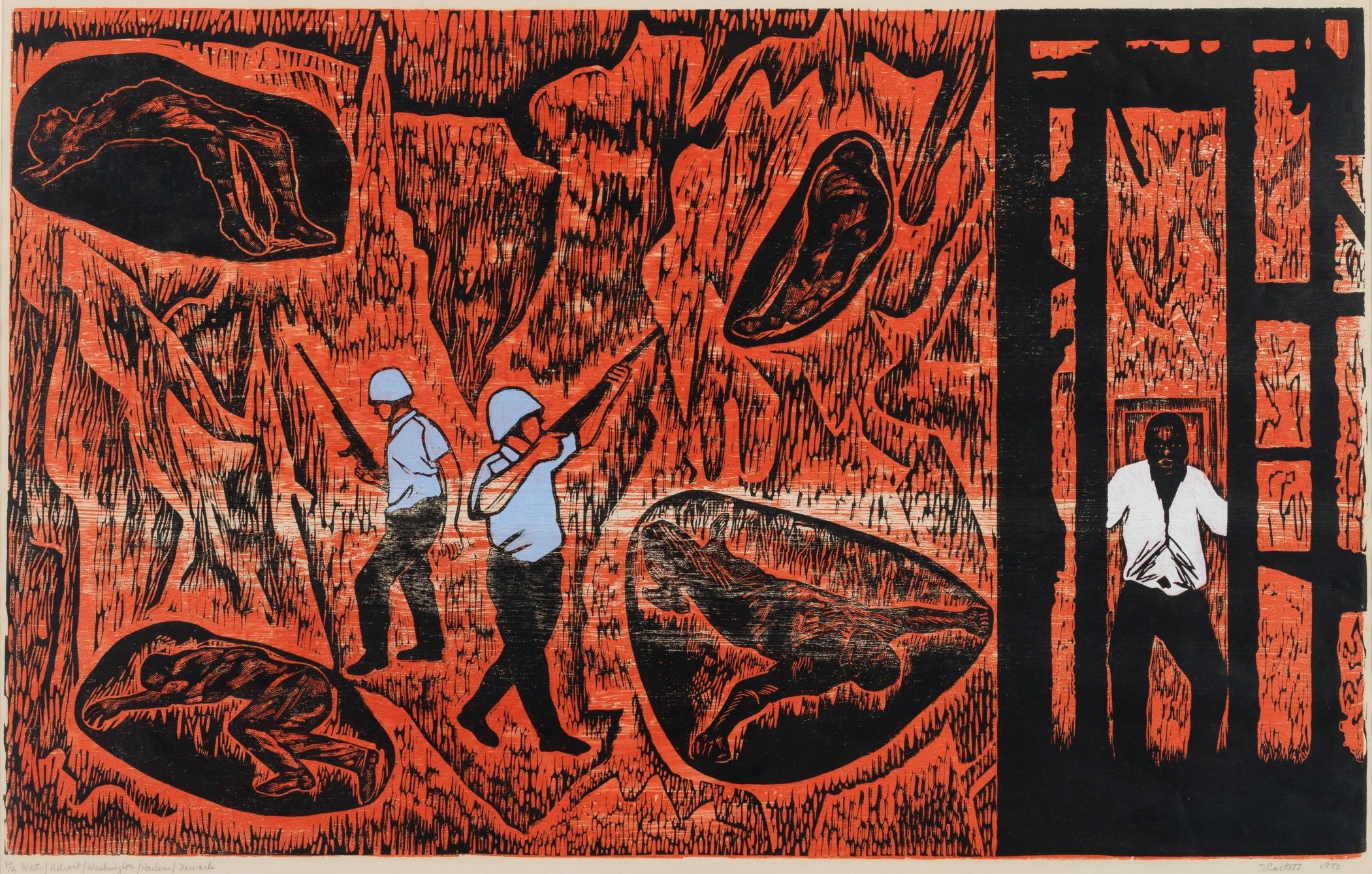
The Torture of Mothers was on view at Intergrafik 70 along with four other prints by Catlett, their titles given in German in the exhibition catalogue: Malcolm X spricht für uns, Die schwarzen Panther sprechen für uns, Schwarz ist schön, and Watts-Detroit-Washington-Newark (figs. 8–11).45 These five prints had been shown together a few months earlier in Catlett’s solo exhibition of sculpture and prints titled Experiencia Negra at the Museo de Arte Moderno, Instituto Nacional de Bellas Artes, Mexico City, which went on view in July 1970. Shown in two consecutive, politically oriented exhibitions, this group of five prints, all produced in 1969/70, might be considered an informal series, and they are firmly situated at the heart of Catlett’s activism in printmaking.
Experiencia Negra affirmed the Black liberation movement in the United States and was the opportunity for Catlett, as she was quoted in Raquel Tibol’s introduction in the exhibition’s brochure, “to show the public in Mexico how black people seek dignity and self-respect . . . to show my black experience in Mexico.”46 Developed by Catlett around this unified theme, the exhibition featured twelve prints and included the same core group of five, identified by their Spanish titles in the brochure: Tortura de madres, Malcolm X habla por nosotros, Los Panteras Negras hablan por nosotros, Negro es Bello, and Watts/Detroit/Washington/Harlem/Newark.47 Among Catlett’s most overtly political prints, they constitute a powerful expression of solidarity with the Civil Rights Movement in America.
In each of these two lithographs and three linocuts, Catlett engaged with appropriation that was reflective of the lived experience of Black people in the United States. The 1967 issue of Life magazine, with the cover photograph that inspired The Torture of Mothers, also included numerous other images of racial violence in Newark; these photos likely provided the source for the figures of the heavily armed police and at least one of the felled figures in Watts/ Detroit/ Washington/ Harlem/ Newark (see fig. 11).48 The rigid lines and sharp edges of the linocut carving deliver rawness, especially when augmented with the grain of woodblock, inked to create the scarring effect across the surface of the print. The textural grittiness is intensified by the dominant blood-red color, making the brutality of the scene even more visceral. The positioning of the four felled figures in womblike enclosures creates additional visual resonance with the maternal anguish of The Torture of Mothers.
Photographs of activists Huey Newton, Bobby Seale, and Malcolm X were frequently in the mass media of the 1960s and 1970s, and Catlett made use of them and their recognizability in Homage to the Panthers (Los Panteras Negras) and Malcolm X Speaks for Us (Malcolm X habla por nosotros) (see figs. 8–9). The rifle and the raised fist in Homage to the Panthers, symbols of Black unity and power, appeared often in Black print culture, including in Panther Party newspapers, as did the Black is Beautiful / Panther button of Negro es Bello (fig. 10), where Catlett repeated them in measured multiplicity to both emphasize their popularity and amplify their messaging.49
The Power of Repetition
Catlett leveraged the possibilities that printmaking techniques provided for the calculated reiteration of compositional elements: from the stenciled Panther buttons in the lithograph Negro es Bello to the raised fist reprinted twice from the same linocut block in Homage to the Panthers (Los Panteras Negras) or the painstaking registration (alignment of the paper with the matrices) required for the repeated printing of the blocks in Malcolm X Speaks for Us (Malcolm X habla por nosotros). These prints are among Catlett’s most complex productions and consequently were originally printed in extremely small numbers. Only a handful of proofs of Negro es Bello (probably shown in Experiencia Negra with the inscribed title Negro es Bello II) were printed in Mexico with José Sánchez before the matrix failed, resulting in no formal edition until it was printed by Joseph Kleineman and Maureen Turci in New Jersey in 2001, using new matrices.50 Homage to the Panthers, originally a linocut, was also reprinted in 1993 by Kleineman and Turci using new lithographic matrices. It is unclear how many of the early linocut impressions of Homage to the Panthers were printed.51 Malcolm X Speaks for Us was reprinted in a new edition with color variation by Kleineman and Turci in 2004. The fact that Catlett chose to reprint four of these five core civil rights prints—a form of repetition that in each case further extended the reach of the multiple original—speaks to their fundamental place in her oeuvre.
Malcolm X Speaks for Us (see fig. 8) was first shown in 1969 at the Sálon de Grabado in Mexico City, where it was awarded a purchase prize. It is an ambitiously executed linocut that involved a challenging process of registration, combining a collagraph matrix for the clothlike elements with a set of linocut blocks, repeated to create the emphatic and rhythmic reiteration of female heads surrounding the head of Malcolm X. Significantly, Catlett reprinted the linocut block for I Am the Black Woman from her pioneering Black Woman series of 1946/47, placing it seven times across the top of the composition, thereby appropriating her own iconic work. Masterfully employing repetition and appropriation in an emblematic composition, equally a feminist statement and a civil rights declaration, Malcolm X Speaks for Us was regarded by Catlett as one of her most important prints.52
Catlett stated that in Malcolm X Speaks for Us she “used repetition to strengthen the idea.”53 Her reuse of linocut blocks, sometimes decades after carving them, enabled self-citation in a way that was particularly direct and effective. Central America Says No! (1986) is another example. Here Catlett repurposed linocut blocks first printed in 1980/82 as a statement of opposition to US government intervention in Chile and combined them with a block first printed at the TGP in 1954 as a statement against CIA intervention in Guatemala. Thus, Catlett linked these political histories in a new, powerfully rescaled composition that was perhaps her most emphatic anti-neocolonialist declaration.54
In Angela Libré (1972) Catlett compellingly reemployed the studied use of repetition and appropriation that characterized and empowered the political prints shown in Experiencia Negra. Angela Libré is an homage to activist Angela Davis, of whom Catlett was a fierce supporter, participating in the global movement to free Davis following her unjust imprisonment in 1970.55
Although Angela Libré was ultimately executed as a screenprint, Catlett began with a linocut block, which she used to create the template for the six repetitions of Davis’s image.56 Richard Powell succinctly states the importance of Angela Libré in his narrative of contemporary American art:
Catlett’s conversion/conversation with pop art in Angela Libré and that movement’s pre-occupation with image repetition in mass media is apparent, but there’s more than an homage to Andy Warhol’s Marilyn here, in the primary and secondary colors’ interactions with the silver foil creating a didactic and vibrating color theory primer from the silhouette and visage of an African American cultural icon.57
As Powell suggests, the vibrance and variety of Catlett’s color, as it pulsates against the shimmering foil paper on which it is printed, is beautifully contrapuntal to the beat of the repeating image. The processes of printmaking, both linocut and screenprint, enable and shape the color play and the repetition.
Catlett’s Angela invites an obvious comparison with, as well as a decided contrast to, Andy Warhol’s (1928–1987) images of Marilyn Monroe. Both artists appropriated press photos of cultural icons but to very different effect. Warhol’s images of the film star appear decidedly two-dimensional and artificial, her features flattened through harsh, misaligned color. And when relentlessly repeated in works such as Marilyn x 100 (1962), she is, perhaps counterintuitively, further diminished.58 Repetitiveness, in this case, is a device through which Warhol exposes the shallowness of celebrity and the dehumanization that is the byproduct of the recurring mass-media images that both defined and promoted Monroe’s star power. Catlett’s Davis, in deliberate and forceful contrast, is a compelling homage to the woman and the activist, rendered in strong, solid hues and empowered by emphatic but measured repetition.59
This distinctive compositional choreography of repetition and coloration is a mainspring of Catlett’s printmaking. There Is a Woman in Every Color (fig. 12), executed in different variations beginning in 1975, offers another key example. The print explores repetition through the black/white reversal of the dominant female head, likely created with the aid of a stencil.60 In addition, Catlett repeats a linocut female figure eleven times, aligned vertically along the right side of the composition and printed in rainbow colors. The colors vary somewhat in different versions of the print, but in all versions, the rainbow effect is preserved.61
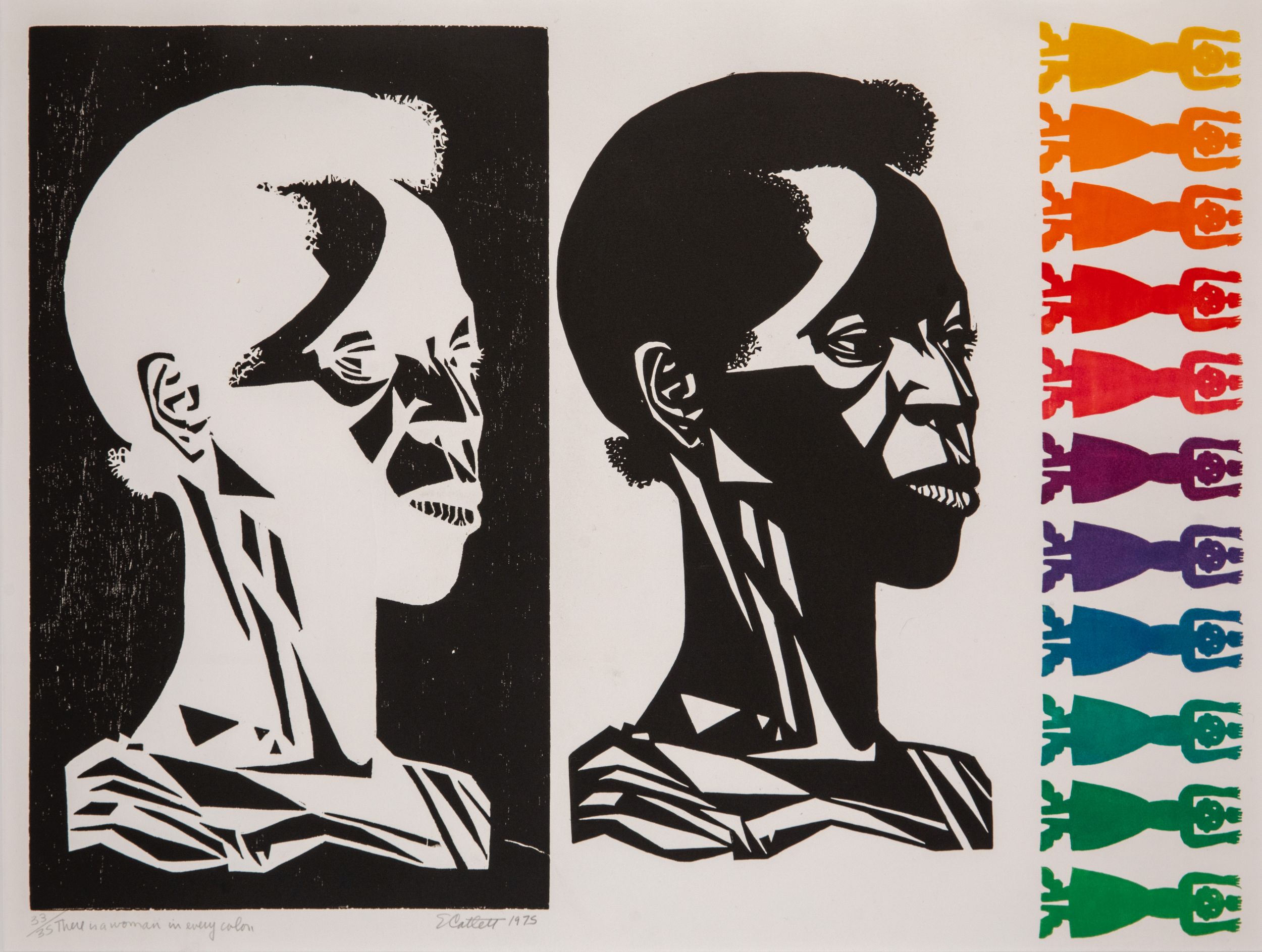
There are multiple ways of interpreting the concept of a rainbow of women, which is likely the point. It may even include a metaphorical reference to the legacy of the Black Panther Fred Hampton, whose Rainbow Coalition was founded in 1969. But a more important touchstone might be that in 1975, the year of the first version of There Is a Woman in Every Color, Catlett was named art honoree of the year by Rainbow Sign, Berkeley, California’s dynamic center for Black culture in the 1970s.62 Significantly, the female figures she employs here are appropriated from the artistic traditions of the Otomi in Mexico, which included handmade bark paper originally produced from amate, a wild fig tree.63 Catlett’s figures evoke pre-Hispanic Mexico, when bark-paper figures (muñecos) were cut by a shaman to create spiritual presences used in rituals for healing, securing the harvest, or driving away evil. Beginning in the 1960s, this papermaking practice was adapted for folk-art painting for the tourist market, and by the 1970s, the cut figures produced by folk artists had become widely known. Catlett would later use similar figures in Magic People, a unique linocut print she made for a youth group affiliated with the Cleveland Museum of Art. She identified the ritualistic origins of these figures to curator Jane Glaubinger, stating that the female figure specifically blessed the tomato harvest.64
“I used repetition to strengthen the idea.”
“For Picasso,” scholar Timothy Anglin Burgard suggests, “appropriation was not merely an artistic exercise in which he critiqued the Modernist reverence for originality and explored his relationship to great art and artists. Indeed, the artist perceived appropriation as a magical transference of power that could be applied to both historical and contemporary art and to objects and people.”65 Similarly for Catlett, the use and reuse of the muñecos in There Is a Woman in Every Color and Magic People also allude to a “transference of power” and point directly to the overarching intention behind all of her appropriations. Enhanced and reconfigured from purposefully recognizable sources, and often boldly self-referential, Catlett’s appropriations are charged by the resonances of multiple histories and associative meanings and are made more powerful with every repetition.
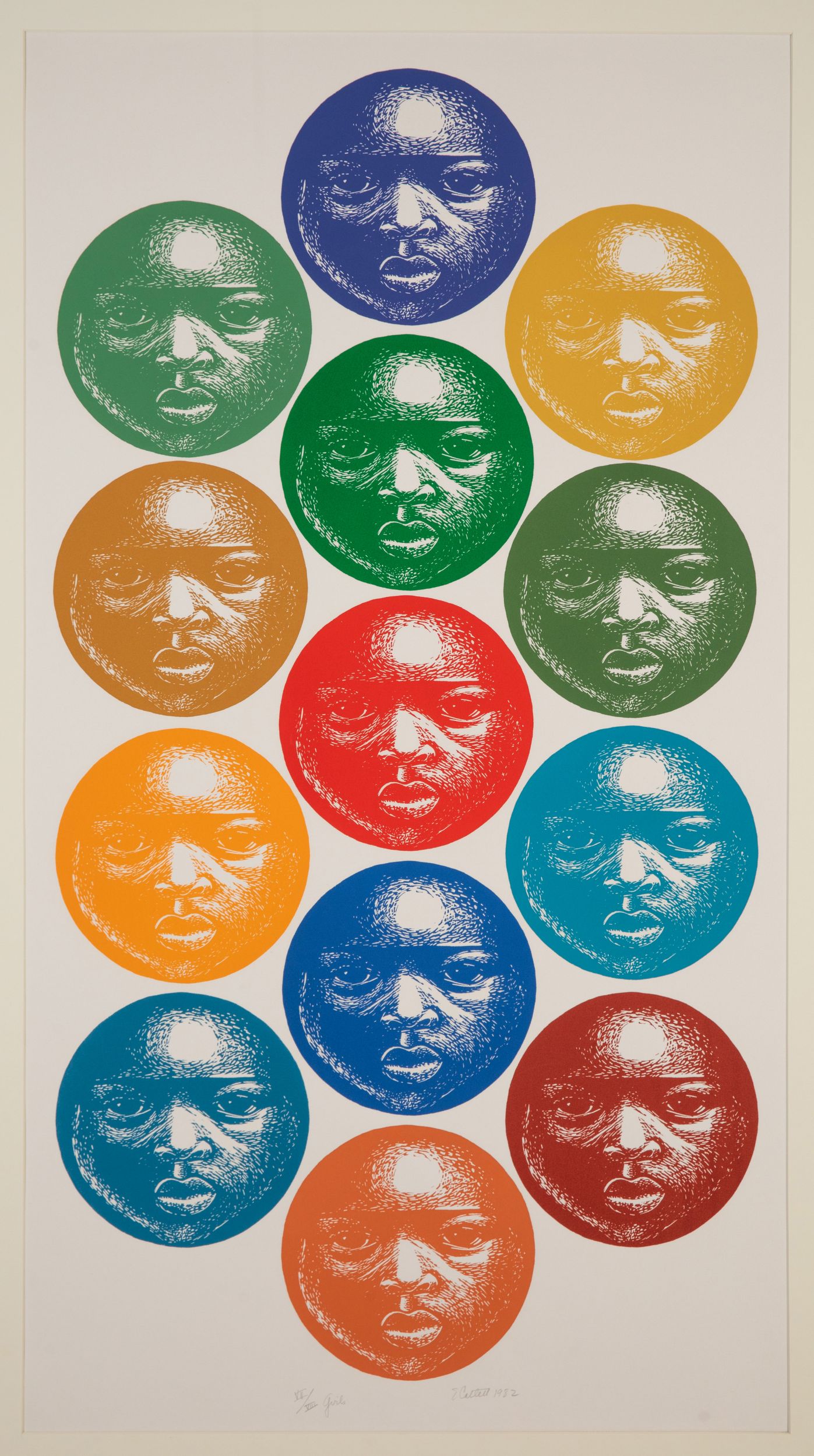
The vibrant multiplicity of color and the rhythmic repetition of the faces in Girls (1982; fig. 13) offer a compositional conversation as well as a form of reprise with the muñecos in There Is a Woman in Every Color, while also echoing the messaging of that title. In Girls—a screenprint, although the face, emphatically repeated here thirteen times in multiple colors, was originally created as a linocut—Catlett capitalizes on the ability of printmaking processes to facilitate both repetition and color play.
Catlett hailed printmaking as the most democratic of art forms, stating that “with one print it is possible to reach thousands of people.”66 Her artistry as a printmaker, however, did not involve maximizing quantity. For Catlett, repetition was the extraordinary power fundamental to printmaking, offering the unique opportunity for experimentation and reinvention through the magic of a repeatable matrix. This repeatability offered a kind of immortality, the siren song for many artist printmakers, as suggested by Jasper Johns (b. 1930), who stated: “In printmaking, I think it would be perfectly reasonable never to destroy the images on the plates and stones, and always to have them available for use in new works, new combinations.”67 For Catlett, the reusability and repeatability of the print matrix—particularly, the linocut block—facilitated the reinventions, repetitions, and resonances that would become her most essential narrative tools. In comments about her working process for Malcom X Speaks for Us (see fig. 8), one of her most political prints, Catlett said: “I experimented with the heads in different ways—repeated one that I had already printed someplace else. And I used repetition to strengthen the idea. I think that this kind of experimentation is important in remaining creatively and esthetically productive.”68
Appropriation and repetition were synergistic forces in Catlett’s printmaking. Appropriation is also, in its own way, a form of repetition. When she chose to appropriate, Catlett reconstructed identifiable imagery but preserved recognizability, associative meanings, and sociohistorical context. Appropriation and repetition became the means through which she traversed the tension between form and figuration—the “principles of form based on the modern approach to art” and the “elements of form recognizable to the majority of people”—that she first identified in 1946. More than just a means for creating multiple originals and reaching a large audience, printmaking processes and techniques intrinsically offered countless opportunities for experimentation and discovery. Printmaking provided the strategies that powered the appropriation and repetition that shaped Catlett’s print practice and through which she successfully connected with, and inspired, her “two peoples.”
Cite this article: Mary Lee Corlett, “Repetition, Resistance, and Remembering in the Prints of Elizabeth Catlett,” Panorama: Journal of the Association of Historians of American Art 12, no. 1 (Spring 2026), https://doi.org/10.24926/24716839.20828.
Notes
Prior to my retirement from the National Gallery of Art in 2023, I was one of the three organizing curators, with Dalila Scruggs and Catherine Morris, of the major retrospective Elizabeth Catlett: A Black Revolutionary Artist, which was on view at the Brooklyn Museum, the National Gallery of Art, and the Art Institute of Chicago in 2024–2025. This article is an extension of my research for that exhibition and includes references to the essay I prepared for the accompanying catalogue (University of Chicago Press, 2024). I am grateful for the unwavering support of the organizing institutions for hosting the exhibition, and most especially for their role in facilitating the critical archival research conducted by my colleagues and myself in preparation for this exhibition and catalogue. In addition, for this essay I particularly want to thank Ruth Fine and Melanie Herzog, who enthusiastically shared their invaluable expertise while offering much-appreciated encouragement and support. Finally, I am eternally grateful for the generosity of the Mora-Catlett family, who so graciously allowed me access to the many Catlett prints held by the estate, while patiently sharing their knowledge and their memories, without which this essay could not have been written.
- Elizabeth Catlett, “Artist’s Statement,” in The Black Woman in America: Prints by Elizabeth Catlett (Krannert Art Museum, 1993), n.p. ↵
- Elizabeth Catlett, quoted in Marc Crawford, “My Art Speaks for Both My Peoples,” Ebony 25, no. 3 (1970), 94. ↵
- “In the printmaking I’m thinking about something social or political, and in the sculpture I’m thinking about form.” Elizabeth Catlett, interview with Mary Gibbons, 1989, audiocassette recording in the collection of Elizabeth Catlett estate, Cuernavaca, Mexico; copy held by Melanie Anne Herzog, who kindly provided this quote. ↵
- For Political Prisoner, see Dalila Scruggs, ed., Elizabeth Catlett: A Black Revolutionary Artist and All That It Implies (University of Chicago Press, 2024), 168. ↵
- See also Mary Lee Corlett, “Pressing Narratives,” in Scruggs, Elizabeth Catlett, 183–85. ↵
- James Lesesne Wells was a distinguished printmaker, painter, and educator associated with the Harlem Renaissance who taught at Howard from 1929 to 1968. For more on Catlett’s education, see Melanie Anne Herzog, Elizabeth Catlett: An American Artist in Mexico (University of Washington Press, 2000), 16. Catlett’s Howard transcripts can be found in the archives of the Rosenwald Collection, box 400, folder 7, John Hope and Aurelia E. Franklin Library, Special Collections, Fisk University, Nashville (hereafter “Rosenwald Collection”); course descriptions can be found in Catalog of the Officers and Students of Howard University, 1931–32 and 1932–33, https://dh.howard.edu/hucatalogs/53 and https://dh.howard.edu/hucatalogs/54. ↵
- Elizabeth Catlett, interview with Camille Billops, October 1, 1989, Artist and Influence 10 (1991): 17. Catlett mentioned engagement with lithography at the Southside Community Art Center (SSCAC) in Chicago in 1941 in her interview with Clifton Johnson, January 5, 1983, tape 2-01, Elizabeth Catlett Papers, Amistad Research Center, Tulane University, New Orleans (hereafter “Catlett Papers”). See also Herzog, Elizabeth Catlett, 26. In an earlier interview, however, Catlett was asked if she had experience with lithography before her study at the Art Students League, and her reply was emphatic: “No. Never”; interview with Frederic Lewis, August 7, 1971, Hayes-Benjamin Papers on African American Art and Artists, Gift of the Estate of Tritobia Hayes Benjamin, Courtesy of the David C. Driskell Center at the University of Maryland, College Park (hereafter “Hayes-Benjamin Papers”). At this writing no lithographs from her time in Chicago are known. ↵
- Catlett’s course at the Art Student League was taught by Harry Sternberg, but she also mentions that she printed there with Robert Blackburn in an interview with Ellen Sragow, Journal of the Print World 17, no. 4 (1994): 30. Philanthropist Julius Rosenwald established the Fund in 1917 as one component of his pioneering effort to provide education and opportunity to African Americans and promote social justice. See Daniel Schulman, ed., A Force for Change: African American Art and the Julius Rosenwald Fund (Northwestern University Press, 2009); and see also https://www.julius-rosenwald-legacy.com. ↵
- Rosenwald application, 1945, box 400, folder 7, Rosenwald Collection. She expressed a similar desired outcome in her 1946 reapplication. ↵
- “Report of Progress and Plan of Work for a Renewal under a Julius Rosenwald Fellowship,” submitted with Rosenwald reapplication, 1946, box 400, folder 7, Rosenwald Collection. ↵
- By 1989 Catlett had renamed the series Black Woman, reflecting the updated terminology when fourteen of its fifteen blocks were reprinted in Blackburn’s workshop in an edition of twenty, plus proofs. See The Black Woman in America, n.p. A workshop invoice indicates that the printer was Gloria Escobar; entry 078-1, box 12, General Correspondence, 1989, Catlett Papers. The block for I Have Studied in Ever Increasing Numbers was not reprinted in 1989, perhaps because it was lost or damaged. The original key block for My Right Is a Future of Equality with Other Americans, the final print in the series, may also have been missing at this time. The Catlett estate holds the original secondary (color) block but no key block for the 1946 carving. Essential as the series coda, the two blocks were remade by Catlett. Both blocks (key and color) for the 1989 reprinting remain with the estate. Lastly, there is an alternate version of I Am the Black Woman; see Heather Nickels, Persevere and Resist: The Strong Black Women of Elizabeth Catlett (Memphis Brooks Museum of Art, 2021), 24n2. The full series, the alternate first print, and the remade final print are illustrated in Scruggs, Elizabeth Catlett, 32–48, 182. ↵
- Elizabeth Catlett, interview with Glory Van Scott, December 8, 1981, Artist and Influence, 10 (1991): 6. ↵
- “I remember Ignacio Aguirre was teaching me how to use the tools that have a lot of little lines. And I was also doing some lithographs.” Elizabeth Catlett, interview with Camille O. Cosby, June 6, 2002, National Visionary Leadership Project, Washington, DC, 2004, draft transcript, 41, https://lccn.loc.gov /2010655499. See also interview with Billops, October 1, 1989, 22. Francisco Mora’s role was confirmed by David Mora Catlett, April 28, 2024, for the publication of Scruggs, Elizabeth Catlett. ↵
- he brochure is included in the Hayes-Benjamin Papers. ↵
- The press release for Charles White’s American Contemporary Art (ACA) Gallery exhibition in February 1951, four years after Catlett’s Barnett-Aden exhibition, falsely took credit for being the first: “‘The Negro women’ he feels, ‘deserves a great deal more recognition for the never-ending sacrifices she has made and the continuing leadership she has given in the struggles of the Negro people for full equality.’ This is the first time any artist has devoted an entire show to the theme”; Committee for the Negro in the Arts Press Release, February 12, 1951, series 6.1, box 7, folder 31, Charles W. White papers, 1933–87, Archives of American Art, Smithsonian Institution, Washington, DC, https://www.aaa.si.edu/collections/charles-w-white-papers-9350/subseries-6-1/box-7-folder-31. By 1949 the Negro Woman series had made its mark in Mexico, too. Four prints from the series were illustrated in Hannes Meyer, ed., TGP México: El Taller de Gráfica Popular, doce años de obra artística colectiva (La Estampa Mexicana, 1949), 66–67. This inclusion is further evidence that Catlett had successfully “introduced the black body to the Workshop’s aesthetic,” as asserted by Theodore W. Cohen, Finding Afro-Mexico: Race and Nation after the Revolution (Cambridge University Press, 2020), 247. ↵
- See Herzog, Elizabeth Catlett, 59–66; and Melanie Anne Herzog, “My Art Speaks for Both My Peoples,” in The Art of Solidarity: Visual and Performative Politics in Cold War Latin America. (University of Texas, Austin, 2018), 29–31 ↵
- See Anita Bateman, “Narrative and Seriality in Elizabeth Catlett’s Prints,” Journal of Black Studies 47, no. 3 (2016): 258–72. ↵
- Emphasis added. “Report of Progress and Plan of Work.” ↵
- Emphasis original. “Report of Progress and Plan of Work.” ↵
- Catlett quoted in Crawford, “My Art Speaks for Both My Peoples,” 94. ↵
- Conrad’s biography was praised by Langston Hughes, in “Here to Yonder: Books are Friends,” Chicago Defender, December 25, 1943, 10. For a full discussion of the importance of Conrad’s book, see Milton C. Sernett, “Earl Conrad and the Book That Almost Wasn’t,” in Harriet Tubman: Myth, Memory, and History (Duke University Press, 2007), 195–224. ↵
- According to early accounts of Tubman’s final escort in 1860, the group included a baby, dosed with laudanum to ensure quiet and safe passage. This journey was illustrated with the caption, “Twenty-Eight Fugitives Escaping from Eastern Shore of Maryland,” in William Still, The Underground Railroad (Porter and Coates, 1872), plate between pp. 102–3, https://www.google.com/books/edition/The_Underground_Rail_Road/8ANWAAAAcAAJ?hl=en&gbpv=1; it is one possible visual source for Catlett’s representations of the travelers. See also Milton C. Sernett, Harriet Tubman: Myth, Memory, and History (Duke University Press, 2007), 56–57, fig. 17. ↵
- For an insightful discussion around the development of Black print culture, its role in African American self-education, and the importance of libraries in Jim Crow America, see Michael Benjamin, “A ‘Colored Authors Collection’ to Exhibit to the World and Educate a Race,” in Education and the Culture of Print in Modern America, ed. Adam R. Nelson and John L. Rudolph (University of Wisconsin Press, 2010), 36–56. ↵
- Catlett’s parents were trained educators. She was raised by her mother who, following the death of her husband, found work in the DC public school system as a truant officer. See Herzog, Elizabeth Catlett, 14–15; and Samella Lewis, The Art of Elizabeth Catlett (Hancraft Studios, 1984), 1–9. For more on the evolution of print culture in America in the early twentieth century, including the impact of technologies such as halftone reproduction, see Christine Bold, ed., The Oxford History of Popular Print Culture, vol. 6, US Popular Print Culture, 1860–1920 (Oxford University Press, 2012). For an overview of the development of the American magazine, see Magazines and the American Experience: Highlights from the Collection of Steven Lomazow, M.D., online exhibition, Grolier Club, accessed May 14, 2026: https://grolierclub.omeka.net/exhibits/show/american-magazines. ↵
- Catlett, interview with Van Scott, 1. For Catlett’s recollections of her childhood in Washington, DC, in the 1920s, see also her interview with Shawn Wilson, July 26, 2005, A2005.170, session 1, tape 1, story 6, HistoryMakers Digital Archive, https://www.thehistorymakers.org/biography/elizabeth-catlett-41. ↵
- Catlett, interview with Wilson, session 1, tape 2, story 2. ↵
- For more on the growth and impact of Black print culture, see Caroline Goeser, Picturing the New Negro: Harlem Renaissance Print Culture and Modern Black Identity (University Press of Kansas, 2007). ↵
- The Bison: 1934, Howard University Yearbooks, book 113; 54, 64, http://dh.howard.edu/bison_yearbooks/113. ↵
- See Elizabeth Catlett, “Responding to Cultural Hunger,” in Reimagining America: The Arts of Social Change, ed. Mark O’Brien and Craig Little (New Society, 1990), 247. See also Herzog, Elizabeth Catlett, 101–3; and Corlett, “Pressing Narratives,” 181. ↵
- See Herzog, Elizabeth Catlett, 57. ↵
- For more on the making of this lithograph, see Masha Zepeda, “José Sánchez: El impresor popular,” part 2, El Alcaraván 1, no. 4 (1991): 23. For Hugo Brehme’s photography, see Susan Toomey Frost, Timeless Mexico: The Photographs of Hugo Brehme (University of Texas Press, 2011), pl. 48. For a reproduction of Siqueiros’s painting, see “Girl Mother; Nina Madre, 1936 (encaustic on panel),” Bridgeman Images, https://www.bridgemanimages.com/en-US/alfaro/girl-mother-nina-madre-1936-encaustic-on-panel/encaustic-on-panel/asset/824983. Catlett’s lithograph is not always attributed to her but can be found in numerous public collections, including at the Allen Art Memorial Museum, Oberlin College, Ohio: https://allenartcollection.oberlin.edu/objects/8873/nina-madre-child-mother. Sanchez notes in the Zepeda interview that the first one hundred impressions were stamped in the bottom-left margin in black ink “Transcripcion Litografica de Elizabeth Catlett.” ↵
- “In the scene, there was the little cherry tree and George Washington with {Gilbert} Stuart’s face of an old man because Wood said nobody would recognize him if he didn’t have that face and his little hatchet.” Catlett, interview with Cosby, 19. See George Washington (The Athenaeum Portrait) / Gilbert Stuart / Oil on canvas, 1796 / National Portrait Gallery, Smithsonian Institution: https://npg.si.edu/blog/gilbert-stuart%E2%80%99s-washington-rare-views-our-first-president. ↵
- For the festival brochure, see “Fine Arts Festival, University of Iowa, July 14-18, 1940,” Iowa Digital Library, https://digital.lib.uiowa.edu/islandora/object/ui%3Aafptesting_753#page/10/mode/2up. ↵
- Catlett, interview with Cosby, 18–19. ↵
- Chandler Owen, Negroes and the War (Office of War Information, 1942); and Richard Wright, 12 Million Black Voices: A Folk History of the Negro in the United States (Viking, 1941). The selection of FSA photographs in Wright’s book was accomplished in collaboration with Edwin Rosskam and included Russell Lee’s Negro Housing, Chicago, Ill (p. 115). Catlett echoes its zigzagging fire escapes in Special Houses. See illustration in Scruggs, Elizabeth Catlett, 46 and 49 (related sketch). For more on FSA photography and American print culture, see Cara A. Finnegan, Picturing Poverty: Print Culture and FSA Photographs (Smithsonian, 2003). ↵
- See “Survivor, 1983, Elizabeth Catlett,” National Gallery of Art, https://www.nga.gov/artworks/222274-survivor. Survivor was executed as a companion print for the deluxe volume of Samella Lewis’s The Art of Elizabeth Catlett, (Hancraft Studios, 1984). See promotional flier in series 4, subseries 2, box 6, folder 5, David C. Driskell Papers, 1800–2014, David C. Driskell Center Archives, University of Maryland, College Park. ↵
- How Long? How Long? 2 a.m. on the “A” Train, Brooklyn, New York; reproduced in Joe Schwartz, Folk Photography: Poems I’ve Never Written, 2000, n.p. For On the Subway, see “On the Subway,” National Museum of African American History and Culture, https://nmaahc.si.edu/object/nmaahc_2011.37.3?destination=/explore/collection/search%3Fedan_q%3Delizabeth%2520Catlett. ↵
- Catlett, interview with Cosby, 60–61. ↵
- For further insightful discussion on this work, see Rebecca VanDiver, “The Torture of Mothers: Elizabeth Catlett’s Prints as a Call for Reproductive Justice,” Art Journal (Summer 2021): 14–29. ↵
- See Herzog, Elizabeth Catlett, 140. ↵
- Gerhard Bondzin, ed., Intergrafik 70, exh. cat. (Altes Museum, Berlin, 1970), 10. ↵
- Catlett, interview with Van Scott, 9. ↵
- The caption on the cover reads: “Wounded by gunshot, Joe Bass, Jr., 12, lies in a Newark Street,” further sensationalized by the accompanying headline: “Shooting War in the Streets. Newark: The Predictable Insurrection.” Two additional photographs of Bass, equally gruesome, were featured inside the magazine. On Life’s circulation, see Erika Doss, ed., Looking at LIFE Magazine (Smithsonian Institution Press, 2001), 2–4. ↵
- In the second edition, the red color was inked, not hand colored. ↵
- Bondzin, Intergrafik 70, 60, 141–42. The title of The Torture of Mothers was given as Die Folter der Mütter. Schwarz ist schön is not illustrated in the catalogue, but it was likely the work Negro es Bello (see fig. 10), based on the catalogue listing that included dimensions comparable to known impressions of Negro es Bello. ↵
- Experiencia Negra (Museo de Arte Moderno / Instituto Nacional de Bellas Artes, 1970). The brochure is in series 1: Correspondence, 1959–84, box 2, folder 11, Catlett Papers. For more on the exhibition, see Herzog, Elizabeth Catlett, 149–50. ↵
- The checklist in the Experiencia Negra brochure lists twelve prints, all titles given in Spanish: 1. Maternidad negra; 2. Tortura de madres; 3. Negro es bello I; 4. Negro es bello II; 5. Negro es bello III; 6. Mujernegra; 7. Malcolm X habla por nosotros; 8. Martin Luther King habla por nosotros; 9. Los Panteras Negras hablan por nosotros; 10. Habla la mujer negra; 11. Watts/Detroit/Washington/Harlem/Newark; 12. Baile. The work Malcolm X habla por nosotros is featured on the brochure’s cover and is the only print illustrated. At this writing, a print bearing an image of Martin Luther King has not been identified. A version of the Experiencia Negra exhibition went on view in New York at the Studio Museum in Harlem in 1971, with a checklist that added prints of Mexican subjects, while retaining ten of the twelve prints from the Mexico City show. See Herzog, Elizabeth Catlett, 149–51, for a discussion of the two exhibitions. The extensive overlap between the Mexico and New York shows is significant and the partially illustrated Studio Museum catalogue offers assistance in identifying some prints listed only by title in the Mexico City brochure. Works numbered 1, 2, 3, 4, 7, 10, 11, and 12 from the Mexico City checklist are reproduced in Elizabeth Catlett: Prints and Sculpture, exh. cat. (Studio Museum in Harlem, 1971). Prints shown in Mexico City but not included on the New York checklist are numbers 8 (Martin Luther King habla por nosotros) and 9 (Los Panteras Negras hablan por nosotros). Number 6, Mujernegra, is likely Black Woman (1967) on the Studio Museum checklist, but there was no catalogue illustration. Alternatively, it may be Mujer Negra; see sale, Swann Auction Galleries, “African-American Fine Art,” April 6, 2017, lot 60, https://www.swanngalleries.com/auction-lot/elizabeth-catlett-1915-2012-mujer-negra_e894c02872. ↵
- See “Revolt in the Newark Ghetto,” Life, 63, no. 4 (July 28, 1967), especially photographs on pp. 22 and 25. ↵
- Catlett incorporated collage elements from the Black Panther newspaper in Mask for Whites, one of the sixteen sculptures in the Experiencia Negra exhibition. See Dalila Scruggs, “Activism in Exile: Elizabeth Catlett’s Mask for Whites,” American Art 32, no. 3 (2018): 2–21. ↵
- Titles for works numbered 3, 4, and 5, on the Experiencia Negra checklist are variations of “Negro es Bello.” Number 3 is likely the lithograph most often inscribed “Black is Beautiful” (see Swann Auction Galleries, “African American Fine Art,” December 10, 2020, lot 57, https://www.swanngalleries.com/auction-lot/elizabeth-catlett-1915-2012-negro-es-bello-black-_5B049708D9), except for the impression lent by the artist to the Studio Museum in 1971, reproduced in the Studio Museum catalogue with the visible inscription: “Negro es Bello I.” The Studio Museum catalogue checklist included Negro es Bello (illustrated), Negro es Bello I (illustrated), and Negro es Bello III (unillustrated), but there is no listing for Negro es Bello II. I suggest that Negro es Bello II (number 4 on the Experiencia Negra checklist) is likely the same as Negro es Bello in the Studio Museum catalogue. Ellen Sragow, Catlett’s friend and longtime New York gallerist, records in her written notes from her conversations with Catlett (generously shared with the author, October 2022) that when this print was in process in Mexico in 1969 (with printer José Sánchez), the matrix failed due to sun exposure, and consequently very few impressions were pulled. Catlett indicated to Sragow that there were about three proofs, likely a black proof and two color proofs. A black proof, seen by the author at the Catlett estate in 2022, is inscribed “Negro es Bello” and dated “69.” In addition, two color proofs are known. One is in the collection of the National Gallery of Art, Washington, DC, acquired by artist Barbara Jones-Hogu directly from Catlett, and then acquired by the National Gallery of Art from Jones-Hogu’s estate. This proof is inscribed “Negro es Bello” and dated “’70” (figure 10). A second color proof is in the collection of Hampton University, Virginia. It is inscribed “Negro es Bello II” and dated “1969” and might possibly be the impression shown in Experiencia Negra, given that it came to Hampton directly from Catlett’s personal inventory. It is unknown whether the impression from the artist’s collection (also inscribed “Negro es Bello II,” which is reproduced in Herzog, Elizabeth Catlett, 138) might be the same one now at Hampton. There was no formal edition of Negro es Bello II until 2001, when J. K. Fine Art Editions in New Jersey created new matrices and printed an edition of one hundred, plus proofs, dated “69-01.” Negro es Bello III, number 5 on the Experiencia Negra checklist and listed, without illustration, in the Studio Museum catalogue, has so far not been identified by the author. However, a lithograph illustrated by Robert Henkes (in The Art of Black American Women: Works of Twenty-Four Artists of the Twentieth Century {McFarland, 1993}, 82), titled Black is Beautiful (no inscription visible in the illustration), features the female head and five Black Panther / Black is Beautiful buttons, as apparently extracted from the bottom right quadrant of Negro es Bello. Sragow’s records suggest the existence of at least one impression of this variant image inscribed “Black is Beautiful II.” It is tempting to speculate, based on the apparently imperfect condition of the print illustrated in Henkes, that this version of “Black is Beautiful” may exist only in a few proofs, possibly salvaged from those early Sánchez matrices. Nevertheless, Catlett chose to include this version in her 1973 reproductive portfolio of offset lithographs printed by Sánchez in Mexico City (held at Beinecke Library, Yale University, New Haven, CT, folio 21). ↵
- The Catlett estate holds an early linocut proof that included the head of Eldridge Cleaver in the panel with Huey Newton and Bobby Seale. Catlett’s son David confirmed (June 2022) that she removed Cleaver when she became angered by his treatment of women. ↵
- Catlett specifically identified it as “an important print in my production” on an artist questionnaire, January 31, 1990, object file for acc. no. 1989.11, Pennsylvania Academy of the Fine Arts, Philadelphia. ↵
- Catlett, quoted in Lewis, Art of Elizabeth Catlett, 91. For further discussion of Malcolm X Speaks for Us, see Corlett, “Pressing Narratives,” 184. ↵
- Chile I and Chile II (1980/82) are reproduced in Jeanne Zeidler, ed. Elizabeth Catlett: Works of Paper, 1944–1992, Hampton University Museum, 1993, 58. The TGP linocut is listed as Defendiendo la soberania de Guatemala defendemos la soberania de Mexico, in Helga Prignitz, TGP Ein Graficker-Kollectiv in Mexico von 1937–1977 (Richard Seitz & Co.,1981), 335, no 169. For an image of the block as reprinted in the 1960s, see Herzog, Elizabeth Catlett, 141. Central America Says No! is in the collection of the Museum of Modern Art, New York: https://www.moma.org/collection/works/73330. For further discussion of Central America Says No!, see Corlett, “Pressing Narratives,” 184. ↵
- See Herzog, Elizabeth Catlett, 136. Catlett discusses her outrage about Davis’s treatment in her interview with Billops, October 1, 1989, 24. Davis was finally acquitted of all charges in 1972. The print is in the collection of the National Portrait Gallery, Washington, DC: https://npg.si.edu/object/npg_NPG.94.132 ↵
- The linocut block and working template remain in the Catlett estate. Catlett significantly shows Davis speaking, explicitly giving her a metaphorical voice. For a similar press image of Davis, see Flier for the Black Community Survival Conference, Smithsonian National Museum of African American History and Culture, inv. no. 2013.46.10, https://www.si.edu/object/flier-black-community-survival-conference:nmaahc_2013.46.10. For further discussion of Catlett’s involvement in the movement to free Davis, including Catlett’s request for photographs of the activist, see Dalila Scruggs, “An Artist-Activist at the Center of the Global Sixties,” in Scruggs, Elizabeth Catlett, 129–33. ↵
- Richard J. Powell, “Colorstruck! Painting, Pigment, Affect, Part 1,” 71st A. W. Mellon Lectures in the Fine Arts, National Gallery of Art, March 20, 2022, posted May 18, 2022, by National Gallery of Art Talks, YouTube, 1:09:05, https://www.youtube.com/watch?v=xHwzADRagbc. ↵
- For examples, see Andy Warhol, Marilyn x 100 (1962), Cleveland Museum of Art, inv. no. 1997.246, https://www.clevelandart.org/art/1997.246; and Andy Warhol, Marilyn (1967), Philadelphia Museum of Art, inv. no. 1977-119-1, https://philamuseum.org/collection/object/200404. ↵
- For an alternative perspective on the influence of Warhol in this image, see Scruggs, “An Artist-Activist at the Center of the Global Sixties,” 132–33. ↵
- Related stencils remain in Catlett’s studio/estate in Cuernavaca. ↵
- Variants of There Is a Woman in Every Color were printed in 2002 and 2004. ↵
- For more on Rainbow Sign and its impact in the Bay Area, see: https://news.berkeley.edu/2017/09/19/rainbow-sign. ↵
- For an illustrated discussion of Otomi bark paper, see Robyn Fleming, “Power Paper: The Amate Manuscripts of Alfonso Garcia Tellez,” April 17, 2019, Metropolitan Museum of Art, https://www.metmuseum.org/articles/power-paper. See also Charles M. Peters, Joshua Rosenthal, and Teodile Urbina, “Otomi Bark Paper in Mexico: Commercialization of a Pre-Hispanic Technology,” Economic Botany 41, no. 3 (1987): 423–32. ↵
- See “Magic People, 2002, Elizabeth Catlett,” Cleveland Museum of Art, https://www.clevelandart.org/art/2002.64. The object file includes notes by former curator Jane Glaubinger with Catlett’s explanation of the figures and correspondence dated March 14, 2002, from Catlett to Glaubinger, regarding the Magic People linocut. Catlett also incorporated the male muñeco in Man, the woodcut and linocut she executed in association with the Print Club of Cleveland in 2003, https://www.clevelandart.org/art/2005.35. ↵
- Timothy Anglin Burgard, “Picasso and Appropriation,” Art Bulletin 73, no. 3 (1991): 479. ↵
- Catlett, “Artist’s Statement,” n.p. ↵
- Jasper Johns, interview with Christian Geelhaar, 1978; quoted in Riva Castleman, Jasper Johns: A Print Retrospective (Museum of Modern Art, 1986), 36. ↵
- Elizabeth Catlett, quoted in Lewis, Art of Elizabeth Catlett, 91. ↵
About the Author(s): Mary Lee Corlett was associate curator of modern and contemporary prints and drawings (retired), National Gallery of Art, Washington, DC