

American Folk Art at MOMA and Folk Nation at the American Folk Art Museum





PDF: Massey, review of American Folk Art and Folk Nation
American Folk Art: Revisiting the Collection of Abby Aldrich Rockefeller
Curated by: Starr Figura and Lydia Mullin
Exhibition schedule: Museum of Modern Art, New York, June 13–August 9, 2026
Catalogue: Starr Figura and Lydia Mullin, American Folk Art: Revisiting the Collection of Abby Aldrich Rockefeller, exh. cat. Museum of Modern Art, 2026. 72pp. 50 color ills. Hardcover: $35.00 (ISBN 9781633451957)
Folk Nation: Crafting Patriotism in the United States
Curated by: Emelie Gevalt and Caroline Culp
Exhibition schedule: American Folk Art Museum, New York, April 10–September 13, 2026 and October 8, 2026–February 28, 2027
Two exhibitions of American folk art in New York mark the nation’s semiquincentennial. Folk Nation: Crafting Patriotism in the United States, at the American Folk Art Museum, alerts viewers to the diversity of the genre, its exhibits materializing historical and contemporary conceptions of American identity. American Folk Art: Revisiting the Collection of Abby Aldrich Rockefeller, organized by the Museum of Modern Art (MoMA) in collaboration with the Colonial Williamsburg Foundation, focuses on MoMA’s institutional history, showing American folk art and American modernism as intertwined since the museum’s inception.
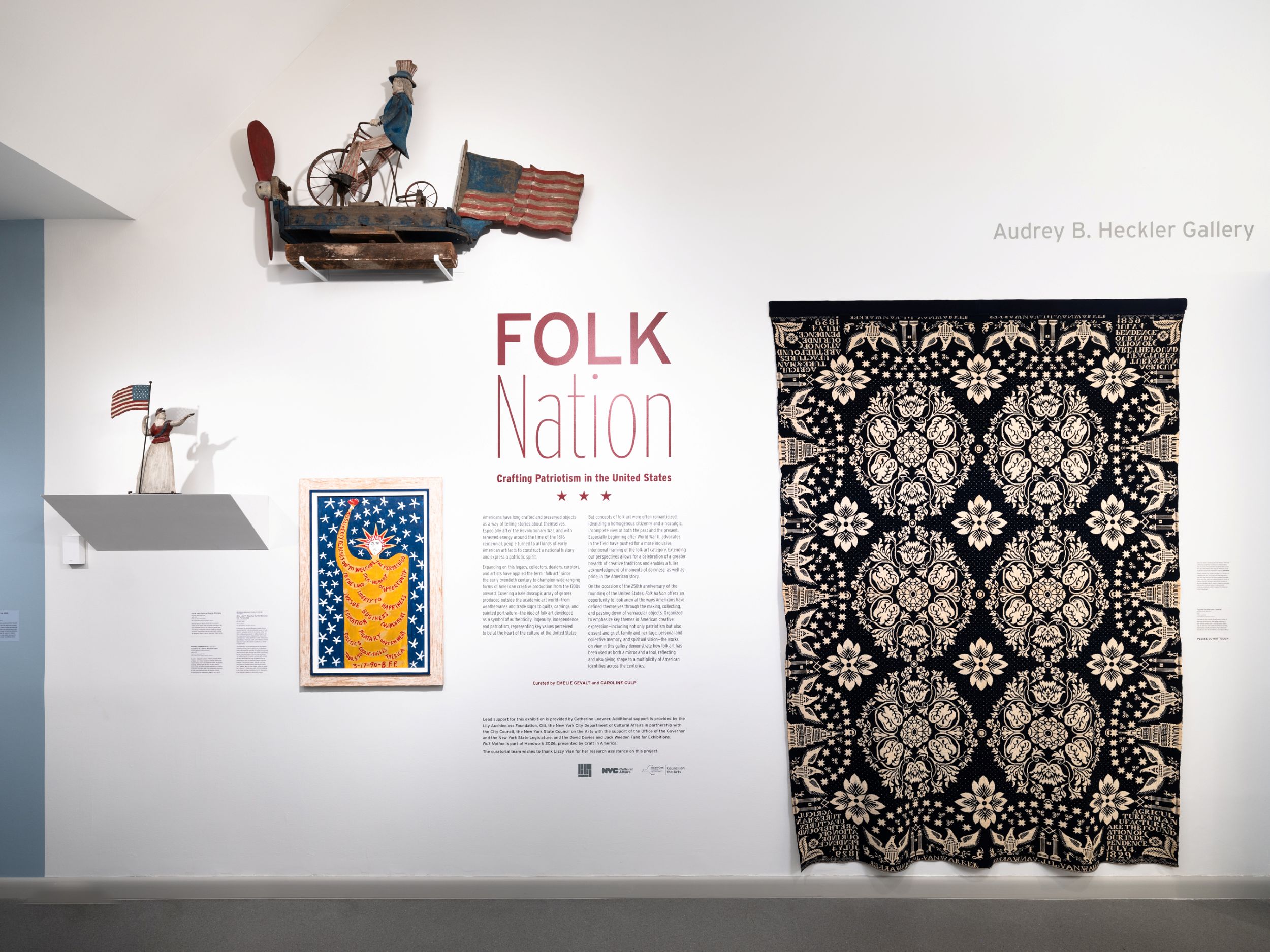
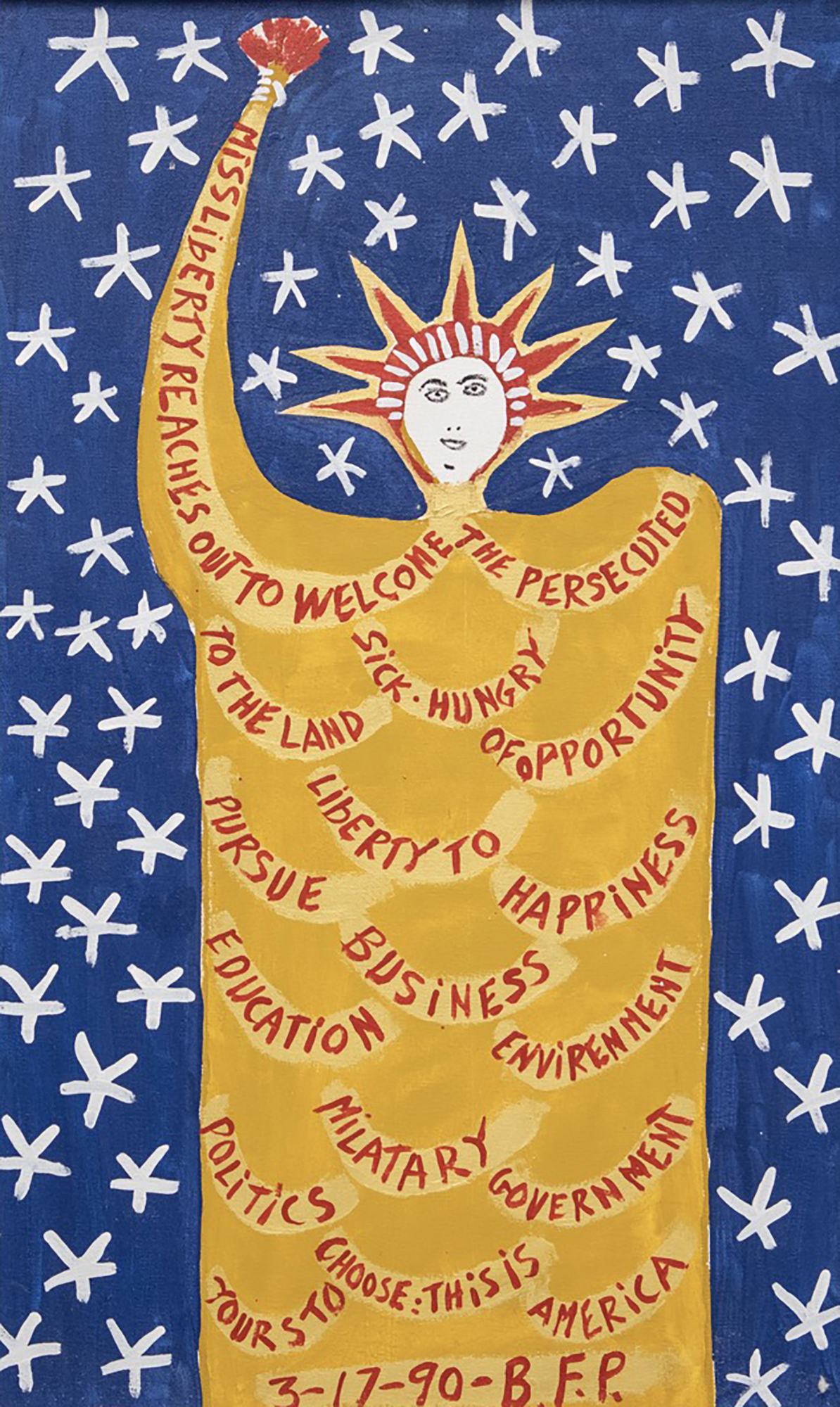
Folk Nation at the American Folk Art Museum is organized around five themes: patriotism, family, historical memory, religious and spiritual traditions, and dissent and grief. These themes help viewers to consider clusters of objects not merely aesthetically but in terms of their original social and cultural contexts. The show’s introductory text presents this idea. Curators Emelie Gevalt and Caroline Culp state the importance of folk art “both as a mirror and a tool, reflecting and also giving shape to a multiplicity of American identities across the centuries.” The section on patriotism (fig. 1) includes an array of objects used by people “to communicate a love of country,” which feature a shortlist of symbols that have come to embody Americanness. A double-cloth coverlet (1829) bears repeated motifs of a bald eagle gripping arrows and an olive branch (the obverse of the Great Seal of the United States), the Freemason square and compass, floral medallions, blossoms, and a monumental architectural fancy. The text on its corners reads, “AGRICULTURE AND MANUFACTURES ARE THE FOUNDATION OF OUR INDEPENDENCE. JULY 4, 1829,” speaking to economic and political attitudes in the early republic. A weathervane (1865–75) features the allegorical figure of Liberty pointing into the wind with one hand while holding an American flag in the other. When placed atop a building, it might symbolize the desire to heal the divisive wounds of the Civil War or affirm pride in the victorious Union. More recent works, like a painting from 1990 by the Reverend Benjamin Franklin Perkins (1904–1993), evoke an ideal of multiculturalism now under threat (fig. 2). Perkins renders the Statue of Liberty in shades of red and gold surrounded by a blanket of stars. Text on the figure reads: “Miss Liberty reaches out to welcome the persecuted, sick, hungry, to the land of opportunity / Liberty to pursue happiness, business, education, envirenment [sic], milatary [sic], politics, government / Yours to choose: this is America.” By employing a comparative, thematic organization, Folk Nation presents folk art as a sociopolitical tool that remains timely today.
American Folk Art at MoMA, in contrast, posits aesthetic affinities between nineteenth-century folk art and artworks by twentieth-century artists, both modern artists and so-called “modern primitives.” It features the collection of Abby Aldrich Rockefeller, one of the museum’s founding trustees and a major donor. The show evokes the MoMA of a century ago, when exhibitions like American Folk Art: The Art of the Common Man in America, 1750–1900 (1932), Masters of Popular Painting: Modern Primitives of Europe and America (1938), and monographic exhibitions of “self-taught” artists like William Edmondson (1937) and Morris Hirshfield (1943) were core elements of the institution’s programming under its founding director, Alfred H. Barr. Rockefeller spurred the new museum to collect and exhibit American folk art. She was a patron of Edith Halpert, whose Downtown Gallery siphoned folk art from far afield into the penthouses of Manhattan’s elite. MoMA’s early shows of American art featured works from Rockefeller’s folk art collection displayed in dialogue with those of self-taught artists like Hirshfield, John Kane, and Joseph Pickett. These exhibitions suggested that folk art could serve as a home-grown source for a modernism that rivaled the sleek innovations of European Art Deco and the Bauhaus. Collecting in this field, then, was a catalyst for a creative renaissance in the interwar United States. Artists like Elie Nadelman, Charles Sheeler, Yasuo Kuniyoshi, and Marguerite Zorach, all of whom are represented in American Folk Art, looked to their own folk art collections and those of friends and patrons for inspiration and guidance (fig. 3). MoMA’s exhibition affirms these affinities through the juxtaposition of folk artworks and similar works by modern artists. American Folk Art thereby treats formal similarities as interpretive facts in lieu of more critical engagement with the ideological forces behind the development of the field of folk art in the United States. Such a framing would lay bare the artificiality of both categories: of “folk” as a pendant and antecedent to the modern, and of “modern” as the inevitable and desirable successor of “folk.”
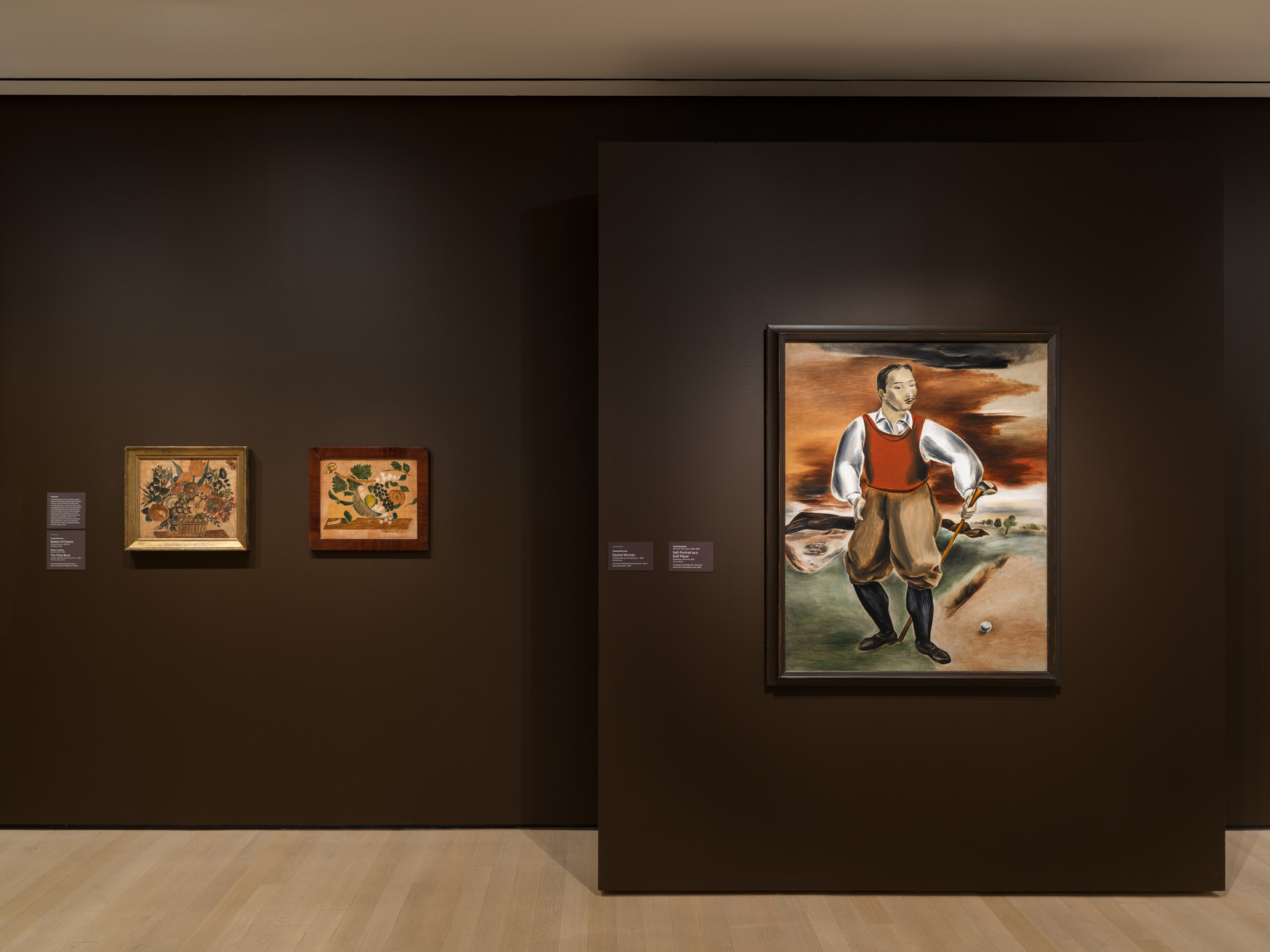
Both the New York exhibitions show the diversity of American folk art, including painted portraits by itinerant limners; memorial drawings on paper; and sculptures in wood, stone, and ceramic, many by unidentified artists, all from the eighteenth and nineteenth centuries. Twentieth-century artworks, mostly by known makers, offer a sense of personability that collectors of folk art prize. The two museums, however, differ in how they treat the perceived approachability of American folk art. In Folk Nation, the American Folk Art Museum utilizes the recognizability of images (both of patriotic symbols and of themes like the populated landscape of a winter scene by Anna Mary Robertson “Grandma” Moses) to teach about the exhibition’s larger themes of American nation building and everyday life, while MoMA settles for the modernist assumption that folk art speaks for itself, since this aesthetic approach makes the affinities between the works seem clearer.
While none of the works shown lack ambition—we can be sure that painters like Grandma Moses and Hirshfield took their work seriously—their seeming simplicity led some to assume that they are symbolically malleable. Period writing supports this claim: Barr, in his 1941 announcement of a permanent display of paintings by “Modern Primitives” in MoMA’s galleries, writes: “For these twentieth century primitives belong to no movement or ‘ism.’ They work in no tradition either technical or esthetic. All of them earn or earned their living as ordinary men. . . . All share the common denominator of Western culture at its most democratic level and all express the straightforward, innocent and convincing vision of the common man, ignorant of art or unaffected by it.” Barr proclaims folk art to be a democratic, American response to the intellectualization of modern art, the foundation on which a strong national tradition can grow. MoMA, for its part, does little to contradict this well-worn line of thinking in American Folk Art, despite great movement in the field toward more complex, nuanced engagement with the arts and artists that compose it.
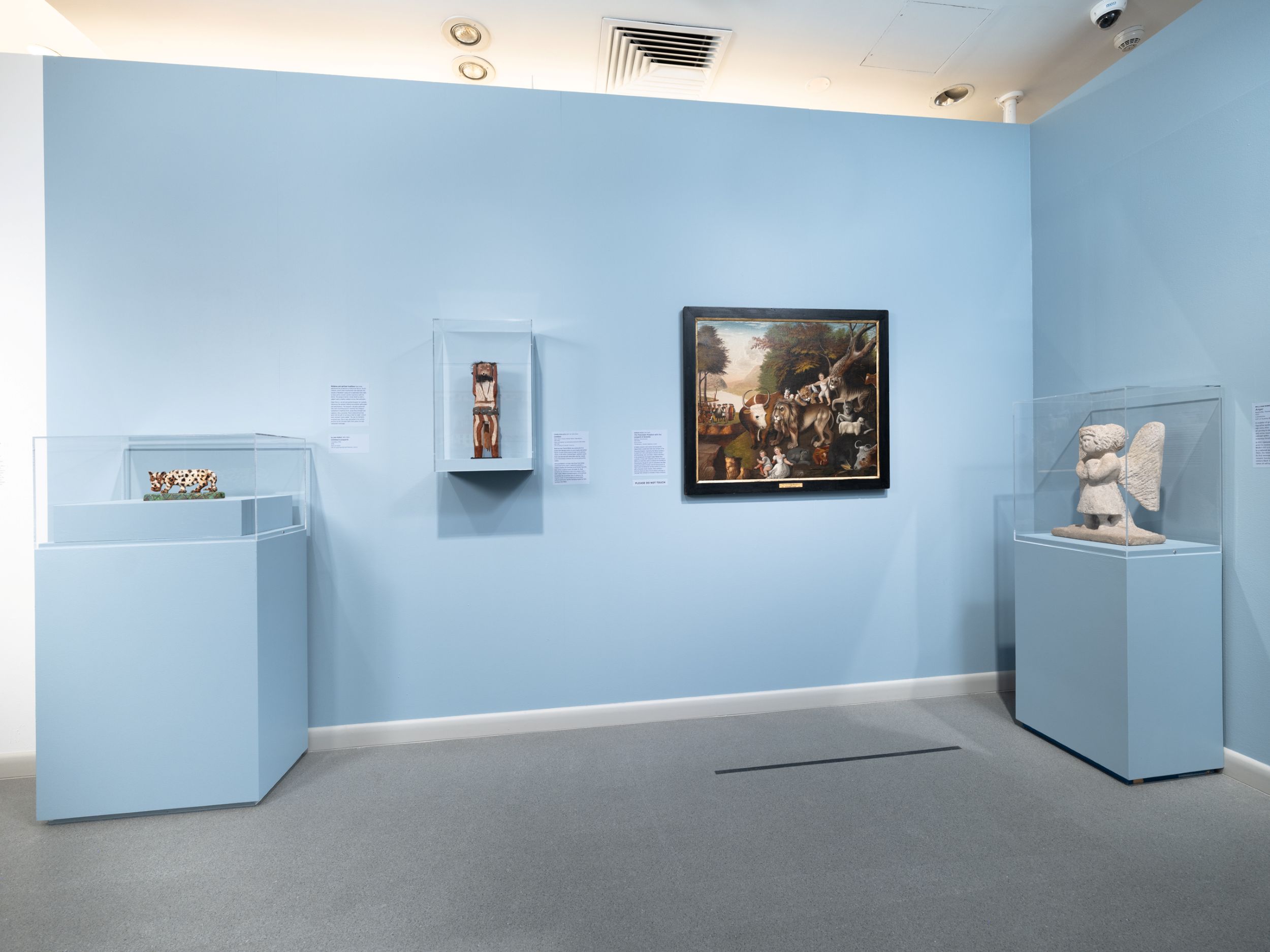
Works by Edward Hicks (1780–1849) and William Edmondson (c. 1874–1951) appear in both exhibitions. Their respective uses provide a helpful case study of the contrasting approaches. Of the sixty-odd versions of The Peaceable Kingdom that Hicks painted during his lifetime, one is on view in each exhibition (American Folk Art Museum, c. 1835–40; MoMA, 1832–34). While labels at both museums describe the Quaker context in which Hicks repeatedly painted the scene, MoMA places its version near another of Hicks’s paintings, The Residence of David Twining (c. 1845–47), and a painting by Charles Sheeler (1883–1965), Bucks County Barn (1932) (fig. 4). Sheeler took inspiration from the vernacular architecture of Bucks County, Pennsylvania, Hicks’s home county. Rockefeller purchased all three paintings for her collection and gave them to MoMA in the 1930s. In contrast, the American Folk Art Museum shows its Peaceable Kingdom alongside Angel (1937), a sculpture by William Edmondson, in a section on religious and spiritual traditions (fig. 5). These works join a tiger sculpture by Elijah Pierce (1892–1984) and a doll sculpture by Charlie Willeto (1906–1964), a Diné medicine man. Like other devotional artworks, the curators write, Angel “reveals belief as both a subject and creative catalyst across time and place.” Gevalt and Culp quote Edmondson in the label for Angel, saying that Jesus “planted the seed of carving in me”; they thus frame Edmondson’s work as a spiritual expression through stone carving rather than an art-making practice as such. Meanwhile, at MoMA, Edmondson’s work is placed among the creations of twentieth-century “self-taught” artists that the museum championed in its first decades. Artists like Edmondson, Hirshfield, and Kane were “discovered,” usually by wealthy members of the coastal elite, and brought into the art world as novelties. These artists were outside the norms of the established art world. The press release for Edmondson’s 1937 MoMA exhibition claims that he “is simple, almost illiterate, entirely unspoiled, and happy in his work.” It continues: “He sees visions in the sky and fixes them in his carvings. His visions are not for the eyes of ordinary mortals; they are reserved for him alone.”1 In American Folk Art, MoMA has sanitized the esoteric mysticism that defined its earlier discussions of these works, but that legacy, part and parcel of the ideological construction of self-taught art, remains.
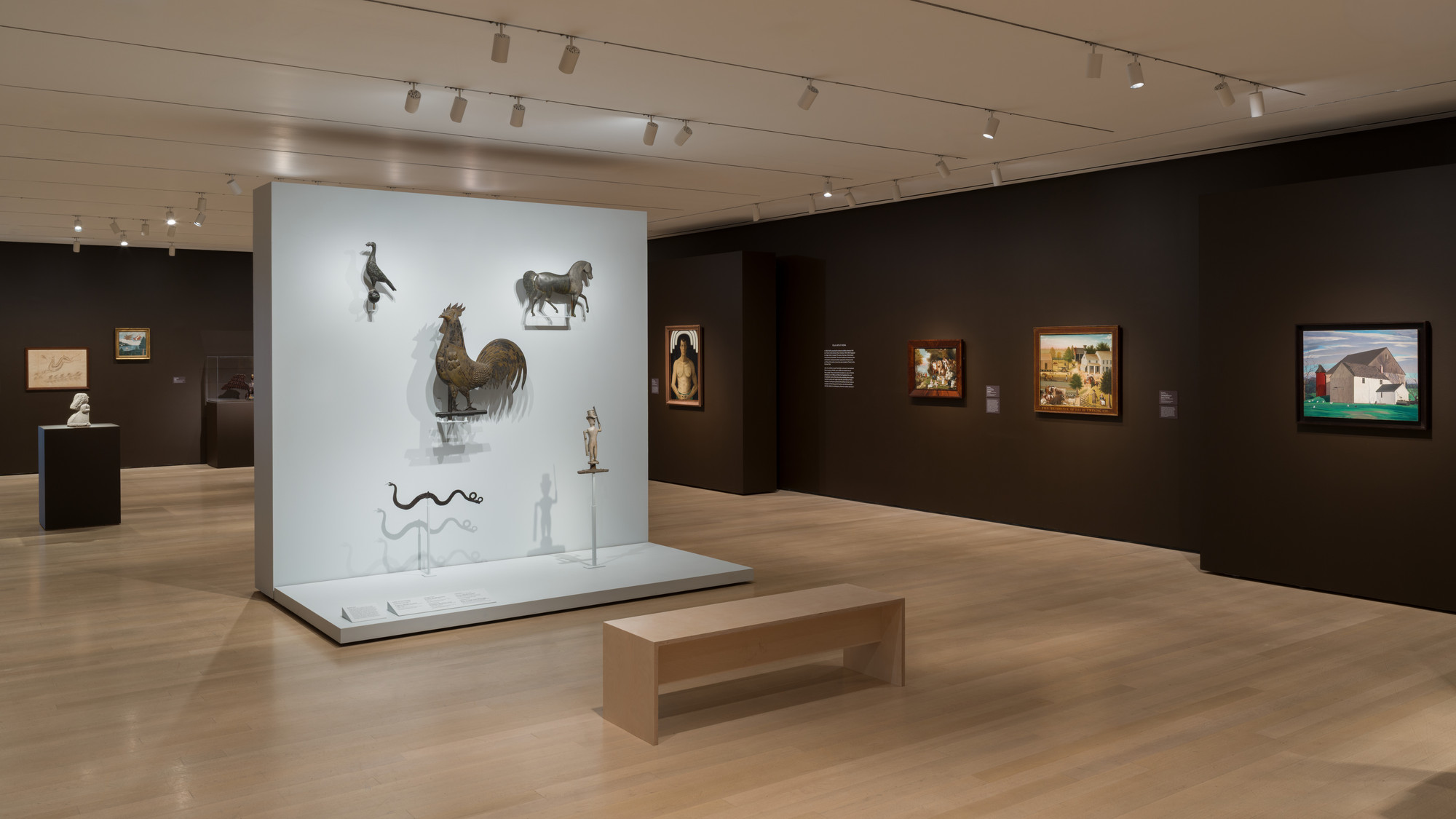
Both shows offer versions of how institutions define folk art as a category. The multitude of objects in the opening gallery of American Folk Art speaks to the diversity—and instability—of the folk category. MoMA does little to interrogate the construction of the “folk” of which it speaks endlessly in the exhibition. On a wall label, curators Starr Figura and Lydia Mullin define folk art as “art rooted in the cultural traditions of particular communities or regions and created in accordance with styles and techniques passed down or learned in apprenticeships, trades, or local schools.” They continue, “Such works were often produced to serve a practical or ritual function.” Furthermore, the exhibition “reflect[s] the specific kinds of American vernacular art that were marketed and valued as folk art in the 1920s and 1930s.” This conflation of the terms “folk” and “vernacular” leaves the exhibition’s focus, beyond the biographical connection to Rockefeller, slippery and imprecise. Whereas the American Folk Art Museum’s recent exhibition programming has privileged the plurality of folk art through expansive international exhibitions (such as Francesc Tosquelles: Avant-Garde Psychiatry and the Birth of Art Brut [2024] and Madalena Santos Reinbolt: A Head Full of Planets [2025]), MoMA has largely ignored folk art for decades. Following the museum’s 2024 exhibition Lillie P. Bliss and the Birth of the Modern, which focused on another of its founders, MoMA here affirms its self-effacing progressive vision as exemplified by Rockefeller as a collector of both folk art and modern art.
Despite differences in terms of focus and definition, these shows offer strategies for reading a popular American presence into the material record. Folk art can present women and other minorities as agents in the creation and propagation of American material culture. Theorem paintings and mourning pictures in American Folk Art reprise the sentimental and memorial expressions of nineteenth-century women in ways that more traditional artistic mediums do not. Rockefeller herself, quoted in the exhibition’s accompanying catalogue, spoke of her collection comprising “pictures painted by our great grandmothers and great aunts, a few by men, between 1790 and 1820 or 30.”2 Finding the work of these women in this and other forms is laudable and a worthy contribution to the field. Folk art can highlight the visual presence of people who remain unidentified but who are authors nonetheless. Works like Situation of America (1848), in Folk Nation, speak to the liveliness of antebellum New York City—but, as the curators note on the label, the painting’s “bright colors and ordered layout belie the ugly history that gave shape to American affluence, especially during this period: the country’s reliance on enslaved labor, which is only subtly referenced in the painting’s undulating border of cotton blossoms.” The inclusive, revisionist work of Folk Nation evokes memories of the 2023 exhibition Unnamed Figures: Black Presence and Absence in the Early American North, cocurated by Gevalt, and the superb show Locating Girlhood: Place and Identity in Early American “Schoolgirl” Art, curated by Gevalt and Culp and on view at the American Folk Art Museum through February 28, 2027. In their hands, American folk art breaks out from the boundaries set by early twentieth-century collectors like Rockefeller and asserts its status and utility as a marker of the complex and multifaceted American lives that are often absent from the historical record.
Folk art is one index of change through which Americans define themselves and their places in the world. Its conceptual development and frequent revivals attest to the continuing resurgence of anxieties around American identity during periods of strife. Perhaps, amid another one of those periods, American folk art can guide visitors at the American Folk Art Museum and the Museum of Modern Art to think carefully—and critically—about the country founded 250 years ago.
Cite this article: Joshua Massey, review of American Folk Art: Revisiting the Collection of Abby Aldrich Rockefeller, Museum of Modern Art, and Folk Nation: Crafting Patriotism in the United States, American Folk Art Museum, Panorama: Journal of the Association of Historians of American Art 12, no. 2 (Fall 2026), https://doi.org/10.24926/24716839.21538.
Notes
- Museum of Modern Art, “Exhibition of Sculpture by William Edmondson,” press release, October 18, 1937, https://assets.moma.org/documents/moma_press-release_333062.pdf. ↵
- Starr Figura and Lydia Mullin, American Folk Art: Revisiting the Collection of Abby Aldrich Rockefeller (Museum of Modern Art, 2026), 15. ↵
About the Author(s): Joshua Massey is a doctoral candidate at the Bard Graduate Center, New York.