

Rieles y Raíces: Traqueros in Chicago and the Midwest





PDF: Doyen, review of Reiles y Raíces
Curated by: Ismael Cuevas and Alejandro Benavides, National Museum of Mexican Art, Chicago
Exhibition schedule: National Museum of Mexican Art, Chicago, November 21, 2025–April 26, 2026
As the United States celebrated its semiquincentennial, Chicago’s National Museum of Mexican Art reflected on the founding of our nation’s infrastructure. The exhibition Rieles y Raíces: Traqueros in Chicago and the Midwest examined the historic contributions of Mexicans and Mexican Americans in establishing the US railway system. Cocurators Dr. Alejandro Benavides and Ismael Cuevas traced the migrations of traqueros (railroad workers) through archival and community-based research, demonstrating their place-making efforts despite hostile working conditions and governmental persecution. Through its demographic and geographic scope, the exhibition reinforced the foundational yet often overlooked role of Latinos and the region of the Midwest in the development of the United States.
With the expansion of US territory and industrialization in the nineteenth century, the Midwest served as a gateway to the West. The US government orchestrated the mass dispossession of Native land to construct networks of railroads spanning the eastern and western United States for the first time, through which Chicago emerged as a major economic and transportation hub. This network also connected northern and southern regions, as the Mexican Central Railway (Ferrocarril Mexicano) linked to the US Southwest in 1884—effectively establishing a migratory circuit between Mexico and the Midwest (fig. 1). These railway connections and an increased demand for industrial labor prompted the recruitment of Mexicans and Mexican Americans from the borderlands—a population that would ultimately compose two-thirds of the US railroad industry’s labor force from 1880 to 1930.1
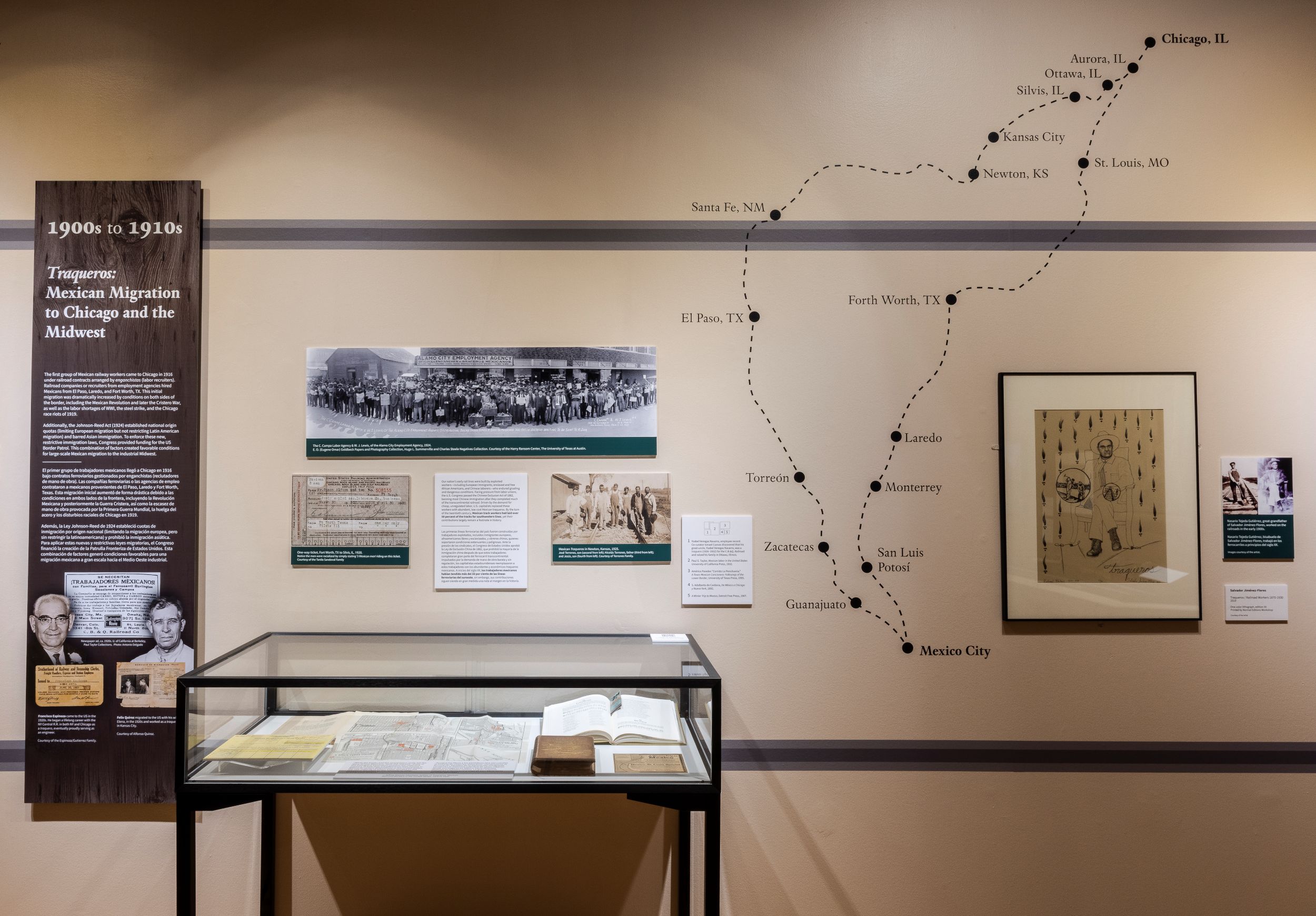
Rieles y Raíces showed the history and material culture of the Mexican American communities who built and lived along these railroad lines. A central focus of the exhibition was its thoroughly researched and careful presentation of historic boxcar settlements in Chicago and nearby Aurora, Illinois. These settlements, also known as boxcar camps, were constructed by railroad employers from decommissioned boxcars to incentivize family relocation. Although the living conditions of boxcar camps were poor—offering little shelter from frigid winters and nearby industrial pollutants—the families that occupied them were among the earliest Mexican American communities in the Midwest. Given that most boxcar camps no longer exist, Benavides and Cuevas relied on community narratives, US Census records, and historic aerial photographs to locate the sites of boxcar camps—leading to the discovery of a forgotten camp in the East Side neighborhood of Chicago. In the exhibition, the boxcar camps were presented through displays of historic photographs, artifacts, and research-based model train displays made by Benavides and Chicago-based model railroader Derrick James (fig. 2).
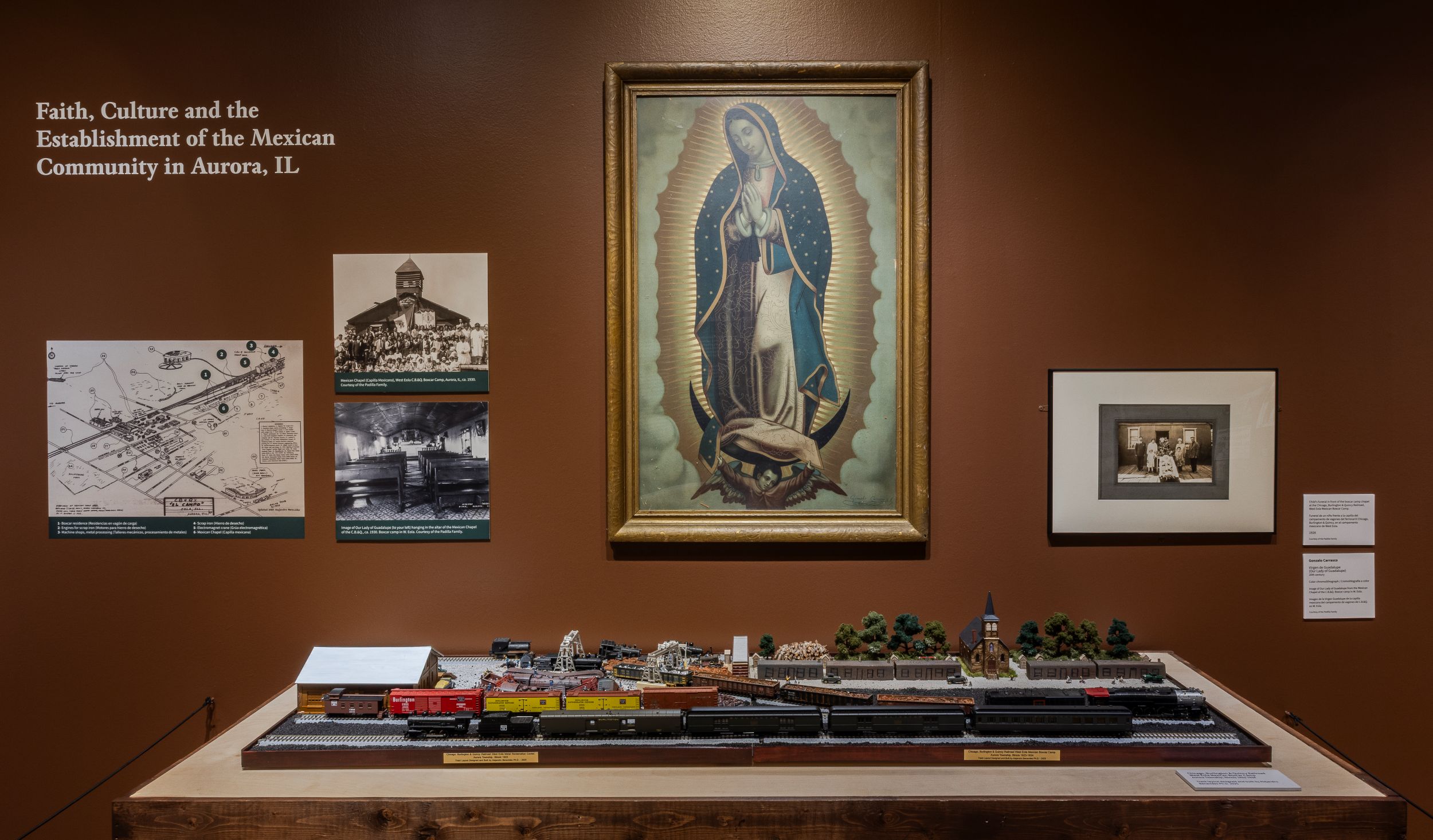
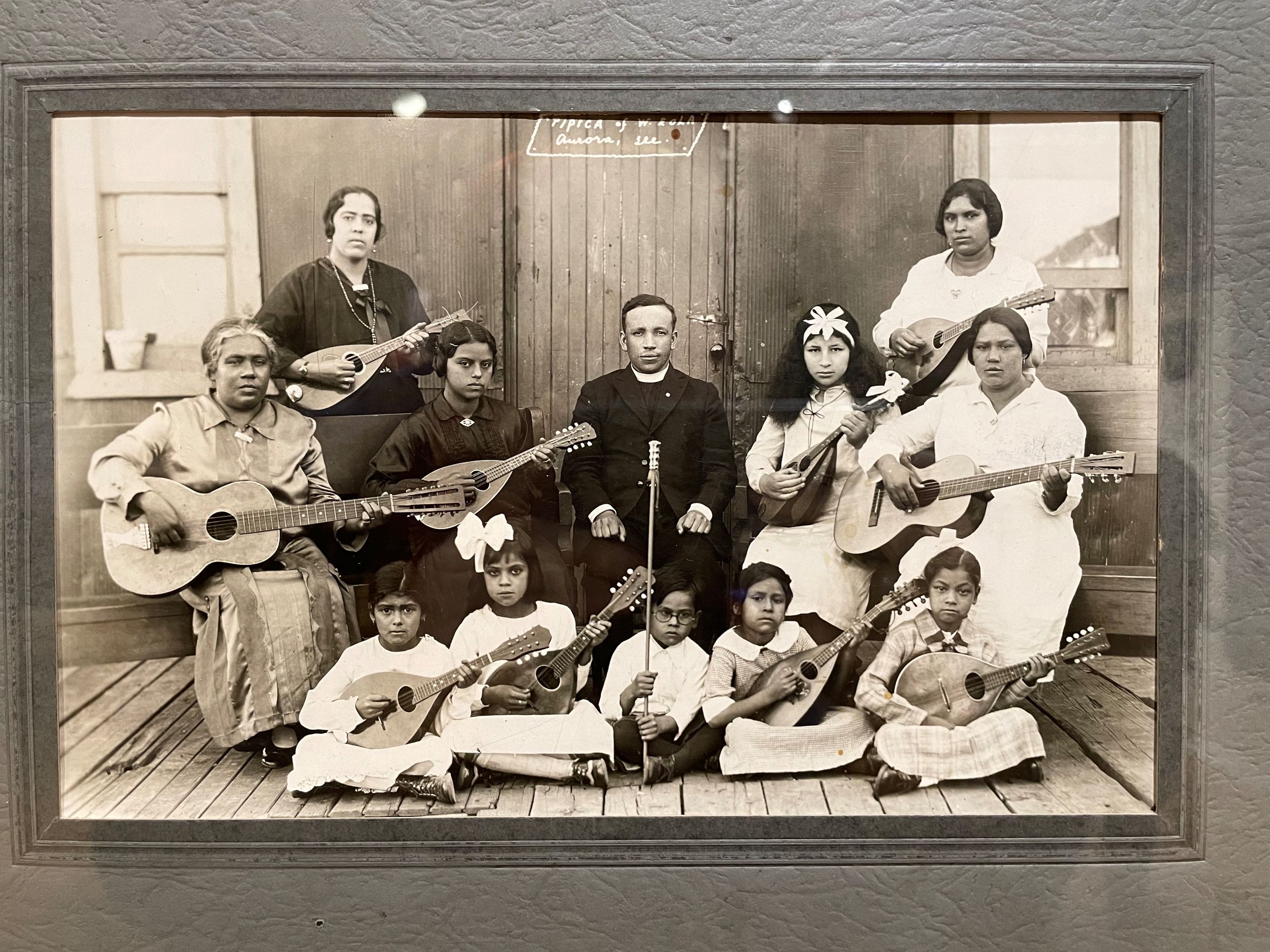
Traqueros and their families brought with them their rich cultural and religious traditions from Mexico. They built social institutions from salvaged wood and metal, constructing churches that hosted religious services as well as cultural and community events, including public forums and musical or theatrical performances. Women, in particular, also used these spaces to convene sociedades mutalistas (mutual-aid societies), such as Aurora’s Guadalupanas, to promote spiritual leadership and provide charitable services. Remarkably, some objects from these cultural institutions were saved by Julia Pérez—a former member of the Guadalupanas—and exhibited in Rieles y Raíces, including the original framed lithograph print of La Virgen de Guadalupe that hung in the West Eola boxcar camp chapel (see fig. 2) and the mandolin played by Pérez when she was in the local female string ensemble Típica, formed by her uncle Father Alberto Valdez (fig. 3). The inclusion of these objects emphasized the crucial role of material culture in retaining cultural heritage throughout the diaspora.
The exhibition also addressed the contested presence of traqueros in the United States as Mexican migration was increasingly scrutinized into the twentieth century. Governmental campaigns such as “Operation Wetback” instigated mass deportations and, in Illinois, relied on the rail infrastructures that were built by traqueros to do so. The exhibition featured personal narratives that relay the frustrating circumstances of deportation and self-deportation, wherein many traqueros felt betrayed by their employers and country after establishing careers in the railroad industry and even purchased homes in their communities. These narratives expose a fundamental contradiction embedded in the United States’ infrastructure—that is, the simultaneous dependency on and disposability of an exploited and racialized working class.
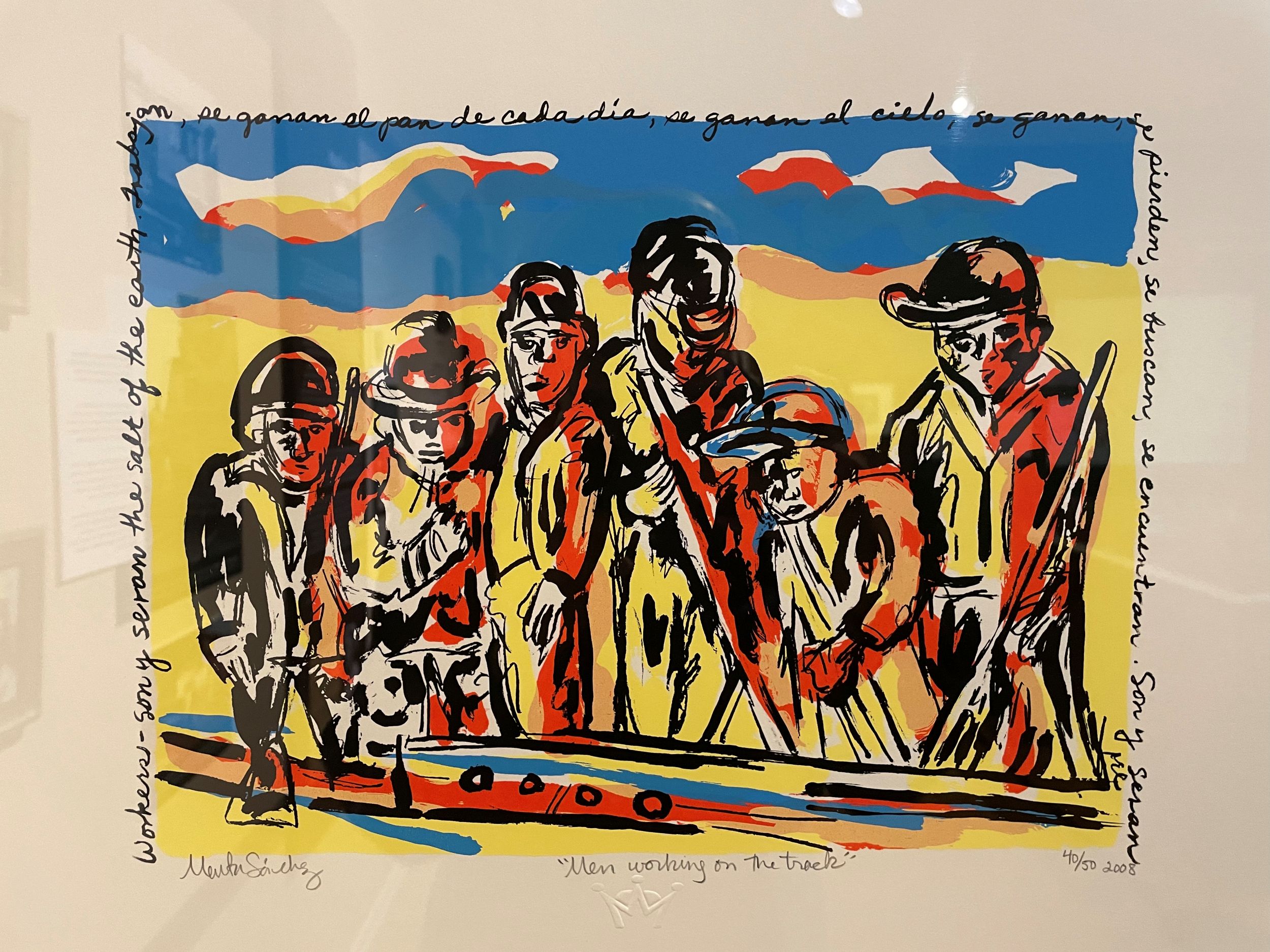
Works by contemporary Latinx artists contextualize the lasting legacy of traqueros. In a rare lithograph by the celebrated sculptor Salvador Jiménez-Flores (see fig. 1), the artist pays homage to his great-grandfather Nasario Tejeda Gutiérrez, whose labor in the railroad industry in the early 1900s cemented his family’s roots in Chicago. For artist Marta Sánchez, growing up along the railyards of San Antonio, Texas, introduced her to the workers and carpas (Mexican entertainment troupes) who maintained and traveled these tracks. The National Museum of Mexican Art’s permanent collection contains selections from Sánchez’s Transcendental Train Yard, a collaborative series of serigraphs with poems by Norma E. Cantú. Sánchez’s featured serigraph, Men Working on the Track (fig. 4), immortalizes the cross-geographical icon of traqueros while her own positionality attests to the gendered networks within the railyards. As mentioned in a section of the exhibition devoted to “Latinas in the Railroad,” women sustained these early traquero families and communities and even contributed their labor to the industry amid worker shortages during World War II.
The overwhelmingly positive reception of Rieles y Raíces emphasizes the demand for further research on and greater representation of Midwest Latinx histories. Although the exhibition was mounted in the museum’s Xicágo Gallery—a space dedicated to temporary displays with a maximum occupancy of thirty-eight people—more than three hundred visitors wrapped the block to attend the opening and, by its closing, more than thirty-seven thousand people had attended the show. For local audiences, the exhibition was also immediately impactful as a community archiving project. In preparation for the exhibition, curators consulted community members who had personal connections and objects related to traquero history in the Midwest.2 These collaborations between local communities and an intergenerational curatorial team underscore the various kinds of expertise necessary to recover such marginal histories.
This locally based work also builds on nearly two decades of Benavides’s research as a historian of Mexican American communities in Aurora. By collecting oral histories about Aurora’s traqueros and their cultural institutions, Benavides was instrumental in procuring a historical marker for the West Eola Mexican boxcar camp.3 Rieles y Raíces is supported by this rich historical research as well as Benavides’s self-published manuscript, A Community Narrative: The First Mexican Community in Aurora, Illinois. Although this investigation is a welcome contribution to the growing study of Latinos in the Midwest, I caution against its reliance on synthetic imagery. While the text does include original historic photographs, the manuscript’s use of artificial intelligence to generate the cover and touch up images throughout can undermine the historic specificity of an already marginalized community and its long-standing presence in the Midwest.
For the field of US art history, Rieles y Raíces demonstrates the potential of utilizing railroad infrastructure as an analytical framework. Given that railroads were constructed through the means of the government, corporations, and a largely disenfranchised laboring class—comprised of men and women from Chinese, European, and Latin American descent, as well as both enslaved and formerly enslaved African Americans—they pose an intersectional opportunity to think across structures of race, class, gender, and power. Railroads also expose the capitalistic, carceral, racial (specifically, anti-Indigenous), and environmentally detrimental motivations of our developing nation. And yet, this enduring national infrastructure has shaped regional economies, facilitated migrations, instigated labor movements, forged communities, and fascinated artists and the general public alike. The cultural influence of the railroad at large, then, establishes common ground between otherwise disparate demographics and geographies. Just as Rieles y Raíces identified the icon of the traquero in Latinx art, so, too, does the cultural iconography of railroads emerge across the historical and contemporary works of Black artists. Not only is this infrastructure invoked as a defining and subverted logic for the Underground Railroad, but its trains, stations, tracks, and even railroad models also appear as artistic subjects for Jacob Lawrence, Walter Ellison, and Charles “Teenie” Harris, to name only a few artists.4
Within the context of Latinx art history specifically, the analytical and diasporic framework of railroad infrastructure presents an opportunity to bring the histories of Latinos in the Midwest from margin to center. The dominant focus on bicoastal urban centers and southwestern borderlands within the subfield and Latino studies at large overlooks this “middle American” region that Latinos have occupied for over a century. This disciplinary and lived marginalization denies the diversity of US Latinidad and the fundamental role played by these communities in the development of critical US infrastructure that still sustains the country today. There is also an urgency in asserting and preserving these histories at a time when the region is increasingly becoming the nation’s key political battleground and a hotbed for state violence via immigration enforcement, police brutality (as the Midwest was George Floyd’s home), and environmental racism.
Connected by railroads, traquero histories also intersect with their Midwestern diasporic counterparts. In Michigan, for example, Mexican migration and labor took on a similar character to that in other industrial and agricultural sectors. As agricultural employers recruited Mexicans and Mexican Americans from the borderlands, they also enticed prospects with employer-provided housing, known locally as “migrant camps.”5 Structurally, these living quarters closely resemble the boxcar settlements occupied by traqueros, which suggests promising future research on Latinx residential architectures in the industrial Midwest. Migrant camps in Michigan were also spatially separated from cities since they were anchored to farmlands, akin to how boxcar settlements were relegated to marginal railyard outskirts.
Additionally, like the Illinois traqueros, the emergent population in Michigan was decimated by mass deportations during the Great Depression. This expulsion was prompted, in part, by public outcry that characterized Mexicans as a strain on the labor force and public resources; yet in the years that followed, the same agricultural employers returned to the border to supplement insufficient local labor.6 These parallel histories of Mexican migration in Michigan and Illinois prove the extended historical lineage of Latinos in the Midwest. They also establish a historical precedent for our current political moment, wherein the belonging of Latinos is being publicly challenged and subjected to state violence.
Rieles y Raíces marks an important step toward recognizing the historical significance of Latinos in the Midwest. As a workforce, traqueros helped develop critical national infrastructure. As budding communities, traqueros and their families remained committed to each other and their heritage, forging a distinctly Midwestern Latinidad from within the region’s industrial conditions. Despite their historic contributions, the publicly contested presence of traqueros echoes the challenges faced by other Latinos throughout the Midwest in the twentieth century and still today. As our nation simultaneously celebrates its Semiquincentennial and debates its political and even geographic identity, Rieles y Raíces makes a historical claim to the place of the Midwestern Latinx diaspora in our national identity. To return to Cantú’s words in Sánchez’s serigraph Men Working on the Track:
Workers son y serán,
the salt of the earth.
Trabajan, se ganan
el pan de cada día,
se ganan el cielo.
Se ganan, se pierden,
se buscan, se encuentran.
Son y serán.
Workers are and will be,
the salt of the Earth.
They work,
they earn their daily bread,
they earn heaven,
they earn, they lose.
They search, they find themselves.
They are and will be.7
Cite this article: Kale Serrato Doyen, review of Rieles y Raíces: Traqueros in Chicago and the Midwest, National Museum of Mexican Art, Chicago, Panorama: Journal of the Association of Historians of American Art 12, no. 2 (Fall 2026), https://doi.org/10.24926/24716839.21578.
Notes
- Jeffrey Marcos Garcilazo, Traqueros: Mexican Railroad Workers in the United States, 1870–1930 (University of North Texas Press, 2016), 34. ↵
- These efforts continue as cocurator Ismael Cuevas is now collecting traquero histories from northwest Indiana. See Ismael Cuevas (@shcuevas), “Help me tell the 100 year #history of Mexicanos in Northwest #Indiana,” Instagram, August 12, 2026, https://www.instagram.com/reel/Db8zV5-PEOV/?utm_source=ig_web_copy_link&stkn=MzRlODBiNWFlZA==. ↵
- David Sharos, “Aurora Township Honors History of Boxcar Camp, Austin-Western Neighborhood,” Aurora Beacon-News, September 24, 2024, https://www.chicagotribune.com/2024/09/26/aurora-township-honors-history-of-boxcar-camp-austin-western-neighborhood. ↵
- Here, I am referring specifically to Lawrence’s acclaimed Migration Series; Ellison’s 1935 painting Train Station (1935; Art Institute of Chicago); and Harris’s various images of Pittsburgh railyards, as well as a fascinating image of a model train that he kept in his basement darkroom (see Carnegie Museum of Art, Pittsburgh, inv. no. 2001.35.13892, https://collection.carnegieart.org/objects/639a2b4a-c397-4051-a62b-6cbfbd45028e). ↵
- As part of my own research-based artistic practice, I began photographing Mexican migrant camps in Michigan and interviewing locals about their history. See Kale Serrato Doyen, “Visualizing Chicanx Presence in the Rural Midwest,” Intervenxions 2 (Fall 2023): 100–109, https://www.latinxproject.nyu.edu/intervenxions/visualizing-chicanx-presence-in-the-rural-midwest. ↵
- Steven Rosales, “‘This Street Is Essentially Mexican’: An Oral History of the Mexican American Community of Saginaw, Michigan, 1920–1980,” Michigan Historical Review 40, no. 2 (2014): 33–62. ↵
- Translation by Norma E. Cantú, in Transcendental Train Yard: A Collaborative Suite of Serigraphs (Wings, 2015), 24–25. ↵
About the Author(s): Kale Serrato Doyen is a doctoral candidate in the history of art and architecture at the University of Pittsburgh.