

A Nation of Artists: 250 Years of Creativity





PDF: Igoe, review of A Nation of Artists
Curated by: Kathleen Foster, Philadelphia Museum of Art; Alexandra Kirtley, Philadelphia Museum of Art; Julia Hamer-Light, Philadelphia Museum of Art; Leah Triplett, Pennsylvania Academy of the Fine Arts, Philadelphia; and Lea C. Stephenson, Pennsylvania Academy of the Fine Arts, Philadelphia
Exhibition schedule: Philadelphia Museum of Art, April 12, 2026–July 5, 2027; Pennsylvania Academy of the Fine Arts, Philadelphia, April 12, 2026–September 5, 2027
Exhibition catalogue: A Nation of Artists: 250 Years of Creativity, exh. cat. Philadelphia Museum of Art and the Pennsylvania Academy of the Fine Arts, 2026. 96 pp.; 84 color illus. Paperback: $18 (ISBN: 9780876333150)
Art museums and galleries across the country are marking the 250th anniversary of the signing of the Declaration of Independence at a fraught and polarized political moment. Exhibitions and permanent collections reflect on the United States’ founding and the role of art and artists in its conception and understanding of itself. In Philadelphia, the Philadelphia Museum of Art (PMA) and the Pennsylvania Academy of the Fine Arts (PAFA) have unveiled installations in which their holdings are interspersed with paintings and decorative arts from the private Middleton Family Collection. Presented across the two museums, A Nation of Artists: 250 Years of Creativity features more than one thousand artworks spanning three centuries that together aim to tell an expansive and inclusive history of American art, with Philadelphia often at the center.
While the PMA and PAFA both organized their presentations under similar thematic sections (which include “Prosperity, Abundance, and Inequity”; “Globalism, Innovation, and International Exchange”; “Encounters in the West”; “Nature, Spirit, and Horizons: Landscapes and Spaces Between”; “Figures and Dreams: The Modern Art of Surrealism”; and “Geometry, Industry, and the Modern Imagination”), they explore these themes with very different approaches, dictated by their own collection strengths and curatorial organization. The PMA primarily organized its galleries chronologically, covering 1850 to the mid-1900s (with a handful of notable contemporary interventions). PAFA embraced a more thematic approach that purposefully invites dialogue between its historic and contemporary collections, with often surprising and insightful results.
Both institutions have experienced upheavals and changes over the past few years. PAFA ended its degree-granting college program in the spring of 2025, and its Historic Landmark Building, designed by Frank Furness and George Wattson Hewitt, closed for major renovations in 2023. The opening of A Nation of Artists at PAFA coincides with the grand reopening of this important building. PAFA director Eric Pryor stepped down at the end of 2024, and the academy welcomed a new director and CEO, Kristen Sheperd, earlier this year. The PMA’s director, Sasha Suda, was fired by the museum’s board in a cloud of controversy last fall, and the museum is now under the leadership of Daniel Weiss. The newly installed American art galleries at the PMA and PAFA, while years in the making and planned under previous leadership, symbolically mark the beginning of a new era for both institutions.
The museums are keen to demonstrate that visual and material innovation, craft, and expression in the United States have been driven by diverse artists and makers. At the PMA, one of the most successful galleries that demonstrates this artistic diversity repeats the exhibition title: “A Nation of Artists.” This gallery, including work from the 1800s to the mid-1900s, underscores the many pathways to becoming an artist, from formal training and apprenticeships to self-teaching. This prompt inspired the curatorial team to think beyond painting and sculpture and incorporate light-sensitive materials—like works on paper and textiles—which will be rotated out of the galleries every few months. The inclusions allowed for the display of unique, rarely seen works from the museum’s collection, like General Washington’s Retirement (c. 1800), embroidered and painted in watercolor on silk by Sarah Montgomery Thompson from a drawing by John James Barralet. The gallery also includes face vessels made by formerly enslaved African American artists who learned their skills from the commercial potteries around Edgefield, South Carolina. Also displayed are two olla, or water jars, made by Frances Pino Torvino (Sra-Ma-Tyai, “Singing Child”) and her daughter Wanda Aragorn (Dzinats’ituwits’a, “Rainclouds over the horizon”), underscoring the matrilineal passing of knowledge at Acoma Pueblo. A fire-hose reel ornament from around 1850 by the painter and civil rights activist David Bustill Bowser, a leader in Philadelphia’s free Black community, on loan from the Atwater Kent Collection at Drexel University, demonstrates that residents of the nineteenth-century city viewed and consumed visual art in a variety of places. Centered around a carousel horse (1917–36) carved by Daniel Müller and painted by Angelo Calsamilia, whose families immigrated to the United States from Germany and Italy, this gallery illuminates how art and craft from myriad artists and makers have been integral to American life.
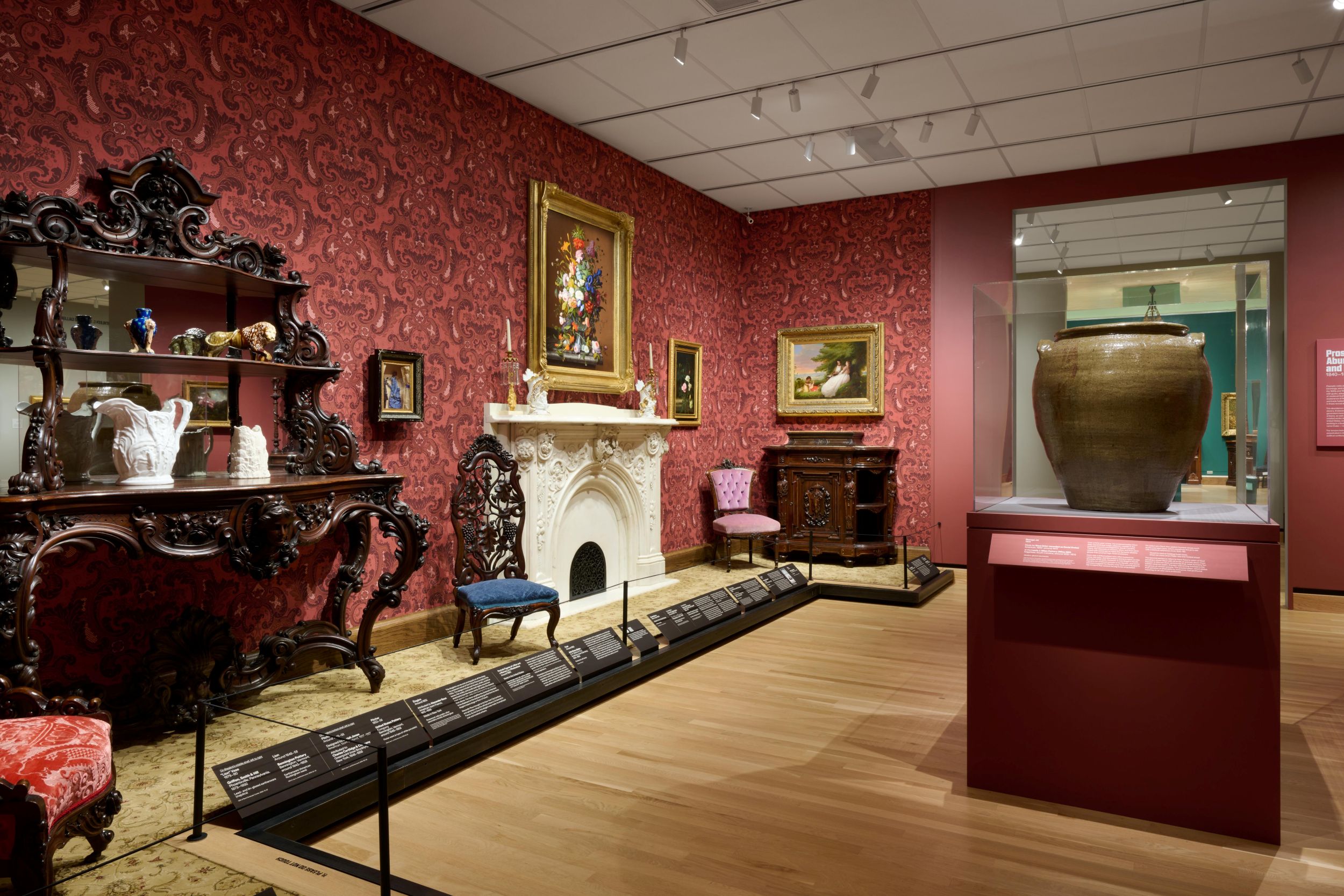
A stoneware vessel by Dave the Potter, or David Drake (1800–around 1870), anchors the next gallery, “Prosperity, Abundance, and Inequity” (fig. 1). Surrounded by decorative arts and paintings that revel in the revival of rococo and gothic design, the storage jar by Dave is inscribed with one of the artist’s signature rhyming verses—“Good for lard or holding fresh meat / blest we were when Peter saw the folded sheet”—identifying its function and referencing a Biblical passage that may allude to an abolitionist message. According to the accompanying label, “The proclamation, which states that salvation is attainable by everyone, had profound meaning to all who were enslaved.” Over the past year, Dave’s heirs established the Dave the Potter Legacy Trust and sought to reclaim these vessels, made under duress and stolen from their maker, as a form of ethical restitution.1 At of the time of this writing, five museums, including the Boston Museum of Fine Arts and, most recently, the Virginia Museum of Fine Arts, Richmond, have either repurchased Dave’s vessels from his descendants or returned pieces that have been lent back to the institutions. While Dave’s heirs are in touch with the PMA, the museum has not yet moved to return or repurchase the vessel.2 Dave’s monumental yet austere jar and inscription, written at a time when it was illegal for enslaved people in South Carolina to learn to read and write, stands as a powerful counterpoint to the material abundance surrounding it in the gallery—much of it likely made by, or funded by the products of, enslaved labor. But the PMA must address its own complicity in this system of disenfranchisement and work with Dave’s heirs toward a more responsible and ethical ownership of this remarkable work.
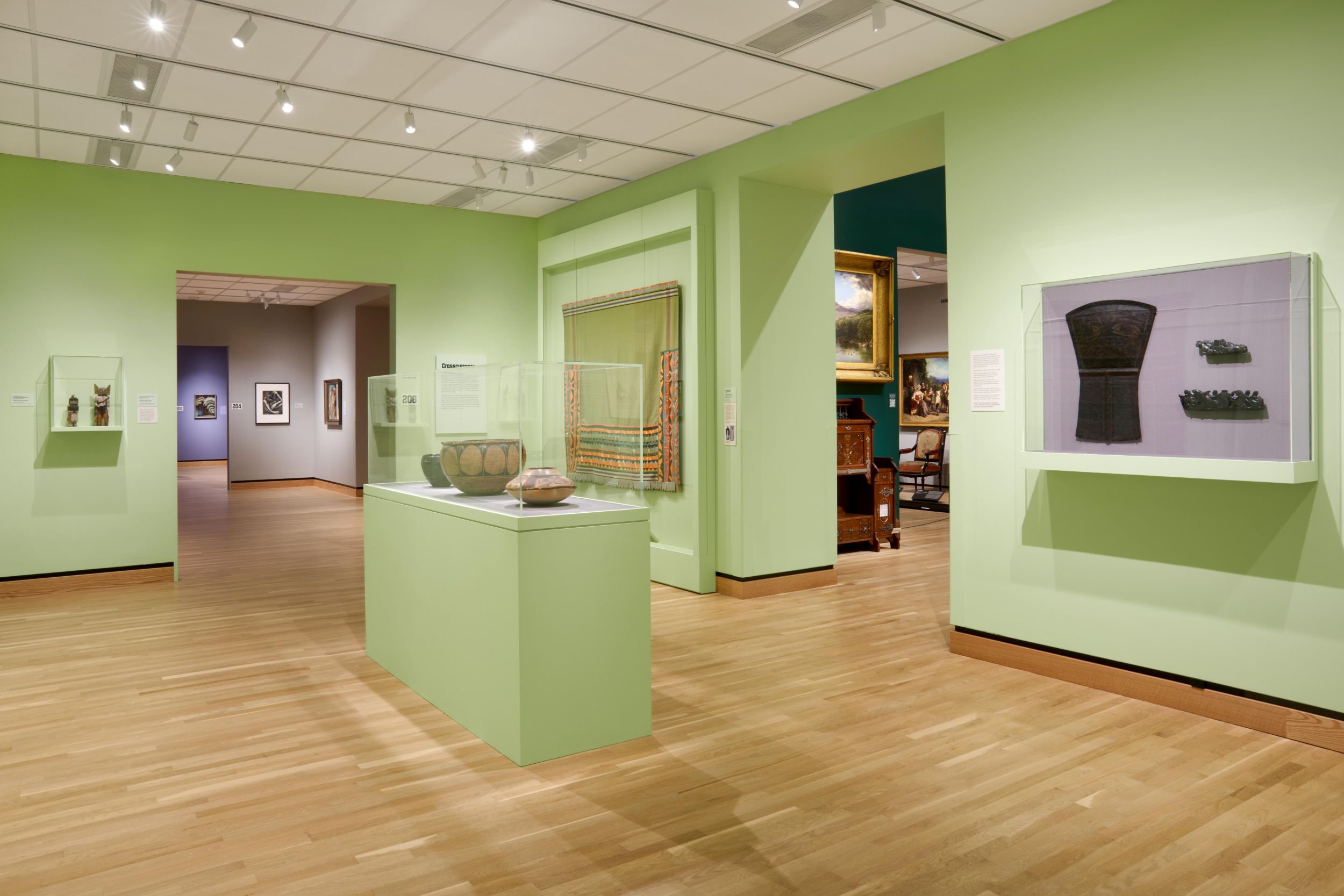
The PMA’s A Nation of Artists exhibition marks the first dedicated focus on Native American art and perspectives within its broader American art galleries after 1800. The curatorial team collaborated with an advisory committee of Indigenous curators, scholars, and culture bearers in the selection and interpretation of the artwork. With a few exceptions, Native American art is primarily featured in a gallery titled “Crosscurrents: Indigenous Modernisms” (fig. 2), which “shows how Lenape, Haida, Hodínöhšö:ni:h, Diné, Hopi, and Pueblo artists created Modern art forms by incorporating new materials, technologies, and ideas,” according to the label text. This gallery features historic Native American art from the PMA’s collection, often in dialogue with contemporary pieces. Auntie’s Purse (2025) by Randee Spruce (Heron Clan, Seneca Nation) a new acquisition made for the museum this year, is displayed next to a petal-shaped pincushion (c. 1830–60) by a once-known Seneca artist. The accompanying text written by Hayden Haynes (Deer Clan, Seneca Nation, and director of the Onöhsagwë:de’ Cultural Center, Seneca-Iroquois National Museum and Archives) illuminates how the Seneca began using glass seed beads—instead of traditional porcupine quills and moose hair—to ornament goods to sell to white settlers following their displacement. One of the standout artworks in the gallery is a striking Lenape Silkhasik Ahkwiyàn (honor blanket) from 2023, by Laura Watters Maynor (Delaware Tribe of Indians, Wolf Clan), on loan to the exhibition. The honor blanket was made for the artist’s granddaughter who served as Delaware Tribal Princess, an ambassadorial role, from 2023–24; it “symbolizes the enduring strength and resilience of Lenape identity and culture.” Together with the olla by Wanda Aragorn mentioned above, these inclusions of contemporary art by Spruce and Maynor powerfully show the endurance and innovation of Indigenous cultural expression in the United States. They also stand out as the only instances of contemporary art displayed within the historic galleries. While this is a significant and meaningful inclusion, it also unintentionally aligns these works with the art of the past.
There is an obvious moment at the end of the exhibition where a wider range of contemporary art could have also been included. The PMA’s presentation concludes with an exuberant yet ultimately unfulfilling celebration of local artists working in the present. A video highlights the practice and careers of seven artists and makers—Maria Albornoz, Dan Cutrone, shanina dionna, Warren Holzman, Larissa Huff, Richie Wilde Lopez, and Cynthia Zhou—whose work encompasses blacksmithing, woodworking, and movement, while a nearby case features their tools and materials. During each of my visits to the gallery, visitors lingered in the space, lured by the comfortable seating and clearly engaged by the artists speaking on the video screen. A label for the video explains that viewers will “learn how Philly’s unique culture and communities offer support and inspiration,” but the artist’s actual work is not on view, a missed opportunity for the museum to champion living local artists, after declaring them the legacy of “the continued diversity of our ‘nation of artists.’” Despite this omission, PMA’s reinstalled galleries highlight the ongoing effort of its curators to collect and exhibit work by diverse artists in a wide range of media and to incorporate Indigenous perspectives in its interpretation.
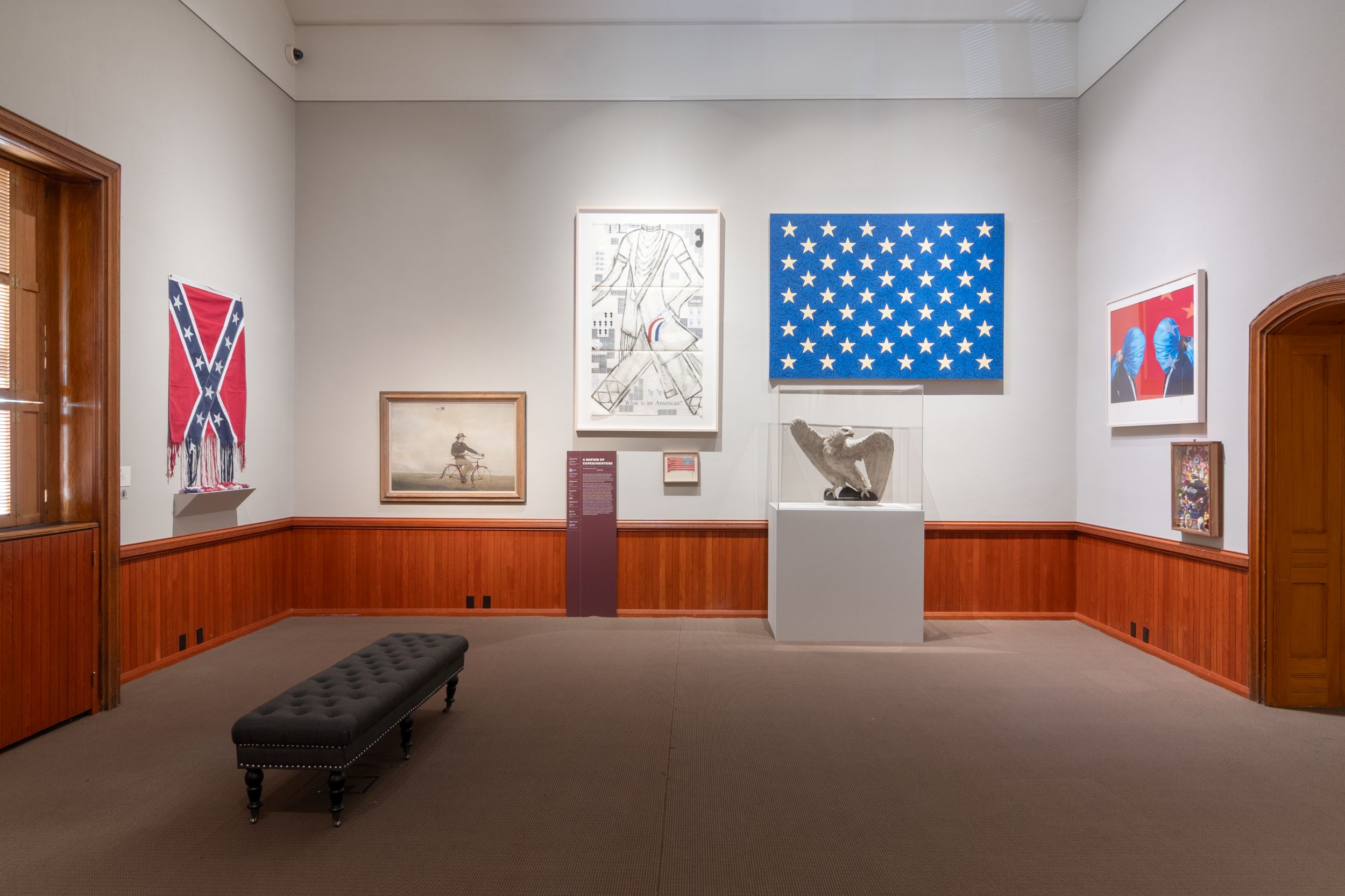
PAFA took a decidedly different approach in its presentation by displaying historic and contemporary work in thematic groupings that eschew chronology. The academy’s curators and designers successfully break down the rigidity of the historic building’s interior architecture, using temporary walls, painted blocks of color, vertical bars of section text, and a dynamic, salon-style hang that offers compelling and sometimes challenging dialogues between artworks. PAFA’s presentation opens in the Alumni Gallery on the first floor, brilliantly setting the stage for the rest of the exhibition with a meditation on the American flag (fig. 3). The exhibition text describes the flag as “an abstract art object meant to mark a space, place, or people,” and the work displayed in the gallery interrogates this potent symbol. Bold colors of red, white, and blue unite much of the artworks, but their meanings are multivalent. Unraveling (2017) by Sonya Clark, for example, presents a Confederate flag meticulously picked apart and undone by the artist and other participants, turning the flag’s lower inches into a pooling pile of thread. This piece symbolizes the process of unraveling the harm and racism entangled within the Confederate flag and American history more broadly. In What Is an American? (2001–3) by Jaune Quick-to-See Smith (Confederated Salish and Kootenai Nation), a cascade of red, white, and blue stripes erupts from the hand of a striding figure with a bandolier-style bag, posing the question of who is considered American in a country steeped in settler-colonial violence and the disenfranchisement of Indigenous peoples. A small woven American flag (1974) by Lenore Tawney is purposefully untitled, as the artist felt the flag was shamed in the wake of the Richard Nixon administration. Other works by artists including William Rush, Andrew Wyeth, Mark Dean Veca, and vanessa german prompt reflection on potent symbols of Americanness that permeate our daily lives.
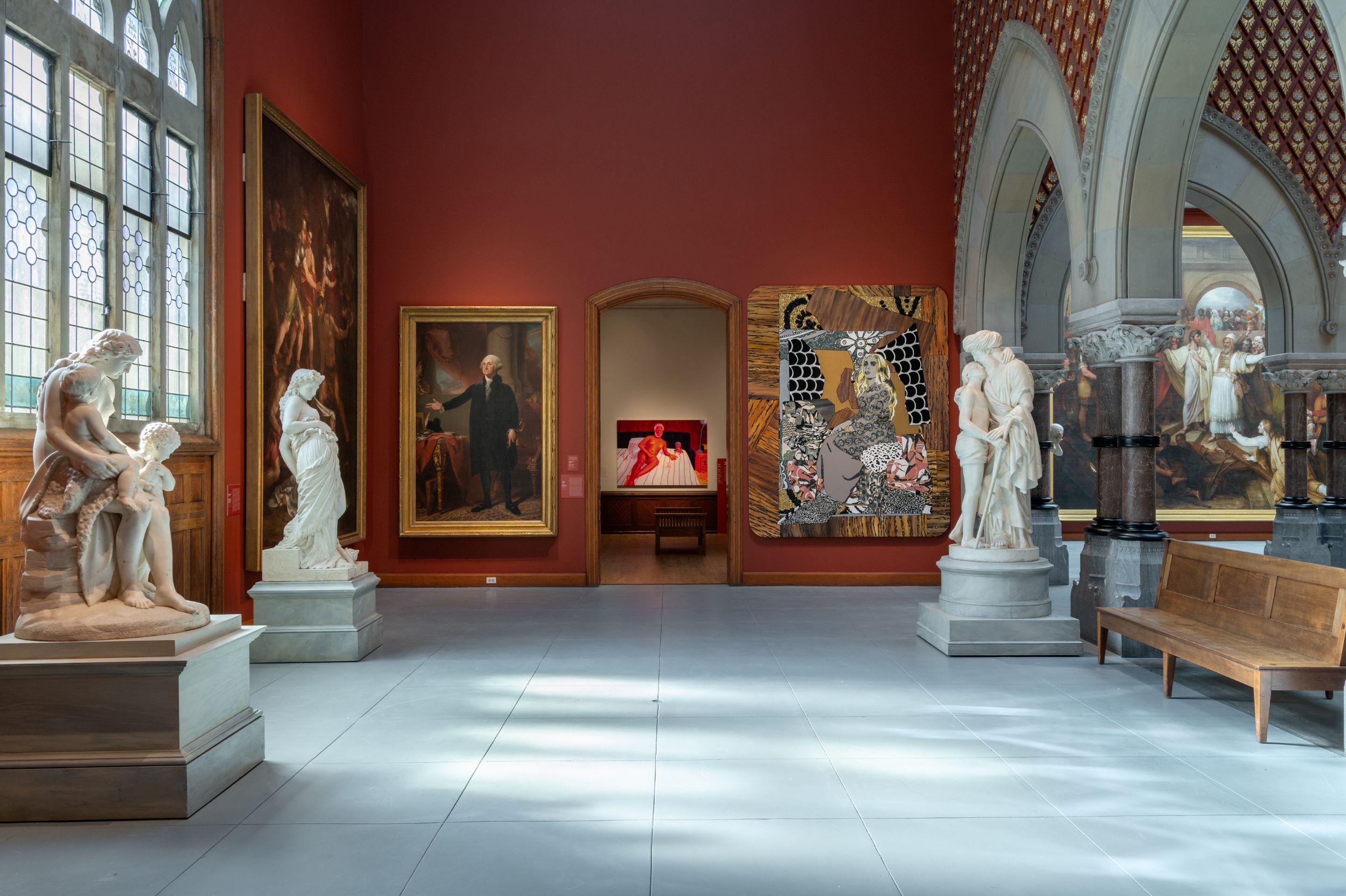
In the upstairs galleries, PAFA visitors encounter additional conversations between artworks from different centuries that speak to similar topics or concerns. George Washington (The Landsdowne Portrait) (1796) by Gilbert Stuart, for example, flanks Din Avec La Main Dans Le Miroir (2008) by Mickalene Thomas across a gallery entrance, framing Arcmanoro Niles’s Homesick for a Home I Never Had (2018) on the far wall (fig. 4). Together, these three portraits encourage us to think about the role of place and identity in monumental portraiture. Elsewhere, The Artist in His Museum (1822) by Charles Willson Peale, a monumental self-portrait of Peale as the masculine organizer of the natural world through his art and museum curation, is displayed across from Claudia Bach Pregnant (1975) by Alice Neel, Self-Portrait (1977) by Joan Brown, The Study of a Student (c. 1940s) by Laura Wheeling Waring, and Clinic Defense (1990) by Sarah McEneane: a group of paintings by women artists that celebrate women’s bodies and their autonomy.
Displayed at both PMA and PAFA are 120 artworks from the Middleton Family Collection, lent by philanthropists Leigh and John Middleton. John Middleton made his fortune in the tobacco industry and is the principal owner of the Philadelphia Phillies baseball team. The Middletons’ collection is, frankly, jaw-dropping in quality and scale. In an article in The New York Times, Kathleen A. Foster, the Robert L. McNeil Jr. Senior Curator of American Art and director of the Center for American Art at PMA, notes that Alice Walton, founder of Crystal Bridges Museum of American Art in Bentonville, Arkansas, once declared the Middleton collection “the greatest private collection in the US.”3 It is hard to disagree. The “Nature and Nation” section at the PMA (fig. 5), showcasing landscape paintings from 1850 to 1880 hung salon style, displays eleven works (out of twenty-two shown) from the Middleton collection, including museum-quality paintings by Albert Bierstadt, Worthington Whittredge, Francis Augustus Silva, Frederic Edwin Church, Martin Johnson Heade, Thomas Moran, John Frederick Kensett, and Robert S. Duncanson. I whistled out loud when I first saw Albert Bierstadt’s The Shore of the Turquoise Sea (1858), on loan from the Middletons. Its spectacular blue cresting wave practically shimmers on the canvas.
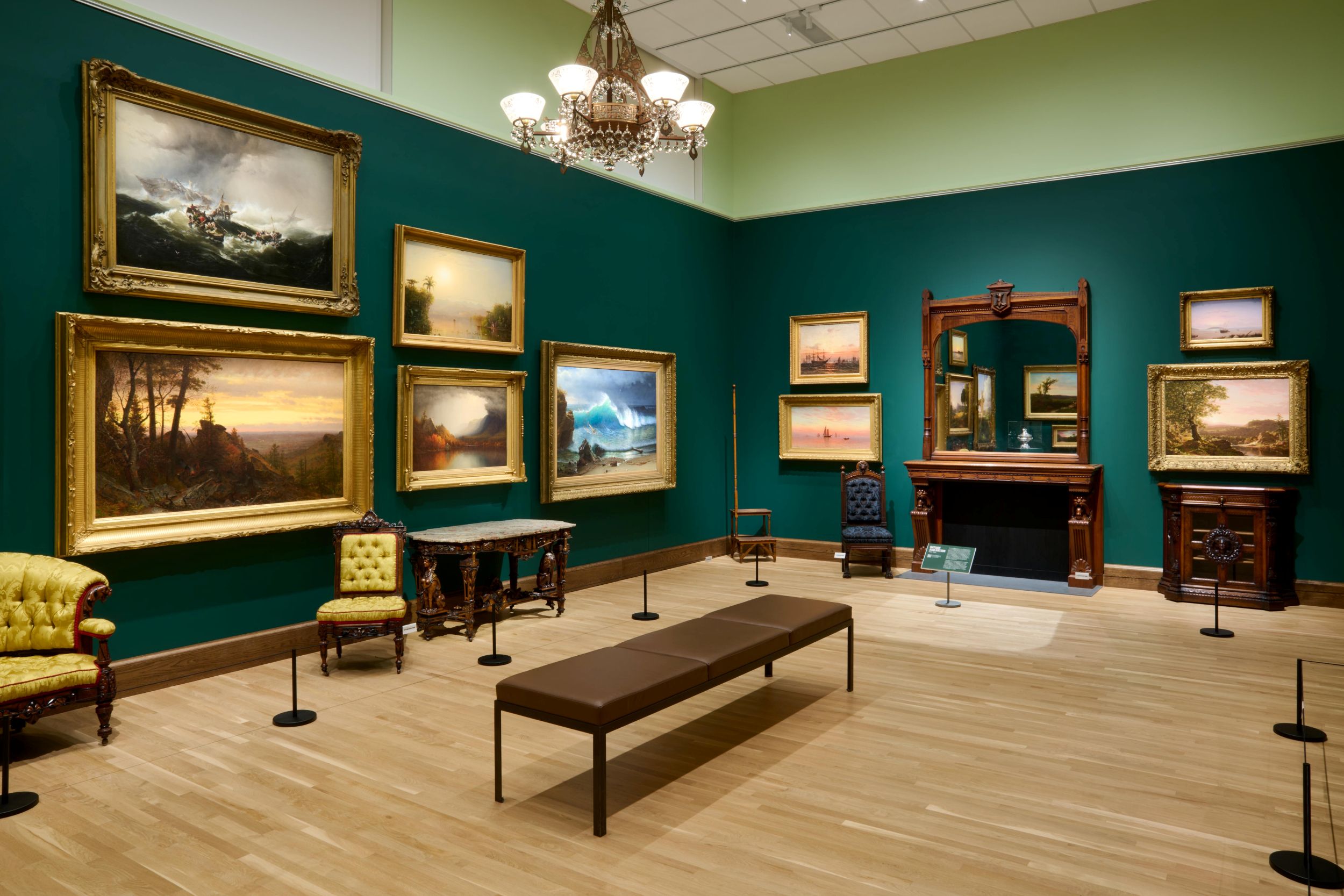
To imagine this painting, along with the Middletons’ other masterworks, in a private home provides an additional layer of context to the exhibitions’ previously mentioned theme of “Prosperity, Abundance, and Inequity.” Museums, of course, have historically relied on ultra-wealthy donors for both art and financial support (the Middleton Family is listed as the lead funder of A Nation of Artists exhibition). This is especially critical at a moment when several cultural institutions are shuttering in the Philadelphia region. The University of the Arts, which educated generations of artists since 1876, unexpectedly declared bankruptcy and closed in 2024. Philadelphia’s Academy of Natural Sciences, founded in 1812, closed to the public at the end of September this year. Many other museums in the city are operating with a significant deficit.4 Museums need philanthropic support to survive and thrive, but the resulting entanglement of donors, collectors, and museums can be uneasy. The Middleton collection predominantly features the work of white men—with works by Duncanson, Mary Cassatt, and Georgia O’Keeffe as the few exceptions. Fortunately, both the PMA and PAFA made a concerted effort to highlight diverse artists and makers from their own collections to more fully tell the story of “a nation of artists.”
Organizing an overview of two and half centuries of American art in 2026 is a significant undertaking, and the PMA and PAFA have ultimately presented a dynamic and provocative survey across their galleries, which bodes well for the future of creating, studying, and displaying American art in Philadelphia. As the Nation of Artists guidebook declares, “Artists working in the United States have emerged from an array of cultural backgrounds, experiences, races, genders, and pathways,” and both museums have made great strides toward inclusivity in their galleries (72). While there is more that museums, including the PMA and PAFA, can do to be equitable, A Nation of Artists effectively celebrates the diverse legacy of art making in the United States through its inclusion of multiple voices, perspectives, and interpretive frameworks.
Cite this article: Laura Turner Igoe, review of A Nation of Artists: 250 Years of Creativity, Philadelphia Museum of Art and Pennsylvania Academy of the Fine Arts, Panorama: Journal of the Association of Historians of American Art 12, no. 2 (Fall 2026), https://doi.org/10.24926/24716839.21530.
Notes
- Jori Finkel, “Their Ancestor Was an Enslaved Potter: They Are Battling to Recover His Legacy,” New York Times, March 25, 2026, https://www.nytimes.com/2026/03/25/arts/design/dave-the-potter-family-legacy.html. ↵
- I am using Dave the Potter instead of David Drake, as the family prefers not to use the name of Dave’s first enslaver. Elizabeth Wellington, “The Philadelphia Museum of Art Owns Work by an Enslaved Potter. His Family Wants It Back,” Philadelphia Inquirer, October 10, 2026, https://www.inquirer.com/arts/dave-potter-philadelphia-museum-of-art-20261010.html. ↵
- Patricia Leigh Brown, “The Phillies Owner and His Wife Collect Art’s Heavy Hitters,” New York Times, April 16, 2026, https://www.nytimes.com/2026/04/16/arts/design/the-phillies-owners-other-superstars.html. ↵
- Peter Dobrin, “The Philadelphia Museum of Art Is Running Record Deficits. The Next Few Years Look Rocky,” Philadelphia Inquirer, July 26, 2026, https://www.inquirer.com/arts/philadelphia-museum-of-art-finances-deficits-20260726.html. ↵
About the Author(s): Laura Turner Igoe is the Gerry and Marguerite Lenfest Chief Curator at the Michener Art Museum, Doylestown, PA.