

Museum Studies Pedagogy as Noncompliance in an Era of Federal Censorship





PDF: Coren, Museum Studies Pedagogy as Noncompliance
For academic and cultural institutions, the 2026 United States’ semiquincentennial in 2026 arrives with mixed expectations after a year of disruption and peril. The National Endowment for the Humanities calls for projects celebrating the “exceptional achievements of the United States,”1 and congressional budget battles threaten the very existence of identity-based museums and programming. Against this backdrop, what does it mean to teach museum studies? How do we prepare emerging museum professionals to enter a field where institutional survival increasingly depends on historical amnesia?
In my spring 2025 museum studies seminar, “Museums as Learning Institutions,” students encountered these contradictions head-on. We started the semester examining the Heritage Foundation’s call for museums to “reclaim their civic duty”2 alongside the Wall Street Journal’s article regarding the then–national archivist Colleen Shogan’s directive to remove references to Indigenous displacement and Japanese internment from public exhibits.3 We studied the 2010 Hide/Seek exhibition controversy in which a video by artist David Wojnarowicz was removed from the National Portrait Gallery as historical precedent, and then watched it play out again as politicians threaten the nascent National Museum of the American Latino for telling stories deemed too “divisive.” The pattern has revealed itself: Any narrative complicating American exceptionalism is suspect; any institution centering the experiences of historically underrecognized groups is a target.
But here is the tension: My classroom is not the museum. While institutions bend to political pressure, terrified of losing funding or facing congressional inquiry, pedagogical spaces offer something institutions increasingly cannot—the freedom to name what is happening. Students arrived at my class angry and grief-stricken, watching the field they are preparing to enter capitulate in real time. My role is not to offer false comfort but to channel that fury into analysis and strategy. We learned to recognize the architecture of censorship: the euphemistic language (“balanced perspectives,” “celebrating unity”), the strategic removals, the manufactured controversies. We studied how museums have historically served nationalism and then asked: How might we resist it? The pedagogy itself becomes resistance.
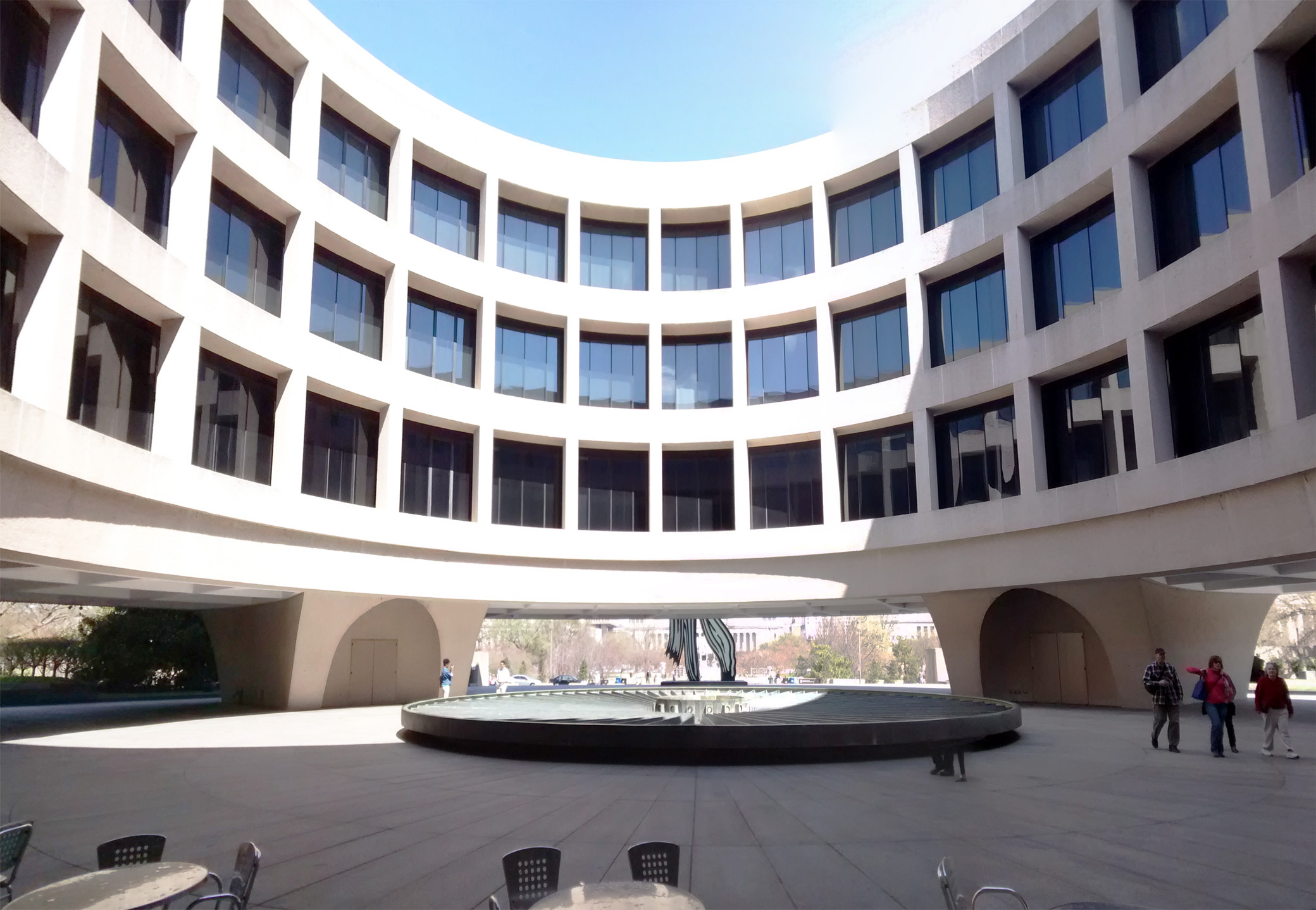
When we read texts like Alexandra Letvin’s “How Can Museum Labels Be Antiracist?”4 students do not just read theory, but they also learn that ethical storytelling is still possible under political siege, and they practice how to maintain intellectual integrity while navigating institutional climates that demand extreme caution. At the Smithsonian Asian Pacific American Center’s exhibition Sightlines: Chinatown and Beyond, we examined what it means to build a temporary space for local communities whose histories are often absent from national conversations. Our three site visits, which also included the Hirshhorn Museum (fig. 1) and the People’s House: A White House Experience, became lessons in survival, investigating which institutions found pathways to truth telling, which chose safety, and what their choice cost.
The US Semiquincentennial may produce programming and exhibitions that will disappoint those with a firm grasp on the wider picture of censure. But in museum studies classrooms, we can teach about a different anniversary: 250 years of questions. Who gained independence? At whose expense? Sustained through whose erasure? We can teach students to ask: What gets remembered when exceptionalism becomes mandatory? What possibilities can still emerge when we reject the sanitized script?
This is not pessimism but realism forged through care. Care means refusing to lie to students about the field they are entering. It means teaching them to recognize institutional paralysis without becoming cynical, to maintain ethical commitments in hostile contexts, to build coalitions that transcend individual institutions. It means acknowledging that museums have survived censorship before but have never emerged unchanged—and never without their workers willing to risk something. If we train students only in institutional compliance, who will continue the great work done by museum workers of the past and present? The classroom becomes the space where we model what museums could be: sites of genuine inquiry, uncomfortable truths, and institutions of principled resistance to nationalist mythology. Teaching museum studies in 2026 means teaching that scholarship itself is unflinching and committed to plurality. The United States’ semiquincentennial will test whether American museums can tell complex truths about American history. Our pedagogical responsibility is ensuring that the next generation knows that failure is a choice and that other choices remain possible.
Cite this article: Ashleigh Dior Coren, “Museum Studies Pedagogy as Noncompliance in an Era of Federal Censorship,” in “Call and Response: DEIA Tensions in Scholarship, Practice, and National Identity,” Colloquium, edited by Keidra Daniels Navaroli and Frederica Simmons, Panorama: Journal of the Association of Historians of American Art 12, no. 1 (Spring 2026), https://doi.org/10.24926/24716839.20925.
Notes
- “Celebrate America! Chairman’s Grants in Honor of America’s 250th Anniversary,” National Endowment for the Humanities, accessed February 7, 2026, https://www.neh.gov/program/celebrate-america. ↵
- Brenda Hafera, “Reclaiming Museums’ Civic Duty,” Heritage Foundation, June 29, 2023, https://www.heritage.org/american-history/commentary/reclaiming-museums-civic-duty. ↵
- Andrew Restuccia and Rebecca Ballhaus, “America’s Top Archivist Puts a Rosy Spin on U.S. History—Pruning the Thorny Parts,” Wall Street Journal, October 29, 2024, https://www.wsj.com/politics/policy/national-archives-history-colleen-shogan-f8512bc3. ↵
- Alexandra Letvin, “How Can Museum Labels Be Antiracist?” Allen Memorial Art Museum, Oberlin College, accessed February 7, 2026, https://amam.oberlin.edu/exhibitions-events/exhibitions/current/2020/09/09/how-can-museum-labels-be-antiracist. ↵
About the Author(s): Ashleigh Dior Coren is an independent curator and Professorial Lecturer at the Corcoran School of the Arts & Design at George Washington University.