

With Unvarnished Eyes: Indexing Radical Pedagogy in Stephanie Syjuco’s Present Tense (Roll Call) at BAMPFA





PDF: Villar Miranda, With Unvarnished Eyes
How do we as educators, students, and learners reclaim public space for knowledge increasingly under threat?
—Stephanie Syjuco1
When I was beginning my studies as an undergraduate at the University of California, Berkeley, I nearly left campus, convinced I would never return. I had entered intending to study medicine and instead found myself in cavernous lecture halls, one student among thousands, systematically weeded out by pre-med requirements. I felt acutely what bell hooks resists in Teaching to Transgress: a “rote, assembly-line approach to learning.”2 Seeking escape, I wandered into Oakland art crawls, indie music shows in hole-in-the-wall venues, and botched dates that turned into meandering self-revelations. Knowledge began to appear elsewhere, in the kinds of moments Fred Moten and Stefano Harney describe as “talking and walking around with other people, working, dancing, suffering,” what they call an “irreducible convergence of all three, held under the name of speculative practice.”3
Nearly a decade later, returning to Berkeley as a curator at the Berkeley Art Museum and Pacific Film Archive (BAMPFA) felt uncanny. In retrospect, it seems fitting that my final exhibition there would be with Stephanie Syjuco, whose work insists that education is a shared and often unruly practice rather than a solitary project.
In 2024, while working as a curatorial associate at BAMPFA, I collaborated with Syjuco on Present Tense (Roll Call), a 63-foot installation that transformed the museum’s massive Crane Forum, an amphitheater used for public events, into a working-classroom archive (fig. 1). In the work, photocopied excerpts from books, manifestos, and essays contributed by more than thirty educators cascade across the sprawling wall in overlapping layers. Staggered across the wall from end to end, the packets hover just beyond arm’s reach. Their stapled pages flutter in the wake of passing visitors, foregrounding their material presence before their textual content. Neither purely image nor document, they invite reading while resisting direct access.
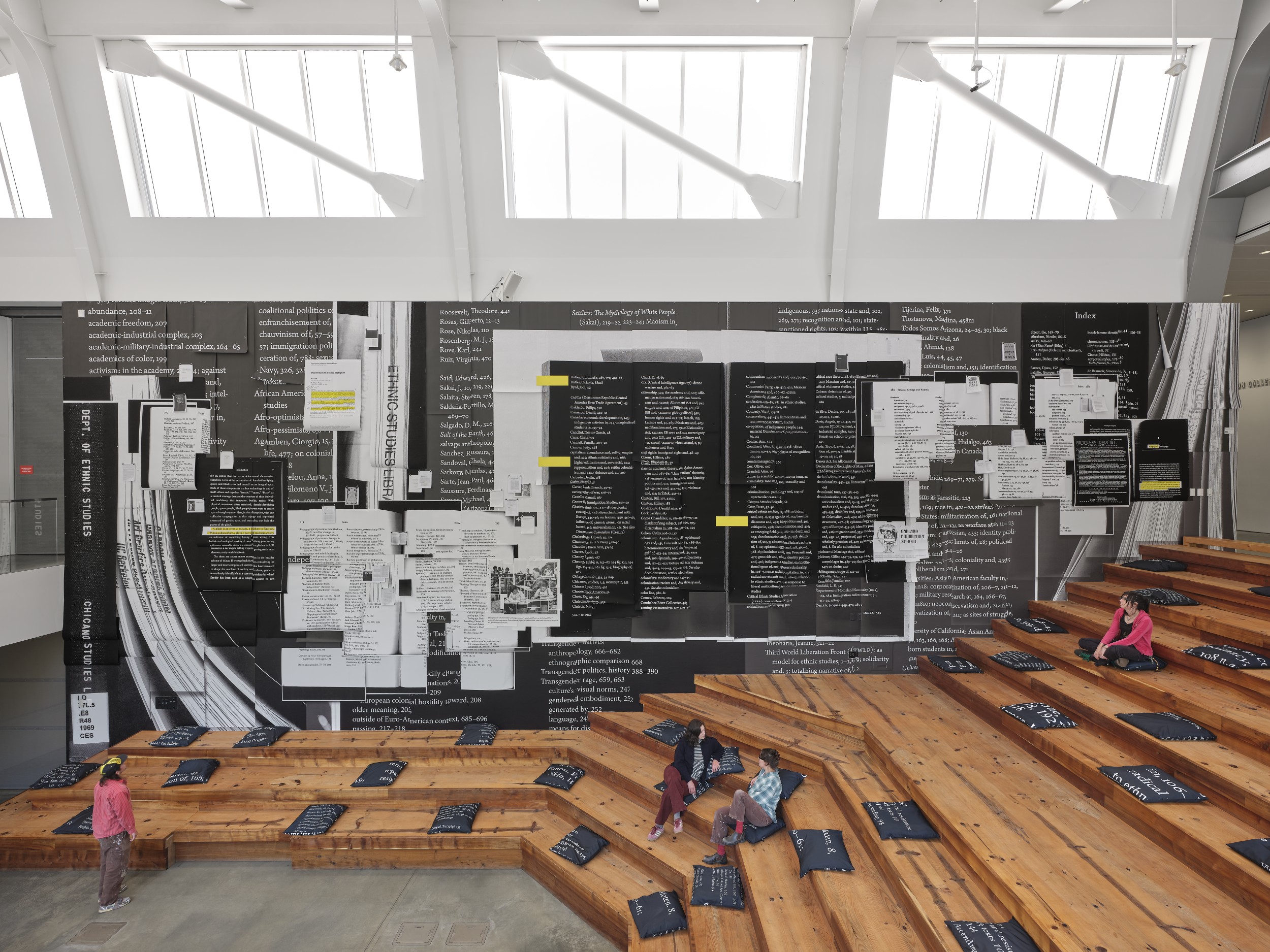
Together, the texts constitute a compendium of strategy, manifesto, and pedagogical reflections that have raised generations of artists and educators. Nayland Blake, Syjuco’s mentor from her days at the recently shuttered San Francisco Art Institute, offers a guide to writing artist statements, flapping beside Young Joon Kwak’s Glitter Mani Festo. Nearby Al-An deSouza’s teaching notes on Achille Mbembe’s “Planetary Entanglement” waft beside enlarged passages from Eve Tuck and K. Wayne Yang’s “Decolonization Is Not Metaphor,” one of the articles I contributed to the project.4 Together, these texts form a collective reader of teaching materials, hundreds of pages that transform private annotations into public declarations of an intellectual lineage.
The title comes from the classroom ritual of attendance. Roll call is bureaucratic and repetitive, yet it also functions as a mechanism of recognition. It determines who is recorded and who is omitted. In conversation with Syjuco, we often returned to what it means to show up for one another when funding disappears and entire fields are cast as suspect. She asked, how do we hold space for knowledge under threat, “ten months [from now] into the future, despite not knowing what art, education, policy, and protest will look like?”5 The project could not have landed with the same resonance anywhere but Berkeley, where histories of ethnic studies and student protest continue to reverberate across campus and its surrounding neighborhoods.
At the highest point of the installation, just beneath the forum’s eaves, enlarged index entries from Critical Ethnic Studies: A Reader appear in white text on black ground: “abundance,” “academic freedom,” “academics of color,” and “academic-military-industrial complex.” Their adjacency produces uneasy friction between aspirational and oppositional terms, educational hopes met with structural realities. The index—typically a neutral navigational tool—becomes a deliberate structuring of antithetical ideas. The graphic inversion reverses the page’s visual hierarchy and turns an apparatus of reference into a site of confrontation. Claire Bishop, building on Ernesto Laclau and Chantal Mouffe’s ideas of antagonism, writes that “a democratic society is one in which relations of conflict are sustained, not erased.”6 The index thus operates as a para-archival gesture. It registers language at the moment it risks erasure, exposing contradictions within interlocking systems of power.
That risk is not hypothetical. Recent reports from PEN America document hundreds of terms flagged or removed from federal documents and public sites, including references to Harriet Tubman and the Underground Railroad.7 At the same time, universities across the country have begun dismantling or defunding diversity initiatives.8 Museums such as BAMPFA have also faced a “war on woke” and federal funding cuts to the National Endowment for the Arts (NEA) and Institute of Museum and Library Services (IMLS), resulting in nearly a quarter of a million dollars of loss to exhibitions like Routed West: Twentieth-Century African American Quilts in California, curated by Elaine Yau, whom I assisted while there.9 In this context, Syjuco’s index reads as a defense of pedagogy unraveling in real time.
Two historical anchors from Berkeley’s own past bracket the installation. One end features an oversized spine labeled “Dept. of Ethnic Studies.”. The other reproduces a 1969 progress report from the Third World Liberation Front demanding a Third World College at UC Berkeley (fig. 2). Ethnic studies, Syjuco reminds us, arose from the largest student strike in US history: “Like the Free Speech Movement that was born at UC Berkeley in 1964, students had to protest and force the university to listen to them. This is a reminder that this change, even in incomplete forms, was hard-won and involved arrests, mass demonstrations, and targeted efforts—against the university.”10 Half a century later, though the college was never formed, the document is a testament to the generative dissent and reorienting power of student activism.
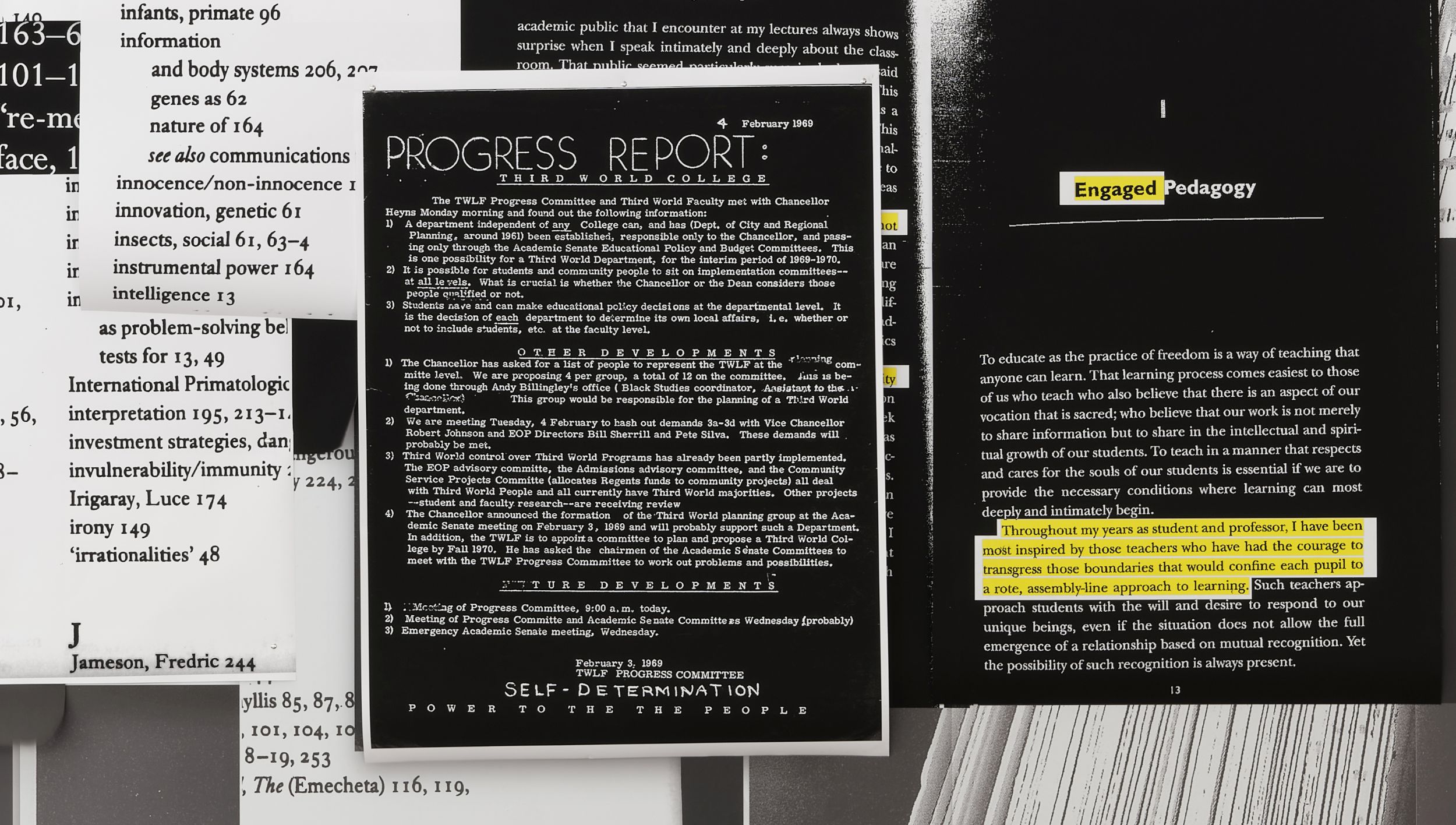
Clusters of terms across the wall expose those contradictions: “multiculturalism,” “ethnic studies association,” “Department of Homeland Security,” and “immigration enforcement” placed alongside “Third World Liberation Front” and “solidarity,” nearly aligned with an electrical outlet. The placement may be incidental, but it strikingly literalizes the people–power ethos of activist movements. Universities often champion diversity rhetorically while failing to protect the students and faculty they have recruited from doxxing campaigns or immigration raids.11 The wall stages these tensions materially. Institutions appear as infrastructures that transmit both care and discipline, support and control.
Syjuco’s strategies of unalignment and distortion visualize this dynamic. Books buckle under their own weight. Fanned-out pages segment edge-printed stamps. Words stutter across seams. One highlighted passage from Legacy Russell reads, “A glitch is an error, a mistake, a failure to function.” I was reminded of artist Ashley Hunt’s question, posed while organizing Undoing Time: Art and Histories of Incarceration: “What does it look like when systems break down in attempts to contain the totality of information?”12 Syjuco answers visually. The installation piles up texts until the illusion of total knowledge begins to falter. What at first appears as flat begins to protrude and jut, demanding depth and excess. Some fragments are sharpened while others dissolve into partial legibility, exposing the unstable processes through which knowledge is preserved and contested.
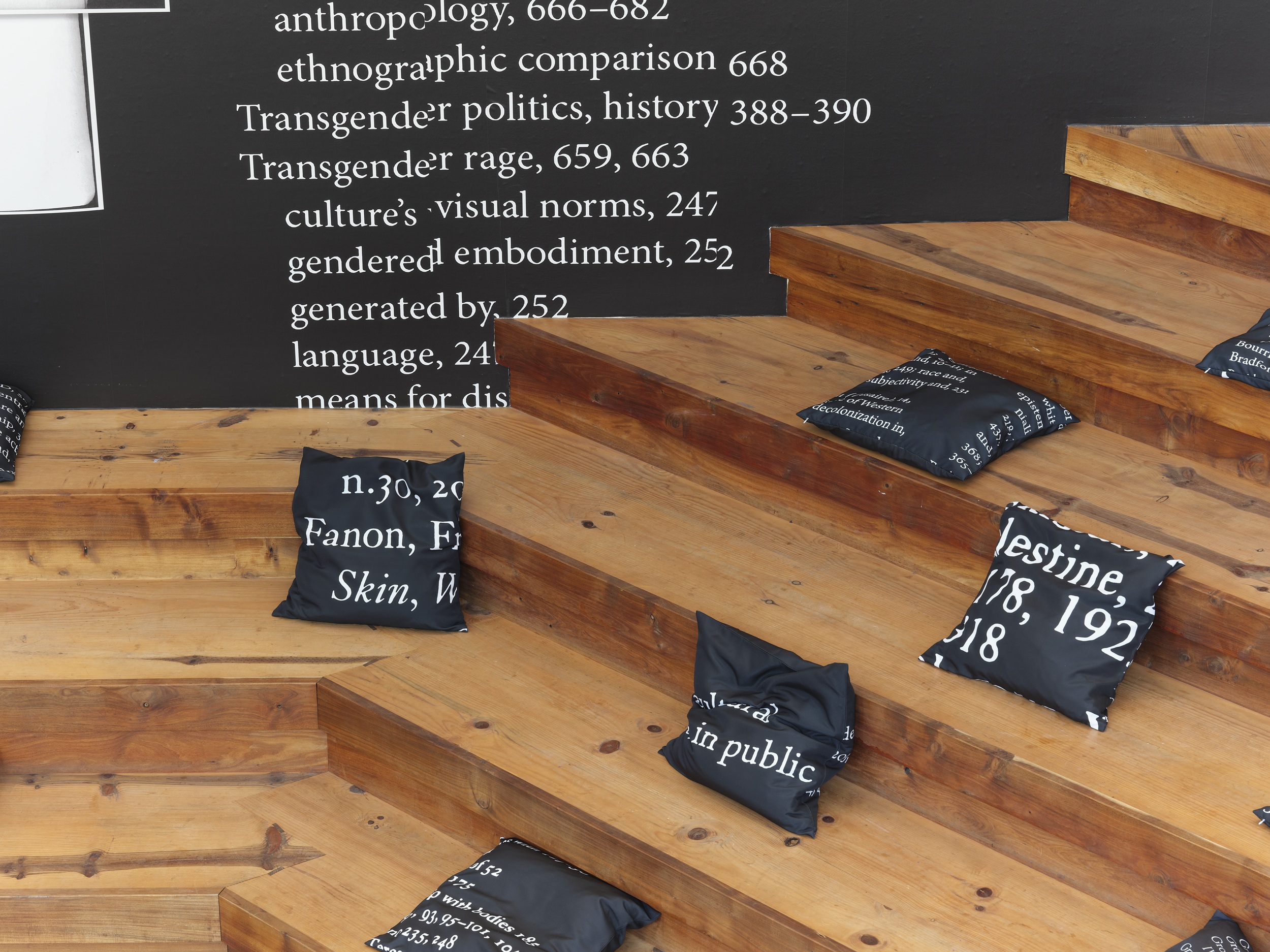
A distinct haptic register runs through the installation. Large printed pillows slouch near the words “Transgender Rage” from the Critical Transgender Studies Reader. Visitors lean into them, resting against theory. Here, Frantz Fanon’s reflections on racialized embodiment take on literal form: the word “Skin,” from Black Skin, White Masks, becomes both a physical and cerebral encounter (fig. 3). The words “gendered embodiment” tumble near excerpts from Judith Butler’s Gender Trouble; the word “intimacy” sags near entries from Edward Said’s Orientalism. They no longer simply describe positionality; they enact it, pressing viewers into contact with broader bodies of knowledge. Touch returns the reader to earlier forms of intuitive learning.
Two figurative images interrupt the sea of text. One is the logo of the Black Panther Party’s Oakland Community School, which declared, “The World Is Our Classroom” (fig. 4). Founded in 1973, the school pioneered a holistic model of education that combined free meals with social services and health care. This approach nurtured both body and mind and later informed the development of full-service community schools across California.13 Within Syjuco’s installation, the image reflects how some of the most transformative pedagogical experiments emerged from the ingenuity of grassroots organizing.
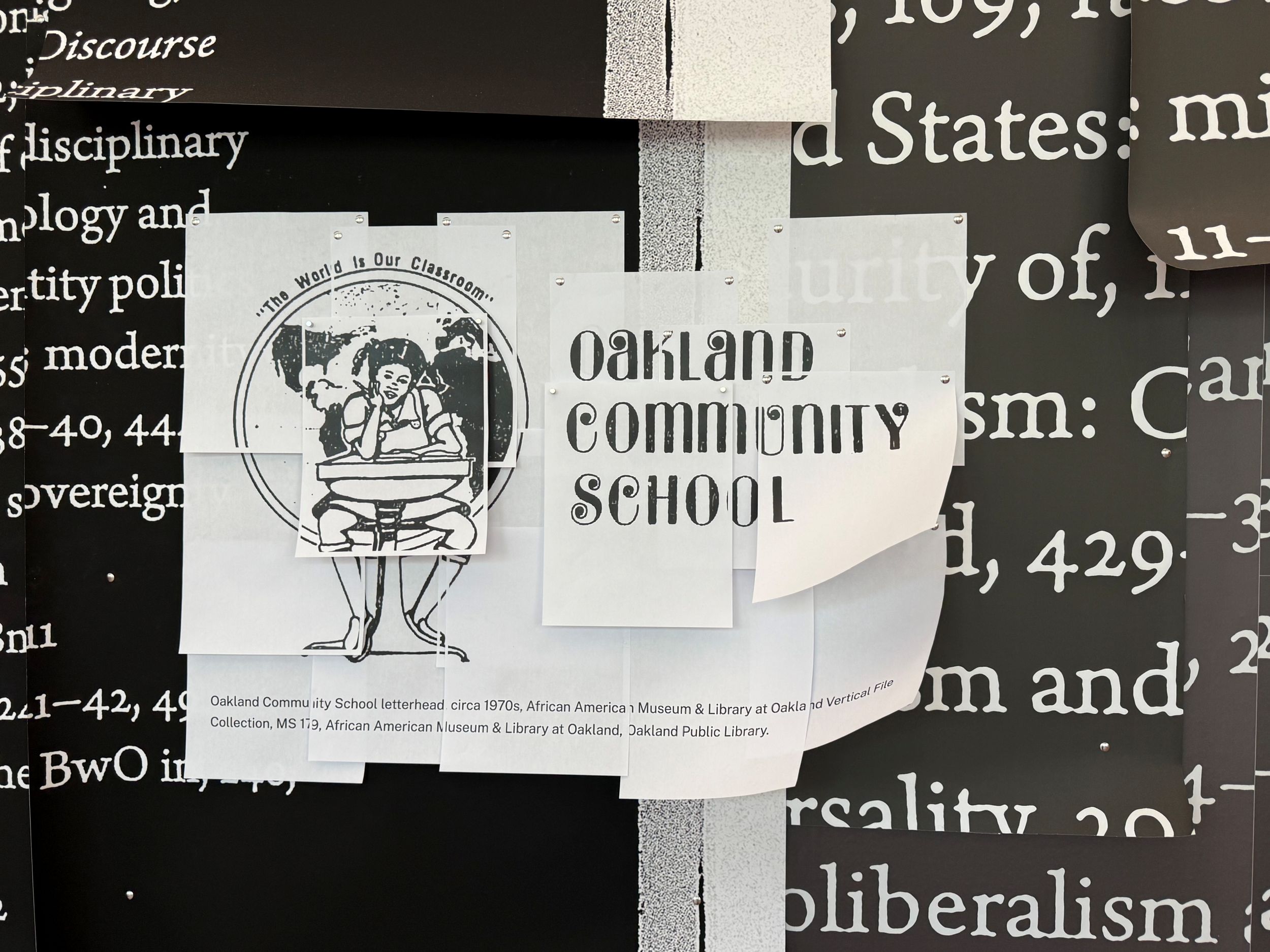
Writing about the Panthers’ educational vision, Fred Moten and Stefano Harney describe the “surrounds” of study as a form of collective life grounded in obligation rather than correction, urging that “we owe each other everything.”14 Their formulation resonates with the Philippine concept of utang na loob, translated as a “debt of inner self,” an ethical sense of duty that binds people through reciprocal care and responsibility.15 Read together, these ideas suggest that pedagogy relies on mutual interdependence.
The second image forms a portrait of the Japanese American painter and teacher Chiura Obata, pieced together from photocopied pages (fig. 5). Obata continued teaching while incarcerated at the Tanforan and Topaz detention centers during World War II, relying on the generosity of former Bay Area students who sent art supplies for his classes in the camps.16 During the exhibition’s opening, Syjuco met Obata’s granddaughter Kimi Kodani Hill. She brought Fred Shinoda, now ninety-two years old, who had appeared as a child in the foreground of a historic photograph of Obata teaching at the Tanforan camp art school. As Hill recounted, Fred was eight years old when his family was forcibly removed from their home and detained behind barbed wire in the sunscorched Utah desert.17 Seeing himself again on the wall decades later, Shinoda encountered his own image, once buried within the shadow of a carceral archive and now reassembled before him.
![Detail of text wall in fig. 1, with a photograph in the center of young Asian boys in a school setting. The caption reads: "Photograph of Chiura Obata teaching at a children's art class at Tanfcaran[?] Art School, 1942 / unidentified photographer. Chiura Obata papers, circa 1891–2000, 1942–1945, Archives of American Art, Smithsonian Institution](https://journalpanorama.org/wp-content/uploads/2026/06/word-image-20915-5.jpeg)
As the United States approaches its semiquincentennial, and as museums face renewed pressure to celebrate unity and exceptionalism, Present Tense (Roll Call) offers another path. Amid ongoing book bans and defunding in education, Syjuco insists on the enduring value of collective knowledge and radical pedagogy. Berkeley’s motto is Fiat Lux, “Let there be light.” Syjuco’s thirteen years of teaching help us see, with “unvarnished eyes,” that light is never singular.22 It appears instead as a shared incandescence, refracted through teachers, students, artists, and organizers whose relations extend beyond the institutions meant to dim them.
Cite this article: Matthew Villar Miranda, “With Unvarnished Eyes: Indexing Radical Pedagogy in Stephanie Syjuco’s Present Tense (Roll Call) at BAMPFA,” in “Call and Response: DEIA Tensions in Scholarship, Practice, and National Identity,” Colloquium, edited by Keidra Daniels Navaroli and Frederica Simmons, Panorama: Journal of the Association of Historians of American Art 12, no. 1 (Spring 2026), https://doi.org/10.24926/24716839.20915.
Notes
- Quoted in the exhibition text for Art Wall / Stephanie Syjuco: Present Tense Roll Call, August 13, 2025–June 28, 2026, written by the author and commissioned by the Berkeley Art Museum and Pacific Film Archive. ↵
- bell hooks, Teaching to Transgress: Education as the Practice of Freedom (Routledge, 1994), 13. ↵
- Stefano Harney and Fred Moten, The Undercommons: Fugitive Planning & Black Study (Minor Compositions, 2013), 110. ↵
- Syjuco compiled an anthology titled The Reader, Volume 1, featuring thirty-six texts from educators and artist-educators who discussed ideas significant to their teaching and practice. Titles of works appearing as elements within the installation are cited in the main text without full bibliographic references; full citations are provided when works are quoted or discussed analytically. ↵
- Stephanie Syjuco (@ssyjuco), Instagram, July 15, 2025, https://www.instagram.com/p/DMJ7QglRfbG/?img_index=1. ↵
- Claire Bishop, “Antagonism and Relational Aesthetics,” October 110 (October 2004): 66, https://doi.org/10.1162/0162287042379810. ↵
- Jon Swaine and Jeremy B. Merrill, “Amid Anti-DEI Push, National Park Service Rewrites History of Underground Railroad,” Washington Post, April 6, 2025, https://www.washingtonpost.com/investigations/2025/04/06/national-park-service-underground-railroad-history-slavery. ↵
- Nicholas Confessore, “University of Michigan to Scuttle Its Flagship D.E.I. Program,” Education, New York Times, March 27, 2025, https://www.nytimes.com/2025/03/27/education/university-of-michigan-dei.html. ↵
- Karina Ioffee, “BAMPFA Loses Federal Grant to Conserve Its Prized African American Quilt Collection,” Berkeleyside, April 28, 2025, https://www.berkeleyside.org/2025/04/28/bampfa-african-american-quilt-collection-institute-of-museum-and-library-services. ↵
- Stephanie Syjuco (@ssyjuco), Instagram, July 27, 2025, https://www.instagram.com/p/DMoW1GDSwaa/?img_index=1. ↵
- Sam Levin, “UC Berkeley Shares 160 Names with Trump Administration in ‘McCarthy Era’ Move,” US News, The Guardian, September 12, 2025, https://www.theguardian.com/us-news/2025/sep/12/uc-berkeley-trump-administration-antisemitism. ↵
- Author’s notes from organizing the exhibition Undoing Time: Art and Histories of Incarceration at Arizona State University Art Museum, September 10, 2021–February 12, 2022. ↵
- Ida Mojadad, “Black Panthers Ran a First-of-its-Kind Oakland School. Now it’s a Beacon for Schools in California,” San Francisco Standard, August 7, 2023, https://sfstandard.com/2023/08/07/oaklands-pioneering-educational-model-has-black-panthers-to-thank. ↵
- Harney and Moten, Undercommons, 20. ↵
- Virgilio G. Enriquez, From Colonial to Liberation Psychology: The Philippine Experience (University of the Philippines Press, 2008), 83–84. ↵
- Chiura Obata, “Statement on Forced Relocation and Activities (Incomplete),” Chiura Obata Papers, 1891–2000 (bulk 1942–1945), series 3, box 1, folder 91, Archives of American Art, Smithsonian Institution, Washington, DC, https://www.aaa.si.edu/collections/chiura-obata-papers-17607/series-3/box-1-folder-91. ↵
- Stephanie Syjuco (@ssyjuco), Instagram, September 7, 2025, https://www.instagram.com/p /DMoW1GDSwaa/?img_index=1. ↵
- Amy Sadao and Susette Min, “Abolition of a Category”, Brooklyn Rail, July 30, 2024, https://brooklynrail.org/2022/07/criticspage/Abolition-of-a-Category. ↵
- Author’s notes from the “Abolish the Category” convening, November 9–12, 2023, Jan Shrem and Maria Manetti Shrem Museum of Art; emphases added. ↵
- Chiura Obata and Kimi Kodani Hill, Chiura Obata’s Topaz Moon: Art of the Internment Camps (Heyday, 2000), 100. ↵
- Chiura Obata Papers, 1891–2000 (bulk 1942–1945), series 3, box 1, folder 87, Archives of American Art, Smithsonian Institution, Washington, DC, https://www.aaa.si.edu/collections/chiura-obata-papers-17607/series-3/box-1-folder-87. ↵
- Stephanie Syjuco (@ssyjuco), Instagram, September 7, 2025, https://www.instagram.com/p/DMoW1GDSwaa/?img_index=1. ↵
About the Author(s): Matthew Villar Miranda is a PhD student in the department of Art and Art History at Stanford University and a former Curatorial Associate at the Berkeley Art Museum and Pacific Film Archive.