

Reimagining American Art at the Worcester Art Museum in Massachusetts





PDF: Sherry, Reimagining American Art
In the reinstalled galleries of American art before 1900 at the Worcester Art Museum (WAM) in Massachusetts, visitors encounter a bronze relief sculpted by Randolph Rogers around 1855 depicting Christopher Columbus leaving the monastery where he awaited funding for his initial voyage across the Atlantic. A cast of one of the eight panels Rogers made for bronze doors at the US Capitol, this work glorifies Columbus as the “discoverer” of America and the embodiment of an intrepid American spirit, in part through allusions to the iconography of Jesus Christ’s Entry to Jerusalem.
Rogers’s sculpture had been languishing in storage for decades. Putting it on view now might seem ironic (or worse) in light of the fairly recent removal of many Columbus monuments across the United States. Yet, the opportunity to address the explorer’s shifting reputation and complex legacy—to tackle the nation’s difficult history—is precisely why we included this work in the reimagined galleries, which opened in April 2026.
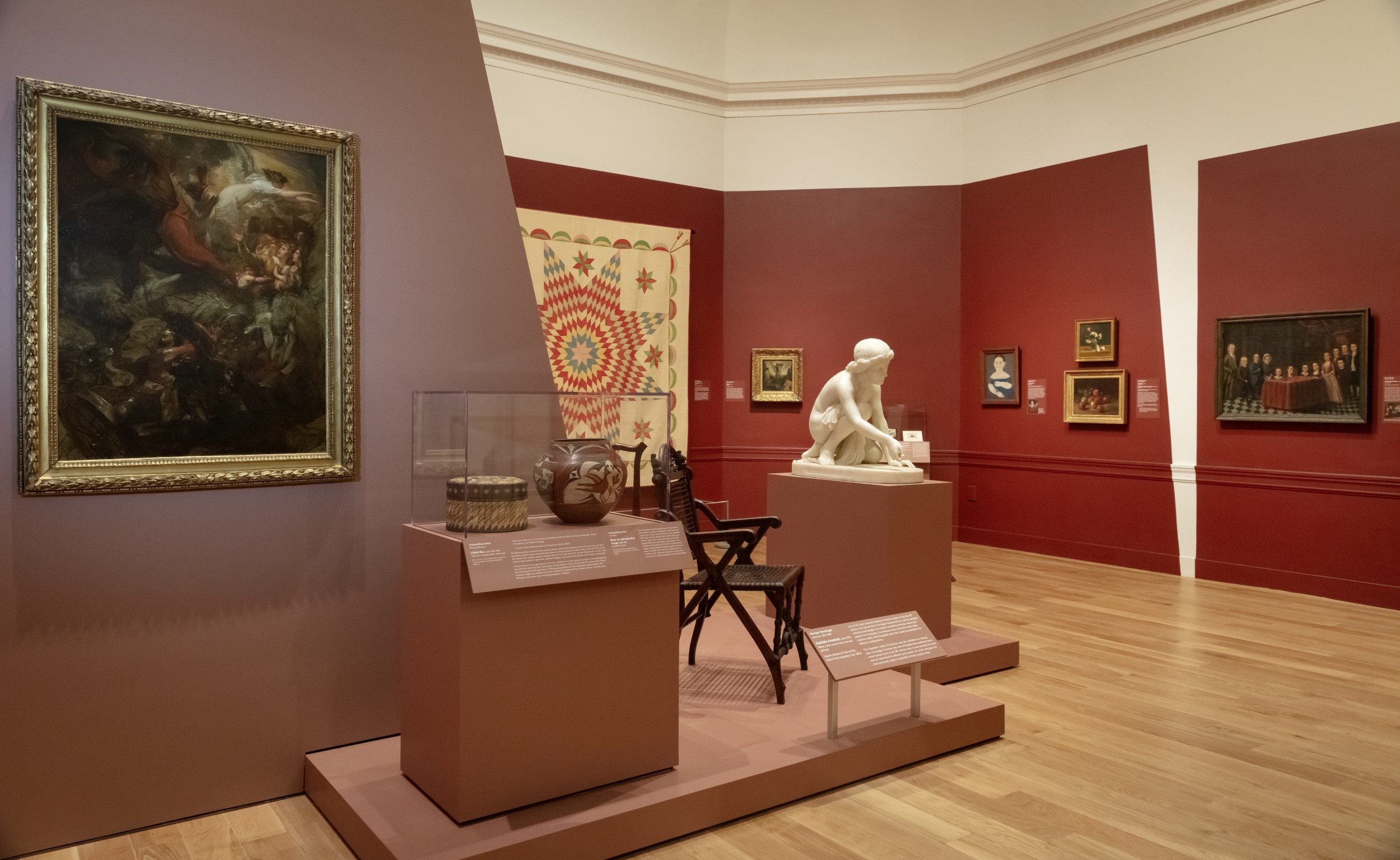
American art, 2026. Photo: Worcester Art Museum
Planned in conjunction with infrastructural improvements, WAM’s reinstallation provides a fresh and critically engaging approach to its American collection (fig. 1). In stark contrast to the previous iteration (a decades-old display featuring primarily paintings arranged chronologically), the new galleries integrate art of many different media and organize works thematically. The introductory section, with the Columbus relief, defines the parameters of “American art” for this installation—art produced in what became the United States—and outlines art’s role in constructing national mythologies. The other thematic sections in the galleries explore nature, regional expression, global connections, constructing identities, and artistic practice.
A key goal of this reinstallation is to showcase more diversity in the artists, stories, and types of objects on view. This was particularly challenging given the contours of WAM’s collection, which is best known for its holdings of early American portraiture (including the iconic portraits of the Freakes and Thomas Smith), silverwork by Paul Revere, and American impressionist paintings. Limited resources for acquisitions and loans make it difficult to fill collection gaps. Whenever possible, we mined the collection for works by historically underrepresented artists, such as the female miniaturist Eliza Goodridge and the Black engraver Patrick Reason. Another way we diversified the exhibition is by acknowledging the unnamed apprentices and enslaved people who helped produce some of the works, such as the silver spout cup from John Edwards’s Boston workshop.
These are “no tech” galleries that use the traditional format of wall panels and object labels. Yet, the interpretive dialogue prompts audiences to consider the art in new and more nuanced ways. Gallery texts address the institutional biases and structural inequalities that shaped not only WAM’s collection but also American art history in general. For instance, in the section about artistic practice, the labels for a biblical painting by Benjamin West, who became president of London’s Royal Academy and history painter to King George III, and a still life by Charles Ethan Porter, the first Black artist admitted to the National Academy of Design, discuss access to training opportunities and the academy’s influence on artistic hierarchies and museum collections. Texts also explore hidden histories, such as the erasure of Indigenous people in an Albert Bierstadt landscape and the ecological impact of a mahogany chest made in Rhode Island.
WAM’s reinstallation of the galleries of American art before 1900 seeks to foster deeper audience engagement with this collection. The thematic organization prompts critical comparisons among works of art, while the interpretation presented in gallery texts delves into complex stories about the objects. Overall, these galleries present a richly layered vision of American art—one that is provocative, enjoyable, educational, and relevant for today.
Cite this article: Karen Sherry, “Reimagining American Art at the Worcester Art Museum in Massachusetts,” in “In the Galleries,” edited by Elizabeth McGoey and Sara Picard, Panorama: Journal of the Association of Historians of American Art 12, no. 1 (Spring 2026), https://doi.org/10.24926/24716839.21058.
About the Author(s): Dr. Karen Sherry is the curator of American art at the Worcester Art Museum in Massachusetts.