

Where Creativity Meets Wonder





PDF: Slinkard, Where Creativity Meets Wonder
This past March, the Peabody Essex Museum (PEM) in Salem, MA, opened an installation in East India Marine Hall, celebrating the two hundredth anniversary of the museum’s original building and exhibition space (fig. 1). Reexamining the museum’s origin story through more than four hundred objects collected during the global voyages of the East India Marine Society, PEM’s founding institution, the gallery invites visitors to reflect on the history that shaped the museum as well as that of the broader identity of the early United States.
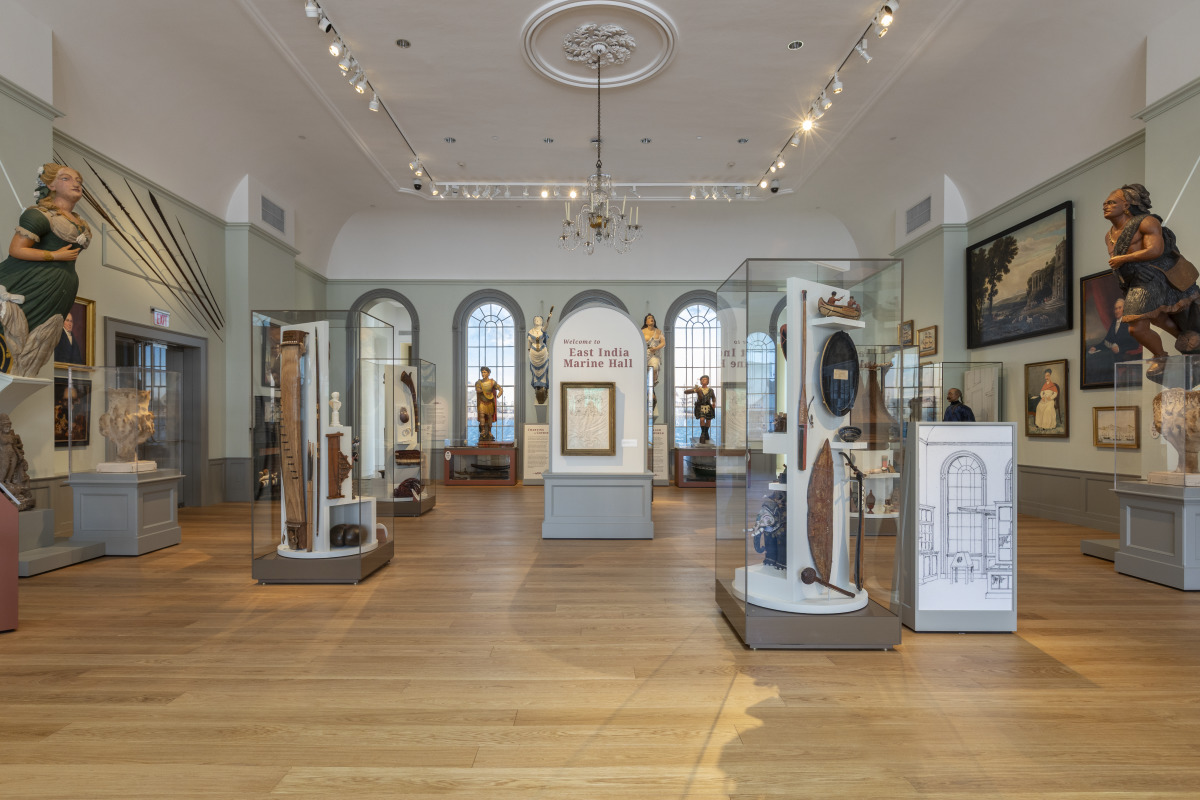
This installation gives voice to early collectors, trading partners, and museum visitors who have discussed these objects—with some accounts extracted from records in the museum’s vast archive. “Over the last two hundred years, East India Marine Hall has been visited by people from all walks of life in the United States and across the globe—from American presidents to foreign travelers to the farmer in the town next door,” said Dan Finamore, PEM’s deputy chief curator and the Russell W. Knight Curator of Maritime Art and History. These captivating stories and works that reflect local and global history, as well as the impact of maritime trade, reposition East India Marine Hall as the center of the museum. From its inception, this space and the objects in it have elicited empathy, curiosity, and wonder, transporting their viewers to places around the world.
Built in 1824/25 by the society, East India Marine Hall was designed by architect Thomas Waldron Sumner in the Greek Revival style. The hall is distinguished by its tall arched windows and the nineteenth-century ship figureheads that line its walls. It was built using local Cape Ann granite and served as the society’s exhibition hall, as well as the site for long and lavish dinners where members toasted their adventures and shared their stories of ocean voyages beyond the Cape of Good Hope and Cape Horn.
“The hall’s new installation aims to revive the experience of a nineteenth-century museumgoer who declared ‘to walk around this room was to circumnavigate the globe,’” notes curator-at-large George Schwartz. He continues, “Visitors will encounter artistic and cultural achievements that stitch connections across time and space while providing a global perspective on what, over the centuries, has made Salem such a distinctive city.”
Answering the East India Marine Society’s founding call “to form a museum of natural and artificial curiosities,” its members collected flora and fauna, including ostrich eggs, the lower jaw of a very large sperm whale, and a taxidermied King penguin, as well as many expressions of cultural identity from around the world. These works of art include spears from Fiji, ship models from China, a Māori nose flute, ceremonial kava bowls, and part of the museum’s very first donation: a pipe with two stems that came from the north coast of Sumatra and was gifted by Captain Jonathan Carnes.
Coinciding with the United States’ Semiquincentennial in 2026, PEM’s efforts in East India Marine Hall are part of our ongoing initiative to expand narratives of American art and identity through collection installations that challenge conventional boundaries while addressing our shared complex history. This commitment is evident across multiple galleries in the museum. In American Art: Traditions Transformed, a diverse range of materials are featured—from wood and glass to paint and fiber—in showcased objects whose inspirations have their origins in Europe, Asia, and the Americas. These works tell a larger story of connection and cultural exchange, highlighting compelling narratives of American history and everyday life while presenting the sea as an enduring source of opportunity and peril, inspiring creativity and encouraging engagement with the wider world. This installation provides a range of perspectives, spanning centuries and continents, that demonstrate Salem’s rich history of maritime trade and exploration.
Other galleries turn a different lens on the American experience. A long-term installation, titled On This Ground: Being and Belonging in America, brings together two extraordinary collections of Native American and American art for the first time, spanning ten thousand years of creation. This installation celebrates a diverse range of voices, modes of artistic expression, cultures, and media. Additionally, the installation of Bethany Collins’s work America: A Hymnal (on view through 2027) reinterprets the song “America (My Country, ‘Tis of Thee)” by foregrounding more than one hundred rewritten versions. This powerful artwork uses language to lay bare the continuous, evolving debate over what it means to be American, chronicling dissenting ideas from those advocating revolution and abolition to those supporting the Confederacy and suffrage. Finally, entering its seventh year, PEM’s Fashion and Design gallery continues to explore how fashion and design exist in our lives. A major rotation opening in August 2026 will specifically focus on Salem’s and Essex County’s history in honor of the 2026 Salem 400+ celebration.
Together, these experiences illustrate the Peabody Essex Museum’s dedication to examining and expanding the stories that shape American identity. By embracing an inclusive, interconnected, and human-centered approach in its permanent collection displays, PEM fulfills its mission to share the complex relationship between artistic innovation and identity in North America.
Cite this article: Petra Slinkard, “Where Creativity Meets Wonder,” in “In the Galleries,” edited by Elizabeth McGoey and Sara Picard, Panorama: Journal of the Association of Historians of American Art 12, no. 1 (Spring 2026), https://doi.org/10.24926/24716839.21064.
About the Author(s): Petra Slinkard is the James B. and Mary Lou Hawkes Chief Curator, and Nancy B. Putnam is Curator of Fashion and Textiles, at the Peabody Essex Museum, Salem, MA.