

Hidden in Plain Sight: Concealing Enslavement in American Visual Culture





PDF: Burke, review of Hidden in Plain Sight
Hidden in Plain Sight: Concealing Enslavement in American Visual Culture
by Rachel Stephens
University of Arkansas Press, 2023. 340 pp.; 164 color illus. Hardcover: $60.00 (978-1-68226-233-7)
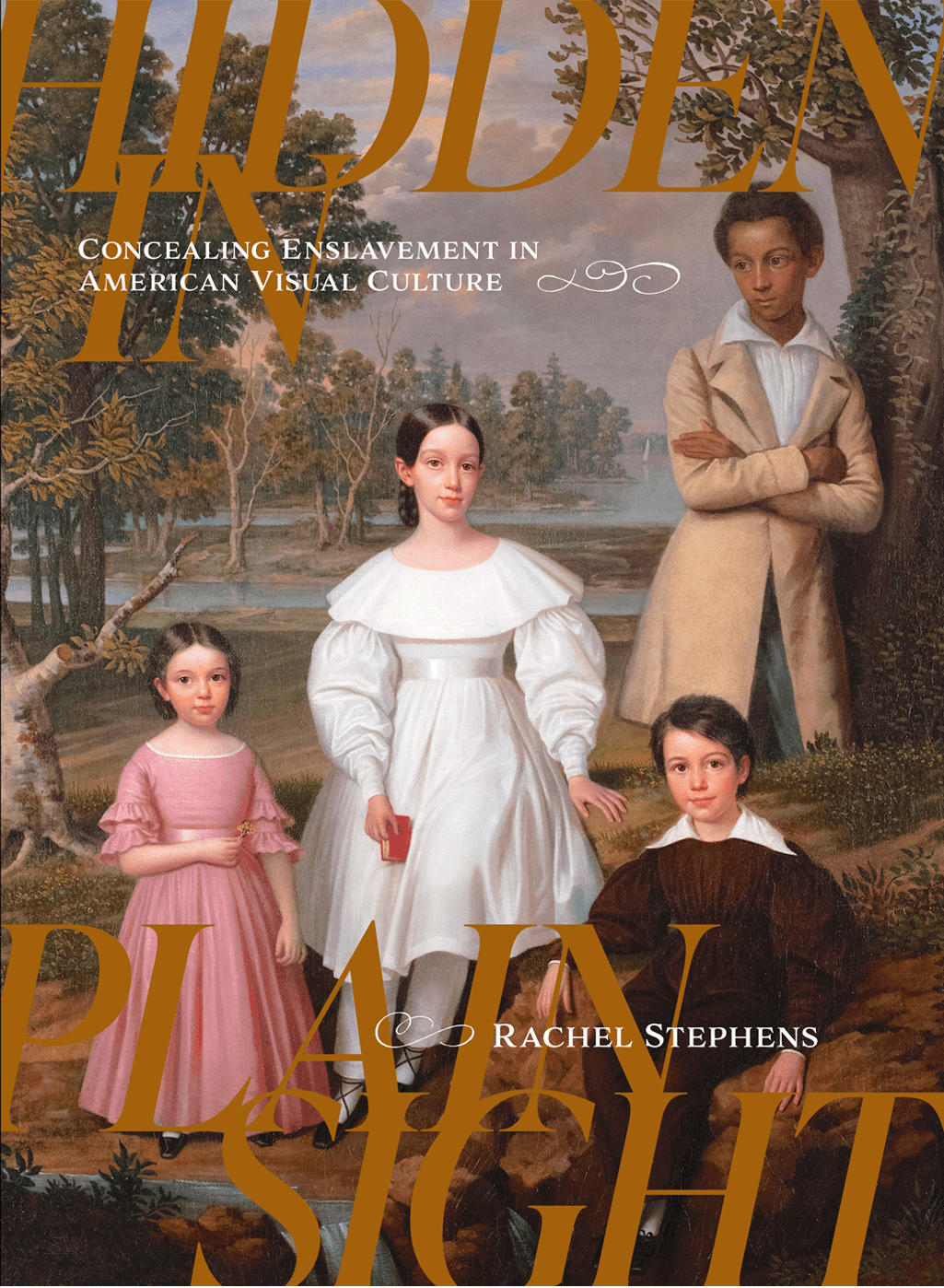 Rachel Stephens’s second book, Hidden in Plain Sight: Concealing Enslavement in American Visual Culture, is an ambitious account that documents the visual record of slavery in the antebellum United States. With more than 160 color illustrations printed over 276 pages, Hidden in Plain Sight examines imagery that was produced across the South “to promote, justify, and deny the violence of the Southern plantation system” (14). Stephens studies ephemera and fine art objects, drawing examples from Louisiana, Kentucky, Mississippi, Maryland, and Virginia to demonstrate how the governing class manipulated all registers of visual media to uphold white supremacy. In her account of what she calls “proslavery art and visual culture,” she argues that Southern artists and patrons promoted idealized representations of enslaved people, erased visual references to institutionalized anti-Black violence, and physically destroyed material that alluded to the inherent cruelty of racialized chattel slavery (38). To address this program of “visual concealment” and assess its impact on historical narratives about the South, Stephens applies the “words of enslavers” to her formal analysis, introducing new archival material to the literature on nineteenth-century American art (3, 15). The result is an expansive tome that successfully establishes antebellum visual culture as the precedent to the romantic “Lost Cause” representations of the South that emerged after the Civil War.
Animating Hidden in Plain Sight, as is the case for all art-historical scholarship on slavery, is the issue of representing violence. All nineteenth-century enslavers and their sympathizers relied on violence to enforce the racialized subjugation and exploitation of enslaved Africans and their descendants, but these perspectives are often omitted in historical records. However, as Stephens establishes, enslavers were also silent on the topic, reluctant to admit their cruelties even in private correspondence. Instead, white enslavers promoted representations of slavery they knew to contradict its violent realities, leaving art historians to grapple with what is absent, what is unseen.
Stephens addresses this dilemma and surfaces hidden proslavery messaging by interpreting the work of Southern artists in comparison to contemporaneous abolitionist media, which was far more likely to delineate slavery’s graphic horrors. She argues that Southern art and visual culture can be understood as a response to antislavery propaganda, offering “falsified” impressions of slavery or “counteroffensive” depictions that demonized Black people and abolitionists (29). Hidden in Plain Sight is an apt title for this iconographic effort, reflecting how visible aspects of Southern culture will yield deeper meaning when read against the nineteenth-century dialectic of abolition and slavery.
The first and third chapters best showcase Stephens’s method, with chapter 1 guiding readers through a “wide ranging and divergent” set of examples—extending from watercolor sketches to midcentury plantation landscape paintings and Confederate banknotes—that paralleled the “multitudinous ways that slavery apologists” defended themselves against abolitionist rhetoric (29). Quoting Kirk Savage, who explains that by the mid-nineteenth century, the “traditional imagery of slavery had already been appropriated by abolitionists,” Stephens recontextualizes Southern artists’ treatment of African and African American figures, tracing how depictions of enslaved people were carefully drawn to avoid evoking antislavery connotations (38). Some creators simply inverted the assumption that enslaved people were victims, casting them instead as inherently villainous. Other images, specifically landscapes of plantations, delivered more subtle responses. At the beginning of the century, landscape painters “tended to ignore enslaved people all together,” but as abolitionism and the corresponding slavery justification movement grew, Stephens argues that artists started incorporating enslaved figures to romanticize and justify the racial caste system on plantations (58). At least a dozen Black figures appear in Charles Giroux’s Cotton Plantation (c. 1850), but they occupy the space with ease, strolling in languid groups under a hazy sunset, in stark contrast to abolitionist characterizations of plantations. Although Giroux’s canvas is one of three examples of plantation landscape paintings, the reader is left to infer the standard audience of this genre and how it relates to the other evidence throughout the chapter—does it matter, for instance, that the visual villainization of abolitionists and enslaved people appeared more often in print than paint? Regardless, Stephens convincingly exposes the different motives at play behind the figuration of Africans and African Americans by white creators in the South. Approached in dialogue with abolitionist imagery, these representations plot a history of “enslavers covering their tracks and idealizing enslavement” that began long before Union victory (71).
In chapter 3, Stephens focuses on satirical prints to surface how rules of decorum shaped both proslavery and antislavery depictions of slavery. She argues that Northerners, less encumbered by codes of decency, “often applied a sarcastic indictment of southerners’ concepts of these traditions, which manifested in a variety of forms of concealment as related to enslavement” (106). Most of the chapter considers political cartoons and Union ephemera that juxtapose the projected gentility of the slave-owning class against their cruelty. Working within their own definitions of propriety, David Claypoole Johnston and other Northern cartoonists exposed the hypocrisy of wealthy enslavers with images like The Early Development of Southern Chivalry (c. 1861), which depicts a young gentleman in a tasteful parlor whipping a feminine Black doll tied to a chair. In this context, elite Southern portraits assume a more sinister edge. The white children’s finery and decorous expressions in Four Children in a Louisiana Landscape (1837), attributed to Jacques Amans (1801–1888) and used as the book’s cover image, belied the system of violence that enslaved the Black child. The same rules of decorum probably led to the enslaved child being painted over, effacing the family’s connection to slavery until a conservator restored the canvas generations later. To conclude, Stephens demonstrates that the proslavery weaponization of decency continued through the war, with artists like Adalbert Volck (1828–1912) using prints to associate patrician etiquette with the South in general, thereby reframing the indecorous operations of battle as a targeted assault on Southern culture and the Confederate mission as a defense of family values rather than slavery. The chapter is missing a clear explanation of exactly what “traditions” and codes of conduct enslavers followed, but Stephens draws important connections between social norms and ruling interests, pointing out how ritualized and classed elements of culture can conceal threats to the status quo.
Throughout the book, Stephens lays out examples of how artists, by refusing to explicitly refer to the violence of slavery, made a visual case for the racialized, hierarchical Southern social structure ruled by white landowners. Her research pushes back against flattering self-portraits of the South, providing readers with an overview of the various—and often contradictory—logics that enslavers employed across states and generations. The thematic organization of this material is sometimes unpredictable and often produces redundancies, but the message is clear: All justifications for slavery were ultimately predicated on the racial inferiority of the enslaved and, by extension, the racial superiority of the enslavers. This belief unified different geographies of slavery in the United States and offered the antebellum foundation for later “Lost Cause” revisionist histories. As Hidden in Plain Sight effectively argues, the erasure of anti-Black violence normalized the different logics of white supremacy and enabled Southerners to reframe the Confederate cause as a hopeless war between honorable agrarians and the industrialized North. To address such a wide array of material, Stephens divides the overarching strategy of “visual concealment” into “examples of idealization, destruction, concealment, and secrecy” (3, 21). By the end of the book, the reader is empowered to name the use of concealment as itself a “brutal form of violence” (276).
Unfortunately, Stephen’s intention “to locate and acknowledge the absences in the visual record” drives a narrow definition of concealment as the negation of something else, which limits the analytical efficacy of the other named tactics (15). Chapter 2 focuses on the destruction—both imaged and literal—of abolitionist and proslavery visual culture; chapter 4 is another study on idealization, focusing on daguerreotype portraits of enslaved caretakers with their white charges; chapter 5 applies the context of wartime secrecy and suspicion to Adalbert Volck’s oeuvre; and chapter 6 considers how a group of Virginia-based white artists idealized the relationships between enslavers and the people they enslaved. The impulse to define all these approaches under “concealment,” however, forecloses the opportunity to confront white supremacy as a visually generative process. For example, in the fourth chapter, Stephens describes portraits of white children sitting with the Black women enslaved to raise them as images that “cover over the true nature of enslavement and present a façade of comfort” (143). Regarding the artistic strategies that constructed this façade, the author identifies some Marian imagery and discusses some technical strategies for photographing skin color, but most of the chapter is spent proving the façade exists, detailing the differences between the daguerreotypes and the households they pictured rather than the visual strategies employed by photographers. Similarly, in her account of Volck, Stephens introduces his prints as direct rebuttals to Union illustrations, issued by an “intransigent and secretive artist” (182). However, the extensive archival evidence of this claim—including information about Volck’s role as a Confederate smuggler during trade blockades—is left out of formal analysis, despite the implicit invitation to read the visual economy of his Flaxman-like drawings as a style born from wartime austerity and secrecy. As an art historian, I wonder if explicitly naming the creation of fiction, in tandem with the concealment of truth, as two sides to the same process of suppression would grant Stephens the space to formally integrate her exciting archival finds.
In general, Hidden in Plain Sight prioritizes quantity of examples over formal analysis. The result is an accessible compendium of primary-source data from the Filson Historical Society, the Virginia Historical Society, and other rich archives, synthesized in relation to a diverse array of visual sources, including objects that have rarely, if ever, been reproduced at this scale.
A word of caution, however: Much of this material, despite the book’s focus on slavery’s absence, consists of graphic depictions of anti-Black violence and racist stereotypes. Produced by both antislavery and proslavery interests, these are upsetting images, and Stephens missed an opportunity here to discuss how the reproduction of these images participates in the long and complicated history of violence that this project documents.
Furthermore, the scope of the book necessitates the clarification of key terms. Stephens lumps together “art” and “visual culture” without defining the parameters or examining how different media from different aesthetic registers informed one another. The terms “proslavery” and “anti-abolitionist” also seem interchangeable, variously applied to describe art made in the South. While these differences might seem minor, specificity is required to discuss images of slavery from the nineteenth century, when aesthetic hierarchies assumed classed distinctions and the regulation of enslavement varied across different states.
Despite these limitations, Hidden in Plain Sight offers a productive resource for scholars interested in exploring how the fine arts and popular media of the nineteenth century were conscripted in the ongoing project of white supremacy. In addition to her introduction of valuable archival material and her inclusion of examples from across the South, Stephens raises critical questions and insights regarding the ways class, religion, and gender were enforced to naturalize slavery. Her analysis demonstrates how visual culture can be approached simultaneously as a passive record and active agent of insidious ideologies. This is important work that feels more relevant than ever. As the federal government of the United States turns increasingly toward white nationalism, it is necessary to remain sensitive to the ways imagery indoctrinates and conceals. Stephens offers a model for this practice, and I found her first-person reflections in the preface, introduction, and conclusion particularly instructive for scholars grappling with their responsibility regarding uncomfortable histories. As Stephens reminds her readers, history is “the project of learning,” conducted in the present tense in service of a better future (19).
Editors’ note: Panorama’s Managing Editor, Jessica Skwire Routhier, performed developmental editing on this book.
Cite this article: Rachel Burke, review of Hidden in Plain Sight: Concealing Enslavement in American Visual Culture by Rachel Stephens, Panorama: Journal of the Association of Historians of American Art 12, no. 1 (Spring 2026), https://doi.org/10.24926/24716839.20888.
About the Author(s): Rachel Burke is a PhD candidate in the History of Art and Architecture at Harvard University.