

Ben Shahn, On Nonconformity





PDF: Edwards, review of Ben Shahn, On Nonconformity
Curated by: Laura Katzman, James Madison University, in collaboration with Steven Brown, The Jewish Museum, New York
Exhibition schedule: Museo Nacional Centro de Arte Reina Sofía, Madrid, October 4, 2023–February 26, 2024; The Jewish Museum, New York, May 23–October 26, 2025
Exhibition catalogue: Laura Katzman, with contributions by Beatriz Cordero Martín, Christof Decker, and John Fagg, Ben Shahn, On Nonconformity. The Jewish Museum, New York, and Museo Nacional Centro de Arte Reina Sofia, Madrid, in association with Princeton University Press, 2025. 288 pp.; 290 color illus. Paperback: $45.00 (ISBN: 9780691273112)
Ben Shahn, On Nonconformity, recently on view at the Jewish Museum in New York, was the first retrospective of Shahn’s art in the United States since 1976. Curator and professor of art history Laura Katzman organized a compelling, timely, fresh look at Shahn, the twentieth-century progressive social realist whose art mattered during his lifetime and remains relevant in ours. Taking the subtitle for the retrospective from one of the talks Shahn delivered for the 1956 Charles Eliot Norton lectures at Harvard University (published in The Shape of Content, 1957), Katzman positioned Shahn as a nonconformist examining the moral health of the nation and responding with empathy and humanity to inequity and injustice wherever he saw it.
The show was originally on view at the Museo Nacional Centro de Arte Reina Sofia in Madrid, where twelve thousand square feet were dedicated to the exhibition. Katzman’s task for the Jewish Museum was to cut the original checklist of 315 objects in half without compromising integrity and relevance. She negotiated 175 loans, several seen only in New York, to fit into the available six thousand square feet. Chelsea Garunay’s nuanced design spaced paintings, mural studies, prints, photographs, and posters to maximum advantage. Occasional recessed walls and accent colors—red, mustard, moss green, and different grays—focused the viewer’s attention unobtrusively. Organized efficiently in cases and vitrines, ephemera and small works supported the curatorial vision outlined on cogently written text panels and chat labels.
At the Jewish Museum, Ben Shahn, On Nonconformity was divided into seven sections: “Art and Activism,” “A New Deal for Art,” “The Labor Movement,” “War and Its Aftermath,” “Age of Anxiety: The Cold War,” “The Struggle for Civil Rights,” and “Spirituality and Identity.” The exhibition proceeded in chronological order through Shahn’s forays into diverse mediums from the early 1930s until his death in 1969.
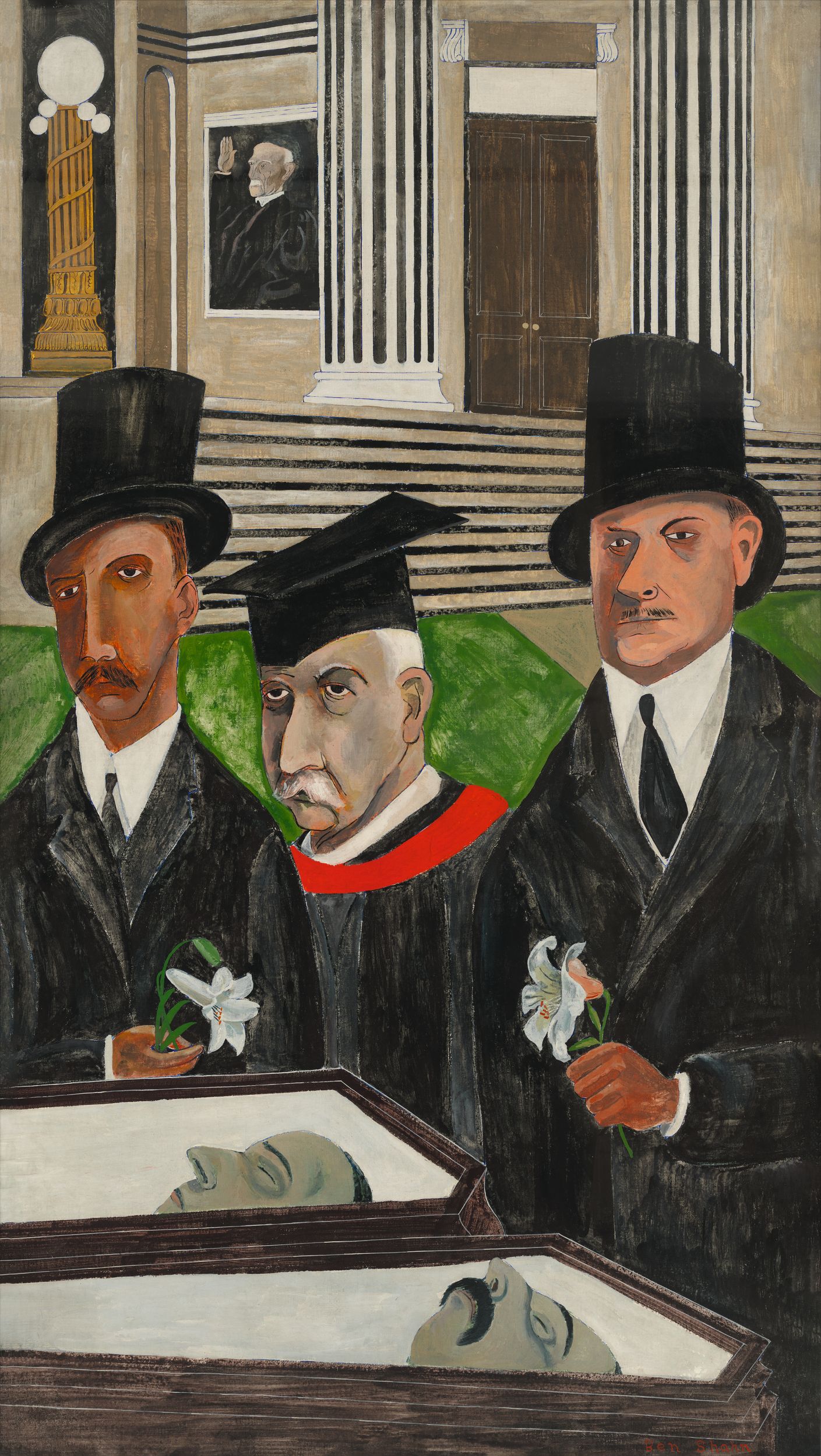
Shahn’s monumental painting The Passion of Sacco and Vanzetti (1931–32), set in a red niche, opened the exhibition (fig. 1). Nicola Sacco and Bartolomeo Vanzetti were Italian immigrants who were sentenced to death for armed robbery and murder in South Braintree, Massachusetts, despite their likely innocence. Shahn, who immigrated to the United States from Lithuania when he was eight years old, was empathetic. The iconic tempera painting depicts members of the Lowell Committee, the presidents of Harvard and MIT, and the judge in the case hovering over the coffins of the executed victims of injustice. The work was created soon after Shahn completed twenty-three paintings devoted to the 1927 executions. The series marked the beginning of Shahn’s signature social-realist style and brought attention to his penchant for defending the disenfranchised.
To research the case and develop the series, Shahn consulted newspaper accounts and published photographs, establishing the working method of bringing together strategies of high art and popular culture that guided the remainder of his career. In the beginning, Shahn downplayed the importance of media sources in his art to prevent accusations of copying. Katzman substantiates a meaningful reconsideration of his use of media by exhibiting source material adjacent to works of art to illustrate how Shahn borrowed subject matter and likenesses liberally but not literally.
The section on the New Deal introduces Shahn as a photographer, a lynchpin of the exhibition. Shahn continued to refer to found material while generating his own images. Throughout his life, Shahn maintained extensive files of catalogued images, his own and those clipped from publications, confirming his belief that all images have the power to communicate.
Moreover, the same narrow depth of field found in photography is evident in Shahn’s stylized figurative representation. Initially, Shahn saw photography as a shortcut to sketching. His friend and studio mate Walker Evans provided rudimentary instructions for using a camera. Shahn possessed a photographer’s eye, and his New York photographs are among his most poignant. His gouache painting Handball (1939) portrays six inner-city youngsters playing the game against a cement wall in front of the built urban environment. Scenes from separate photographs inform the painting’s dynamic spatial arrangement.
Shahn’s tenure as a government employee in the Special Skills Division, Resettlement / Farm Security Administration (RA/FSA) and Office of War Information (OWI) was pivotal. Roy Stryker, director of the RA/FSA, employed dozens of photographers to accumulate over 170,000 photographs that he archived for the Roosevelt Administration, which used the images to illustrate the living and working conditions throughout the country. Neither Shahn nor Stryker disdained the use of his photographs, posters, and graphics for commercial or political reasons, so long as the context was consistent with the original intention. While a photographer for RA/FSA, Shahn began advising Stryker on ways to disseminate New Deal messages through exhibitions, government pamphlets, and periodicals, such as Survey Graphic. An exhibit in this section displays copies of Archibald MacLeish’s 1938 photo book Land of the Free; Richard Wright and Edwin Rosskam’s Twelve Million Black Voices: A Folk History of the Negro in the United States; and Family of Man (1941), which accompanied Edward Steichen’s renowned exhibition.
Shahn’s travels as a photographer, particularly in the rural South at the height of Jim Crow, revealed levels of injustice, discrimination, and inequity he had not realized existed in his adopted country. He referred to his RA/FSA photographs long after he left government work. For example, his photograph of Sam Nichols captures the fear and uncertainty poor tenant farmers faced in Boone County, Arkansas, in 1935 (fig. 2). Nichols’s likeness in tattered clothes with furrowed brow, deep-set eyes, one forearm folded across his chest, and his other hand covering his mouth appears in whole or part in subsequent paintings, prints, and posters. Shahn uses Nichols’s hand to symbolize the dignity of manual labor and pride in one’s work, values Shahn inherited from his working-class father, a carver and carpenter.
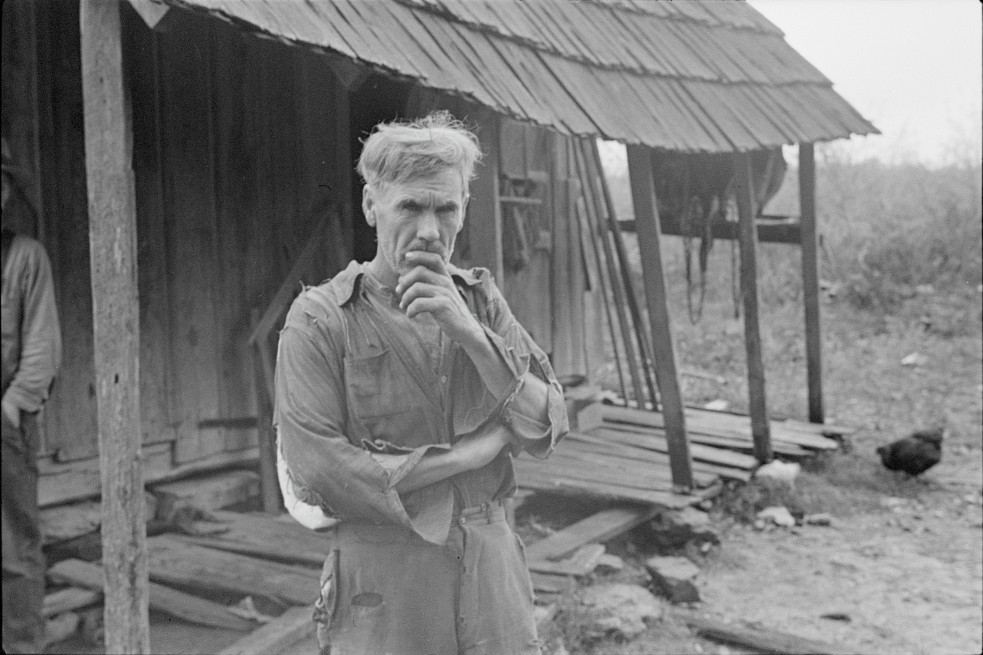
Shahn responded with empathy to the down-and-out as well as the working class, especially manual laborers—farmers, miners, factory workers. Shahn’s mass-produced posters and graphics promote the dignity of labor and his support for unions, starting with the Artists Union in New York in the 1930s.
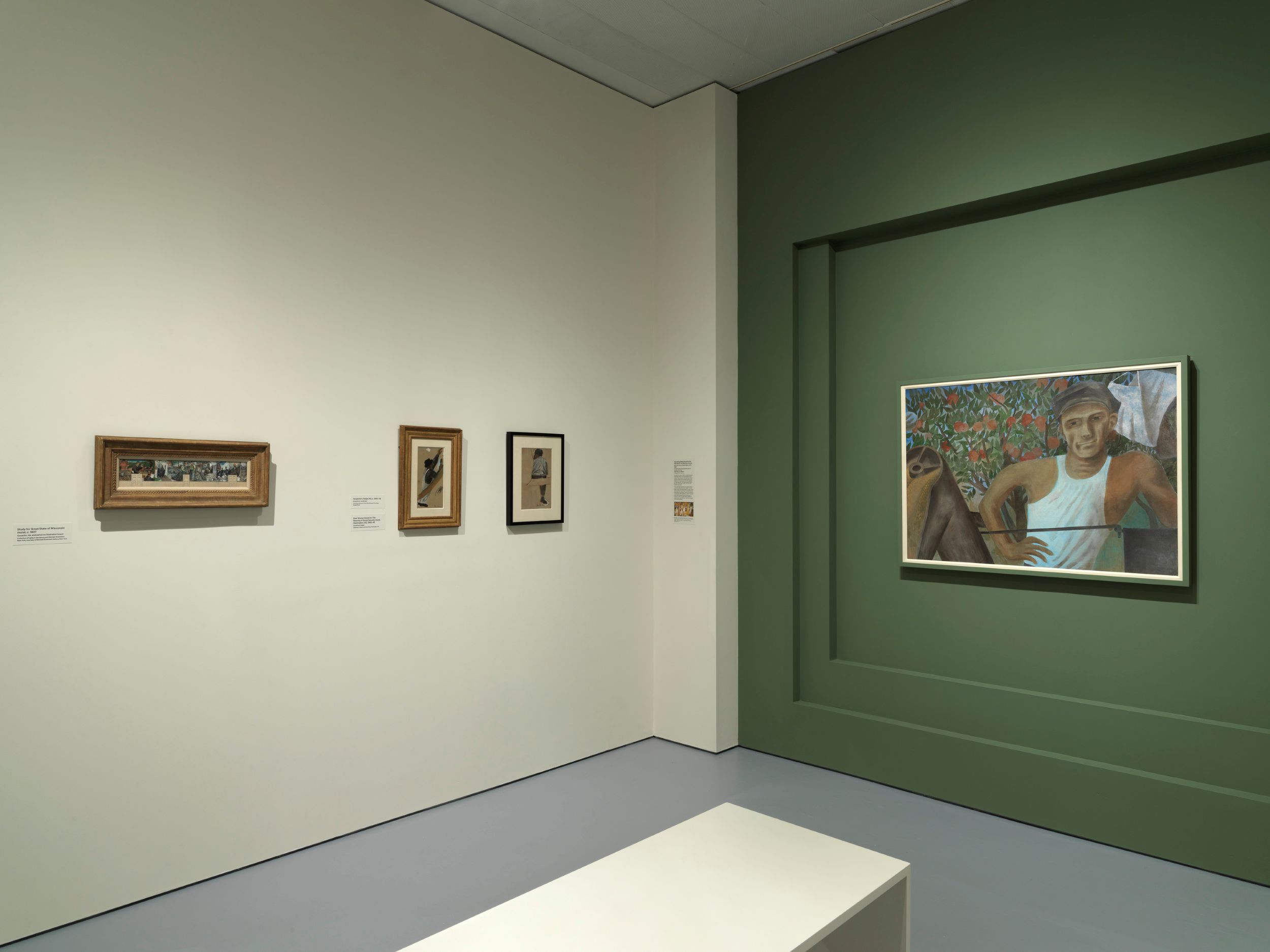
Shahn said he was closely aligned with the goals of the New Deal, such as the Social Security Act (1935), which provided an economic safety net for society’s most vulnerable—the elderly, the blind, children, and the unemployed. He was awarded the commission to create the fresco mural The Meaning of Social Security (1940–42), which remains (for now) in the Wilbur J. Cohen Health and Human Services Building (formerly Social Security Building), in Washington, DC. One half of the two-part mural depicts the downtrodden and the other shows the positive effect of federal assistance. In a small study for the mural titled Steel Worker, a man sits on a girder rendered in line only. The figure is shown in color from behind, one leg dangling below the girder. The worker’s back takes up almost a quarter of the image, recalling the humanity and humility of Giotto’s figures with curved backs in his early fourteenth-century frescoes in the Scrovegni Chapel, in Padua, Italy.
For the Jewish Museum venue only, Katzman located a rare study for the Social Security mural executed in fresco depicting a Midwestern farmer harvesting wheat (fig. 3). Shahn learned fresco technique, which allows no room for error, from the Mexican muralist Diego Rivera, who was so impressed with Shahn’s 1933 gouache series for the Tom Mooney case that he hired Shahn to work on a mural Man at the Crossroads for the RCA Building in Rockefeller Center. In 1934 Nelson Rockefeller had the mural painted over after Rivera refused to remove the unauthorized likeness of Vladimir Lenin. In May 2025 the Cohen building was slated for accelerated disposal, a decision that jeopardizes the Shahn mural and others created during the New Deal, echoing the destruction of Rivera’s mural many decades earlier.
Shahn, an avowed anti-Fascist, created numerous poster designs while employed at the OWI. The exhibition displayed the only two ever circulated: This Is Nazi Brutality (1942) and We French Workers Warn You (1942). Few works in this inclusive retrospective are more disturbingly relevant today than We Fight for a Free World! (c. 1942), a powerful indictment of the tactics of autocratic regimes. In a horizontal gouache and tempera, five handbills are depicted adhered to a brick wall above spray-painted block letters spelling out “THE ENEMY METHOD.” Each flier has a monochromatic figure with a different heading in lowercase serif font: “suppression,” “starvation,” “slavery,” “torture,” “murder.” The likeness of Sam Nichol’s appears behind barbed wire in the flier for slavery. The painting is the prime example of the claim made in the exhibition’s introductory panel that Shahn possessed a talent for layering art within art as well as combining word and image.
The timeliness of the exhibition is unmistakable—anti-immigration activities are rampant, the Wilbur J. Cohen building with its New Deal murals obstructs the sightline of a possible triumphal arch, and war tactics by authoritarian and rogue governments are pervasive. In the postwar years, Shahn responded to the enduring ramifications of war, the loss of property, and painful human sacrifice. For the remainder of his life, the United States and the Union of Soviet Socialist Republics (USSR) were engaged in an ideological Cold War pitting capitalism against communism. After the USSR tested its nuclear bomb, the North Atlantic Treaty Organization was formed. The Age of Anxiety was fraught with the fear of nuclear annihilation.
Shahn was, at times, at odds with his peers, including Robert Motherwell and others who favored nonobjectivity and abstraction in art during the postwar years. In her catalogue essay, Katzman points out that Shahn’s form of social realism was never completely out of favor, reminding readers he was selected to represent the United States at the 1954 Venice Biennale together with Abstract Expressionist Willem de Kooning.
The art in the final two sections of the exhibition was made concurrently, during the last decade of Shahn’s life. With economy of line, a defining characteristic of his art, Shahn paid tribute to slain Civil Rights workers James Chaney, Andrew Goodman, and Michael Schwerner and to Mahatma Gandhi and the cause of anticolonialism. TIME magazine selected Shahn’s rendering of Martin Luther King caught mid-speech for its March 19, 1965, cover. To support Eugene McCarthy’s antiwar campaign in 1968, Shahn created one of his most iconic posters featuring a dove of peace overlayed by bands of red, white, and blue.
Elaborate lettering in English and Hebrew in the final section of the exhibition bring the retrospective full circle. At fourteen, Shahn apprenticed in his uncle’s lithography shop where he learned to draw, immersed himself in literature, developed a lifelong love of letters, and found ways to encourage empathy in a broken world that would appear in his art and service to society for more than fifty years. His wife, Bernarda Bryson Shahn, said her husband returned to religious themes when he was able to revisit them with a fresh eye. His final project, the Hallelujah Suite, comprises fifty lithographs and was a lasting testament to his love affair with calligraphy. Ben Shahn, On Nonconformity affirms that Shahn believed conformity was bad for art, literature, and politics. His life’s work was to communicate to the broadest constituency possible through fine and commercial art—by any means possible—that there is no place for complacency when so much is at stake.
Editors’ Note: The catalogue for this exhibition, by Laura Katzman, with contributions by Beatriz Cordero Martín, Christof Decker, and John Fagg, was reviewed by Katherine Mintie in the Spring 2024 issue of Panorama.
July 9, 2026: Several corrections were made to this review, clarifying the dates of the Madrid venue, the publishing partners for the catalogue, the number of objects in the original checklist, the dates of objects in the exhibition, Shahn’s place of birth, the number of figures in Handball, the publication date of Wright and Rosskam’s Twelve Million Black Voices, the medium of the study for Shahn’s fresco in the Cohen Building, the date of the decision to dispose of the Cohen Building, and the medium of the Hallelujah Suite. The word likely was also added to reflect historical debate over Sacco and Vanzetti’s guilt or innocence.
Cite this article: Susan Edwards, review of Ben Shahn, On Nonconformity, Jewish Museum, New York, Panorama: Journal of the Association of Historians of American Art 12, no. 1 (Spring 2026), https://doi.org/10.24926/24716839.20946.
About the Author(s): Susan H. Edwards, PhD, is the retired Executive Director and CEO of the Frist Art Museum, Nashville.