

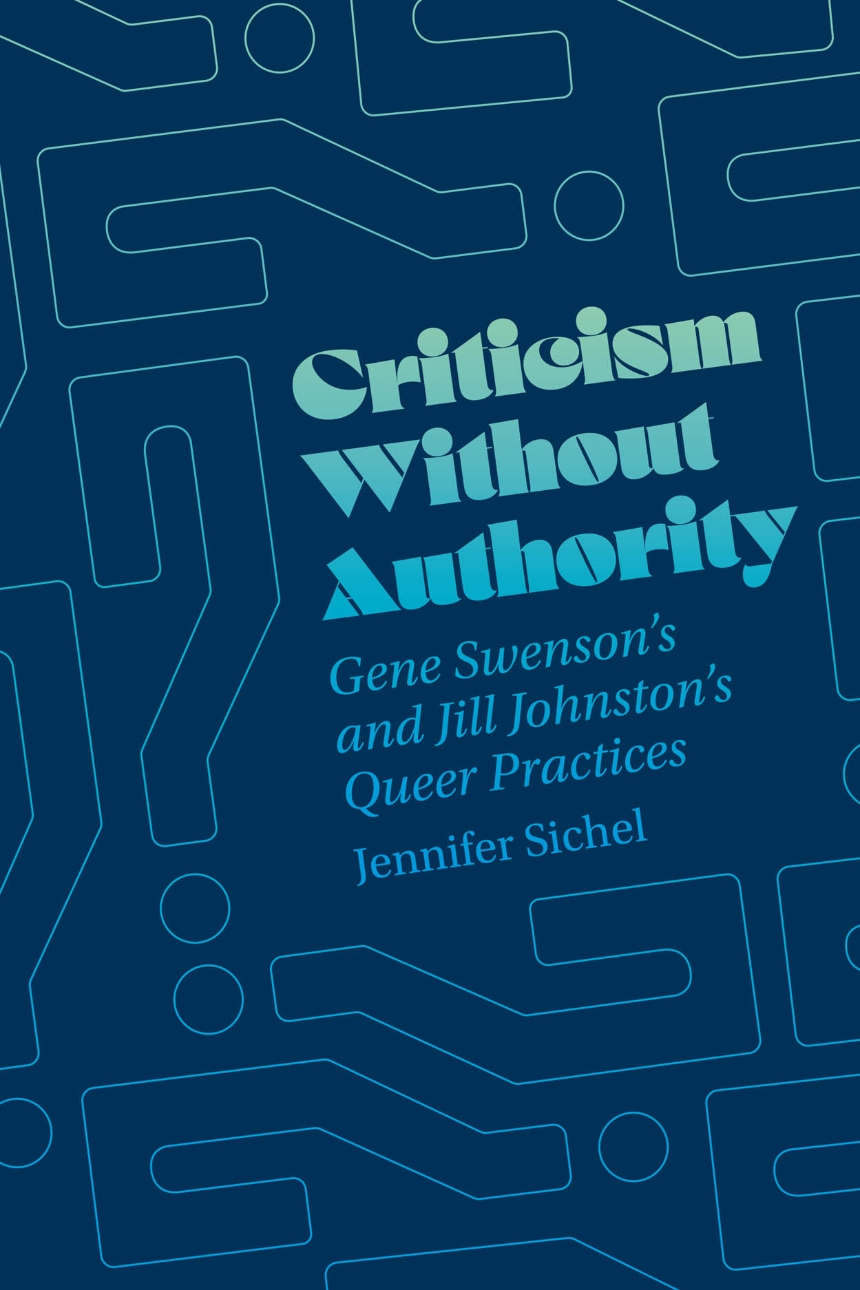
Criticism without Authority: Gene Swenson’s and Jill Johnston’s Queer Practices





PDF: Moonie, review of Criticism Without Authority
Criticism without Authority: Gene Swenson’s and Jill Johnston’s Queer Practices
By Jennifer Sichel
University of Chicago Press, 2025. 192pp.; 63 halftone illus. Paperback: $30.00 (ISBN: 9780226842844)
 In a 1950 review of T. S. Eliot’s prose, Clement Greenberg claims that the critic “has to lay down the law.”1 Setting aside whether Eliot would have put the matter quite so bluntly, Greenberg’s remark encapsulates a certain ethos of modernist criticism that is no longer widely shared. It might be said that for several decades we have lived through an age of “criticism without authority.” But what does that entail? A short answer, which we might take from Jennifer Sichel’s lively account, is that it looks pretty untidy. However, this does not deter the author. In Criticism without Authority: Gene Swenson’s and Jill Johnston’s Queer Practices, she regards this untidiness as a necessary virtue. Sichel frames her study around the entwined lives and careers of critics (and friends) Gene Swenson (1934–69) and Jill Johnston (1929–2010). What Sichel characterizes as the “disintegration” of their personal lives and activities provides the impetus for a compelling account of queer practice and criticism. While Sichel’s account sets itself against critical “authority,” it is not Greenberg who is the main antagonist but rather Michael Fried, who, in his 1967 essay “Art and Objecthood” attempted to police the boundaries that Johnston and Swenson destabilized. The terms impure and situation, both explicitly opposed by modernist critics, are set up by Sichel as positive values (13). Sichel is not the first to reverse Fried’s terms in such a way, but she puts this reversal in the service of a novel claim for those two overlooked figures as exemplars of queer practice and criticism.
Swenson’s career as a critic and curator was tragically cut short by a car accident. By this point, he had become disillusioned with the art world. In February 1968, he picketed the Museum of Modern Art, New York (MoMA) at lunchtime each day, holding a Plexiglas question mark above his head. Sichel borrows the term quiticism from Gregory Battcock to describe Swenson’s attitude, but she also applies the term to Johnston, who outlived Swenson by more than forty years. Johnston’s column in the Village Voice influenced a range of figures who have blurred the boundaries between criticism, memoir, and fiction: among them Hilton Als, Chris Kraus, Maggie Nelson, and David Wojnarowicz (139).
Sichel marshals the messiness of her material into a fluent and well-formed narrative that provides a valuable recontextualization of the cultural history of the late 1960s and 1970s. On the face of it, her queer history may appear distinct from standard accounts, but in many ways, it complements existing histoires to build a fuller and more complex picture of the period. Although they appear to be marginal figures, Johnston and Swenson were indicative of, and embedded within, wider cultural and sociopolitical trends. While they were dealing with personal breakdowns, the culture of modernism was undergoing a crisis of its own. Mel Ramsden pithily described Conceptual art as “modernism’s nervous breakdown,” a formulation that makes explicit the connection between the personal and the cultural.2 The 1960s may be remembered as heady days of liberation, but it was a period of fear and uncertainty as the social order faced new threats. This fear was not the preserve of conservatives. As T. J. Clark has recently remarked of the UK context, these were also difficult times for those on the left.3
Sichel’s first chapter deals primarily with Swenson. Seen as a rising star in the mid-1960s, he was an advocate of Pop Art early in the decade. He curated The Other Tradition in 1966 at the Institute of Contemporary Art in Philadelphia. The show’s Surrealist inclination paralleled the famous Artforum issue on the subject. It included work by Paul Thek, Joseph Raffaele, and Michael Todd. For Swenson, those three artists embodied a “post-Freudian” situation, where repression gives way to the more explicit embrace of sexuality. Swenson’s extensive catalogue essay reveals him to be an astute and well-informed commentator. He broached the demise of formalist orthodoxy and made the case for new critical vocabularies. In this sense, the text and its accompanying show anticipated Leo Steinberg’s better-known essay “Other Criteria,” originally published in 1968. Unfortunately, Swenson’s life soon went into a downward spiral. A combination of professional disappointments and personal problems left him an embittered and isolated figure. When he picketed MoMA, the museum guards refused to admit him, while former colleagues kept their distance. More problematically, he penned anti-Semitic tirades against the art establishment. Sichel, correctly, makes no excuses for this (65).
Sichel also engages with Swenson’s interview with Andy Warhol in a 1963 issue of Art News, titled “What Is Pop Art?” As Sichel notes, the published interview was heavily redacted. It is not entirely clear how the edits transpired, although in a footnote Sichel suggests that editor Thomas Hess was most likely responsible (28). The original interview contained discussions around homosexuality that sometimes veered into disturbing territory, such as Swenson’s account of his ambivalent fascination/horror at seeing a man being savagely beaten. The unredacted Warhol interview provides Sichel with the grounds to argue for a different definition of Pop: one that is more explicitly queer but with a much darker undercurrent, already glimpsed in Warhol’s Disaster series. Nonetheless, the informality of the interview makes it difficult to gauge the extent to which a broader theory can be extrapolated from it.
Chapter 2 focuses largely, though not exclusively, on Johnston. Sichel deals with the “disintegration” of the critic, which has a double-edged significance. On the one hand, the term can be taken to signify a broader loss of authority in the figure of the critic in general; however, the disintegration was also personal. Both Swenson and Johnston were institutionalized several times at the psychiatric ward in New York’s Bellevue Hospital during the 1960s. Johnston’s 1969 public panel, “Disintegration of a Critic: An Analysis of Jill Johnston,” brought together her personal crises with the demise of criticism. In a press release, Johnston, in Sichel’s words, “offer[ed] herself up as a version of Artaud’s martyr” (78). Further, Johnston’s column in the Village Voice underwent a transformation, becoming “a space to shatter and disorganise language, to subvert literary codes, and to assemble experiential codes of expression” (79). Sichel stresses Johnston’s understanding of the instability of selfhood, later a staple of postmodernism. The remark calls to mind Bob Dylan’s contemporaneous album Self Portrait (1970), which confused listeners with the inclusion of cover versions and indifferent live recordings. Robert Slifkin’s study of Philip Guston argued that this formed part of Dylan’s deconstruction of his own myth: in some respects quite different from Johnston but each indicative of a broader crisis of the self.4
Johnston’s panel, which Warhol published as transcript, descended into chaos. Subsequent accounts by Battcock, John Perrault, and Lil Picard were effusive in their praise for Johnston, although, as Sichel admits, the panel had “no easy upshot” (88). The chapter closes by turning back to Swenson, whom Johnston reflected on in a moving Village Voice column in 1972. Here, Johnston revealed details of her own breakdown and incarceration. Johnston drew upon R. D. Laing’s notion of psychosis not as a pathology but, as he put it, as something “a person invents in order to live in an unliveable world” (89). Sichel contends that Johnston reframed what Laing called the “queer” (that is, strange) experiences of the psychotic as a means to account for her own, and Swenson’s, queer desires in a repressive society.
Chapter 3, titled “lesbianlesbianlesbianlesbianlesbianlesbianlesbianlesbian,” focuses on Johnston’s “lesbian solutions.” As the title of the chapter indicates, Johnston had plenty of proposals, among them an unsuccessful attempt to convert all women to lesbianism. Sichel describes Johnston’s manifesto Lesbian Nation (1973) as a “bad object” redolent of the “excesses of second-wave feminism” (97). She adds that other writers have tended to avoid engaging with Johnston in this regard, passing off her arguments as a problem to be dealt with by other disciplines. For instance, Sally Banes claims that when Johnston came out in July 1972, she simply abandoned art criticism to pursue “political ideology.” Sichel counters this by asserting that Johnston’s “feminist solutions . . . belong to the history of art and performance” (97). Here, she places Johnston in explicit opposition to Fried, valorizing his notion of “theatre” and championing the very dissolution of boundaries that he claimed were essential to aesthetic value (101). This goes hand in hand with destabilized notions of identity and selfhood. As Johnston put it, “The solution to identity is: get lost” (109).
Johnston was the feature of a special issue of Les Levine’s publication Culture Hero in 1970, with a cover that mimicked the infamous photograph of Marcel Duchamp playing chess with a nude Eve Babitz in 1963. The issue included a large number of testimonies about Johnston. The only one to express disapproval was from Barbara Rose. While Rose claimed to have previously read Johnston’s column “religiously,’” she now asked, “Did you really finally decide criticism was hopeless, or meaningless or impossible? Or did you just begin to think you were more interesting than what you were looking at?” (116). Rose’s criticism is indicative of her conservative turn during that decade. Similar criticisms of “autofiction” have emerged in recent years, accusing the form of self-indulgence or “oversharing.”5
In the conclusion, Sichel makes a claim for the broader stakes of her argument. She contends that Johnston and Swenson “used criticism as a method to figure out how to be queer in a world that did not want them to be” (137). Criticism, then, is a way of being in the world rather than “laying down the law.” Sichel expands on this, asserting that through criticism, critics engage in “a process of writing themselves into being over and over again.” Further, Sichel argues for the pair’s “queer practices as art practices” (138). This claim complements Sichel’s advocacy for disintegrating boundaries, whether in art or in life. The reader might reflect here on two such instances. The first is chapter 3’s account of Johnston’s appearance at “A Dialogue on Women’s Liberation” in New York in 1971. Here, Johnston gave a speech as her colleagues rushed the stage to cavort with her, much to the irritation of the chair, Norman Mailer. What was this event? A Happening? A performance? Did it count as an act of criticism or as an act of protest against a panel on women’s liberation chaired by a notorious misogynist? Johnston herself termed it an “episode.” Sichel adds that this “ambiguous word . . . signals a state of animated suspension, a period of time in which something is happening” (124). The assertion “queer practices as art practices” also recalls Swenson protesting outside MoMA, his question mark held in the air. His gesture encapsulates the ambiguous provocations that lie at the heart of Sichel’s account. Those do not offer us any easy or comforting solutions, but despite Johnston’s and Swenson’s own failures, Sichel argues that their practices nonetheless continue to “vibrate with the possibilities of new intimacies, new lives, and new worlds” (139).
Cite this article: Stephen Moonie, review of Criticism without Authority: Gene Swenson’s and Jill Johnston’s Queer Practices by Jennifer Sichel, Panorama: Journal of the Association of Historians of American Art 12, no. 1 (Spring 2026), https://doi.org/10.24926/24716839.20974.
Notes
- Clement Greenberg, “T. S. Eliot: The Criticism, The Poetry,” in Clement Greenberg: The Collected Essays and Criticism, ed. John O’Brian (University of Chicago Press, 1993), 3:68. ↵
- Mel Ramsden, cited in Charles Harrison, Conceptual Art and Painting: Further Essays on Art & Language (MIT Press, 2003), 27. ↵
- Speaking of the new left in the UK, Clark said, “I mean, the situation in those fabled ‘late 60s’ was actually very difficult, very bewildering, threatening in all sorts of ways . . . people were often desperate.” Quoted in Andrew Whitehead, “The New Left: T. J. Clark,” June 14, 2021, https://www.andrewwhitehead.net/new-left-tj-clark.html. ↵
- Robert Slifkin, Out of Time: Philip Guston and the Refiguration of Postwar American Art (University of California Press, 2013). ↵
- Lauren Oyler, herself an author of autofiction, provides an account of those criticisms. See “I am the one who is sitting here for hours and hours and hours,” in No Judgment (Virago, 2025), 142–92. On Barbara Rose, see Chloë Julius, “Barbara Rose’s Right Turn,” Selva 6 (2025), https://selvajournal.org/article/barbara-roses-right-turn. ↵
About the Author(s): Stephen Moonie is senior lecturer in Art History in the Department of Fine Art, Newcastle University.