

Homelands: Mnë’nának, Māēnāēwah, Tešišik, at the Milwaukee Art Museum





PDF: Busciglio-Ritter, Homelands
The Milwaukee Art Museum’s Homelands: Mnë’nának, Māēnāēwah, Tešišik Gallery is a rethinking of what American art looks like and who gets to narrate it (fig. 1). From its conception, the Homelands Gallery was driven by collaboration rather than curatorial authority. The project was developed with the Milwaukee Art Museum’s Native Initiatives Advisory Group (NIAG), a circle of activists, artists, curators, and educators from tribal nations across Wisconsin.1 Its title draws on Indigenous names for the current city of Milwaukee in Potawatomi (Mnë’nának, “the good land”), Menominee (Māēnāēwah, “some misfortune happens”), and Ho-Chunk (Tešišik, “bad lake”), underscoring that this land has always been shaped by Native cultures. The gallery’s themes of land, water, and identity extend that grounding. Through works by artists like Fritz Scholder, Truman Lowe, and Leon Polk Smith—in addition to John James Audubon and Robert S. Duncanson—the installation asks visitors to consider how landscapes we still experience have been depicted and how these depictions articulate relationships to space and contested natural resources.
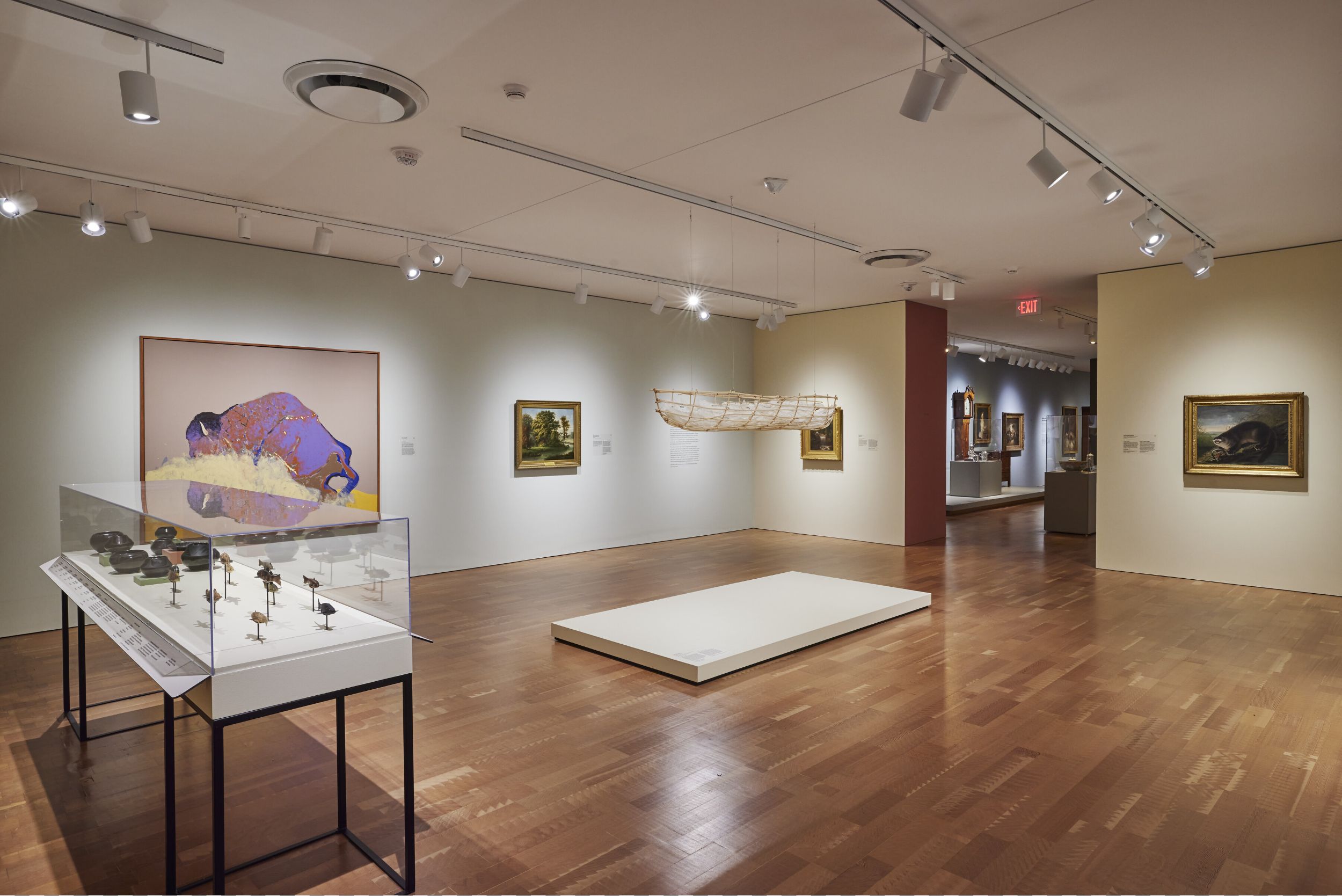
Inaugurated June 2025, this reinstallation of the museum’s former American West Gallery was conceived to correct a long-standing imbalance in museum displays that have too often framed Indigenous Peoples as subjects rather than knowledge-bearers shaping both the past and present. The Homelands Gallery brings a clear objective into focus: to foreground contemporary Native art while reinterpreting historical works to offer visitors a more honest account of American history.
The gallery is equally committed to changing how museums interpret. With NIAG’s guidance, the space challenges one-sided narratives and introduces a multivocal model. NIAG members have contributed reflections that sit alongside curator-authored labels, inviting visitors to encounter both Euro-American and modern Indigenous artworks through additional perspectives and lived experiences. This approach aligns with the gallery’s broader mission to create a space where diverse visitors can feel a sense of belonging while making room for truth telling about representation, collecting, and storytelling.
Situated within the Milwaukee Art Museum’s American Wing, the Homelands Gallery redefines curation as a relationship between artworks, communities, and responsibilities, rather than a mere arrangement of objects. A related symposium held in November 2025, which featured Indigenous artists and curators, extended that ambition, emphasizing the responsibilities of museums regarding Native heritage and Native life in the present, as well as the ways museums and tribes can be allies in promoting Indigenous creativity. More than a discrete reinstallation, Homelands Gallery has become a blueprint for how the museum can tell richer stories, ones in which Indigenous presence is a central foundation of American art.
Cite this article: Thomas Busciglio-Ritter, “Homelands: Mnë’nának, Māēnāēwah, Tešišik, at the Milwaukee Art Museum,” in “In the Galleries,” edited by Elizabeth McGoey and Sara Picard, Panorama: Journal of the Association of Historians of American Art 12, no. 1 (Spring 2026), https://doi.org/10.24926/24716839.21016.
Notes
- With advising from NIAG, the gallery was cocurated by Chyna Bounds, assistant curator of American Decorative Arts and Design at the Milwaukee Art Museum, and Kendra Greendeer, PhD (Ho-Chunk), Ihlenfeld Curator of Collaborative and Community Exhibitions at the Weisman Art Museum in Minneapolis. The project was supported by a grant from the Terra Foundation for American Art. ↵
About the Author(s): Thomas Busciglio-Ritter is the Abert Family Associate Curator of American Art at the Milwaukee Art Museum.