

New American Galleries at the Philadelphia Museum of Art





PDF: Foster and Hamer-Light, New American Galleries at the PMA
Celebrations for the 250th anniversary of the United States coincide with the long-awaited opening of the permanent collection galleries at the Philadelphia Museum of Art (PMA) displaying American art from about 1840 to 1960. Promoted as part of A Nation of Artists, a joint survey of American art by the PMA, the Pennsylvania Academy of the Fine Arts (PAFA), and the Middleton Family Collection, the project is at heart a reinstallation. Superb loans from the Middletons will add sparkle for fifteen months, but the core presentation reflects a new long-term reinterpretation of the PMA’s American collection.
The 2026 reinstallation follows on the 2021 opening of new spaces on the first floor for the early American collections of works dating from the mid-1600s to about 1840. Renovated galleries on the second floor now pick up that story and carry through to the mid-twentieth century. Challenges included both visual and intellectual continuity from the earlier galleries and the development of key themes shared with PAFA in their parallel installation. The overarching title A Nation of Artists seeks a message of pluralism and inclusion in a divisive time: Americans can unite, we hope, to appreciate a panorama of three centuries of creativity. Insisting that there is no single story of American art, the first gallery (fig. 1) introduces the idea that “artists are everywhere” and examines the variety of styles, materials, and communities that will echo throughout the rest of the galleries. It also represents the many pathways to becoming an artist, which can include academic training but also, for the majority of artists, involves experiences at home, at work, or alone.
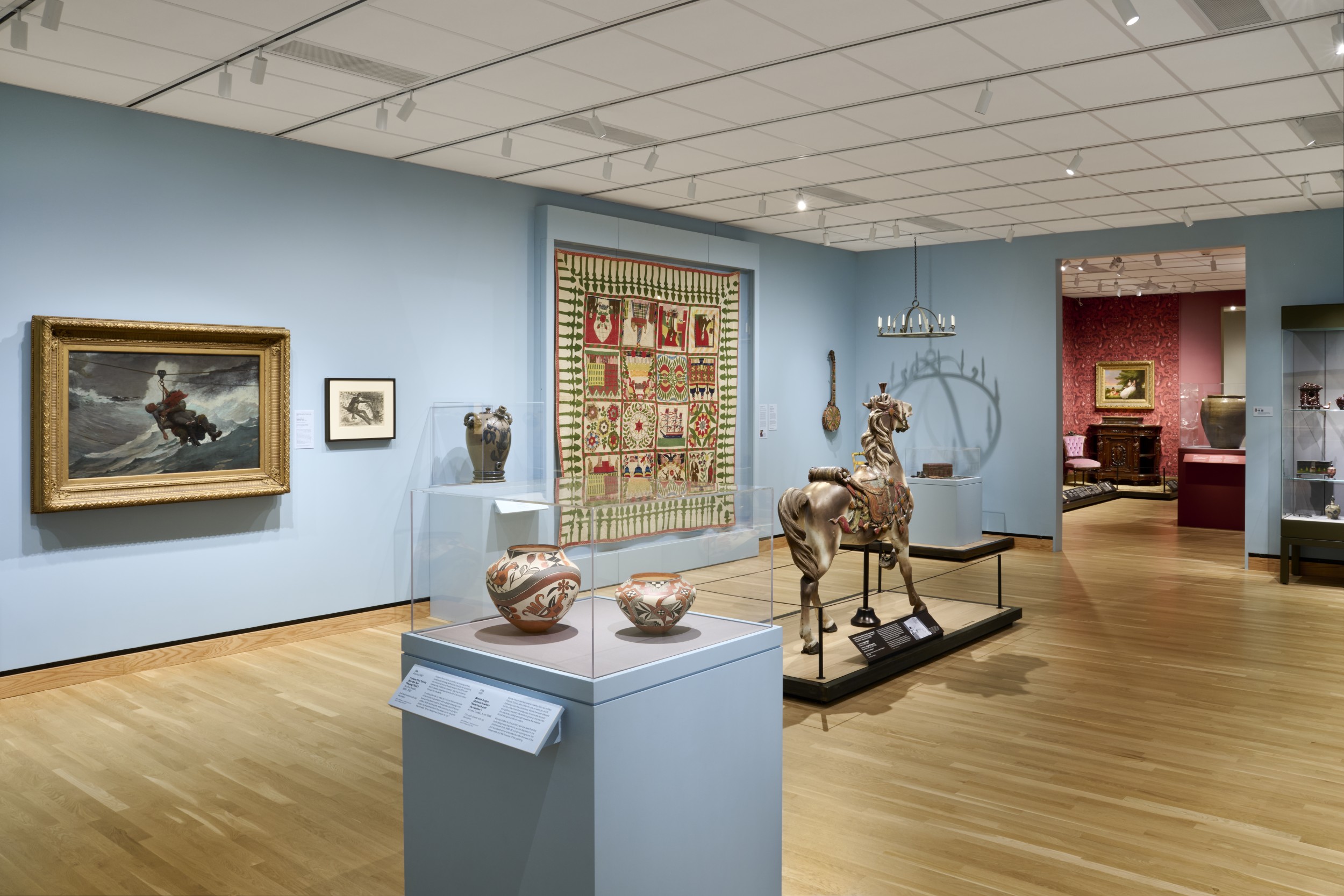
The first objects encountered in this initial gallery are by Indigenous artists: Acoma mother and daughter Frances Torivio and Wanda Aragon. Their presence foreshadows a later gallery that, for the first time at the PMA, focuses on the work of Native American artists from the 1800s to the present. Curated in collaboration with five Indigenous curators, scholars, and culture bearers from across North America, the installation emphasizes how, despite settler violence and displacement, Native creativity has always been resurgent. We invited advisors based on strengths within the PMA’s historic collection of Indigenous art to build the checklist from the ground up. After presenting the interpretive throughlines structuring the entire run of galleries, we asked our advisors to explore how they could bring art from different cultural areas into dialogue. To emphasize the continuing vitality of these communities, our advisors helped secure contemporary work: the loan of Honor Blanket by Lenape artist Laura Watters Maynor and the acquisition of a beadwork pouch by Seneca artist Randee Spruce. The advisors also wrote labels or reviewed texts written by our curatorial team. The result is the first presentation of multivocal interpretive texts in the PMA’s galleries.
Celebrating something as complicated as our nation’s founding requires humility; it is important to not always be the expert. As we move forward, we hope that the framework established in these new galleries will continue to provide pathways to bring more stakeholders and communities into the museum to tell their own stories.
Cite this article: Kathleen A. Foster and Julia Hamer-Light, “New American Galleries at the Philadelphia Museum of Art,” in “In the Galleries,” edited by Elizabeth McGoey and Sara Picard, Panorama: Journal of the Association of Historians of American Art 12, no. 1 (Spring 2026), https://doi.org/10.24926/24716839.21025.
About the Author(s): Kathleen A. Foster is the Robert L. McNeil, Jr., Senior Curator and Head of American Art; and Julia Hamer-Light is the Barra Fellow in American Art, both at the Philadelphia Museum of Art.