

The Wadsworth’s “Look Again” Initiative





PDF: Monroe and Tycz, The Wadsworth’s ‘Look Again’ Inititiative
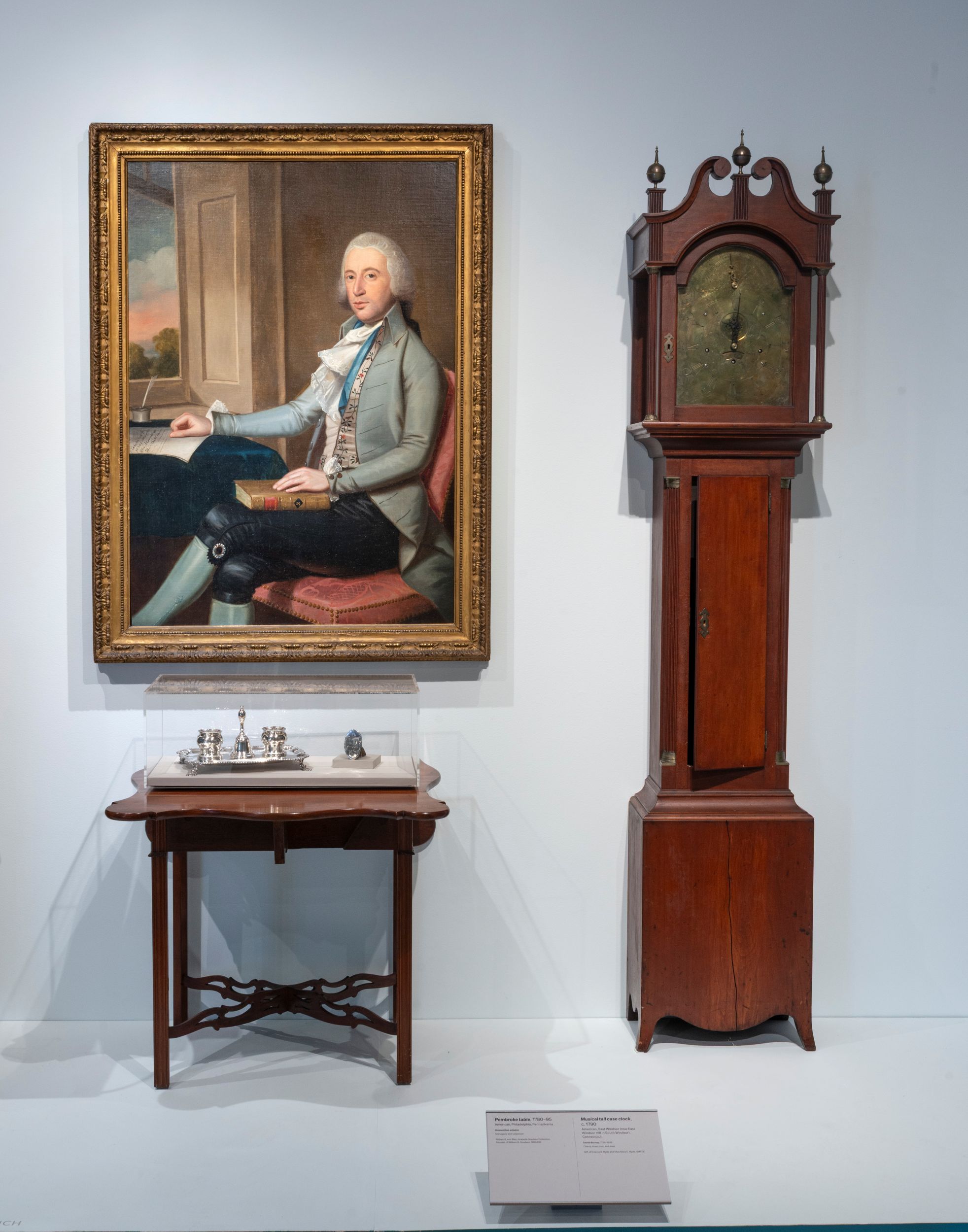
Captured in his portrait, Benjamin Judah, confident and sophisticated, pauses in his examination of paperwork to look out toward the viewer (fig. 1). Nearby is a case displaying an elegant cann, or mug, made by the silversmith Myer Myers (1723–1795) between 1770 and 1776. For the museum visitor glancing at the portrait canvas by Ralph Earl (1751–1801), a deeper connection between the successful New York merchant and the silver vessel is not immediately apparent. Upon reading a label titled “Look Again,” however, the visitor learns that Judah and Myers were both successful in colonial America despite their minority status as Jews. They each marketed their skills to various clientele—for example, Myers made secular pieces and Judaica—and both supported the Jewish community by helping govern the historic Congregation Shearith Israel in New York City. Illuminating these connections reveals the multifaceted context of the American experience that is fundamental the curatorial strategy of The Wadsworth (until recently the Wadsworth Atheneum Museum of Art) in Hartford, Connecticut.
The Earl/Myers pairing is part of The Wadsworth’s reimagined installation of the American decorative arts collection. Unveiled in January 2026, the two galleries are dedicated to the early American colonies and nascent United States. They feature a dynamic display of paintings with furniture, textiles, architectural fragments, metalwork, ceramics, and glass. The gallery titled “Across the Sea: Crafting Early America, c. 1630–1740” explores the colonies’ global connections, while the gallery titled “‘The Age of Homespun’: Materializing American Life, c. 1741–1850” (fig. 2) celebrates American artistry and ingenuity of the late colonial era and the early Republic. Entering the year of the United States’ Semiquincentennial, the added interpretation on our labels helps to advance a curatorial framework that addresses the complexities of American art, artists, and makers by showing that there is no “single story” in American history and visual culture.
Working collaboratively, The Wadsworth’s curatorial and learning and engagement teams have devised “Look Again,” an initiative to foreground a multiplicity of voices and interpretive viewpoints across the museum’s collections. The “Look Again” project features chat labels providing focused perspectives and critical analyses of objects from the permanent collection. One of its primary goals is to present underrepresented historical narratives and voices as integral to focused and comprehensive scholarship and research. An example is the Jewish Art & Culture Research Project, launched in 2023 to examine The Wadsworth’s collections through the lens of the Jewish experience, considering Jewish art expansively and across time.1 At a time of rising antisemitism and heightened public discourse around identity, the Wadsworth’s approach offers thoughtful and accessible means of exploring Jewish experience through art while also celebrating the resilience and creative contributions of Jewish artists.2 Multiple galleries now feature “Look Again” labels reflecting more than two years of research into the collection as part of this project. The initiative will continue as part of The Wadsworth’s forthcoming reinstallation and rotations of the American galleries, scheduled throughout 2027.
Cite this article: Erin Monroe and Katherine Tycz, “The Wadsworth’s ‘Look Again’ Initiative,” in “In the Galleries,” edited by Elizabeth McGoey and Sara Picard, Panorama: Journal of the Association of Historians of American Art 12, no. 1 (Spring 2026), https://doi.org/10.24926/24716839.21038.
Notes
- See https://www.thewadsworth.org/jac-project. ↵
- The Jewish Art & Culture Research Project is co-curated by Erin Monroe, the Krieble Curator of American Paintings and Sculpture, and Rachel Spiegel Gerstein, an independent scholar who draws from her art-historical training and Jewish background. Thank you to The Wadsworth’s director, Matthew Hargraves, for conceiving of the project, and to Jama Holchin, Evaluation and Digital Interpretation Specialist, The Wadsworth, for her guidance in interpreting historically complex topics. ↵
About the Author(s): Erin Monroe is the Krieble Curator of American Paintings and Sculpture, and Katherine Tycz is the interim Richard Koopman Associate Curator of American Decorative Arts, both at The Wadsworth, Hartford, CT.