

Americas in the Making





PDF: Ortega-Guerrero, Americas in the Making
In a column-lined corridor of the Art Institute of Chicago, an earthenware Storyteller from first-millennium Jalisco, Mexico, calls to visitors with a diaphragmatic breath and emphatic gesture (fig. 1). Similar ceramic figures were made and used by the societies of ancient West Mexico, interred as offerings in shaft tombs, and, in the mid-twentieth century, often unearthed to meet the demands of collectors in the United States. Today, the Storyteller continues to recount these transitions while presiding over another.
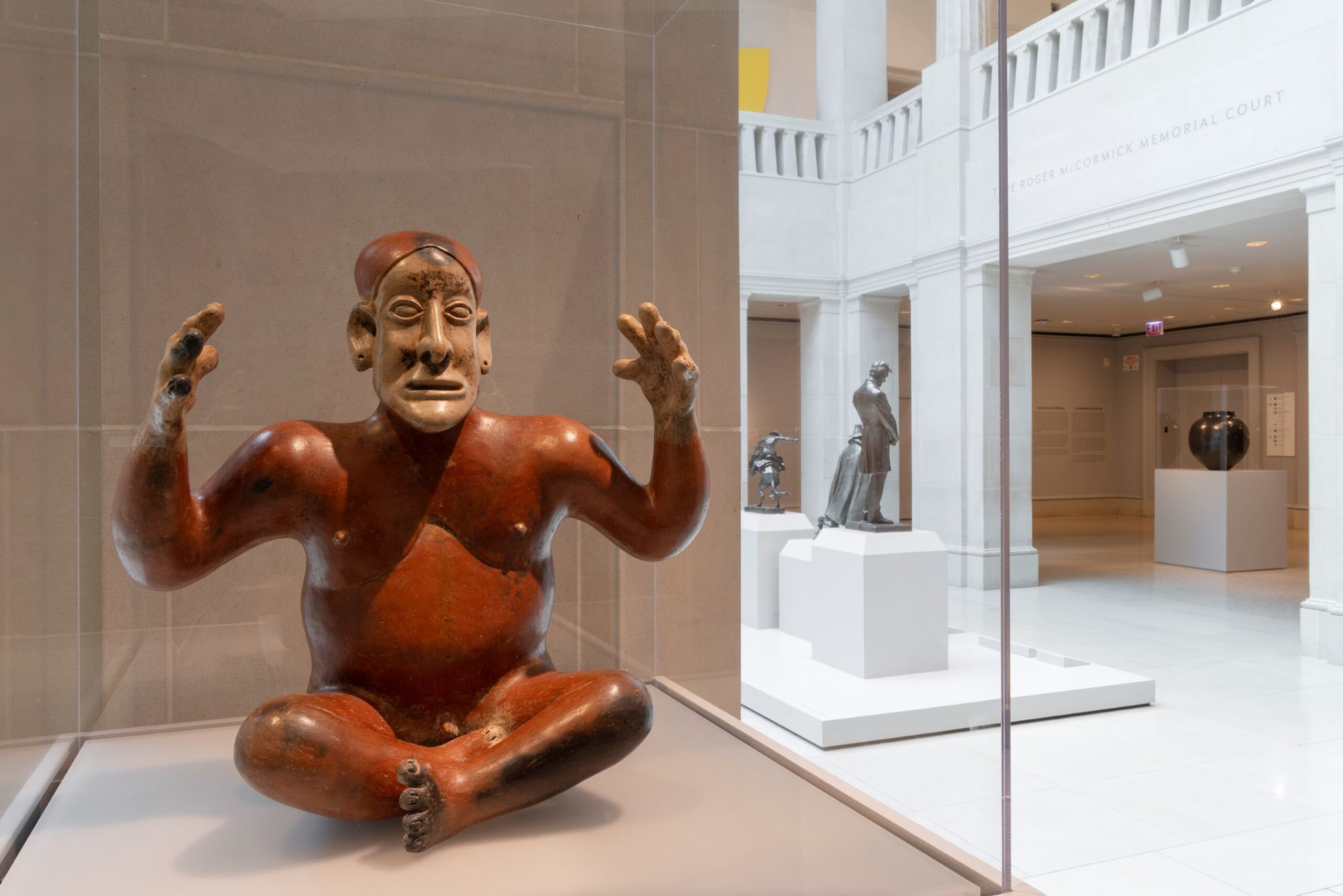
Since 2020 the Art Institute of Chicago has taken a hemispheric approach to the interwoven histories of the arts of the Americas, with gallery reinstallations that advance a line of collective questioning: How do objects reveal the relational networks of their makers? How do we reconcile contextual specificities with integrative displays that resonate across medium, time, and place? How do we begin to tell more complete stories of the Americas in the making?
The Storyteller responds through parted lips of clay, stirring dialogue across sightlines in the Sculpture Court (Gallery 161). Woman with a Birdcage, a 1941 painting by Rufino Tamayo (1899–1991), faces the animated sculpture and seems to listen attentively. Rendered in oils, this figure even mirrors the masklike features of her West Mexican counterpart—a testament to Tamayo’s artistic influences and collecting practices alike.
Behind the Storyteller, we encounter a grouping of histories and myths narrated in bronze. From left to right, Frederic Remington’s (1861–1909) The Bronco Buster (modeled 1895, cast 1899) bucks away from Augustus Saint-Gaudens’s (1848–1907) The Puritan (modeled 1883–86, cast after 1899), whose strident pose is outmatched by Daniel Chester French’s (1850–1931) contemplative Abraham Lincoln (modeled 1912, cast after 1912). These figures were forged to preside over public spaces and domestic interiors as icons of United States history. But in what ways do these objects tell only partial stories? The platform labels invite visitors to interrogate such artistic, historical, and mythological narrations.
Finally, a burnished, blackware storage vessel (around 1900) by Sara Fina Tafoya (1863–1949) punctuates our sightline. Tafoya, a Tewa ceramist from Santa Clara Pueblo in New Mexico, became well known for such pots in the early twentieth century. The motif of two bear paws that she impressed on this example recall the storytelling gesticulation of our opening sculpture from West Mexico. Tafoya welcomes the visitor to the Sculpture Court in clay and in chorus: David Drake’s (c. 1800–c. 1870s) storage jar from Edgefield, South Carolina, is just adjacent (behind the pictured column). Inscribed in 1857—when enslaved people, like Drake, faced systemic violence for reading and writing—this ceramic body continues to enunciate its maker’s name.
These objects are only a few of nearly five thousand North, Central, and South American works, made between 5000 BCE and the present, that are now stewarded by the Art Institute. As the Arts of the Americas department embarks on a full-scale reinstallation, slated to open in 2028/29, the Sculpture Court paves the way for a hemispheric reenvisioning of this extensive collection. Like the Storyteller, our curatorial work begins with an inhale, as we strive to articulate the artistic multiplicities of the Americas.
Cite this article: Sofia Ortega-Guerrero, “Americas in the Making,” in “In the Galleries,” edited by Elizabeth McGoey and Sara Picard, Panorama: Journal of the Association of Historians of American Art 12, no. 1 (Spring 2026), https://doi.org/10.24926/24716839.21042.
About the Author(s): Sofia Ortega-Guerrero is the Luce Curatorial Fellow in the Arts of the Americas department at the Art Institute of Chicago.