

Baltimore Museum of Art: War and Its Impact in the American Modernism Galleries





PDF: Anderson, Baltimore Museum of Art
An installation of five objects from the permanent American art collection at the Baltimore Museum of Art (BMA) is centered on war and the violence, social upheaval, and displacement of people that result from it (fig. 1). This focused display is situated within a larger gallery dedicated to American modernism from the period 1900 to 1950, which is organized thematically, capturing through social histories some of the radical changes taking place at the time in the United States in the areas of urbanization, labor and industry, artistic innovation, and American imperialism. Although it has been on view for a couple of years now, the installation continues to feel relevant and spark new ideas for me, particularly as war, immigration policy, and their economic impact dominate current headlines. In this collection of works, we can see how those issues manifested for artists working in the 1930s and ’40s as they synthesized the artistic styles of their time with their own lived experiences.
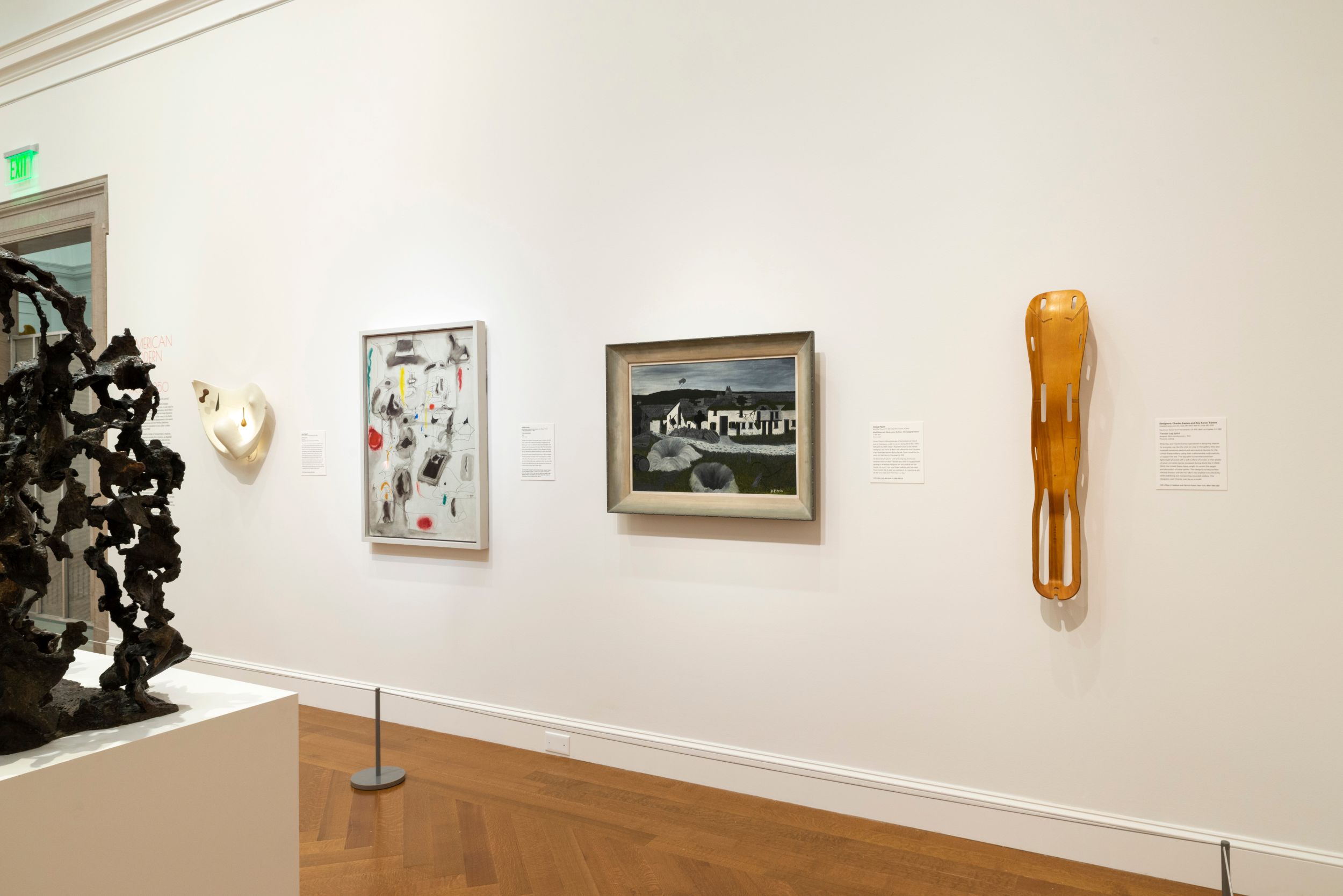
A signature aspect of our American galleries at the BMA is the integration of painting, sculpture, and decorative arts objects, and to me that material combination really underscores the social themes in play. Isamu Noguchi’s Floating Lunar (c. 1943–52) is a wall sconce made of plaster, with small wooden elements suspended across a cotton thread. Noguchi (1904–1988) drew inspiration from his internment in Arizona as an American citizen of Japanese descent during World War II. His painful memory of the isolation he experienced, as well as the enduring image of moonlight on the desert landscape, are filtered through the formal language of biomorphic surrealism to create this elegant and austere lighting design.
His work is paired with Arshile Gorky’s (1904–1948) The Unattainable (1945), which channels the artist’s ongoing trauma as a refugee from the Armenian genocide and his pain following the death of his mother into thinned, ghostly paint in an abstract Surrealist scene. Horace Pippin’s (1888–1946) Shell Holes and Observation Balloon, Champagne Sector (c. 1931–37) captures the aftermath of a bombing in World War I, in which Pippin had fought as a member of the 369th Infantry Regiment, the Harlem Hellfighters. I have often been struck by how the images of the blasted earth in the foreground of Pippin’s painting echo the hovering black forms in Gorky’s work, suggesting that these, too, might reference graves or sites of violence.
These themes and formal qualities all seem to come together in Charles (1907–1978) and Ray Eames’s (1912–1988) Traction Leg Splint (designed 1941, manufactured c. 1942), commissioned by the United States Navy. Undulating organic forms are here put to use in a lightweight plywood leg splint designed to stabilize and transport wounded American soldiers from the battlefields of World War II.
Nearby is a bronze sculpture of a female figure entwined with plantlike forms, The Two Rites (1942), by the Brazilian modernist Maria Martins (1894–1973). Produced during her time in New York, the sculpture draws on Amazonian myths, in keeping with Surrealist interest in Indigenous cultures (often colored by stereotyping ideals). The violence of her imagery resonates within the historical moment, conveying the global scope of the war.
This group of objects centers the artistic production of artists from diverse backgrounds who were all profoundly and personally affected by war and migration, each telling their individual stories through innovative formal styles that place them at the vanguard of the artistic production of their era. My hope is that this installation pays tribute to the complexity of the American experience, conveyed through beautiful and emotionally resonant artworks.
Cite this article: Virginia M. G. Anderson, “Baltimore Museum of Art: War and Its Impact in the American Modernism Galleries,” in “In the Galleries,” edited by Elizabeth McGoey and Sara Picard, Panorama: Journal of the Association of Historians of American Art 12, no. 1 (Spring 2026), https://doi.org/10.24926/24716839.21007.
About the Author(s): Virginia M. G. Anderson is the senior curator of American art and the department head of American Painting & Sculpture and Decorative Arts at the Baltimore Museum of Art.