

Local Connections at SLAM





PDF: Wolfe and Torbert, Local Connections at SLAM
Welcome to the Jeanne and Rex Sinquefield Gallery at the Saint Louis Art Museum (SLAM), which is more often than not called the “Bingham Gallery” (fig. 1). This nickname is not surprising, since the gallery displays five paintings by George Caleb Bingham (1811–1879), and SLAM is arguably the most important repository of his works. The museum owns eighteen paintings by Bingham, as well as twenty-nine prints and two printing plates after his works. We also hold fifty-nine of his drawings on long-term loan from the Bingham Trust.
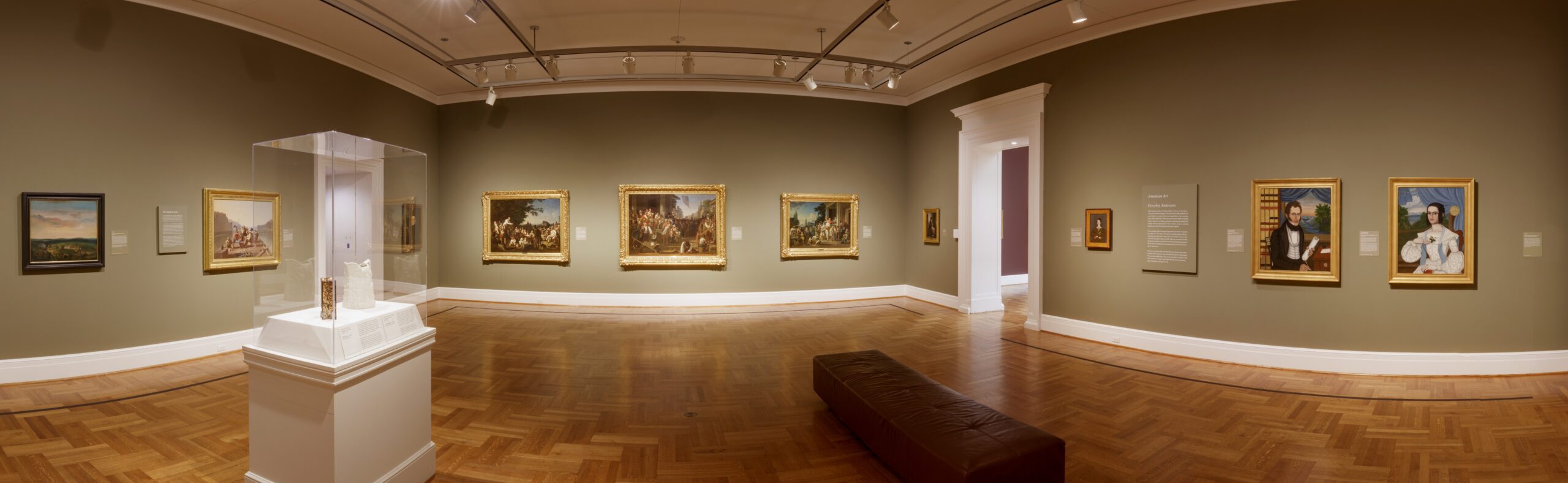
If you look carefully, you’ll see that this gallery is installed to highlight Bingham’s regional rather than national connections. His paintings are not installed alongside those of his national cohort, such as Thomas Cole or John Frederick Kensett, nor among other nationally known genre painters in the collection, such as John Greenwood or Winslow Homer. Instead, Bingham is joined by Lucinda Redmon Orear and the “Potosi Painter.” You may not recognize these names, but these artists represent the regional art world around St. Louis to which Bingham belonged.
We chose this approach for two reasons, both stemming from what we believe to be a curatorial responsibility to our collections and to our local audiences. First, the local emphasis that structures this gallery comes from Bingham himself. He was a self-taught painter from the region and chose to identify throughout his career as “the Missouri Artist.”1 This approach establishes the important interconnectedness of regional and national art worlds, strengthening our understanding of both. It brings deserved parity to the accomplishments of lesser-known artists, such as Orear, whose works hold their own next to Bingham’s. Placing Bingham into a vibrant local art world outside the major centers of the 1840s and 1850s informs our interpretations of his works.
The second reason for this approach is that it creates opportunities for regional visitors to “see themselves” in the museum. We know this phrase has, in many instances, become a cliché. However, our embrace of it is best exemplified by the experience of a fourth grader from Potosi, a town located in an economically disadvantaged area about an hour’s drive from St. Louis. While touring the gallery with her summer camp, she encountered Portrait of Cresswell Farm, painted in the early 1840s by an itinerant artist we affectionately call the “Potosi Painter.”2 The student immediately knew the house, which still stands, and she was amazed and proud that something she recognized from her own town was in SLAM. Such an experience is not singular to this gallery, of course, but this story demonstrates the importance of being intentional in providing museum space that facilitates it.
Keeping this resonance for viewers as our priority, over the past ten years, we have focused conservation resources on deserving regional works whose condition issues prevented their display. Likewise, we acquired a number of works from regional artists that broaden our ability to tell compelling stories about the art that was produced in our own communities by both locally and nationally celebrated artists.
Cite this article: Melissa Wolfe and Amy Torbert, “Local Connections at SLAM,” in “In the Galleries,” edited by Elizabeth McGoey and Sara Picard, Panorama: Journal of the Association of Historians of American Art 12, no. 1 (Spring 2026), https://doi.org/10.24926/24716839.21076.
Notes
- Nearly every newspaper article that mentioned Bingham in the 1840s and 1850s included this phrase. For one early example, see “Boonville—The Ball,” Boon’s Lick Times, January 2, 1841, 3. ↵
- This artist painted portraits of at least three families during his or her stay in Washington County, Missouri, in the 1840s. These paintings are identifiable by shared characteristics, such as the artist’s style for rendering hands. The known works include: George Cresswell (Saint Louis Art Museum, inv. no. 196:2017); Hannah Cliff Cresswell (Mrs. George Cresswell) and Son Joseph (Saint Louis Art Museum, inv. no. 197:2017); Teresa Haefner Casey (Mrs. John H. Casey) and Daughter Priscilla Catherine (Saint Louis Art Museum, inv. no. 259:1948); John Casey (Springfield Art Museum, MO); and William Parkinson and Sarah Kennedy Parkinson (current locations unknown). ↵
About the Author(s): Melissa Wolfe is the curator of American art at the Saint Louis Art Museum. Amy Torbert is the Andrew W. Mellon Foundation associate curator of American art at the Saint Louis Art Museum.