

Portrait of Mr. Jefferson: A French Miniature and the Origin of John Trumbull’s The Declaration of Independence





PDF: Auricchio and Ehrenpreis, Portrait of Mr. Jefferson
The Declaration of Independence by Connecticut painter John Trumbull (1756–1843)—with a monumental version in the US Capitol Rotunda, an engraving on the back of a two-dollar bill, and reproductions galore—is a beloved icon representing the founding of the United States (fig. 1).1 Its depiction of Thomas Jefferson (1743–1826) presenting a draft of the Declaration of Independence to the Continental Congress is ubiquitous in 2026; it is the go-to illustration for articles and exhibitions reflecting on the nation’s 250th anniversary and a favored scene on commemorative Semiquincentennial merchandise.
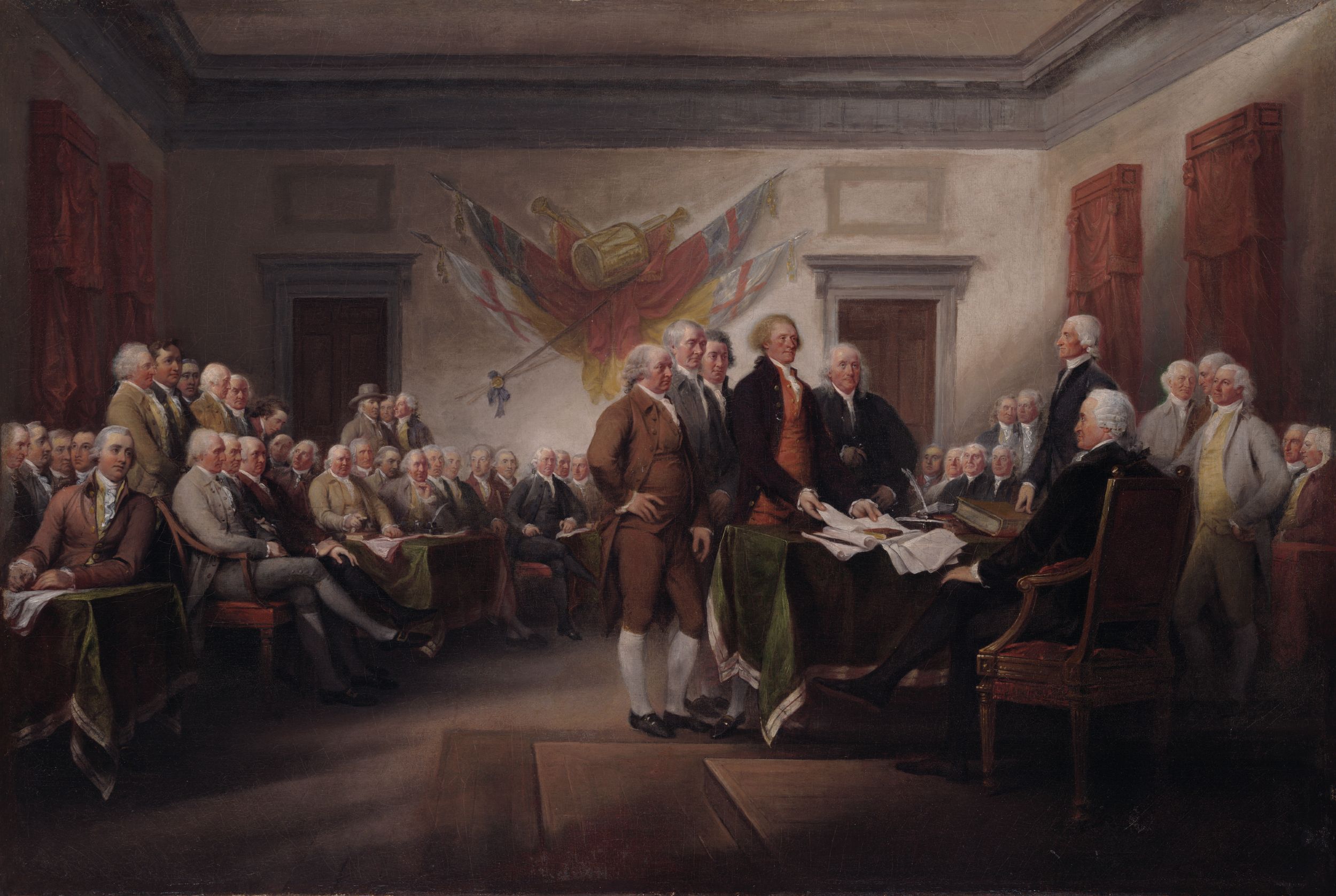
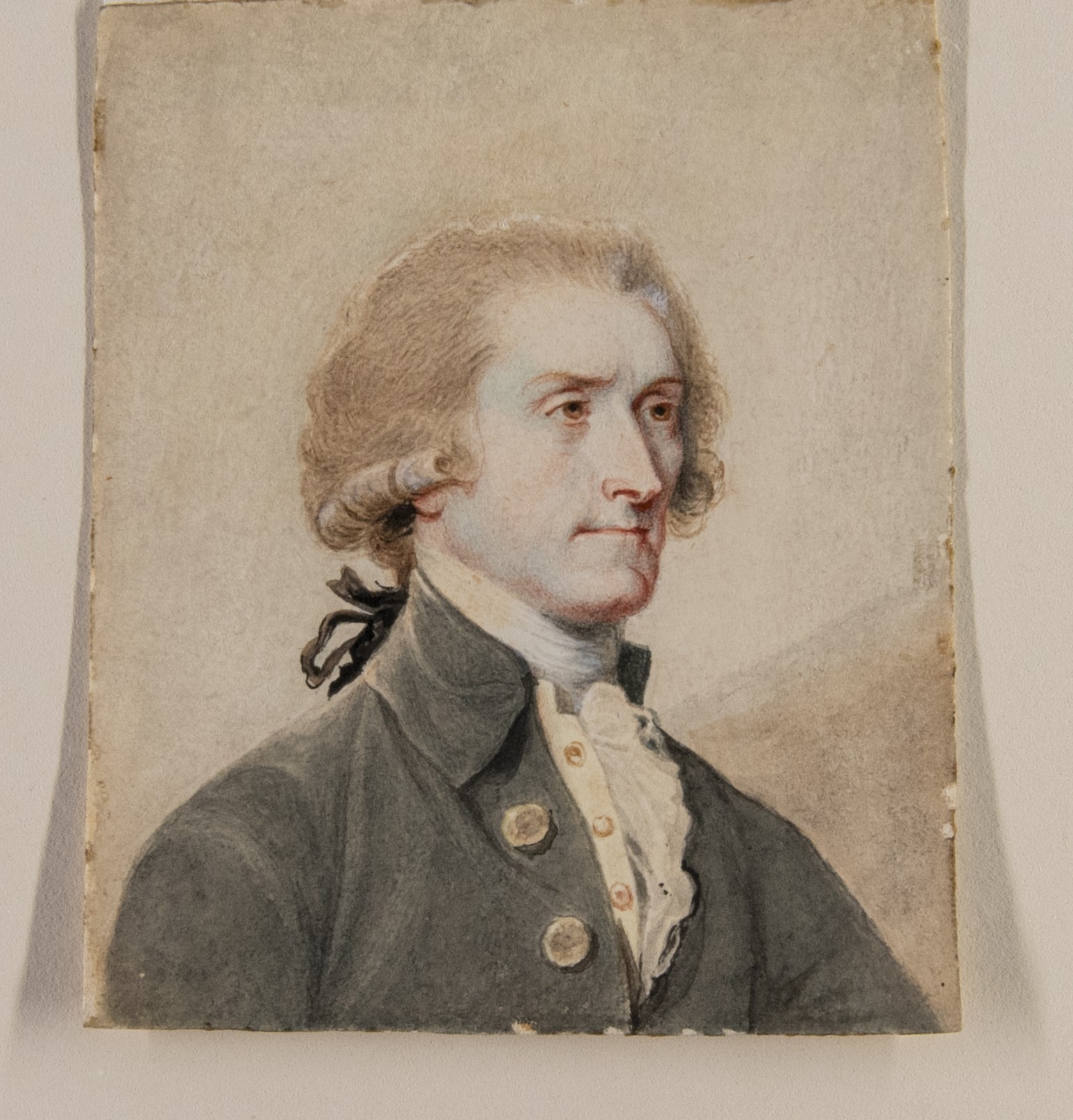
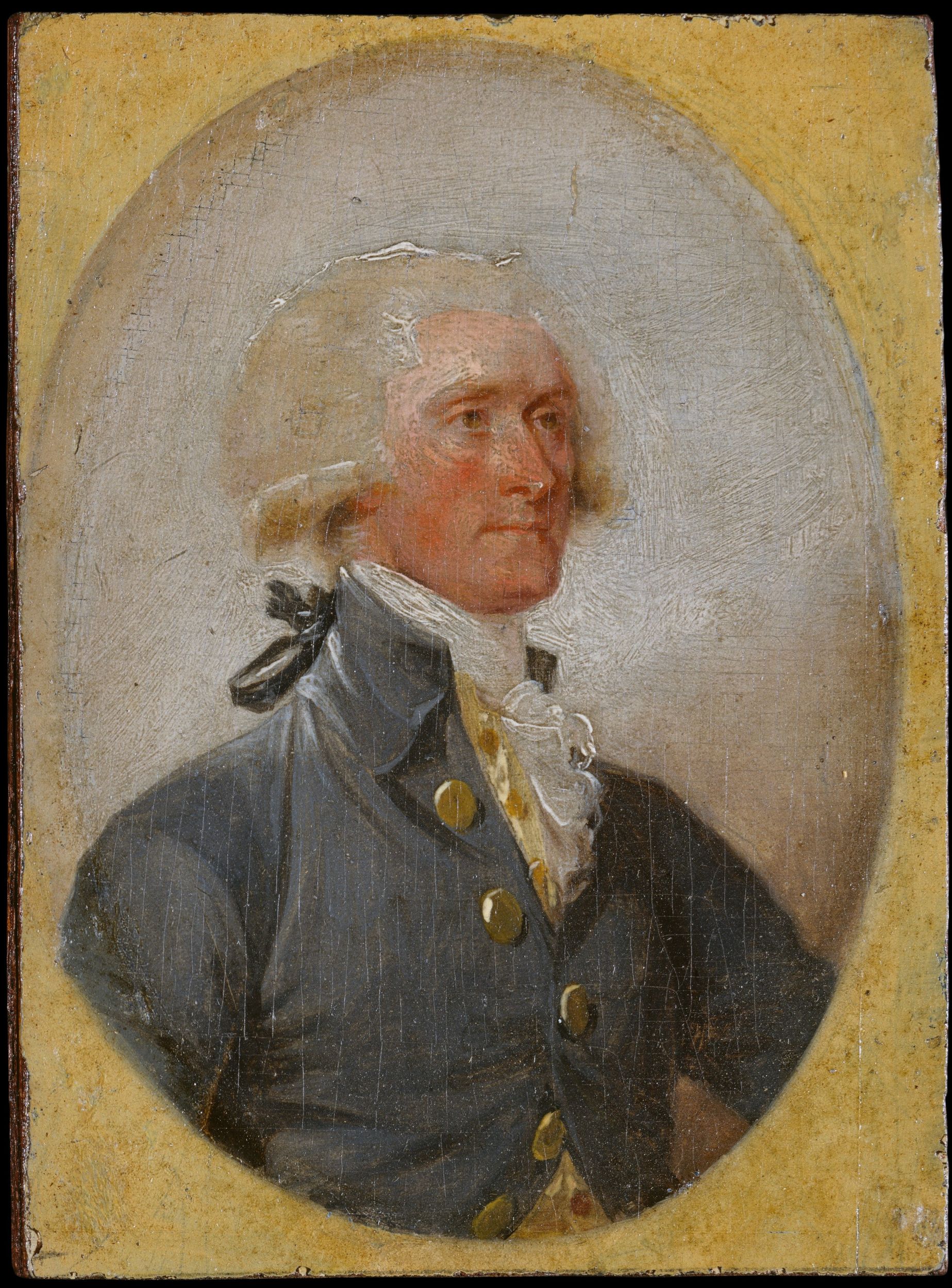
The present essay takes a fresh look at this familiar image, focusing on previously unexamined French influences that informed the canonical American work. Abundant scholarship has established that the first, smaller version of the Declaration painting was jointly conceived by Jefferson and Trumbull in 1786, when Jefferson, then minister plenipotentiary to France, hosted the fledgling artist in Paris.2 But the extent to which Jefferson and his French milieu influenced Trumbull’s image has not been fully appreciated. By identifying a French miniature on paper as a model for the Declaration’s portrait of Jefferson (fig. 2) and solving a mystery surrounding an entry in Jefferson’s memorandum book, this Research Note introduces our larger project on the painting’s Franco-American history and its role in Jefferson’s self-fashioning.
Trumbull in Paris
In the spring of 1786, Jefferson and Trumbull met in London, introduced by their mutual friend John Adams (1735–1826). The thus-far self-taught Trumbull, finding “no artist from whom I could gain oral instruction” closer to home, had crossed the Atlantic to study with expatriate Benjamin West (1738–1820).3 There he started a series of paintings depicting events of the American Revolution, intended for publication as engravings. Trumbull, a Revolutionary War veteran, began with scenes honoring patriots lost in battle. Two of these, The Death of General Warren at the Battle of Bunker’s Hill and The Death of General Montgomery in the Attack on Quebec, were ready for viewing when Jefferson visited.4 Trumbull remembered that Jefferson, who “had a taste for the fine arts . . . highly approved my intention of preparing myself for the accomplishment of a national work. He encouraged me to come to Paris, to see and study the fine works there, and to make his house my home.”5
Trumbull arrived at Jefferson’s townhouse around August 1, 1786, bearing letters of introduction to dignitaries of all varieties. He also carried his two completed battle paintings, for which, he wrote, he had “the great object of finding proper engravers.”6 Trumbull did not emerge with an engraver, but the New Englander found something more precious—privileged access to the premier buildings and collections in Paris and its environs, as well as entrée to the art world’s most influential circles. Trumbull was frequently joined in his art viewing by the English miniaturist Richard Cosway (1742–1821) and his wife, the artist Maria Hadfield Cosway (1760–1838).7 It was Trumbull who introduced Jefferson to Maria Cosway, perhaps as early as August 10, initiating their lifelong connection. Trumbull noted that thereafter “Mr. Jefferson joined our party almost daily.”8
Looking back on his experience in this rich artistic milieu, Trumbull wrote, “I employed myself, with untiring industry, in examining and studying whatever had relation to the arts.”9 The thirty-year-old Trumbull feared he had “entered the profession at too late an hour,”10 and he lamented that New England’s dearth of cultural treasures had largely limited his early instruction to copying after prints. Eager to make up for lost time, he kept a journal documenting his travels and recording his responses to paintings, sculptures, and architecture.11 Trumbull also noted French artists’ reactions to his work. Having dined with Jacques-Louis David (1748–1825) at the fashionable home of the prominent art dealer Jean-Baptiste-Pierre Lebrun (1748–1813) and his wife, the celebrated portraitist Élisabeth Vigée-Lebrun (1755–1842), Trumbull invited David to view his “national works” at Jefferson’s house. David’s response was not what Trumbull hoped: “The Sieur David . . . did me the honor to visit my pictures; his commendation, I fear, was too much dictated by politeness.”12
Jefferson, in contrast, took great interest in Trumbull’s project. Amid peripatetic rounds of sightseeing and socializing, Jefferson and Trumbull discussed Trumbull’s great American series, devising a new scene centered on the Declaration of Independence meant to be painted and engraved with the rest.13 Jefferson left no comment on why he favored this topic for Trumbull, but in a 1786 letter to a French historian, he wrote, “The memory of the American Revolution will be immortal and will immortalize those who record it.”14 The painted Declaration of Independence would solidify Jefferson’s role as the author of the nation’s founding document while establishing Trumbull as the artist who helped fellow citizens envision its debut.
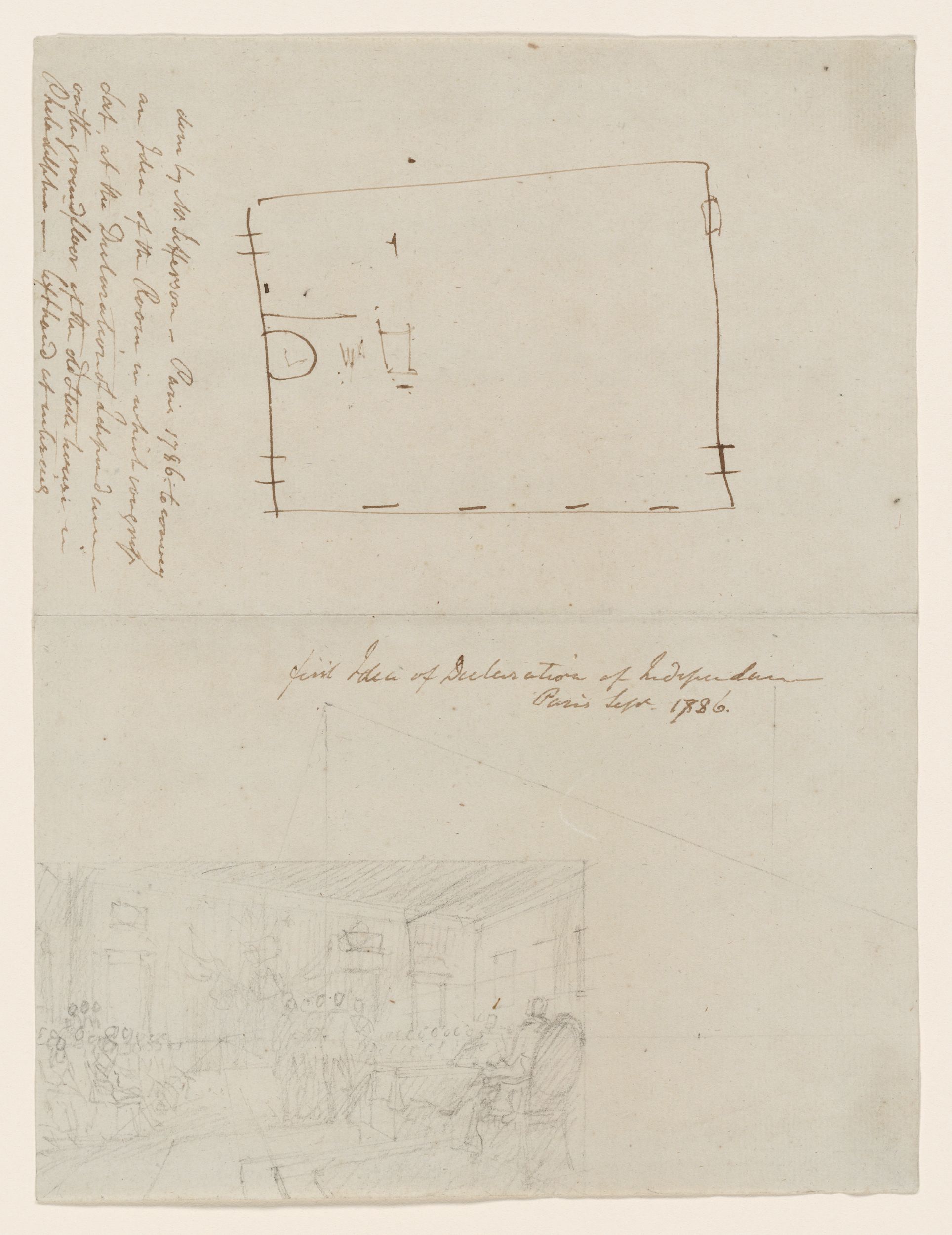
As the conversation evolved between the statesman and the artist, Jefferson helped shape the image. He recounted who attended and even sketched the floorplan of the Pennsylvania State House Assembly Room where the Declaration was presented (fig. 3).15 Trumbull added to the same small sheet a compositional sketch featuring Jefferson as the central figure driving the narrative, labeling the two drawings “First Idea of Declaration of Independence, Paris, Sept. 1786.”16 The Declaration project aligned with Jefferson’s recently conceived gallery of “American Worthies” featuring portraits of the nation’s founders. Inspired by the famed Temple of Worthies at Stowe Gardens in Buckinghamshire, England, which he and Adams visited in April 1786, Jefferson planned for his Virginia home, Monticello, a series of portraits of “calm philosophers” and “Worthies who spent their lives in action.”17 Immortalizing the men who embodied both the thought and the action necessary to form a new nation, the Declaration exemplified the values Jefferson sought to promote.
On September 9, 1786, Trumbull set out for the border town of Metz, France, leaving Jefferson behind. His journal is silent on what, if anything, Trumbull did before his coach departed, but Jefferson devoted the day to his customary cultural rounds. The memorandum book, where Jefferson recorded his daily spending, lists expenses including books, a performance at the Comédie-Italienne, a tour of the royal storehouse known as the Gardes-Meubles, and, of greatest interest to our story, a “picture” that has gone unidentified for 240 years: “Pd. Mlle. Guyard [crossed out text] for picture 240f.”18
The Studio of Adélaïde Labille-Guiard
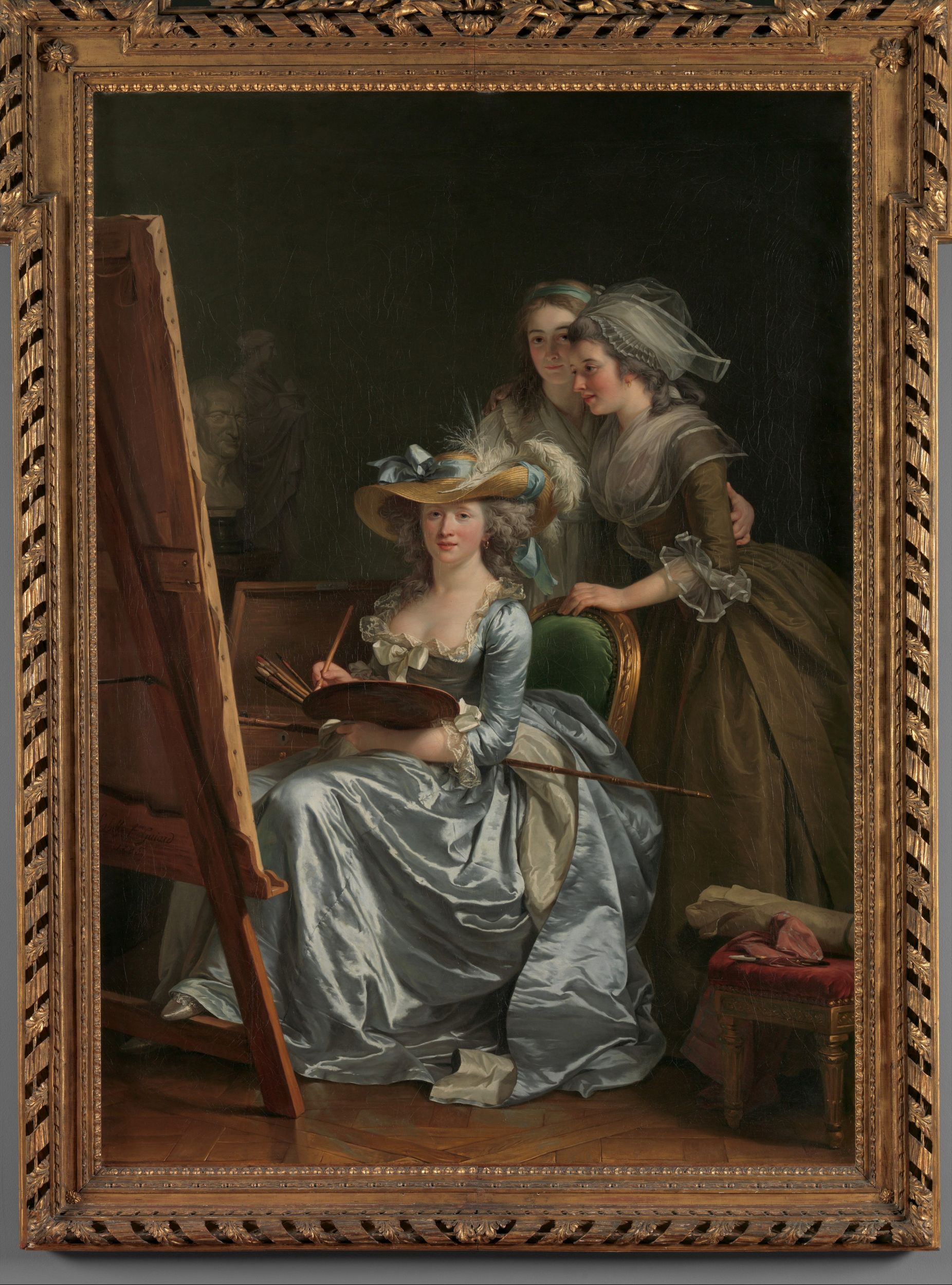
Adélaïde Labille-Guiard (1749–1803) ranked among the most acclaimed portraitists in Paris during the 1780s.19 She and Vigée-Lebrun had been admitted to the Royal Academy of Painting and Sculpture on the same day in 1783, doubling the number of female Academicians and causing a stir. Her star rose still higher at the 1785 Salon, where she exhibited her life-sized Self-Portrait with Two Pupils (fig. 4), depicting the artist with her students Marie Marguerite Carreaux de Rosemond (1765–1788) and Marie-Gabrielle Capet (1761–1818). Now in the collection of the Metropolitan Museum of Art, New York, this stunning triple portrait of women artists inspired viewers to choruses of accolades. We know from Trumbull’s journal that he visited the women’s studio on August 11, possibly accompanied by Jefferson.20 He apparently lingered long enough to sketch Rosemond, the student at the left of Labille-Guiard’s Self-Portrait with Two Pupils, in the margins of an unrelated drawing.21
We believe the picture for which Jefferson paid “Mlle Guyard” on September 9 is the watercolor miniature on paper depicting Jefferson now housed in the Virginia Museum of History and Culture (VMHC), Richmond (see fig. 2). Bearing the words “Portrait of Mr. Jefferson” in Trumbull’s handwriting on the verso and clearly related to the Declaration’s portrait of Jefferson, the miniature was long attributed to Trumbull.22 However, the VMHC miniature differs so significantly from any known work by Trumbull that this attribution cannot be correct.
Trumbull did create scores of portrait sketches, taken either from life or from other works of art, to serve as the basis of his narrative paintings. These are generally either oil-on-wood miniatures or monochromatic graphite drawings that define bold facial volumes with heavily worked lines.23 In contrast, the VMHC miniature on paper combines delicate drawing with judiciously applied watercolor. In a mode favored by eighteenth-century French artists, the shadows are shot through with nuanced color: Blue-green hues model contours; blended passages of yellow, white, and gray suggest the neckband’s curvature; and sanguine shading delineates the chin, jawline, and eye sockets.24
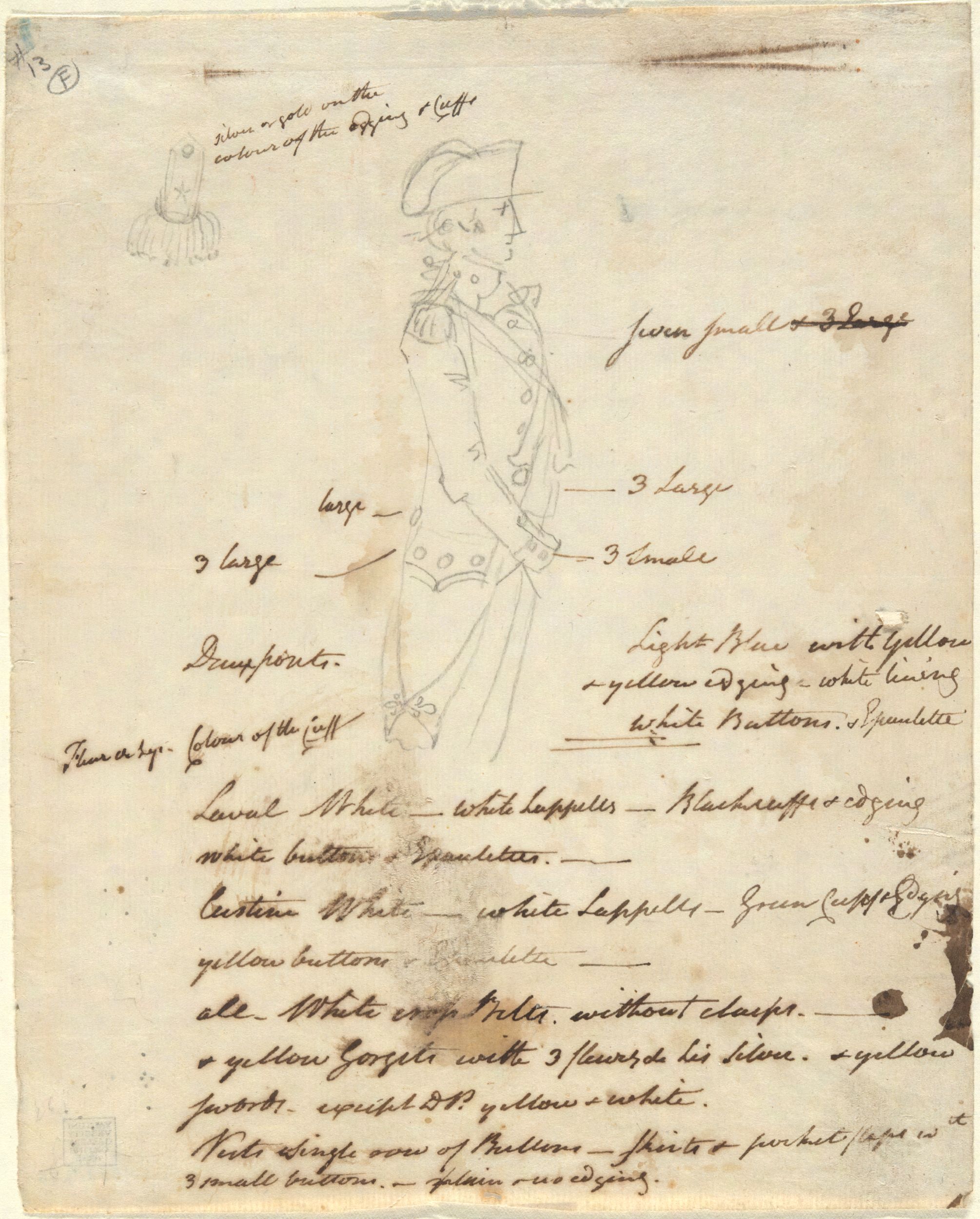
The miniature’s approach to costume is equally unlike Trumbull’s. His pencil sketches generally suggest dress through cursory strokes; to record specifics of sitters’ attire, Trumbull created outline drawings with explanatory annotations (fig. 5). Trumbull’s autobiography acknowledges the challenges he faced in capturing the look and feel of clothing, recalling a 1784 episode when he showed a recently completed double portrait to the preeminent British painter Sir Joshua Reynolds. As Trumbull put it, “The moment [Reynolds] saw it, he said, in a quick sharp tone, ‘that coat is bad, sir, very bad; it is not cloth—it is tin, bent tin.’ The criticism was but too true.”25
Depicting fashions and fabrics ranked among the strengths of Labille-Guiard’s studio. The daughter of a merchant who ran a stylish notions shop, Labille-Guiard was raised around fabrics and accoutrements, and she possessed an exceptional ability to evoke a wide range of materials. Self-Portrait with Two Pupils showcases these skills, capturing shimmering silk, lush velvet, and translucent lace (see fig. 4). It also reveals the artist’s currency in the fast-changing fashions of the day, featuring a pose and costume inspired by fashion plates circulating at the time.26 The miniature shares this attention to style and texture, picturing Jefferson in a frock coat with a high, turned-down collar of a type inspired by English trends and increasingly worn in 1780s Paris.27 Jefferson’s hairstyle is similarly au courant, coiffed into a pigeon-wing curl and swept back in a queue held in place by a looping ribbon.
The format, pose, and medium of the Jefferson miniature are as typical of Labille-Guiard’s studio as they are unusual for Trumbull. Although best remembered for magnificent full-length paintings, Labille-Guiard and her students routinely produced bust-length portraits in oil, pastel, or miniature. Whether made in preparation for grand compositions, commissioned as copies after more elaborate productions, or intended as finished pieces, these comparatively modest works generally depict figures seated in three-quarter poses against undifferentiated backgrounds and dressed in carefully observed styles befitting their stations.28 Labille-Guiard and her students particularly excelled at watercolor miniatures. In 1774, Labille-Guiard sent a miniature self-portrait on ivory to her first exhibition, and elite clientele continued to commission miniatures from her studio throughout her career.29 The medium remained so central to her studio’s identity that one of the last known paintings by Labille-Guiard is a 1798 oil portrait of Marie-Gabrielle Capet, the student seen at the right of Self-Portrait with Two Pupils, shown at work on a miniature in progress.30
Jefferson’s Memorandum Book Entry
Jefferson’s memorandum book—with the line: “Pd. Mlle. Guyard [crossed out text] for picture 240f”—offers compelling clues about the “picture” Jefferson purchased from this sought-after studio. The recorded sum of 240 francs (a denomination Jefferson used interchangeably with livres) suggests a work of the watercolor’s size and medium.31 As a favored portraitist to the aunts and sister of King Louis XVI, Labille-Guiard commanded prices that matched the elevated status of her patrons. In 1783, she received 1,200 livres for a single portrait of the king’s aunt Madame Adélaïde.32 When Jefferson visited, she was occupied with additional royal projects that she would exhibit at the salon in 1787. That year, she was paid 9,060 livres “for several portraits commissioned by Madame Élisabeth,” the king’s sister, and be named peintre de Mesdames—official painter to the aunts of Louis XVI.33 For 240 livres, Jefferson could have acquired only a small work from her studio, most likely painted on paper; an ivory support would increase the cost.
For Jefferson, though, 240 livres was a substantial outlay: The pictures he purchased in Europe generally cost less than half that amount.34 An entry in the memorandum book on the following day reflects a more typical purchase: On September 10, Jefferson paid Jean Valade 96 livres for a painting known to be the copy of a portrait of Benjamin Franklin that now hangs at Monticello.35 Jefferson had, however, been willing to pay almost exactly 240 livres for one piece of art earlier that year. In London on April 25, 1786, Jefferson sat for the American painter Mather Brown (1761–1831) and paid him 10 English pounds—roughly 240 livres—for a half-length oil portrait of himself.36 It appears that recording his own visage for posterity was worth the expense.
Two other aspects of this entry are more mysterious. The first is that some of the text is crossed out. Scientific examination indicates that the effacing marks and the addition of the correct word “picture” were made by Jefferson at the time of the notation.37 While the passage remains difficult to decipher, one study suggests that he initially wrote “engraving” only to strike it out, replacing it with “picture.”38 If this is correct, Jefferson could have been clarifying his thoughts: The Declaration was conceived as an engraving, as he might have written at first, but the picture he acquired was in service of that engraving.
The second enigma involves Jefferson’s reference to paying “Mlle”—an abbreviation for mademoiselle, meaning an unmarried woman—“Guyard.” Because Guiard (or Guyard) was the surname of Labille-Guiard’s husband, the artist was never known as “Mlle Guiard”: Before marriage she was Mlle Labille; in 1786 she was Mme Guiard. Exchanging “Mlle” for “Mme” could have been an orthographic error. Yet, since Jefferson reviewed this entry and made one correction, it seems likely that he would have caught a second error. Moreover, because courtesy titles rarely appear in Jefferson’s memorandum books, the word choice seems significant. Perhaps his transaction was not, in fact, with Labille-Guiard, but with one of her unmarried students.
The scarcity of known works by most of Labille-Guiard’s students makes it difficult to attribute the miniature to a particular pupil with certainty. But the one student for whom a sizable oeuvre has survived was, in a sense, the “mademoiselle” of Labille-Guiard’s household—Marie-Gabrielle Capet.39 Labille-Guiard’s star student, Capet lived with her teacher at multiple residences throughout their lives. So familial were their bonds that Capet’s last will expresses her wish to be buried next to “my father,” referring to Labille-Guiard’s second husband, François-André Vincent (1746–1816).40 It is thus possible that Jefferson referred to Capet as “Mlle Guyard.”
Capet’s portraits in miniature, pastel, and oil reflect the influence of her teacher in their poses, attention to styles, and rendering of fabrics and textures, and both women were consistently praised for the honesty of their portraits.41 For instance, a review of the 1782 exhibition at the Place Dauphine lauded the “truthfulness” of Capet’s pastels, and an account of the 1785 Salon described Labille-Guiard as a “painter of nature and truth.”42 This reputation for fidelity to nature distinguished both artists from the more flattering Vigée-Lebrun, whose coloristic manner Jefferson would later denigrate as “fan colouring.”43 Capet, who typically followed the widespread practice of capturing her sitters’ appearances in watercolor on paper before putting her brush to more precious ivory tablets, could well be the unidentified artist of the Jefferson watercolor.44
A Model Likeness
Given the comparatively large sum that Jefferson paid Mlle Guyard, it is curious that he seems never to have recorded this picture again. It appears in no correspondence, on no packing lists, and nowhere in his relatively comprehensive Catalogue of Paintings &c. at Monticello.45 Surely, he did not simply lose track of such a valued object?
We believe Jefferson never recorded the picture again because Trumbull took it with him when they parted. Trumbull left Paris intending to include The Declaration of Independence in his “national work,” but the reality of physical distances and the time required to capture portraits of the fifty-six signers meant the painting and print might take years to accomplish, which is in fact what happened.46 As a contingency, perhaps Jefferson provided Trumbull with a picture on which to model his likeness in the Declaration.
As events unfolded, Trumbull returned to Paris in 1787, where, according to his autobiography, he “painted the portrait of Mr. Jefferson in the original small Declaration of Independence.”47 Trumbull’s methodical approach generally involved preparatory portraits, yet we know of no preliminary portrait of Jefferson by Trumbull. Because of this absence, it has long been assumed that Trumbull painted Jefferson from life directly onto the canvas without availing himself of his usual preliminary study. However, the similarities between the images of Jefferson in Trumbull’s Declaration and the French miniature suggest that the artist consulted the watercolor while painting the oil in Jefferson’s presence.
Jefferson’s pose and expression in the two works match nearly exactly, as do the style of his clothing and hair ribbon. In fact, the anglicized French style that Jefferson had favored during his Paris sojourn echoes across the Declaration, clothing men of 1776 in fashions rarely seen on American shores until the 1790s.48 The most striking similarity between the miniature and Trumbull’s rendering of Jefferson in the first, smaller version of the Declaration of Independence is the size: If the watercolor were placed over the Declaration, the respective outlines of Jefferson’s figure would map perfectly onto each other.
Why would Jefferson commission a preparatory work from an artist other than Trumbull? Certainly, Jefferson admired Trumbull’s ambitions, trusted him to design a complex narrative composition, and believed he possessed the administrative abilities to coordinate the scores of portrait sittings the Declaration required. Yet Jefferson apparently harbored doubts about Trumbull’s readiness to capture compelling individual likenesses. On October 4, 1787, Jefferson intimated as much in a letter to Trumbull himself. Writing to the artist, Jefferson requested that Trumbull “ask the favor of Mr. [Mather] Brown to draw a picture for me of Mr. [Thomas] Paine, author of common sense, now in London.”49 Alluding to the unspoken fact that he did not want Trumbull to draw Paine himself, Jefferson added, “I hope there is no gaucherie in charging you with this commission to a brother painter.”50
Trumbull evidently turned to the watercolor again in 1788, using it as the model for three miniature oil portraits of Jefferson painted for Angelica Schuyler Church (1756–1814), now in the Metropolitan Museum of Art (fig. 6); Maria Cosway; and Jefferson’s daughter Martha (1772–1836).51 Because these miniatures share the pose, expression, and clothing style of the Declaration’s Jefferson, scholars have assumed they were copied after the Declaration.52 This misconception was fueled by a letter from Maria Cosway to Jefferson of March 6, 1788, asking, “Will you give Mr. Trumbull leave to make a Coppy of a certain portrait he painted at Paris?”53 We believe the Declaration and the oil miniatures share a common source in the watercolor, which depicts Jefferson in the same hairstyle and clothing colors as the oils but features a high level of observed detail that marks it as the original. Although Cosway requested a copy after a work by Trumbull, the oil and watercolor miniatures seem to have been made by different artists: The oils feature broader handling, more exaggerated flesh tones, and a notable shift in the alignment of the three lower buttons. Trumbull had a portrait of Jefferson by his own hand in the Declaration, but he based Cosway’s oil miniature on the French portrait his patron provided.
Trumbull worked on the Declaration for a few years before setting it aside until 1817, when John Adams and Jefferson backed his effort to revive and expand the project.54 Trumbull received a commission “to compose and execute four paintings, commemorative of the most important events of the American Revolution, to be placed . . . in the capitol of the United States.”55 The agreement prioritized the Declaration as the first work to be undertaken.56
In a letter to Jefferson dated October 1, 1823, Trumbull celebrated the achievement of the “favored project,” terming it “this work which I meditated, & which you assisted me to arrange.”57 But our research has shown that Jefferson did more than help “arrange” the Declaration. By commissioning a miniature portrait from the studio of Labille-Guiard as a reference for Trumbull, Jefferson ensured that he would be portrayed according to his wishes, as a polished statesman, equally comfortable in the power center of Paris and in the Pennsylvania State House. Like the document it celebrates, the painted Declaration of Independence evidently sprouted from European roots.
Cite this article: Laura Auricchio and Diane C. Ehrenpreis, “Portrait of Mr. Jefferson: A French Miniature and the Origin of John Trumbull’s The Declaration of Independence,” Panorama: Journal of the Association of Historians of American Art 12, no. 2 (Fall 2026), https://doi.org/10.24926/24716839.21385.
Notes
The authors wish to thank the dedicated staff at the following institutions who generously shared their time, resources, and expertise with us as this project developed: Fordham University Libraries; Frick Collection; Historical Society of Pennsylvania; Massachusetts Historical Society; Metropolitan Museum of Art, American Wing; Virginia Museum of History and Culture; and Yale University Art Gallery, Department of American Art and Department of Prints and Drawings. We are also grateful to the John Simon Guggenheim Memorial Foundation and the Thomas Jefferson Foundation for their support. A special thank you to Wendy L. Tackett and Paul Tackett for bringing this miniature to our attention.
- Our understanding of Trumbull is primarily indebted to the following sources: Richard Brookhiser, Glorious Lessons: John Trumbull, Painter of the American Revolution (Yale University Press, 2024); Irma B. Jaffee, John Trumbull: Patriot-Artist of the American Revolution (New York Graphic Society, 1975); Irma B. Jaffee, Trumbull: The Declaration of Independence (Viking, 1976); Theodore Sizer, with the assistance of Caroline Rollins, The Works of Colonel John Trumbull: Artist of the American Revolution, rev. ed. (Yale University Press, 1967); Paul J. Staiti, Of Arms and Artists: The American Revolution Through Painters’ Eyes (Bloomsbury, 2016); and John Trumbull, The Autobiography of Colonel John Trumbull, Patriot-Artist, 1756–1843, ed. Theodore Sizer (Yale University Press, 1953). ↵
- Jaffee, Trumbull: The Declaration of Independence, 64–67. ↵
- Trumbull, Autobiography of Colonel John Trumbull, 61. ↵
- Both works are now in the Yale University Art Gallery, New Haven, CT, inv. nos. 1832.1 and 1832.2, respectively. ↵
- Trumbull, Autobiography of Colonel John Trumbull, 92–93. ↵
- Trumbull, Autobiography of Colonel John Trumbull, 92. ↵
- Trumbull, Autobiography of Colonel John Trumbull, 93. ↵
- Trumbull, Autobiography of Colonel John Trumbull, 120. ↵
- Trumbull, Autobiography of Colonel John Trumbull, 93. ↵
- Trumbull, Autobiography of Colonel John Trumbull, 91. ↵
- Trumbull, Autobiography of Colonel John Trumbull, 93. ↵
- Trumbull, Autobiography of Colonel John Trumbull, 111. ↵
- Trumbull remembered that “during my visit, I began the composition of the Declaration of Independence, with the assistance of his {Jefferson’s} information and advice.” Trumbull, Autobiography of Colonel John Trumbull, 93. ↵
- G. S. Wilson, Jefferson on Display: Attire, Etiquette and the Art of Presentation (University of Virginia Press, 2018), 57. ↵
- Jaffee, Trumbull: The Declaration of Independence, 75. ↵
- Jaffee, Trumbull: The Declaration of Independence, 65. ↵
- Emilie Johnson, “Artistic Friends and Foes,” in Monticello Magazine (Spring–Summer 2025), 19–20; William Gilpin, A Dialogue upon the Gardens of the Right Honourable the Lord Viscount Cobham, at Stow in Buckinghamshire, 2nd ed. (B. Seeley, 1749), 28–30. Jefferson owned the revised edition: Benton Seeley, Stowe: A Description of the Magnificent House and Gardens of the Right Honourable Richard Greville Temple (B. Seeley, 1783). For more on Jefferson’s art collection and his understanding of worthies, see Susan R. Stein, “A Revolutionary Gallery: Monticello’s Remarkable Parlor,” Monticello Magazine (Summer 2018), 20–23; and Wilson, Jefferson on Display, 44–50. ↵
- “Memorandum Books, 1786,” Founders Online, National Archives, accessed August 19, 2026, https://founders.archives.gov/documents/Jefferson/02-01-02-0020. Originally published in The Papers of Thomas Jefferson, 2nd ser., Jefferson’s Memorandum Books, ed. James A. Bear Jr. and Lucia C. Stanton (Princeton University Press, 1997), 1:605–49. ↵
- On Adélaïde Labille-Guiard (sometimes spelled Guyard), see Laura Auricchio, Adélaïde Labille-Guiard: Artist in the Age of Revolution (J. Paul Getty Museum, 2009); Anne-Marie Passez, Adélaïde Labille-Guiard, 1749–1803: Biographie et catalogue raisonné (Georges Petit, 1973); Roger Portalis, Adélaïde Labille-Guiard (1749–1803) (Georges Petit, 1902); Bridget Quinn, Portrait of a Woman: Art, Rivalry & Revolution in the Life of Adélaïde Labille-Guiard (Chronicle, 2024); Paris A. Spies-Gans, A Revolution on Canvas: The Rise of Women Artists in London and Paris, 1760–1830 (Yale University Press, 2022). ↵
- Trumbull, Autobiography of Colonel John Trumbull, 111. ↵
- An inscription on the verso of Trumbull’s drawing Madonna and Child with Saints Joseph and John (1786) identifies the female figure in the upper margin as Rosemond: Fordham University Libraries, New York, Trumbull Drawings, https://www.library.fordham.edu/digital/item/collection/trumbull/id/8. Trumbull later developed a more complete drawing of Rosemond. See Sizer, Works of Colonel John Trumbull, fig. 134. ↵
- The Trumbull attribution might have originated with the sale catalogue, which states, “This miniature appears to be an hitherto unrecorded miniature of Jefferson by Trumbull”; Sotheby’s, New York, Property from the Estate of the Late Edith Kane Baker, October 28–29, 1977, p. 621, lot 618. Prior to 1977, this miniature was unknown to scholars. It was not included in Alfred L. Bush, The Life Portraits of Thomas Jefferson: Catalogue of an Exhibition at the University of Virginia Museum of Fine Arts, 12 Through 26 April 1962, exh. cat. (Thomas Jefferson Memorial Foundation, 1962). It is published in Virginius C. Hall, Portraiture in the Collection of the Virginia Historical Society (University of Virginia Press for Virginia Historical Society, 1981), 128. ↵
- For an example of Trumbull’s preparatory pencil sketches, see the portrait titled Hopkins (1791), Fordham University Libraries, New York, Trumbull Drawings, https://www.library.fordham.edu/digital/item/collection/trumbull/id/33. On Trumbull’s characteristic use of oil on wood in miniature painting, see Sizer, Works of Colonel John Trumbull, 133–37. ↵
- On the use of colored shadows, especially blues and greens, in eighteenth-century French art, see Paul Smith, “Painted Coloured Shadows: An Introduction,” Vision Research 209 (August 2023), https://doi.org/10.1016/j.visres.2023.108225. ↵
- Trumbull, Autobiography of Colonel John Trumbull, 86. ↵
- On Labille-Guiard and fashion plates, see Laura Auricchio, “Self-Promotion in Adélaïde Labille-Guiard’s 1785 ‘Self-Portrait with Two Students,’” Art Bulletin 89, no. 1 (2007): 51–53. ↵
- On Jefferson’s preference for the frock coat, see Wilson, Jefferson on Display, 36–40. ↵
- For instance, in the online edition of Dictionary of Pastellists before 1800 Neil Jeffares reproduces dozens of pastels in this format by Labille-Guiard (see https://www.pastellists.com/Articles/LabilleGuiard.pdf, updated July 16, 2026) and by her student Marie-Gabrielle Capet (see https://www.pastellists.com/Articles/Capet.pdf, updated July 23, 2026). ↵
- Adélaïde Labille-Guiard, Self Portrait (1774), Foundation Miniaturensammlung Tansey, Celle, Germany, inv. no. 10418, https://tansey-miniatures.com/en/collection/10418. See discussion in Auricchio, Adélaïde Labille-Guiard, 5–16. ↵
- See Auricchio, Adélaïde Labille-Guiard, 104, fig. 72. ↵
- “Memorandum Books, 1784,” Founders Online, National Archives, accessed August 19, 2026, https://founders.archives.gov/documents/Jefferson/02-01-02-0018. Originally published in Bear and Stanton, Jefferson’s Memorandum Books, 1:541–72. Jefferson used the symbols f and ₶ interchangeably. For more on efforts to identify the work, see Auricchio, Adélaïde Labille-Guiard, 50; and Quinn, Portrait of a Woman, 117. ↵
- Adélaïde Labille-Guiard, Royal Receipts, payment from the Maison du Roi, inv. no. F/17/1306, Archives nationales, Paris. ↵
- “. . . pour différents portraits ordonner par Madame Élisabeth”; “État des Dépenses Extraordinaire faits en la Chambre de Madame Élisabeth de France, de son ordre et Exprès Commandement, et ordonnées par Madame la Comtesse Diane de Polignac, Dame d’honneur pendant l’Année 1787,” inv. no. O/1/3787, Archives nationales, Paris. We are aware of three Labille-Guiard paintings of Mme Élisabeth dating to or around 1787, one pastel and two oils. In 1791, with inflation weakening French currency, Labille-Guiard was paid 5,000 livres for a single copy of a portrait of Madame Adélaïde. Receipt, February 14, 1791, inv. no. A1494, Archives des Yvelines, Montigny-le-Bretonneux, France. ↵
- Susan R. Stein, The Worlds of Thomas Jefferson at Monticello (Harry N. Abrams, 1993), 29. ↵
- “Memorandum Books, 1786,” 605–49. ↵
- “Memorandum Books, 1786,” 605–49. Historical Currency Converter, accessed July 11, 2026, https://www.historicalstatistics.org. ↵
- Joseph Lasala, research fellow at Thomas Jefferson Foundation, to the author, July 1, 2025. ↵
- Lasala to the author, July 1, 2025. ↵
- On Capet, see Arnauld Doria, Gabrielle Capet (Beaux-Arts, 1934); Jeffares, Dictionary of Pastellists before 1800; Nathalie Lemoine-Bouchard, Les peintres en miniature actifs en France, 1650–1850 (l’Amateur, 2008), 137–39; and Marie-Gabrielle Capet, 1761–1818: Une virtuose de la miniature, exh. cat. (Snoeck, 2014). ↵
- “Mon père Vincent.” Testament Capet, October 20, 1818, Minutier Central, Étude CVIII/961, Archives nationales, Paris. ↵
- For a thorough discussion of Capet’s working method and its relation to her teacher’s, see Bernd Pappe, “Marie-Gabrielle Capet et la miniature sur ivoire,” in Marie-Gabrielle Capet, 37–44. ↵
- “On doit des éloges aux portraits en pastel de Mlle Capet, ils ont de la vérité” (Mlle. Capet’s pastel portraits deserve praise; they capture the truthfulness of the subject); “Arts: Exposition de la Place Dauphine,” Journal de Paris 158 (June 7, 1782), 640. “Peintre de la nature et de la vérité”; “A Mad. Guiard, de l’Académie royale de Peinture,” Journal Général de France 115 (September 24, 1785), 463. ↵
- “Thomas Jefferson to William Short, 6 April 1790,” Founders Online, National Archives, accessed August 10, 2026, https://founders.archives.gov/documents/Jefferson/01-16-02-0188. Originally published in The Papers of Thomas Jefferson, vol. 16, 30 November 1789–4 July 1790, ed. Julian P. Boyd (Princeton University Press, 1961), 318–21. ↵
- Pappe, “Marie-Gabrielle Capet et la miniature,” 42. ↵
- For a transcription of Jefferson’s handwritten catalogue, see Stein, Worlds of Thomas Jefferson, 434–36, or “Catalogue of Paintings,” Thomas Jefferson’s Monticello, https://www.monticello.org/encyclopedia/catalogue-paintings. The original manuscript is catalogued as Accession #2958-b, Thomas Jefferson Papers, Special Collections, University of Virginia Library. ↵
- Jaffee, Trumbull: The Declaration of Independence, 95–101. The small, painted version of the Declaration was completed in 1820, the engraving was published in 1823, and the large canvas was installed in the Capitol Rotunda in 1826. ↵
- Trumbull, Autobiography of Colonel John Trumbull, 152. ↵
- The signers’ anachronistic attire has been widely discussed. See, most recently, Chloe Chapin, “This Iconic Painting Went Full ‘Bridgerton’ on the Founding Fathers,” Washington Post, July 2, 2026, https://www.washingtonpost.com/opinions/2026/07/02/declaration-independence-painting-keeps-fashion-secret. ↵
- “Thomas Jefferson to John Trumbull, 4 October 1787,” Founders Online, National Archives, accessed August 10, 2026, https://founders.archives.gov/documents/Jefferson/01-12-02-0206. Originally published in The Papers of Thomas Jefferson, vol. 12, 7 August 1787 – 31 March 1788, ed. Julian P. Boyd (Princeton University Press, 1955), 206–7; and David Meschutt, “The Adams-Jefferson Portrait Exchange,” American Art Journal 4, no. 2 (1982): 49n13. ↵
- Trumbull replied politely, assuring Jefferson that “there was no gaucherie.” “John Trumbull to Thomas Jefferson, 30 October 1787,” Founders Online, National Archives, August 10, 2026, https://founders.archives.gov/documents/Jefferson/01-12-02-0289. Originally published in Papers of Thomas Jefferson, 12:297; and Meschutt, Adams-Jefferson, 49n14. In 1788, Trumbull painted a portrait of Thomas Paine as a gift for Jefferson, now in the Thomas Jefferson Foundation Collection, Albemarle County, VA, inv. no. 1957-28, https://collections.monticello.org/mDetail.aspx?rID=1957-28&db=objects&dir=Collections&osearch=paine&list=res&rname=&rimage=&page=1. ↵
- On these works, see Elizabeth Cometti, “Maria Cosway’s Rediscovered Miniature of Jefferson,” William and Mary Quarterly 9, no. 2 (1952): 152–55; Stein, Worlds of Thomas Jefferson, 124–25; and Wilson, Jefferson on Display, 63–67. Church’s version is in the Metropolitan Museum of Art, New York, inv. no. 24.19.1, https://www.metmuseum.org/art/collection/search/12829; Cosway’s version is in the White House Collection, Washington, DC, https://www.whitehousehistory.org/photos/thomas-jefferson-by-john-trumbull; and Randolph’s version is in the Thomas Jefferson Foundation Collection, inv. no. 1958-38, https://collections.monticello.org/mDetail.aspx?rID=1958-38&db=objects&dir=Collections&osearch=trumbull&list=res&rname=&rimage=&page=1. ↵
- See, for example, Cometti, “Maria Cosway’s Rediscovered Miniature of Jefferson,” 153; and Wilson, Jefferson on Display, 63–67. ↵
- “Maria Cosway to Thomas Jefferson, 6 March 1788,” Founders Online, National Archives, accessed August 15, 2026, https://founders.archives.gov/documents/Jefferson/01-12-02-0705. Originally published in Papers of Thomas Jefferson, 12:645. ↵
- Jaffee, Trumbull: The Declaration of Independence, 94–95. ↵
- Trumbull, Autobiography of Colonel John Trumbull, 259. ↵
- Trumbull, Autobiography of Colonel John Trumbull, 259. ↵
- “John Trumbull to Thomas Jefferson, 1 October 1823,” Founders Online, National Archives, accessed August 15, 2026, https://founders.archives.gov/documents/Jefferson/03-20-02-0174. Originally published in The Papers of Thomas Jefferson, Retirement series, vol. 20, 1 July 1823 to 31 March 1824, ed. J. Jefferson Looney et al. (Princeton University Press, 2023), 171–72. Jefferson lived long enough to receive the finished engraving, for which Trumbull charged him, but he never saw the paintings. ↵
About the Author(s): Laura Auricchio is vice president of the John Simon Guggenheim Memorial Foundation, New York. Diane C. Ehrenpreis is curator of decorative arts and historic interiors at the Thomas Jefferson Foundation, Albemarle County, VA.