

Searching for The Freedman





PDF: Reason, Searching for The Freedman
Based on the descriptive specificity of features in this work [The Freedman], it is tempting to speculate that the figure may have been based on a living model rather than on an idealized type.
—James Smalls, The Shape of Power
One may ask, was Ward an abolitionist? I am not so sure. No one can be certain; the historical record does not bring us such clarity.
—Kelvin Parnell, Emancipation: The Unfinished Project
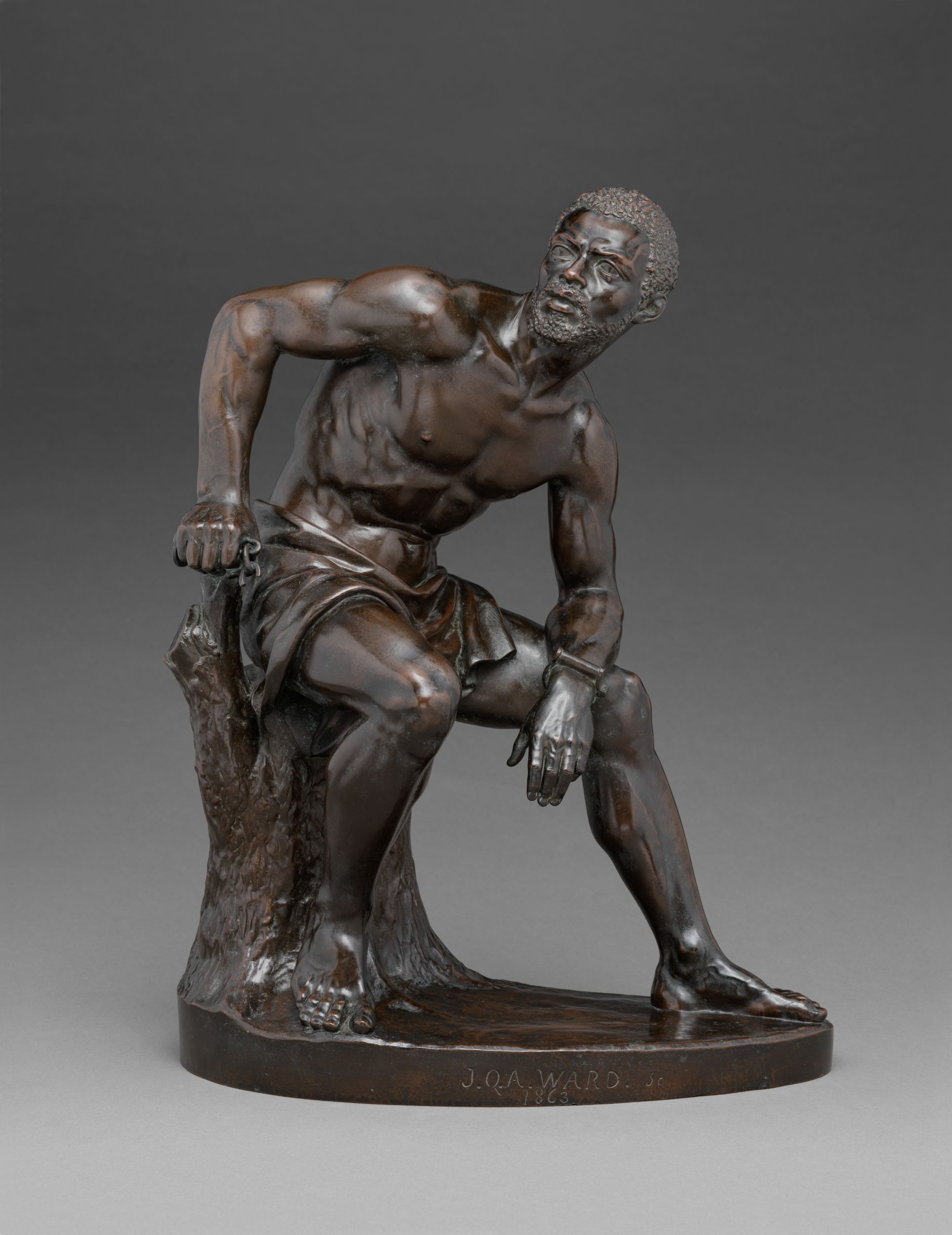
John Quincy Adams Ward (1830–1910) first exhibited a plaster of his statuette The Freedman (fig. 1) at the spring 1863 exhibition of the National Academy of Design, New York, a few months after President Abraham Lincoln’s Emancipation Proclamation went into effect that January. Art historians surmise that Ward began the sculpture the previous fall in response to Lincoln’s preliminary proclamation in September 1862. Although it measures just under twenty inches tall, the statuette has nonetheless received extensive critical and scholarly attention for its rare depiction of a formerly enslaved African American man liberated from bondage through his own action. Scholars have considered the sculpture from a number of perspectives, most recently in three important exhibitions that attended to issues of race, colonialism, and white supremacy in American sculpture: Fictions of Emancipation: Carpeaux Recast at the Metropolitan Museum of Art, New York, in 2022; Emancipation: The Unfinished Project of Liberation at the Amon Carter Museum of American Art in Fort Worth, Texas, in 2023; and The Shape of Power at the Smithsonian American Art Museum, Washington, DC, in 2024.1 All three projects extend our understanding of the sculpture in significant ways, building on the work of art historians Lewis Sharp, whose catalogue raisonné of the artist remains the indisputable basis for all subsequent scholarship on Ward, and Kirk Savage, whose insightful discussions of the work appear in his important Standing Soldiers, Kneeling Slaves and elsewhere.2
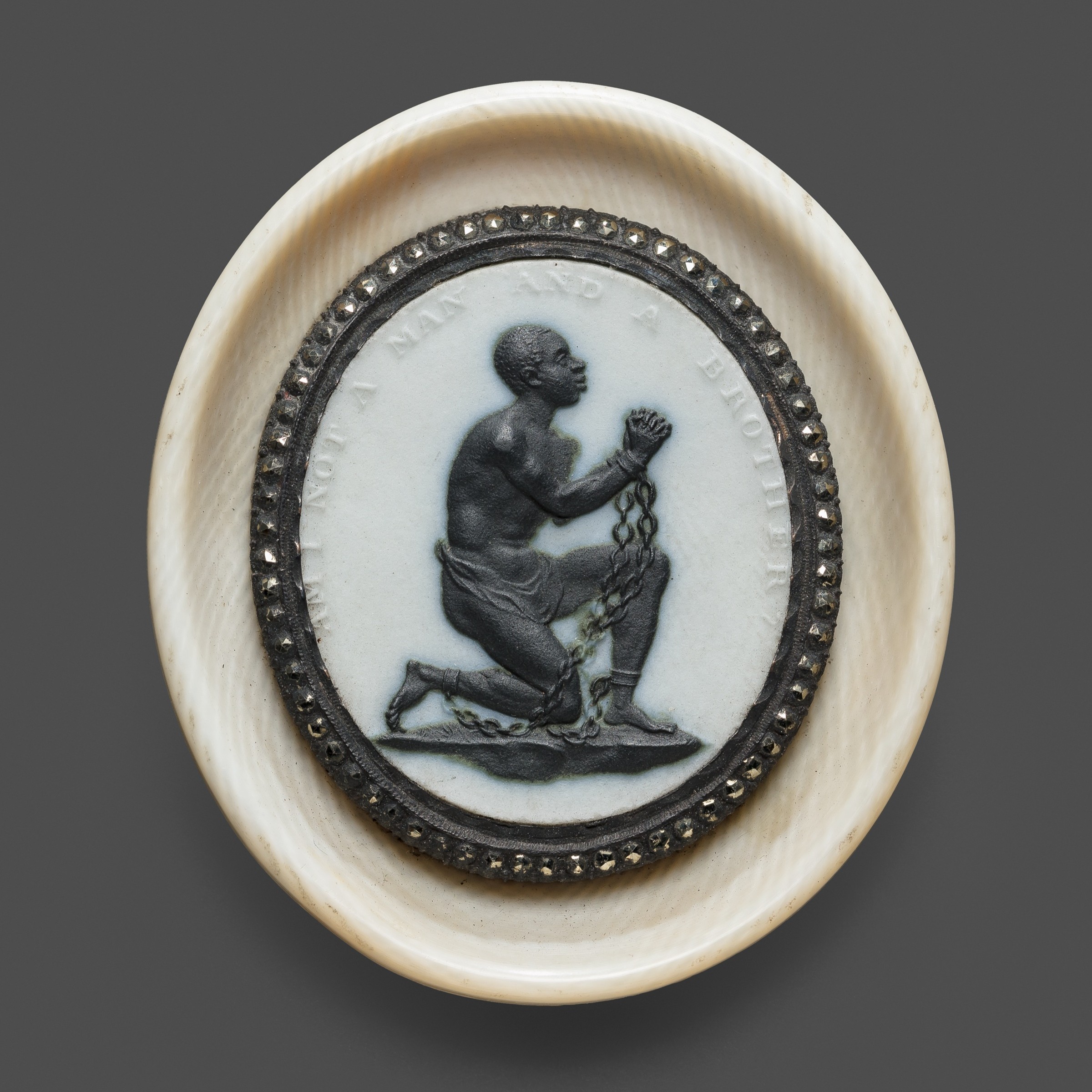
The statuette is notable for several reasons. Art historians consider The Freedman to be among the first depictions of an African American in bronze.3 The sculpted representation of an enslaved Black figure, who effects his own liberation, was also virtually unprecedented. The work has no parallel, even in imagery made in support of abolition, such as Josiah Wedgwood’s well-known antislavery medallion (fig. 2), which Ward’s figure both echoes and subverts. Unlike Wedgwood’s shackled, kneeling slave, Ward’s figure is at rest, seated on a tree stump, having freed himself from bondage, with a broken shackle held in his right hand and a remaining one encircling his left wrist. Both figures are nearly nude, yet unlike Wedgwood’s childlike supplicant, the musculature of Ward’s figure asserts his mature masculinity and emphasizes his self-determination. Although his left wrist retains its bonds, Ward’s Freedman seeks no intercessor to liberate him. His fate may be uncertain, but his agency in his own liberation is clear—and it is this action that sets the sculpture apart from other works of the period.
Scholars and critics, past and present, have also noted Ward’s deft fusion of classicism in the idealized physique of the man with realism in the specificity of the details of his face.4 Although art historians, including James Smalls, have suggested that Ward sculpted The Freedman’s distinctive features from life, no possible models have been named. While the Emancipation Proclamation was undoubtedly the political catalyst for the sculpture, it was also presumably shaped by the artist’s own politics and by his personal interactions with specific African American men. Ward himself never publicly identified his model (or models), but according to family tradition, the statuette was modeled on Ward’s childhood neighbor Caesar Russell (?–1860).5 While this family lore should not be taken at face value, there is reason to consider Russell as a potential influence on the figure. Yet scrutiny of the context in which the work was created, including an examination of the artist’s early patrons, suggests additional models on which Ward may have drawn. Indeed, a closer examination of the artist’s early career offers several clues about the origins and meaning of The Freedman. As Kelvin Parnell indicates, we cannot know with certainty what Ward’s political inclinations were when he crafted The Freedman, but we can continue to probe the archives to tease additional meaning from this provocative work.
Ward Before The Freedman
Ward’s family history and career have been thoroughly addressed by Sharp and Savage, but it is useful to review some critical points in his early career that precede the creation of The Freedman. Ward was born into a prominent family in Urbana, Ohio, and he began modeling figures from clay found on his family’s farm as a child. Family and friends took note of his talent, and in 1849, with encouragement from his older sister Eliza Thomas, Ward left Ohio for Brooklyn, New York, to live with Eliza and her husband. Eliza arranged an introduction to the Brooklyn sculptor Henry Kirke Brown (1814–1886), and Ward became his apprentice for the next seven years. Brown was a generous mentor, and the two men remained friends throughout the elder artist’s lifetime. Savage and others attribute Ward’s interest in both African American and Indigenous subject matter to Brown’s influence. Brown designed several works that included such figures, though he was not always able to secure the patronage to bring these projects to fruition. Brown’s interest in Black subjects reflected his politics. Although his patrons included wealthy southern enslavers and he lived for an extended period in South Carolina, art historians believe that Brown supported abolition.6
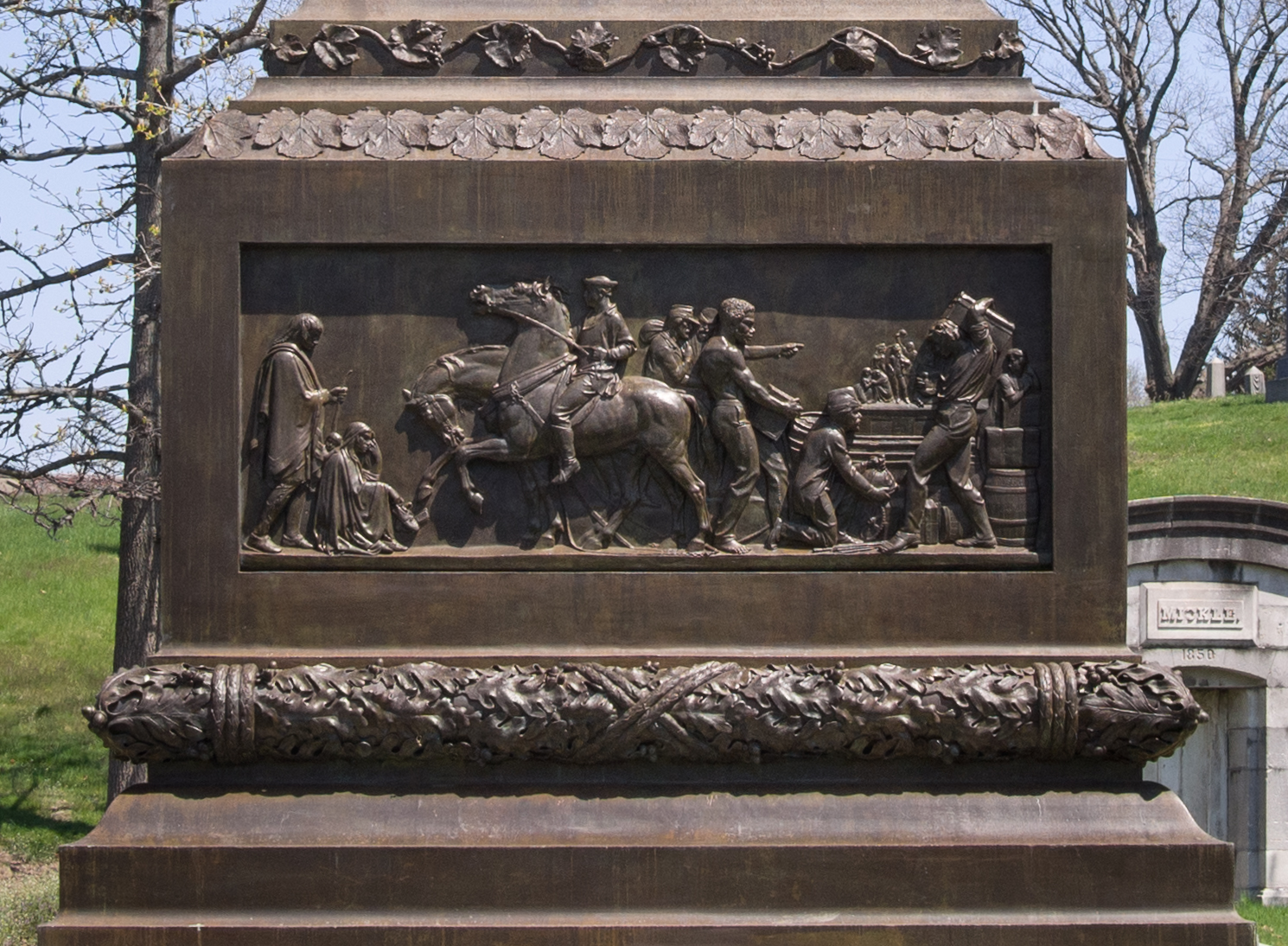
During his apprenticeship, Ward likely assisted Brown with at least one work that includes an African American figure: his 1852 statue of New York Governor Dewitt Clinton (1769–1828) for Green-Wood Cemetery in Brooklyn. A bronze relief panel below the freestanding portrait of Clinton depicts an African American man in a scene illustrating commercial productivity fostered by the opening of the Erie Canal (fig. 3), the construction of which was a signal accomplishment of Clinton’s career. In the image, a Black stevedore appears near the center of the composition, carrying a box labeled “Virginia plug tobacco.” The man’s legal status is unclear: When the canal opened in 1825, New York had passed a gradual emancipation law, yet slavery persisted into the 1850s. Regardless of whether the figure is free or enslaved, the cargo he carries connects not only him but also Northern mercantile trade in general with the institution of slavery. Brown’s depiction of an African American man in bronze was likely the only such example that Ward would have seen before he sculpted The Freedman.7
In 1856, Ward’s contributions to Brown’s equestrian statue of George Washington for Union Square in New York were significant enough that Brown inscribed the younger artist’s name on the work along with his own, marking the start of Ward’s professional career as sculptor. Ward left Brown’s studio that year and spent the next few years traveling between New York; Washington, DC; and Ohio in search of patrons. Intermittently, he kept a studio in Washington, perhaps hoping for government patronage.8 Although his frequent travel makes it difficult to pin down the precise dates of Ward’s residency in the city, we can catch glimpses of him throughout these years in letters, newspapers, and public documents. Ward was certainly resident in Washington in 1859 and 1860, when newspapers announced his presence in the city. Ward also exhibited with the short-lived Washington Art Association in both years.9
Ward’s move to Washington situated him, for the first time, in a city where slavery was not prohibited. Slavery in the nation’s capital was a highly contentious issue prior to the Civil War, despite efforts to curtail its presence there. For decades, abolitionists had called out the hypocrisy of a democratic republic that permitted slavery in its national capital. Abolitionists decried the presence of slave pens and coffles near the grounds of the Capitol building. Although the public sale of enslaved persons was prohibited within the city by the Compromise of 1850, slavery was not abolished in the capital until 1862. Ward did not record his thoughts about what he saw in Washington, but he undoubtedly witnessed enslaved persons firsthand during his sojourn in the city. Eastman Johnson’s (1824–1906) 1859 painting Negro Life at the South (New York Historical) vividly captures the conditions of urban slavery in the city at a time when Ward was present. The work depicts an intergenerational group of enslaved people in the rundown back lot of a home in Washington’s F Street, a few blocks from Ward’s 1860 residence. Likewise, his mentor, Brown, made at least one sketch of an African American man while resident in Washington, which Brown labeled “a dark page in human affairs,” suggesting that the subject was possibly in bondage.10
Ward and Abolition
Failing to obtain a federal commission, Ward turned to private patronage, seeking commissions for portraits primarily from the city’s political class.11 Among those who sought portraits from Ward were politicians representing both sides of the slavery question—including ardent abolitionists and passionate defenders of the institution of slavery. We lack any definitive statement from Ward on the question of slavery, but what can be gleaned from his family history, his patrons, and his work suggest that he was not in favor of the institution. A 1913 article in the Urbana Daily Citizen declared that Ward’s family “was strongly abolitionist,” but there is limited proof to back this assertion.12 Ward’s father, John Sr., was undeniably a Whig.13 During the war, the artist was pro-Union and identified with the Republican Party, but evidence of his politics before 1860 is slim. However, it seems likely that, even if he was not overtly abolitionist, he was sympathetic to the antislavery movement. Indeed, nearly all his congressional sitters and several of his friends were outspoken abolitionists.
The earliest of Ward’s portraits from this period appears to be a bust (now lost) of the abolitionist Ohio congressman Joshua Giddings (1795–1864). Giddings represented the Western Reserve for two decades, during which he became well known for his staunch antislavery views.14 Initially elected as a Whig, his opposition to slavery led him to join the Free Soil Party prior to becoming a founder of the Republican Party. In the House, Giddings was censured for violating the “gag rule” that prohibited Congressional debate about slavery. During his career, he voted to limit the expansion of slavery in the West and vocally encouraged enslaved people to revolt, earning him the animus of his Southern colleagues. Giddings likely sat for Ward sometime in the fall of 1858, just prior to his retirement from the House. Several newspapers announced the completion of Ward’s plaster bust of the congressman in February 1859. The sculptor solicited subscriptions when he exhibited the work in Cleveland from mid-June to mid-July 1859, suggesting that the bust may have been a speculative venture rather than a commission. Ward likely felt that interest in the bust would be high since Giddings had just ended his long and storied tenure in the House of Representatives.15
Although there is no evidence that Ward was able to raise the funds to produce the Giddings bust in marble, the plaster received significant attention in the press. Notably, descriptions of the bust appeared in several abolitionist newspapers, including William Lloyd Garrison’s Liberator.16 The newspaper Frederick Douglass’ Paper called the work “an exact and spirited likeness of the original, as you may see him when about to ‘pitch into’ the slave-drivers.”17 Other papers covering the Giddings bust noted that Ward was also ready to begin portraits of Ohio Senator Benjamin Wade, New Hampshire Senator John Parker Hale, and Ohio Congressman Richard Mott—all men who vigorously opposed slavery. Additionally, Ward appears to have sculpted busts of other antislavery politicians in this period, including Lincoln’s future vice president, Hannibal Hamlin, and Ohio Governor William Dennison. Unsurprisingly, many of these men were from Ward’s home state. It is likewise significant that he does not seem to have sculpted any Democratic members of the Ohio delegation. Ward clearly moved within a circle of abolitionists and chose this potentially polarizing group of patrons to sit for his first public works. Unfortunately, none of these portraits has been located, despite their inclusion in many biographical accounts of Ward’s career. Ward’s involvement with these antislavery politicians would have made his name familiar to abolitionist patrons in the years before he undertook The Freedman. Furthermore, the decision to sculpt so many antislavery figures would seem to affirm the artist’s own stance regarding slavery.
One further work suggests Ward’s sympathies for the plight of African Americans just prior to the war. Art historian Paul H. D. Kaplan recently uncovered evidence that Ward completed a portrait bust of the prominent African American collector Edward M. Thomas (1821–1863), made while he was living in Washington.18 Thomas was employed as an official messenger for the House of Representatives, which is likely how he and Ward met. Thomas had an interest in the arts and built a collection, consisting mostly of paintings by African American artists. Thomas also owned an extensive collection of books, coins, and autographs, most of which were auctioned upon his death in 1863, but the bust ended up in the hands of William Dorsey, another prominent African American collector. A profoundly accomplished man, Thomas was a writer, a Freemason, and later became an agent of the Contraband Association. Unfortunately, Ward’s bust of Thomas is lost, and no other likenesses of him have come to light. Whether completed in plaster or marble, this was, as Kaplan suggests, one of the first sculptural portraits made of an African American. It also attests to Ward’s interest in African American subjects before he completed The Freedman.
A Visit to Georgia
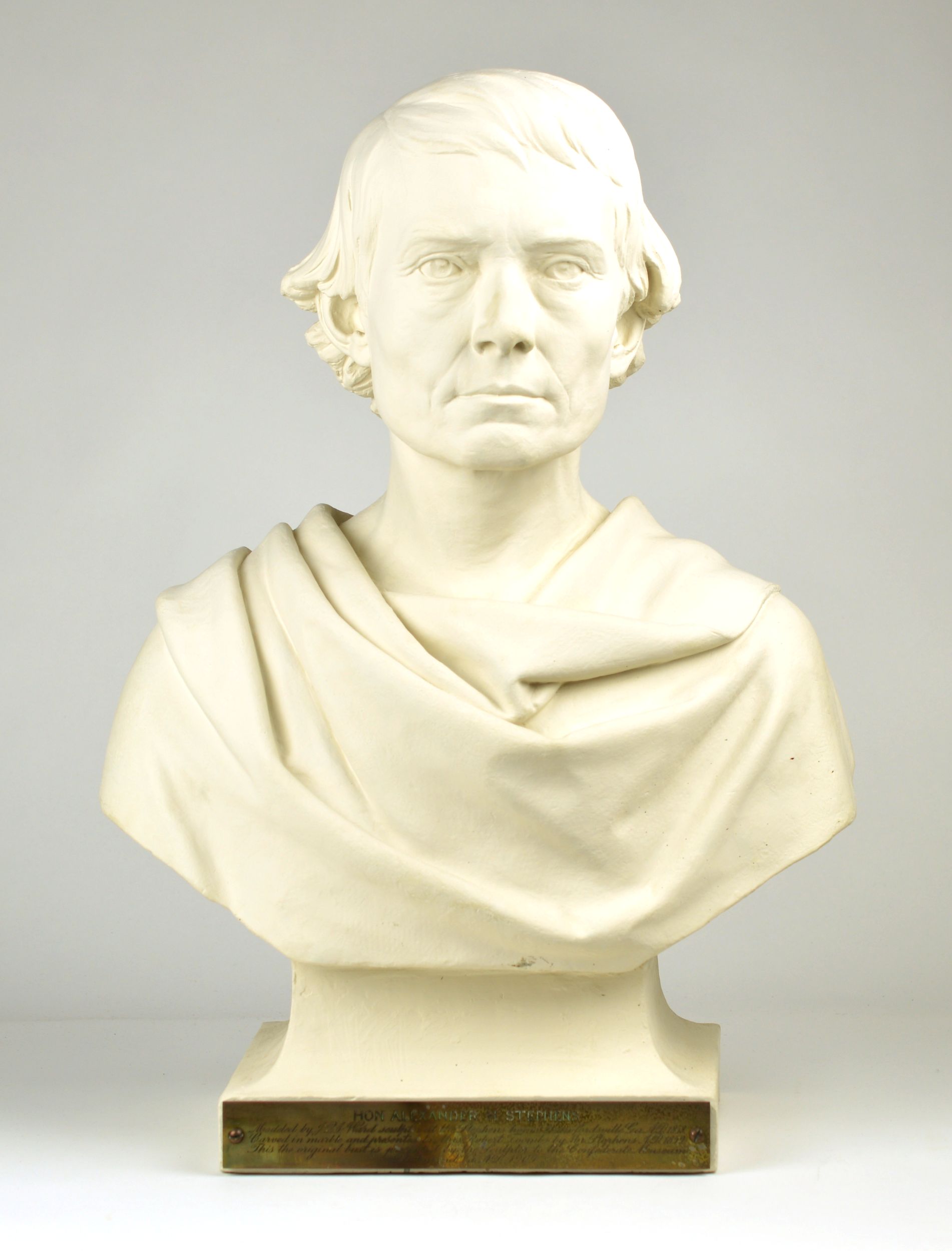
Although most of Ward’s patrons were well known for their antislavery or abolitionist views, there was one notable exception in these early years. In spring 1859, following the completion of the Giddings plaster, Ward received a commission from the Georgia politician and enslaver Alexander Stephens (1812–1883). Best known today for his 1861 “Cornerstone Speech,” which offered a vigorous defense of slavery as the cornerstone of the Confederacy, Stephens would serve as vice president of the Confederacy during the Civil War. Ironically, Ward received Stephens’s patronage through the antislavery congressman Richard Mott, whom Stephens referred to as “a Quaker and a great personal friend of mine.”19 According to a letter Stephens wrote to his brother Linton regarding the commission, it was Mott who brought him to Ward’s studio on 11th Street to sit for a portrait.20 The bust is only known today through the surviving plaster (fig. 4), but Ward completed the work in marble in 1860 as a gift from Stephens to the wife of his friend Robert Toombs, making it one of the few sculptures of the period that Ward was able to execute in stone. In this way, Stephens became an important patron of Ward’s during a period in which the sculptor had no other major commissions.21
Stephens sat for Ward in Washington, but he returned to Georgia at the end of the congressional session and invited the artist to continue the work there.22 For his part, Ward seemed reluctant to take the commission, claiming that he undertook the bust merely to “gratify his own wish” and that he did not seek payment for it, nor could he afford to travel.23 Stephens prevailed, offering to advance the artist thirty dollars to enable him to take the train from Washington, DC, to Liberty Hall, his home in Crawfordville, Georgia. Ward arrived around March 19 and stayed at least a week. An October 1859 letter from Ward to Stephens offers several insights about the commission and provides evidence of Ward’s firsthand encounters with enslaved people in Georgia. At this time, Ward wrote Stephens from New York, asking his sole paying patron for a substantial advance for the bust, which he had yet to complete. He flattered Stephens with expressions of gratitude for his kindness and friendship and boldly laid out his financial straits. Telling Stephens that he “had no money save the forty [sic] dollars you gave me last spring,” Ward now asked for “one or two hundred dollars” to allow him to return to Washington. Stephens “cheerfully complied” with Ward’s request for funds, eventually sending him two payments totaling four hundred dollars for the work.24
Although many details about Ward’s stay in Georgia are not known, The Freedman may have been based on studies that Ward made during this trip. For instance, J. Walker McSpadden, writing in 1924, indicated that “Ward went with Stephens to Georgia to complete this portrait and thus had opportunity to study Southern types. One product of this visit, done a few years later, was ‘The Freedman.’”25 Unfortunately there are no known sketches of African Americans from Ward’s time in Georgia.26 However, the artist became familiar with several enslaved people during his visit to Stephens’s home. In a troubling postscript to Ward’s October 1859 letter, he writes:
My simple nature is such that I cannot write you without recalling the dark faces of your happy household from Harry’s good face to Tim’s jolly little figure. They have furnished [illegible] for many a pleasant story of the ‘South.’ Harry’s name is not unknown to many a friend in the North.27
Harry is well known to historians as Stephens’s personal servant. He managed countless issues on the estate, especially during Stephens’s extended travels. He appears as the most highly valued individual in inventories of Stephens’s human property in 1860.28 Harry was married to Eliza, Stephens’s cook. Tim was one of Harry and Eliza’s five children and their oldest son. A remarkable photo in the Metropolitan Museum of Art (fig. 5) shows Harry and Eliza with their family. Harry appears on the left, while Tim is probably the serious-looking boy on the right. Apart from Harry and Tim, Ward does not mention any of the other roughly thirty enslaved people who resided at Liberty Hall. One wonders if Ward sketched Harry or members of his family during his stay, and if he did, how he reconciled this activity with his abolitionist leanings. Although Stephens’s patronage was crucial for the struggling artist at this moment, Ward surely compromised any antislavery principles he may have possessed in accepting it. The commission is fraught with contradictions. While the tone of Ward’s letter is patronizing toward the enslaved workers, it should also be remembered that his audience was not only a slave-holding patron and his sole paying customer but also someone he was actively soliciting for a substantial cash advance. Does the letter reflect Ward’s own opinions or those that he thought would appeal to Stephens? It is hard to know. Nonetheless, what is clear is that Ward’s visit to Georgia exposed the sculptor to plantation slavery for the first time, a reference point that no doubt informed The Freedman, even if he did not base the figure directly on the enslaved people that he met there.
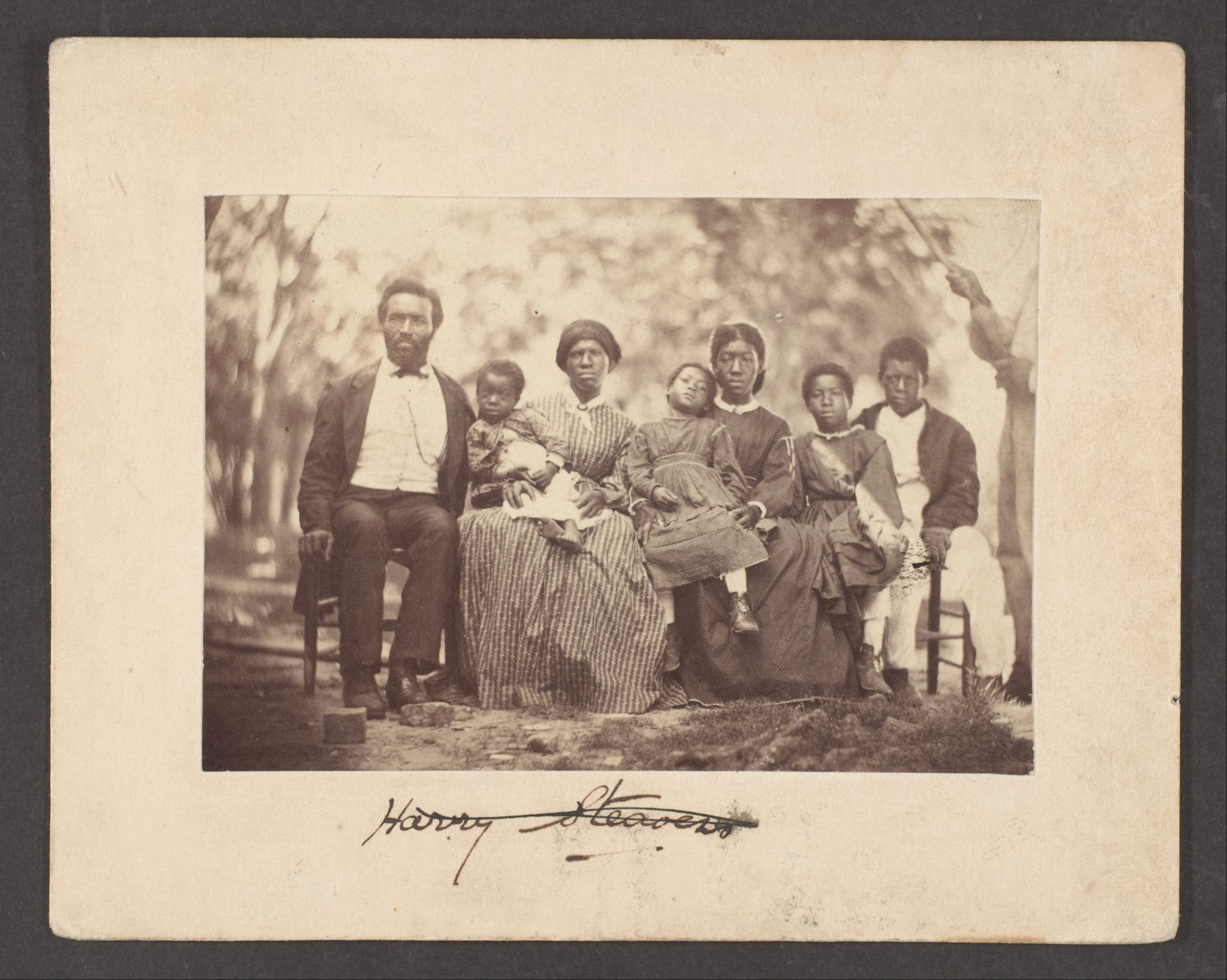
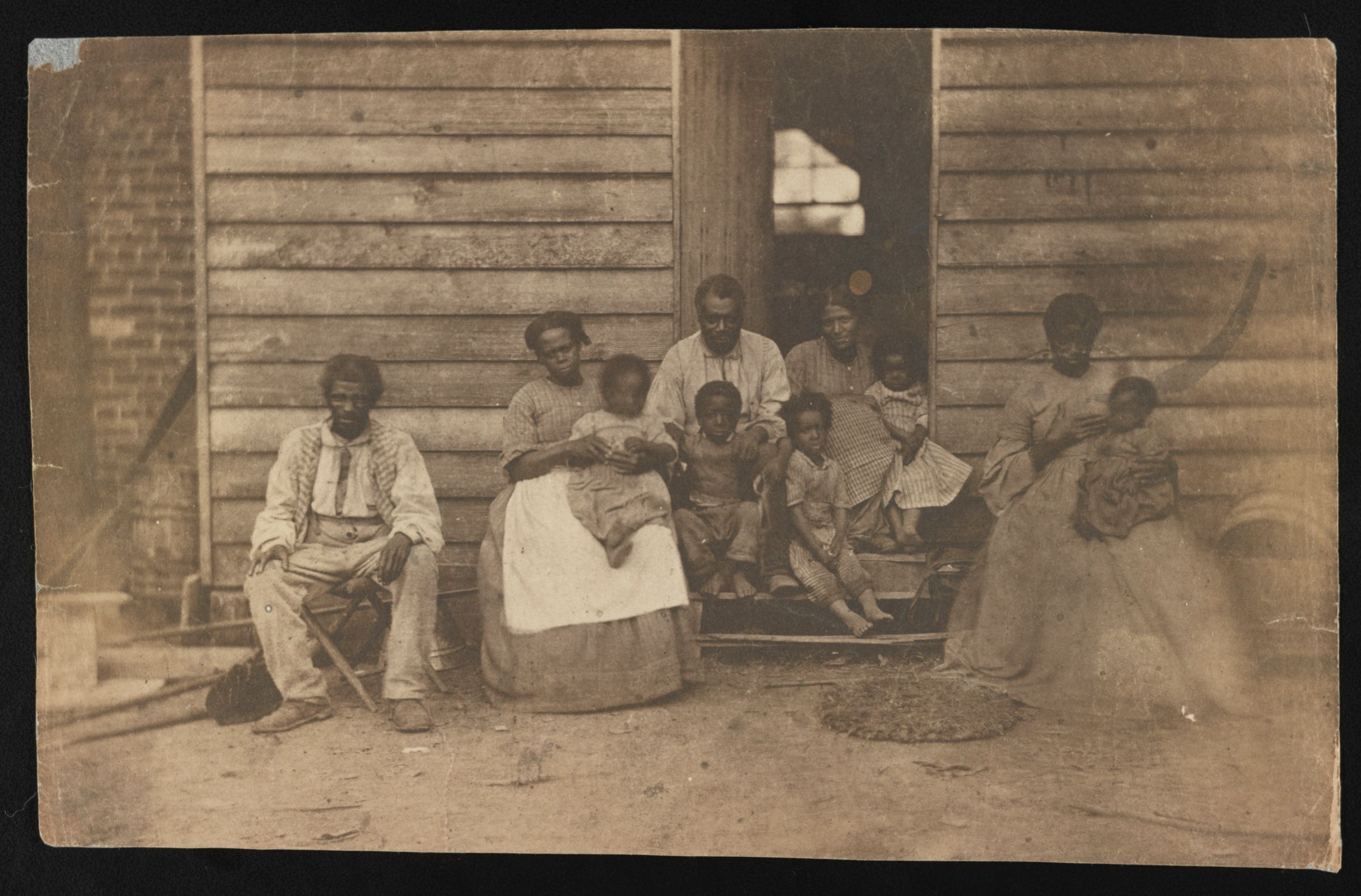
However, the significance of the photograph should not be entirely dismissed. The image was taken by Vermont photographer George Harper Houghton (c. 1824–1870), who in 1861 and 1862 traveled to Virginia with the Vermont brigades during the Civil War. Another print of the photograph (fig. 6) is part of a scrapbook in the collection of the Library of Congress, Washington, DC, that was assembled by Ward’s friend, the sculptor Larkin Mead (1835–1910). Mead also went to the front at this time, and he and Houghton, who were both from Brattleboro, Vermont, became friends. Ward met Mead when they apprenticed together in Brown’s studio. The two men were regular correspondents, and Ward visited Mead in Vermont several times starting in the 1850s. The photo of the enslaved family, identified by the Library of Congress as depicting the plantation of Dr. William Gaines in Hanover County, Virginia, was taken by Houghton when he was in the field. Despite the photo’s arresting subject matter, the image was not widely circulated, and Houghton, unlike more famous photographers of the era, remained little known until recently.30 This suggests that the print came to Ward via more personal means, probably through his connection to Mead. Whether or not Ward used the image in his development of The Freedman, clearly someone in the artist’s orbit associated the photo with the sculpture and labeled it accordingly.
Caesar Russell
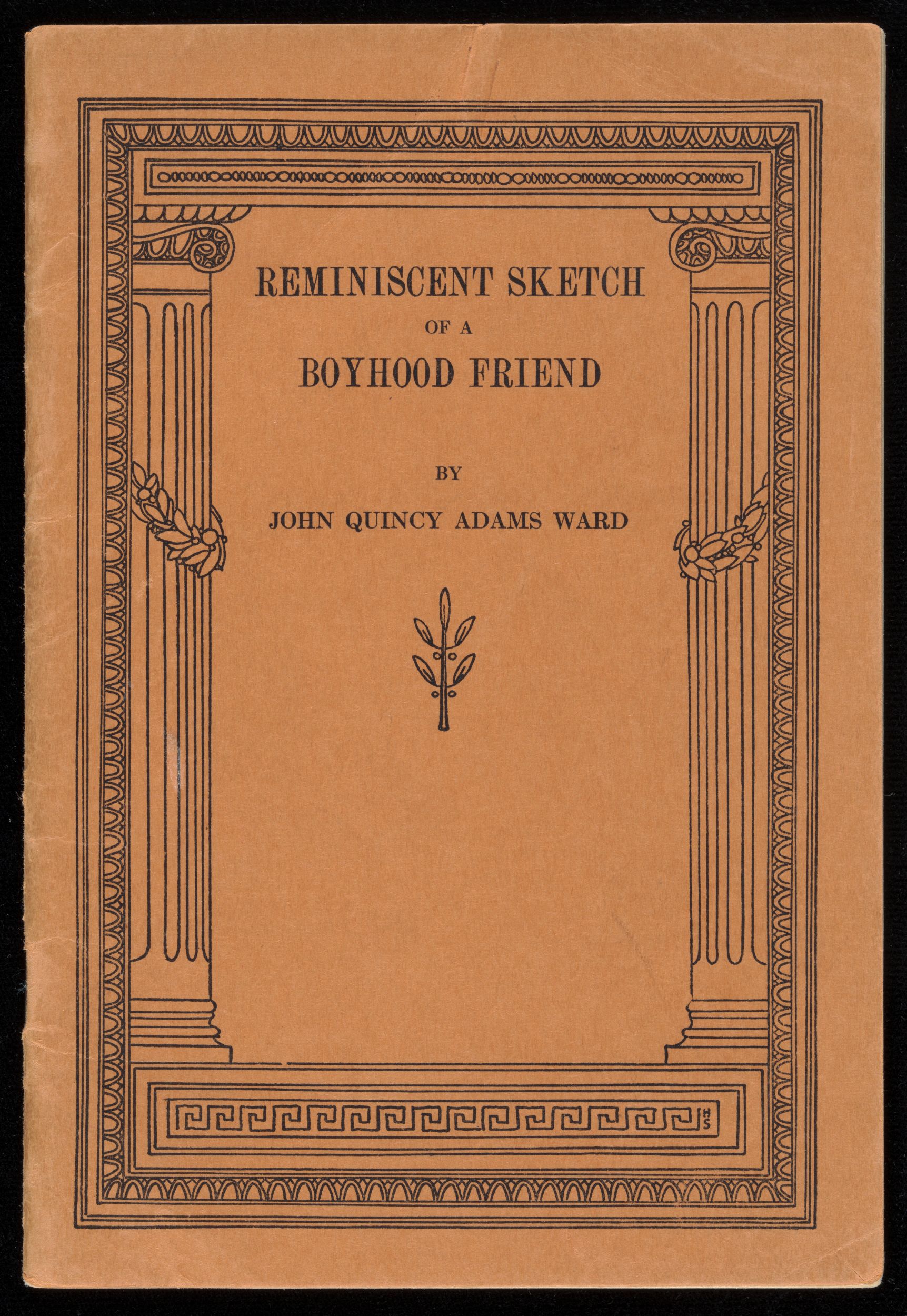
While the above discussions suggest Ward’s politics and the ways in which his encounters with chattel slavery may have influenced the creation of The Freedman, the sculpture may have been more directly informed by Ward’s close, personal relationship with his Ohio neighbor Caesar Russell, an African American man who may indeed have been a “freedman.” In May 1908, the society editor for the Citizen Times newspaper of Urbana, Ohio, invited Ward to contribute “some reminiscences of his boyhood as part of a series of articles by natives of the town who remembered it in its early days.”31 As one of Urbana’s most successful former citizens, Ward was a logical choice for the series. Although Ward ultimately submitted a lengthy remembrance, it arrived too late for inclusion in the series and was published posthumously in the Urbana Daily Citizen days after the artist’s death, in May 1910, and subsequently as a booklet titled “Reminiscent Sketch of a Boyhood Friend” (fig. 7). Ward’s text was unusual within the context of the nostalgic series, which focused on the town’s leading white citizens. Instead of describing how his hometown fostered his nascent artistic inclinations, Ward chronicled his relationship with Russell, an African American man who lived near the sculptor’s childhood home. Although Ward’s text includes episodes of dialect and demeaning humor typically found in racist writing of the period, it was intended as a tribute to a man who was a formative influence on the future artist.
Ward’s use of racialized humor throughout his account is troubling and also occludes any genuine insight into Russell. However, it is possible to trace some of Russell’s activities by using Ward’s narrative in conjunction with public records and newspapers. According to Ward, Russell began living in a cabin adjacent to his family’s farm in 1844. Census records indicate that Russell was born in North Carolina. He first appears in Ohio tax records in 1828, living in Liberty Township, Clinton County.32 The circumstances that brought Russell to Ohio from North Carolina can only be speculation. However, an 1880s county history describes Liberty as having an “enviable anti-slavery history” due to its ties to the Underground Railroad.33 Regrettably, Ward’s narrative does not delve deeply into Russell’s origins, beyond affirming that he came from North Carolina.34 Both “Caesar” and “Russell” are common enough names that documentation of his pre-Ohio existence remains elusive. North Carolina had a free Black population, but it is more likely that Russell was enslaved, given that 32 percent of North Carolina’s population were in bondage in 1820 and the free Black community was only 2.3 percent of the total population.35 If so, Ward’s childhood association with Russell may have been his first and certainly most personal connection to enslavement.
Russell seems to have moved to Urbana sometime between 1830 and 1840, when he appears there in the federal census. According to Ward, Russell had been resident in Urbana for some time before the death of his wife, Teeny, in 1838. After this point, Ward claims to have “become better acquainted with Caesar and was admitted to a more equal footing with him.”36 Of course, this retrospective claim that a white child could view his relationship with a Black male adult in terms of equality is deeply paternalistic, but it was not uncommon, even among whites who opposed slavery. Russell and his wife had three children, including two sons, Henry and William, with whom Ward was also quite familiar. According to Ward, the Russell boys taught him how to ice skate, and he admired how they had trained their dog to pull a little cart, which he unsuccessfully sought to emulate with his own dog. Ward and Russell’s relationship was also, no doubt, shaped by the fact that Russell’s sons had gone to work young to become barbers. Their sister, Lucinda, was also sent to work early. Thus, the period in which Ward claims to have become “inseparable” from Russell occurred when the older man’s family had mostly left the house. By Ward’s account, he entered Russell’s cabin for the first time only after Teeny’s death, when he was about eight years old.
In the booklet, Ward expresses both genuine fondness and privileged condescension in describing his relationship with Russell in these years. For instance, he speaks especially lovingly of Russell’s cooking, describing the man’s careful preparation of hominy and the sweet potatoes that he cooked in hot embers. Russell advised Ward about how to grow peanuts, which he had cultivated in “Caroliny.” Ward also describes other African Americans with whom he was acquainted, including John Wade, a “work-hand” hired by his father, who is inexplicably antagonistic toward Russell. These passages often veer into racial caricature, with Russell at the receiving end of Wade’s abuse. Ward described his final encounter with Russell during an 1852 trip to Ohio as unenjoyable. The artist claimed that the once-close relationship seemed altered on this visit by what he perceived as Russell’s “conventional and dignified” behavior, oblivious to the possibility that his own transformation into an adult had changed the dynamic. Nonetheless, Ward abruptly concluded his rambling narrative with a testimonial of Russell’s character:
Caesar was an honest man, respectable, polite, and kindhearted. Such little shortcomings in his life as I may have hinted at need not mar the general expression of a noble character. I never heard from his lips an improper word or a vicious thought. In closing my letter the sunshine of those days at home and with Caesar comes flitting through three score years and ten with a warmth and delight pleasant to entertain.37
Russell, who died two years before Ward began The Freedman, could not have modeled for the work. And yet, it is possible that Russell influenced Ward’s conception of The Freedman. Russell was not only the Black man with whom the artist had the longest and closest association, but it is possible that Russell posed for Ward before 1852. Ward knew Russell in the years when he was modeling figures in clay on his family’s farm. Indeed, in his “Reminiscent Sketch,” Ward mentions a small pool near Russell’s home that was yellow from the clay lining its bottom. Ward’s friend, the author William Dean Howells, describes Ward’s clay figures in his book Stories of Ohio, writing, “He modelled in clay the head of a negro, well known in the place, which all the neighbors recognized.”38 McSpadden describes the subject in slightly more detail, writing that Ward fashioned “a negro’s head, giving it the features of an old slave who lived in the vicinity.”39 It seems likely that Caesar Russell was the model for this work. Russell was certainly a notable figure in Urbana. His death in 1860 occasioned an obituary in the local white press, an uncommon occurrence for an African American in this period. If so, Ward’s first effort to sculpt the human figure may have depicted Caesar Russell. Given that Ward spent so much time with Russell, it is also possible that Ward made sketches of him. In 2019, Ward’s descendant Stephen Peters claimed to own a sketch that he found “tucked inside a family book,” showing Caesar Russell seated on a stump in a pose like that of The Freedman. Peters believed that Russell was unquestionably the model for the sculpture. Unfortunately, the drawing disappeared following Peters’s death in 2024. While this lost sketch is intriguing, the relationship between the two men is perhaps more so.40 Ward never identified Russell as The Freedman, even in the extended “Reminiscent Sketch” that he wrote about him. Yet, Russell must surely be present in The Freedman to some degree.
As Parnell suggests, one cannot know with certainty what Ward believed about race and abolition in the years before he sculpted The Freedman, but it is possible to speculate about the ways that his patronage and upbringing positioned him to create this astonishing figure. The condescension revealed in Ward’s letters to Stephens and in his account of Russell betray a belief in white supremacy that, while ugly, is not unusual, even among those who held antislavery views; yet, I would argue that it is not the whole story. In the 1850s, Ward’s near-exclusive depiction of abolitionist men seems to affirm his own antislavery politics in this period. Furthermore, growing up, Ward felt a closeness to Russell that he believed was worth acknowledging fifty years after the older man’s death. Unequal as it may have been, Ward’s relationship with Russell, as with other African American men, shaped The Freedman and perhaps even influenced one of Ward’s postwar compositions. In the 1880s, Ward conceived a radical design for the Brooklyn Soldiers’ and Sailors’ Monument that could be viewed as a kind of coda to The Freedman. In this unbuilt project, Ward placed “an enfranchised negro” at the center of a large and prominent relief, receiving the fruits of peace: “science, art, agriculture, industry, and education.”41 In other words, the relief shows a freedman arisen from his liminal state between slavery and freedom and envisions his place in civil society. Although there are many unknowns, Ward’s work certainly owes a debt to the sculptor’s personal encounters with enslavement and the men who may have inspired him.
Cite this article: Akela Reason, “Searching for The Freedman,” Panorama: Journal of the Association of Historians of American Art 12, no. 2 (Fall 2026), https://doi.org/10.24926/24716839.21423.
Notes
- Elyse Nelson and Wendy S. Walters, eds., Fictions of Emancipation: Carpeaux’s “Why Born Enslaved!” Reconsidered, exh. cat. (Metropolitan Museum of Art, 2023); Margaret C. Adler et al., Emancipation: The Unfinished Project of Liberation (Amon Carter Museum of American Art, 2024); Karen Lemmey et al., The Shape of Power: Stories of Race and American Sculpture (Smithsonian American Art Museum, 2025). Although The Freedman was not included in the Shape of Power exhibition, it is referenced in the catalogue. The epigraphs for this essay are from James Smalls’s essay in The Shape of Power, “American Modernism’s Slippery Slope: Classicism, Primitivism, Ethnography in Sculpture” (153); and Kelvin Parnell’s essay in Emancipation, “What to America Is The Freedman?” (36–37). ↵
- Lewis I. Sharp, John Quincy Adams Ward: Dean of American Sculpture (University of Delaware Press, 1985); Kirk Savage, Standing Soldiers, Kneeling Slaves: Race, War, and Monument in Nineteenth-Century America (Princeton University Press, 1997); Kirk Savage, “Molding Emancipation: John Quincy Adams Ward’s The Freedman and the Meaning of the Civil War,” Art Institute of Chicago Museum Studies 27 (2001): 26–39. ↵
- Savage, Standing Soldiers, Kneeling Slaves, 54; Margaret C. Adler, “I Contain Multitudes: The Varied Lives of a Cast of J. Q. A. Ward’s The Freedman,” in Adler et al., Emancipation, 11. ↵
- Such descriptions first appear in contemporary newspaper accounts when the work was exhibited in the 1860s. Sharp and Savage elaborate on these traits, as do Parnell, Smalls, and others. While I speculate here about possible models, it is also likely that Ward used life models in New York or Washington, DC. ↵
- Scott Smith, “History, Art, Family,” Times Record (Fort Smith, AR), January 12, 2019, https://www.swtimes.com/story/lifestyle/2019/01/13/history-art-family/6293148007. ↵
- See, for example, Savage, “Molding Emancipation,” 31. ↵
- Karen Yvonne Lemmey, “Henry Kirke Brown and the Development of American Public Sculpture in New York City, 1846–1876” (PhD diss., City University of New York, 2005), 122; Parnell, “What to America Is The Freedman?,” 31–33. ↵
- Previously unnoted, Ward appears to have married soon after his arrival in Brooklyn. According to the 1850 census, Ward was living with his wife, Anne (neé Baumann), in his sister Eliza’s Brooklyn household. Sharp puts Ward’s marriage later, writing that Ward married “Anna Bamman” on February 10, 1858; Sharp, John Quincy Adams Ward, 36. The 1860 census lists “Ann Ward” as living with her parents, John and Ann Baumann, along with her sister, Louisa, presumably while Ward was in Washington. Anne’s name appears variously in records as Annie, Anne, or Anna. She died in 1870 of breast cancer and is buried in Green-Wood Cemetery in Brooklyn. Both her parents died in the 1860s. In the 1870 census, Louisa Baumann is living with Ward and listed as a teacher. ↵
- Sharp, John Quincy Adams Ward, 36; “Personal,” New York Tribune, February 18, 1859, 6; “Art in Washington and Elsewhere,” States and Union (Washington, DC), May 2,1860, 3. The 1860 census, taken that August, shows Ward living in a Washington boardinghouse a few doors from Edwin Stanton, President Lincoln’s future secretary of war. ↵
- On slavery in Washington, see Paul Finkelman and Donald R. Kennon, eds., In the Shadow of Freedom: The Politics of Slavery in the National Capital (Ohio University Press, 2011). For more on Eastman Johnson’s painting, see John Davis, “Eastman Johnson’s Negro Life at the South and Urban Slavery in Washington, DC,” Art Bulletin 80, no. 1 (1998): 67–92. Karen Lemmey has speculated that this sketch may relate to the Black figure depicted in the relief on the Clinton Monument; Lemmey, “Henry Kirke Brown and the Development of American Public Sculpture,” 122. ↵
- The establishment of a National Art Commission in spring 1859, with Brown as chair, may have encouraged Ward about the potential for federal patronage. Yet recommendations submitted by the art commission to Congress in 1860 were not funded, and the commission was disbanded soon after. ↵
- “Fitting Memorial to Great Sculptor Will Be Erected,” Urbana Daily Citizen, November 7, 1913, 1. ↵
- John Ward named his son after the former president John Quincy Adams, who at the time equivocated on the issue of slavery but would later become well known in Congress for his abolitionist views. Ward’s father also hosted an 1840 campaign event in his orchard for Whig presidential nominee William Henry Harrison. ↵
- For a discussion of Giddings’s antislavery beliefs, see James B. Stewart, “Christian Statesmanship, Codes of Honor, and Congressional Violence: The Antislavery Travails and Triumphs of Joshua Giddings,” in Finkelman and Kennon, In the Shadow of Freedom, 36–57. ↵
- “On Exhibition,” Cleveland Leader, July 6, 1859, 4. The subscription was probably intended to raise the funds to allow Ward to carve the work in marble. ↵
- Liberator, March 25, 1858, 3. ↵
- “Miscellaneous News Items,” Frederick Douglass’ Paper, March 4, 1859, 3. ↵
- Paul H. D. Kaplan, Contraband Guides: Race, Transatlantic Culture, and the Arts in the Civil War Era (Pennsylvania State University Press, 2020), 195; J{ohn} W{esley} Cromwell, “An Art Gallery and Museum, Not in the Guide Book,” New National Era, October 1, 1874, 2. ↵
- Alexander H. Stephens to Linton Stephens, March 20, 1859, Alexander H. Stephens Collection, Manhattanville University Library Special Collections, Purchase, NY. ↵
- Alexander H. Stephens to Linton Stephens, March 20, 1859. ↵
- Ward also exhibited the work at the Washington Art Association in 1860. Correspondence between Stephens and Robert Toombs indicates that the bust was still unfinished in January 1860 but expected to be complete in a week or two. In other correspondence, in February 1860, Stephens complained that he had not heard from Ward since October of the previous year when he sent the artist a substantial advance payment. Ulrich Bonnell Phillips, ed., The Correspondence of Robert Toombs, Alexander H. Stephens, and Howell Cobb (Government Printing Office, 1913), 2:456, 463. ↵
- In his letter, Stephens writes that his last sitting for Ward in Washington was the day before the adjournment of the legislative session. According to the legislative calendar for the House of Representatives, the session ended on March 3, so the sitting would have been on March 2. Alexander H. Stephens to Linton Stephens, March 20, 1859. ↵
- Alexander H. Stephens to Linton Stephens, March 20, 1859. ↵
- This would appear to confirm that the Giddings commission was not a paying one and that the subscription campaign had failed to yield the necessary sum when the work was exhibited that summer in Cleveland. John Quincy Adams Ward to Alexander H. Stephens, October 17, 1859, Alexander H. Stephens Papers, Library of Congress, Washington, DC. Two letters from Stephens reference payment: Alexander H. Stephens to John Quincy Adams Ward, October 7, 1859, Gilder Lehrman Collection, New York; and Alexander H. Stephens to John Quincy Adams Ward, October 22, 1859, Gilder Lehrman Collection, New York. ↵
- J. Walker McSpadden, Famous Sculptors of America (Dodd Mead, 1927), 10–11. See also Judy A. Barter et al., American Arts at the Art Institute of Chicago: From Colonial Times to World War II, exh. cat. (Art Institute of Chicago, 1998), 193. ↵
- Sketchbook 5 in the John Quincy Adams Ward Collection at the Albany Institute of History and Art includes some landscape sketches, including a train depot that may be in Crawfordville. One page in the book lists the train stations between Richmond and Crawfordville. ↵
- John Quincy Adams Ward to Alexander H. Stephens, October 17, 1859. ↵
- Alexander H. Stephens Papers, David M. Rubenstein Rare Book & Manuscript Library, Duke University, Durham, NC. Harry’s name first appears in the 1850 and 1860 inventories. ↵
- John Quincy Adams Ward Papers, Albany Institute of History and Art, #CM 544. ↵
- On Houghton, see Donald H. Wickham, A Very Fine Appearance: The Civil War Photographs of George Henry Houghton (Vermont Historical Society, 2011). ↵
- John Quincy Adams Ward, Reminiscent Sketch of a Boyhood Friend (n.p., c. 1910). ↵
- “Ohio, Tax Records, 1800–1887,” accessed December 4, 2025, via familysearch.org. ↵
- Albert J. Brown, The History of Clinton County Ohio: Containing a History of Its Townships, Cities, Towns . . . (W. H. Beers, 1882), 352. ↵
- Ward, Reminiscent Sketch of a Boyhood Friend, 9. In the account, Russell also mentions growing peanuts in “Caroliny” (21). ↵
- John Hope Franklin, The Free Negro in North Carolina, 1790–1860 (University of North Carolina Press, 1943, reprint 1995), 18. ↵
- Ward, Reminiscent Sketch of a Boyhood Friend, 11–13. At times, Teeny worked for Ward’s family. ↵
- Ward, Reminiscent Sketch of a Boyhood Friend, 30. ↵
- William Dean Howells, Stories of Ohio (American Book Company, 1897), 269. ↵
- McSpadden, Famous Sculptors of America, 5. ↵
- Smith, “History, Art, Family.” Stephen Peters’s widow, Sandy, described the drawing in email correspondence with the author (September 15, 2025), but she was unable to locate it among the other Ward materials in her home. ↵
- “Gallery and Studio,” Brooklyn Daily Eagle, February 7, 1886, 4. The figure is identified as female in “A Monument to Brooklyn Heroes,” Frank Leslie’s Illustrated Newspaper, February 20, 1886, 5. For more on Ward’s design for the Brooklyn Soldiers’ and Sailors’ Monument, see Akela Reason, Politics and Memory: Civil War Monuments in Gilded Age New York (Yale University Press, 2025), 126–42. ↵
About the Author(s): Akela Reason is a professor at the University of Georgia.