

Cómo se Aprende (How do you learn?)




PDF: vallejo santiago, Cómo se Aprende
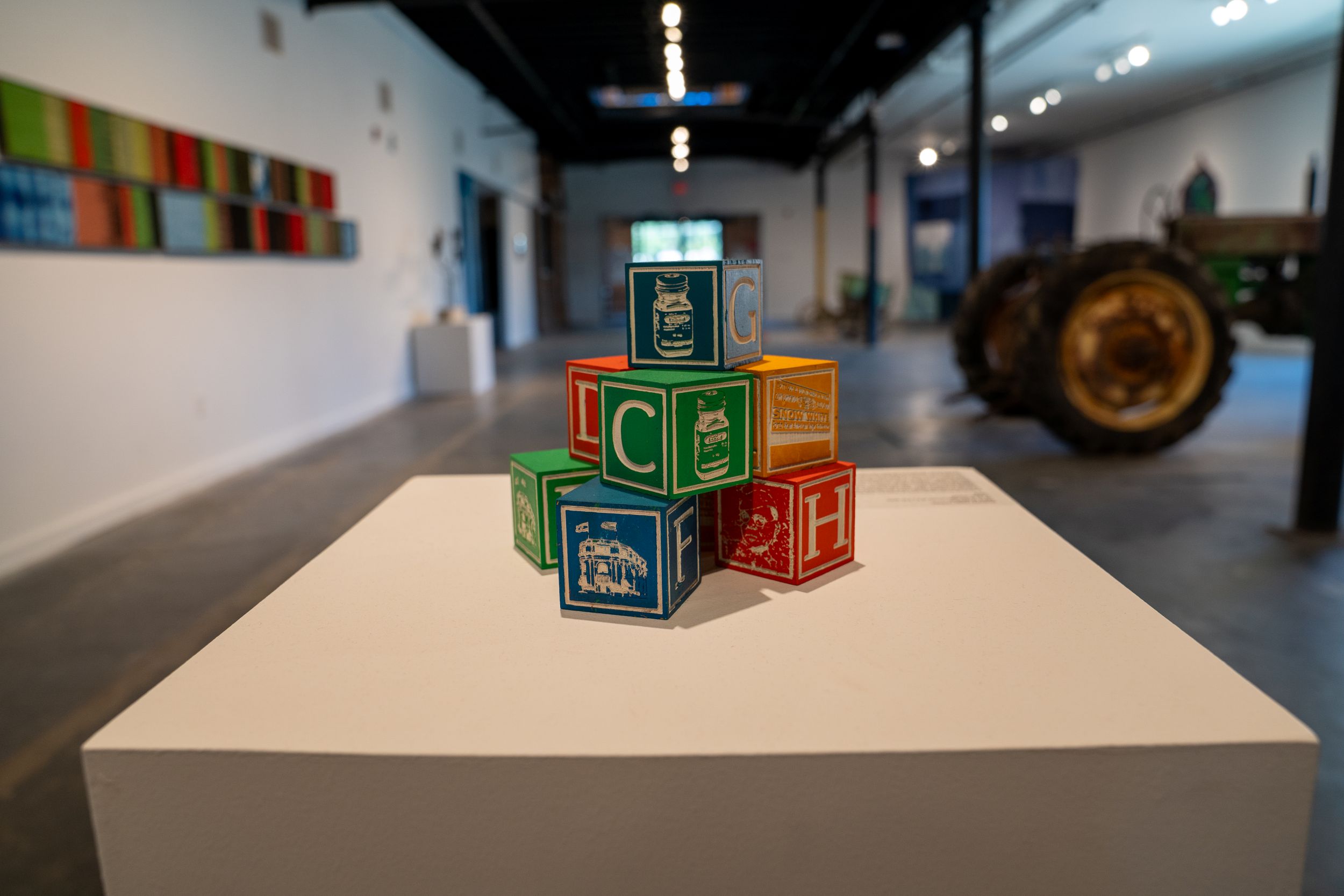
To be a student of the United States is to be enraged. My sculpture Cómo se aprende (How do you learn) (2026) emerged from that rage and from the recognition that some of the earliest lessons we have been given are the ones we later must fight to unlearn (fig. 1). The work was exhibited in Radical Rage at Stove Works, Chattanooga, Tennessee. It grew from my frustration with the contradictions embedded within my own schooling.1 Cómo se aprende consists of painted wooden blocks arranged on a pedestal, recalling children’s alphabet blocks and the visual language of early learning. Along with carved letters, there are images that reference Puerto Rico’s colonial history involving banking, reproductive experimentation, and colonial medicine.2 By placing these histories within the form of a children’s learning tool, I scrutinize how colonialism is taught and normalized. Colonial violence is not only enacted through occupation or displacement, but it is also sustained through the stories people inherit about the past, through definitions of progress, and through the types of lives that are considered valuable.
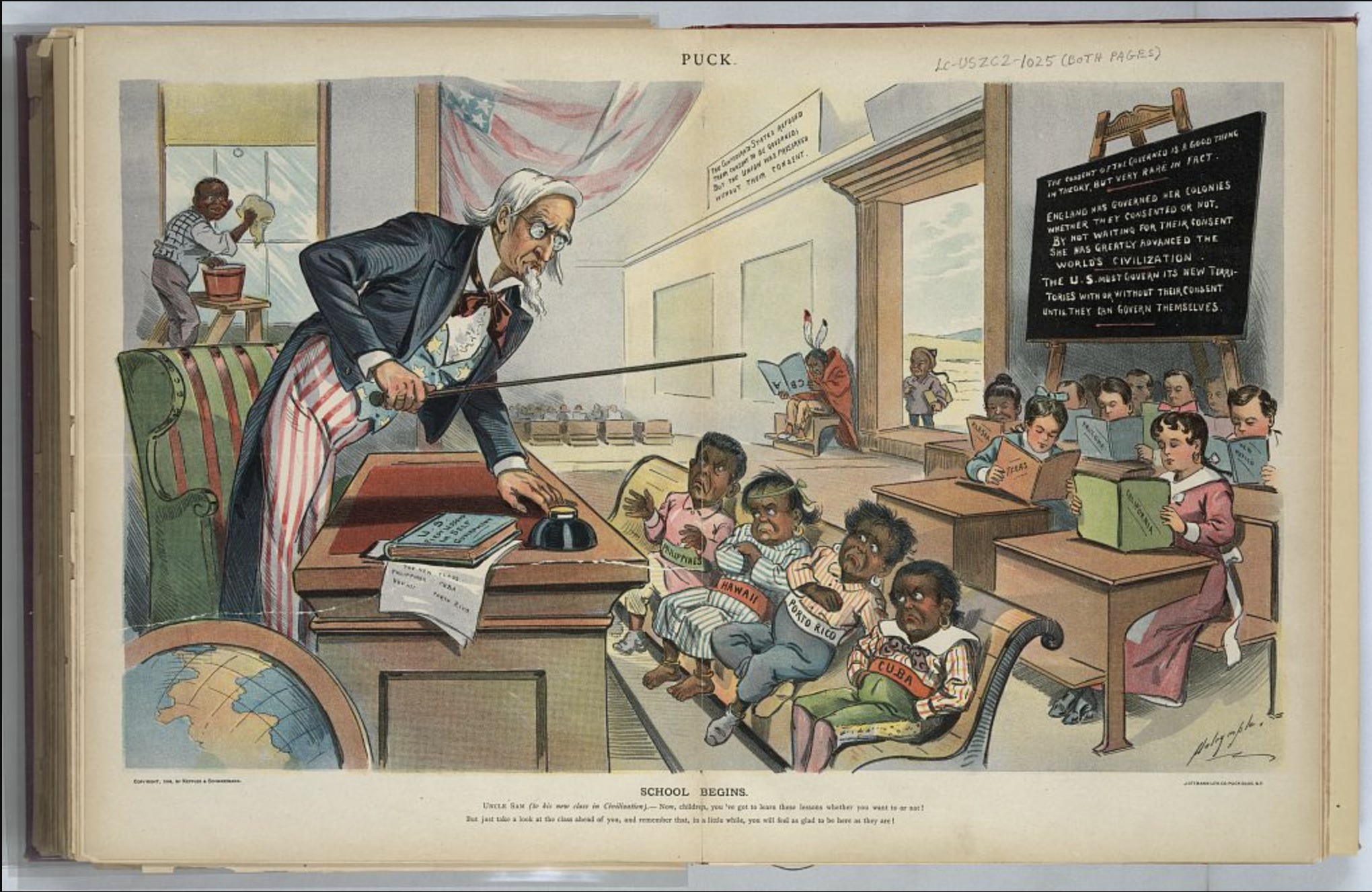
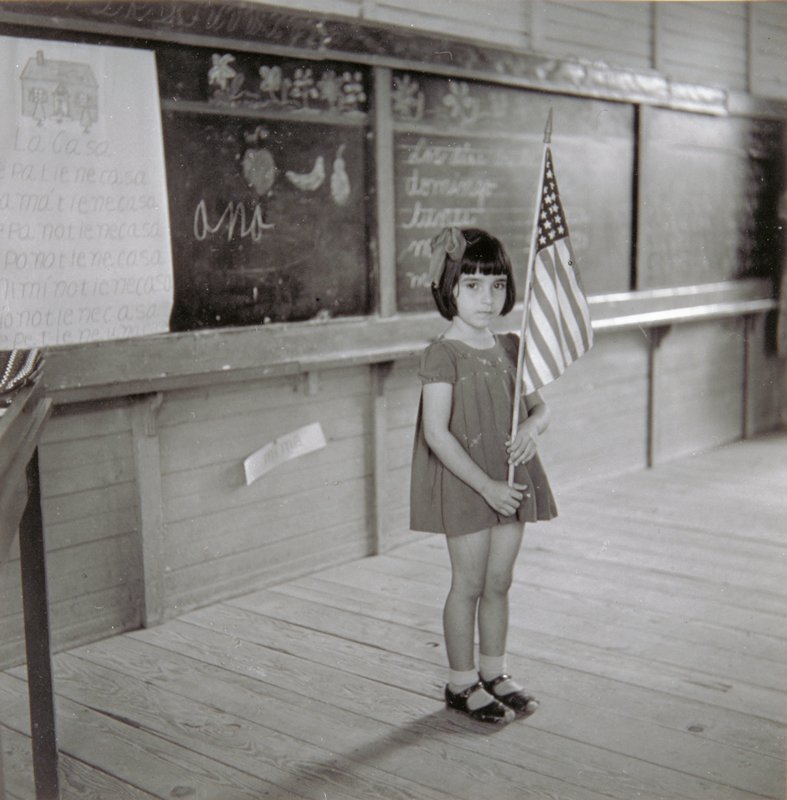
As both a teacher and a student, I constantly return to the idea that education gives us the language to understand ourselves, our histories, and the worlds we inhabit. Yet when it is manipulated, education can become one of colonial power’s most effective instruments. Miseducation disciplines—it assimilates—until domination resembles order, erasure becomes history, and learning no longer expands us but makes us smaller. As the United States marks its 250th anniversary, that contradiction becomes harder to negate. In Louis Dalrymple’s 1899 Puck cartoon titled School Begins, Uncle Sam presides over Puerto Rico, Cuba, Hawai‘i, and the Philippines personified as unruly children awaiting a lesson in “civilization” (fig. 2). The creature lays out its intent: The United States claimed the authority to govern these territories through invasion until it could remake them on US-American terms.3 But this “education”—this Americanization—did not end with imperial rhetoric.4 Nearly fifty years later, Jack Delano photographed a Puerto Rican child pledging allegiance to the US flag in a classroom (fig. 3). The caricature disappears, but the lesson persists through a child, a raised flag, and a repeated pledge. Empire shifts its form, crawling into the everyday classroom to feed its need to dominate the “other.”5 In Delano’s photograph, the Puerto Rican child appears fully assimilated: She is white. Puerto Rico and its people are being remade into the subjects the empire desires.
That history reaches into the present. Under the oversight of the United States–appointed Fiscal Board, schools across the archipelago have been forced to close, including Carlos Conde Marín School in Carolina, Puerto Rico, my hometown. After years of closures and austerity, the classroom becomes a space once used to produce belonging and now marked by abandonment.6 The promised care, progress, and development of US colonial rule remain unstable and largely unrealized. My work Cómo se aprende emerges from this context, revealing what Puerto Ricans have learned, what we have been taught to forget, and who benefits from that erasure (see fig. 1).
As an art historian, I often encounter Puerto Rico through terms like “modernization,” “development,” “education,” and “progress”—words that obscure how unevenly those assurances are enacted. For many Puerto Ricans, access to our own histories and cultural resources remains limited, while a “better education” often requires leaving the archipelago. Indeed, while these terms seem promising, they mask the beast. My artistic practice gives me another way to engage these histories: I can deconstruct the image, rearrange its parts, challenge its original order, and ask what happens when the student begins to reshape the lesson—and I can let my anger out. Through curator Charlie Farrell’s approach to “rage,” I was able to understand it as a tool. Within the exhibition, my anger became a form of knowledge keeping, a way to recognize the wrongs and to do something about it.
I am angry, but I am still here to learn and to teach. Celebration is difficult to recognize when the United States commemorates 250 years of independence while continuing to negate the freedom of mine. Puerto Rico, Guam, Samoa, the Virgin Islands, the Northern Mariana Islands, alongside Hawai‘i, disrupt the anniversary’s orderly narrative, but that is exactly where learning begins. Thus, I ask: How do you learn? And just as importantly, How do you unlearn?
Cite this article: estefanía vallejo santiago, “Cómo se Aprende (How do you learn?),” in “Call and Response: Facts and Fables in the Fundamentals of (American) Visual Formation,” ed. Keidra Daniels Navaroli and Frederica Simmons, Colloquium, Panorama: Journal of the Association of Historians of American Art 12, no. 2 (Fall 2026), https://doi.org/10.24926/24716839.21460.
Notes
- Radical Rage, curated by Charlie Farrell, Stove Works, Chattanooga, TN, August 7–November 14, 2026, exhibition. ↵
- The symbols embedded in Cómo se aprende reference different structures of colonial power in Puerto Rico. Banco Popular, founded under Spanish rule in 1893, later became embedded within the archipelago’s US colonial economy. The Snow-White sugar logo refers to the sugar produced at Central Mercedita in Ponce; in 1926, the Serrallés family established the Porto Rican American Sugar Refinery, Inc. to produce the Snow-White brand, linking a locally owned sugar enterprise to the broader United States–dominated refining economy that reshaped Puerto Rican agriculture after 1898. A contraceptive pill bottle references the 1950s birth-control trials conducted on Puerto Rican women, while American pathologist Cornelius Rhoads’s medical research in Puerto Rico and his infamous racist letter expose the violence embedded within colonial medicine. ↵
- During the War of 1898, US forces invaded Puerto Rico, landing at Guánica on July 25, 1898. The subsequent Treaty of Paris, signed December 10, 1898, ended Spanish rule over much of its remaining overseas empire: Spain ceded Puerto Rico and Guam to the United States, transferred the Philippines to US control for $20 million, and relinquished sovereignty over Cuba, which subsequently came under US military occupation. Hawai‘i, also represented in Dalrymple’s School Begins, was not a Spanish territory but was annexed separately by the United States in 1898. See César J. Ayala and Rafael Bernabe, Puerto Rico in the American Century: A History Since 1898 (University of North Carolina Press, 2007), 15–24; and David C. Atkinson, “The Wars of 1898 and the US Overseas Empire,” in The Cambridge History of America and the World, ed. Kristin Hoganson and Jay Sexton (Cambridge University Press, 2022), 2:195–218. ↵
- “Americanization” refers here to the US colonial project of culturally and politically incorporating Puerto Ricans after 1898, particularly through public education. Schools became central sites for inculcating US civic values, national identity, language, and forms of citizenship, even as Puerto Rican educators negotiated and resisted these efforts. See Aida Negrón de Montilla, Americanization in Puerto Rico and the Public-School System, 1900–1930, 2nd ed. (Editorial Universitaria, Universidad de Puerto Rico, 1975); and Solsiree del Moral, Negotiating Empire: The Cultural Politics of Schools in Puerto Rico, 1898–1952 (University of Wisconsin Press, 2013). ↵
- In 1948, Puerto Rico’s legislature enacted Law 53, commonly known as “La Ley de la Mordaza” (the Gag Law), which criminalized forms of political organizing and expression associated with challenging the insular government and was used to suppress the Puerto Rican independence movement. The law remained in force until 1957. Its policing of speech, assembly, and nationalist expression demonstrates how colonial authority extended beyond formal governance into the regulation of political identity and everyday life. See Ivonne Acosta-Lespier, “The Smith Act Goes to San Juan: La Mordaza, 1948–1957,” in Puerto Rico Under Colonial Rule: Political Persecution and the Quest for Human Rights, ed. Ramón Bosque-Pérez and José Javier Colón Morera (State University of New York Press, 2006), 59–66; and José Atiles-Osoria, “Colonial State Terror in Puerto Rico: A Research Agenda,” State Crime Journal 5, no. 2 (2016): 220–41. ↵
- Congress created the Financial Oversight and Management Board for Puerto Rico through the Puerto Rico Oversight, Management, and Economic Stability Act (PROMESA) in 2016, granting the federally appointed body broad authority over Puerto Rico’s fiscal plans and budgets. School closures accelerated amid the debt crisis and austerity measures that followed: Between 2007 and 2018, the Puerto Rico Department of Education closed 673 public schools, 44 percent of the archipelago’s total, with declining enrollment and fiscal savings repeatedly cited as justification. Carlos Conde Marín School in Carolina closed at the end of the 2016–17 school year despite community opposition. See Jonathan M. Katz and Diana Zeyneb Alhindawi, “The Disappearing Schools of Puerto Rico,” New York Times Magazine, September 12, 2019. ↵
About the Author(s): estefanía vallejo santiago is an educator, writer, artist, and curator from Carolina, Puerto Rico. She is a PhD candidate in art history at Florida State University.