

Allan Rohan Crite: Neighborhood Liturgy





PDF: Mays, review of Allan Rohan Crite
Allan Rohan Crite: Neighborhood Liturgy
Edited by Diana Seave Greenwald and Christina Michelon
 Princeton University Press, 2025. 208 pp.; 162 illus. Hardcover: $45 (ISBN: 9780691973944)
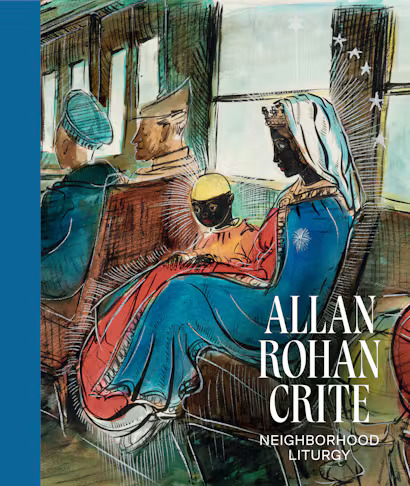
Allan Rohan Crite: Neighborhood Liturgy, edited by Diana Seave Greenwald and Christina Michelon, undertakes the Herculean enterprise to celebrate a life’s work and to place in proper perspective, with nuance and scope, the eighty-year career of painter Allan Rohan Crite (1910–2007). The cover art, as well as the title of this impressive work, announces the distinctiveness of the artist and the editors’ approach to accommodating his legacy. Crite’s Streetcar Madonna (1946), which adorns the cover, is a visual enunciation of the complexity of the man and the profundity of his artistic choices, which were at once divine and quotidian, almost always placing Black people at the center of his artistic projects.
Crite was a Boston-based African American painter who worked across his long career in multiple mediums, among them oils, watercolors, sketches, lithographs, murals, illustrated gospels in pamphlets, liturgical paintings and illustrations, and stained-glass windows. Crite was also an author, essayist, lecturer, and historian. When he passed away in 2007 at the age of ninety-seven, he was still a working artist who proudly assumed his honorific role as Boston’s griot (a reference to the West African figure tasked with preserving the history, narrative genealogies, and traditions of a people) and dean of the Black art community in the city. As a painter, he was most recognized for his Neighborhood series (1935–45), which focused on Black urban working- and middle-class life in Boston’s South End and Roxbury communities, which were Crite’s base for his entire career. The series, which earned Crite recognition in the first half of the twentieth century, was comprised mostly of genre scenes featuring Black people’s dignity, humanity, and spirituality in everyday activities as they moved along urban streets and gathered for religious worship. These works stood out as unremarkable in their time in contrast to painters celebrated by Harlem Renaissance leader Alain Locke, such as Archibald Motley Jr. (1891–1981), who painted the jazz-themed Bronzeville series, and Jacob Lawrence (1917–2000), who depicted rural Southerners traveling north in the Migration of the Negro series (1940–41).
Allan Rohan Crite: Neighborhood Liturgy is the first major book-length account of Crite’s artistic career and was written to accompany three major exhibitions that opened in 2026 at the Isabella Stewart Gardner Museum, Boston; the Boston Athenaeum; and the Zimmerli Art Museum at Rutgers University, New Brunswick, New Jersey.1 In this it is unparallelled. The book comprises scholarly essays interspersed with the artist’s works, archival reproductions of documents and photographs, biographical and historical sketches, and vignettes from those who knew Crite. Because there are multiple authors lending their voices to describe Crite as an artist, there is some redundancy in biographical detail as each scholar is compelled to reintroduce the artist.
These collected materials map Crite’s career through the decades, tracking his many creative shifts attuned to social concerns and creative movements, including the Harlem Renaissance, African Continental expressive forms, the influence of European masters, the Black Arts Movement, international pilgrimages, and progressive politics. Several of the essays also showcase Crite’s idiosyncrasies, such as his experimentation with printing presses in an effort to make his art more accessible to his community, which was foremost among his concerns and second only to his religious faith.
Voices leading the chorus in this volume to witness2 the art, life, and legacy of Crite are museum directors Peggy Fogelman, of the Isabella Stewart Gardner Museum, and Leah Rosovsky, of the Boston Athenaeum, who discuss Crite’s stature in Boston in their foreword. The other contributors to the volume celebrate Crite as one of the most important American artists of the twentieth century. They all recognize his choice to place Black people at the center of his street scenes, portraits, and liturgical works, as well as his community devotion, which profoundly shaped his artistic legacy.
In the preface, Theodore C. Landsmark celebrates Crite’s important role as an artist who undertook the responsibility of building bridges between different communities and mentoring subsequent generations of young artists. Landsmark characterizes Crite as an elder statesman, infused with “optimism” and “joy” for the future, themes that repeat throughout book. Landsmark’s hope for the exhibitions and, by extension, this collection of texts is that they will inspire others to follow Crite’s example in commitment to art and community.
Focusing on Crite as a Bostonian, Diana Seave Greenwald and Christina Michelon’s essay, “Allan Rohan Crite: The Omnipresent Artist,” tracks the history of Crite’s relation to the city. They underscore his engagement with Boston’s institutions, starting with the Children’s Art Center, where Crite took his first art classes, and follow his studies through the School of the Museum of Fine Arts and Harvard University Extension School. Greenwald and Michelon also note that Crite worked at the Charlestown Naval Yard as a draughtsman, honing his drawing skills, and they highlight Crite’s paintings and illustrations of Boston as records of place. They argue that his art captured the politics of movement and location during migration, segregation, and social change.
In addition to Julie Levin Caro’s detailed timeline of Crite’s life and work, her essay, “Re-Presenting the Black Urban Scene: Allan Rohan Crite’s Neighborhood Series,” suggests that Crite’s idiosyncratic creative choices situated him both within and outside of several important art-historical projects, including the Harlem Renaissance and Depression-era American Scene Painting. While Crite showed his art with other Harlem Renaissance painters, Caro argues that Crite’s determined investment in a Black middle class, part of a White mainstream ideal that was part of his Black Bostonian upbringing, placed him outside of Locke’s call to embrace the “racially expressive art” of the Harlem Renaissance.
Crite worked for the Works Progress Administration (WPA) during the Great Depression as a “non-relief” artist (meaning he was not dependent on relief aid) but after a year, he rejected WPA support when they required that he shift status to a “relief” (dependent) artist. Crite disliked the welfare stigma. This truncated affiliation with the WPA, and thus with other Depression-era American Scene painters, placed him at the margins of that school and associations with it. These factors, Caro asserts, may be why Crite has been so consistently absent from survey texts. She situates Crite in more nuanced comparison with other regional artists, such as fellow Bostonian John Wilson (1922–2015), who offered bleaker depictions of Boston’s racial politics. She also newly complicates Crite’s long-observed artistic investment in representing a middle-class aesthetics and explains how Crite’s unique understanding of the middle class shaped his approach to representing Black people.
Paula C. Austin’s contribution, “Street is a Memory,” offers a reading of Crite through the complexity of the racial currents that connect Crite’s political and artistic formations at an early age to Black political struggles and Black political organization in Boston’s South End. Using Crite’s paintings, photographs, and words, Austin sketches a Black political backdrop that includes the National Association for the Advancement of Colored People and the League of Women for Community Service, a Black women’s service organization dedicated to the educational advancement of Black women, which exhibited works by Black women artists such as Loïs Mailou Jones (1905–1998) and Meta Warrick Fuller (1877–1968). Austin makes clear the relevance of political struggles to Crite’s critical and creative engagement with African American people.
Efeoghene Igor Coleman’s essay, “Ordinary Divinity: The Enduring Appeal of Allan Rohan Crite’s Streetcar Madonna,” takes up Crite’s belief that Christian art should address biblical stories to modern audiences. Coleman argues that Streetcar Madonna (1946) is not only representative of the protective relationship between Mother Mary and the Christ Child, who is depicted on the streetcar, but that it also holds special significance for Black mothers. The daily threat of losing a child to extralegal violence was, and still is, disproportionately real for Black mothers. Pointing to the antilynching campaigns of Crite’s youth, Coleman argues that today the threat is police violence, evidenced by the murder of George Floyd under the knee of Officer Derek Chauvin. Crite’s use of Christian imagery was addressed to his times, and as Coleman demonstrates, it remains relevant to our own, which she emphasizes by highlighting the factually chilling realities of Black motherhood today.
Art curator and Crite expert Barry Gaither says of Crite’s legacy, “If there were one thing I’d want to underscore about Mr. Crite, it’s that when we think of the art of African Americans in the twentieth century, we have to think of it as a living tradition. A living tradition isn’t one generation of work. A living tradition is a stream of work that’s being built upon and added to” (198). Allan Rohan Crite: Neighborhood Liturgy offers a portrait of Crite as an artist of intergenerational and multidimensional legacies: those he inherited, across a range of concerns, and those he leaves behind. The collection offers a new generation of artists and scholars a way into Crite’s legacies to us all.
Cite this article: A. Louise Mays, review of Allan Rohan Crite: Neighborhood Liturgy, edited by Diana Seave Greenwald and Christina Michelon, Panorama: Journal of the Association of Historians of American Art 12, no. 2 (Fall 2026), https://doi.org/10.24926/24716839.21597.
Notes
- Allan Rohan Crite: Griot of Boston, Boston Athenaeum, October 15, 2025–January 24, 2026; Allan Rohan Crite: Urban Glory, Isabella Stewart Gardner Museum, Boston, October 23, 2025–January 11, 2026; and Allan Rohan Crite: Neighborhood, Zimmerli Art Museum, Rutgers University, New Brunswick, NJ, February 4–July 31, 2026. ↵
- In the tradition of Black communal religious and spiritual practice, this term means to raise one’s voice in supportive testimony of a spiritual and religious truth, which can include, among other things, teachings in Christianity as well as the events of a life. ↵
About the Author(s): A. Louise Mays is a senior lecturer in the Africana Studies Department at the University of New Mexico.