

A Flood of Pictures: The Formation of a Picture Culture in the United States





PDF: Morrissy, review of A Flood of Pictures
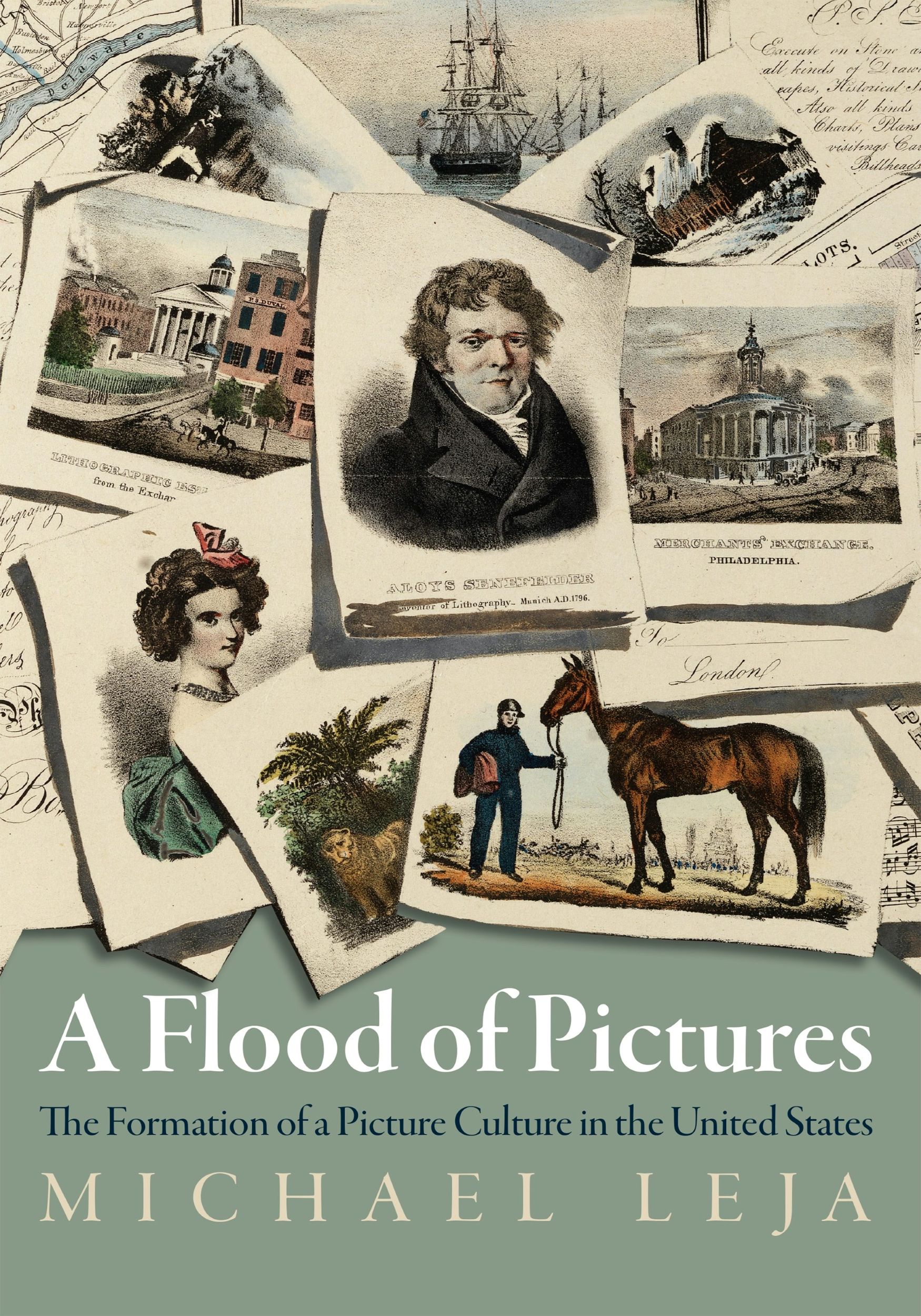 A Flood of Pictures: The Formation of a Picture Culture in the United States
by Michael Leja
Philadelphia: University of Pennsylvania Press, 2025. 400 pp.; 142 color ills. Cloth: $54.95 (ISBN: 9781512826807)
An ever-intensifying image ecology continues to exert a transformative influence on American society. Via smartphones, in particular, commodified images function as crucial nodes through which questions of identity, memory, social status, and power are negotiated. In A Flood of Pictures: The Formation of a Picture Culture in the United States, Michael Leja identifies the period between 1830 and 1860 as a formative moment in this process. Across seven main chapters, he demonstrates how mass-produced images were integrated within a rapidly changing society by performing crucial social, political, and economic functions. Central to this analysis is his account of how images were used to constitute a mass audience from among a heterogeneous population, albeit one that was strongly circumscribed by racism and xenophobia (346–47).
Leja’s extensively researched book examines a wide range of visual media, including Bibles, portraits, magazines, and photography, alongside underexplored formats such as almanacs and gift books. The breadth of its evidentiary base speaks to the author’s embrace of the vast array of digitized historical material that has come online in recent years. Bringing these archives into dialogue with comprehensive historiographical research, Leja combines in-depth visual analysis with detailed discussions of reproductive technologies. He examines the role of techniques, including woodcut, wood engraving, steel engraving, mezzotint, electrotype, and photography, in constructing the new image world while also undertaking insightful analyses of transitions between media. Challenging narratives of technological determinism, Leja shows how producers adapted pictorial forms to meet an expanding public’s demands for news, instruction, political expression, entertainment, aesthetic gratification, and social identification. At the same time, he describes the conceptual adjustments necessary to apprehend this emerging visual culture, including new habits of pictorial literacy; the ability to navigate hybrid, fragmented, and sometimes contradictory images; and an expanded understanding of visual experience as collectively shared and commercially organized. Across these analyses, pictures emerge as unstable instruments of both cohesion and division: They provided often-fragmented audiences with a “common visual anchor” while provoking disputes over truth, identity, and power (83).
In his previous works, Reframing Abstract Expressionism (1993) and Looking Askance (2004), Leja traced the relationship between modernism, mass media, visual practices, and subjectivity from the early twentieth century through the post–World War II period and, in the latter case, from the Civil War to the early twentieth century. Although the balance of emphasis among these elements has shifted, A Flood of Pictures extends this line of inquiry back another three decades, to the period from the mid-1830s to the early 1860s. A growing body of scholarship and curatorial work by Lynda Klich, Christina Michelon, Benjamin Weiss, and Allison Rudnick has likewise foregrounded the scope and ideological significance of print imagery.1 By turning to picture culture’s formative decades, Leja extends this increasingly prominent strand of research while demonstrating how images can be read as evidence of producers’ strategic orientation to the market—an emphasis perhaps best exemplified by the work of Jennifer M. Black.2
Leja identifies Walter Benjamin’s account of commodification as a theoretical point of departure, although the book’s engagement with theory remains limited and is only intermittently explicit in the chapters’ interpretive arguments (23–24). For instance, Benjamin’s technique of using implied, rather than explicit, parallels between the current political moment and the history of the nineteenth century is evident throughout Leja’s book. Indeed, Leja’s discussions of electoral chicanery, media sensationalism, and the conversion of celebrity into political power carry acute contemporary resonance, although the author leaves the precise nature of these connections unstated.
Arguing that the “flood of pictures” was integral to the formation of a mass society, Leja’s introduction draws the reader through a kind of vortex. Identifying crucial moments in mass visual culture, beginning in the recent past, he demonstrates how successive generations, reaching back to the 1830s, understood themselves as experiencing a deluge of mass-produced imagery. Prior to this, Leja identifies popular traveling exhibitions of large-scale paintings, such as Rembrandt Peale’s Court of Death (1820), as important precursors. The enduring appeal of Peale’s sensational panorama, nearly 24 feet wide and containing twenty-two larger-than-life figures, was underscored when a color lithographic copy was produced in 1859 and advertised in an edition of one hundred thousand (17). Alongside an examination of important but understudied formats, such as gift books—steel-engraved collections containing poetry, stories, essays, and pictures—Leja outlines the foundations for the main themes explored throughout the text: the reciprocal relationship among image technologies and pictorial forms, their complex connections to the politics of market demand, and the conceptual and cultural adjustments involved in constituting mass audiences.
Chapter 1, “Picturing News,” argues that the commodification of news in the 1830s was foundational to American mass visual culture. Although they initially contained few illustrations, penny newspapers such as the New York Sun provided a pathway to the news for an expanding working-class audience. By juxtaposing lurid imagery with ostensibly neutral documentary depictions, the penny press disguised the sensationalism at the core of its approach. Iterative depictions of disasters, such as fires and shipwrecks, also show how images were frequently revised to sustain interest. At the same time, agreements between newspapers and related forms of entertainment, including dioramas, fostered a media culture compromised by profit. Readers consequently had to negotiate pictures whose claims to documentary authority were complicated by their sensational and commercial functions. Across media, sensational imagery helped transform news into a visual commodity whose wide circulation gave a geographically dispersed mass audience a set of shared visual reference points, even as the same pictures generated disagreements over truth, propriety, and politics.
Leja’s second chapter, “Almanacs and the Image Campaign of 1840,” examines how William Henry Harrison’s successful run for the presidency used images to mobilize voters. Focusing on the motif of the log cabin in the campaign’s almanacs, Leja shows how even contradictory imagery could forge partisan cohesion through electoral division, fostering the social affiliation and nationalist fervor characteristic of populist movements (347). Harrison’s campaign repurposed the log cabin, originally an insult, to recast the Virginia aristocrat as a man of humble origins while keeping his platform deliberately vague. The versatility of the theme facilitated further contradictory conceptions of the candidate, including as a frontiersman, a folk hero, and a farmer. Some images even cast Harrison—who turned sixty-eight shortly before his inauguration and died thirty-one days into his first term—as a vigorous young man. Highlighting the susceptibility of democratic politics to media manipulation, Leja makes the contemporary connection almost explicit, describing the Whigs’ methods as “techniques that have become familiar in late twentieth- and twenty-first-century presidential campaigns” (85).
Shifting from mendacity to sincerity, chapter 3, “Illuminating a Bible for the Masses,” examines how illustrated Bibles helped usher in this visual revolution, fueled by technologies such as steam power and electrotyped wood engravings. Harper’s Illuminated Bible deployed larger artistic scenes alongside smaller images whose informal style was derived from cheap pamphlets and fairy tales. Its pursuit of “unlimited circulation” depended on an ostensibly neutral Protestantism that remained shaped by nativism and anti-Catholicism (157). Focusing intently on the smaller images, Leja compellingly demonstrates that religious illustrations—when stylized in vernacular, rather than art-historical iconographies—helped both adults and children to connect biblical narratives to everyday experience, contributing to the consolidation of Protestantism’s cultural dominance. Although Leja distinguishes the missionary zeal of nonprofit religious publishers from the commercial calculations shaping Harper’s project, his account gestures toward mass culture’s infantilizing tendencies while resonating with the commoditization of the Bible in contemporary politics.
Having examined Harper’s combination of artistic and vernacular imagery, Leja turns in chapter 4, “Fortified Political Portraits,” to the fluid relationships among image technologies. Daguerreotypes of individual politicians were singular objects, but their images could be translated into reproducible mezzotints. Leja examines this process of remediation in Thomas Doney’s large-scale mezzotint United States Senate Chamber, which synthesized portraits of approximately one hundred separately photographed senators and spectators into a monumental group portrait. This translation and recombination produced unique results: Although their hybrid character could confuse viewers, daguerreotypes conferred evidentiary authority while mezzotint enhanced psychological effects (175–76). Moreover, the subsequent reworking of Doney’s plate challenges narratives of technological determinism. When heavy demand began to degrade the mezzotint plate, Doney reworked it by adding engraved lines throughout, enabling further impressions to be printed. Demand, that is, could also compel producers to modify technologies.
Chapter 5 moves from the remediation of specific portraits to an analysis of the image’s inability to capture the essence of the sitter. Focusing on the Swedish soprano Jenny Lind’s 1850 American tour, Leja explores the role played by widely circulated portraits in expanding the singer’s celebrity and generating profit. Lind was renowned for her personal virtue and her beautiful voice but also for her plain appearance. Against the backdrop of class tensions exemplified by the Astor Place Riot of 1849, Leja argues that the contrast between Lind’s extraordinary musical gifts and quotidian appearance helped render her classless. P. T. Barnum exploited this apparent transcendence of social divisions to market her to a broad audience, addressing different classes on their own terms without challenging the divisions between them (347–48). The chapter’s strongest insight concerns the inconsistency of Lind’s likenesses: Because no single portrait could reconcile her ordinary appearance with her supposedly exceptional inner character, each new attempt encouraged further scrutiny and consumption. Extending his examination of image culture’s ambiguity to the politics of celebrity, Leja reveals how Lind’s popular visual appeal rested on the instability of images rather than the establishment of a fixed, authoritative depiction.
Moving from market success to commercial limitation, chapter 6 focuses on the Langenheim brothers’ photographic experiments in relation to the growing culture of tourism. Their Panorama of the Falls of Niagara (1845), assembled from five daguerreotype plates, reinforces Leja’s argument that the awe provoked by technology linked the sublime encounter with the falls to the tourist experience of the landmark, helping to satisfy the “restless search for visual gratification” (238–42, 266–67). After several experiments of varying success, the Langenheims helped popularize photography through stereographs in the 1850s. Yet their preference for expensive glass images prevented them from fully exploiting the market they helped create; cheaper card stereographs ultimately won out. Developing his critique of technological determinism from another angle, Leja convincingly illustrates that affordability, standardization, and audience building were as important as technical innovation in making photography a mass medium.
Leja’s final chapter, “An Illustrated Weekly for the United States: Gleason’s Pictorial,” offers one of the book’s most compelling arguments, exploring how experimental forms that developed within mass-market visual culture helped shape the more rarefied realm of American modernism. After reconstructing the editorial, commercial, and collaborative conditions behind the publication’s success, he turns to Winslow Homer’s use of decorative borders to synthesize small vignettes within larger composite images. Such layouts required readers to navigate multiple pictures at once and, like the Langenheims’ multiplate panorama of Niagara, offer an analogy for publishers’ attempts to shape a mass audience from a fragmented public. Leja connects these structures to the distortions of scale and spatial disjunctions of Homer’s later work, relating them to similar effects in Édouard Manet’s paintings. Extending a line of argument developed in his previous books, Leja suggests that modernist form did not emerge in opposition to vernacular imagery but partly from the collective and commercial production of mass culture.
These case studies decisively achieve Leja’s aims by tracing picture culture’s material and formal development, its perceptual demands, and its entanglement with American modernization. Notwithstanding the book’s numerous strengths, one wonders whether a more expansive engagement with Benjamin—whose observation concerning commodification and the mass public Leja identifies as the source of the book’s central questions—might have deepened its exploration of the emergent image world. Leja favors a streamlined definition of the commodity as something “produced for purchase by anonymous buyers through middlemen in a marketplace” (25). While functional, this formulation does not fully capture the complexity of the commodity form as Benjamin understood it: as a strange and contradictory phenomenon through which modernity assumed a phantasmagoric appearance. By largely setting aside these complexities, Leja relinquishes the opportunity to explore more fully how and why the surreal dimensions of media culture that he discusses—strange lunar creatures, salacious Lustmorde, mermaids, human-sized animal traps, and false teeth the size of a railway car (30–31, 50–54, 76–80, 113–14, 334–38)—penetrated the modern consciousness.3
A Flood of Pictures emphatically succeeds in illuminating the processes through which a mass-picture culture came into being in the United States. It also reconstructs the new habits of seeing through which diverse audiences learned to navigate images that could consolidate collective experience while sharpening social and political divisions. Its account of the visual strategies used by producers to respond to a diverse and dynamic market provides a substantial foundation for future research, extending Leja’s inquiry beyond the book’s chronological scope to examine how these pictures became “thoroughly commodified” and how that development reshaped American culture and the social, political, and institutional relations that sustain it (2).
The breadth of Leja’s analysis will interest scholars of American history, cultural studies, mass media, and book history. Its ability to speak indirectly, but forcefully, to issues we face in the current political moment will also appeal to general readers and promises strong conceptual engagement from students, suggesting the book will serve as a highly effective teaching tool. Lavishly illustrated with 142 color images, the volume represents a major contribution to print culture and ephemera studies and—in the manner of books such as Peter Marzio’s The Democratic Art—will likely serve as a scholarly touchstone for decades to come.
Cite this article: Shane Smith Morrissy, review of A Flood of Pictures: The Formation of a Picture Culture in the United States by Michael Leja, Panorama: Journal of the Association of Historians of American Art 12, no. 2 (Fall 2026), https://doi.org/10.24926/24716839.21608.
Notes
- See Lynda Klich and Benjamin Weiss, Real Photo Postcards: Pictures from a Changing Nation (Boston MFA, 2022); Christina Michelon, “Touching Sentiment: The Tactility of Nineteenth-Century Valentines,” Common-place 16, no. 2 (2016), https://commonplace.online/article/touching-sentiment; Christina Michelon, “Views of Chicago: Picturing the Ruins of the Great Fire,” Panorama: Journal of the Association of Historians of American Art 7, no. 2 (2021), https://doi.org/10.24926/24716839.12401; Allison Rudnick, ed., Art for the Millions: American Culture and Politics in the 1930s, exh. cat. (Metropolitan Museum of Art, 2023); and Allison Rudnick, ed., The Art of the Literary Poster: The Leonard A. Lauder Collection (Metropolitan Museum of Art, 2024). ↵
- Jennifer M. Black, Branding Trust: Advertising and Trademarks in Nineteenth-Century America (University of Pennsylvania Press, 2023). ↵
- The lunar creatures appeared in Alfred E. Baker’s Lunar Animals and Other Objects Discovered by Sir John Herschel (1835), a lithograph issued in connection with the New York Sun’s Great Moon Hoax (30–31). The eroticized murder scene refers to Alfred Hoffy, John Bowen, and Henry R. Robinson’s Ellen Jewett (1836), a hand-colored lithograph of the murdered courtesan (50–54). The mermaids appeared in three wood engravings commissioned by P. T. Barnum for the New York Herald, Atlas, and Sunday Mercury in 1842 (76–80). The mantrap appeared in the anonymously produced New Orleans broadside Federal-Abolition-Whig Trap, to Catch Voters In (1840), which transformed a log cabin into a trap baited with hard cider (113–14). The false teeth appeared alongside overturned railway cars in John Phoenix {George Derby}, “Phoenix’s Pictorial and Second Story Front Room Companion,” San Diego Herald, October 1, 1853 (334–38). ↵
About the Author(s): Shane Smith Morrissy is currently the Joe and Wanda Corn Postdoctoral Fellow at the Smithsonian American Art Museum and the National Museum of American History.