

Alice Adams: Sculpture and Drawings, 1964–2025





PDF: Hanin, review of Alice Adams
Curated by: Gwenolee Zürcher
Exhibition schedule: Zürcher Gallery, New York, May 17–July 22, 2025
Taking leading publications on American Minimalism as a guide, one would be excused for thinking that the inventive and versatile New York artist Alice Adams, age ninety-five, does not exist.1 Yet Adams’s oeuvre—now spanning over seventy years—boasts an impressive and eclectic body of work, mostly wood, metal, and foam sculptures; tapestries; and public art across the United States. The twenty-object show at the Zürcher Gallery in New York, which represents Adams, followed on the heels of Zürcher’s 2023 and 2024 shows featuring other works by Adams from the 1960s to 2023. The latest show, titled Alice Adams: Sculpture and Drawings, 1964–2025, was a welcome chance to elevate Adams’s profile and her place among prominent American Minimalists, as well as to ponder why this recognition has been so long delayed.
The exhibition consisted of nineteen objects made by Adams—eight wooden sculptures, a wall-mounted latex-and-foam object, and ten works on paper—along with one historically significant exhibition poster from 1966, described below. Gwenolee Zürcher, the gallery’s owner and curator, received approval from Adams for curatorial decisions. In addition to hosting three Adams shows in as many years, Zürcher has also published a thoughtful, comprehensive 209-page catalogue of Adams’s art, freely available online.2 Prior to the 2023 Zürcher exhibition, Adams’s last solo show in New York City took place forty-two years earlier at the Hal Bromm Gallery in spring 1981.3
Along with the Zürcher show, Adams has recently garnered international attention with the concurrent exhibition Abstract Erotic: Louise Bourgeois, Eva Hesse, Alice Adams (June 20–September 14, 2025) at the Courtauld Gallery in London, the first presentation of her work in the United Kingdom.4 The Courtauld show brought together a small but notable group of objects by the three artists nearly sixty years after the 1966 Eccentric Abstraction show at the Fischbach Gallery in New York, curated by Lucy Lippard, which featured eight artists and helped launch the careers of Adams, Bourgeois, and Hesse. The Courtauld included a number of Adams’s well-known early pieces, including a cotton-cord-and-rope object (Sheath, 1964); seven wooden beams leaning against a wall (Resin Corner Pieces, 1967); and a steel-cable-and-metal-plate object (Threaded Drain Plate, 1964) (the second and third courtesy of Zürcher). Although Lippard herself had referred to Adams’s “animate references” as “erotic and often humorous,” Adams’s Courtauld pieces were less erotically suggestive than those of Bourgeois and Hesse, nor did the objects in the Zürcher show center on that theme.5 Nevertheless, a promotional video of the Courtauld exhibit, with curators discussing the three artists and their work, was played at Zürcher for visitors interested to learn more, and the Zürcher exhibition helpfully included a 1966 poster for the Fischbach show, linking past and present, the New York and Courtland shows.
Born in New York in 1930, Adams received her bachelor’s in fine arts in painting from Columbia University in 1953, where she also studied architecture with the art historian Meyer Schapiro. Adams then spent a highly formative year in Aubusson, France, studying tapestry on a French government fellowship, calling it “a life-changing experience.”6 As Adams recounts, while in France, she “visited many Romanesque churches and their frescos” and photographed architectural ruins.7 Since the mid-1950s, Adams mostly lived and worked in New York City, cofounding an influential co-op gallery at 55 Mercer Street in 1970.8 After making tapestry- and rope-based objects in the 1950s and early 1960s, she experimented with diverse media in her sculptural practice, including steel cables and chains, aluminum, polyurethane foam, latex, plaster, and, of course, wood.9 Adams created large site-specific art installations, such as Leveling (1977–86) in Chambersburg, Pennsylvania, and Shorings (1978–79) in Lewiston, New York.10 In the 1980s, she shifted to creating public art in settings such as universities, parks, and mass-transit hubs, like the Denver International Airport and Seattle’s mass-transit system.11
Although the objects in Zürcher’s latest show offered an inevitably selective look at Adam’s art making, they were nevertheless representative of central preoccupations and motifs, as well as technical strategies, in her artistic practice across the decades. Two iconic early works—Column with Frame for Two Arches (1973; figs. 1a–b) and Column with Three Arches Springing (1974; figs. 2a–b)—were, for me, the stars of the show. As Adams observes, “There is a very strong relationship to architecture in my work,” an affinity made vivid in these sculptures.12 Both are larger-than-human scale and constructed using a base made of narrow rectangular wooden segments hammered one above another into long vertical beams; atop the base are lyrical embellished components. The wooden surfaces are roughly hewn and coarsely textured; nails are driven in without aspiring to perfect linearity or excessive effort to mask the art-making process. The sensibility is that of unpretentious woodshop mastery—entirely unlike the sleek, industrially fabricated objects of Donald Judd and Dan Flavin or the flawlessly geometric modular structures of Sol LeWitt from the mid-1960s—against which Adams implicitly appears to rebel. One thinks, rather, of Carl Andre’s wooden sculptures, including Pyramid (1959), Last Ladder (1959), and Hern (1960); Mark Di Suvero’s wooden pieces; and even some aspects of Lucas Samaras’s densely intricate sculptures, like Box #3 (1962–63).13
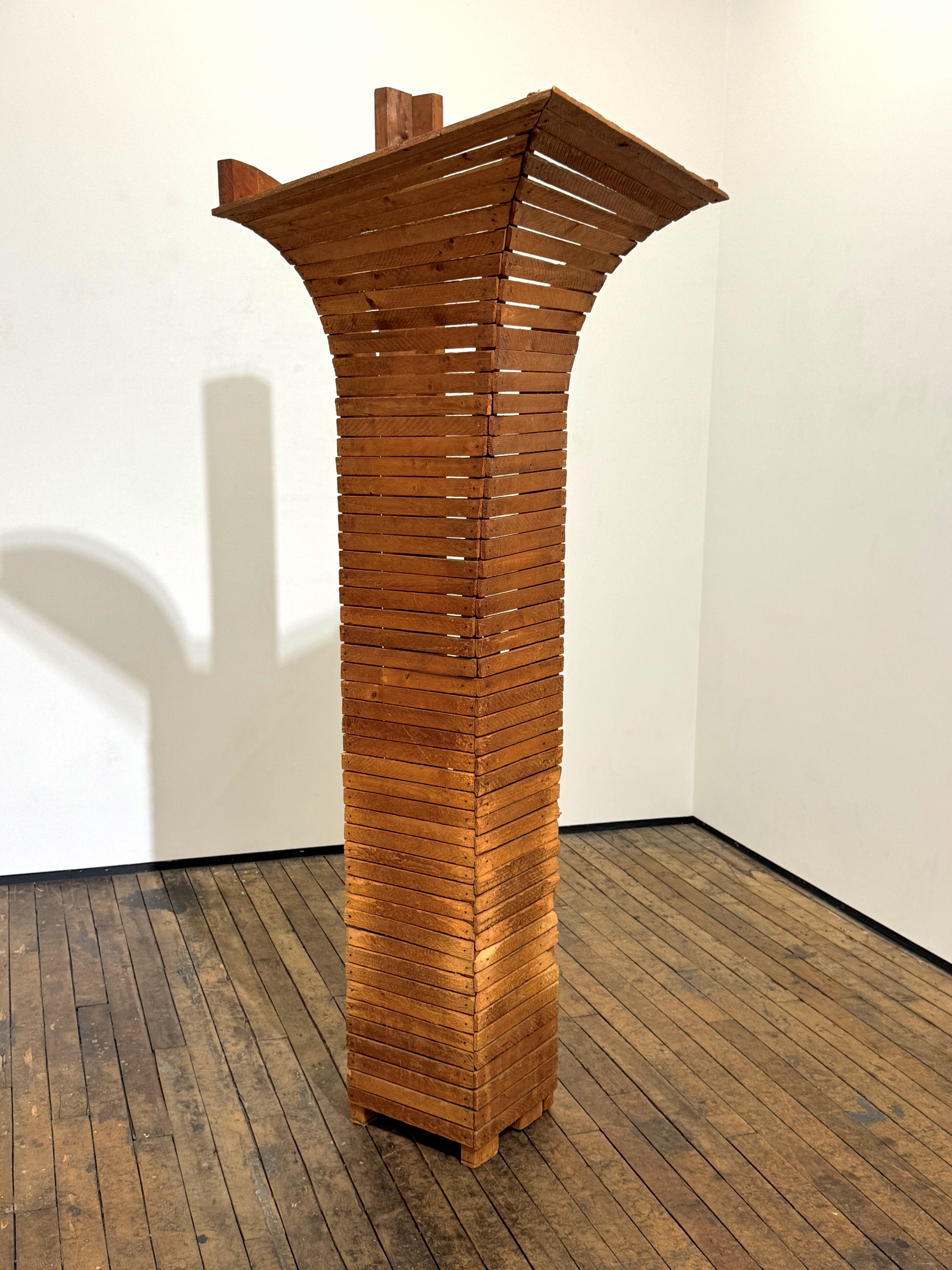
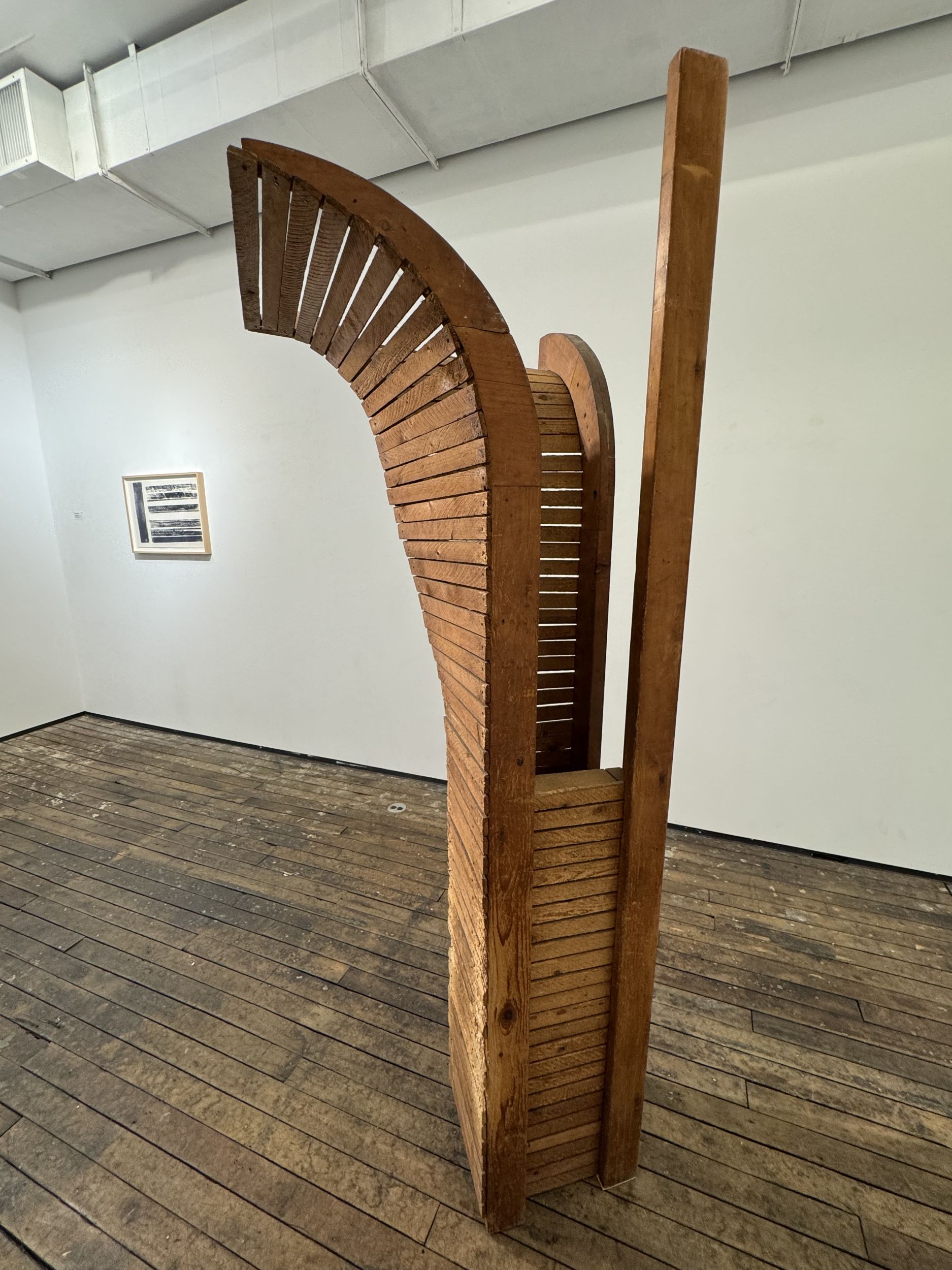
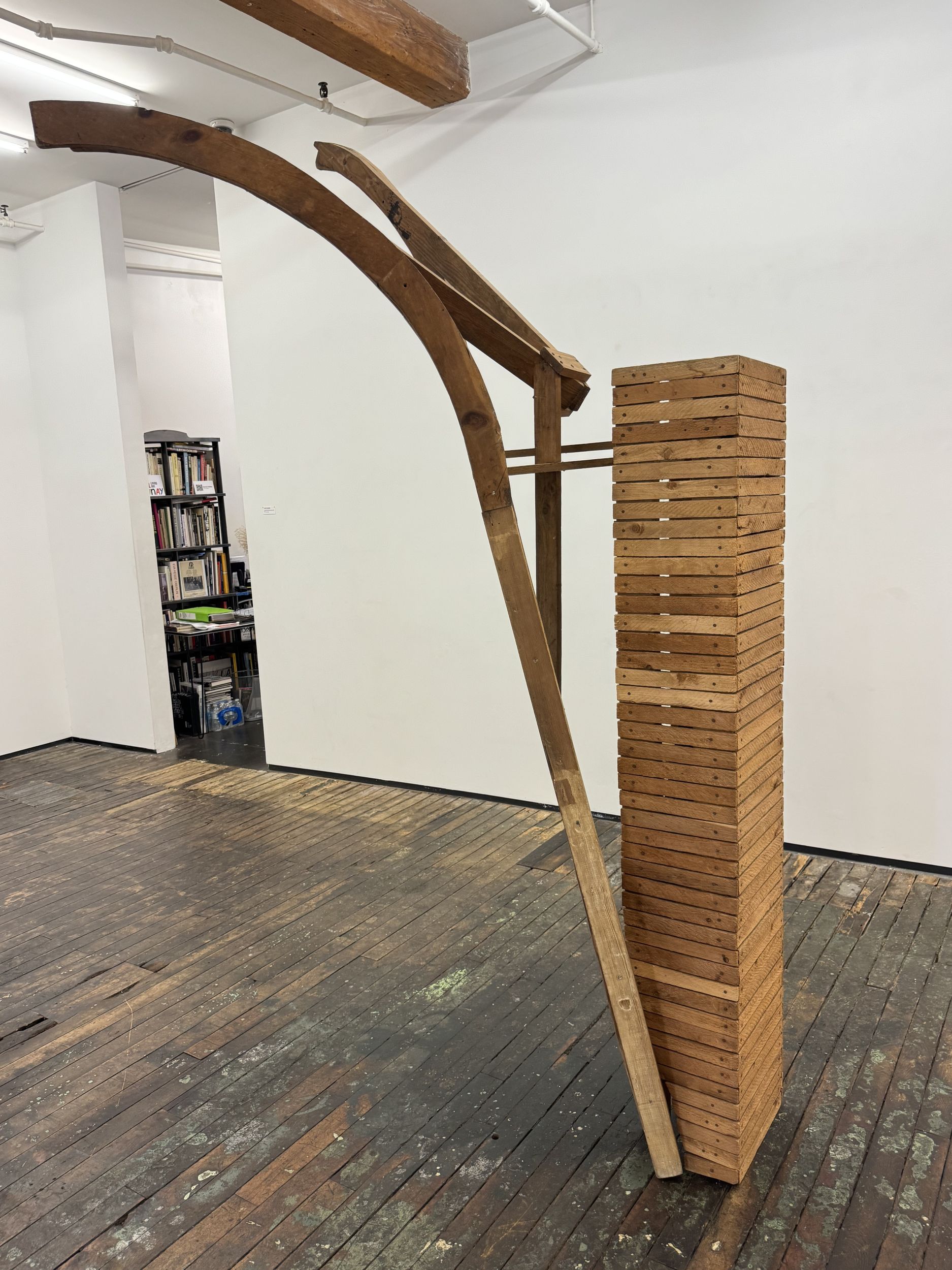
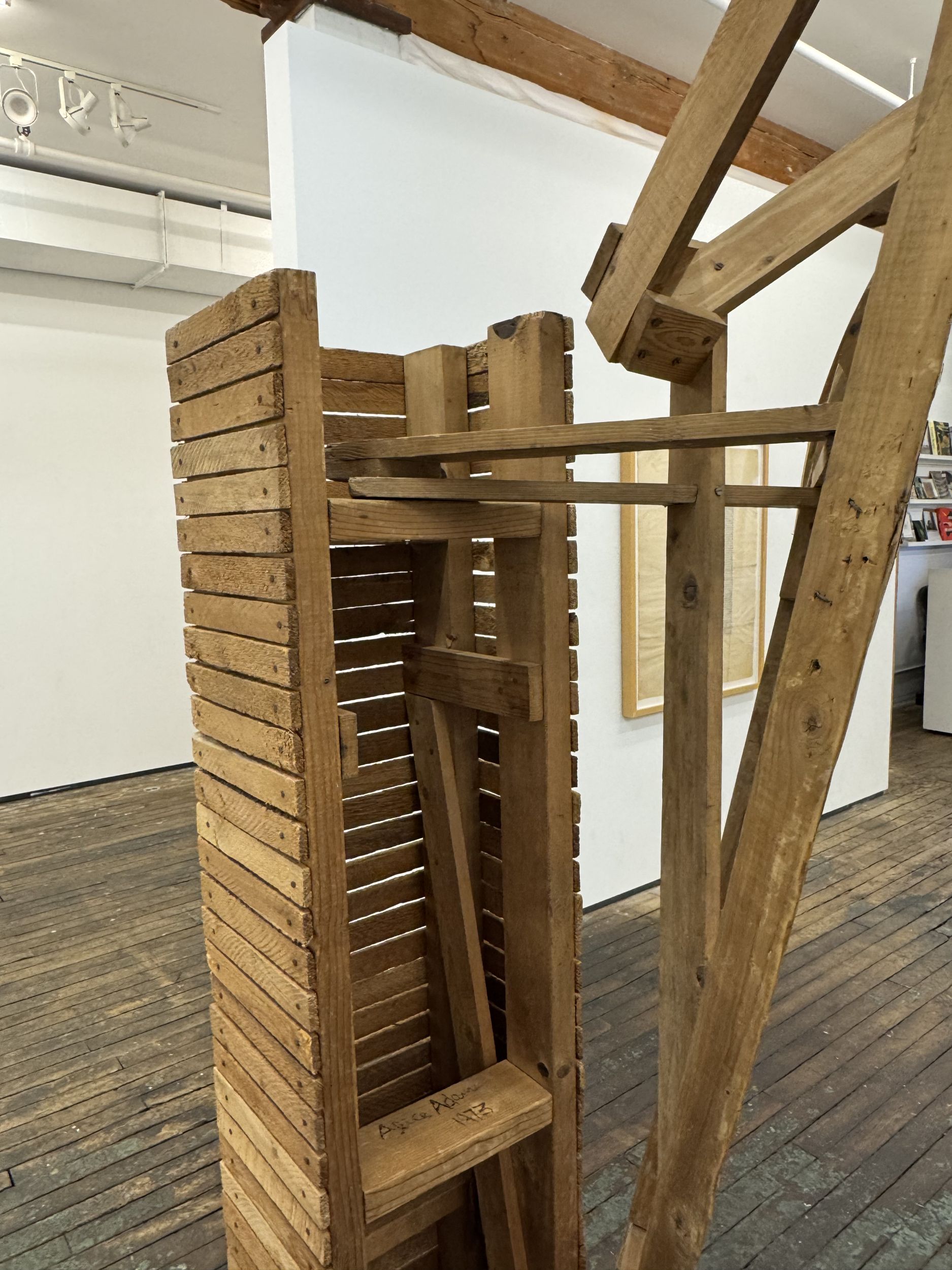
Column with Three Arches Springing arcs upward and curves toward the viewer, its concave slope echoing the Romanesque semicircular arches that Adams had photographed in France or, perhaps, a ship’s elegant bow.14 Column with Frame for Two Arches is more jagged and chaotic, featuring two antler-like emanations made of slender, curving wooden pieces and a complex web of subcomponents. Each shift in perspective discloses new vantage points onto textural details and the interplay of forms, so that the viewer feels somewhat overwhelmed, unable easily to bring the works under a single conceptual category. Hermeneutically dense and almost oracular, these sculptures are perhaps better described as primordial than Minimalist, content to just be without a polemical aim or program. This quality is both a strength and an Achilles’ heel of Adams’s oeuvre—and may be one clue to why her art has received less critical scrutiny over the years than that of many of her contemporaries, such as Eva Hesse.
Six of Adam’s recent sculptures served as intriguing counterpoints, though none rivaled the older sculptures in formal ingenuity and aesthetic force. Column with Three One-Half Arches II (2025) rhymed most clearly with the early pieces in terms of materials, composition, and title. A rectangular wooden anchoring structure created a hollow inner compartment with vertical beams of contrasting heights jutting out from it. The sculpture curved at the top in three linked concave segments, terminating where an architectural keystone would have been, again reminiscent of a support column, with the haunch’s elegant shape accentuated by thicker wooden segments. Despite obvious affinities with Column with Three Arches Springing, this work was less striking overall. I wondered, too, about the practicalities of fashioning such a large-scale object and whether Adams relied on assistants to construct it.
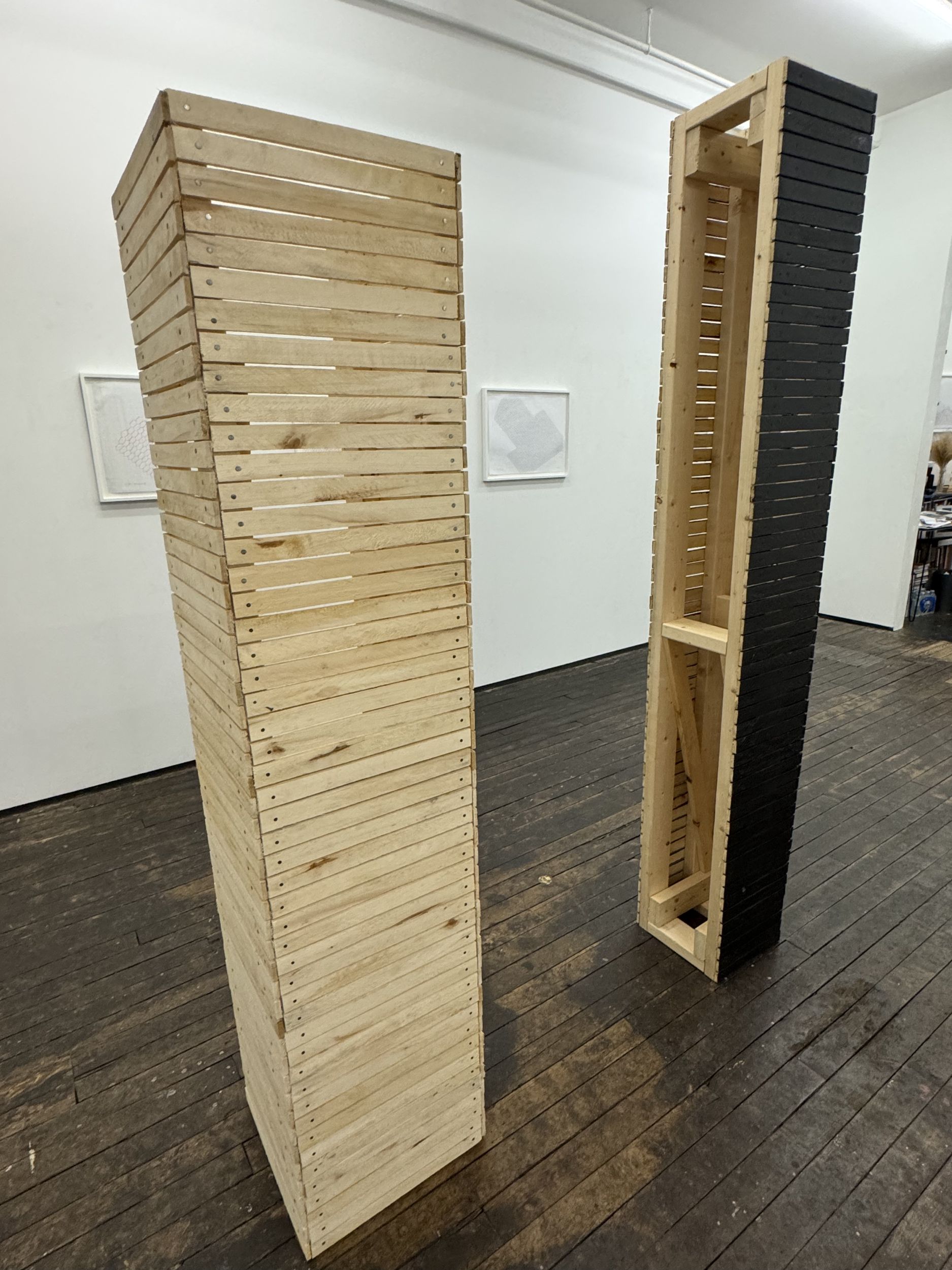
Yet another paired composition—here, integrated into a single sculpture titled Outside In (2024)—consisted of two wooden panels, akin to easels, made up of thirty or so rectangular wooden pieces affixed to a large supporting apparatus. One panel was made of light wood; its Janus-faced companion was painted black, recalling the Linlithgo colors. The panels resembled two people standing with their backs nearly touching, slightly off-center, gazing in opposite directions. Adams ably incorporated subtle asymmetries into the composition, with one panel elevated above the other, the floor supports positioned asymmetrically, and the two planar elements linked by both horizontal and diagonal beams. This work, too, must be seen in context of Adams’s earlier kindred sculptures, such as Long Wall (1973) and Four Corners (1972).
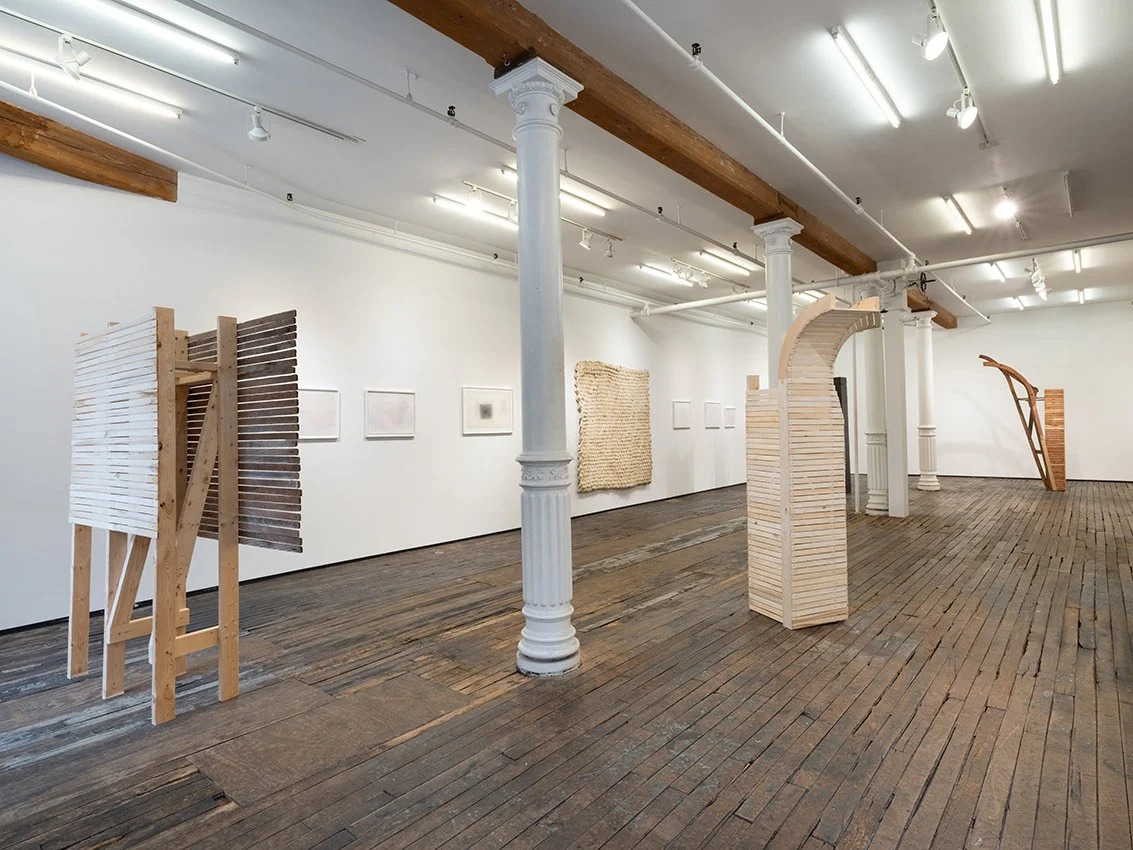
Finally, a pair of deceptively simple sculptures, the smallest on view—Sculpture 1 (2025) and Small Sculpture 2 (2025)—were placed side by side on a windowsill. These again featured rectangular wooden strips, three facing each direction and nailed in staggered cross-shaped formation into a vertical block sitting atop a wooden platform. The companion piece was almost identical, except that three of its wooden segments varied in length, decreasing in size from top to bottom. The simplicity of these sculptures was belied by their deft scaling and assured execution, recalling Adams’s earlier works like Cross Section (1974) and Wall Section B (1974). Although the gallery’s faded, uneven wood plank floors, white support columns, and conspicuous ceiling beams produced intriguing resonances with Adams’s wooden objects across the show, I found that the surfeit of wood and columnal elements in the gallery ultimately made it more challenging for her pieces to stand out than they might have in a more neutral space (fig. 4).
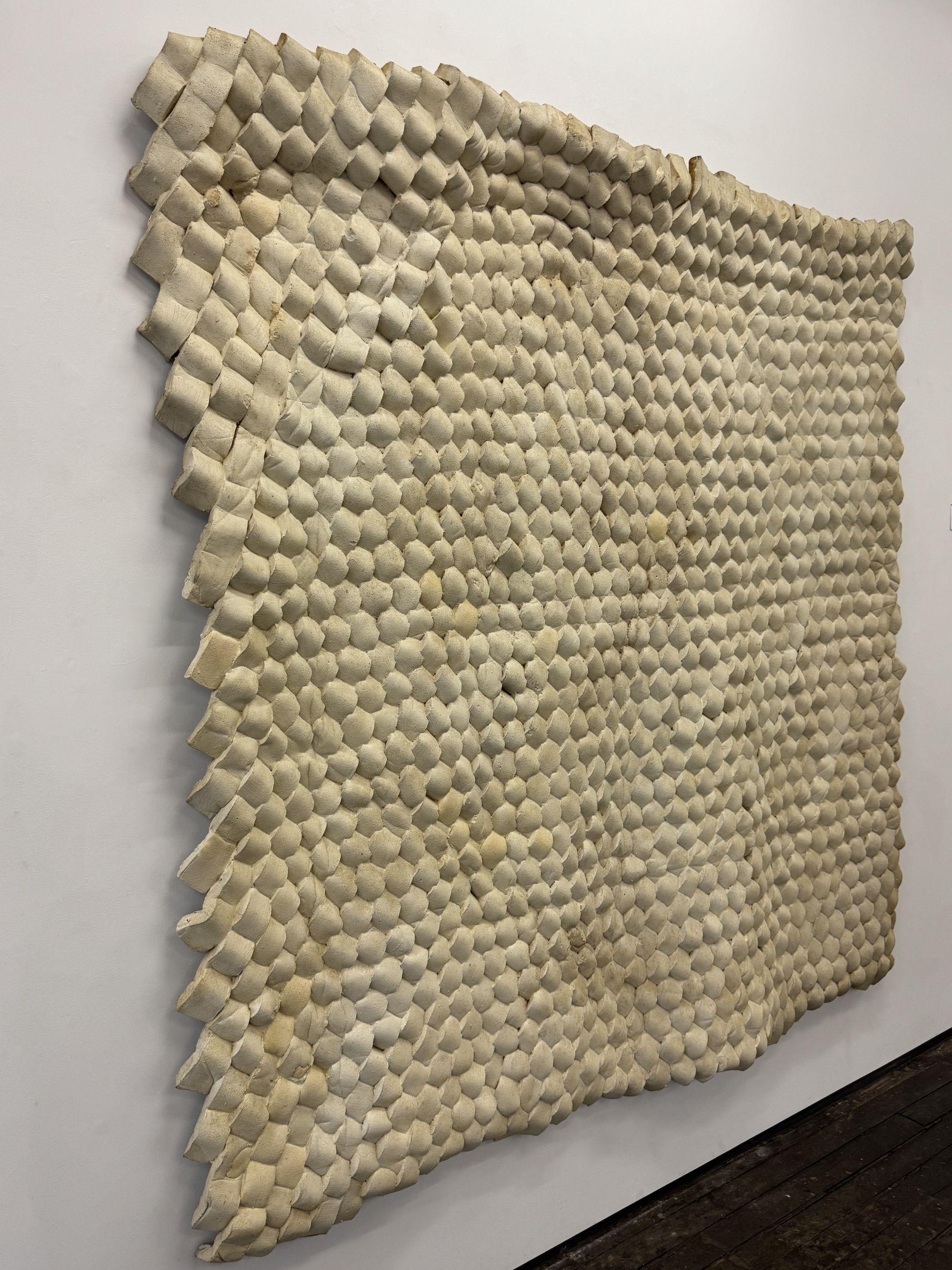
Alongside Adams’s wooden sculptures, a wall-mounted, human-scale sculpture made of foam rubber, latex, and acrylic paint was given pride of place on one of the walls. Latex Covered Foam Construction (1970; fig. 5) is one of several such pieces that Adams fabricated in the late 1960s (along with one in 2017).16 A bit off-putting, the bulbous latex mass looks like a three-dimensional field with faded marshmallow-like protrusions in diagonal rows, the edge pieces sticking out to avoid straight borders. The undulating, quiltlike texture brings to mind Adams’s expertise in woven work and patterns. The sculpture has the quality of a sedimented layer of rock or wall insulation, recalling Adams’s pieces featuring walls, floors, and drywall.17
The repeating shapes and diagonal design of Latex Covered Foam Construction echo the composition of her works on paper or vellum, mostly from 2018 to 2024. Nine were made with felt pen or pencil and featured repetitive hexagonals, L shapes, and other patterns drawn by hand in red or black ink with no pretense of exactitude. The works embodied a tension between geometric perfection and an urge to resist a Platonic ideal by emphasizing the human and imperfect, a tension found in many of Adams’s works. One of the two older drawings, Two Columns on Graph Paper (1964–65), features a dark gray columnar shape paired with a more diminutive shape to its left arcing toward it. The standout work was probably Woodlathe Print #2 (1970), hung in an alcove with Column with Three Arches Springing. An homage to materials central to Adams’s art, the print depicts seven wooden beams resembling two-by-fours—six horizontal and one vertical—as impressionistic, unfinished forms in striking, dark blue ink.18 Running to the margins, the wooden elements dominate the field, telegraphing the primacy of wood in Adams’s aesthetic.
Although it is difficult to diagnose why Adams’s art has not been as widely recognized as it deserves, Alice Adams: Sculpture and Drawings, 1964–2025 offered some insights. What struck me most was how simultaneously thought-provoking yet also self-contained, self-effacing, and hard to pin down some of the works were. Their antipolemical quality—appearing indifferent to, rather than vying for, the viewer’s gaze (which may also be a trait of the artist herself)—likely has something to do with their underappreciated status. Other possible factors are that Adams was initially a weaver rather than a sculptor, that her styles and media kept shifting over time, and that gender bias was common in the mid- to late twentieth-century art world.19
Overall, the show’s works from the 1960s and ’70s embodied greater compositional subtlety and imaginative power than the more recent pieces. The five early works highlighted above—two columnar sculptures, one latex installation, and two works on paper—showcased Adams’s distinctive strengths across three different media. This exhibition, together with Zürcher’s 2023 and 2024 shows, the Courtauld retrospective, and accompanying publications, are welcome and overdue efforts to highlight the ingenuity and breadth of Adams’s art and to begin to raise her profile.20 One hopes that authors of books and compendiums on Minimalist art, where Adams deserves a more prominent place, take note.21
Cite this article: Mark L. Hanin, review of Alice Adams: Sculpture and Drawings, 1964–2025, Zürcher Gallery, Panorama: Journal of the Association of Historians of American Art 12, no. 1 (Spring 2026), https://doi.org/10.24926/24716839.20896.
Notes
- For example, Adams is not mentioned in James Meyer, Minimalism: Art and Polemics in the Sixties (Yale University Press, 2001); Alex Potts, The Sculptural Imagination: Figurative, Modernist, Minimalist (Yale University Press, 2001); Edward Strickland, Minimalism: Origins (Indiana University Press, 1993); Minimal Art: A Critical Anthology, ed. Gregory Babcock (E. P. Dutton, 1968); David J. Getsy, Abstract Bodies: Sixties Sculpture in the Expanded Field of Gender (Yale University Press, 2015); or Judith E. Stein, Eye of the Sixties: Richard Bellamy and the Transformation of Modern Art (Farrar, Straus and Giroux, 2016). She receives a passing mention for taking part in the 1966 Eccentric Abstraction show in Jo Applin, Eccentric Objects: Rethinking Sculpture in 1960s America (Yale University Press, 2012), 8. Interestingly, Meyer’s book Minimalism contains an illustration (on p. 130) from Carl Andre’s book Passport (1960; vol. 1 of Seven Books of Poetry) titled “Map of Chelsea Sculpture Show” (p. 54 of Passport), which is held at the Addison Gallery of American Art. At bottom right, the map includes a dot with the name “Adams” next to it. If that is a reference to Alice Adams, it is the only one in the book. ↵
- See Zürcher Gallery, Alice Adams (Zürcher Gallery, 2025), https://static1.squarespace.com/static/5db4974f6420426c488ba9ff/t/684c8b2c10527c539e556758/1749846831543. ↵
- See Alice Adams, Hal Bromm Gallery (March 28–April 21, 1981), https://halbromm.com/alice-adams-2. ↵
- Zürcher also presented a selection of Adams’s works from 1964 to 1970 at the Frieze Masters, London, in October 2025. See “‘Spotlight’: 20th-Century Luminaries at Frieze Masters 2025,” Frieze, June 17, 2025, https://www.frieze.com/article/spotlight-20th-century-luminaries-frieze-masters-2025; and “Alice Adams: Frieze Masters,” Zürcher Gallery, https://www.galeriezurcher.com/alice-adams-spotlight-section-october-15-19-2025. ↵
- Lucy R. Lippard, “Eccentric Abstraction,” in Changing: Essays in Art Criticism (E. P. Dutton, 1971), 110. ↵
- Alice Adams, interview with Jonathan D. Lippincott, American Abstract Artists, May 1, 2022, https://americanabstractartists.org/alice-adams-interview. ↵
- Adams, interview with Lippincott; see also Zürcher Gallery, Alice Adams, 134–35. ↵
- Zürcher Gallery, Alice Adams, 28, 77. ↵
- See, for example, Adams’s tapestries at David Hall Gallery: Wheatfield (1959), The Alpes (1964), Henry’s Pink Circle (1962), Sheath (1964), and Creature (1964); “Alice Adams,” David Hall Gallery, accessed May 25, 2026, https://davidhallgallery.com/artists/33-alice-adams/works. As Adams put it, she was “working on the edge between a lot of different materials and a lot of different images and a lot of different spaces.” “Painter & Weaver Alice Adams,” New Arts Alive, April 18, 2008, posted June 5, 2024, by Berks Community Television (BCTV), 57:50, YouTube, https://www.youtube.com/watch?v=6h716w6Dk-M (at 5:15). ↵
- For site installation video, see “Painter & Weaver Alice Adams,” 23:45; see also Adams, interview with Lippincott. ↵
- See Alice Adams—Public Projects: 1984–2000 (Lehman College Art Gallery, Bronx, New York, 2000). ↵
- See “Painter & Weaver Alice Adams,” 4:28. ↵
- On Samaras, see Applin, Eccentric Objects, 71. ↵
- See Zürcher Gallery, Alice Adams, 134. ↵
- Zürcher Gallery to author, correspondence, September 26, 2025. ↵
- See, in particular, White Foam Angle Section (1967), Long Purple Wall Section (1970), Expanded Cylinder (1970), and White Coat (2017). ↵
- See, for example, Wall and Floor (1967), Urban Renewal I and II (1967), and Gordy’s Wall (1970). ↵
- The number 7 is also compositionally central to Adams’s Resin Corner Pieces (1967, shown at the Courtauld), her large-scale installation Long Wall (1973), and her sculptural work Cross Section (1974). ↵
- See, for example, Meyer’s discussion of the reception of Anne Truitt’s work as a partial exception proving the general rule; Meyer, Minimalism, 222–28. ↵
- Some writings associated with last year’s shows have advanced this goal. See Glenn Adamson, “Why Artist Alice Adams—Aged 94—Is Finally Getting Her Moment,” Financial Times, October 10, 2025, https://www.ft.com/content/3d636106-5e1f-49b6-8dfb-bff5181ec045; and “Alice Adams Forged a Bold Artistic Language in the 1970s. Now, Her Work Is Making a Comeback,” Artnet Gallery Network, June 26, 2025, https://news.artnet.com/art-world/alice-adams-david-hall-gallery-2671472. ↵
- I am grateful to Panorama’s Exhibition Reviews editors for very helpful comments. ↵
About the Author(s): Dr. Mark L. Hanin is an attorney at the law firm WilmerHale in New York, NY.