

Islands Beyond Empires: Imagining an Archipelago at the Colby College Museum of Art, Waterville, Maine





PDF: Batario, Islands Beyond Empires
On July 11, 2026, the Colby College Museum of Art opened Imagining an Archipelago: Art from Cuba, Guam, the Philippines, Puerto Rico, and Their Diasporas, an exhibition five years in the making. To celebrate the occasion, twenty artists journeyed to Waterville, a small town in central Maine, from as far away as Guam and Mexico.1 Two days later, on July 13, an agent of Immigration and Customs Enforcement (ICE) shot and murdered Joan Sebastian Guerrero, a twenty-six-year-old Colombian immigrant, in front of his wife and toddler daughter.2 This unjust killing happened in Biddeford, Maine, ninety miles south of Waterville. In Maine’s rural context of small, close-knit communities, this may as well have happened next door. I am reflecting on this exhibition relative to the 250th anniversary of the United States while holding two extremely incongruent feelings of pure joy and deep sorrow.
Imagining an Archipelago presents contemporary art related to the intertwined histories of occupation and colonization by Spain and the United States of the islands of Cuba, Guam, the Philippines, and Puerto Rico. The exhibition probes the relationship between political and cultural self-determination, connecting generations across the Atlantic and the Pacific and bringing into dialogue works by forty emerging and established artists. Paintings, sculptures, videos, prints, photographs, and multimedia installations—including six new commissions—speak to the islands’ claims to land, food, and spiritual sovereignties while also considering the complex relationships between Indigeneity and migration.
The exhibition is on view at the Colby Museum for an entire academic year, through June 6, 2027. Imagining an Archipelago will then embark on a national tour, first to the Museo de Arte Contemporáneo in San Juan, Puerto Rico (August 2027–February 2028), then the Yerba Buena Center for the Arts in San Francisco (March–August 2028), and finally the Newark Museum of Art, New Jersey (September 2028–February 2029). The Colby Museum prioritized placing the exhibition in locations where the project would be most meaningful to local communities and where large pockets of the islands’ diasporas are concentrated.
The show’s title and aims are directly inspired by Craig Santos Perez, a CHamoru poet and scholar, who writes, “An archipelagic poetics opens space to express solidarity with other peoples, places, and species who have similar struggles and experiences. . . . The archipelagic links the island to the continent, thus making visible profound differences and power dynamics. . . . [My poems] map and chant the cartography of real and imagined archipelagoes, naming relations and solidarities.”3 This metaphorical framework emphasizes the featured artists’ different yet related strategies toward the critique, defiance, and navigation of conditions brought on by continental empires. Rather than present a single monolithic response to empire, Imagining an Archipelago visualizes a solidarity strengthened by difference.
The exhibition’s historical touchpoint is the late nineteenth century, when independence movements were separately gaining momentum on the islands. At the conclusion of the Spanish-American War of 1898 and the signing of the Treaty of Paris, the United States occupied Cuba and exerted colonial control over the Philippines, Guam, and Puerto Rico. Cuba and the Philippines have since gained independence, while Guam and Puerto Rico remain unincorporated US territories—neither sovereign nations nor fully integrated states, with limited representation in the US Congress. The residents of Guam and Puerto Rico are US citizens but cannot vote in presidential elections.
The Colby Museum began developing this exhibition in 2021, originally scheduling the opening for 2024, with no thought to tying the project to the semiquincentennial. An exhibition run during a presidential election year seemed timely enough. Logistical considerations postponed the show on the institutional exhibition schedule, first to 2025, and then to 2026. Only then did an external interlocutor do the math to tell us of the fortuitous result of our operational decision. In early exhibition descriptions, we prominently tied the project to the 250th anniversary of the United States. While other museums might consider the colonial moment of the founding of this country, we would focus on the history of the nation’s role as a colonizer and interrogate the nature of democracy. Before January 2025, we were emboldened to make such an explicit connection, although the exhibition was not initially conceived to respond to the anniversary.
In spring 2025, the winds began to shift for institutions of art and higher education. Federal scrutiny increased, resulting in lost funding for universities and (self-)censorship in museums and arts organizations. The federal administration attempted to terminate the employment of Kim Sajet, then the director of the Smithsonian National Portrait Gallery, citing her support for diversity, equity, and inclusion (DEI) initiatives.4 One of the more recent exhibitions that Sajet oversaw was 1898: Imperial Visions and Revisions, in many ways the historical forerunner to Imagining an Archipelago.5 In January 2026, ICE came to Maine for the mass-deportation initiative cruelly named “Operation Catch of the Day.”6 As a visibly queer immigrant woman of color, I began carrying my US passport on a daily basis.
These professional and personal contexts prompted me to reconsider the visibility of the exhibition relative to the semiquincentennial. I successfully advocated with the museum’s senior leadership to remove mentions of the 250th anniversary on our promotional materials. Ultimately, and transparently, the timing of the opening for Imagining an Archipelago is a result of the institution’s need to curate a balanced exhibition program while considering staff workload. We decided against foregrounding a connection to the anniversary, while remaining receptive to others seeing the relationship.7
In the months leading up to the opening of Imagining an Archipelago, I wondered if my decision to distance the exhibition from the semiquincentennial was a cowardly move. This opened my thought process to imagining what the ancestors of the artists featured in the show—as well as my own ancestors—did to navigate and survive hundreds of years of colonial subjugation. For five years, I attempted—and sometimes failed—to not reproduce the mechanisms of empire in the making of this exhibition. Imagining an Archipelago has always sought to center the islands, its artists, and their communities. By adopting that approach, I faced a conundrum: how to decenter the empire, when empire is fundamental to understanding the histories of the United States and when empire’s reverberations connect the islands themselves? Paradoxically, the exhibition reluctantly is, and is adamantly not, about the United States.
I decided to sever the tie to the 250th anniversary as a gesture that partially fulfills my original intention. The exhibition is more about the people of the islands than it is about the United States as a national institution. Why ride promotional coattails? And for a museum with programmatic and collecting strengths in the art of the United States, an exhibition dealing with the tenets of freedom and democracy are always relevant, obviating the need for a special promotional designation.
Thus, the issue was purely a matter of external communications and never about the content of the exhibition itself. On that front, the project has always benefited from the backing not only of the museum’s leadership but of Colby College as well. As a curator in an academic museum at a liberal arts college, I developed this exhibition in close transdisciplinary conversation with scholars from various departments, including those of Spanish, history, English, and many others. Through Colby’s Center for the Arts and Humanities, I am one of the faculty organizers of the campus-wide curricular theme of “Islands” across two academic years. At Colby, the right to freedom of academic expression extends to the museum, itself a hub of curricular activity.
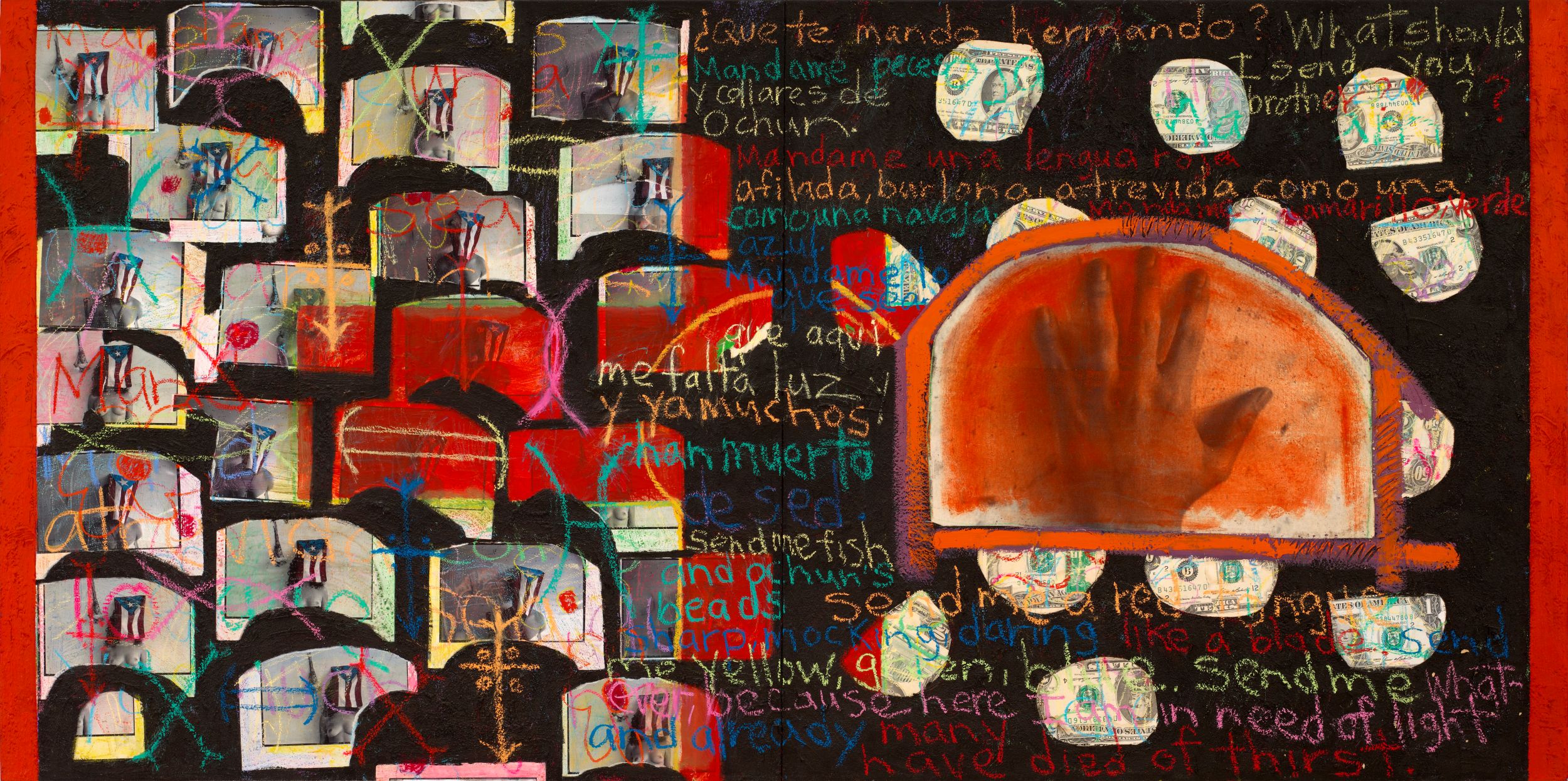
Members of the Colby Museum’s Board of Governors have likewise championed this project, supporting several strategic acquisitions that ensure the longevity of this exhibition’s impact on our institution. For example, in 2025, the Colby Museum acquired Juan Sánchez’s Aquí no hay luz (1995–96), a large-scale mixed-media painting that addresses the struggle for Puerto Rican independence (fig. 1). The composition contains West African symbols layered over nude figures whose faces are obscured by Puerto Rican flags, alongside a handwritten poem in Spanish and English. Sánchez dedicates this text to his friend Elizam Escobar, an artist, poet, and activist affiliated with the Fuerzas Armadas de Liberación Nacional Puertorriqueña (Puerto Rican Armed Forces of National Liberation; FALN). Escobar served nearly twenty years in prison for seditious conspiracy before receiving a presidential pardon from Bill Clinton.
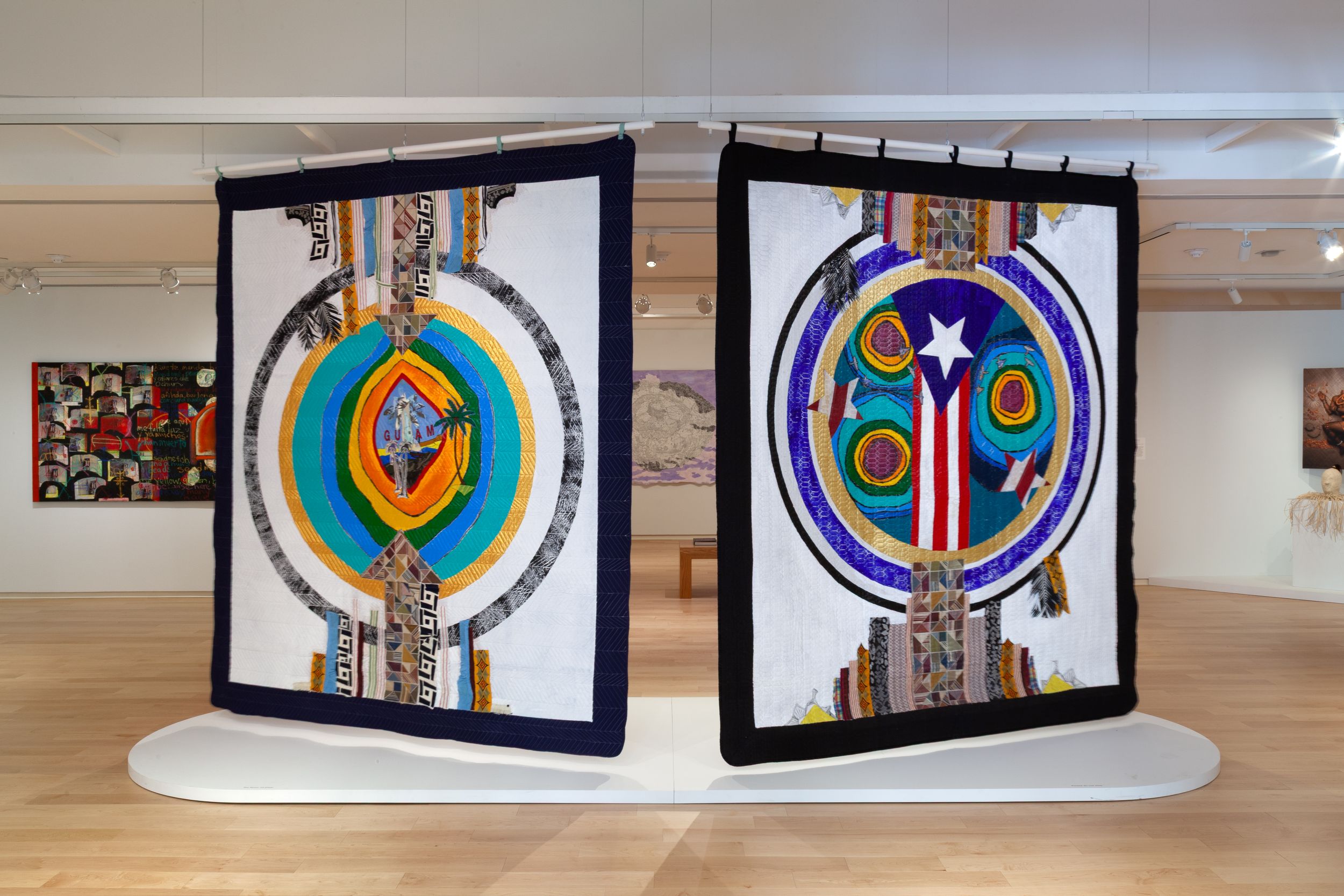
Confident in institutional support and inspired by the exhibition’s artists, not once did I consider revising the checklist or changing the layout of the exhibition. From the start, the show was meant to open with a strong visual thesis of solidarity through two monumental quilts by the Afro–Puerto Rican artist Amber Robles-Gordon (fig. 2). Guam Political / Guam Spiritual and Puerto Rico II Political / Puerto Rico II Spiritual (2021) are double-sided, painted-and-collaged textiles from the artist’s Successions series, a body of work that addresses the sovereignties of US territories. Situated between the Guam and Puerto Rico sections of the exhibition, the quilts hang eighteen inches apart and bridge a gap of more than nine thousand miles of ocean and land, establishing a direct dialogue between the two island territories.
The only change we made to the interpretive materials before opening responded to a relevant political shift concerning Beatriz Santiago Muñoz’s Ojos para mis enemigos (2014), a film that documents a decommissioned military base in Ceiba, Puerto Rico (fig. 3). In late 2025, and against the backdrop of increasing tensions in the Caribbean, the US Navy reopened this base.8 The film now ruminates on a temporary possibility: the reclamation of land and decaying infrastructure by wild creatures. At this juncture, our publication was already in design and going to press, and we could not reflect the development in the book. However, our in-gallery didactics acknowledge the base’s reopening.
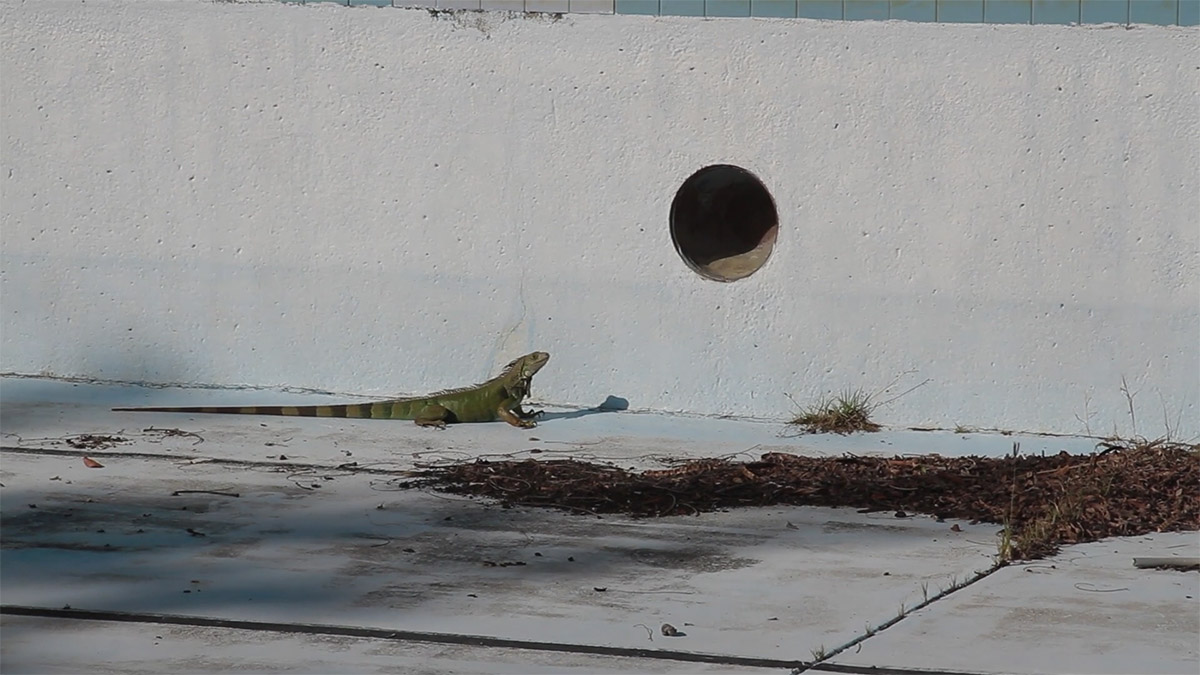
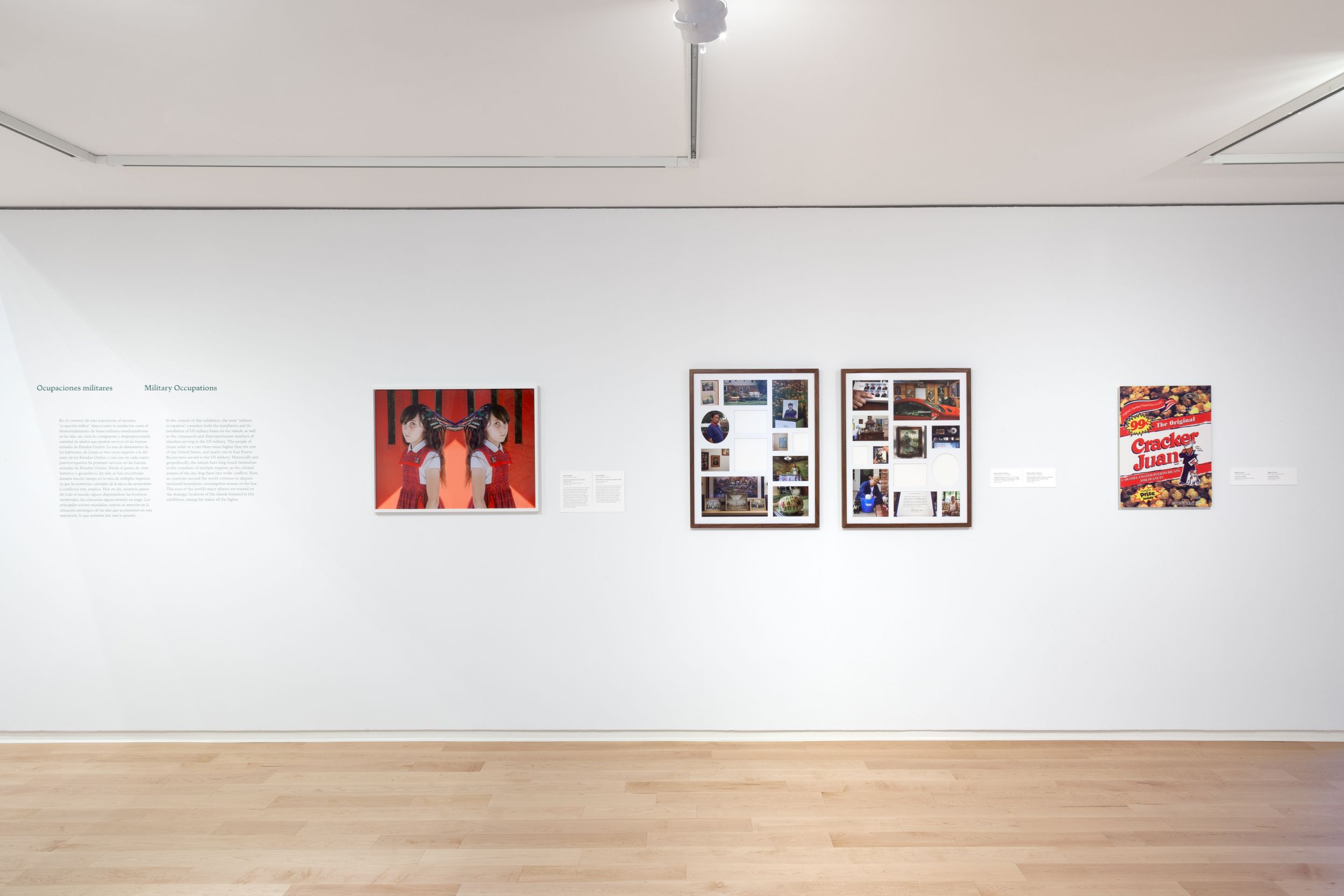
Santiago Muñoz’s film anchors the exhibition section “Military Occupations,” which addresses the installation of bases on the islands as well as the consequent and disproportionate numbers of islanders enlisting in the US military. Historically and geopolitically, the islands have long found themselves at the crosshairs of multiple empires, as the colonial powers of the day drag them into wider conflicts. This section serves critique alongside patriotism, seen in the juxtaposition of Miguel Luciano’s Cracker Juan with Sherwin Rivera Tibayan’s Filipino American Navy series (fig. 4). Poignantly, Sarah Sudhoff’s Ribbon Wars considers militarization through a child’s eyes. The exhibition seeks to validate the heterogeneity of lived experiences in the context of these histories, even when perspectives are widely divergent.
While Robles-Gordon’s quilts greet visitors in spectacular fashion, there are also more subtle ways to imagine an archipelago in a Maine museum. The Colby Museum’s galleries are porous, with four entry points into the show. This permeability allowed us to present separate title walls in each of the four major languages spoken on the islands: English, Spanish, Filipino, and CHamoru (fig. 5). Imaginar un archipiélago, Paglikha ng Kapuluan sa Isipan, Håfa Mohon i Tano’-ta Mo’na. In discussing the CHamoru title, translator Ray Barcinas pointed out the linguistic aspiration in the word mohon: “It is like breathing life into the project.”9 This observation felt all the more significant for an endangered language. By chance, the titles in the other non-English languages feature this soft exhalation of air too: Imaginar, paglikha.
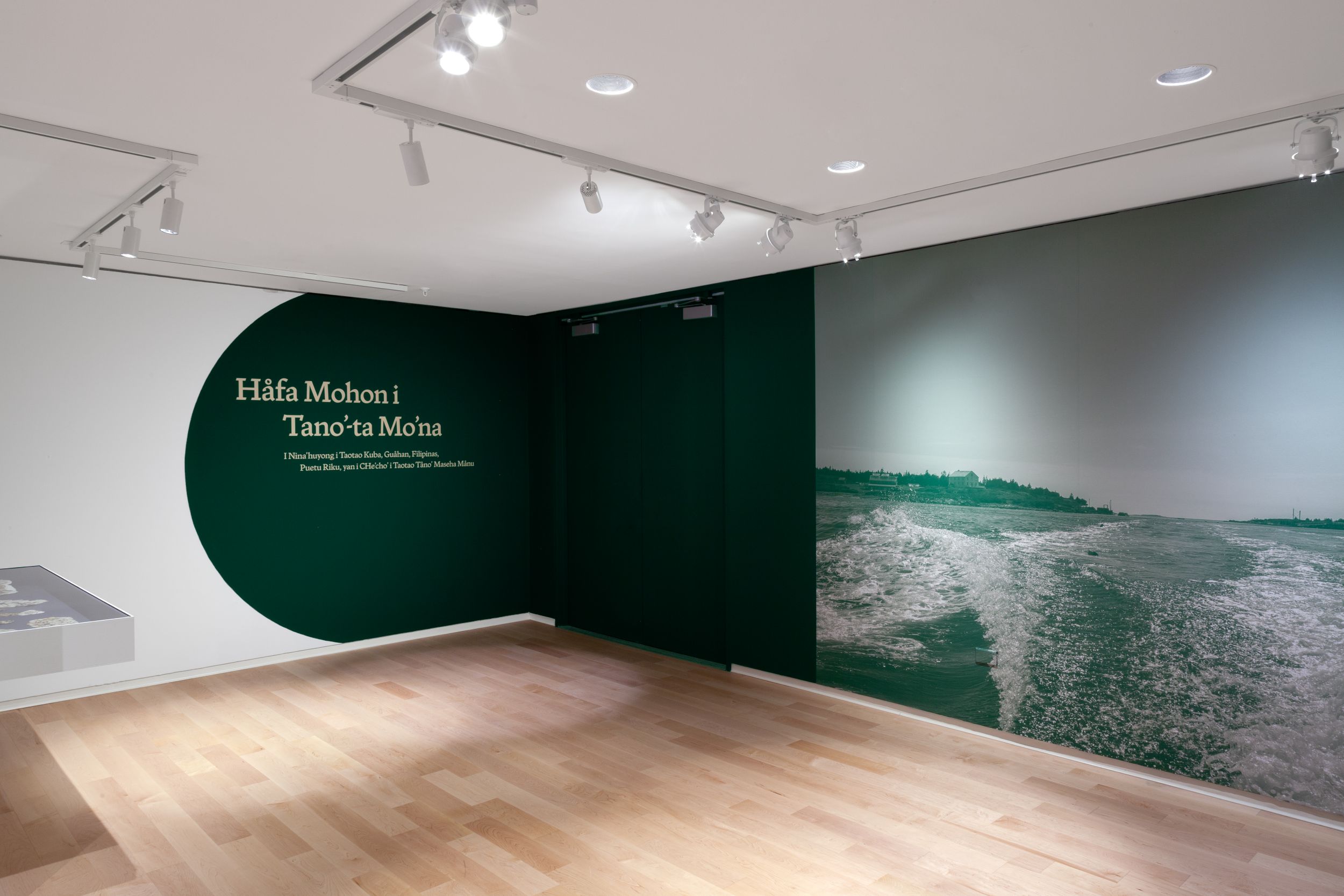
When state violence forces people to take their last gasps of air on the streets, living—breathing—is a fundamental form of resistance. To counter the moments of final respiration that saturate current events, the artists in this exhibition breathe life into artworks both critical and celebratory. May that kind of aspiration resonate with those looking to heal and provide inspiration for the creation of a better world.
Cite this article: Jessamine Batario, “Islands Beyond Empires: Imagining an Archipelago at the Colby College Museum of Art, Waterville, Maine,” in “The Art History of the 250th Anniversary,” In the Round, edited by K. L. H. Wells, Panorama: Journal of the Association of Historians of American Art 12, no. 2 (Fall 2026), https://doi.org/10.24926/24716839.21477.
Notes
- The exhibition has an accompanying publication. See Jessamine Batario, ed., Imagining an Archipelago: Art from Cuba, Guam, the Philippines, Puerto Rico, and Their Diasporas (Colby College Museum of Art, 2026). ↵
- Jacey Fortin, Heather Beasley Doyle, Miriam Jordan, and Hamed Aleaziz, “ICE Agent Kills Person in Vehicle in Maine, Homeland Security Says,” New York Times, July 13, 2026, https://www.nytimes.com/2026/07/13/us/biddeford-maine-ice-shooting.html. ↵
- Craig Santos Perez, “Archipelagic Poetics: A Foreword,” in Contemporary Archipelagic Thinking: Toward New Comparative Methodologies and Disciplinary Formations, ed. Michelle Stephens and Yolanda Martinez-San Miguel (Rowman and Littlefield, 2020), xv–xvi. ↵
- Zachary Small, “Trump Says He Fired Director of National Portrait Gallery, Citing D.E.I.,” New York Times, May 30, 2025, https://www.nytimes.com/2025/05/30/arts/design/trump-smithsonian-kim-sajet-fired.html. ↵
- See also Taína Caragol and Kate Clarke Lemay, eds., 1898: Visual Culture and US Imperialism in the Caribbean and the Pacific (Smithsonian Institution, 2023). Through portraiture and the context of the War of 1898, this exhibition provided a necessary historical foundation for connecting the islands in question. The curators included artwork to represent voices of dissent to US imperialism. ↵
- Hamed Aleaziz, “Trump Administration Starts Immigration Operation in Maine,” New York Times, January 21, 2026, https://www.nytimes.com/2026/01/21/us/politics/maine-somali-immigration-enforcement.html. ↵
- Chadd Scott, “How the United States Became America,” Forbes, July 10, 2026, https://www.forbes.com/sites/chaddscott/2026/07/10/how-the-united-states-became-america. ↵
- Charlie D’Agata, “US Reopens Shuttered Puerto Rico Naval Base as Caribbean Military Buildup Continues,” CBS News, November 15, 2025, https://www.cbsnews.com/news/u-s-reopens-shuttered-puerto-rico-naval-base-caribbean-military-buildup-continues. ↵
- Conversation with the author, June 3, 2026. ↵
About the Author(s): Jessamine Batario is the Linde Family Foundation Curator of Academic Engagement at the Colby College Museum of Art.