

The Art History of the 250th Anniversary





PDF: Wells, Art History of the 250th
Contributors
Wendy Bellion, “‘Remember the Ladies’: Writing Women’s Art History in 1776 and 2026”
Katherine Tycz and Erin Monroe, “Artistic Interpretations, Rooted in Connecticut’s History in Framing American Democracy: Radical Roots at The Wadsworth, Hartford, Connecticut”
Ella Nowicki and Larissa Randall, “Threading the Needle: Secondhand Patriotism and Vernacular Art”
Jessamine Batario, “Islands Beyond Empire: Imagining an Archipelago at the Colby College Museum of Art”
Emily Burns, “Place, Memory, and the Land’s Breath: a Palimpsest of Lakota and US Epistomologies”
Cindy Kang, “Developing Noguchi to Asawa: Designing Postwar America”
Karlee Bergendorff, “Copy-Paste Nationalism: Model Monuments in North Korea and Beyond”
Allan Wallach, “Mr. Trump’s Semiquincentennial Garden”
Introduction
The year 2026 marks the 250th anniversary of the signing of the Declaration of Independence. Our field has long recognized the centennial of 1876 and the bicentennial of 1976 as moments that inspired broad popular interest in the early history of the United States, but this semiquincentennial has been less widely celebrated than politically fraught. President Donald Trump began to enthusiastically embrace the 250th anniversary during his first term, and at the onset of his second term, he established the “White House Task Force on Celebrating America’s 250th Birthday.” Branded as “Freedom 250,” this task force has been criticized by politicians and the press for its opaque funding and corporate structures, for siphoning public money away from the bipartisan congressional commission called America250, and for politicizing the anniversary celebrations to advance Trump’s own agenda.1 Indeed, Trump’s primary political slogan, “Make America Great Again” (MAGA), is fundamentally a discourse of historical revival and memory. Because MAGA ideology insists that America was great at some point in the past, it targets art or scholarship that presents America’s past as less than great for political attack, censorship, and defunding.
Trump’s celebration of the 250th anniversary is consequently part of a larger cultural agenda to censor government museums and historic sites; to defund public media, revisionist scholarship, and inclusive arts programming; to dramatically reshape the architecture of Washington, DC; and to put Trump’s name and image on a wide range of government products and institutions. The president’s executive order on “Restoring Truth and Sanity to American History” denounced the Smithsonian Institution and the National Park Service for inadequately promoting American greatness.2 It attacked considerations of race at Independence National Historical Park in Philadelphia, the Smithsonian American Art Museum, and the National Museum of African American History and Culture in Washington, DC, as well as the treatment of gender by the future Smithsonian American Women’s History Museum. Trump then tried to fire the director of the National Portrait Gallery in Washington, who subsequently resigned, and his administration began removing certain public websites and interpretive signage, which has led to lawsuits and popular protests (fig. 1).3 Other government museums responded with what Steven Nelson has recently categorized as “soft censorship,” reducing the visibility of controversial content rather than removing it.4 Yet Trump seemed to want more dramatic action. On July 4, 2026, the White House’s Domestic Policy Council issued a 162-page report condemning the National Museum of American History as insufficiently patriotic, leading to a congressional hearing with the museum’s director and an executive order to place warning signs outside its exhibits.5
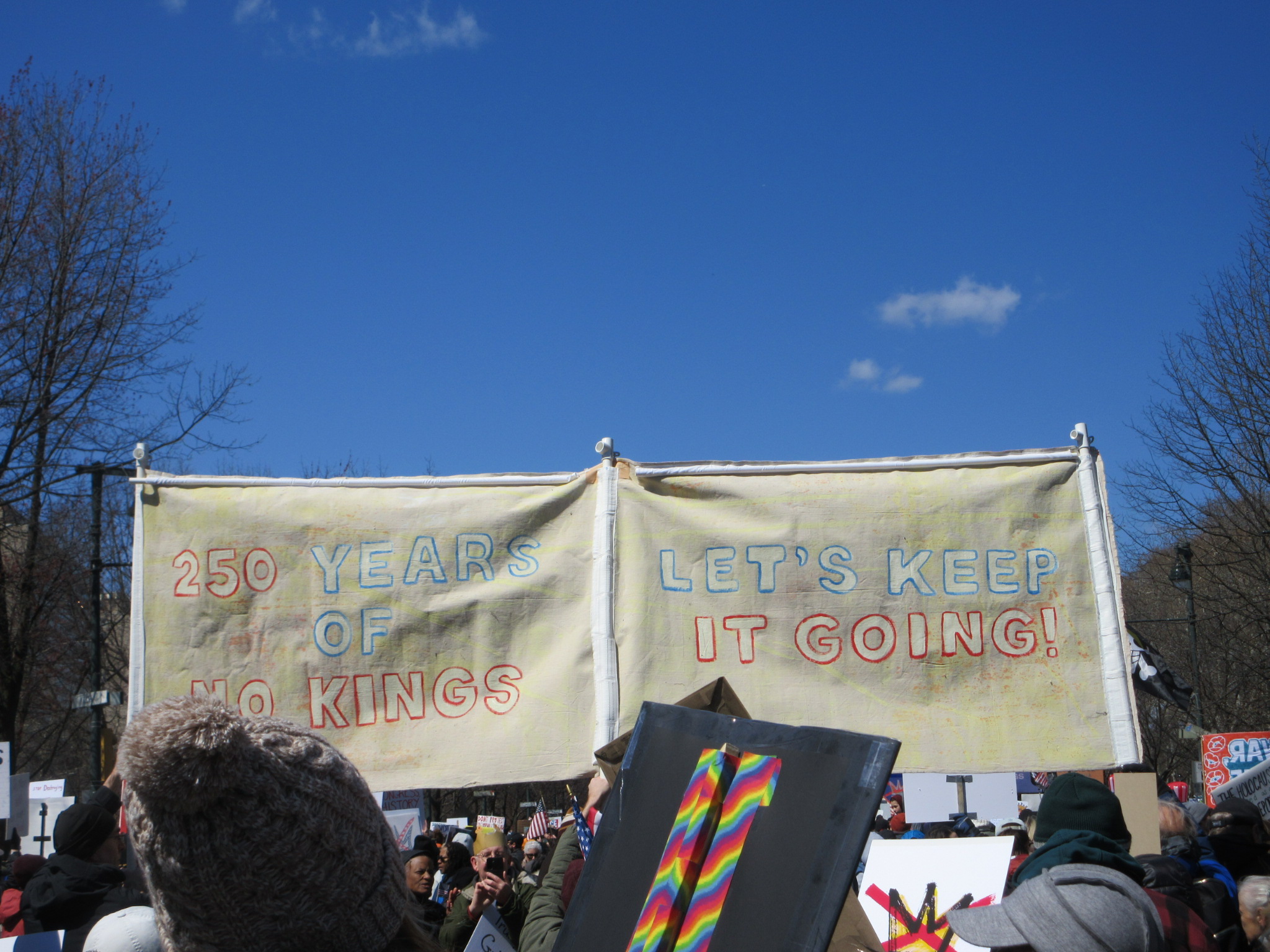
As part of a larger campaign to shrink the federal government, Trump’s administration has eliminated federal funds for National Public Radio (NPR) and the Public Broadcasting Service (PBS) to dismantle the Corporation for Public Broadcasting, and it has canceled already-awarded National Endowment for the Arts (NEA) and National Endowment for the Humanities (NEH) grants in favor of handpicked, politically conservative projects. The government’s larger ban on funding diversity, equity, and inclusion (DEI) initiatives or “gender ideology” has also caused a number of arts organizations to decline their NEA awards.6 In some cases, these funds have been redirected toward the president’s building campaign. Trump’s architectural changes to the nation’s capital have been particularly extensive, from bulldozing the East Wing of the White House to make way for an enormous ballroom to planning a massive triumphal arch for the Virginia side of Memorial Bridge.7 These grandiose monuments, which Trump often declares are in honor of himself, are in keeping with a president who has plastered his name and image on federal institutions (the Kennedy Center, the US Institute of Peace), government programs (TrumpRx, Trump Accounts), battleships, visas, national park passes, and US currency.8
Even more fundamentally, Trump’s attacks on higher education and his persecution of immigrants have had chilling effects on academic freedom, the rights of free speech and assembly, and even the granting of citizenship through birth and naturalization. Trump’s administration has frozen billions in federal research grants and moved to cap “indirect costs” that fund university overhead; banned DEI programs and the participation of transgender athletes in women’s sports; threatened universities with revoking their accreditation, tax-exempt status, or federal funding; and targeted international students through detainment and deportation.9 These actions have dramatically decreased many university budgets and increased government surveillance over scholarship and classroom teaching.10 Trump has justified these changes as a response to the pro-Palestinian protests that occurred across campuses during the 2023–24 academic year, which were sometimes critiqued for using illegal and anti-Semitic tactics. International students who participated in those protests have been particularly targeted by Trump’s larger campaign against immigrants, a campaign that has further discouraged international students from coming to US universities.11
The scale of the immigration crackdown is enormous. In the first year of Trump’s second term, the Department of Homeland Security reported that it deported more than six hundred thousand people and that more than two million more “self-deported.”12 The arrests of immigrants have been met with political protests and have led to further violence, including the killings by federal immigration agents of two US citizens, Renee Nicole Good and Alex Pretti, in Minneapolis in January 2026, as well as the more recent shootings of Lorenzo Salgao Araujo in Houston, Texas, and Johan Sebastian Duran Guerrero in Biddeford, Maine, in July 2026.13 Trump’s executive order on “Protecting the Meaning and Value of American Citizenship” attempted to end birthright citizenship for the children of illegal immigrants, and his administration has moved to revoke the naturalization of citizens who allegedly committed crimes.14
These attacks on citizenship and its most basic rights of free speech and free assembly lay the foundation for Trump’s cultural agenda, which is being enacted through antidemocratic processes that bypass congressional oversight, expert review, or public hearing. Trump’s recent moves to weaken the nation’s long-standing regulations for historic preservation would institute this lack of oversight as a new norm.15 The president is enacting this cultural agenda against popular opposition in the name of celebrating the 250th anniversary of the United States through grand monuments, whitewashed histories, and Trump memorabilia that seemingly prove that he has made America great again.
At a time when Americans at large report feeling exceptionally stressed about our politics and economy, those of us working in arts and academic institutions have reason to feel particularly at risk.16 Yet, as the pieces gathered in this In the Round show, we are also doing exceptional work to commemorate the 250th anniversary of the United States. Many of us have spent years developing exhibitions and research projects that are now reaching the public at a moment of intense political polarization. The scholarship discussed here asks us to consider overlooked histories and to reconsider ostensibly familiar episodes in US visual culture. How does our understanding of US history change if we center women’s stories, vernacular art, islanders’ experiences of colonization, Indigenous epistemologies, or Japanese American incarceration? How does our understanding of art’s role in commemoration change if we consider how the founding of the United States’ oldest public art museum intersects with the career of one of its most celebrated painters, or how Trump’s monumental construction projects relate to those of dictatorships past and present, such as ancien régime France or contemporary North Korea? Collectively, these efforts are an exciting testament to the ways our field has changed and developed in recent years. And, ironically, these projects have likely benefited and may still benefit from increased attention to American art history during this anniversary year.
But as this “In the Round” also shows, there are challenges to continuing to do our work in this highly politicized environment. On the one hand, this moment shows us that our research has never mattered more and that it does have a real public impact, for if our collective art-historical scholarship did not change people’s minds about the history of the United States, then it would not be subject to attack. On the other hand, this moment makes it very difficult, both logistically and emotionally, to do that work. The 250th anniversary is drawing attention to our field, but it is also drawing partisan scrutiny. Such heightened visibility creates both obstacles and opportunities.
My own scholarship has experienced this double-edged quality. In 2016, the year of Trump’s first election, I began developing a research project that resulted in my second book, Uncanny Revivals: Designing an American Identity, which came out earlier this year. The book examines the uncanny aesthetics and White nationalist politics of major revivalist projects of the 1930s and 1940s, such as Colonial Williamsburg in Virginia; the Index of American Design held by the National Gallery in Washington, DC; the Winterthur Museum in Delaware; and the Thorne Miniature Rooms at the Art Institute of Chicago. I argue that the uncanny experience of these revivalist designs, which presented the past as highly immersive and tangible yet oddly familiar, encouraged White Americans of various backgrounds to identify with the early American history on display as their own heritage. In this way, such designs that brought the past back to life furthered the formation of White nationalist identity. But while “uncanny” is a prominent part of my book’s title, “White nationalism” is not. I could have subtitled the book “Designing a White Nationalist Identity” or “Designing a White American Identity” or “Designing a Racial American Identity,” but I self-censored. Because of the book’s exploration of US historical memory, I have repeatedly positioned the project as related to the 250th anniversary and enjoyed real benefits from this relationship. I received an NEH grant in between Trump administrations that supported writing the manuscript, secured a publication date in 2026, and have been invited to speak and write about my scholarship in relation to the anniversary throughout this year. But while I welcome these opportunities to share my work with a wider public, I also did not want to title the book in a way that would make myself an easy target of right-wing harassment. These are the kinds of contradictions that we have all had to grapple with as we bring our research to light.
While we do not know what impact President Trump will continue to have on our museums, universities, immigrants, and citizens, the essays gathered here focus on the impact that we as art historians can have on our fellow Americans. Sometimes, as Wendy Bellion argues, the role of the art historian is to make artistic and archival losses visible, to recover the rich and nuanced histories of those marginalized by more celebrated narratives. At other times, as Alan Wallach demonstrates, art historians can call out those celebrated narratives, revealing their political logics and illogical contradictions. Yet in both these and many other cases, the visual analysis and historical contextualization of art history enable people to see things differently: to see Georgia’s Confederate memorial Stone Mountain in South Dakota’s ostensibly more unifying Mount Rushmore, or the barbed wire of Japanese American incarceration camps in Ruth Asawa’s wire sculptures. And we best preserve our rights to make these art-historical arguments—our rights to free speech, a free press, and academic freedom—by exercising those rights. To paraphrase the journalist Ben Bagdikian, the only way to assert our right to free speech is to speak freely.17
Cite this article: K .L. H. Wells, introduction to “The Art History of the 250th Anniversary,” In the Round, edited by K. L. H. Wells, Panorama: Journal of the Association of Historians of American Art 12, no. 2 (Fall 2026), https://doi.org/10.24926/24716839.21369.
Notes
- Ben Binday and Dan Diamond, “Donors Were Misled by Trump-Backed Freedom 250, House Democrats Allege,” Washington Post, July 2, 2026, https://www.washingtonpost.com/politics/2026/07/02/donors-were-misled-by-trump-backed-freedom-250-house-democrats-allege. ↵
- Exec. Order No. 14253, “Restoring Truth and Sanity to American History,” March 27, 2025, https://www.whitehouse.gov/presidential-actions/2025/03/restoring-truth-and-sanity-to-american-history. See a response at Lena Bohman et al., “Save Our Signs: A Crowdsourced Project to Combat Censorship at US National Park Sites,” Panorama, Journal of the Association of Historians of American Art 11, no. 2 (2025), https://doi.org/10.24926/24716839.20459. ↵
- Uwa Ede-Osifo, “Judge Orders Restoration of National Park Plaques Removed Under Trump Directive,” Guardian, June 12, 2026, https://www.theguardian.com/us-news/2026/jun/12/judge-national-park-trump-displays; and Robin Pogrebin, “For Museum Boss Who Became a Trump Target, It’s Déjà Vu All Over Again,” New York Times, July 30, 2026, https://www.nytimes.com/2026/07/30/arts/design/trump-smithsonian-museums-sajet-hartig.html. ↵
- Steven Nelson, “Soft Censorship,” October 197 (Summer 2026): 195–200, https://doi.org/10.1162/OCTO.a.558. ↵
- Exec. Order No. 14416, “Restoring Trust In The Smithsonian Institution,” July 24, 2026, https://www.whitehouse.gov/presidential-actions/2026/07/restoring-trust-in-the-smithsonian-institution-e061; Robin Pogrebin and Zachary Small, “Trump Orders Warnings Placed at ‘Inaccurate’ Smithsonian History Museum,” New York Times, July 24, 2026, https://www.nytimes.com/2026/07/24/arts/design/smithsonian-signs-trump-executive-order.html. ↵
- Michael Kunselman, “Judge Blocks Trump’s Executive Order to End Federal Funding for PBS and NPR,” PBS News, March 31, 2026, https://www.pbs.org/newshour/nation/judge-blocks-trumps-executive-order-to-end-federal-funding-for-pbs-and-npr; David Collins, “Judge Finds Trump DOGE-Led Cancellation of Humanities Grants Unconstitutional,” PBS News, May 8, 2026, https://www.pbs.org/newshour/nation/judge-blocks-trumps-executive-order-to-end-federal-funding-for-pbs-and-npr; Michaela Towfighi, “Told to Avoid DEI, Arts Groups are Declining Grants Instead,” New York Times, November 20, 2025, https://www.nytimes.com/2025/11/20/arts/design/dei-arts-groups-grants-nea.html. ↵
- Luke Broadwater et al., “Funding for Trump’s Construction Spree is Murky: Here’s What We Found Out,” New York Times, June 24, 2026, https://www.nytimes.com/interactive/2026/06/24/us/trump-dc-costs-ballroom-arch-pool.html. ↵
- Connor Greene, “All the Things Trump Has Put His Name and Face on as President,” Time, March 28, 2026, https://time.com/article/2026/03/27/trump-name-face-signature-currency-government-buildings-programs. ↵
- Ceceilia Smith-Schoenwalder, “Tracking Trump’s Crackdown on Higher Education,” US News and World Report, May 20, 2026, https://www.usnews.com/news/national-news/articles/trumps-higher-education-crackdown-visa-revocations-dei-bans-lawsuits-and-funding-cuts. ↵
- Vimal Patel, “Professors Are Being Watched: ‘We’ve Never Seen This Much Surveillance,’” New York Times, February 4, 2026, https://www.nytimes.com/2026/02/04/us/professors-classroom-surveillance-politics.html. ↵
- Josh Moody, “DHS Targeted Students for Protected Speech,” Inside Higher Ed, January 26, 2026, https://www.insidehighered.com/news/government/politics-elections/2026/01/26/dhs-targeted-students-protected-speech. ↵
- Department of Homeland Security, “DHS Sets the Stage for Another Historic, Record-Breaking Year Under President Trump,” press release, January 20, 2026, https://www.dhs.gov/news/2026/01/20/dhs-sets-stage-another-historic-record-breaking-year-under-president-trump. ↵
- John Cardinale and Kelley Kosuda, “Examining DHS Use of Force Policy after 2 Deadly Minneapolis Shootings,” KCRA, January 29, 2026, https://www.kcra.com/article/examining-dhs-use-of-force-policy-after-2-deadly-minneapolis-shootings/70162218; Maanvi Singh and Fabiola Cineas, “One Week, Two Killings: Trump’s Immigration Crackdown Turns Deadly—Again,” Guardian, July 19, 2026, https://www.theguardian.com/news/ng-interactive/2026/jul/19/ice-killings-immigration-crackdown. ↵
- Exec. Order No. 14160, “Protecting The Meaning and Value of American Citizenship,” January 20, 2025, https://www.whitehouse.gov/presidential-actions/2025/01/protecting-the-meaning-and-value-of-american-citizenship; Justin Jouvenal, “Supreme Court Upholds Principle That Almost All Born on US Soil Are American,” Washington Post, June 30, 2026, https://www.washingtonpost.com/politics/2026/06/30/birthright-citizenship-upheld-by-supreme-court-ruling-against-trump-order; Camillo Montoya-Galvez, “Trump Administration Launches Largest Ever Effort to Denaturalize US Citizens Accused of Fraud or Other Crimes,” CBS News, June 8, 2026, https://www.cbsnews.com/news/denaturalization-us-citizens-fraud-crimes-trump-administration. ↵
- Rachel Treisman and Ayesha Rascoe, “Trump Allies Approve New Rules That Will Weaken Protections for Historic Sites,” NPR Weekend Edition, July 26, 2026, https://www.npr.org/2026/07/26/nx-s1-5906719/trump-allies-approve-new-rules-that-will-weaken-protections-for-historic-sites. ↵
- Nicholas Riccardi and Linley Sanders, “Americans Are Exceptionally Anxious About Their Political System, New Gallup Polling Shows,” Associated Press, February 4, 2026, https://www.ap.org/news-highlights/spotlights/2026/americans-are-exceptionally-anxious-about-their-political-system-new-gallup-polling-shows. ↵
- Bagdikian was assistant managing editor at the Washington Post when he acquired the Pentagon Papers. He is credited with encouraging the Post to publish those classified papers by saying “the (only) way to assert the right to publish is to publish.” Wikipedia, “Ben Bagdikian,” last updated September 2, 2026, https://en.wikipedia.org/wiki/Ben_Bagdikian. ↵
About the Author(s): K. L. H. Wells is associate professor of American art and architecture at the University of Wisconsin-Milwaukee.