

Benjamin Franklin’s “Political Cards” and the Moralization of Impairment: Vulnerability, Responsibility, and Contradiction





PDF: Morrissy, Benjamin Franklin’s Political Cards
Please note that images in this article may be disturbing to readers.
At the Metropolitan Museum of Art, New York, the United States’ semiquincentennial is being celebrated with a series of exhibitions, events, public programs, and performances.1 An exhibition titled Revolution! explores the trajectory of American independence during the Revolutionary War (1775–83) and its aftermath. Situating the events in a more local context, another show, Independence and Identity, shifts the focus to New York’s role in the conflict. While reviewing materials for these commemorative exhibitions in the Study Room for Drawings and Prints over the past several months, curator Constance McPhee drew my attention to an 1833 reproduction of an image first designed by Benjamin Franklin (1706–1790) as a small political message card printed in the winter of 1765–66, during the Stamp Act crisis. Titled Magna Britannia, Her Colonies Reduc’d (fig. 1), the image confronts the viewer with an unusually violent scene, imagining Britain’s political future through the metaphor of a dismembered woman.
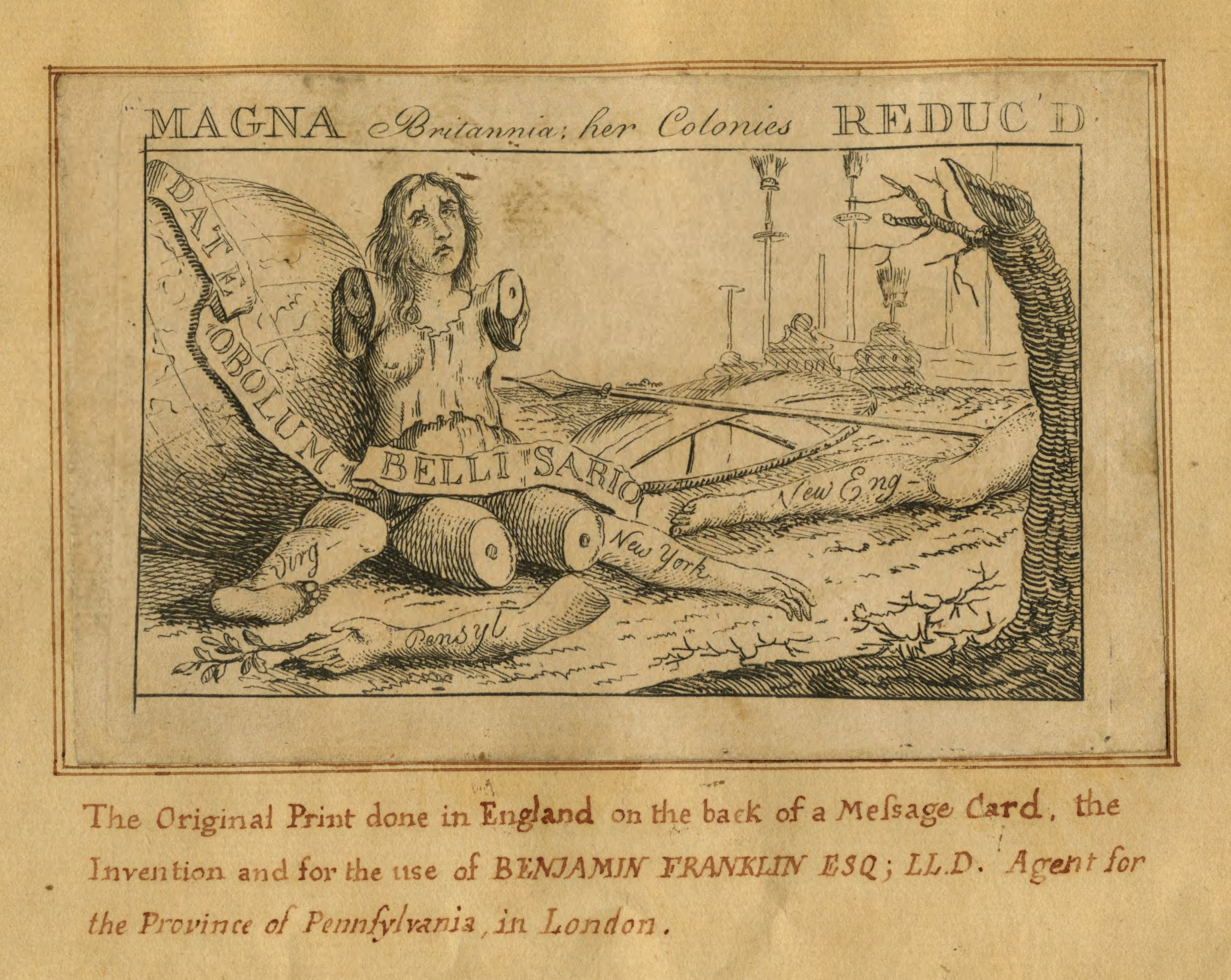
Franklin deploys the violently injured body to protest the passage of the 1765 Stamp Act, through which Britain sought to impose a tax on the commercial use of paper in the colonies. The image argues that the act’s passage would rupture the relationship between the imperial power and its North American settlements. To illustrate this, Britannia’s severed limbs (labeled “New Eng-,” “New York,” “Pensyl-,” and “Virg-“) are scattered about her torso. She is propped against a globe—the emblem of Britain’s imperial dominance—indicating that she has fallen from mastery into dependence. Her spear and shield are cast aside, signaling the end of her imperial might. In the background, the underlying economic consequences are highlighted. Idle British merchant ships are shown with brooms attached to their topmasts, indicating that they are for sale or rent.2 Underscoring her impoverishment, Britannia wears a sash bearing the Latin text “Date Obolum Bellisario.” Translated as “Give a penny to Belisarius,” it invokes the mythic tragedy of an esteemed Byzantine general who was falsely accused of plotting against the emperor Justinian. Blinded by the vengeful and capricious ruler, he was reduced to penury.3 The message is blunt but clear: Britain may survive without the colonies, but she would be “reduc’d”—physically sundered and economically devastated.
Struck by the horror of the image, I began to explore its multiple iterations, tracing their shifting meanings in dialogue with staff and other fellows. I discovered that what began as a provocation on a small card was transformed in its reproductions across various formats. The image drew on a long-standing and widely recognized tradition of representing the body politic through violent dismemberment, including in Franklin’s own work. Closer examination, however, reveals a moral economy of dependency within the print’s argument, one that links impairment to poverty, blame, and diminished status in late colonial America.4 In the absence of an extensive record of reception by colonial readers, a careful unpacking of the work’s logic allows us to reconstruct the ideological framework of impairment that it reinforced. Her Colonies Reduc’d did not merely borrow injury as metaphor; it linked disablement to degraded status and poverty, framing it through the lens of moral responsibility.5
Initially created by Franklin as a small message card (similar to a business card), the image was later disseminated through multiple iterations. In particular, a single-sheet American edition featuring explanatory text, produced after the Stamp Act’s repeal, in March 1766, helped advance a political argument that normalized negative social consequences for those with physical impairments. At a pivotal moment in the history of British North America, when questions of rights, liberties, and social status—alongside the distribution of such privileges—were intensely contested, the print shows how media could help shape understandings of what we now call disability.
Scholars including Kim Nielsen have shown how injury was mediated by class status in the Colonial period.6 Reading Her Colonies Reduc’d within a broader national and international framework shows how that relationship was reproduced visually, at the intersection of mass media and art. Franklin’s own skepticism toward public provision, which reflected a widely held belief that privation encouraged industry, illustrates Nielsen’s point: Franklin argued that reliance on anything other than one’s own “industry and frugality” would breed indolence and “increase poverty.”7 Care, in other words, was tolerable only when it could be made productive. Taken together, the print and Franklin’s writings show how disability helped structure ideas about poverty, labor, and dependence during a formative moment in American political culture.
The Stamp Act crisis, which began in March 1765, not only supplies the immediate historical background for this argument but also clarifies why the print Franklin designed during the winter of 1765–66 would have carried such force. The violent resistance to the Stamp Act often took the form of bodily threat and public spectacle, marking the kind of injuries depicted by Franklin as readily legible political forms. Among the image’s later iterations, the enlarged single-sheet edition produced for the American market in 1767 is especially revealing: Its accompanying text clarifies how physical incapacity was framed in terms of personal responsibility. Building on Nielsen’s argument that the lived consequences of impairment in colonial America depended heavily on the resources available within one’s local networks, I show how Her Colonies Reduc’d converted the framework of bodily vulnerability into a moral allegory that helped naturalize the classed disparities that defined the period. The print’s allusion to Belisarius sharpens this classist logic by linking impaired dependency to begging, poverty, blame, and ultimately diminished respect. I conclude by setting this logic of social hierarchy against Franklin’s own experience of physical impairment: His wealth and political authority insulated him from the very consequences the print attributes to impairment, a distinction dramatized in well-known accounts of the debilitated Franklin being carried to the Constitutional Convention in a sedan chair.
Bodily Politics and the Stamp Act Crisis
Within a violent political climate in which conflict was routinely staged as bodily threat, Franklin’s image underscored a link between the metaphorically injured body and the political sphere. More than an isolated curiosity, his print explicitly rendered conflict legible as injury and dependence. Its continued reproduction reinforced this association, showing how print ephemera participated in the social construction of disability at a formative moment of American history.
The Stamp Act crisis was fought not only in speeches and prints but also in threats, effigies, and public displays of punishment—forms that made the body an especially potent vehicle for political argument. Britain’s attempt to tax the American colonies after the French and Indian War (1754–63) triggered widespread resistance. The military victory confirmed Britain’s global dominance, but it also imposed significant costs. Informed by the difficulties that arose from earlier revenue measures in the years following 1763, the 1765 Stamp Act sought to recoup the expense of maintaining troops in the American colonies by imposing a direct tax upon the colonists. The Stamp Act required that many printed materials be produced on official paper issued and taxed by the British government. Absent this endorsement, legal documents would not be recognized, and certain paper-based commodities could not be lawfully sold.8 Without political representation or direct consent, however, the tax was widely regarded as illegitimate.9 Although it was eventually repealed in 1766, the conflict intensified a pattern of resistance to new taxation measures that would help define later confrontations, including the Boston Tea Party in 1773 and the constitutional struggle over parliamentary authority that culminated in the Declaration of Independence in 1776.
As Pennsylvania’s colonial agent stationed in London, Franklin played a central role in negotiations surrounding the dispute. His liminal position, however, provoked suspicion of divided loyalties on both sides of the Atlantic. As this distrust intensified, it came to threaten his own bodily security.10 The intensity of colonial opposition surprised Franklin and his associates. John Hughes, for instance, whom he had named as stamp distributor for Pennsylvania, wrote to Franklin expressing his shock at the rapid escalation of violent dissent. As resistance to the act spilled into attacks on specific individuals, Hughes came to believe that it had provoked a “Sort of Frenzy or Madness” in the American people. An angry crowd attacked the home of the stamp distributor for Massachusetts, Andrew Oliver. The mansion of Lieutenant Governor Thomas Hutchinson was then ransacked and left in ruins. Franklin’s business partner David Hall warned Franklin not to return to Philadelphia for fear of his safety. Others suggested that he might be tortured in effigy.11 “O Franklin, Franklin, thou curse to Pennsylvania and America,” declared Benjamin Rush in a letter to a friend, “may the most accumulated vengeance burst speedily on thy guilty head.”12
It was during the winter of 1765–66, amid growing concerns for his safety, that Franklin designed his message card depicting the grisly fate that awaited Britain should she insist on imposing and enforcing the tax.13 As Parliament moved toward debate over repeal, he circulated copies through his correspondence and, according to a contemporary annotation, employed a waiter to place one in the hands of each member of Parliament as they entered the chamber to debate the Stamp Act.14 Franklin’s campaign culminated in his appearance before the full House of Commons in February 1766 as Parliament considered repeal. Ordered to attend along with several other witnesses, he was questioned about the colonial response. By arguing that the Stamp Act could not be enforced without military coercion and severe disruption to British trade, Franklin gave members of Parliament, who were already inclined toward repeal, a practical justification for abandoning it without appearing to surrender parliamentary authority. Repeal followed the next month and took effect on May 1, 1766.15 The popularity and political importance of Franklin’s message cards, however, outlasted the immediate crisis. By adapting established satirical tropes, he had forged a powerful, malleable metaphor that would take on new life across subsequent iterations.
Her Colonies Reduc’d—Precursors and Afterlife
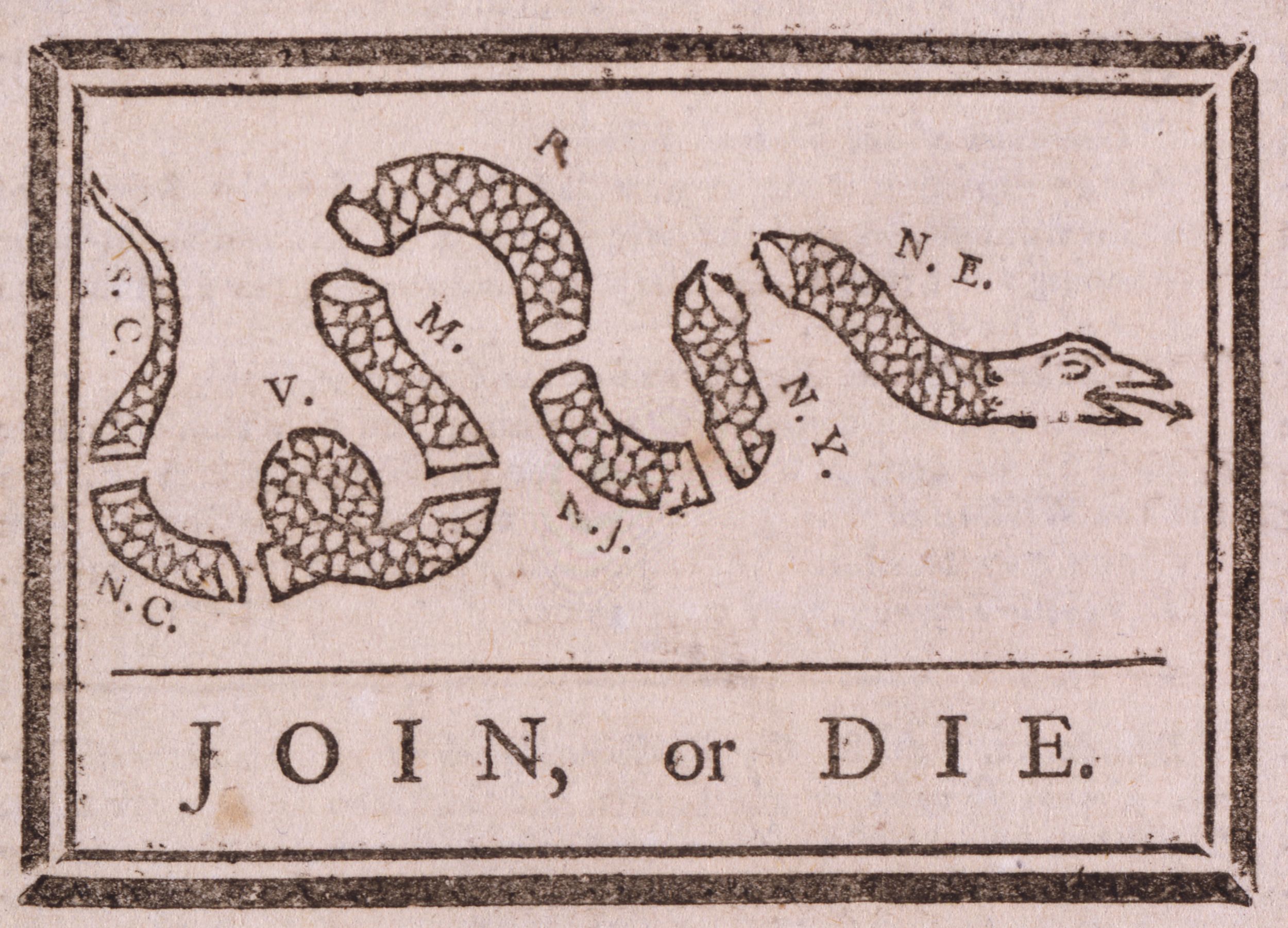
The message-card vehicle was not Franklin’s invention. Nor was the visual metaphor of disembodiment, although it represented a long-standing fascination of his. Among the political prints that Franklin produced throughout his life, his 1754 woodcut Join, or Die (fig. 2) is perhaps the best known.16 Depicting a snake cut into eight pieces, it emphasizes the pressing need for colonial unity in the face of French aggression during the French and Indian War. Her Colonies Reduc’d relocates the site of violence from the animal to the female body.
Although a full analysis of the work’s gendered dynamic falls outside the scope of this essay, the choice is striking given the era’s pervasive domestic realities. In late colonial America, the vast majority of the population lived under the direct authority of male heads of household who possessed near-absolute legal prerogative to physically discipline their dependents. Read against the backdrop of normalized patriarchal violence, Franklin’s metaphor acquires a darker valence. While this gendered subtext deepens the image’s resonance, its primary rhetorical function lay in how it mapped domestic realities onto the imperial stage. By linking physical injury with political vulnerability, the print gave potent visual form to anxieties about dependency and diminished authority.17
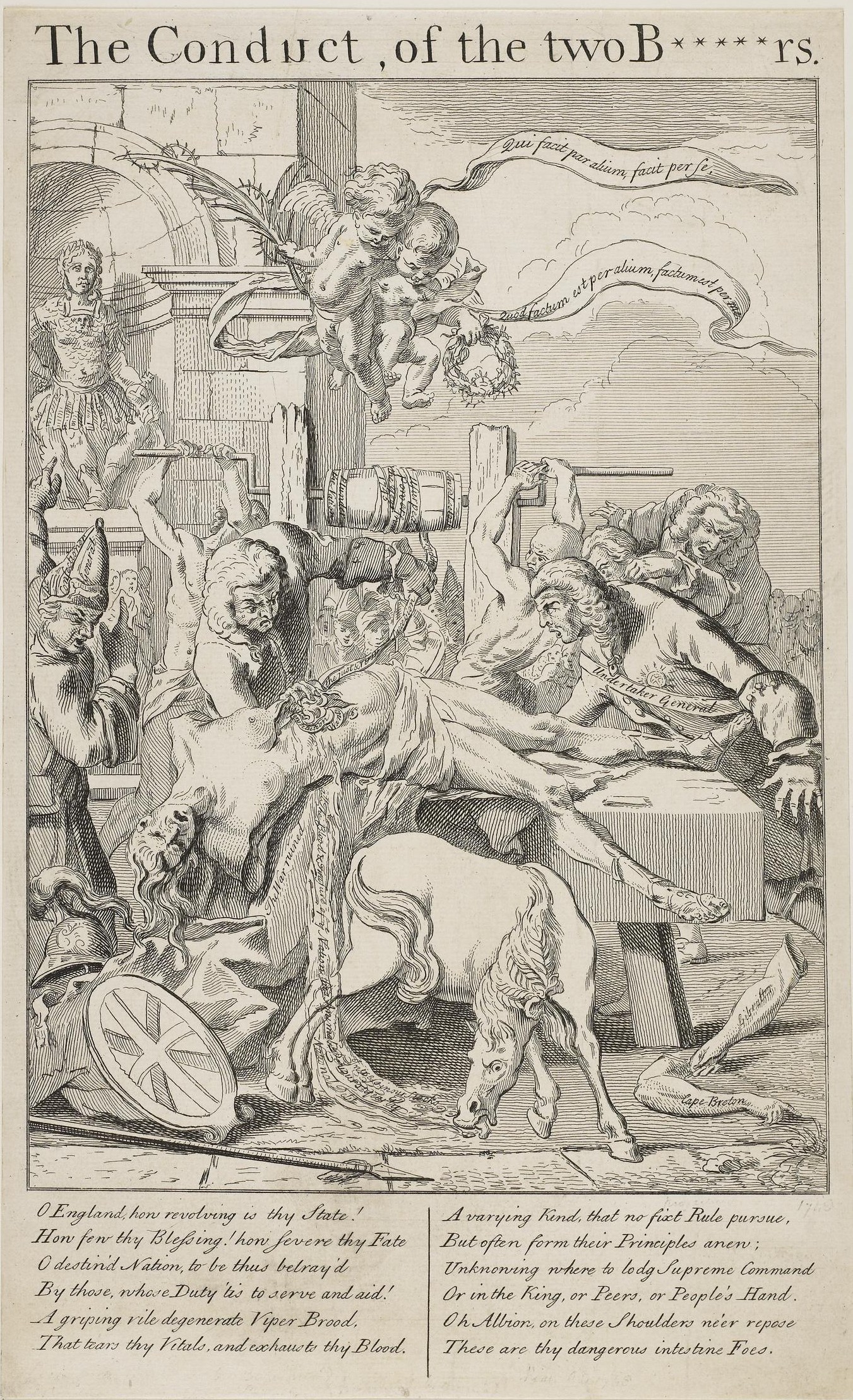
The idea of producing political satires on small stand-alone cards was a relatively recent innovation credited to British army officer and politician George Townshend.18 Her Colonies Reduc’d synthesized this new format with an established tradition of depicting violent dismemberment, drawing heavily on a print by the English satirist George Bickham entitled The Conduct of the Two Brothers (1749) (fig. 3). The image shows Britannia being physically torn apart by then–Prime Minister Henry Pelham and his brother Thomas Pelham-Holles, who, the satirist suggests, sacrificed British interests in favor of George II’s hereditary German territory.19 As in Franklin’s illustration, Britannia’s severed arms—labeled “Cape Breton” and “Gibraltar”—mark recently threatened territories and thus sources of imperial vulnerability. Franklin’s image therefore emerged from a convergence of two precedents: the portable political card and the motif of a dismembered body politic. Its subsequent reproductions altered both its audience and its argumentative force.
As later versions appeared, Her Colonies Reduc’d moved beyond the controlled circulation of Franklin’s message cards among parliamentarians and selected correspondents. The enlarged American version of 1767, produced in Philadelphia, was instead printed anonymously and distributed through the colonies; its expanded explanatory text suggests an audience from whom familiarity with the classical allusion to Belisarius could no longer be assumed.
Although none of Franklin’s original cards survive, discussions with colleagues revealed the existence, locations, and chronology of several other versions. An impression of Franklin’s original produced during the winter of 1765–66, printed on a sheet of paper rather than a small message card, can be found in the Library Company of Philadelphia’s collection.20 Although this surviving impression carries no explanatory text, William Temple Franklin later reported that copies of the original design were also printed on half-sheets with an “Explanation” and a “Moral.” Several other notable versions of the image appeared on both sides of the Atlantic. The enlarged single-sheet version of around 1767—upon which this essay focuses—represents the first reproduction (fig. 4).21 Created for the American market, it was accompanied by an expanded “explanation,” of unknown authorship, and a “moral” closely following that of the earlier version. Another reproduction appeared as the frontispiece to the December 1768 issue of the London periodical The Political Register. Two further adaptations, one French and one Dutch, were published later. These four later versions retain the motif of Britannia’s dismembered torso alongside the Belisarius allusion, binding impairment to the social scene of poverty.22 It is the American single-sheet edition from around 1767, however, that makes this association explicit.
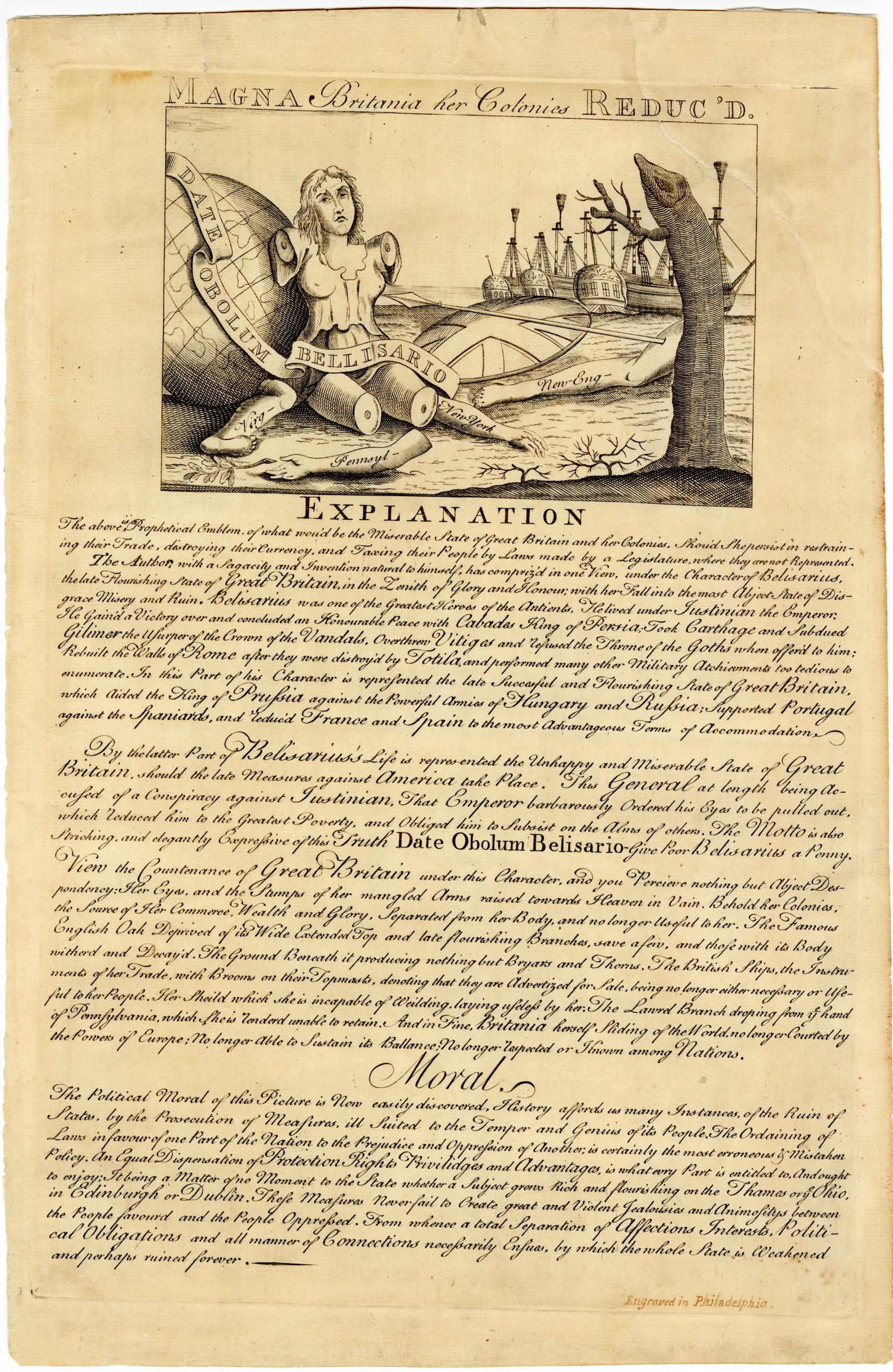
The implied violence in Franklin’s depiction belonged to a broader Enlightenment discourse in which a citizen’s bodily self-control—moderation, industriousness, restraint—was cast as a prerequisite for political autonomy.24 Few North Americans emphasized this connection more forcefully or repeatedly than Franklin himself.25 Within this framework, impaired dependency becomes a powerful negative image precisely because it violates the civic ideal of bodily mastery on which authority is imagined to rest. The specific language of the explanation and moral make this logic explicit. Referencing Franklin’s allusion to Belisarius, the text links its model of personal responsibility to an assertion of the diminished worth of those with serious physical injuries.
The fact that the single-sheet edition was produced after the Stamp Act’s repeal is also significant. The accompanying text provided viewers with a framework for making sense, retrospectively, of Franklin’s design. Together, they return to the crisis by reopening it as a still-contingent scenario. Addressing the image, the text frames the conflict of the Stamp Act in prophetic, conditional terms, as if its outcome remains unresolved:
The above Prophetical Emblem, of what wou’d be the Miserable State of Great Britain and her Colonies, Shou’d She persist in restraining their Trade, distroying [sic] their Currency, and Taxing their People by Laws made by a Legislature, where they are not Represented.26
The moral then generalizes the lesson in the timeless, gnomic present:
The Ordaining of Laws in favour of one Part of the Nation to the Prejudice and Oppression of Another, is certainly the most erroneous & Mistaken Policy.27
By returning to the crisis in conditional terms and stating its moral as a general rule, the text centers Britannia’s agency, casting her predicament as the foreseeable consequence of deliberate policy. Vulnerability is shown not as misfortune but as the result of the figure’s choices.
A comparison with Bickham’s work underscores this emphasis. In Two Brothers (see fig. 3), the perpetrators of the violence are the focus of the satire; in Her Colonies Reduc’d, no such actors are depicted. Within the print’s logic, the harm appears as the consequence of Britain’s own conduct and thus Britannia’s choices. The rhetorical effect is subtle but decisive: Responsibility is relocated from an external aggressor to the injured subject.
The Belisarius sash extends the argument from responsibility to consequence. It turns the body-politic allegory into a warning that separation from the colonies would also reduce Britain to dependence and diminished respect—an argument that relied on the social legibility of injury as abasement. The addenda are unusually direct on this point. Implicitly transferring Belisarius’s injuries and impoverishment to Britannia, the explanation describes her as “reduced to the Greatest Poverty, and Obliged . . . to Subsist on the Alms of others.” The explanation goes further, extending the stigma to the social realm: Readers are also informed that Britain will be “no longer respected” among other nations.28 The phrasing translates impairment into social worth: Diminished capacity is made to entail diminished standing; dependence is framed not simply as vulnerability but as discredit. It is precisely at this point that a core tension arises between the moral economy advocated by the print and Franklin’s own experiences. The accommodations made for his bodily vulnerabilities shed light on how the stigma of “dependency” was classed and contingent.
Franklin’s Body and the Classing of Dependence
By the time Franklin designed the print during winter 1765–66, he had already experienced the incapacitating symptoms of gout.29 Although such bodily vulnerability was stigmatized, the ailment was associated with privilege rather than poverty. As a result, the assistance commanded by wealthy sufferers was made to appear a natural response rather than as evidence of the victim’s shortcomings. Set against the logic of Her Colonies Reduc’d, Franklin’s personal experiences expose that contradiction.
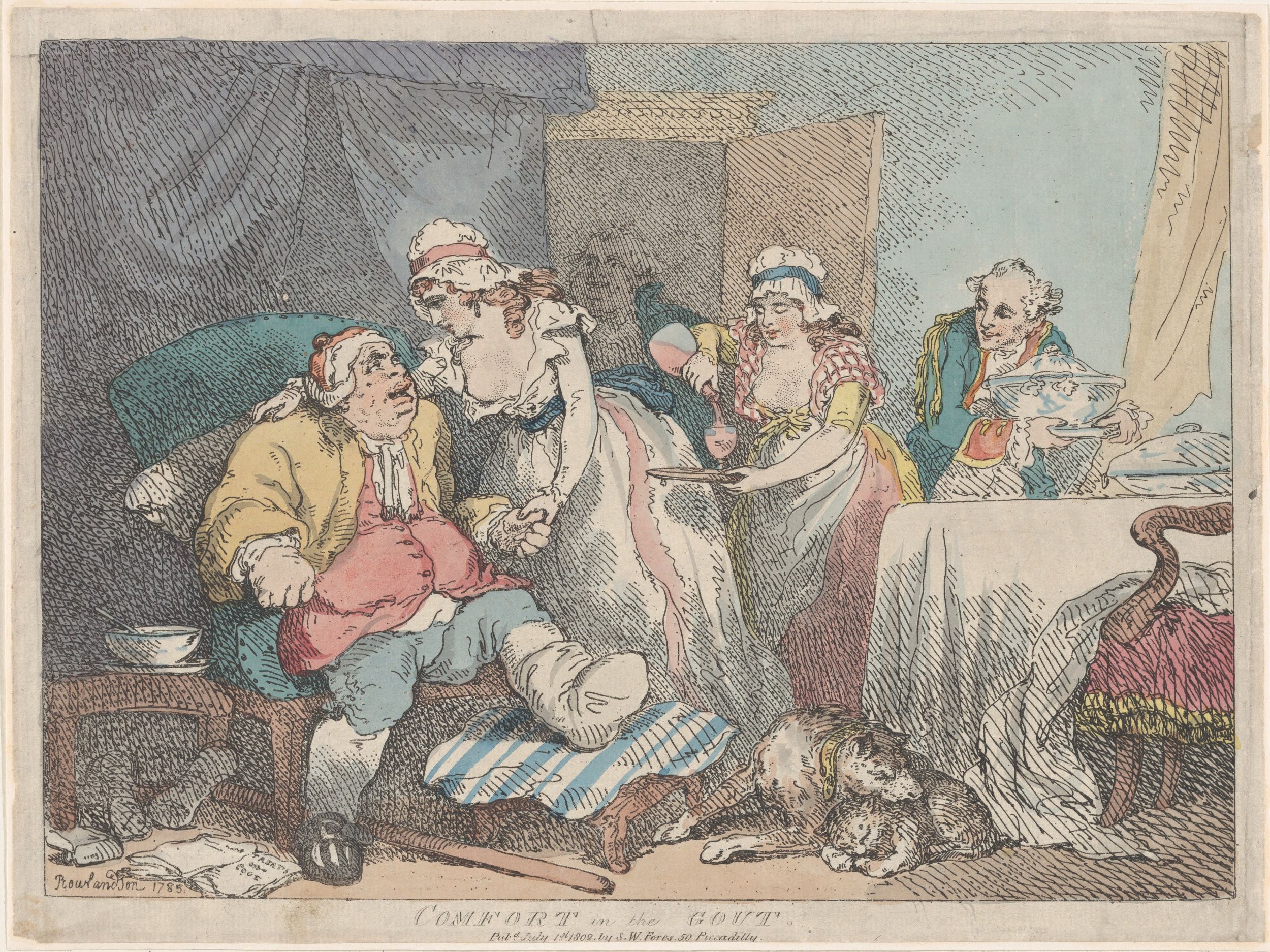
While designing and circulating Her Colonies Reduc’d as part of his efforts to repeal the Stamp Act, Franklin was also contending with increasingly severe symptoms of the disease. Periodic—often months-long—bouts challenged his identity as a self-reliant citizen in the Enlightenment idiom. The disease also exposed him to a set of aristocratic and “Old World” associations that framed gout as the bodily trace of indulgence and corrupt, monarchical habit.30 Popular satirical prints such as Thomas Rowlandson’s Comfort in the Gout (fig. 5), first issued in 1785, visualize the entrenched prejudices to which the disease was subject. Rowlandson’s image shows the “elite, overweight, [and] helpless” subject being catered to by footmen in livery, while two young women pour his wine and console him.31 Prints such as Rowlandson’s stigmatize the sufferer’s incapacity and do little justice to Franklin’s own cultivated moderation and republican self-fashioning.32 However, they also normalize the labor and assistance on which the incapacitated sufferer depends.
Rowlandson’s print evokes a striking parallel with the enduring image of the eighty-one-year-old Franklin’s journey to the Constitutional Convention in 1787. According to later accounts, the ailing delegate was carried to the Pennsylvania State House in an enclosed sedan chair. Borne by four prisoners from the local jail, the apparatus was supported on flexible rods that cushioned the occupant from potentially discomforting jostling as the men carried him aloft.33
The accommodation—which extended far beyond the kind of prudent self-provision for old age advocated by Franklin—makes clear that social participation, even at the highest levels, did not hinge on bodily independence. Set against the ethic of self-sufficiency espoused by Her Colonies Reduc’d, the scene makes the contradiction unmistakable. When supported by wealth, institutional accommodation, and social norms—reinforced through the circulation of print media—physical impairment need not inevitably entail material deprivation or disgrace. Such inconsistencies persist because dependence is less a fixed property of bodies than an effect of social arrangements, allocated through practices of support and exclusion. Franklin’s print turns impairment into abasement by imagining dependence without accommodation or respect. The contrast with his own life experiences exposes the punitive logic inherent to Her Colonies Reduc’d.
Without standing in for a broader history of disability in late colonial America, Her Colonies Reduc’d nevertheless offers a precise instance in which bodily loss is made to signify not only political vulnerability but also social degradation. Across its iterations, the reference to the myth of Belisarius alongside the explanatory texts converts the image from a historical allusion into a didactic account of agency and consequence. Together, they cast impairment as blameworthy and link diminished capacity to diminished respect. Franklin’s own embodied experience, and the accommodations made for it, expose the contingency of that moral logic. Civic participation did not require bodily independence, and “dependency” names a social relation shaped by status and willingness to accommodate. Read in this light, Franklin’s print shows how ideals of autonomy and fitness for political participation were articulated through the moralization of disabling destitution, even as Franklin’s career exposed the inherently interdependent nature of social life.
Cite this article: Shane Smith Morrissy, “Benjamin Franklin’s ‘Political Cards’ and the Moralization of Impairment: Vulnerability, Responsibility, and Contradiction,” Panorama: Journal of the Association of Historians of American Art 12, no. 2 (Fall 2026), https://doi.org/10.24926/24716839.21400.
Notes
- “The Metropolitan Museum of Art to Commemorate America’s 250th Anniversary with an Array of Art Displays and Events,” Metropolitan Museum of Art, November 10, 2025, https://www.metmuseum.org/press-releases/america-250-display. ↵
- “Magna Britannia: Her Colonies Reduc’d, (January–February 1766),” Founders Online, National Archives, accessed August 12, 2026, https://founders.archives.gov/documents/franklin/01-13-02-0023. Originally published in The Papers of Benjamin Franklin, vol. 13, January 1 through December 31, 1766, ed. Leonard W. Labaree (Yale University Press, 1969), 66–72. ↵
- “Magna Britannia.” ↵
- On the use of the body in political satire during this period, see Antoine de Baecque, The Body Politic: Corporeal Metaphor in Revolutionary France, 1770–1800 (Stanford University Press, 1997). ↵
- For an extensive discussion of Her Colonies Reduc’d, see Lester C. Olson, Benjamin Franklin’s Vision of American Community: A Study in Rhetorical Iconology (University of South Carolina Press, 2004), 77–111. ↵
- Kim E. Nielsen, A Disability History of the United States (Beacon, 2012), esp. 31–48. ↵
- Benjamin Franklin, “‘Arator’: On the Price of Corn, and Management of the Poor,” in Labaree, Papers of Benjamin Franklin, 13:510–16; Benjamin Franklin, “Some Account of the Pennsylvania Hospital,” in The Papers of Benjamin Franklin, vol. 5, July 1, 1753, through March 31, 1755, ed. Leonard W. Labaree (Yale University Press, 1969), 283–85. ↵
- Gordon S. Wood, The Americanization of Benjamin Franklin (Penguin, 2004), 107. ↵
- Wood, Americanization of Benjamin Franklin, 105–8. ↵
- Wood, Americanization of Benjamin Franklin, 120. ↵
- Wood, Americanization of Benjamin Franklin, 109–11. ↵
- Wood, Americanization of Benjamin Franklin, 112; Benjamin Rush to Ebenezer Hazard, November 8, 1765, in Letters of Benjamin Rush, ed. L. H. Butterfield (Princeton University Press, 1951), 18. ↵
- Wood, Americanization of Benjamin Franklin, 111–12. ↵
- Olson, Benjamin Franklin’s Vision of American Community, 85. ↵
- Wood, Americanization of Benjamin Franklin, 119. ↵
- Tim Clayton, “War of Words,” in Versailles and the American Revolution, ed. Valerie Bajou (Gourcuff Gradenigo, 2016), 50–56. ↵
- John Gilbert McCurdy, “Gender and Violence in Early America,” in The Cambridge World History of Violence, ed. Robert Antony, Stuart Carroll, and Caroline Dodds Pennock (Cambridge University Press, 2020), 3:255–73. ↵
- Clayton, “War of Words,” 50. ↵
- “Magna Britannia.” ↵
- Erika Piola, curator of graphic arts at the Library Company of Philadelphia, drew my attention to the existence of this version. ↵
- “Magna Britannia.” ↵
- Edwin Wolf, “Benjamin Franklin’s Stamp Act Cartoon,” Proceedings of the American Philosophical Society 99, no. 6 (December 15, 1955): 389–93; Olson, Benjamin Franklin’s Vision of American Community, 78, 83–85. ↵
- “Magna Britannia.” ↵
- Maurie D. McInnis and Louis P. Nelson, eds., Shaping the Body Politic: Art and Political Formation in Early America (University of Virginia Press, 2011), 1–5. ↵
- David Waldstreicher, “The Long Arm of Benjamin Franklin,” in Artificial Parts, Practical Lives: Modern Histories of Prosthetics, ed. Katherine Ott, David Serlin, and Stephen Mihm (New York University Press, 2002), 300–306. ↵
- “Magna Britannia”; emphasis added. ↵
- “Magna Britannia”; emphasis added. ↵
- “Magna Britannia.” ↵
- Benjamin Franklin to John Ross, June 8, 1765, Founders Online, National Archives, August 12, 2026, https://founders.archives.gov/documents/Franklin/01-12-02-0083. Originally published in The Papers of Benjamin Franklin, vol. 12, January 1 through December 31, 1765, ed. Leonard W. Labaree (Yale University Press, 1967), 172–74. ↵
- Corinna Wagner, Pathological Bodies: Medicine and Political Culture (University of California Press, 2013), 167–71, 175–76. ↵
- Nicole Belolan, “Material Culture of Gout in Early America,” in Making Disability Modern: Design Histories, ed. Elizabeth E. Guffey and Bess Williamson (Bloomsbury Visual Arts, 2022), 24. ↵
- Wagner, Pathological Bodies, 167–97. ↵
- Walter Isaacson, Benjamin Franklin: An American Life (Simon & Schuster, 2003), 446. ↵
About the Author(s): Shane Smith Morrissy is currently the Joe and Wanda Corn Postdoctoral Fellow at the Smithsonian American Art Museum and the National Museum of American History.