

Confluence: Situating New Beginnings in the Work of Seitu K. Jones





PDF: Nicome, Confluence
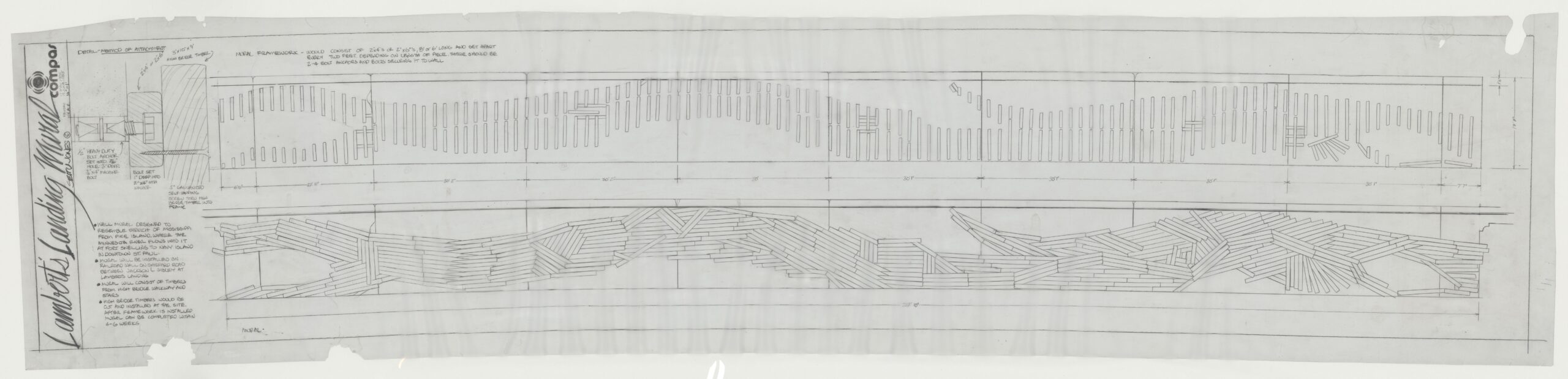
In a preparatory sketch for Confluence, a mural designed by Minnesota-based artist Seitu Ken Jones, we see the surface and structural layers of a large-scale environmental portrait. Part of the drawing delineates the “mural framework,” a series of hidden supports Seitu would place at regular intervals along the two-hundred-foot wall (fig. 1). He then sketched the image he planned to install on top of the supports: an abstract arrangement of sharply cut, tightly woven timbers that portray the confluence of the Mississippi and Minnesota rivers. For his primary material, Seitu used reclaimed wood from a decommissioned railway bridge that once spanned the Mississippi at Lambert’s Landing in Saint Paul, Minnesota, the urban site where he methodically installed the mural during the summer of 1986.1 When it was completed, Confluence filled the peripheral vision of viewers in ships, on bikes, and in cars, whizzing past the industrial waterfront of downtown Saint Paul (fig. 2). The Department of Planning and Economic Development, a city agency that supported the project, celebrated Seitu’s mural for “capturing the diversity of the river, both past and to come” (fig. 3).2
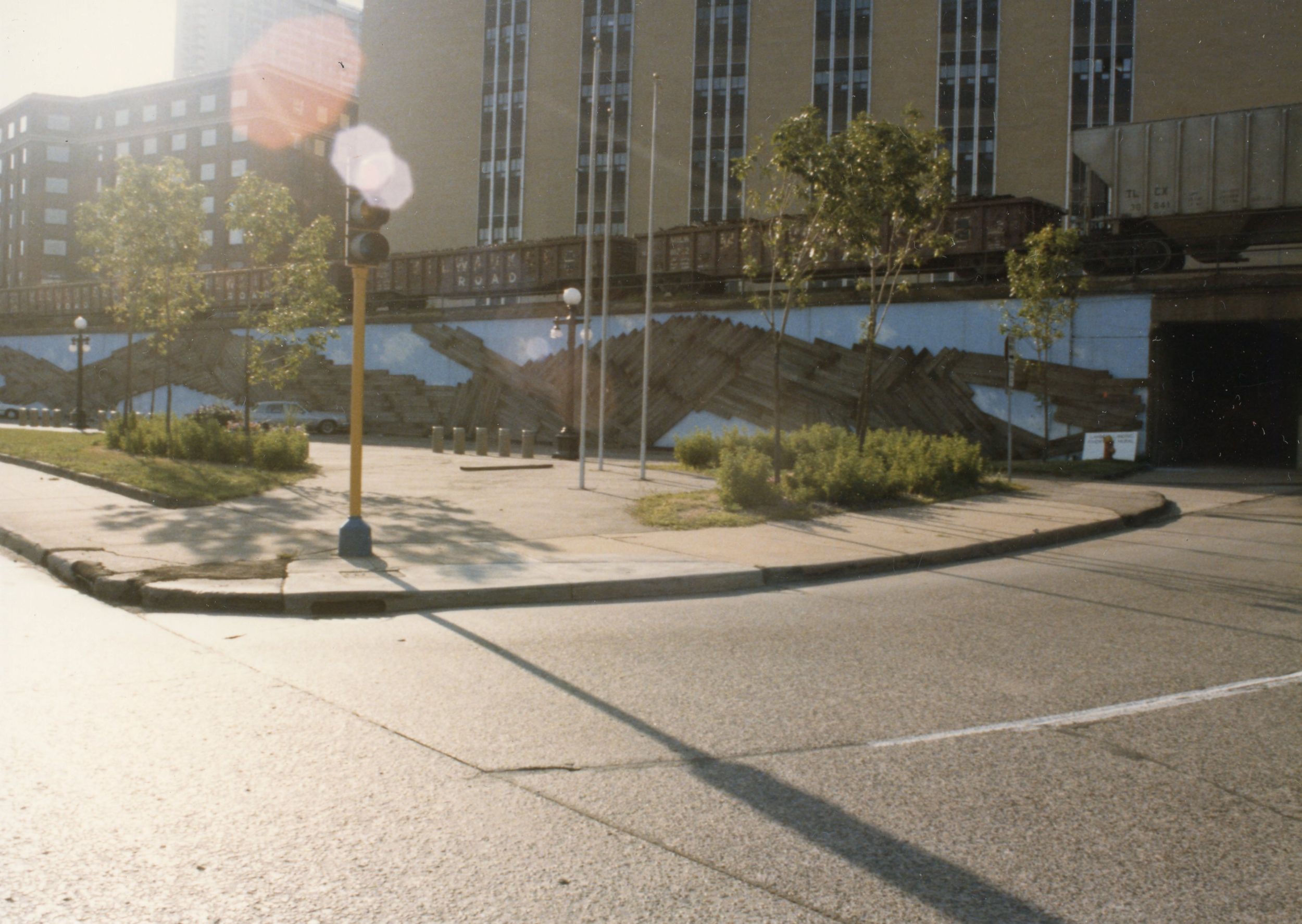
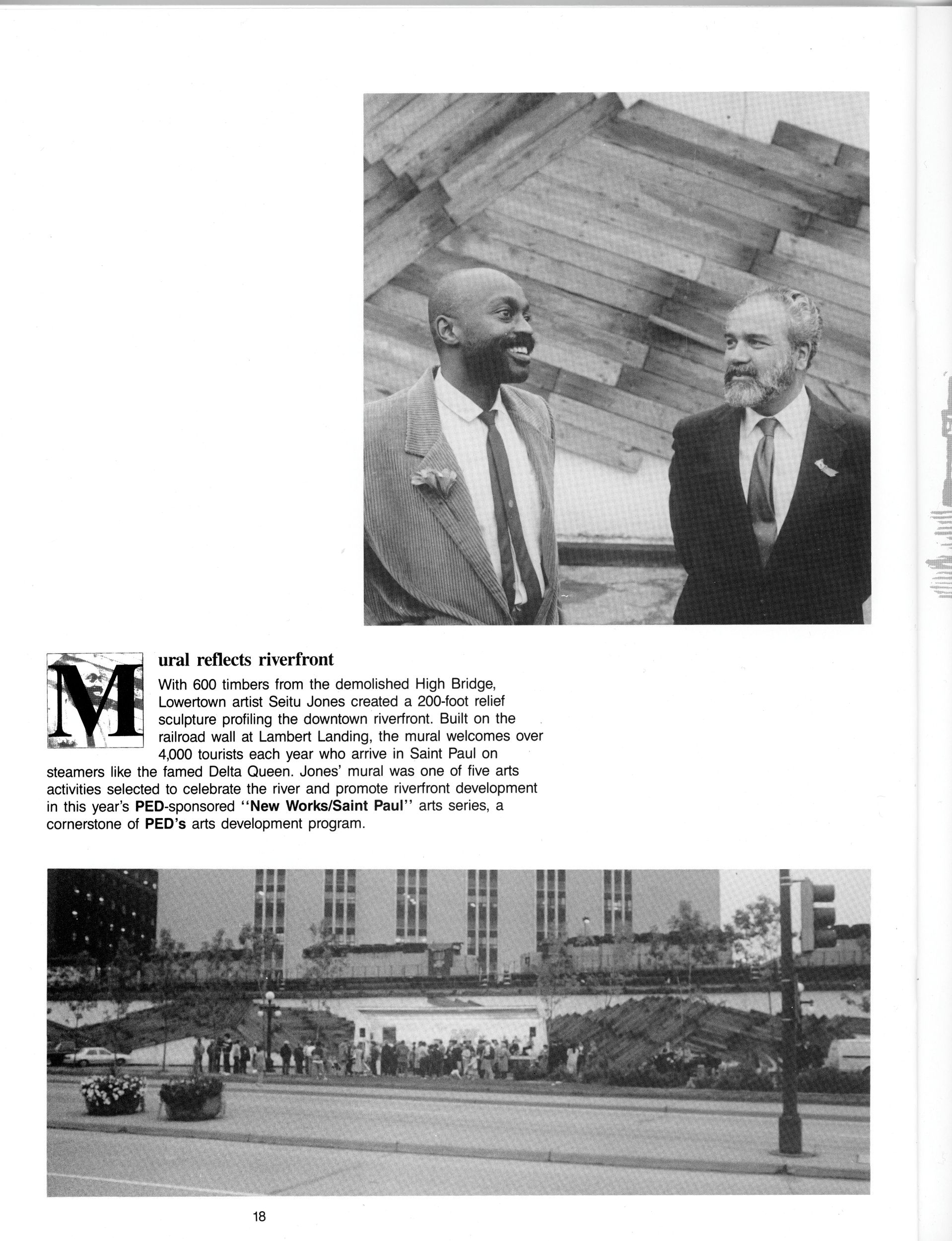
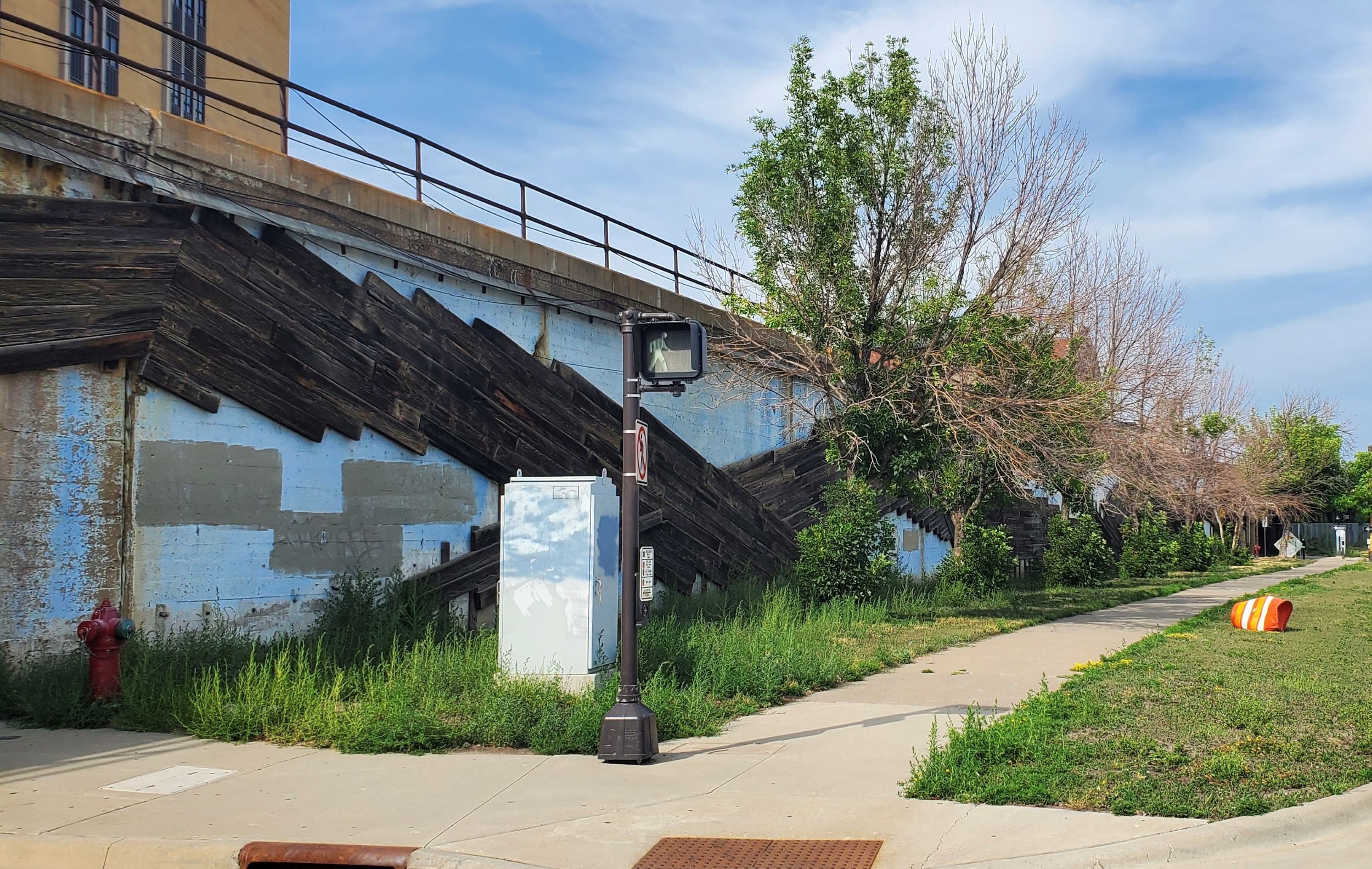
I open with a description of the mural’s preparatory drawing because Seitu’s technical sketch and the documents that rehearse the process of permitting, funding, and installing the mural—archival materials—constitute the only remaining forms in which we can see Confluence. The mural itself no longer exists. Seitu ceremonially disassembled the timbers and two-by-fours in September 2025, because, in the decades after it was installed, the work had fallen into disrepair (fig. 4). During a site visit with the artist in 2024, I saw wires from the above railway drooping across the surface of the mural. Vegetation in front of the wall had grown tall and wide, obscuring nearly every angle from which a passerby might view the work. Some pieces of the historic timber were marked with graffiti, while others had been stripped from the wall and carried away. Seitu hopes to mount a new work in place of his original vision, but a chronic lack of funding for the arts leaves the future of the site uncertain. Since 2020 I have been in dialogue with the artist and archivist Ego Ahaiwe Sowinski as we construct a physical and intellectual system for the manuscripts, administrative records, photographic documentation, and preparatory works that chart Seitu’s experience as a Black artist in the Midwest.
Decades of environmental exposure and administrative neglect deteriorated the surface of Confluence and compromised its structure, so for Seitu, the current president’s policies have only accelerated a process of erasure that was already underway. Archival practices ground his most recent strategy to counter violence against nondominant cultural heritage; Seitu hopes these preservation methods are durable enough to keep the memory of his work alive.
Born in 1951 and raised in Minneapolis, Seitu has produced public art and socially engaged projects from his Twin Cities home base for over fifty years. Speaking to a local news reporter just before Confluence was completed, Jones explained that he was committed to making art for civic spaces because “there are a great number of people inhibited by museums and galleries. . . . there’s an audience that’s not being reached.”3 While Jones did show his work at museums and galleries, he was primarily focused on bringing art to public spaces, where he could reach people in the course of everyday life. But the fate of Confluence reveals that while civic spaces may be more accessible venues for art than the rarified white cube, they can become unreliable and inaccessible over time. And while we are building an archive to keep the memory and documentary evidence of Seitu’s work, our efforts pour into a provisional, community-based archival space. We are describing and arranging documents in a rented room, and our records are surrogates for works of art that are at demonstrated risk of destruction and loss. Our archive is not permanent.
The convergence of the two rivers that Seitu depicted in his environmental portrait is called Bdote, which, as Indigenous scholar Waziyatawin Angela Wilson explains, “literally means the joining or juncture of two bodies of water. . . . It is sacred because it is here that the Bdwakantunwan Dakota creation story places the origins of our first people.”4 The United States government has subjected Bdote to generations of humanitarian, environmental, and narrative attacks; Confluence—the artwork and its fate—mirror that violence in the conceptual junctures of its structure, surface, and surrogates and in its history.
Seitu’s inherently unstable records do not repair or prevent structural harm. Instead, his archives—housed in Rondo, a historically Black neighborhood in Saint Paul—arrange and describe his relationship to violence and provision our communities with narratives through which we can strategize, rehearse, and perform our survival.
Cite this article: Alexandra Nicome, “Confluence: Situating New Beginnings in the Work of Seitu K. Jones,” in “Call and Response: DEIA Tensions in Scholarship, Practice, and National Identity,” Colloquium, edited by Keidra Daniels Navaroli and Frederica Simmons, Panorama: Journal of the Association of Historians of American Art 12, no. 1 (Spring 2026), https://doi.org/10.24926/24716839.20939.
Notes
- Charles Fredeen, “Timbers from High Bridge to Become Art,” Skyway News, July 2, 1985, 1, Seitu Ken Jones Professional Papers, The Black Gate (Seitu Ken Jones Archives), Saint Paul, MN (hereafter “Jones Professional Papers”). ↵
- City of Saint Paul Department of Planning and Economic Development, “Reflections of the Riverfront,” New Works News: A Celebration of Art in Saint Paul, 1986, Jones Professional Papers. ↵
- Kris Pranke, “New Mural Will Mask Riverfront’s Eyesore,” Skyway News, July 16, 1986, 15, Jones Professional Papers. ↵
- Waziyatawin Angela Wilson, “A Journey of Healing and Awakening,” American Indian Quarterly 28, no. 1 (2004): 279–80, http://doi.org/10.1353/aiq.2005.0028. ↵
About the Author(s): Alexandra Nicome is a Belle da Costa Greene Curatorial Fellow at The Morgan Library & Museum, and Archives Coordinator for Seitu Jones Studio.