

Dyani White Hawk: Love Language





PDF: Gaudet, review of Dyani White Hawk
Curated by: Siri Engberg (Walker Art Center) and Tarah Hogue (Remai Modern), with Brandon Eng (Walker Art Center)
Exhibition Schedule: Walker Art Center, Minneapolis, October 18, 2025–February 15, 2026; Remai Modern, SK, April 25–October 4, 2026
Exhibition catalogue: Tarah Hogue and Siri Engberg, eds. Dyani White Hawk: Love Language, exh. cat. Walker Art Center, distributed by D.A.P. Exclusive, 2025. 320 pgs. Hardcover: $50.00 (ISBN: 9781935963349)
Dyani White Hawk (b. 1976), the award-winning Sičáŋǧu Lakota artist, defines her multimedia artistic practice as an “expression of love.”1 This intimate and relational ethos does not mean that she avoids addressing past or present injustices in her artwork but rather that she does so in the spirit of collective growth. Dyani White Hawk: Love Language, the artist’s midcareer retrospective, which opened at the Walker Art Center in Minneapolis, bears out this vision of artmaking as an act of generosity shared within and across diverse communities. Organized into four thematic sections chosen by the artist herself—“See,” “Honor,” “Nurture,” and “Celebrate”—the Walker’s survey of White Hawk’s oeuvre is a paean to the communities she belongs to and the connections that bind us all. In the final months of the Walker’s installation, amid a period of heated public demonstrations, the exhibition’s emphasis on the triumphant power of art to build and sustain human connection gained greater urgency than curators Siri Engberg and Tarah Hogue could possibly have predicted.
The exhibition opened with a challenge to dominant histories of Western modernism and abstract art. In a series of introductory galleries, selections from White Hawk’s early career evidence her dedication to recognizing and upholding the influence of Indigenous abstraction. Drawing on parallels between Lakota aesthetics and strategies employed by mid-twentieth-century American modernists, White Hawk proposes a more plural history of abstraction. These works reflect White Hawk’s eclectic artistic training at Haskell Indian Nations University in Lawrence, Kansas; the Institute of American Indian Arts, Santa Fe, New Mexico; and the University of Wisconsin-Madison. While studying for her MFA at Wisconsin, White Hawk began to recognize that she and her peers had learned different histories of art. Canvases like Master’s Study (2011) bridge the gap between these different approaches and between distinct lexicons of abstraction. Thick, horizontal lines in red, white, and black alternate irregularly to fill the square canvas, interspersed by thinner, bright blue, hyphenated lines. Combining the style of a Diné “chief’s blanket” with the form of Mark Rothko’s Color Field paintings, White Hawk uplifts an alternative canon of masterworks. Other pieces assembled under the theme “See” introduce viewers to White Hawk’s savvy intermedial negotiations: beads stitched on antique ledger paper, painted quillwork, and the first of several sculptural installations that punctuate the gallery’s wide throughways.
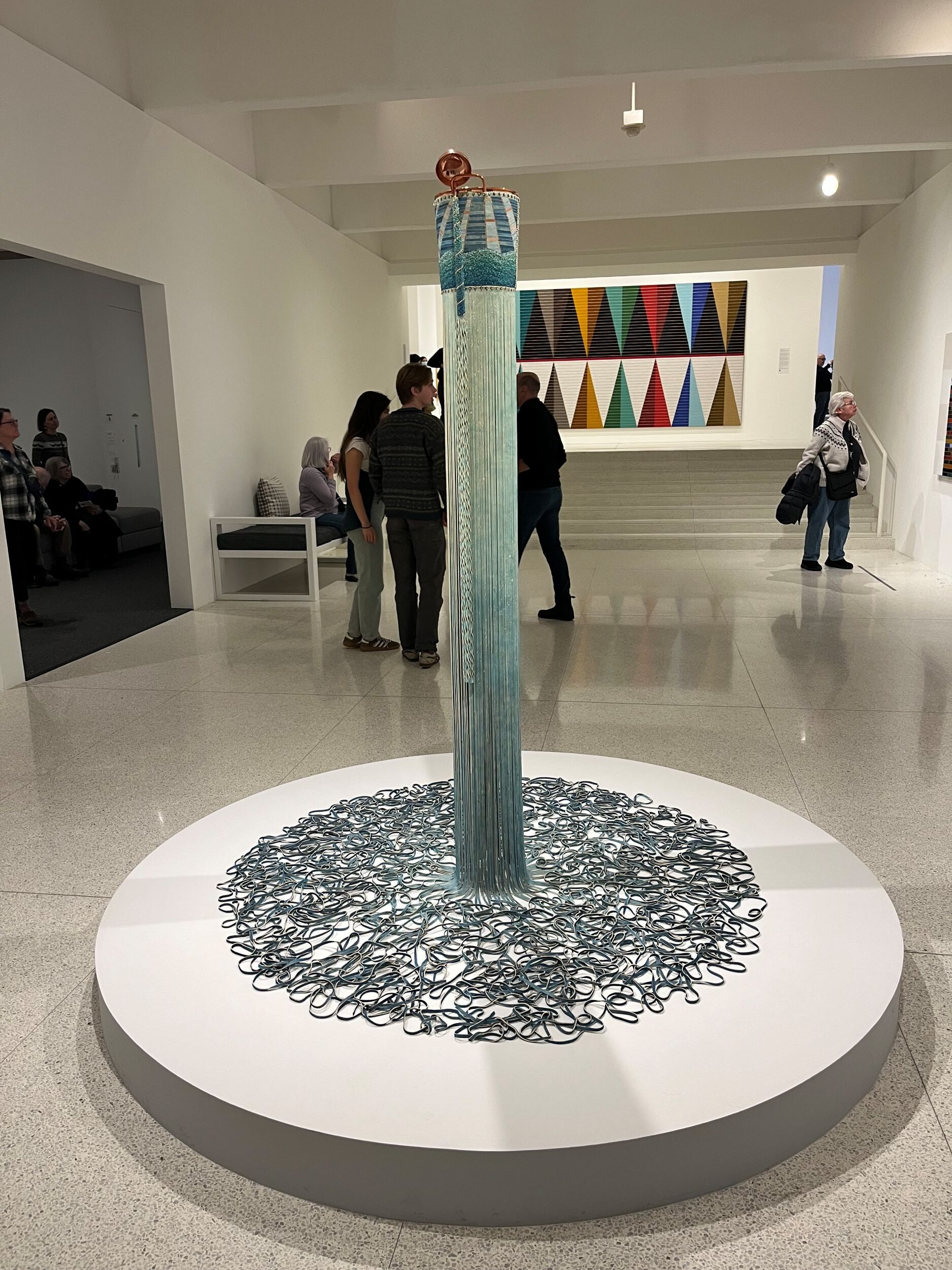
Sculptures from White Hawk’s Carry series consist of a large copper bucket and ladle wrapped by intricately beaded skirts and fringed by long buckskin strips, whose ends gather on the plinths below like an elaborate root system (fig. 1). An invisible armature lends these sculptures a commanding yet spectral presence in the gallery. A label for the series explains that White Hawk wanted to challenge the tendency to relegate craft to anthropological spaces, a vision she accomplishes through imposing scale and the honorific adornment of utilitarian objects in a kind of regalia. In their catalogue essay, Hogue and Engberg articulate how these sculptures—first introduced in “See” and appearing again in the sections “Honor” and “Nurture”—reveal how “Indigenous abstraction extends beyond form” to include the “relational and functional aspects of objects.”2 Like the root system in which they terminate, these sculptural forms anchor the exhibition in an aesthetic and artistic practice that is as engaged with revising an art-historical canon as it is in honoring the resilience of those historically excluded from it.
Women are often the recipients of White Hawk’s honorific artwork. In another series, Takes Care of Them (2019), White Hawk commemorates the way women lead, nurture, protect, and create for their families and communities. The English words, paired with the Lakota concepts they approximate, provide the title for a series of four prints abstracted from Plains women’s dresses. The four dresses serve as portraits (including one of the artist’s mother) and as surrogate protectors. They evoke the US military veterans who stand at the four directions during a Wabléniča Ceremony to welcome back individuals removed from Indigenous communities by adoption or foster care. The artist’s mother, Sandy White Hawk, has been instrumental in spearheading this healing ceremony.3
This careful attention to women’s artistry and community work runs throughout Dyani White Hawk: Love Language. Several of White Hawk’s large-scale paintings pay homage to female relatives and art forms traditionally made by women such as star quilts. In two 2015 canvases, Wičháȟpi Wakíŋyaŋ Wíŋyaŋ Wíŋyaŋ (Thunder Star Woman) and Čhokáta Nažiŋ Wíŋyaŋ (Stands in the Center Woman), White Hawk celebrates women’s inventive incorporation of trade goods, like calico, into a Lakota aesthetic. Other recurrent motifs, like moccasin vamps, attest to White Hawk’s generosity as an artist and curator. These elliptical shapes serve, in the artist’s words, as “an entry point for Native audiences . . . who aren’t art historians or art students” to offer an “immediate point of recognition.”4 Several of these vamps reference a long history of Indigenous resistance to what historian Nick Estes (Lower Brule Sioux), echoing his grandfather, calls “the paper world” of colonialism5—that is to say, the bureaucratic forms and systems used to manage Indigenous Peoples and their lands. Antique ledger paper stitched over with beads or acrylic paint tether White Hawk’s abstracted vamps to the Plains artists of the nineteenth century, who repurposed pages from accounting books to record their lives.
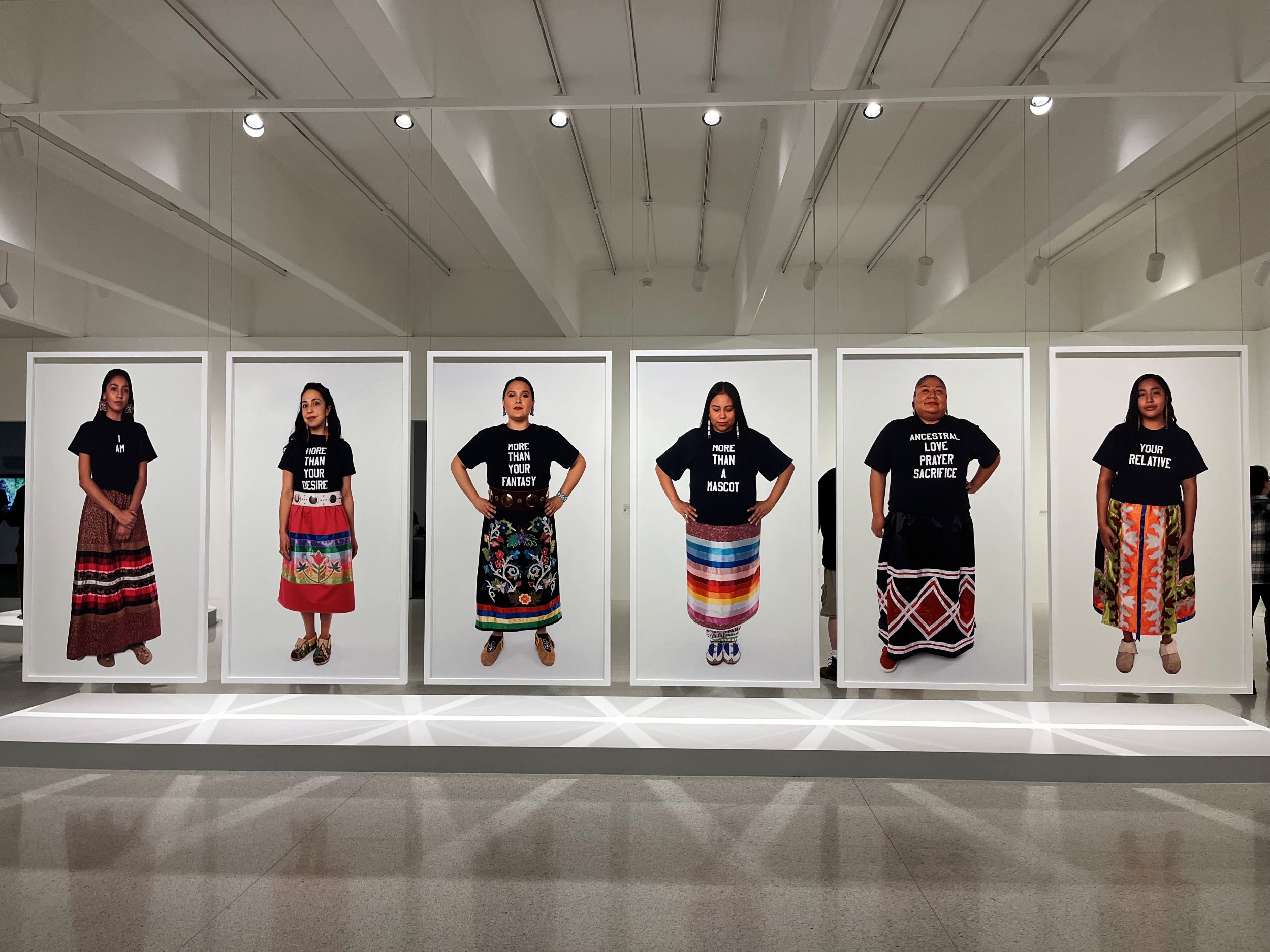
Although themes and motifs recur, White Hawk’s body of work spans media and scalar extremes. This diversity is a testament to her collaborative spirit. In the series of photographs I Am Your Relative (fig. 2), White Hawk worked closely with photographer Tom Jones (Ho-Chunk) to document a performance she first staged three years earlier at a women’s rights forum in Minneapolis. Installed at the top of a shallow staircase, these six, nearly life-size photographs confronted viewers at the threshold between two galleries. Each woman wears a ribbon skirt from her tribe with a lettered black t-shirt that, read together, proclaim: “I am/ more than your desire/ more than your fantasy/ more than a mascot/ ancestral love prayer sacrifice/ your relative.” This commanding photographic installation refutes stereotypes and highlights the real stakes of representation in Indigenous women’s lives. It also speaks to White Hawk’s deepening engagement with language—a concept she explored further in the nearby eight-channel video installation LISTEN (2020). On each monitor, a woman speaks her Indigenous language interspersed with footage from her tribal homelands. An insightful catalogue essay by Mary V. Bordeaux (Sicangu/Oglala Lakota) describes the work as an invitation to an “intimate act of communal deep listening,” rooted in Indigenous ways of knowing.6 For some visitors it is an introduction to languages previously unheard, while for others it is an affirming celebration of familiar sounds. Couches adorned with throw blankets and pillows designed by White Hawk and produced by Minnesota’s Faribault Woolen Mills offered a comfortable place to sit and reflect.
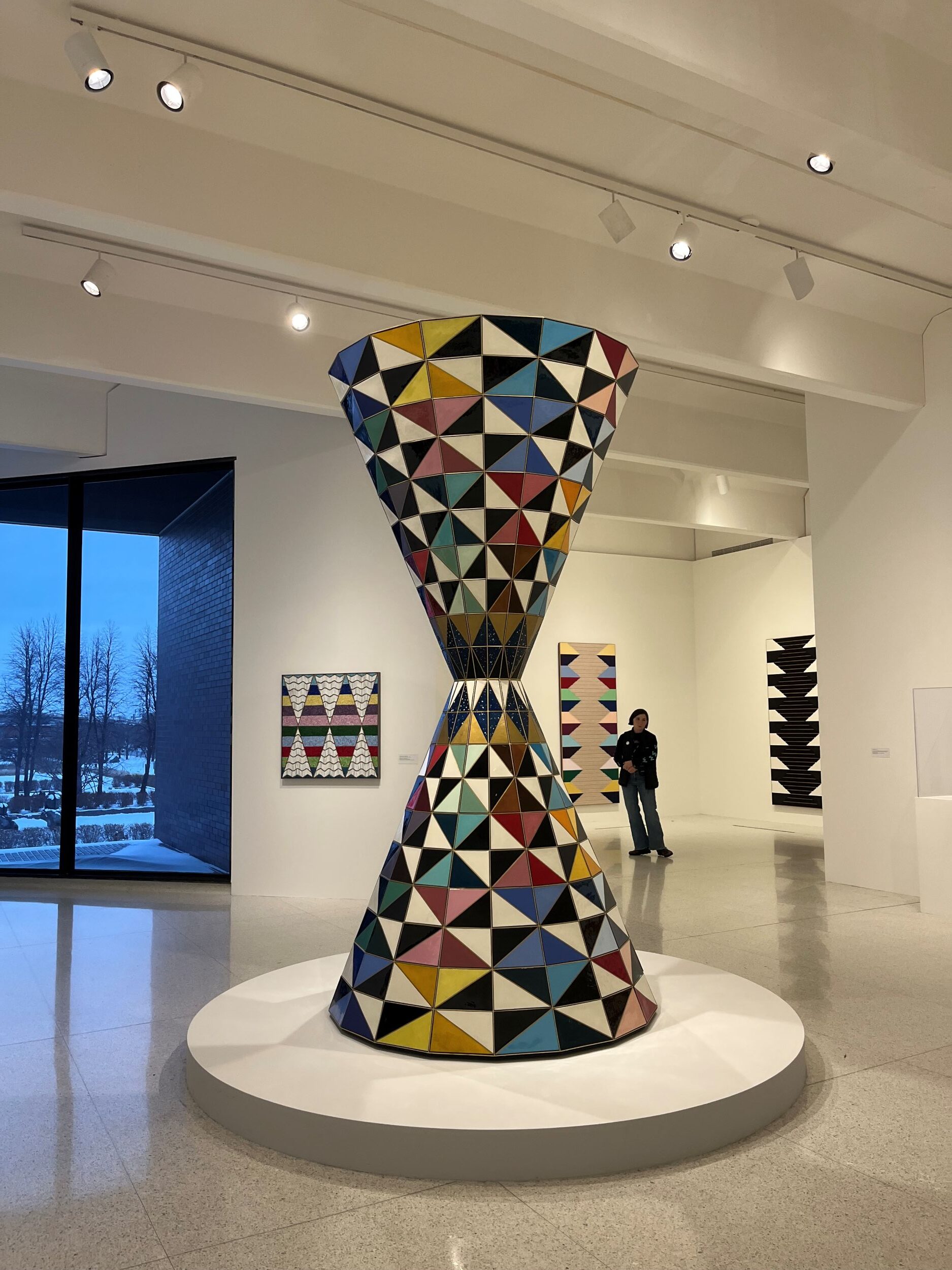
The final section of the exhibition, “Celebrate,” was an exploration of scale. The new monumental mosaic sculpture Infinite We (fig. 3) makes the kapémni—an important symbol in Lakota cosmology and a longstanding interest of White Hawk’s—three-dimensional for the first time in the artist’s work, taking on a towering form. Composed of two triangles joined at their points, this hourglass symbol for the connections between the “expansive star world above and the grounded world of the Plains below” recurs throughout White Hawk’s oeuvre.7 Made with colored enamel, copper, and brass, the ten-foot-tall Infinite We is inviting despite its immense scale. The air that flows around its tapered axis seems to anchor the sculpture and its viewers in the same breath.
In the final room of the exhibition, another tower dominates, this one rectilinear and ornately decorated with sparkling seed beads. The columnar form of Visiting (2024) is an homage to Minnesota-based artists George Morrison (Grand Portage Ojibwe) and Jim Denomie (Lac Courte Oreille Ojibwe), while its beadwork is a tribute to the artists who work with White Hawk in her studio. The tower consists of strips beaded by White Hawk’s studio team and assembled like a puzzle. A nearby interactive label gave viewers the opportunity to feel the beadwork and see the difference between lane-stitch and loomed work. Similar touch stations scattered throughout the exhibition also featured quillwork and buckskin. Unlike the uniform strips of color that make up the adjacent Wopila|Lineage (2022), which first debuted at the 2022 Whitney Biennial, White Hawk encouraged her studio workers to bring their own vision and creativity to the beadwork on Visiting. Pieced together like a quilt, the diverse array of beaded designs generously makes visible the community of artists, past and present, to which White Hawk belongs.
Dyani White Hawk: Love Language is a jubilant solo exhibition for the Minneapolis-based artist. It also issues a challenge to the genre of the individual artist retrospective. Although the artist won the coveted MacArthur Fellowship in 2023, colloquially referred to as the “genius grant,” the works included in White Hawk’s retrospective, their interpretation, and the accompanying catalogue belie the art-historical myth of a lone artistic genius. In their acknowledgments in the catalogue, Hogue and Engberg report that White Hawk was determined that the publication also serve as a “platform for her artist peers.”8 As such, the publication includes a roundtable conversation between White Hawk, Marie Watt (Seneca Nation), and Christi Belcourt (Métis), moderated by the curator and writer Candice Hopkins (Carcross/Tagish First Nation). White Hawk’s midcareer retrospective is a celebration of the reality that no artist works alone and that art is, and always has been, an opportunity to gather and to build better worlds together.
Cite this article: Manon Gaudet, review of Dyani White Hawk: Love Language, Walker Art Center, Minneapolis, Panorama: Journal of the Association of Historians of American Art 12, no. 1 (Spring 2026), https://doi.org/10.24926/24716839.20954.
Notes
- Dyani White Hawk, “Artist’s Acknowledgments,” Dyani White Hawk: Love Language, ed. Siri Engberg and Tarah Hogue (Walker Art Center, distributed by D.A.P. Press, 2025), 16. ↵
- Siri Engberg and Tarah Hogue, “Continuity: Lineage, Innovation, and Care in the Work of Dyani White Hawk,” in Engberg and Hogue, Dyani White Hawk, 27. ↵
- Nancy Marie Spears, “An Indigenous Adoptee Reclaims Her Culture,” Imprint, January 12, 2023, https://imprintnews.org/top-stories/an-indigenous-adoptee-reclaims-her-culture/237550; Sandy White Hawk, A Child of the Indian Race: A Story of Return (Minnesota Historical Society Press, 2022). ↵
- yani White Hawk quoted in Sheila Regan, “Dyani White Hawk: Speaking to Relatives,” Mn Artists, Walker Art Center, April 12, 2021, https://mnartists.walkerart.org/dyani-white-hawk-speaking-to-relatives. ↵
- Nick Estes, “The World of Paper, Restoring Relations, and the Lower Brule Sioux Tribe,” in Allotment Stories: Indigenous Land Relations Under Settler Siege, ed. Jean M. O’Brien and Daniel Heath Justice (University of Minnesota Press, 2022), 47. ↵
- mary v. bordeaux, “anúnkȟatanhan: acts of reciprocity | storytelling, creativity, and connection in listening,” in Engberg and Hogue, Dyani White Hawk, 109. ↵
- Siri Engberg and Tarah Hogue, “Continuity: Lineage, Innovation, and Care in the Work of Dyani White Hawk,” in Engberg and Hogue, Dyani White Hawk, 22. ↵
- Siri Engberg and Tarah Hogue, “Acknowledgments,” in Engberg and Hogue, Dyani White Hawk, 13. ↵
About the Author(s): Manon Gaudet is a postdoctoral fellow St. Francis Xavier University, Nova Scotia