

American and Indigenous American Art at the Virginia Museum of Fine Arts, Richmond





PDF: Hyte and Mazow, American and Indigenous American Art
Last year, when the Virginia Museum of Fine Arts (VMFA) in Richmond acquired Making Medicine: Coyote (Going Forward, Looking Back) by Jaune Quick-to-See Smith (1940–2025), we installed it in front of Progress (The Advance of Civilization) by Asher B. Durand (1796–1886), allowing works from our Indigenous American art collection and our American art collection to hold equal prominence (fig. 1). The installation highlights these two deeply influential artists in their respective fields, who, through these works, articulate their perspectives on what is now the United States. Durand’s painting meshes nature and Indigenous Peoples with industry and settlement. In so doing, however, he casts the advances of the Industrial Revolution in the present and future tense and the three Indigenous figures huddled in the forest in the past tense—as if shoved aside in service of “progress.” Smith’s sculpture foregrounds Coyote, a trickster who plays a central role in Salish creation stories as a teacher of Salish spirituality and lifeways, and as a mischief-maker whose misdeeds illustrate potential for human error. In Making Medicine, Coyote appears to clean up physical remnants of colonial and environmental chaos, with single-use plastics, crucifixes, and syringes filling a monumental canoe. The very titles of these works hint at their divergent temporal sensibilities, with Durand proposing a fixed idea of the “advancement of civilization,” while Smith suggests an Indigenous understanding of time as nonlinear—Coyote looks “backward” to understand how to move “forward.”
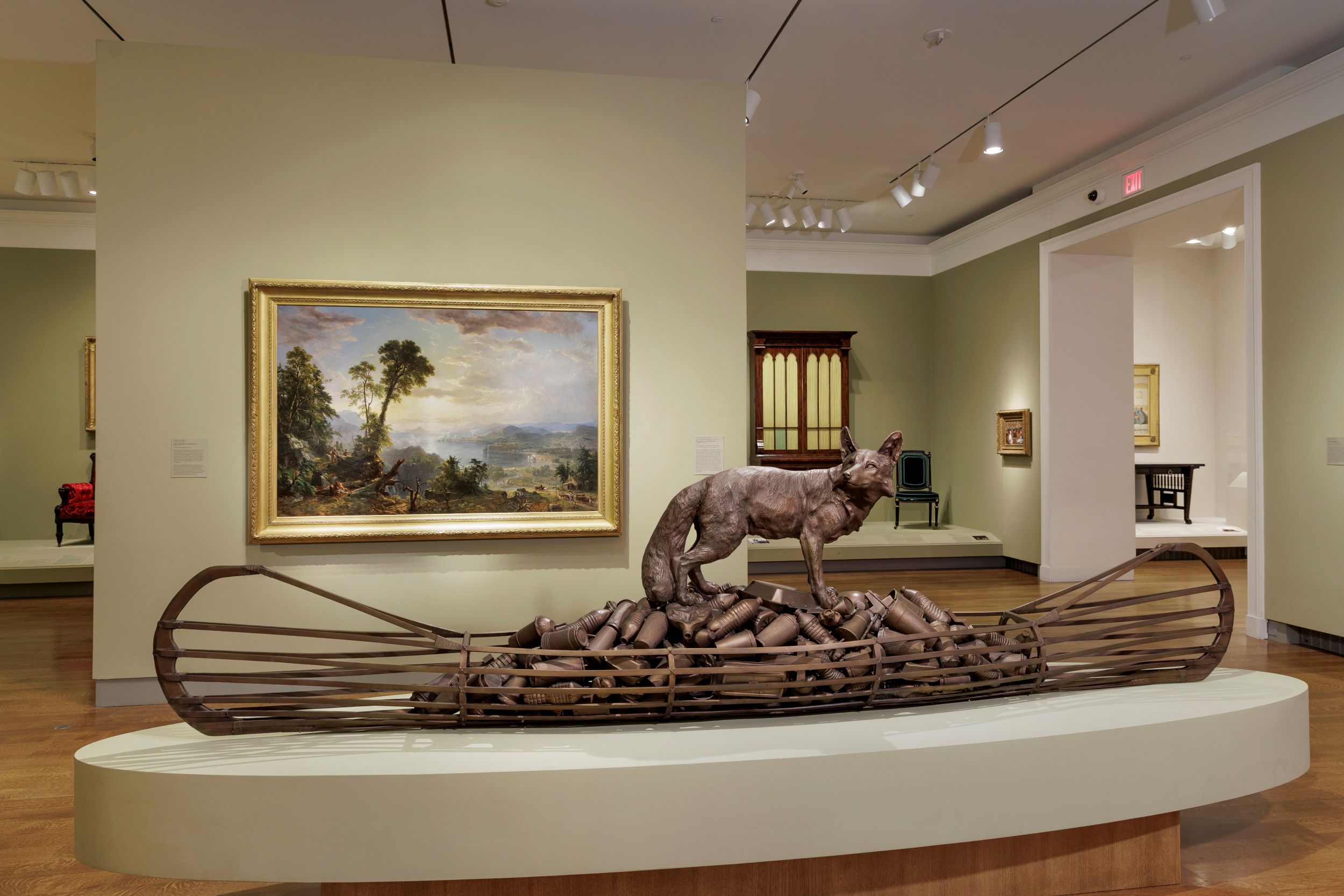
The VMFA is currently preparing for the largest expansion and renovation project in its history. Scheduled for completion in 2029, this transformative building project coincides with the establishment of the museum’s first full-time curatorial position dedicated to Indigenous American art. As curatorial colleagues, we feel that the time is ripe for thoughtfully reimagining dialogues between American and Indigenous American artists in our spaces. What we have been calling the “American galleries” will double in size to thirty thousand square feet in the new wing, with three galleries devoted to Indigenous American art. The new American and Indigenous American galleries will also intermix works falling in both categories.
With this installation, and the future expansion of the galleries, we aim to keep the works of Indigenous artists from becoming a footnote in or mere disruption to the American installations. Indigenous artists belong to sovereign nations whose existences on this land stretch far beyond the confines of American history. Their works should be a part of an equal dialogue within spaces dedicated to understanding America and American art. At twelve feet wide, Smith’s Making Medicine extends farther even than Durand’s panoramic span; her work dominates the room, demanding a symbiotic relationship with Progress. With the Coyote in full force, Making Medicine asserts a strong message of cultural resistance, contrasting Durand’s portrayal of Indigenous Peoples as defeated and transforming his illustration of mourning into a call to action. These narrative tensions, we hope, will provide museum audiences with more options for destabilizing quick assumptions about land and what it means to claim place.
Cite this article: Siera Hyte and Leo Mazow, “American and Indigenous American Art at the Virginia Museum of Fine Arts, Richmond,” in “In the Galleries,” edited by Elizabeth McGoey and Sara Picard, Panorama: Journal of the Association of Historians of American Art 12, no. 1 (Spring 2026), https://doi.org/10.24926/24716839.21029.
About the Author(s): Siera Hyte (Cherokee Nation) is the Schiller Family Curator of Indigenous American Art, and Leo Mazow is the Louise B. and J. Harwood Cochrane Curator of American Art, both at the Virginia Museum of Fine Arts, Richmond.