

Visions of America at Crystal Bridges





PDF: Bailly, Visions of America
In a journey through art, architecture, and nature, Visions of America is the opening chapter of Crystal Bridges Museum of American Art’s complete reinstallation of the collection of five centuries of American art. The new presentation reveals the museum’s commitment over the last six years to craft and Indigenous art, foregrounding these practices as central to the story of American art. In five thematic sections, Visions of America shifts how American art can be experienced and understood.
As guests cross the threshold into the “We” section, an arresting example of Arkansas quartz crystal stands at the center of the gallery (fig. 1). The natural marvel signals a clear sense of place and reveals the earth as a creator of objects of aesthetic beauty on par with artworks reflecting America. All around, portraits of ordinary to world-famous American figures in real and imagined settings greet visitors. Collection icon Rosie the Riveter (1943) by Norman Rockwell appears beyond two new commissions, “Sheyahtse” Warrior (2024) by Jeri Redcorn (Caddo/Potawatomi) and K’Gui Stah Gyah, Gyah Stah Gyah (The Kiowa World: As We Have Always Been, As We Are, As We Will Be) (2025) by Teri Greeves (Kiowa), her largest work to date. Redcorn’s ceramic head with copper designs and earrings, and Greeves’s beaded and hand-dyed silk triptych representing past, present and future Kiowa women, convey feelings of strength and resilience that reverberate through the gallery.
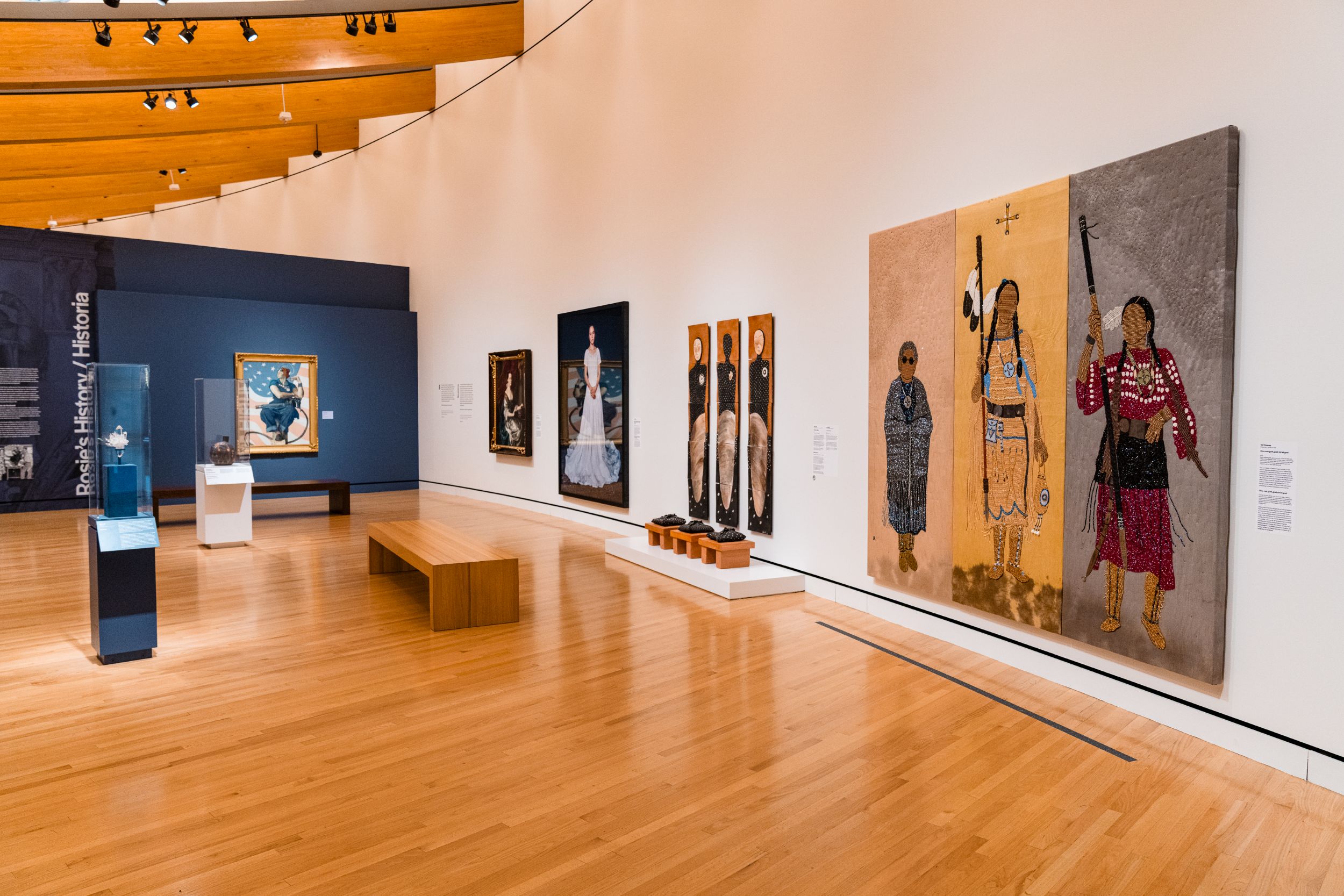
The following sections—”Dreaming,” “Nature,” “Making Our Mark,” and “We the People”—each revolve around large-scale works creating focal points. “Dreaming” embraces imagination, possibility, and reinvention through Nicholas Galanin’s (Lingít and Unangax̂) recombined bronze totem I think it goes like this (memory and interference) (2024) and Joseph Stella’s Tree of My Life (1919), on loan from sibling collection Art Bridges. “Nature” explores relationships between people, the earth, and materials. Raven Halfmoon’s clay Caddo Woman Warrior (2021) and a case of Norm Sartorius’s inventively carved wooden spoons demonstrate artists pushing the expressive limits of a medium. The colorful confetti stained‑glass of Tiffany Studios’ Mountain Landscape (Root Memorial Window) (1917), newly conserved and illuminated, prompts a heightened awareness of nature’s details and artists’ approaches to light.
“Making Our Mark” revolves around Tomokazu Matsuyama’s You, One Me Erase (2023), a twenty‑one‑foot‑wide painting recreating art and objects from across art history in an imaginary interior. Cobalt‑blue furniture matching the sofas depicted in the painting blurs boundaries between the canvas and the gallery. This extension of the painting encourages visitors to feel a part of the art and take it all in, including the adjacent ceramic wall installation, Betty Woodman’s House of the South (1996).
“We the People” explores the unfolding story of America. Thousands of varied shoelaces making up Nari Ward’s We the People (black version) (2015) dangle before images of faith and family, everyday life and labor, and national symbols.
Aligning with the museum’s fifteenth anniversary and expansion in 2026, Visions of America celebrates the role of artists in shaping our sense of identity and possibility.
Cite this article: Austen Barron Bailly, “Visions of America at Crystal Bridges,” in “In the Galleries,” edited by Elizabeth McGoey and Sara Picard, Panorama: Journal of the Association of Historians of American Art 12, no. 1 (Spring 2026), https://doi.org/10.24926/24716839.21012.
About the Author(s): Austen Barron Bailly is deputy director, curatorial affairs at Crystal Bridges Museum of American Art and the Momentary.