

“A Variety of Perspectives”: American Art at the Chrysler





PDF: Culp, Variety of Perspectives
At the Chrysler Museum of Art in Norfolk, VA, a recent reinstallation in Gallery 209 positions the ambitions of early America in dialogue with the questions of our present in Virginia’s Hamptons Roads region (fig. 1).1 The result is less a linear narrative than a conversation that moves across centuries. On the back wall, a sculpture by Betye Saar from 2010 evokes the enduring trauma of the slave ship. Its message reverberates through the adjacent paintings: at left, a portrait of a white mother and child by the formerly enslaved professional artist Joshua Johnson; at right, a group portrait with three Black women standing behind the white family they were forced to serve. With Saar’s sculpture as an anchor, these works articulate a moving dialogue about enslavement and its lasting impacts across three centuries.
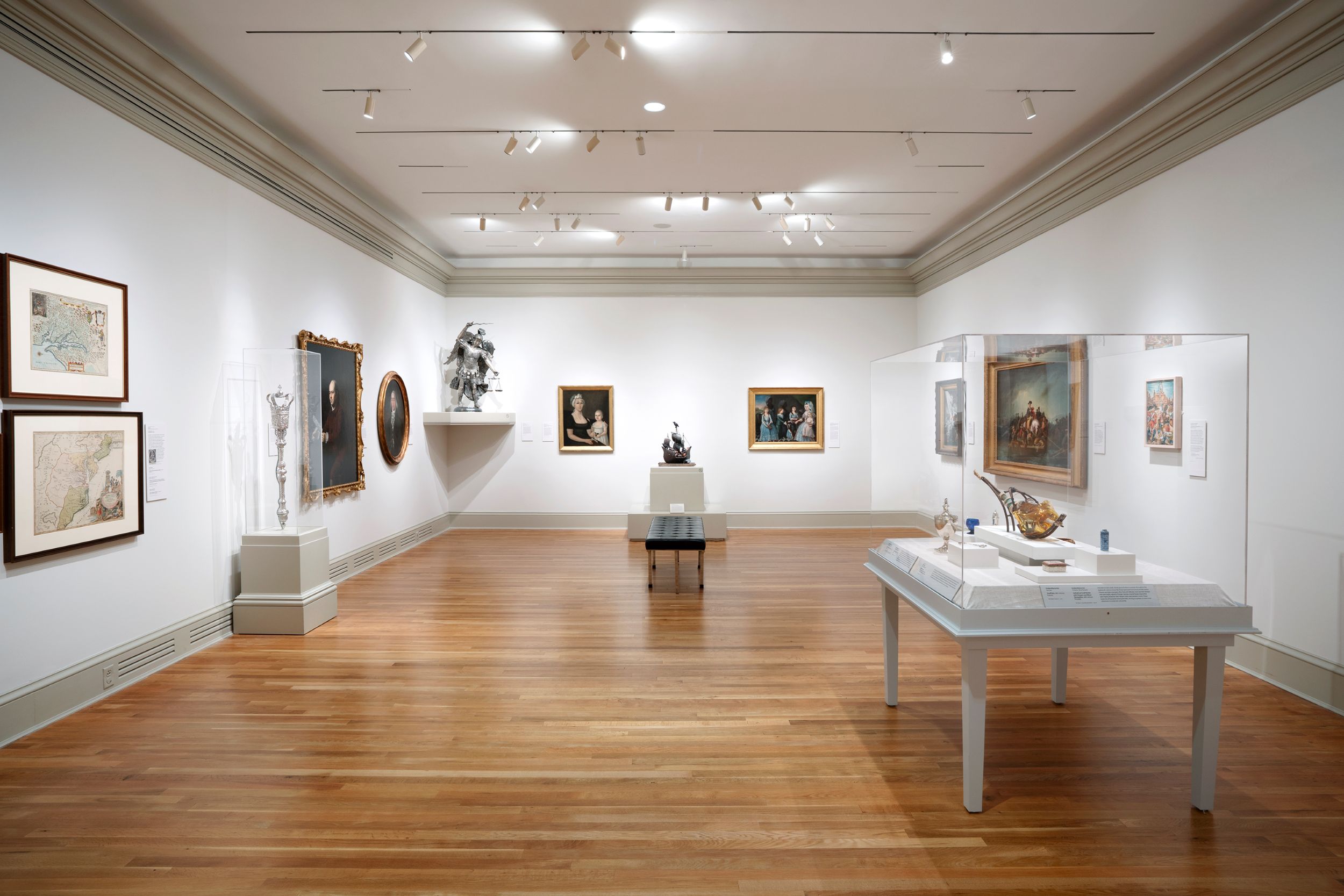
On the adjacent wall, Hale Woodruff’s Death of Crispus Attucks, George Caleb Bingham’s Washington Crossing the Delaware, and Edward Hicks’s Declaration of Independence illustrate events from the American Revolution. Completed in the nineteenth and twentieth centuries—many years after the actions they describe—these works prompt visitors to rethink familiar questions: Who tells the stories of our nation’s past? Who tells us which of those stories matter?
Those questions find direct answers in the gallery’s collaborative interpretive framework on the opposite wall. Seventeenth-century maps of Virginia (see fig. 1, far left)—derived from the surveys of English colonizers such as John Smith—are presented alongside interpretive texts developed with local Pamunkey citizens Rebecca Hill and Jessica Bradby.2 This juxtaposition demonstrates the ways in which early map-making projects were not neutral initiatives but instead the tools used by colonizers to rename, partition, and claim Indigenous land. Furthermore, Hill and Bradby redirect attention to what these maps omit: the Pamunkey Reservation, the oldest of its kind in the country, on land in eastern Virginia that was never ceded to the United States government. The reservation’s absence, in this context, becomes a form of evidence.
As Bradby observes, museums are spaces where people come to learn but also to listen. Centering this proposition, Gallery 209 expands the stories told by American art and redistributes authority over who gets to define it, an approach that offers a preview of some of the interpretive directions for the museum’s comprehensive reinstallation of its American art collection that will begin in 2028.
Inspired by the Chrysler Museum’s larger mission to foster community connection and celebrate our shared humanity, future installations of American art will continue to incorporate a variety of multivocal narratives in its galleries. As Bradby observed, “When you hear voices from your area, people listen; they become curious. People want the truth, and it’s important to share the truth by including a variety of perspectives.”3
Cite this article: Caroline Culp, “‘A Variety of Perspectives’: American Art at the Chrysler,” in “In the Galleries,” edited by Elizabeth McGoey and Sara Picard, Panorama: Journal of the Association of Historians of American Art 12, no. 1 (Spring 2026), https://doi.org/10.24926/24716839.21020.
Notes
- This reinstallation was organized by former Brock Curator of American Art Corey Piper in 2025. ↵
- Rebecca Hill is the executive director of the Virginia Native Artist Alliance, an artist, a Pamunkey citizen and councilperson, and one of the creators of the outdoor installation TSENACOMMACAH (2023), on view at the Chrysler Museum of Art from 2023 until 2025. Jessica Bradby is a Pamunkey citizen serving her tribe as the Enrollment and Citizen Services Manager / Indian Child Welfare Act Representative. ↵
- Emily Cayton, interview with Rebecca Hill and Jessica Bradby, Chrysler Magazine, Fall 2025, 22. ↵
About the Author(s): Caroline Culp is the Brock Curator of American Art at the Chrysler Museum of Art, Norfolk, VA.