

Off the Coast of Paradise: Artists and Ossabaw Island, 1961–Now





PDF: Trafton, review of Off the Coast of Paradise
Curated by: Erin Dunn, Telfair Museums, Savannah, GA; and Beryl Gilothwest, guest curator
Exhibition schedule: Telfair Museums’ Jepson Center, Savannah, GA, March 13–September 6, 2026
Exhibition catalogue: Erin Dunn and Beryl Gilothwest, Off the Coast of Paradise: Artists and Ossabaw Island, 1961–Now, exh. cat. Telfair Books, 2026. 184pp., 75 color ills. Cloth: $45 (ISBN 978-0933075252)
When Eleanor “Sandy” Torrey West (1913–2021) established the Ossabaw Island Project on a 26,000-acre southern barrier island near Savannah, Georgia, she used the word catalyst to describe its mission to spark creative endeavors. The Telfair Museums in Savannah has a long connection to Ossabaw, making the institution an appropriate organizer for Off the Coast of Paradise: Artists and Ossabaw Island, 1961–Now. The exhibition was the first full documentation of the visual arts produced by participants during West’s two-decade project (1961–82) and of the variety of artistic programs in the years since the West family transferred the island to the state of Georgia as a Heritage Preserve.1 Off the Coast also examined the effect on artists of the dramatic and isolated location and the island’s legacy of human displacement, enslavement, and extraction. The installation presented the natural ecosystem (including the salt marshes, beaches, and upland forests that house eagles, alligators, and loggerhead sea turtles). It also presented Ossabaw as a microcosm of the history of the southern United States and its transformation during the postwar period. Recent museum exhibitions have used the idea of place as an organizing idea. Off the Coast deepened and abstracted cultural topography and moved beyond being an archive of the program by developing a thematic tension between danger and beauty, complicating the idea of paradise introduced in the exhibition title. The curatorial framework also paralleled Sandy West’s own exploration of questions about the conditions under which human creativity and inspiration emerge, using this case study of artistic community to pose abstract questions that have relevance to today’s audiences.
West founded the program after she, her husband Clifford, and their nieces and nephews inherited Ossabaw in 1958 from her parents, Northerners who had bought the island as a winter getaway. The ownership of a place of such dramatic natural beauty and fraught history weighed heavily on her. Following thousands of years of Indigenous presence, the island was a site of settlement and displacement of the Guale people, Spanish explorers, Muscogee hunters, English settlers, and enslaved Africans. After brief habitation by formerly enslaved families during Reconstruction, the island was seized by white landowners (along with hundreds of other South Carolina and Georgia barrier Sea Islands) and sold in the early twentieth century. By the time of her 1958 inheritance, Sandy West also feared the prominent mid-twentieth-century challenge facing the islands: the development of golf communities that destroyed the natural environment (as seen at places like Hilton Head, South Carolina).
Her innovative Ossabaw Island Project (OIP) preserved the natural landscape by using it “in an educational, ecological way,” offering a small number of residencies lasting between one week and two months. Most often compared to the artist residency programs of Yaddo in Saratoga Springs, New York, and MacDowell in Peterborough, New Hampshire, OIP differed significantly in its emphasis on interdisciplinary collaboration instead of the isolated working practices at those two more-established programs. Like other emerging artist communities and residency programs of the 1960s and 1970s, OIP encouraged artists to work together, to share ideas, and to create projects that drew on the skills of one another. However, it did not include any organized educational components. Also, the program notably invited participation by scientists, social scientists, writers, religious thinkers, and educators, as well as artists. West believed in multidisciplinary work as a source of creative inspiration and selected, as the program described it, “dedicated men and women of creative thought and purpose in the arts, the sciences, industry, education and religion . . . people so indispensable to the peace and value of man.”2
The exhibition of sixty-five objects by thirty-two artists occupied the temporary exhibition galleries at the Telfair’s Jepson Center. Adept at dealing with the cavernous galleries and high sloping ceilings of the space, the curators grounded the objects, most of which are modestly sized and muted in color, on light gray panels matching the wall color. Sculptures on pedestals stood in the middle of the galleries alongside cases of objects and historical materials. The exhibition design was subtle and unobtrusive and did not assert a dominant aesthetic, probably necessary given the wide variety of the artworks and the important role played by black-and-white historical photographs and printed ephemera in the exhibition. The ambitious goal of documenting the residency program while simultaneously presenting a curatorial narrative that tied the artworks together in a critical way was structured around a thematic progression. In both the catalogue and the exhibition, the curators presented a chronological overview of the program and its creative legacy in conjunction with abstract themes: “Catalyst” (nurturing human creativity), “Terrain” (the effect of the unfamiliar environment on artists), and “Paradox” (the context of the complex human interactions in the place).3
In addition to the parallel thematic and chronological organizational structure, the curators emphasized the natural features of the island in order to evoke a sense of place for visitors unlikely to visit Ossabaw themselves. The excellent use of wall-size photo murals and videos in every gallery helped viewers understand the island’s natural features, the human history of the island, and the collaborative and innovative practices that characterized the artists’ visits. Although the curators’ extraordinary research in the West family archives, artists’ papers, and institutional collections is evident in the carefully reconstructed history of the program, this information did not inundate viewers. The wall labels were clear and concise, introducing the place, the artists, and their working methods. The curators made use of plentiful historical materials; however, most of the materials other than photographs were unobtrusive but accessible to interested viewers in flat display cases or in strategically placed handouts, information panels, or online materials.
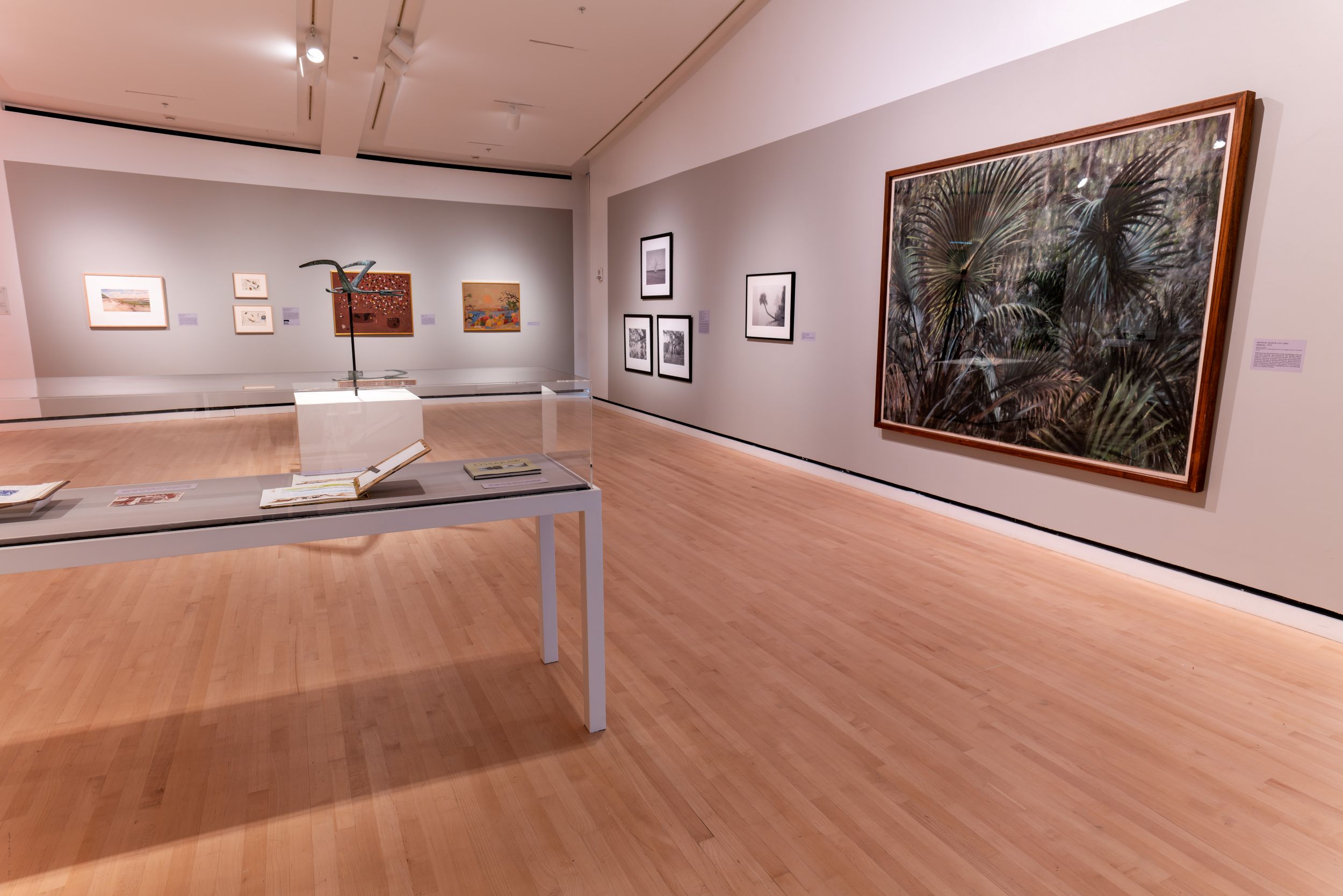
The diversity of the artworks and the thirty-eight lenders to the exhibition further showcased the curators’ detective work. Not all the artists were well known to contemporary audiences, and the beautiful catalogue accompanying the exhibition helpfully includes biographies. Although the visual artists who cycled through the program found varied inspiration, the curators selected works that reveal direct connections to Ossabaw, either by depicting the place or by taking inspiration from fellow artists encountered there. Some representations make the connection self-evident, such as Michael Mazur’s large painting Palmetto, showing the thick canopy of palmetto leaves filtering the dappled light (1975; fig. 1) or the many photographs of the island’s beaches, marshland, and foliage. Other artists wove together symbolic representations of human and natural history, such as Marcy Hermansader’s pastel-and-collage work The Magic Hoe (1982), in which she depicted nature, references to the agriculture on the island, and an African American folktale; she also imbued the paper with the soil of Ossabaw and collaged mosquito netting.
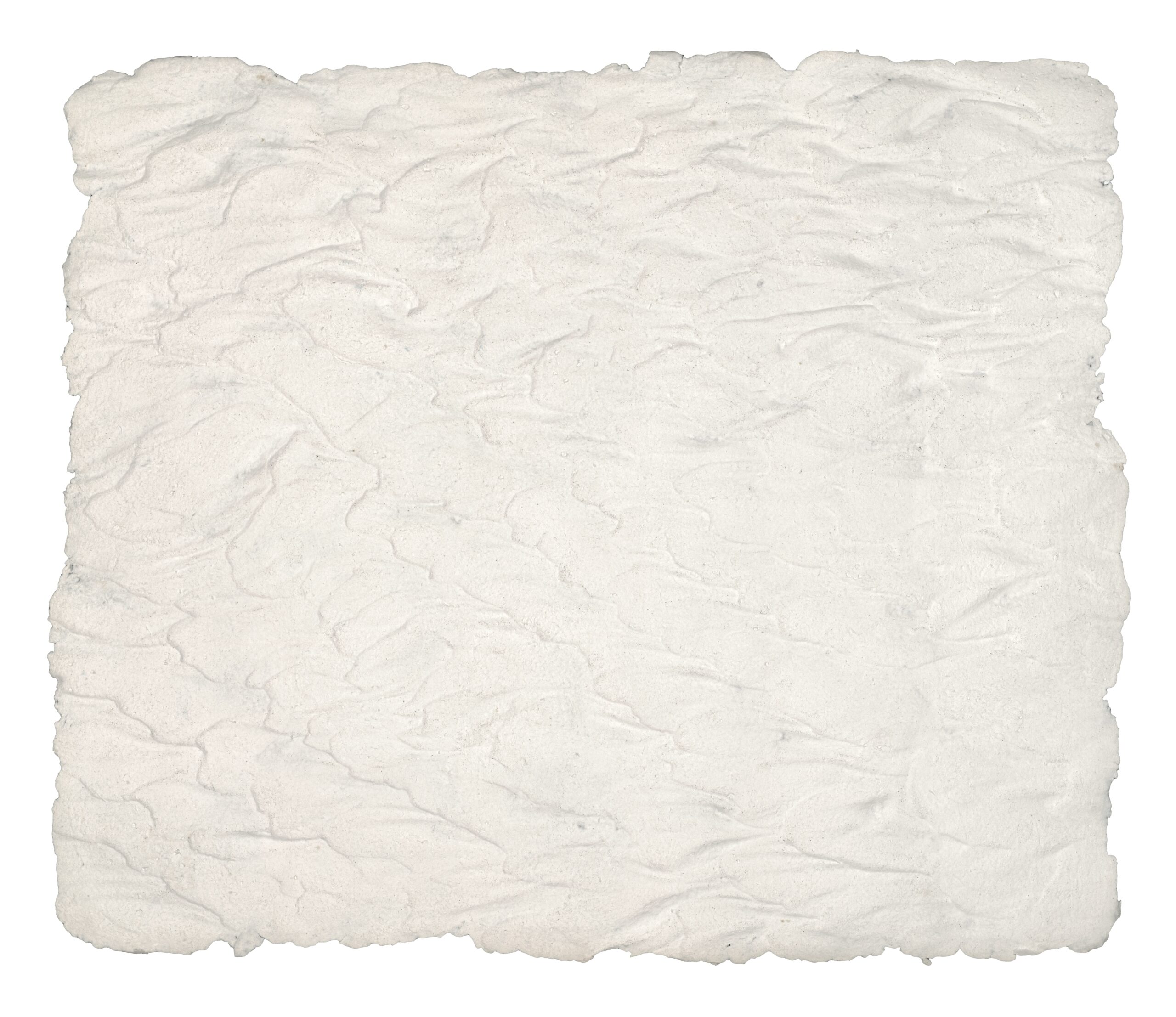
Ties to Ossabaw are not always so visually obvious. While Agnes Denes’s photographs of the repeated wave patterns along the beach are identifiable (Sun’s Reflection on Wet Sand [1981]), and Helen Hamada’s photographs of her body on the beach highlight the connection between participants and nature (Ossabaw Island [1974]), Athena Tacha’s pressed-paper works (fig. 2) appear to be beautifully textured, abstract compositions, not immediately recognizable as the impression of the sand carved by wave patterns. The casual visitor to the exhibition would be challenged to see the link to the environment (especially given the stylistic variety in the exhibition) without reading the labels—but hung together and carefully explained in accompanying texts, the works are connected to one another and to Ossabaw itself.
Another curatorial challenge for this exhibition was in representing a program that valued creative inspiration, which might not have emerged in an artist’s work until well after their residency. The curators included some examples highlighting the long impact of visits to Ossabaw on artistic practice. Following sculptor Harry Bertoia’s residency, for example, his shift to the spill-casting technique explored the natural forces of erosion he had witnessed on Ossabaw. Painter, sculptor, and writer Anne Truitt noted about her Day Book (published seven years after her residency) that Ossabaw facilitated a transformative moment in her writing: “At Ossabaw Island I began to realize—I might be writing a book.”4 In both cases, the island residency nurtured later developments in the artists’ creative processes.
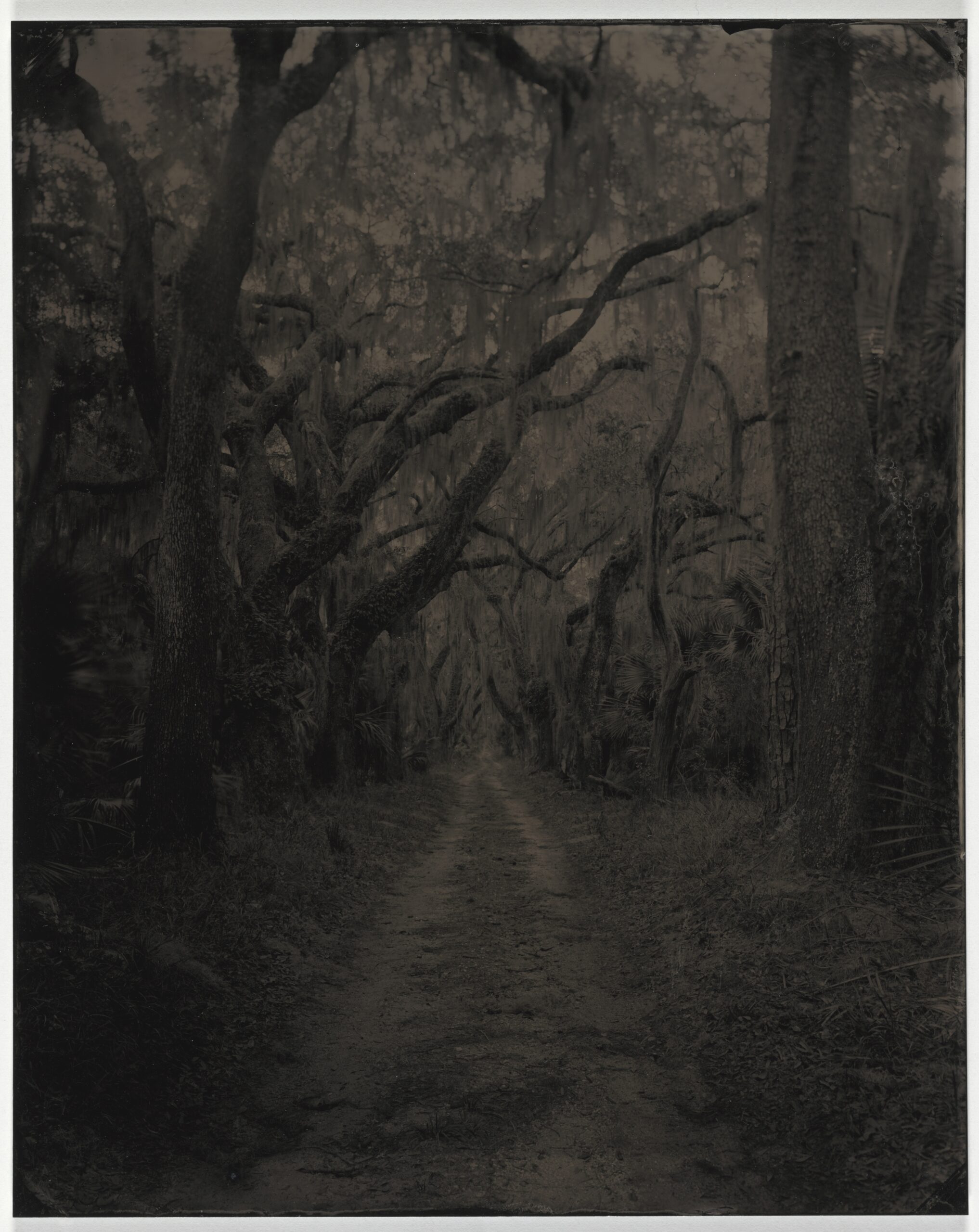
Although a few of the artists during the years of the program, like Hermansader, addressed the complexity of the island’s past, the most direct references to this weighty topic were expressed by artists who visited after the OIP ended in 1982. Although these “Legacy” artists do not neatly fit with the curatorial focus on the active years of the OIP, the group includes some of the most familiar names in the exhibition: Suzanne Jackson, Sally Mann, and Tyrone Mitchell. Rashod Taylor’s tintype, in material form and composition, ties together historical racial violence and the dramatic landscape (2024; fig. 3). This group is more explicit than earlier artists in addressing historical undercurrents and demonstrates the evolving legacy of the OIP. In addition, the selection amplified the curatorial effort to document the complicated human habitation of the island. In the final rooms of the exhibition, the curators contextualized the human role of the transformation of a barrier island into an artist retreat—and the possible aestheticization of the landscape—by commemorating the people who worked for the Wests and OIP. The galleries featured cook Queenie Williams and caretaker Cyrus Martin, whose stories and songs document their traditions and a history of displacement, as well as Martin’s Gullah Geechee heritage. The final rooms also presented filmmaker Allison Janae Hamilton’s eighteen-minute minute film Venus of Ossabaw, commissioned by the museum for this exhibition. The film dramatizes the historical experience of Titus and other colonial-era people enslaved on Ossabaw and encapsulates the themes of the exhibition: the connections and tensions between landscape, human history, and creative inspiration.
The Telfair Museums has importantly documented the innovative artistic community to which it has been connected, both during the heyday of OIP and through later artistic programs currently organized by the Ossabaw Island Foundation and the Ossabaw Island Education Alliance. The challenge for curators was to move beyond documentation in order to present a cohesive exhibition of vastly different artworks, which they have done in multiple ways. They have shown the effect of human history and the natural environment on the artworks, evoking both beauty and danger. In addition, they have developed philosophical questions about the cultivation of human imagination and creativity. This is consistent with the OIP’s own goals to support “the importance of the creative individual, his works and his opportunity to communicate,” as stated in an early program brochure from the mid-1970s.5 As the twenty-first century grapples with human isolation and the role of machine learning in creativity, these topics remain important. While visitors leaving the exhibition may have been hard-pressed to describe a “typical” artwork produced at Ossabaw and may have been sobered by the representation of this microcosm of the human history of North America, they were likely also inspired by the preserved natural environment and the creative community nurtured there.
Cite this article: Melissa Geisler Trafton, review of Off the Coast of Paradise: Artists and Ossabaw Island, 1961–Now, Telfair Museums’ Jepson Center, Panorama: Journal of the Association of Historians of American Art 12, no. 2 (Fall 2026), https://doi.org/10.24926/24716839.21555.
Notes
- The Ossabaw Island Project opened in 1961 and offered its last residency in 1982. Genesis (a program for college students) opened with twenty-eight students in the summer of 1970. The transfer to the state of Georgia was made in 1978, an action initiated by then-governor Jimmy Carter. The Wests transferred the island to the state through a partial gift and partial sale; Atlanta philanthropist Robert Woodruff (former Coca-Cola board chairman) donated a significant amount to the state to enable the purchase. ↵
- OIP brochure, c. 1975, Anne Truitt papers, Telfair Museums, Savannah, GA. ↵
- The exhibition includes an additional section on the Genesis program. ↵
- Corrected typescript, Anne Truitt Papers, 198, quoted in Beryl Gilothwest, “Like a Veil,” in Erin Dunn and Beryl Gilothwest, Off the Coast of Paradise: Artists and Ossabaw Island, 1961–Now (Telfair Books), 15. ↵
- OIP brochure. ↵
About the Author(s): Melissa Geisler Trafton is assistant professor of art history at the South Carolina School of the Arts, Anderson University.