

Sixties Surreal





PDF: Barton, review of Sixties Surreal
Curated by: Dan Nadel, Laura Phipps, Scott Rothkopf, and Elisabeth Sussman
Exhibition schedule: Whitney Museum of American Art, New York, September 21, 2025–January 19, 2026
Exhibition catalogue: Dan Nadel, Laura Phipps, Scott Rothkopf, and Elisabeth Sussman, eds., Sixties Surreal, exh. cat. Whitney Museum of American Art in association with Yale University Press, 2025. 403 pp.; 200 b/w illus, 200 color illus. Paperback: $50.00 (ISBN: 9780300284508)
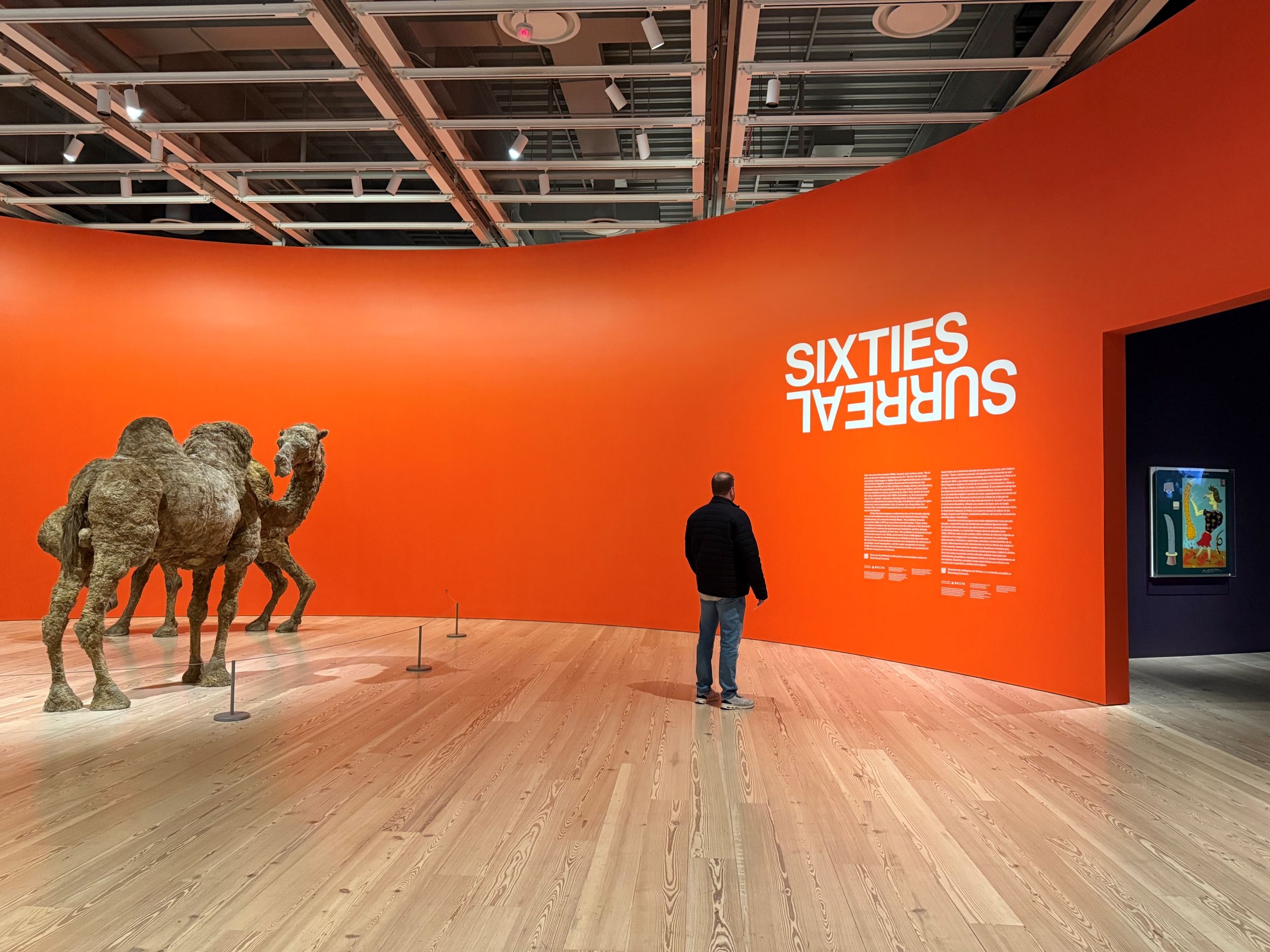
The exhibition Sixties Surreal at the Whitney Museum of American Art, New York, emphasized the oddities, curiosities, and dreamscapes that emerged from bold reimaginings of artistic practice during the mid-twentieth century. At the entrance, Nancy Graves’s (1939–1995) nearly life-sized camel sculptures served as a welcoming committee (fig. 1), returning to the Whitney after their 1969 debut at Graves’s solo exhibition in the museum’s former uptown location. Using the uncanny anatomy of the camel as a point of departure, comprising both natural and synthetic materials, Graves’s works foreshadowed the blurred boundaries ahead. The sculptures aimed to remind visitors that reality itself, especially in a camel’s fatty humps and fleshy hooves, can be otherworldly. Referencing the absurd and disquieting, the artworks included in the exhibition functioned as a nuanced portal into the porous, overlapping realms of both the real and the imagined. In doing so, Sixties Surreal presented the products of a complicated middle ground that constituted the fertile space of abandoned expectation on which artists of the postwar era thrived.
During the 1960s, significant cultural upheaval relentlessly shifted the ground underneath artists’ feet, and the artworks produced in response reflected their seismic surroundings. Immersed in a zeitgeist marked by overwhelming change and resistance, artists looked to the past directly and cited surrealistic influence, finding release in its abandonment of expectation. For instance, in 1967, curator Peter Selz compared the art style Funk to Surrealism, noting that “Funk artists know too well that a fraudulent morality is a fact of their world, and they have no illusions that they can change it. If these artists express anything at all, it is senselessness, absurdity, and fun.”1 Indeed, Selz’s summary of Funk artists, many included in the exhibition, aligned with André Breton’s manifesto from nearly forty years prior that elucidated the value of freedom from reason. Likewise, psychedelic-poster artist Wes Wilson affirmed that he was influenced by Surrealism, not Art Nouveau, despite his use of its sinuous forms, because the goal of his work was to transform the world around him.2 This was not an isolated circumstance; in fact, psychedelic art was coined “the “surrealism of our technological age” by Arts Magazine in spring 1968.3 As the visitor meandered through the exhibition, its curation evoked an eerie feeling, likely familiar to contemporary museumgoers, that reality was a drifting sentiment that ebbed and flowed like the era’s soundtrack of radio airwaves that delivered piecemeal, often earth-shattering updates.
The exhibition was curated by Dan Nadel, Laura Phipps, Scott Rothkopf, and Elisabeth Sussman and centered on Surrealism’s impact on American art, calling it “a liberating force” for artists of the 1960s. Punctuated by shifting, saturated wall colors, seven frameworks guided visitors through this nuanced landscape: “An Other Pop,” “Body Ego,” “Social Surreal,” “Show of Force,” “Assembling,” “The Big Rip Up,” and “Mojo Secrets.”
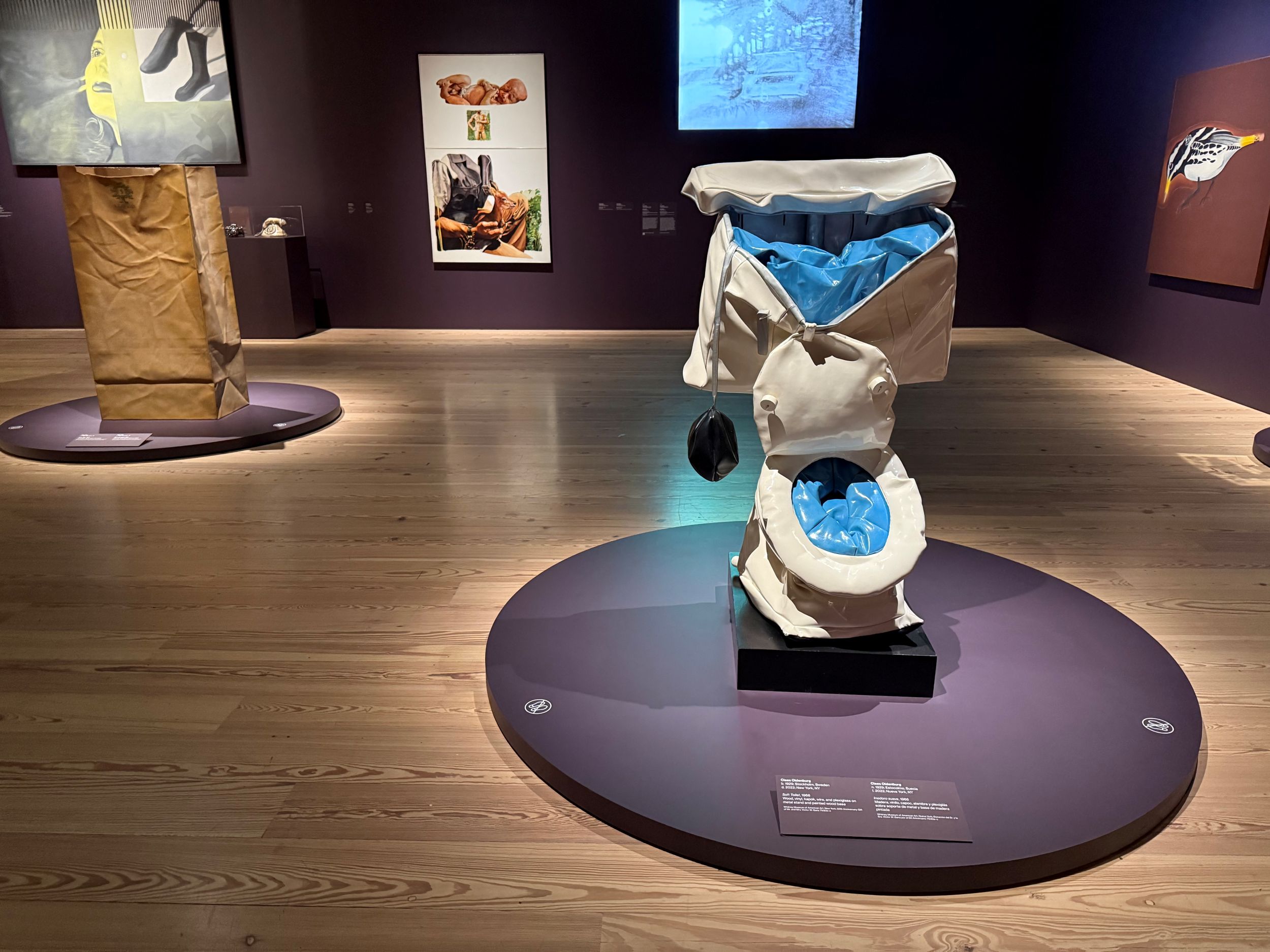
The first segment, “An Other Pop,” looked askance at popular culture. Standing out against the deep plum walls, the shiny white vinyl of Claes Oldenberg’s (1929–2022) Soft Toilet (fig. 2) grounded the room in a recognizable yet uncanny tone. Meanwhile, works by Ed Ruscha, Martha Rosler, Vija Celmins, and Robert Arneson presented unconventional depictions of popular media and common objects. For instance, House #1 (1965), a fur-filled structure by Celmins, gestured to Méret Oppenheim’s Object,4 an anchor of Surrealism’s penchant for revising the mundane. As the corresponding label text notes, the artworks in this introductory portion were intended to have a “destabilizing effect on the viewer” through an interrogation of consumption and identity.
Other segments of the exhibition, such as “Show of Force,” spoke to collective resistance directly with works like Fritz Scholder’s Indian and Rhinoceros from 1968. In the painting, Scholder, an enrolled member of the Luiseño tribe, depicts a Native American holding a peace pipe standing beside a rhinoceros in front of the Bureau of Indian Affairs (BIA). The combination of imagery highlights the absurdity of the United States government’s relationship with Native Americans and gestures to decades of federal policies resulting in forced removal from sovereign land and broken treaties. Placed approximately in the center of the exhibition, Scholder’s rhinoceros echoes Graves’s camels, showing how artists incorporated elements of the natural world, particularly representations of nonhuman animals, to engage with the surreal moments of their everyday lives. Other works, like Judith Bernstein’s Vietnam Garden (1967) and Kay Brown’s The Devil and His Game (1970), offered critiques of the Nixon administration and the United States’ involvement in the Vietnam War. In “The Big Rip Up,” artworks facilitated conversation about the women’s liberation movement through the surrealist method of juxtaposition, predominantly through the mechanism of collage and layering. For example, Kiki Kogelnik’s Gee Baby—I’m Sorry (1965) employs oil and acrylic paint to portray layers of pattern and representational components, including bent, splayed legs.
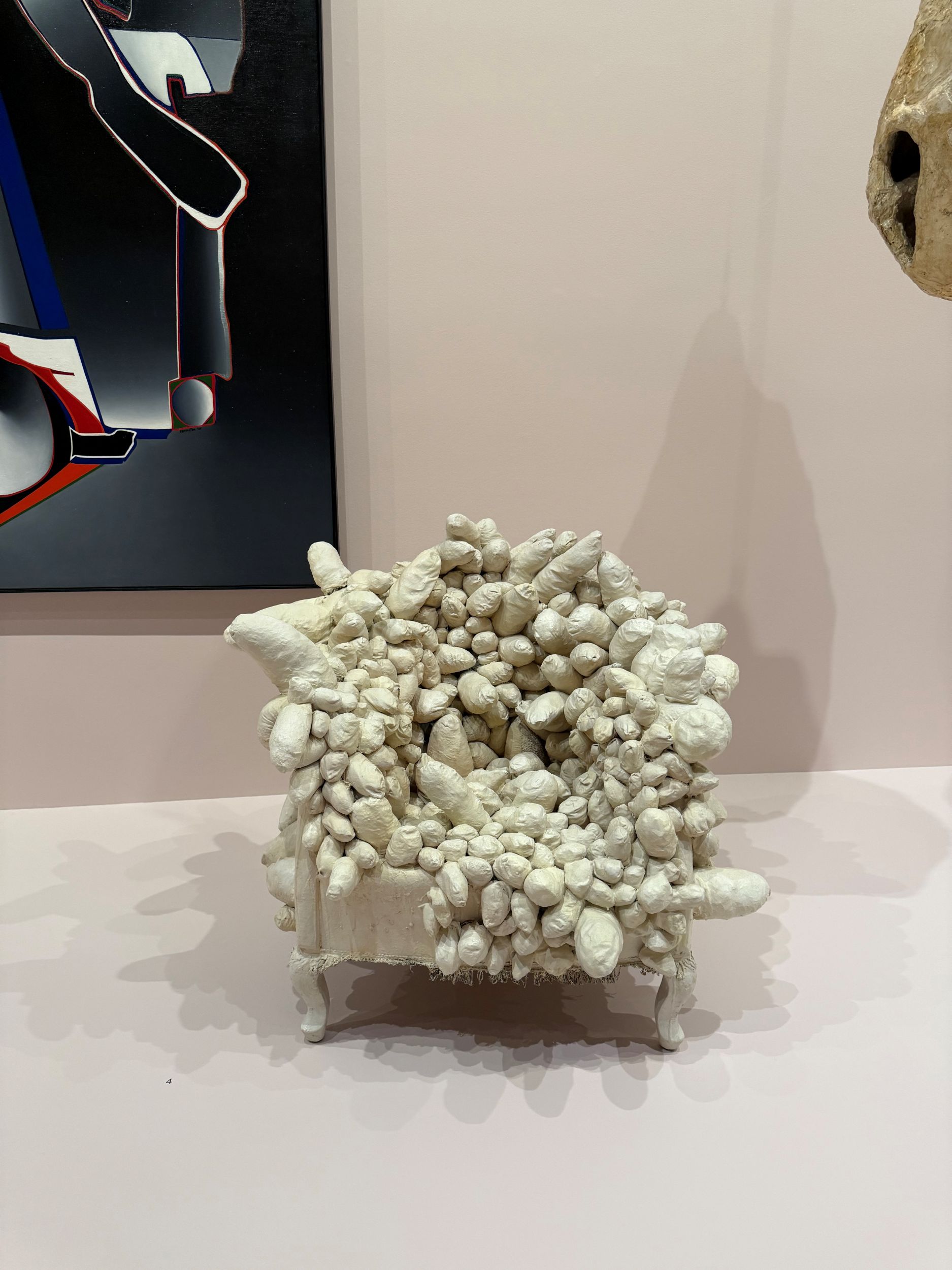
The exhibition sections “Body Ego” and “Assembling” explored artists’ use of materials and technique to engage in surrealistic practices and drew attention to artist collectives, like Bruce Conner’s Rat Bastard Protective Association, which produced inflammatory work constructed out of consumerist debris as a challenge to social norms and commercialism. In label text, works featured in “Body Ego” were described as “forms and materials that evoke the sensual feelings of having and exploring a body of flesh and bones.” As promised, each piece beckoned the viewers’ fingertips. The wispy monofilament of Kay Sekimachi’s Katsura (1971), the bulbous plaster knobs of Louise Bourgeois’s (1911–2010) Fée Couturière (1963; fig. 3), the shag carpet of H. C. Westermann’s The Plush (1963–64), and the glossy enamel of Jeremy Anderson’s Riverrun (1965) collectively bestowed a sumptuous exploration of tactile meaning that encouraged viewers to imagine grazing their hands along the surfaces.
Many artworks in this portion of the exhibition were reunited following their inclusion in two important coastal exhibitions from 1967: Funk curated by Peter Selz and Eccentric Abstraction curated by Lucy Lippard. In conversation together, these works served to construct a bicoastal bridge from Berkeley, California, to New York, respectively, to draw attention to the curatorial history to which this reprise now contributes.
Although geography did not play a central role in the exhibition, careful attention to object labels revealed the broad reach of Surrealist influence in the 1960s across the United States, beyond the expected hot spots of San Francisco, Chicago, and New York. The label text for Westerman’s The Big Change (1963), which serves as the cover art for the exhibition catalogue, expresses this sentiment perhaps most concretely, stating: “The title alludes to the radical social and political shifts that defined the 1960s . . . the knotted form has also come to symbolize the tying together of like-minded painters and sculptors across the country.” The large, laminated Douglas-fir knot serves as a symbol of a collective resistance, one made stronger when pulled tighter. It was installed in natural light across from large windows overlooking the city, a view only interrupted by Harold Stevenson’s massive nine-panel painting of a reimagined Adam. Pulling visitors out of the exhibition’s historical setting and into the current moment, the installation of Westerman’s sculpture and Stevenson’s oil-on-linen painting, in view of New York City and its shifting scenery, proposed an opportunity to contemplate what works like The Big Change might mean to us today.
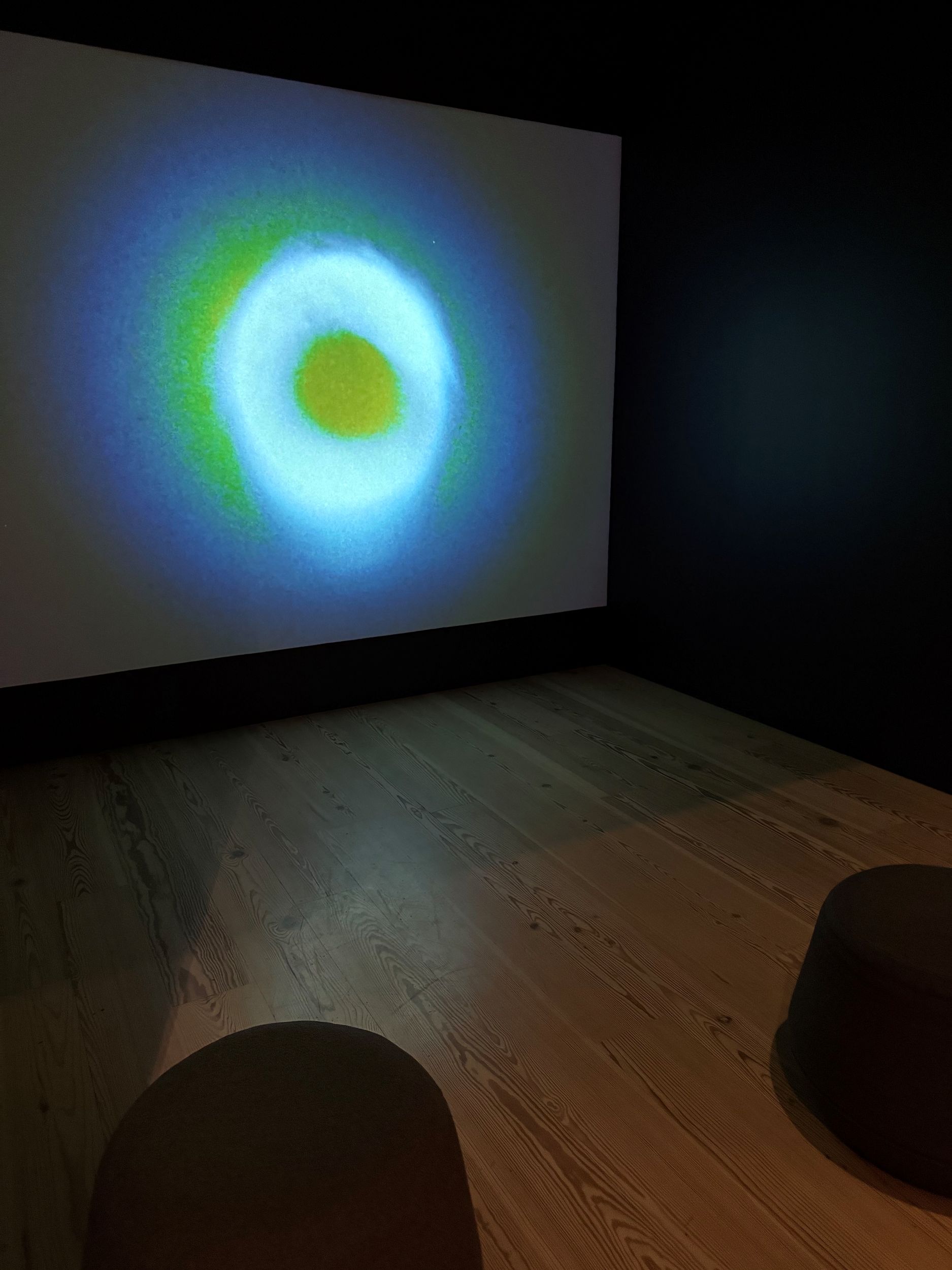
Importantly, the exhibition examines the role of spirituality in surrealist practice, especially as organized religion underwent a massive reappraisal during the 1960s. Named after Betye Saar’s Ten Mojo Secrets, the exhibition titled “Mojo Secrets” tied together themes connected to surrealist influence, including palmistry, astrology, and tarot. At the same time, Barbara Rossi’s devotional image and a geometric, quilt-like painting by Oscar Howe (Yanktonai Dakota) sought to expand the definition of spirituality for visitors. Other works reframed historic Surrealism’s promotion of esotericism as a method of accessing one’s unconscious self and its revival in the mid-twentieth century through new media, including Jordan Belson’s (1926–2011) Samadhi (1967; fig. 4), projected in a darkened room. The sound of inhaling and exhaling on the electronic score contributed to its sensory effect and offered a moment of pause while underscoring the role of technological experimentation as means of accessing a meditative state.
Developed thematically, Sixties Surreal operated as an assemblage of work developed out of joy, fear, rage, and serenity. The artworks did not always seem to belong together in one space, and that was an important, if not crucial, element of its curation. Flipping between explicit antiwar messaging to instances of the preternatural, the exhibition produced a disjointed effect that served as a real-time reflection of the media whiplash of the decade, propelled by the introduction of the television in living room homes that could now “confront you with images of Count Dracula one moment and the Vietnam War the next,” as the wall text reminded visitors.
As I moved through each room, alongside the subtle hum of phones buzzing with push notifications and text messages, each haptic alert was a reminder of how this feeling of overwhelm continues into the current moment. Sixties Surreal did not operate as a time capsule but instead fostered a sense of connection to the past as reverberations of its themes continue to rattle our present day-to-day lives.
Cite this article: Aleisha E. Barton, review of Sixties Surreal, Whitney Museum of American Art, Panorama: Journal of the Association of Historians of American Art 12, no. 2 (Fall 2026), https://doi.org/10.24926/24716839.21522.
Notes
- Peter Selz, Funk (University of California, Berkeley, Press, 1967), 4–5. ↵
- Geoffry Link, “The Influence of Psychedelic Art Reaches Far and Wide,” Columbus Daily Telegram, November 16, 1967, 9. ↵
- Barry N. Schwartz, “Psychedelic Art: The Artist Beyond Dreams,” Arts Magazine 42 (April 1968): 39. ↵
- Museum of Modern Art, New York, inv. no. 130.1946.a–c, https://www.moma.org/collection/works/80997. ↵
About the Author(s): Aleisha Barton is the Ray and Margaret Horowitz Visiting Professor in American Art at Boston University.