

The #CharlestonStrong Machine





PDF: Pope, The #CharlestonStrong Machine
On this 250th anniversary of the United States’ “founding,” there are calls to name the country’s strength. As I reflect on what strength means, I recall Charleston, South Carolina, ten years ago, in 2016, when strength became a mask and a spectacle. That moment marked one year after the massacre at Mother Emanuel AME Church, when the phrase #CharlestonStrong blanketed storefronts and tourism advertisements and echoed throughout civic speeches. It offered resilience without reckoning. Unity without structural change. Forgiveness without justice.
After a year of #CharlestonStrong and the liberal and denialist projections it carried, we decided to interrupt the script.
Earlier that spring, organizers from Southerners on New Ground (SONG) met with the artist-activist group AgitArte. This cultural organizing collective uses performance to dramatize state violence and grief.1 From them, we learned a form: Build a machine out of bodies. Expose what operates invisibly. Construct repetition. Escalate contradictions. And watch it explode.
On a gray, wind-heavy afternoon at Waterfront Park in Charleston, we performed what we called the #CharlestonStrong Machine (fig. 1). Tourists walked behind us along the harbor. The water formed the backdrop. We wore plain white T-shirts, visually neutral and almost uniform. I began the loop: “We’re better than Ferguson. We’re better than Baltimore.” A Black organizer stepped into frame and raised a Black Power salute. A white woman entered and yanked their arm down, yelling, “All Lives Matter.” The sequence repeated.
Another person entered the frame, dropped to their knees in prayer, looping, “We are hurting.” A man holding a camera appeared and asked, “Where’s the church?” Another white participant stepped forward, patting backs, their back, mine, the All Lives Matter chanter’s—a choreography of congratulatory liberalism. Behind them, someone sighed loudly: “Oh my gosh.”
We operated in repetition. Mechanical. Unfeeling. Steady.
The machine made visible how Charleston itself was operating: grief converted into branding, racial terror absorbed into civic pride, white denial moving like muscle memory. Spectators paused. Some filmed. Most kept walking. The harbor wind cut through our loops.
Then we stopped.
As the wind lifted the white fabric of our shirts, the person who had been kneeling said, “This is a #CharlestonStrong machine. It is a living, breathing mechanism that thrives off of grief tourism and willful ignorance; a way of patting oneself on the back for profiting off of violence and historic suffering. This is not what a strong Charleston looks like. We are hurting.”
The loops resumed, louder, with more rage, pain, and urgency: “We’re better than Ferguson.” “All Lives Matter.” “Where’s the church?” “We are hurting.” The contradictions collided until the noise became unbearable. Then we stopped again. I placed a white flower on the ground and walked away.2
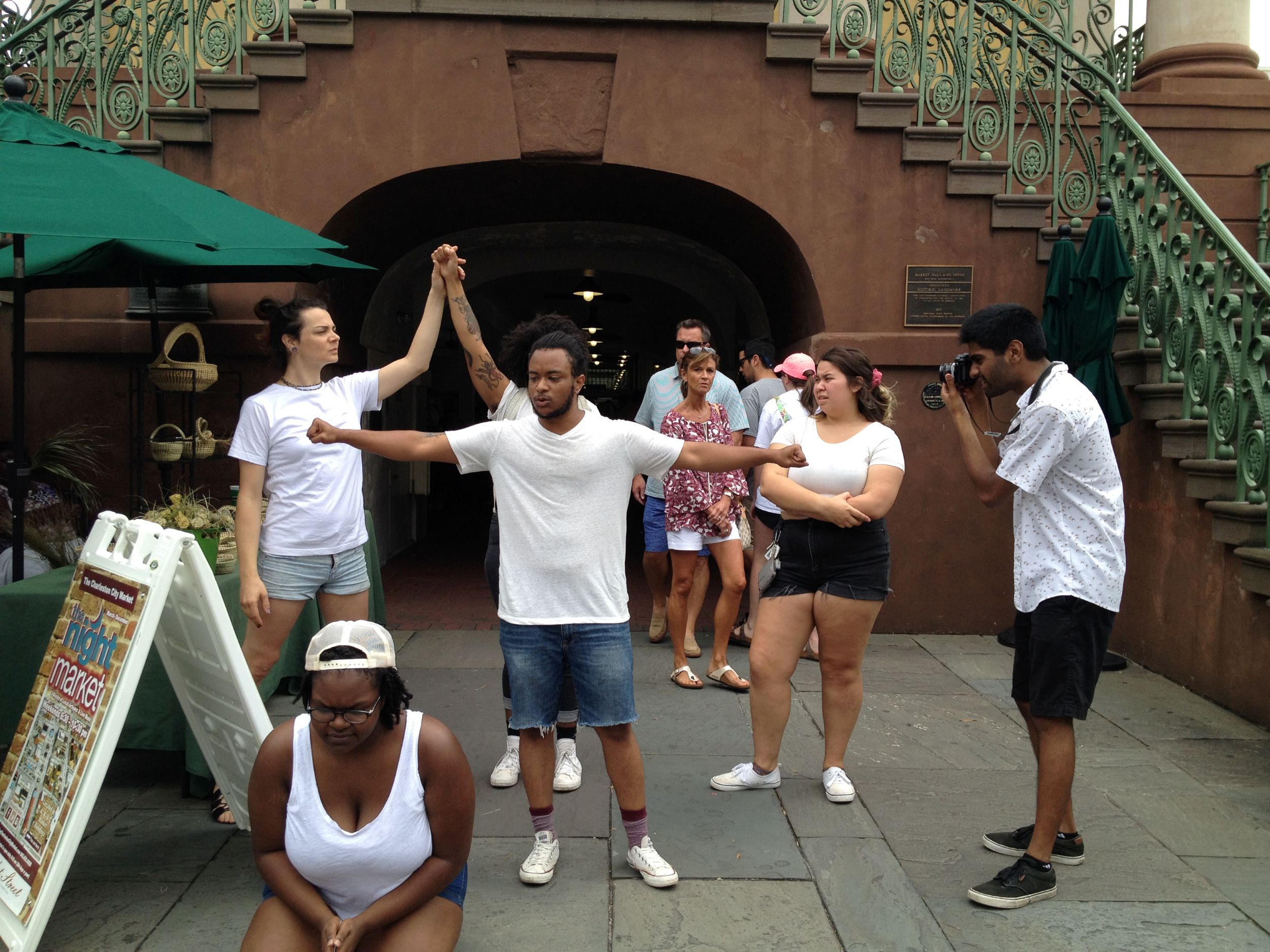
This kind of guerrilla theater was not embellishment; it was infrastructure. The action did not ask for institutional validation. It did not wait for museum walls. It used public space as its stage and repetition as its medium. The waterfront, layered with tourism, with histories of enslavement and trade, became a temporary site of exposure. The city’s antebellum mystique cracked, even if only for a moment.
The machine functioned as a counter-monument. Not cast in bronze, no permanence, no plaque. Instead, it staged the mechanics of denial. The white shirts became a blank canvas onto which spectators projected themselves. The choreography mapped how white liberalism performs solidarity while suppressing Black grief. The loops mirrored how slogans circulate faster than structural transformation.
This form did not come from nowhere. Across the South, queer organizers have long relied on embodied action to surface what the state prefers to keep abstract. From die-ins to pride marches that double as protests, performance has functioned as both an archive and a tactic. The collaboration between SONG and AgitArte placed #CharlestonStrong Machine within a longer lineage of cultural organizing in which the body becomes medium, stage, and evidence. Just days before we began building the machine, the Pulse nightclub massacre had unfolded, and the weight of that violence sat with us as we gathered.
In the wake of the massacres at both Mother Emanuel Church and the Pulse nightclub in Orlando, days before their one-year anniversaries, public officials reached quickly for new slogans: “Orlando Strong” and “Charleston Strong.” Strength became shorthand for silence. The machine refused that closure. It insisted that mourning is political. That grief cannot be hashtagged into resolution. That unity without accountability is choreography.
As the United States prepares to celebrate its semiquincentennial, the question is not whether freedom exists but how it is staged—and for whom. The #CharlestonStrong Machine exposed how narratives of national resilience depend on the suppression of Black suffering. It showed that organizing itself can function as visual culture: ephemeral, embodied, confrontational.
The flowers were gone by morning.
The script was not.
Cite this article: Kamau Pope, “The #CharlestonStrong Machine,” in “Call and Response: DEIA Tensions in Scholarship, Practice, and National Identity,” Colloquium, edited by Keidra Daniels Navaroli and Frederica Simmons, Panorama: Journal of the Association of Historians of American Art 12, no. 1 (Spring 2026), https://doi.org/10.24926/24716839.20935.
Notes
- AgitArte, “A Look Back at 2016,” AgitArte, May 20, 2016, https://www.agitarte.org/a-look-back-at-2016. ↵
- Southerners on New Ground (SONG), “#CharlestonStrongMachine,” Southerners on New Ground, accessed March 1, 2026, https://southernersonnewground.org/charlestonstrongmachine. ↵
About the Author(s): Kamau Pope is a doctoral candidate in the History Department at Duke University.