

Forms of Persuasion: Art and Corporate Image in the 1960s





PDF: O’Steen, review of Forms of Persuasion
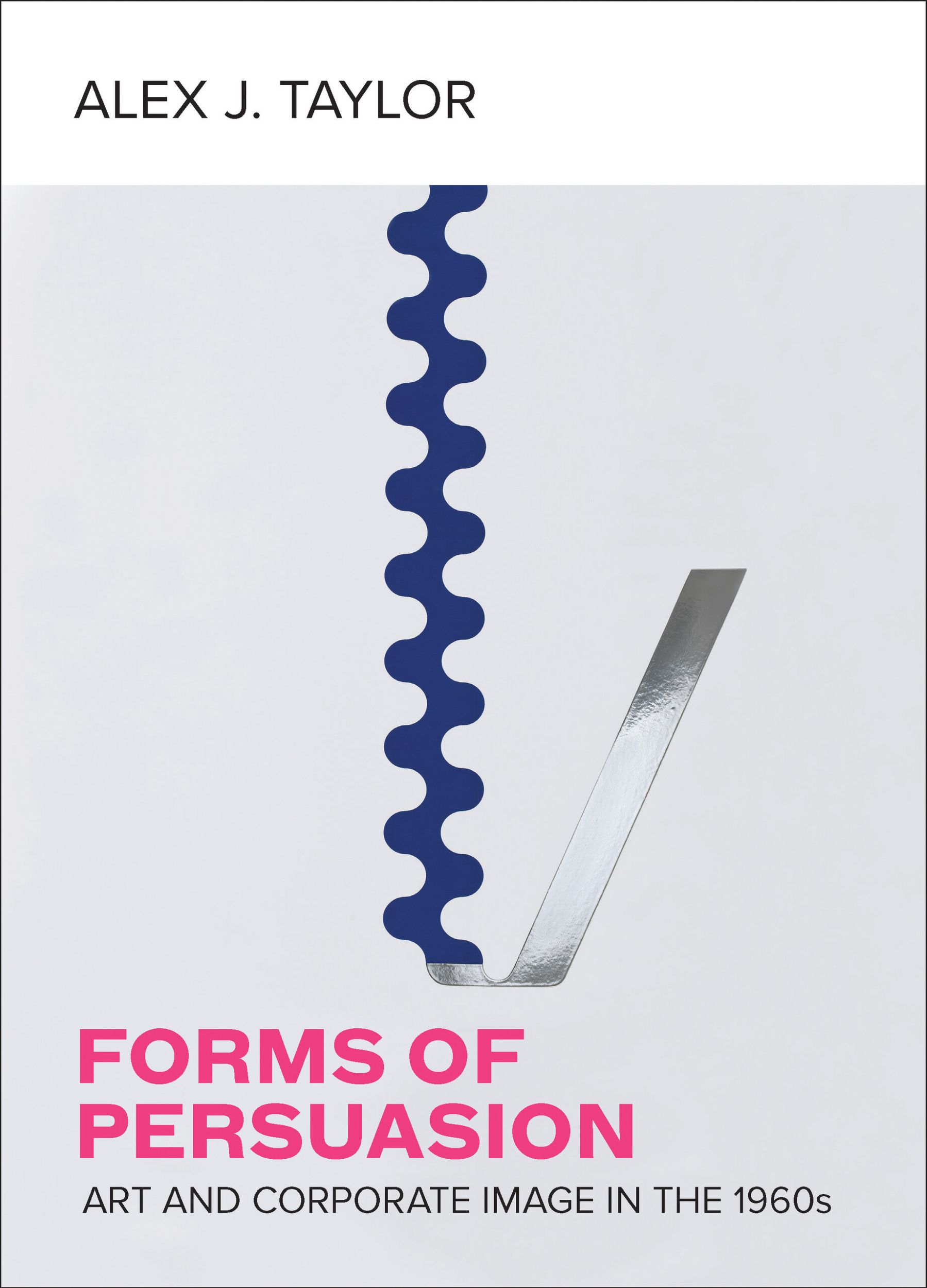
Forms of Persuasion: Art and Corporate Image in the 1960s
By Alex J. Taylor
University of California Press, 2022. 320 pp.; 52 color illus.; 47 b/w illus. Hardcover: $49.95 (ISBN: 9780520383562)
Today, corporations build their identities through seemingly invisible channels, tapping into user data and adapting to their consumers in alarming ways. Art historian Alex J. Taylor’s book Forms of Persuasion: Art and Corporate Image in the 1960s delves into a more overt—and often problematic—moment in the 1960s when the corporate world used artworks, artistic commissions, and collaborations to shape public perception.
Taylor is refreshingly unafraid to discuss the financial innerworkings of his case studies and to place artists in the starkness of the era’s growing consumer culture. He explores instances when artists went the commercial route, took sponsored gigs, and found financial support in corporate partners. Taylor complicates art-historical assumptions of the 1960s as a time predominantly occupied with counterculture creativity and expansive material expression. He sees tendencies in some scholarship to demonize commercial involvement in art, which can “too readily romanticize the undiluted and uncorrupted culture of an imaginary past” (8). Instead, he draws parallels between corporations and art-historical patrons dating back to the Italian Renaissance to understand how particular companies impacted artists and their art.
The book is organized into three sections: first, “Repackaging Pop,” on the collisions of fine art and advertising around Pop Art; second, “Abstraction at Work,” looking at fine art in corporate collections and organized environments; and lastly, “Marketing Materials,” considering industrial-steel companies engaging with artists to elevate the status of their material.
In “Repackaging Pop,” Taylor offers three examples of Pop Art’s uneasy intersections with corporate culture and marketing, and he discusses the ambivalence of an art form that both celebrated and criticized commercial consumerism. With chapter 1, he tackles Andy Warhol’s (1928–1987) relation to the Campbell Soup Company and the tricky line Warhol walked, both engaging directly with the company—making a tomato soup can painting as a commission for retiring Campbell board chairman Oliver Willits—and responding to the company’s litigious complaints about his continual use of their brand. Taylor captures a transitional stage for Warhol as he was balancing commercial imagery with his tongue-in-cheek approach, engaging Campbell soup as his subject, his patron, and his opponent.
Chapter 2 looks at the corrugated-box producer Container Corporation of America (CCA) that commissioned Warhol and James Rosenquist (1933–2017) to make paintings promoting their products and tried to control the content of their works. Taylor tells a compelling story in which CCA tapped Rosenquist to contribute to the company’s Great Ideas of Western Man series, which used art to promote the cultural contributions of the company. Rosenquist’s resulting shaped canvas depicts a yellow taxi door overlaid with images of spaghetti in red sauce. Initially, Rosenquist included the Super Operating Corporation name on the cab’s door (referencing taxi mogul and art collector Robert Scull) among other company logos. Taylor’s contention is that Rosenquist was critiquing corporate agendas in the painting for CCA—or at the very least making it clear to his viewers that he was operating under the influence of his patrons. CCA requested that Rosenquist remove “Super Operating Corp” from the painting—even though Scull had approved of the use. Rosenquist’s final move was to later name the work The Friction Disappears, a phrase that alludes to the corporate intervention. CCA’s overall collection toured and was eventually gifted in 1984 to the National Museum of American Art, now the Smithsonian American Art Museum.
The third chapter in this section focuses on tobacco giant Philip Morris in the early stages of the company’s long-standing support of the arts. Taylor looks at the company’s commissioned portfolio of pop prints, 11 Pop Artists, organized with support from public relations firm Ruder & Finn. Philip Morris was trying to reinvent its image in the wake of new health research and regulatory policies. Planning for the portfolio began in 1964, coinciding with the Surgeon General’s linking of smoking to cancer, and was finished by 1965, when a warning label became required for cigarette packages. Taylor delves into the entanglements of these prints in the back-and-forth correspondence between the artists, their galleries, the corporation, and its public-relations representative. The case study reveals the company’s increasing inclination toward abstraction to improve corporate perception, moving away from the potential critical underpinning of Pop Art. Taylor writes of Philip Morris’s preference for “the communicative flexibility and ideological openness of abstraction over the realistic representational modes that they had, initially, found so appealing about pop” (89). The 11 Pop Artists portfolio was also gifted to the Smithsonian American Art Museum.
In the second section, “Abstraction at Work,” Taylor looks at the growth of abstract art in corporate collections through two case studies. Chapter 4 focuses on Chase Manhattan Bank and its collection, which prioritized abstract modernist art to “humanize” the company’s new corporate life, streamlined offices, and visual conformity (103). Chase executive and arts patron David Rockefeller was a driving force toward acquiring abstract art, even with pushback from other administrators. Together with Rockefeller, Chase built a collection with support from a committee of museum professionals, including Alfred Barr and Dorothy Miller from the Museum of Modern Art (MoMA). MoMA’s involvement was multifold. Miller sent works from her historic 16 Americans show to the bank for consideration, and the museum sold eight prints from its collection to the company in 1965: “duplicate material” by artists including Marc Chagall, Henri Toulouse-Lautrec, Giorgio Morandi, Jean Arp, and Pablo Picasso (114). Miller also organized a rapid-fire event for the bank’s art committee to see works in the office: “In 1965 the committee evaluated 250 works of art in a three-hour, fifteen-minute meeting, and in 1967 it looked at 156 works in a two-hour, fifteen-minute meeting” (266, no. 73).
Taylor concludes the chapter by following Chase’s collecting practices in 1969 as it tried to engage the political moment and support a more diverse group of artists. The company organized a benefit sale for Harlem’s new Studio Museum, committing to purchasing any works that went unsold. That group included Faith Ringgold’s Black Light Series #10: Flag for the Moon: Die N*gger from 1969, which Chase refused to buy because the last two words of the title are prominently inscribed in the artwork’s composition. In an awkward turn, Ringgold invited Chase executives to choose another work from her studio, and they selected The American Spectrum, a series of six faces in varying skin colors intended to be a reflection of the multiethnic ancestry of African Americans (the work’s first title was Six Shades of Black). The bank chose to frame the work as a representation of American diversity, paying the artist three thousand dollars—her first major sale. For Taylor, this history impacted the reception of the work, but it gave Ringgold the upper hand in her retitling of the piece and her recounting of the event in her memoir: “Her action—especially through its subsequent disclosure—should also be understood to smuggle the politics of her practice into the bank’s collection under the guise of its misperceptions” (132).
The fifth and final chapter in this section turns to the large abstract paintings the corporation commissioned by the Turmac Tobacco Company—the Dutch manufacturer of Peter Stuyvesant cigarettes. Turmac developed an art collection that was displayed among their workers as they manufactured cigarettes. The collection also toured internationally, to mixed reviews. The exhibitions promoted the art as beneficial to its workers, even though the employees expressed a disinterest in the largely abstract collection. One stop at the Stedelijk Museum in Amsterdam incorporated wall-sized photographs of the factory and cigarettes in production among the fine art, despite the disconnect between the workers and the corporation. Taylor also includes moments in which artists incorporated Peter Stuyvesant cigarettes into their works, including a 1965 painting by Karel Appel (1921–2006) depicting an abstracted figure made up of the company’s labels.
The last section, “Marketing Materials,” follows three industrial steel companies that engaged artists to elevate the status of their materials through public-relation campaigns meant to garner business and distract from labor-relations issues. Taylor contextualizes the increasing interest in steel among artists while exploring the changing corporate realities as these companies moved away from craftsmanship and toward automation, which, in turn, impacted artists’ use of these resources. I appreciated the material focus in this section, where Taylor recounts how artists navigated the increasingly complicated political dynamics around steel.
Chapter 6 considers artists in residence at Italsider, a steel company that grew during the postwar economic boom in Italy but also had labor issues and an image problem. The company used cultural programming to boost its profile, inviting ten international sculptors in 1962 to work in the factories, including Alexander Calder, Beverly Pepper, David Smith, and Lynn Chadwick. Artists were given labor support and materials. Calder (1898–1976) sent a maquette for a work to be produced, leading to problems behind the creation of his monumental sculpture Teodelapio. David Smith (1906–1965) produced twenty-seven sculptures in thirty days and used materials from the older forging site, which was being replaced by a higher-efficiency factory. The artist’s work engaged with the company’s shift away from specialized labor to a more mechanized system. His connection continued: After leaving Voltri, Italsider sent leftover steel to Smith’s studio in Bolton Landing, New York, which was used in his Voltri-Bolton sculptures.
Taylor focuses on the company US Steel in chapter 7 and its proprietary material alloy Cor-Ten. US Steel was trying to regain its hold in the markets in the 1960s, coming out with Cor-Ten steel as a new material with a rusting exterior. Cor-Ten found interest among architects, and it was used as an exterior surface for the Chicago Civic Center, finished in 1965. Pablo Picasso (1881–1973) was also commissioned to make a public work in Cor-Ten for the Civic Center’s plaza. The finished artwork—a fifty-foot-high bust—was used to celebrate the new material, bolstering the reach of US Steel. Taylor argues that this early example contributed to Cor-Ten steel’s rise as an important material for artists in subsequent years.
The final case study, in chapter 8, follows Richard Serra (1938–2024) at Kaiser Steel Company in Fontana, California, during his 1969 residency, which was organized by the Art and Technology Program at the Los Angeles County Museum of Art. Taylor outlines the complicated relationship between the artist and the workers, in the middle of the company’s deterioration. Kaiser was eager for the good press and publicity around this arranged relationship, even though Serra was making experimental and precarious temporary installations with massive amounts of materials on Kaiser’s grounds. The project created friction between Serra and the employees, despite the artist’s cultivated workman persona. The employees saw the project as a reflection of the company’s negligence. Serra later distanced himself from the collaboration—yet another instance of an artist later reacting against their corporate patrons.
In 1969 Grace Glueck, writing for The New York Times, warned against museums’ growing reliance on industrial partners. Reviewing the Milwaukee Art Center’s exhibition A Plastic Presence, which partnered with the Philip Morris corporation and its plastics subsidiary Milprint, Glueck described the show as an effort in “image-building for the plastics industry,” spelling out a troubling future for museum exhibitions.1 The incursions of corporate sponsorship in the 1960s art world are well known, but they are often simplified or denigrated as transactional realities in histories of the moment. Art history has rarely acknowledged the messiness of corporate sponsorship, particularly in shaping the production and reception of art. In considering the intertwined relationships of artists, institutions, and industrial partners during the 1960s—a precedent that continues today—Taylor brings texture to our understanding of the works that resulted. He offers an expanded and nuanced look at individual, often understudied projects that were “inextricably entangled in the vast machinery” of these corporations and their ambitions (237). Ultimately, Taylor widens scholarship on the 1960s in his approach, revealing the politics around the making of these artworks, the complexities of a company developing its image through fine art, and the trial-and-error realities of corporations trying to boost public perception through cultural patronage.
Cite this article: Danielle O’Steen, review of Forms of Persuasion: Art and Corporate Image in the 1960s by Alex J. Taylor, Panorama: Journal of the Association of Historians of American Art 12, no. 1 (Spring 2026), https://doi.org/10.24926/24716839.20978.
Notes
- Grace Glueck, “Building the Plastic Image,” New York Times, December 7, 1969, D28. ↵
About the Author(s): Danielle O’Steen is an independent curator and adjunct professor in the Department of Art History at Arcadia University.