

Necessarily Panoramic: Unsettling Borders of Nation, Discipline, and Practice





PDF: Ajayi, Necessarily Panoramic
What might a mall in Croydon, England, screening a double-feature of British filmmaker Mark Leckey’s Fiorucci Made Me Hardcore (1999) and American Arthur Jafa’s Love Is the Message, the Message Is Death (2016) have to do with American identity? To me, the answer lies in how the United States consecrated the enclosed, climate-controlled shopping complex as a cornerstone of the post–World War II suburb; in the relationship between UK club culture and the imports of Chicago house and Detroit techno music; and in Jafa’s work, with the heavy hit of Love Is the Message that rushes its viewers through Black mourning, Black joy, Black vitality, and Black struggle, all quintessentially American aspects.
Jafa’s and Leckey’s videos were shown at the exhibition HARDCORE/LOVE in the Conditions gallery space, a former electronics shop in the Whitgift Shopping Centre in Croydon, from June 28 to August 10, 2025.1 Despite what I recognized as a transatlantic resonance, nodded to in the very choice to program these films alongside each other, after pitching a review of HARDCORE/LOVE to Panorama, I was met with a series of questions from the then Executive Editors:
Regardless of Jafa being American and that his film collages comment upon race in a profound way, we are left wondering if he is doing so in a nationalist vein, that mines history? Or is he doing so in a way that is simply about the present moment?2
Besides the fact Jafa’s film literally mines history—culling archives, snapshots, and feeds from (African) American pasts, presents, and potential futures—I was puzzled by the notion that one could “simply” talk about the present. For what does it look like to speak to the present without knowing, alluding to, being in tension with, refusing or acknowledging, or surviving in the shadow of some kind of history? The present is not naturally ahistorical. In her book-length poem “Nomenclature for the Time Being,” Dionne Brand writes that we are “transfused presently / for a few decades.”3 There is nothing simple or solitary about our current moment, and that in many ways is the thesis of Love Is the Message: a rapid torrent that proclaims, in shots, bursts, and sparks, exactly what it took to get us here. Oftentimes, the language of nationalism is a death trap. It kills some things (potentially expansive points of entry) while breathing life into others (insular racial logic). Panorama left me, in turn, wondering, and I never did write that review.
The journal’s initial response is diagnostic of prevailing myopic nationalist thinking. While Panorama is a journal of “American art,” it seems to me that part of that work is to never stop wrestling with what that might mean.4 My research is most defined by an understanding of Blackness as a global, unfinished condition, a search for resonance and dissonance across the transnational Black Atlantic, shaped by what Paul Gilroy calls a “desire to transcend both the structures of the nation state and the constraints of ethnicity and national particularity.”5 This approach makes me sensitive to flattened prescriptions of nationhood, and it is shaped by my undergraduate studies in architecture in the United States as an international student and my master’s studies in history of art in the United Kingdom as a domestic student.
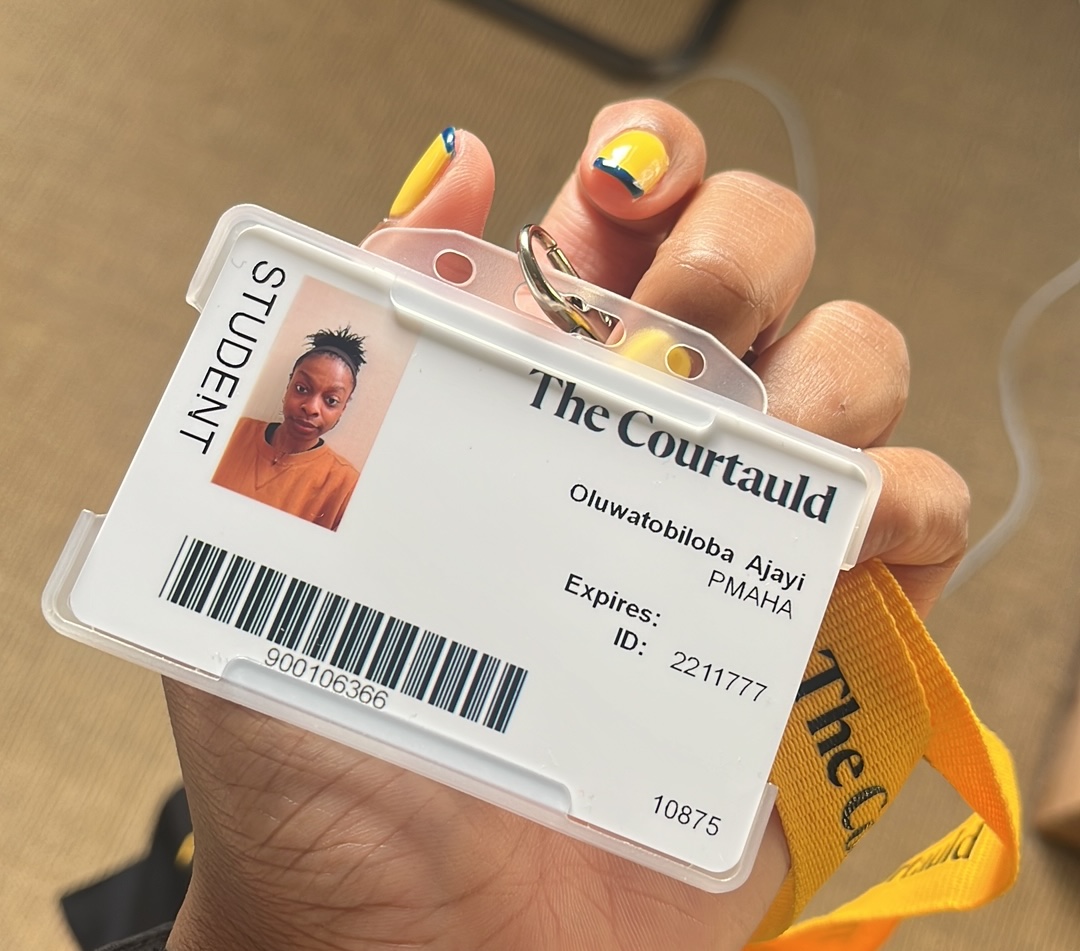
During my time at the Courtauld Institute of Art, I specialized in postwar Black British art, keen to stretch my literacy of Black artists beyond the continental United States. I had come from the school of Imani Perry, Tina Campt, Tiona Nekkia McClodden, and so many others, who taught me how to name myself in my work. They taught me that my positionality is valuable, and it is often a generous thing to acknowledge it. But after submitting my first essay at the Courtauld, I was dissuaded from my embodied approach and told that I did not know the “ABCs of Art History.” Of course, they were right; I had earned a degree in architecture, and while I had written about visual art vis-à-vis archi-tectural theory, I was and am not a historian. Still, it felt dissociative and disingenuous to the work to be dissuaded from naming my proximity to my material—as a Black British student, the only one, on a course about Black British art, where we were learning about a group of artists zealous about naming their own identities and a movement itself entrenched in the politics of representation.6 This was a course taught for the first time at the UK’s preeminent school for the history of art. I was studying “Black Art” (a borrowed Americanism) in Britain, but I could not name my Black British (Americanized) self.7
The same myopic logic that polices national boundaries polices disciplinary ones. Both are invested in ideas of orthodoxy, prevalence, and even purity, and they can deny relationality, fearful of that which inevitably lives and leaks in from the margins. What allowed me to push beyond institutional chokeholds was the artists themselves: the photo-poetic testimonies of Maude Sulter, the contemplative wanderings of Ingrid Pollard in the Lake District, and Veronica Ryan’s insular, obsessive palm-size gatherings of domestic detritus. Ryan, who is rapidly gaining popularity on both sides of the Atlantic, moved to New York in 1989, fleeing a repressive racial discourse she felt was drowning out the psychological concerns of her work.8 That British artists—like Ryan but also Eddie Chambers and Frank Bowling before her—felt compelled to pursue practice in the United States is part of American art history. It is also part of British art history. Chambers, who previously had an art practice, pivoted to writing and curation and ultimately to academia in the United States, to be his own critic, his own researcher, and his own historian in a British landscape that did not recognize Black artists.9 What is the metric value, then, of nationality or discipline in this discursive context where Black thought leaders are denied the privilege of both—or, in Chambers’ case, forced into the interstitial?
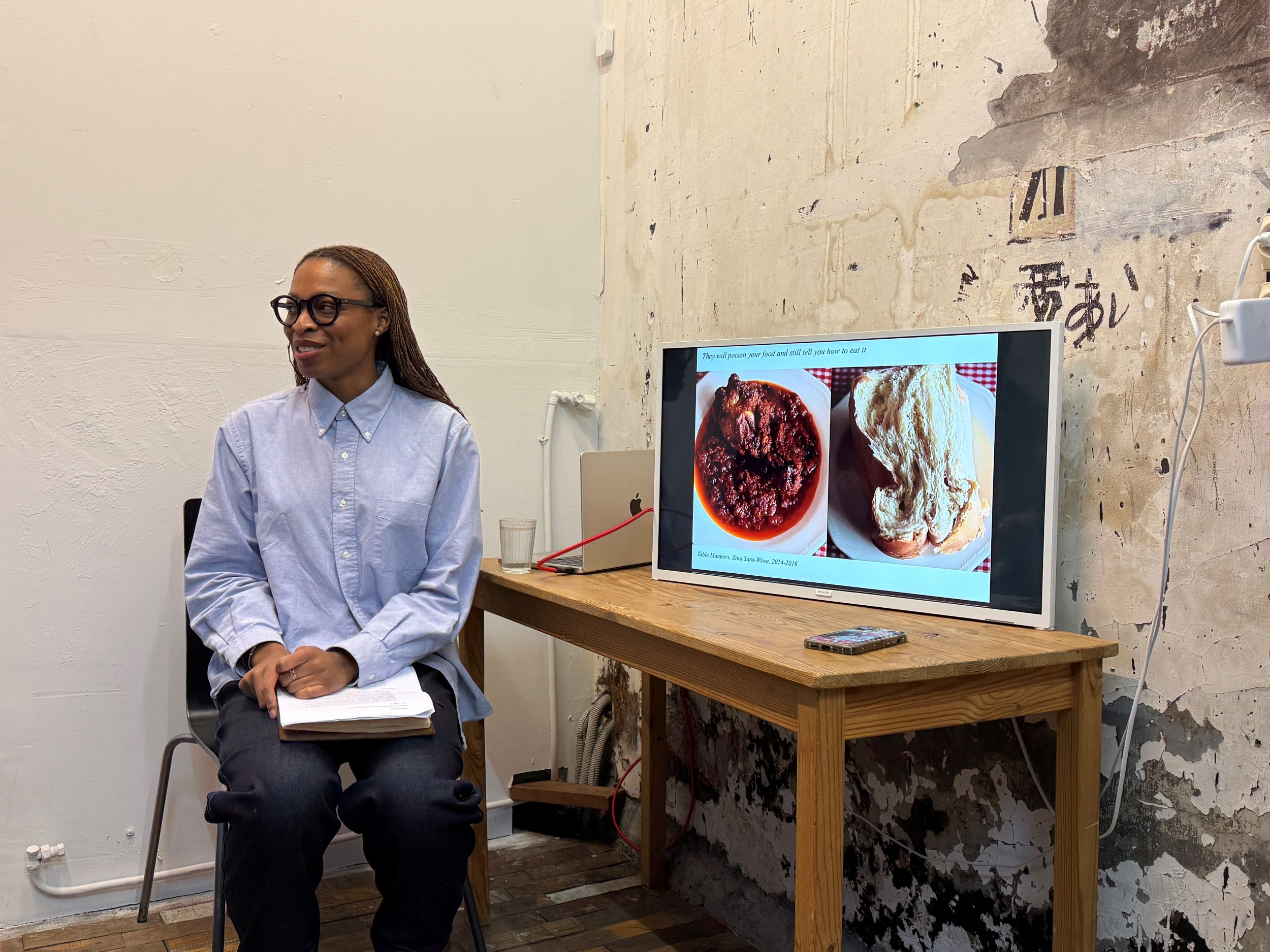
In my attempts to build a Black feminist architectural theory, my nascent career has come up against multiple flavors of gatekeeping. Nevertheless, I carry my multiplicities with rigor into my interdisciplinary work, across continents, and they are compounded by a peripatetic life that means my Black, female, autistic self has been and continues to be shaped over a multitude of geographies—Amsterdam, Las Palmas, London, Lagos, Budapest, and Princeton, and, and, and. . . . It is the accretion of these experiences, in scholarship, in learning, in life, that perhaps led me to recognize the contingent sovereignties implicated in the showing of Jafa in a shopping center in Croydon. I tell of these frictions not to scold anyone but to endear us to the possibilities of troubling borders, be they national, disciplinary, editorial, or otherwise. America is defined as much by the edges of its mass as it is by the seas around it; these seas define other nations that touch others still. It is in loosening our grip on suffocating containers, and in this loosening paying better attention to that which is unfixed and yet unrealized, that we become better, more generous students and, hopefully, scholars.
Cite this article: Oluwatobiloba Ajayi, “Necessarily Panoramic: Unsettling Borders of Nation, Discipline, and Practice,” in “Call and Response: Facts and Fables in the Fundamentals of (American) Visual Formation,” ed. Keidra Daniels Navaroli and Frederica Simmons, Colloquium, Panorama: Journal of the Association of Historians of American Art 12, no. 2 (Fall 2026), https://doi.org/10.24926/24716839.21452.
Notes
- HARDCORE/LOVE, Conditions, Whitgift Centre, June 28–August 10, 2025. ↵
- Frederica Simmons, citing previous Panorama Executive Editors, email message to author, July 12, 2025. ↵
- Dionne Brand, “Nomenclature for the Time Being,” in Nomenclature: New and Collected Poems (Penguin, 2023), 3. ↵
- “We embrace the study of the diverse artistic production that circulates within and beyond the constructed geographies of what is now the United States.” See the journal’s mission statement at “About,” Panorama: Journal of the Association of Historians of American Art, accessed October 26, 2026, https://journalpanorama.org/about. ↵
- Paul Gilroy, “The Black Atlantic as a Counterculture of Modernity,” in The Black Atlantic: Modernity and Double Consciousness (Harvard University Press, 1993), 19. ↵
- Formed in Wolverhampton in 1979, the Blk Art Group was a collective of young artists based in the Midlands: Eddie Chambers, Donald Rodney, Marlene Smith, and Keith Piper. The group was fundamental to the development of the British Black Arts Movements of the 1980s, which was formalized around the October 1982 National Black Arts Convention, organized by the group and hosted at Wolverhampton Polytechnic. The Blk Art Group was inspired by the US Black Arts movement and the writings of Stuart Hall; their ideas were Pan-Africanist, rooted in resistance against anti-Black racism, imperial legacies, and the struggles of Black Britons. ↵
- See Eddie Chambers, “The Marginalisation of Black Art,” Race Today Review (1986): 32–33. ↵
- Siddhartha Mitter, “Veronica Ryan’s Uncanny Objects,” New York Times, March 18, 2022, https://www.nytimes.com/2022/05/18/arts/design/veronica-ryans-artist-paula-cooper-whitney-turner.html. ↵
- “I’m not sure if it was a case of inspiration or searching, but it was very much a case of needing to do things myself. For artists of color, there’s a history of them having to be their own researchers, their own art critics, their own art historians. That was my experience. When I was at art school, information on Black artists in Britain was nonexistent. This reflects, to some extent, the way in which the art world in Britain didn’t think Black artists existed.” Eddie Chambers, quoted in Karolina DeResende, “A Conversation with Eddie Chambers,” MFABoston, May 3, 2022, https://www.mfa.org/beyond-the-gallery/frank-bowling-and-5-1/a-conversation-with-eddie-chambers. ↵
About the Author(s): Oluwatobiloba Ajayi is an artist, writer, and PhD student at the Slade School of Fine Art, University College London.