

Isamu Noguchi: “I am not a designer”





PDF: Smith, review of Isamu Noguchi
Curated by: Monica Obniski and Marin R. Sullivan
Exhibition schedule: High Museum of Art, Atlanta, April 10–August 2, 2026; Peabody Essex Museum, Salem, MA, September 19, 2026–January 3, 2027; Memorial Art Gallery, University of Rochester, Rochester, NY, February 13–June 6, 2027
Exhibition catalogue: Monica Obniski and Marin R. Sullivan, eds., Isamu Noguchi: “I am not a designer,” exh. cat. High Museum of Art; New York, 2026. 368 pp.; 275 color and b/w illus. Hardcover: $95.00 (ISBN: 9780847876198)
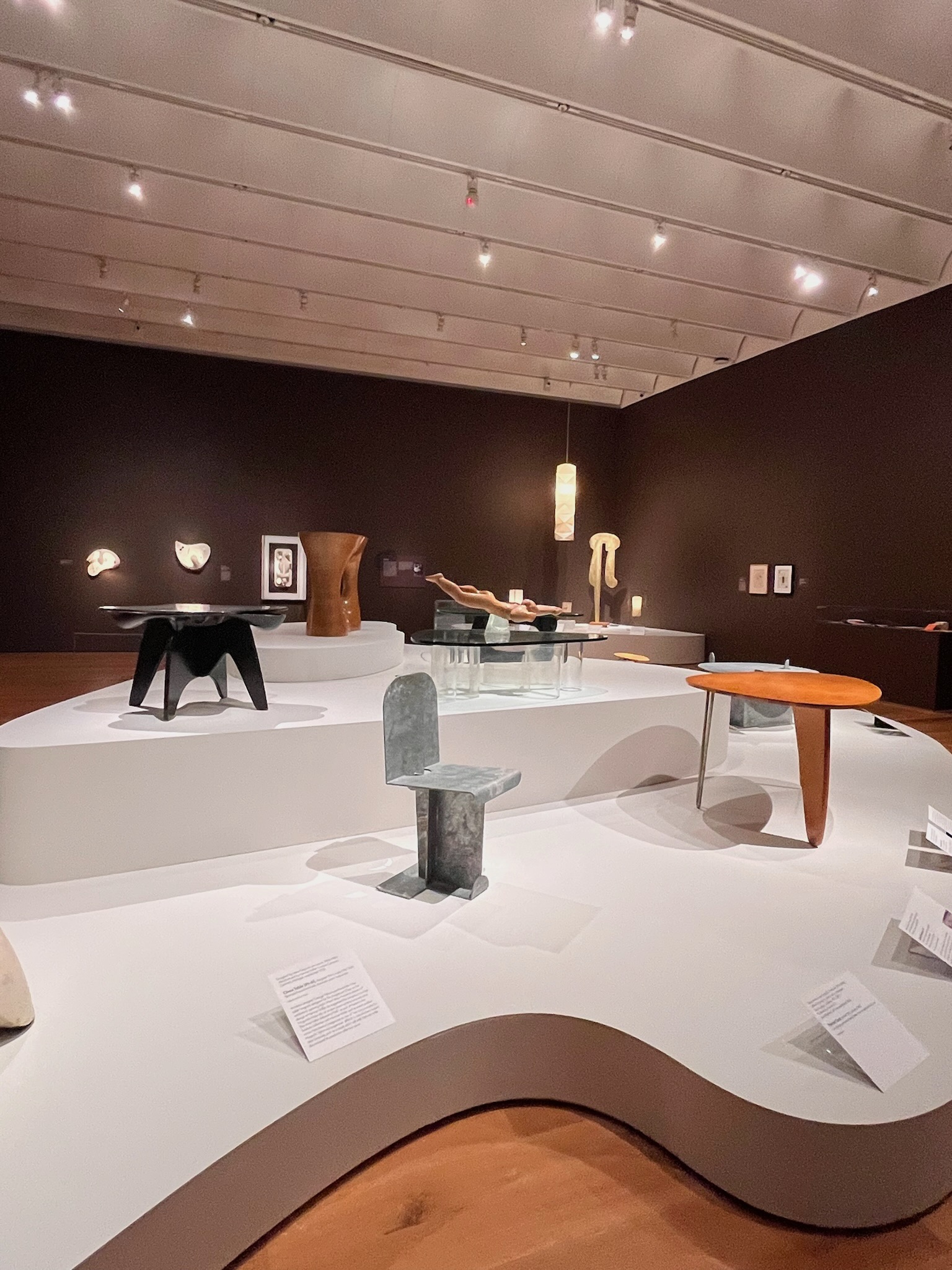
The diverse practice of Japanese-American artist Isamu Noguchi (1904–1988) resists easy classification. His elusiveness has long been scrutinized by scholars, but Noguchi is given his most comprehensive survey to date in the recent exhibition at the High Museum of Art, Atlanta. Cocurators Monica Obniski and Marin R. Sullivan have re-evaluated his six-decade-long career through the lens of his 1949 declaration captured in the exhibition’s subtitle. Made in the post–World War II moment that exalted fine art as heroic and uncommercial, Noguchi’s assertion, as the exhibition illuminated, was less a rejection of design and more a defense of sculpture’s unlimited boundaries. Assembling nearly two hundred works, including commercial homewares, stage sets, abstract sculptures, and architectural models, the retrospective explored the arc of an artistic practice that was as deeply entangled with various modes of sculpture and design, and guided by a sustained sensitivity to human experience and a desire to integrate art into the everyday.
The exhibition was divided into three thematic sections. The first, “Making Multiples,” examined Noguchi’s pioneering work at the intersection of fine art sculpture, industrial manufacturing, and collaborative design (fig. 1). The works on display included his designs in homewares such as Radio Nurse (1937), a small, abstract Bakelite baby monitor commissioned by the Zenith Radio Corporation; the now well-recognized IN-50 coffee table, the result of Noguchi’s 1944 design for Herman Miller; and one of the artist’s first custom tables (made around 1941) commissioned by architect and banking heir Philip Goodwin, which conflated Noguchi’s skills in sculptural carving and functional design. Also featured were designs for tableware, seating, and a chess table alongside the Lunar series of lamps and wall sconces (1959). Unlike his other homewares, Noguchi’s Akari lamps—crafted from mulberry paper, bamboo, and wire—were easily mass-produced and widely distributed. The exhibition incorporated period spreads from House & Garden, Life, and Harper’s Bazaar to illustrate how these lamps were marketed as accessible and stylish objects for daily life.
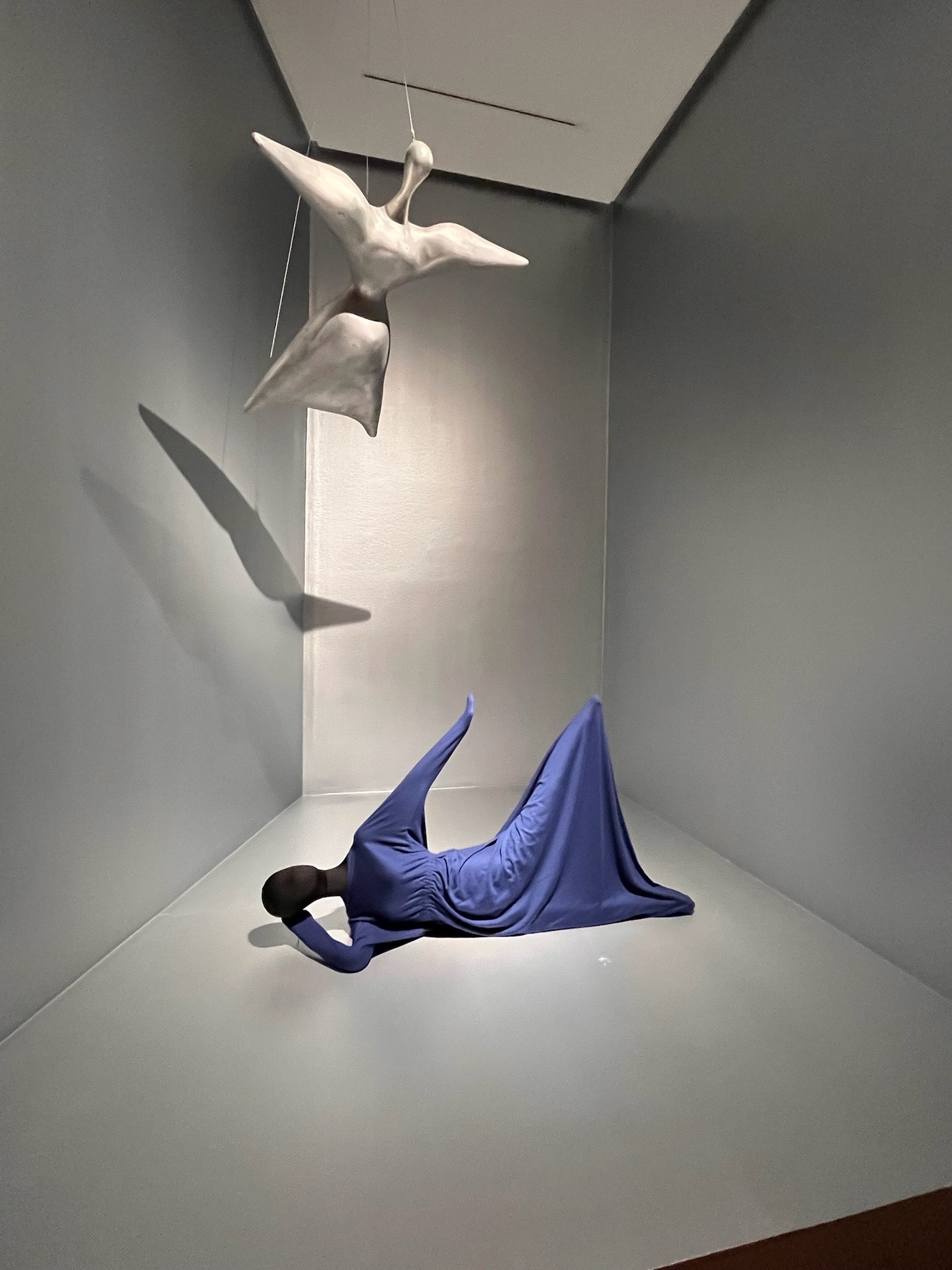
Diverse collaborative endeavors were also brought together in this section. These included Noguchi’s illustrations for the poetry of Charles Henri Ford in View: The Modern Magazine, which graced its 1946 cover, alongside commercial lighting concepts like the Lunar series noted above—a mass-market design fabricated by lighting designer Edison Price that explored light’s interaction with the reflective surfaces of aluminum. Also featured was an early 1932 set and costume collaboration with avant-garde modern dancer Ruth Page. For her solo performance Expanding Universe, Noguchi reimagined a soft sack dress as a rigid, sculptural sheath of hollowed aluminum—an “angel-like ab-straction” that hovered onstage to challenge bodily limits, as noted in the wall text (fig. 2).
The “Making Multiples” section also examined how Noguchi’s practice operated on a spectrum of production techniques, exemplified by his Remembrance series (1944). Translated from a unique mahogany carving into multiple bronze casts, this series of multiples ultimately reflected a design based on discrete, interlocking parts that effectively bridged fine art editions and modular product design. While this section’s sweeping range of objects convincingly demonstrated Noguchi’s versatility, it did occasionally seemed disjointed and unfocused in its array of disparate works.
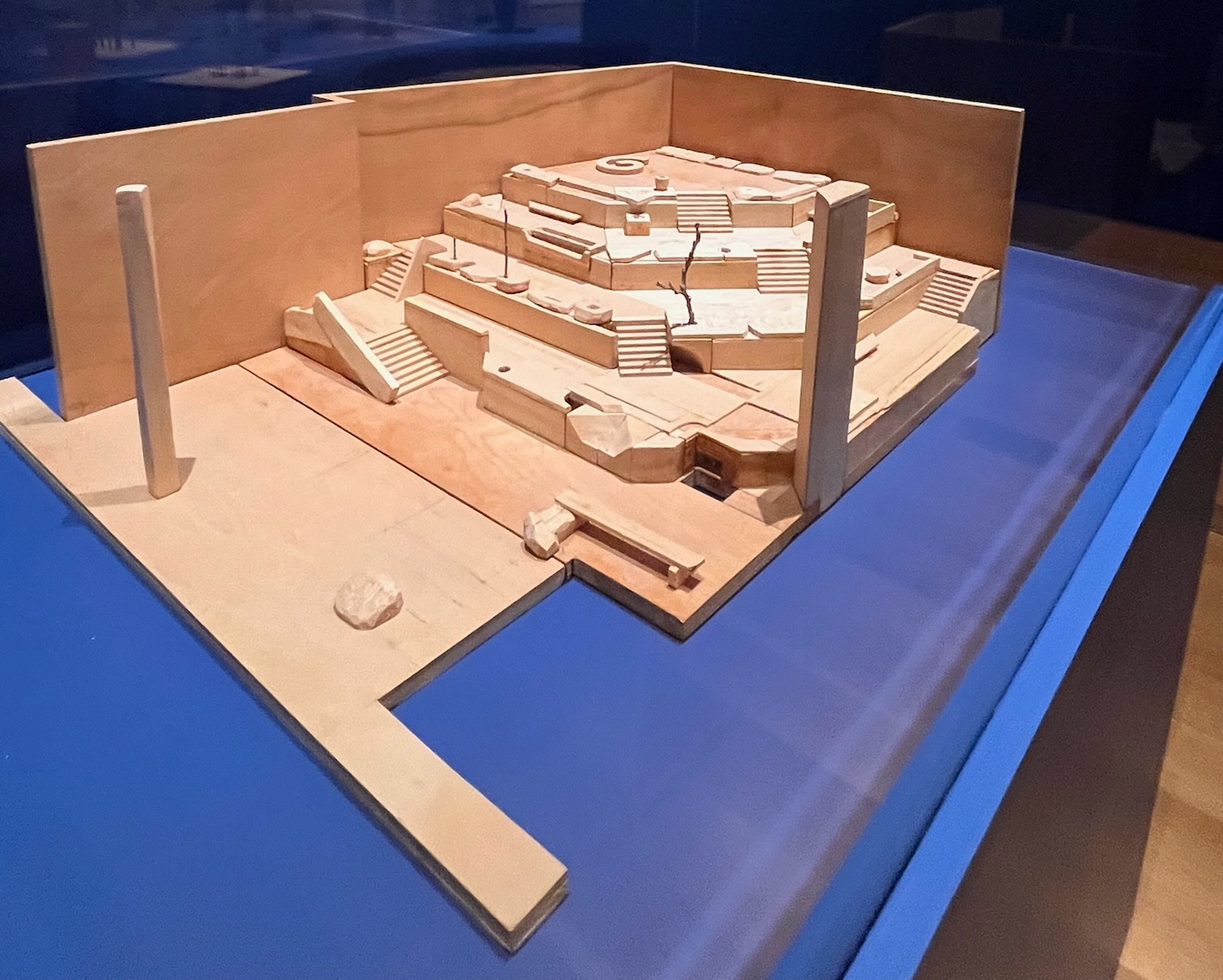
The second thematic section, “Elements of Architecture,” centered on Noguchi’s synthesis of sculptural volume and built space, which the exhibition text described as “hypothetical spaces: neither sculpture nor architecture but celebrations of the space in between.” The exhibition framed the artist’s lack of formal architectural training as liberating, allowing him to deploy architectural language in a variety of hybrid ways, seen in sculptures like Capital (1939), on loan from the Museum of Modern Art, New York, or interior spaces and holistic environments that combine architecture with sculpted typographies. This liminality between architecture and sculpture informed his 1955 drawings for a pavilion-style residence designed with architect Kazumi Adachi for artists Liam O’Gallagher and Robert Rheem. A drawing of a sequence of floating structures arranged around a central courtyard demonstrates Noguchi’s interests in dissolving structural boundaries and engaging negative space. The design for an interior garden titled Heaven (1977; fig. 3)—represented by a model—further illustrates this liminal approach. Commissioned for the Sogetsu Hall in Tokyo, the headquarters of the avant-garde School of Ikebana (the Japanese art and philosophy of flower arrangement), Heaven combines stepped tiers with cascading water channels to create a dynamic interior plaza where architectural and sculptural forms invite human interaction.
Across the exhibition, travel was rightly emphasized as foundational to Noguchi’s spatial philosophy. In the section “Elements of Architecture,” the exhibition underscored how the artist’s biracial identity and his postwar journeys to Japan informed his practice. Beyond satisfying the logistical demands of international public commissions, travel functioned as essential field research. Archival photographs from his 1949 grant from the Bollingen Foundation document his extensive investigation into what he termed the “study [of] the relationship of leisure to public spaces.” With this funding, he traveled through countries including Britain, France, Greece, India, Sri Lanka, and Cambodia, from 1949 to 1955. Although the promised book for the Bollingen Foundation never materialized, some of these photographs circulated in influential contemporary architectural publications, such Portfolio: The Annual of the Graphic Arts (1951) and Perspecta: The Yale Architectural Journal (1960), which were also on display.
This section, in addition, examined Noguchi’s architectural collaborations—most poignantly his work with Kenzō Tange for the Hiroshima Peace Memorial Park. In 1952, Noguchi installed sculpted handrails for two monumental concrete bridges leading into the park—one referencing the rising sun of rebirth, the other a boat’s prow signaling departure—which engaged the visitor’s somatic movement. Conversely, his proposal for the Hiroshima Peace Center—a largely subterranean granite cenotaph fusing ancient haniwa funerary structures with modernist abstraction to honor the bomb’s victims—was rejected as overly abstract and hard to understand. The exhibition presented a small terracotta study titled A World I Did Not Make (1952) as an unrealized playground potentially intended for the same site. Its title registers as pragmatic but resistant to atomic devastation, a stance bolstered by its surface geometries that recur in Noguchi’s later play environments. While the intent remains speculative, the curators productively leveraged this model to guide the visitor toward a more cogent understanding of Noguchi’s interests in bodily play as a generative catalyst for life.
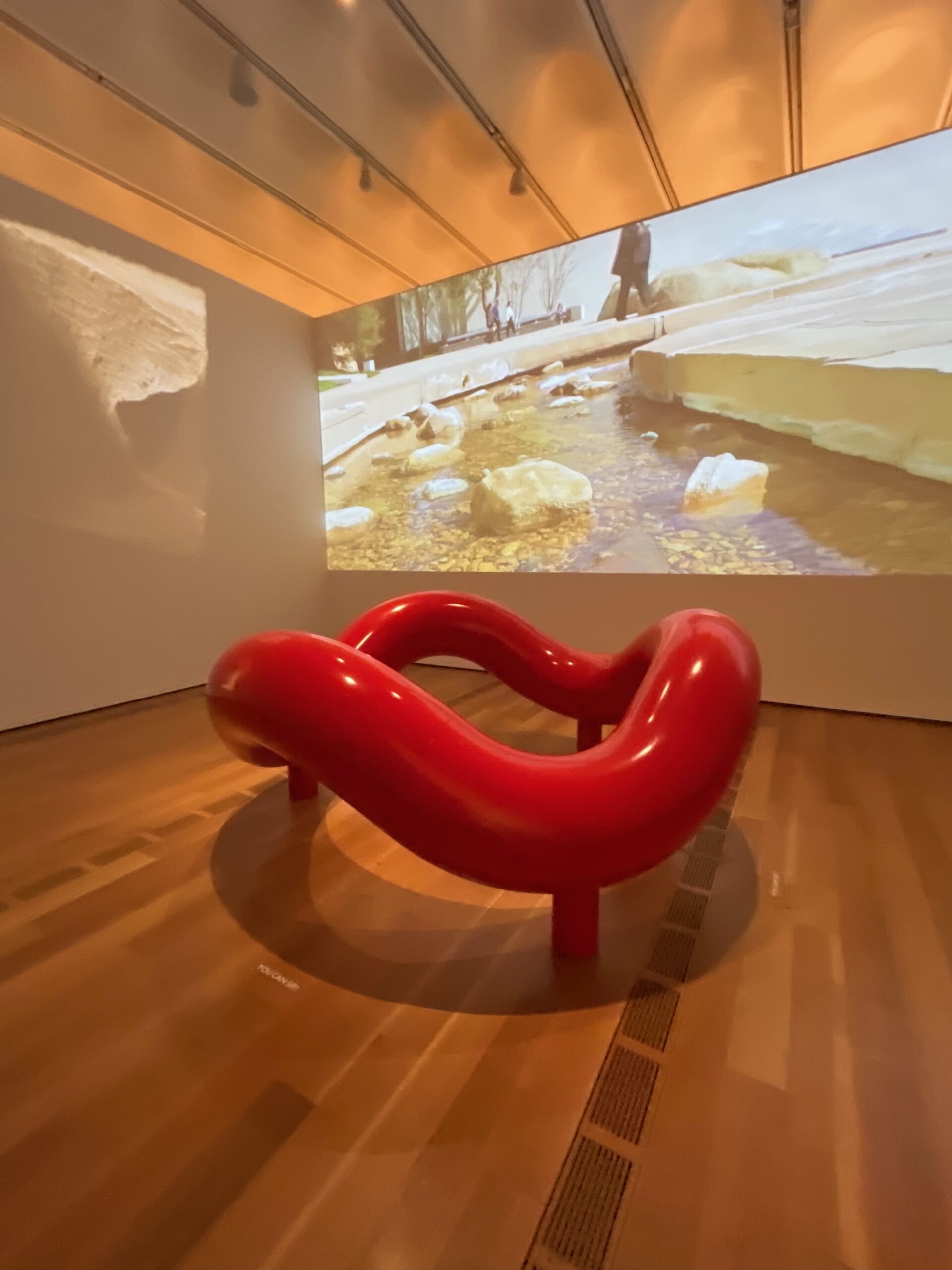
The final thematic section, “Shaping Spaces,” examined what was perhaps Noguchi’s grandest vision: large-scale, predominantly outdoor environments designed for human interaction and play. Here, the exhibition really stands out in object presentation, narrative, and visitor engagement. Invoking the artist’s own reflective ethos—that “playgrounds are a way of creating the world”—the exhibition text underlined how fundamental play and the broader landscape were to Noguchi’s practice, a conceptual trajectory that had been hinted at in the preceding sections. Indeed, Noguchi persistently attempted to realize public play environments across every decade of his career. The earliest iteration appeared in a 1933 plaster model for Play Mountain. Conceived as a civic intervention against urban decay, Play Mountain proposed reconfiguring an entire Manhattan city block into a terraced topographic earthwork featuring a stepped amphitheater and a waterslide for the summer months that could also double for sledding in the winter months. Although dismissed by municipal authorities at the time, this radical proposal laid the conceptual groundwork for his future play environments, including Atlanta’s Playscapes (1976), the only public playground built by Noguchi in the United States during his lifetime. To further celebrate this fact, the exhibition also featured some archival footage of children playing at Atlanta’s Playscapes as well as the work Play Sculpture (fig. 4), with which the museum visitors were able to engage.
This section also underscored how Noguchi’s environments drew on George Nelson’s concept of the “subscape.” For Noguchi, subscapes symbolized the primordial foundations of existence, the very gravity from which one emerges and makes a life. Although this concept is present in objects throughout the exhibition, even in his early collaborative furniture pieces, the subscape is explored in this section through Noguchi’s subterranean trenches and chasms that populate the models and drawings for his monumental public commissions. These include the sunken courtyards for Yale’s Beinecke Library in New Haven, Connecticut (1960–64), and Chase Manhattan Bank in New York City (1961–64), as well as many of his playground designs. On display as a model was his rejected proposal for the Expo ’70 US pavilion in Osaka, which paired a subterranean exhibition space—crowned with a floating structure reminiscent of a NASA satellite—with surrounding play equipment and smaller interactive subscapes.
As much as the cavernous was important to Noguchi so, too, was light. The section “Shaping Spaces” featured several projects wherein the play of light was a crucial medium and primary activator of space, including grid-like ceiling lighting from the Akari series (model PL2) (c. 1965) and a fabricated anodized-aluminum screenlike sculpture Sesshū (1958), which embedded the dynamism of light within its surface of abstract textures, protrusions, and recesses. The most visually striking of these was the skeletal but seemingly kinetic stage set Noguchi created for choreographer Martha Graham’s Seraphic Dialogue (1955), on display for the first time in over fifty years following conservation. Made from minimalist brass rods and steel wire and fabricated by Edison Price, the set allowed for, in Noguchi’s words, “moods to be varied by changing intensities between the various elements,” in order to complement the movement of the dancers’ bodies. Caverns and light came together in what is one of his most impressive interior designs—the lobby ceiling for the American Stove Company Administration Building in St. Louis (1946–47). Through drawing, models, and blueprints, the curation demonstrated how Noguchi intended this undulating ceiling to emerge organically from the interior’s structure, trans-forming the mundane function of a commercial lobby into a space over which to marvel.
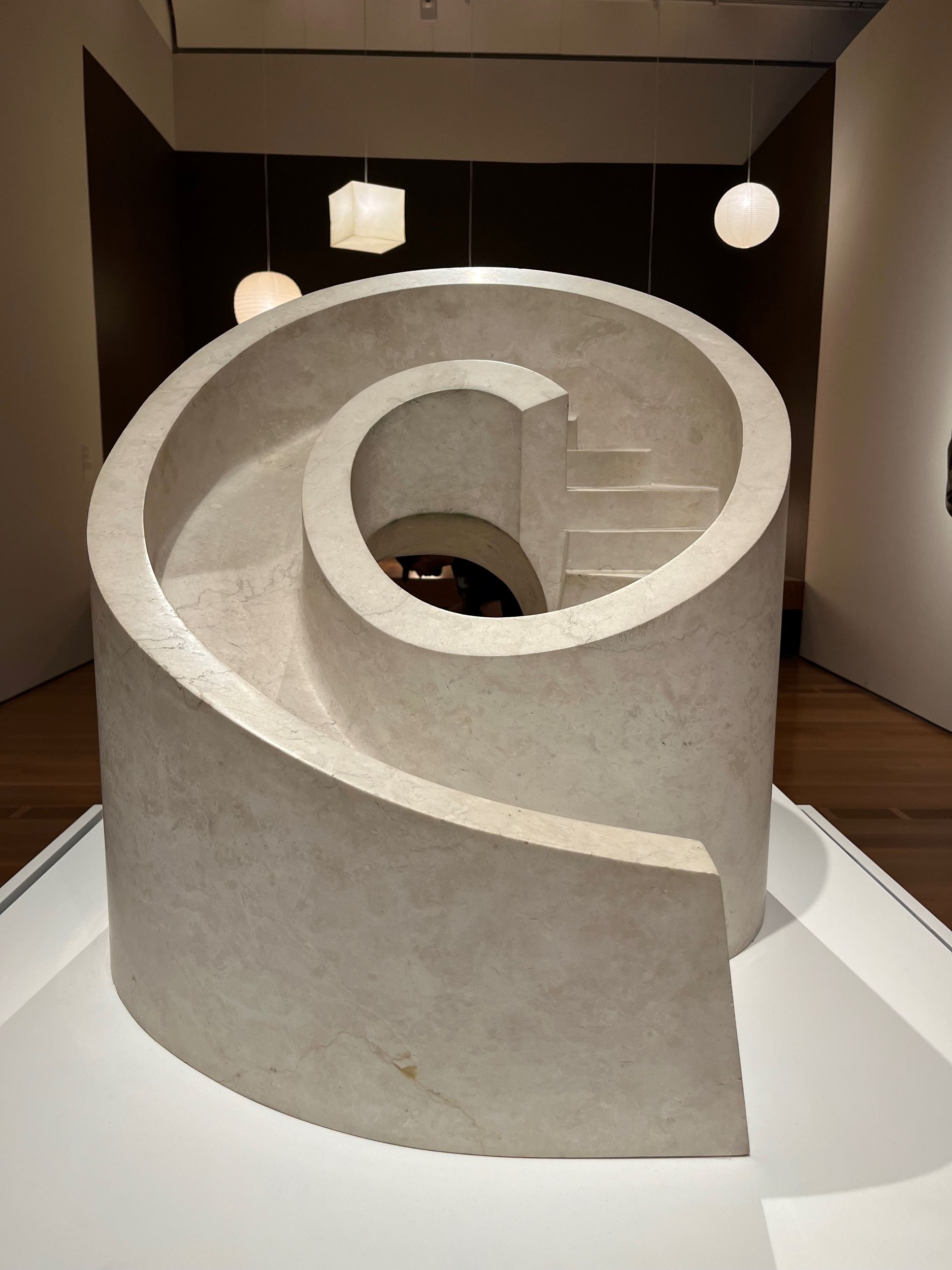
The exhibition’s final room highlighted one of Noguchi’s crowning achievements: his unprecedented 1986 show at the 42nd Venice Biennale—the first time a single artist occupied the entire US pavilion. Then in his early eighties, Noguchi presented works under the title What Is Sculpture?, anchored outside by the monumental Slide Mantra. In the exhibition, this work was represented by a maquette (fig. 5), alongside archival photographs documenting the public engaging with its form. Inside the pavilion, Noguchi displayed design models of large-scale environments alongside the mass-produced commodities of his Akari series. Thus, Noguchi’s selections—as an answer to the pavilion’s titular question—signaled an abiding commitment to both democratic engagement and public access, asserting that art belongs to everyone and should be part of everyday life.
Slide Mantra, as a later work, also serves as an intellectual mantra for the whole of Noguchi’s oeuvre, emblematizing his lifelong resonating interests in the transformative, daily power of sculpture. As Noguchi contended in 1946, sculpture is “the continuum of our existence”—an evolving medium that, like nature itself, demands “growth . . . attuned to the living” and “more direct contact with humanity.”1 Richly detailed and intellectually compelling, the retrospective at the High Museum revealed that Noguchi’s enduring legacy lies in his commitment in expanding sculpture into the very act of living.
Cite this article: Laura Lake Smith, review of Isamu Noguchi: “I am not a designer,” High Museum of Art, Panorama: Journal of the Association of Historians of American Art 12, no. 2 (Fall 2026), https://doi.org/10.24926/24716839.21563.
Notes
- Isamu Noguchi, Isamu Noguchi: A Sculptor’s World (1968; Steidl, 2004), 28. ↵
About the Author(s): Laura Lake Smith is assistant professor of modern and contemporary art at the University of Alabama in Huntsville.