

Martin Puryear: Nexus





PDF: Sullivan, review of Martin Puryear
Curated by: Emily Liebert, Cleveland Museum of Art; and Reto Thüring, Foundation for Art, Culture, and History in Winterthur, Switzerland; with Gabriella Shypula, Cleveland Museum of Art
Exhibition schedule: Museum of Fine Arts, Boston, September 27, 2025–February 8, 2026; Cleveland Museum of Art, April 12–August 9, 2026; High Museum of Art, Atlanta, September 25, 2026–January 17, 2027
Exhibition catalogue: Emily Liebert and Reto Thüring, eds., Martin Puryear: Nexus, exh. cat. Cleveland Museum of Art, 2025. 240 pp., 212 color + b/w illus. Cloth: $65.00 (ISBN: 9780300283921)
In 1982 Martin Puryear (b. 1941) realized Bodark Arc, an expansive, site-specific sculpture for the Nathan Manilow Sculpture Park, located at Governors State University, about an hour southwest of Chicago. Anchored by a bronze chair inspired by the thrones of West African elders placed in a row of Osage orange trees, the work reveals itself only as the viewer moves through the meadowed landscape, walking in a semicircular path that passes through a large wooden arched gate and over a boardwalk. Though perhaps one of his lesser-known monumental projects, Bodark Arc is quintessential Puryear: ambitious but subtle, minimal in form but infused with layers of specific meaning and cultural references, open and gracious in its address but assured in its physical presence. Puryear stated of Bodark Arc, “One of the problems associated with public sculpture is context, deciding what the function of sculpture is in society today. It’s one of the most difficult things to settle.”1
Bodark Arc remains on the prairie campus for which it was commissioned, but it is also one of several large-scale projects prominently featured in Martin Puryear: Nexus—the first comprehensive exhibition of the artist’s work in nearly twenty years. Projects such as Box and Pole (1977) for Artpark in Lewiston, New York; Bodark Arc, Big Bling (2014) commissioned by the Madison Square Park Conservancy in New York; and Lookout (2023) for the Storm King Art Center in New Windsor, New York, demonstrate Puryear’s decades-long investigation into the context and function of sculpture, public or otherwise. They are deftly represented in the exhibition through photographs, drawings, models, and other ephemera.
Puryear’s large-scale projects are a welcome inclusion. As some of the most important of his career, they are indeed vital to any comprehensive presentation of his work, but they do also carry with them unavoidable limitations. Made for specific locations, monumental in scale, and either temporarily realized, destroyed, or still in situ, this type of work is notoriously difficulty to convey fully in a gallery setting. Context, as Puryear himself suggests, is crucial, even if difficult to settle. While the large maquette for Big Bling or A Column for Sally Hemings (2021; fig. 1), an indoor site-specific piece included in the Puryear’s solo presentation in the American pavilion at the 2019 Venice Biennale, hold their own as sculptural objects within the exhibition, they also are disconnected from the contexts for which they were created. This is especially true in the case of the latter, whose stately presence in carved marble and cast iron was originally installed in the rotunda of a building modeled on Thomas Jefferson’s Monticello during the first presidential term of Donald Trump. Like all of the objects in the exhibition, A Column for Sally Hemings is political, imbued with complicated, layered cultural and historical references, but for reasons both sensible and infuriating in this present moment, they become here somewhat dispossessed and sterilized.
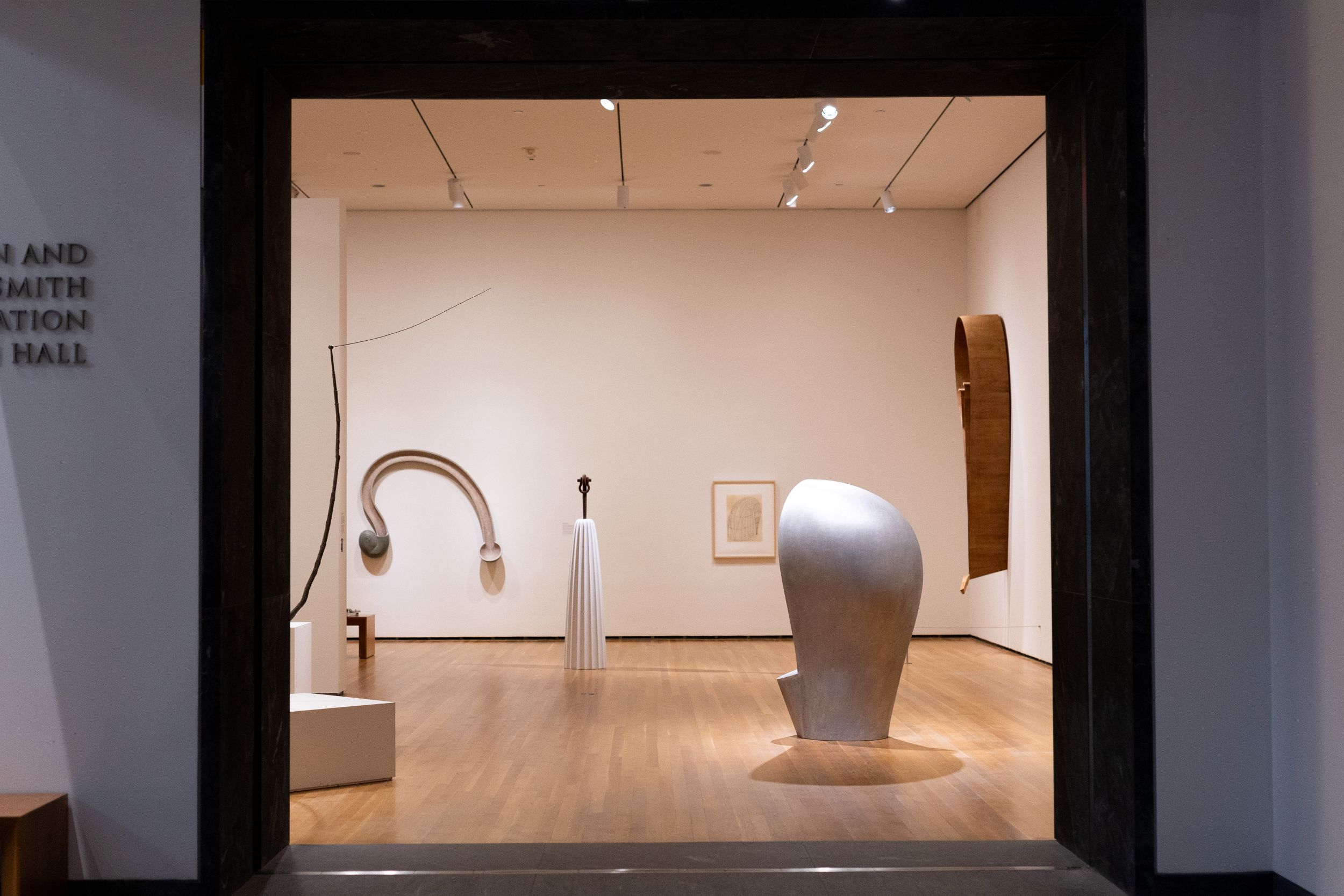
Context, after all, is not just a question of location but also concerns the myriad influences and references embedded within the work or meant to be expressed through it. The fifty or so objects included in the exhibition lay bare Puryear’s dense, distinctive artistic language, cultivated over the course of his long career. Formal resonances become apparent, repeating and evolving as the viewer moves through the exhibition, which is arranged in a roughly chronological path. The earliest works are from the 1960s, including several etchings the artist made while studying printmaking at the Royal Academy of Fine Arts in Stockholm. The most recent include objects created in the early 2020s, including Looking Askance (2023), a silver-painted wood construction that feels oddly out of sync with the other works in the exhibition. Dividing walls are kept to a minimum, and sculptures, large and small, are largely placed directly on the floor, in the round, without stanchions or platforms, enabling both a refreshingly intimate encounter with the work and the ability to make connections across time, medium, and material—even if one occasionally wishes pieces were given a bit more breathing room.
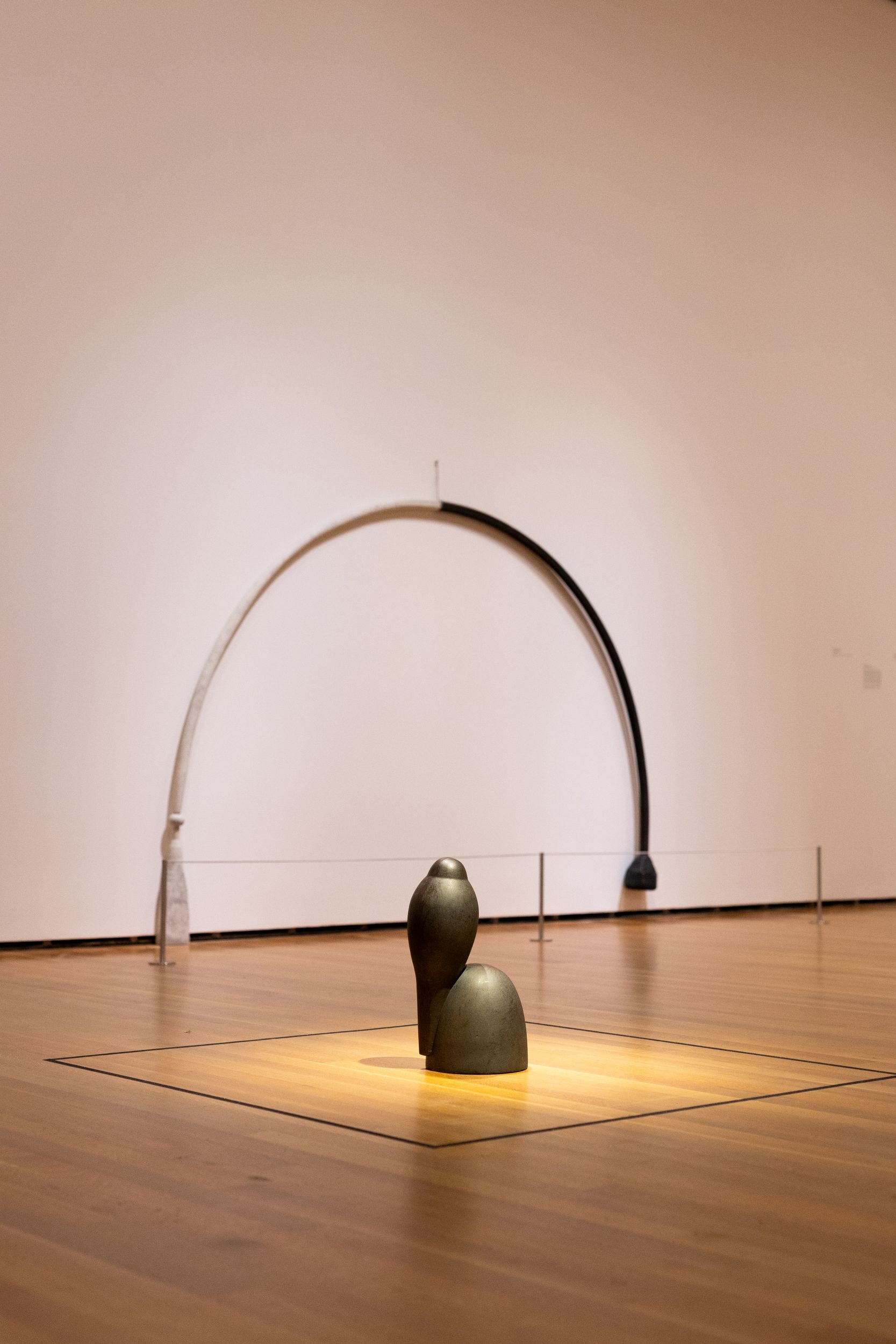
The adherence to chronology does lead to some missed opportunities to create a deeper sense of interconnectedness. One of the smallest but strongest sculptures in the exhibition, On the Tundra (1986; fig. 2), an abstracted cast-iron rendering of a gyrfalcon resting on a rock, was not shown within eyesight of On the Tundra (Winter) (2022), a revisiting of the imagery rendered anew in white marble. This later sculpture was instead hidden around a corner, in the last gallery, and placed on a large, cumbersome pedestal. As the recent traveling exhibition of work by Constantin Brancusi (organized by the Centre Pompidou—Musée national d’art moderne, Paris) superbly demonstrated, placing similar works side by side can evocatively demonstrate the impact of material choices.
What the chronological organization does enable, however, is an array of additional context for viewers wishing to gain a richer understanding of Puryear’s work. The curators of Nexus do an admirable job of sharing a broad range of information without causing the exhibition to feel overly didactic. Wall texts and object labels frequently include supporting reference images as well as multiple voices, offering alternate interpretations. The excellent accompanying catalogue further reveals the artist’s rigorous and poetic engagement with social, racial, political, natural, and art histories. Collectively, these materials comprehensively track Puryear’s global travels, insatiable curiosity, and profound material knowledge gleaned over a lifetime.
The work itself also discloses multifaceted references and the meanings embedded in traditions of making: weaving, woodworking, and printmaking; sculpture in ebony, bronze, and marble. Coffins, cages, and boxes mix with abstracted renderings of creatures, real and imagined. References to various headdresses, including the Phrygian caps of enslaved Romans and French revolutionaries and fila gobi, the ceremonial hats worn by the Yoruba people of Nigeria, are prevalent, as are circles, arches, spirals, and spheres. Special attention is given to the artist’s sustained interest in the natural world, especially ornithology, which began in childhood with John James Audubon’s Birds of America and continued into adulthood, when Puryear trained as a falconer. Birdlike forms appear throughout the gallery, perhaps most overtly in the variations of On the Tundra, their material solidity standing in contrast to their nimble, vibrant inspiration.
Works like On the Tundra or Night and Day (1984)—a semicircular wall-relief arch of pine painted in black and white with one terminus suspended just above the floor in a manner that counterintuitively imbues the work with a sense of great weight—express a formal tension of contrast, performing a sort of visual sleight of hand that upends expectations and defies easy readings. The immense power of Puryear’s work, however, is contained in an irresolvable core that draws on the contradictions of context. His work often seems to obfuscate its specificity—or, rather, seems to not be dependent on the legibility of the references that informed its creation.
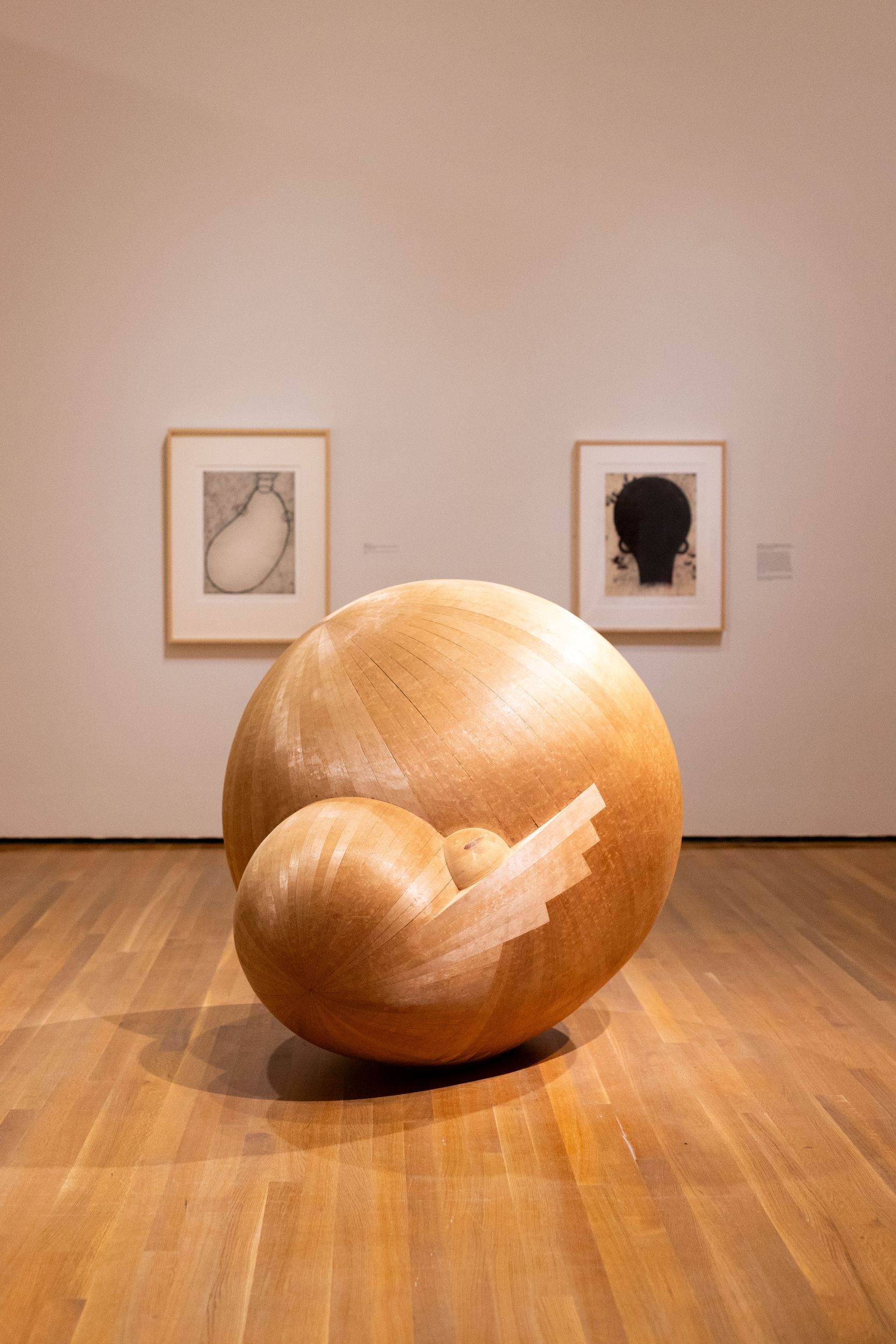
Take for example, Alien Huddle (1993–95; fig. 3), an abstract, circular construction of smooth red cedar and pine, which stands on its own as an exquisite formal expression of joinery, woodworking, and modernist sculpture. During the press preview for the exhibition, Puryear revealed to Cleveland Magazine, likely for the first time publicly, that the sculpture was “not about an alien from outer space” but about “embracing a new entity in your life,” further explaining it had been inspired by the birth of his daughter and the growth of his family from two people to three.2 This further context indeed reveals a truth, a contextual insight that, once learned, shapes the work into a touching if complicated portrait of familial embrace and perhaps uneasy growth. The strength of Puryear’s work, however, is that such insights really are not necessary to reach the same conclusions.
Over and over again throughout Nexus, contextual confusion adds a palpable charge to the work, which impressively never feels secretive or withholding. The revelation of specific knowledge may enhance a viewer’s understanding, but as autonomous objects, Puryear’s work offers a gracious generosity that rewards slow, close looking. These are complex, contradictory sculptural things—quiet but assertive, subtle but sensuous, and undeniably beautiful in their function. Both individually and when experienced collectively, they ask countless questions while adroitly resisting singular answers. What Nexus underscores is the inherent openness of Puryear’s work, inviting a multiplicity of entry points and interpretations.
Cite this article: Marin R. Sullivan, review of Martin Puryear: Nexus, Cleveland Museum of Art, Panorama: Journal of the Association of Historians of American Art 12, no. 2 (Fall 2026), https://doi.org/10.24926/24716839.21572.
Notes
- Quoted in Hugh M. Davies and Helaine Posner, Martin Puryear (University Gallery, University of Massachusetts, Amherst, 1984), 34. ↵
- Annie Nickoloff, “The Story Behind Martin Puryear’s ‘Alien Huddle,’ a Highlight of the Cleveland Museum of Art,” Cleveland Magazine, April 9, 2026, https://clevelandmagazine.com/articles/the-story-behind-martin-puryear-s-alien-huddle-a-highlight-of-the-cleveland-museum-of-art. ↵
About the Author(s): Marin R. Sullivan is an art historian and curator based in Chicago.