

Alfred Jackson’s Hermitage





PDF: Lennard and Stewart, Alfred Jackson’s Hermitage
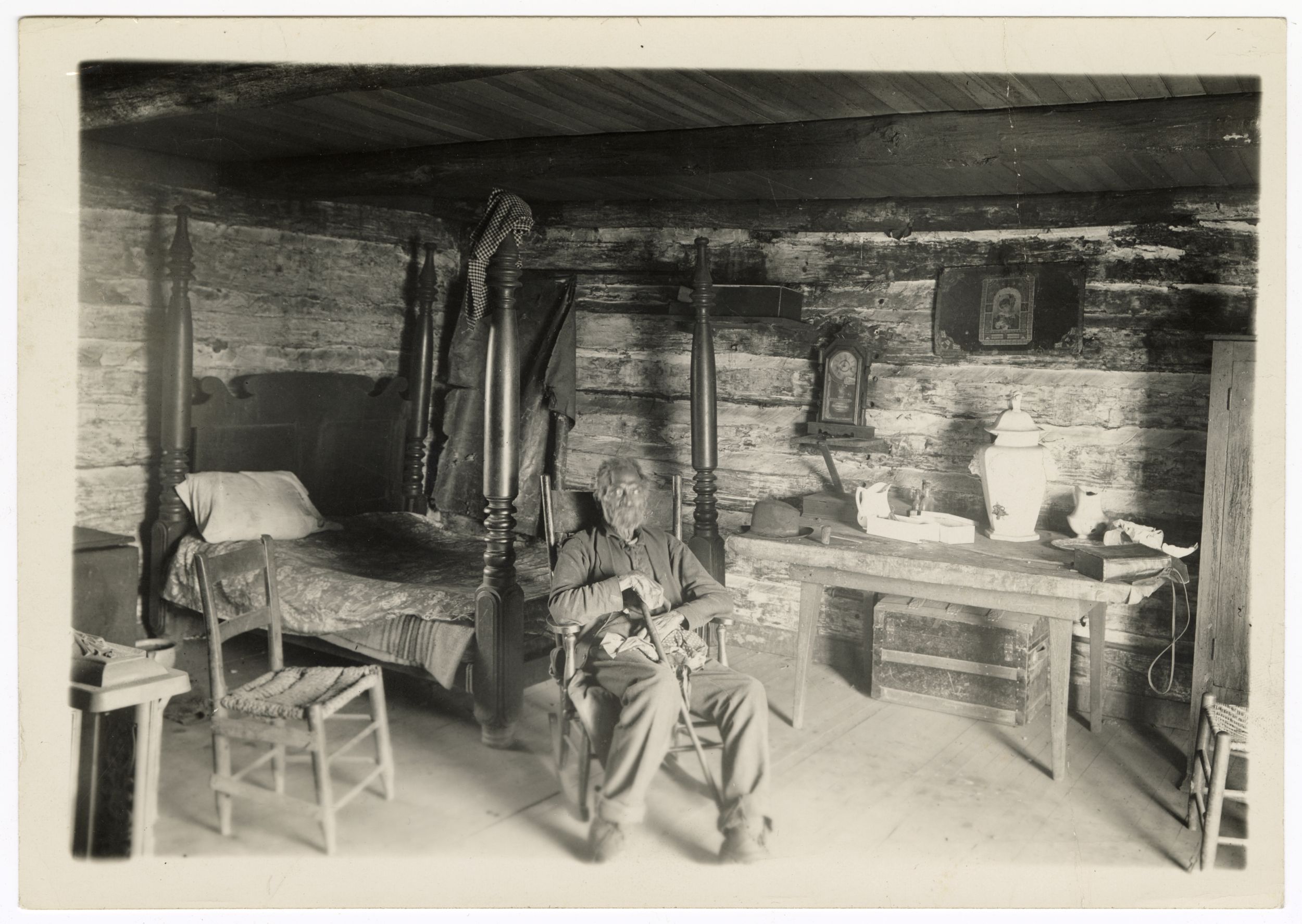
Around 1890, Alfred Jackson posed for a portrait in his cabin (fig. 1). Built in 1841, the structure was one of several cabins built for enslaved people on the grounds of the Hermitage, President Andrew Jackson’s plantation, just outside Nashville, Tennessee.1 Alfred had been one of those enslaved people. He was born on the plantation in the early nineteenth century and remained there for the rest of his life.2 After claiming their emancipation in 1865, Alfred and his wife, Gracy Bradley, continued to live on the Hermitage grounds, taking on new roles as tenant farmers, caretakers for Jackson’s living descendants, custodians of the property, and tour guides at a historic site of national interest.3
When Alfred and Gracy led tours of the Hermitage, they played active roles in this commemorative work, causing one journalist to remark, “No one of the old hero’s own blood could feel greater pride of birth or a more religious reverence for his name [than they did].”9 After Gracy’s death in 1887, Alfred’s memories of Jackson took on even more importance. At least one journalist who visited the site during this time described Alfred as the site’s “most interesting relic,” a term that characterized him as the living remnant of a bygone time.10 But “relic” had another connotation. This term also evoked the “swords, canes, pipes, and bric-a-brac once owned and used by the former President himself,” quotidian items made valuable by their affiliation with a figure of national historic importance.11 Identifying Alfred as a “relic” also reduced him to yet another object “once owned and used by the former President.” Although other people enslaved by the Jackson family still lived in the Nashville area, including Alfred and Gracy’s children, Alfred was unique in that he continued to live at the Hermitage. Unlike his wife and children, he took the Jackson name as his own. While Alfred’s presence at the Hermitage made Andrew Jackson’s reliance on enslaved labor impossible to ignore, Alfred’s stories also contributed to an increasingly widespread portrayal of the president’s slaveholding in benevolent, even romantic terms.
By the time Alfred sat for the portrait in his cabin in 1890, he was no stranger to serving as a living monument to Andrew Jackson’s legacy. It is hardly a stretch to imagine that Harry Vaughn, the young Nashville man who took the photograph, sought to portray his subject in precisely this way.12 This image is one of many taken of Alfred in his lifetime, and while the intended use of this image is unknown, the survival of several extant prints suggest that the photographer recognized the historical importance of his subject. Several of these prints include captions identifying their subject as “Uncle Alfred / body servant of Andrew Jackson.”13 Both parts of this caption reveal the extent to which mythic representation had superseded the reality of Alfred’s life. The term “uncle” identified Alfred as a “faithful slave” unwilling to leave bondage behind. Meanwhile, the characterization as Jackson’s “body servant” glossed over the reality of Alfred’s work as a physical laborer on the plantation grounds during his enslavement, recasting him instead as an intimate and trusted companion.14 That at least one earlier account cited Alfred as the author of this seeming elevation in status only makes matters murkier.15 Portrayals of Jackson as a kind slaveholder largely dominated historical literature until the turn of the twenty-first century, due in no small part to the seemingly fond recollections of people he had once enslaved.16
A closer look at this photograph, however, suggests another angle of approach. Alfred continued to live at the Hermitage after his emancipation, but this photograph does not depict a man living in the past. On the one hand, Alfred sits in a simple rocking chair, next to a rough-hewn ladder-back chair, like those frequently found in antebellum slave cabins. But just behind him, a large, finely made four-poster bed reaches almost to the ceiling. To his left is another rough piece of furniture (a table), but atop it sits a porcelain water vessel with a delicate lid, lion-head handles, and a metal spigot. Hanging over the table are a case clock and mirror whose refinement seems in tension with the rough cloth tacked on the wall beside the bed. The longer one looks at this photograph, the stranger the scene becomes. What might this seemingly dissonant collection of household items reveal about the final decades of Alfred’s life at the Hermitage? During this period, Alfred promoted Andrew Jackson’s status as an icon of American democracy, but the contents of his cabin suggest that he undertook this work for reasons that extended beyond his own investment in Jackson’s legacy. In the last decades of his life, Alfred subtly but unmistakably claimed the Hermitage, a historic site dedicated to promoting Jackson’s national legacy, as his own.
§
Many late nineteenth-century observers held up Alfred and Gracy’s decision to continue living at the Hermitage as justification for seeing Jackson’s slaveholding in a positive light. Portrayals of Jackson as an “indulgent master” circulated in the popular press in the years after the Civil War, propelled in part by the recollections of Hannah, another woman formerly enslaved by the Jacksons.17 But despite Hannah’s praise, she moved to Nashville, away from the Hermitage plantation, immediately after claiming her freedom. Gracy’s claim that all the enslaved members of the former president’s household “would ‘a’ died for him” may have held more weight since she continued to serve Sarah Yorke Jackson, the president’s daughter-in-law, in freedom, just as she had while enslaved.18 In this way, both Alfred and Gracy could be held up as living evidence supporting the “Lost Cause” myth. While the earliest articulations of this myth helped Southerners explain the political and military failures of the Confederacy, the theory was rooted in the fervent belief that all Southerners, including formerly enslaved people, had been happier before emancipation and yearned for the antebellum social order.19 In his influential 1918 book, American Negro Slavery, historian U. B. Phillips describes bondage as beneficial to Black people, asserting that those who had been manumitted longed to return to slavery: “They had been happy before but were wretched now.”20 The Old South, champions of the Lost Cause argued, had been filled with happy slaves in happy homes. Defenders of Andrew Jackson’s legacy held up Alfred as a prime example of this dynamic well into the twentieth century. In 1915, one account of the Hermitage’s preservation describes Alfred as “a genuine specimen of the old plantation slave of long ago” but argued that “those old plantation days were not so bad. Oftentimes there was genuine affection and esteem between owner and slave, and this was the case with Uncle Alfred.”21
While Alfred and Gracy allowed visitors to see their enslaver in a positive light, there is little chance that they had forgotten the realities of enslavement. At the time of his death, Andrew Jackson enslaved 161 people, many of whom entered bondage at the Hermitage through Jackson’s active participation in the domestic slave trade.22 Antebellum plantations were places of violence, trauma, and coercion, and the Hermitage was no exception.23 In 1804, Jackson placed an ad in the Tennessee Gazette that requested help locating an enslaved man who had fled the Hermitage, offering an extra ten dollars for “every hundred lashes any person will give him, to the amount of three hundred.”24 In 1821, Jackson ordered that Alfred’s mother, Betty, should be whipped at the first sign of “impertinence” or “disobedience of orders.”25 “I am determined that she shall in all things behave herself well or receive exemplary punishment,” he wrote, just one of the many instances in which Jackson characterized the delivery of punishment as a solemn—if distasteful—duty of a responsible enslaver.26 Even Jackson’s advocacy for several of his enslaved men following their arrest for murder in 1839 must be a reminder that the profit motive of slavery could undermine even the most generous acts.27 No matter how Jackson treated the people he enslaved during his lifetime, his death revealed his ultimate view of enslaved people as heritable property. His will dictated that all those he enslaved would now belong to his heir, Andrew Jackson Jr.28
Alfred and Gracy continued to publicly explain their presence at the plantation in terms easily understood by champions of the Lost Cause.29 Late nineteenth-century visitors to the Hermitage enthusiastically documented the couple’s words, actions, and material life, taking particular delight in their stories featuring Andrew Jackson but also in their portrayals of their own lives during enslavement. News stories portraying the couple often characterized Alfred as a defender of antebellum social hierarchies along lines of race and class. One reporter portrayed Alfred castigating “new-fangled” Black Americans, who he said were “fit for nothing but stealing.”30 It is tempting to write off this and other similar stories as racist fabrications, but the reality is probably more complicated. When early observers argued that Alfred and Gracy’s decision to remain at the Hermitage and to continue to serve the Jackson family after emancipation distinguished them from other formerly enslaved people in the community, their remarks only reinforced reductive racial stereotypes and class divisions within Black communities.31 Alfred and Gracy’s recollections of their enslaver served as currency in a society operating on these terms, particularly when they were speaking to white audiences. Whether or not they were personally invested in these social distinctions, both Alfred and Gracy must have recognized that playing into such stereotypes provided them with a certain measure of social capital and security.
Alfred’s intimate knowledge of the interior and grounds of the Hermitage was particularly invaluable during the site’s transition to a dedicated house museum in the early 1890s. Andrew Jackson built the Hermitage as a space for entertaining both family guests and state dignitaries, but in the years after his death, the house began to draw members of a public interested in seeing for themselves the material traces of such an important figure in US history.32 The plantation’s historic value was clear enough by 1856, when Jackson’s cash-poor heirs, Andrew Jackson Jr. and his wife, Sarah Yorke Jackson, sold the property to the state of Tennessee.33 After vacating the grounds for several years, Jackson’s heirs arranged with the state to live rent-free in the mansion, in exchange for maintaining and protecting the former president’s home and final resting place. Still, the family could not preserve the mansion’s once-grand interiors. With the death of Sarah Yorke Jackson in 1887, the contents and stewardship of the home passed to yet another generation, but both debt and decay continued to mount. One 1888 visitor wrote with concern that “the house is slowly rotting down, the valuable contents covered with mildew and dirt, and the articles used by the sturdy old general are slowly but surely disappearing.”34
The inspiration for solving these compounding problems came from the ongoing efforts to preserve the home of another slaveholding president: George Washington’s Mount Vernon. In 1889, Amy Rich Jackson, wife to Andrew Jackson III, the former president’s grandson, proposed the formation of the Ladies’ Hermitage Association (LHA), a memorial organization modeled on the Mount Vernon Ladies’ Association (MVLA), founded thirty years earlier.35 From the start, members of the LHA envisioned their work as something more than a local history project. As their initial call for donations explained: “The Association is national in character, as Andrew Jackson was national in reputation. He belonged to the people, and to them the association now appeals for assistance.”36 One of the key tasks of the LHA was to raise funds that would allow them to purchase the home’s original furnishings and decorative items from Jackson’s heirs.37 While these historic objects would allow visitors to see the Hermitage mansion as it had looked during Andrew Jackson’s lifetime, it mattered that these items were “relics,” the actual items once used by the family.38 The collection and return of Jackson family heirlooms to the site took years, and Alfred was integral to this process.39 The LHA reacquired Jackson family heirlooms and placed them throughout the plantation mansion with Alfred’s help, returning spaces like Jackson’s bedroom to its appearance at the time of the former president’s death.40 Alfred was, as one early history reported, “familiar with the arrangement of furniture in the early days” and therefore helped make sure “every piece was put in its original and proper place.”41 He also made an effort to maintain the security of these items after their installation at the house museum. One of the LHA’s founders later described a portion of Alfred’s tour of Andrew Jackson’s bedroom, which included his explanation that “iron guards” placed in the room were “to keep ‘de second class’ from taking things.”42
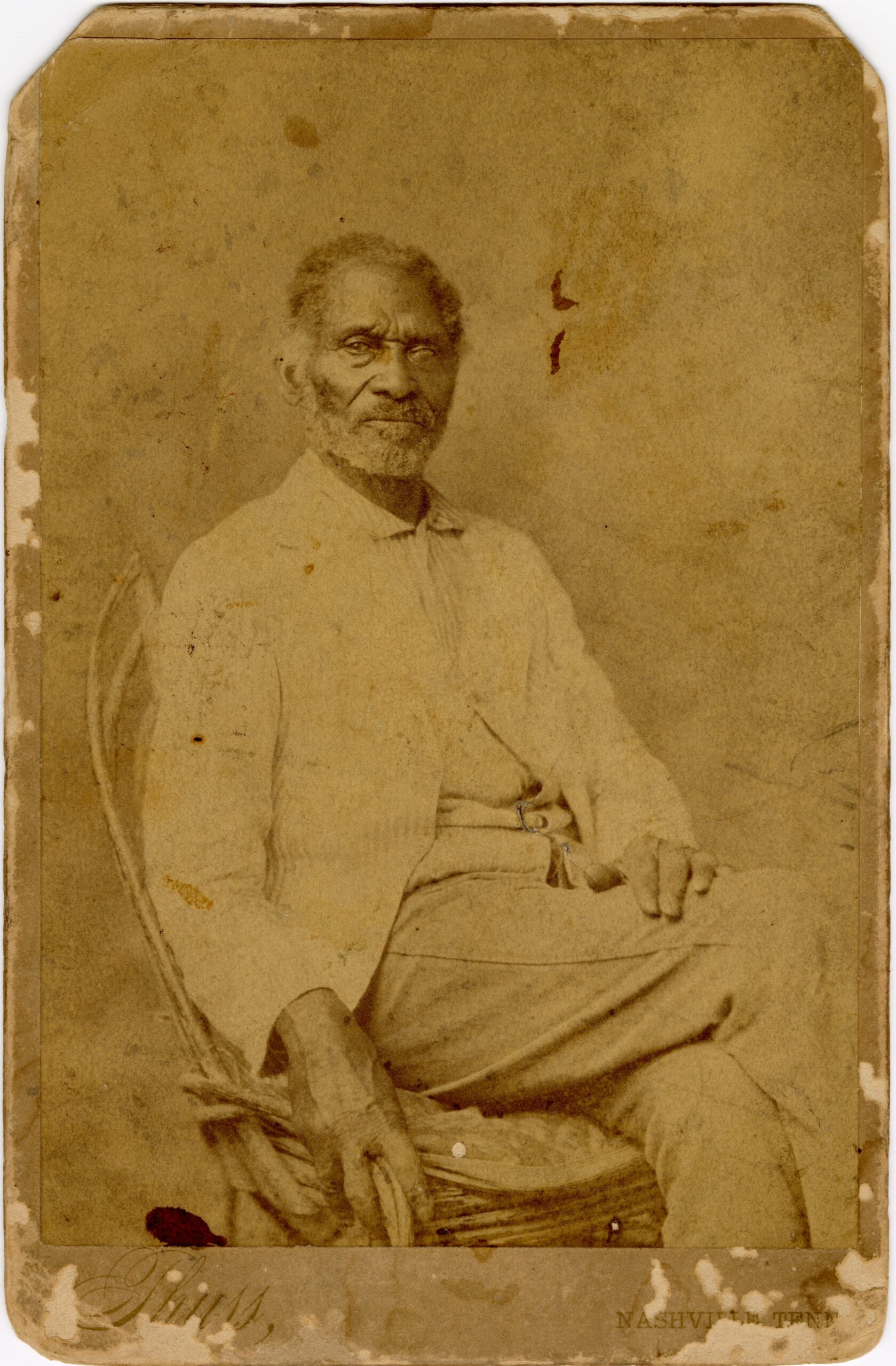
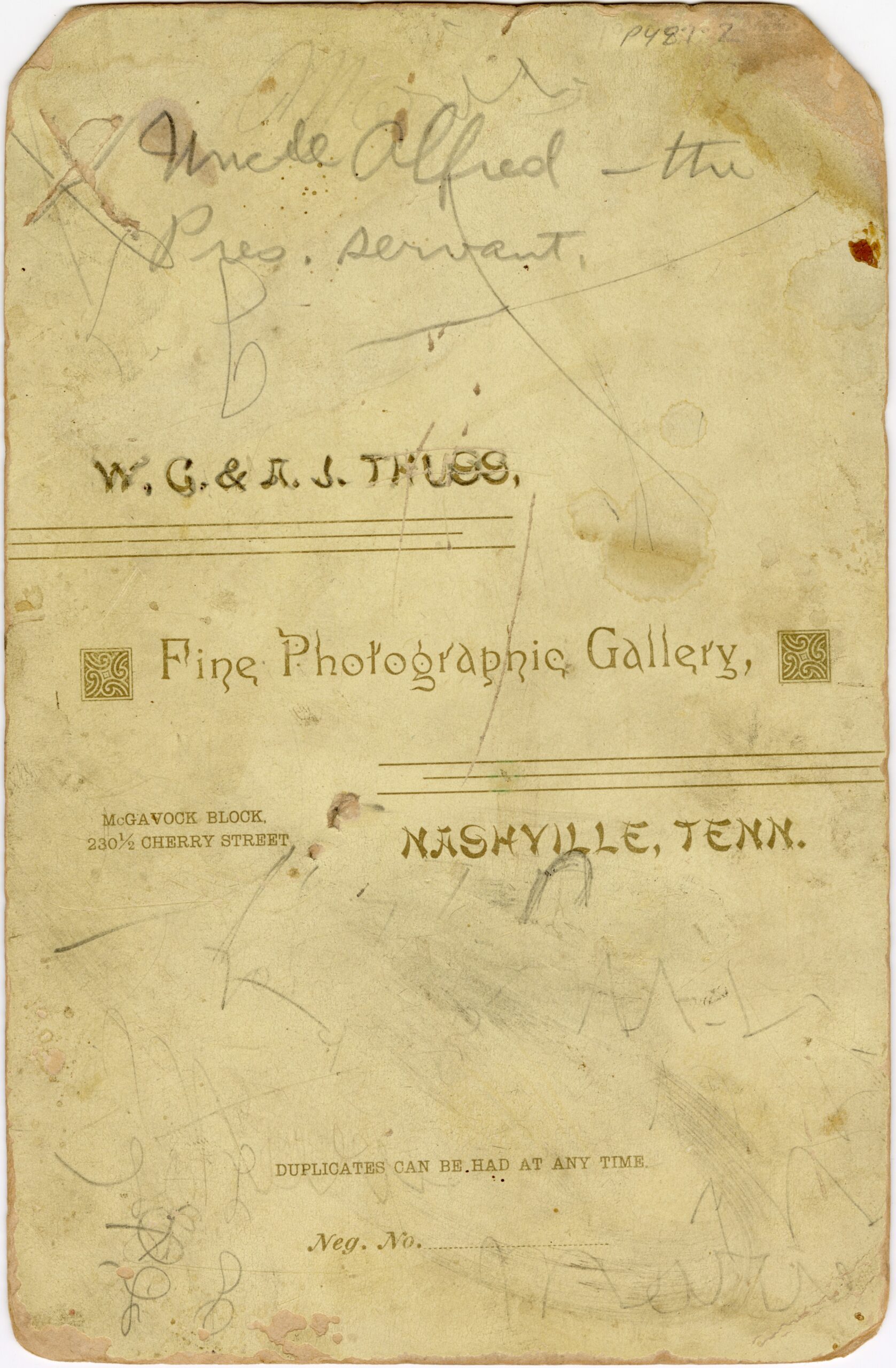
Early visitors and members of the LHA alike described Alfred as “the most interesting part of the Hermitage trip,” but their appreciation often reinforced his former status as property.43 The fundraising strategies of the LHA only furthered this association. Along with admission fees, the group sold souvenirs of the Hermitage’s history to visitors; these included material relics, like splinters of the decaying structure of the “original Hermitage,” an older log cabin inhabited by the Jacksons before they built the mansion, as well as photographs, many capturing Alfred himself.44 Newspapers reported Alfred traveling to Nashville to be photographed for the LHA’s benefit, since stereographs featuring his image “sold readily, as visitors after seeing him always wanted his picture” (fig. 2).45 Selling Alfred’s portrait to remind visitors of their trip to the Hermitage unsettlingly reproduced the logic of the “old plantation days” that the LHA so readily evoked.46
§
But Alfred’s attention to the material life of the Hermitage was hardly limited to caring for the mansion house or even bolstering Andrew Jackson’s historical legacy. A closer look at the everyday objects in Alfred’s own cabin reveals the complex reality of life in the New South, as Black families navigated real material continuities in communities where they were once enslaved.47 Even before emancipation, Black people across the South worked to make the spaces where they lived and worked into something of their own.48 Archaeological evidence abounds at the Hermitage, from guns and pierced coins to writing implements and eyeglasses. These items have allowed scholars to illuminate enslaved people’s many tactics of survival and meaning making at the plantation. Archaeologist Whitney Battle-Baptiste argues that the material culture of the Hermitage reveals enslaved residents’ attempts “to form semi-autonomous, secure spaces” that could transform sites of captivity into “homespaces.”49 Larry McKee similarly identifies “evidence of . . . minor but pervasive alterations made by residents to their assigned living quarters” at the Hermitage.50 These signs reveal that enslaved Hermitage residents followed strategies used by other enslaved Southerners to create homes and, in the process, create meaning within (and often against) the brutal confines of the peculiar institution.51 These practices contrasted sharply with romantic Lost Cause narratives that argued enslaved people made a home because of enslavement, not in spite of it.
Promoters of the Lost Cause ignored reality and instead focused on postbellum Black homes as evidence that Black Southerners were either unable or unwilling to progress past their former status as slaves. A 1904 statistical report on Black farmers, for example, noted that the continued existence of so many one-room cabins (which physically looked like or in some cases had once been slave cabins) demonstrated that they wanted to merely “maintain the standard of living derived from the slave quarters.”52 If this “windowless, one-room cabin” of slavery still “satisfied his creature wants,” then it could be reasoned that his former status still satisfied him, too.53 When free Black Southerners continued to live in one-room cabins, defenders of the Lost Cause portrayed this choice as a conscious desire to live as they had in slavery. This warped logic could be used to portray emancipation as a mistake. If Black Southerners did not want to leave the plantation, Lost Cause advocates could argue that laws and customs that upheld racial hierarchies were not only justified but morally necessary. Although many Black Americans loudly and frequently rejected these reductive interpretations of complex choices, the material conditions of everyday life in the South served as evidence for the defenders of a noxious historical myth.54
While some viewers might see the photograph of Alfred as confirmation of his wish to remain living in the past, a closer look at the items in his cabin challenges this perspective. Many of the objects in Alfred’s domestic portrait could have been found in the cabin before his emancipation, but the photograph also shows tangible evidence that Alfred had actively shaped his domestic space as a free man.55 Following the accidental death of Andrew Jackson Jr. in 1865, Sarah Yorke Jackson was forced to sell the estate’s land and possessions to make ends meet. The family’s financial crisis was by no means exceptional in the Reconstruction South; amid a radical transformation of the planter economy, many formerly wealthy estates became insolvent due to mortgages and debts previously secured with enslaved collateral.56 The family’s decision to sell off portions of the estate, including the mansion itself, to the state of Tennessee in 1856 showed that their finances were already perilous before the Civil War. The new political and economic regime of Reconstruction, not to mention cotton crop failures in 1867, only exacerbated their need for cash.57
In July 1867, Alfred and Gracy were among the community members who gathered for a sale of the Jackson family’s personal property.58 Their presence was notable, if not entirely anomalous. Just two years out of slavery, at least seven formerly enslaved people participated in the sale, all purchasing items that their unpaid labor had allowed the Jackson family to buy.59 The items that Alfred and Gracy chose reveal something about their values and priorities as they entered an uncharted phase of their lives. Some of these goods reflect practical needs. Gracy’s purchase of a “tin kitchen,” a metal box used to roast food in front of a fire, suggests that her role in the household had expanded from the days when she served as a skilled seamstress and Sarah Jackson’s lady’s maid.60 Alfred’s selection of two “cotton-picking baskets” indicates his transition from enslaved laborer to tenant farmer, a shift that necessitated his own purchase of tools rather than reliance on his former enslaver.
But along with these clearly practical goods, Alfred and Gracy also made purchases that visibly announced a change in social status. Items like the white porcelain water vessel in Alfred’s cabin portrait, and two ceramic pitchers, or “syrup stands,” could nominally be categorized as practical items (fig. 3). Indeed, the water stand had a tight-fitting lid that would help keep water clean and cool in the Tennessee heat. But its creamy porcelain surface featured ornamentation that revealed its fine origins. The provenance of this item may be even more interesting, as a caption on the back of a print of the Alfred’s cabin photograph notes that Andrew Jackson had brought the vessel to the Hermitage in 1815 after the battle of New Orleans.61 The items Alfred bought at the sale were Jackson family heirlooms, but they also had some symbolic value as material traces of a national hero.
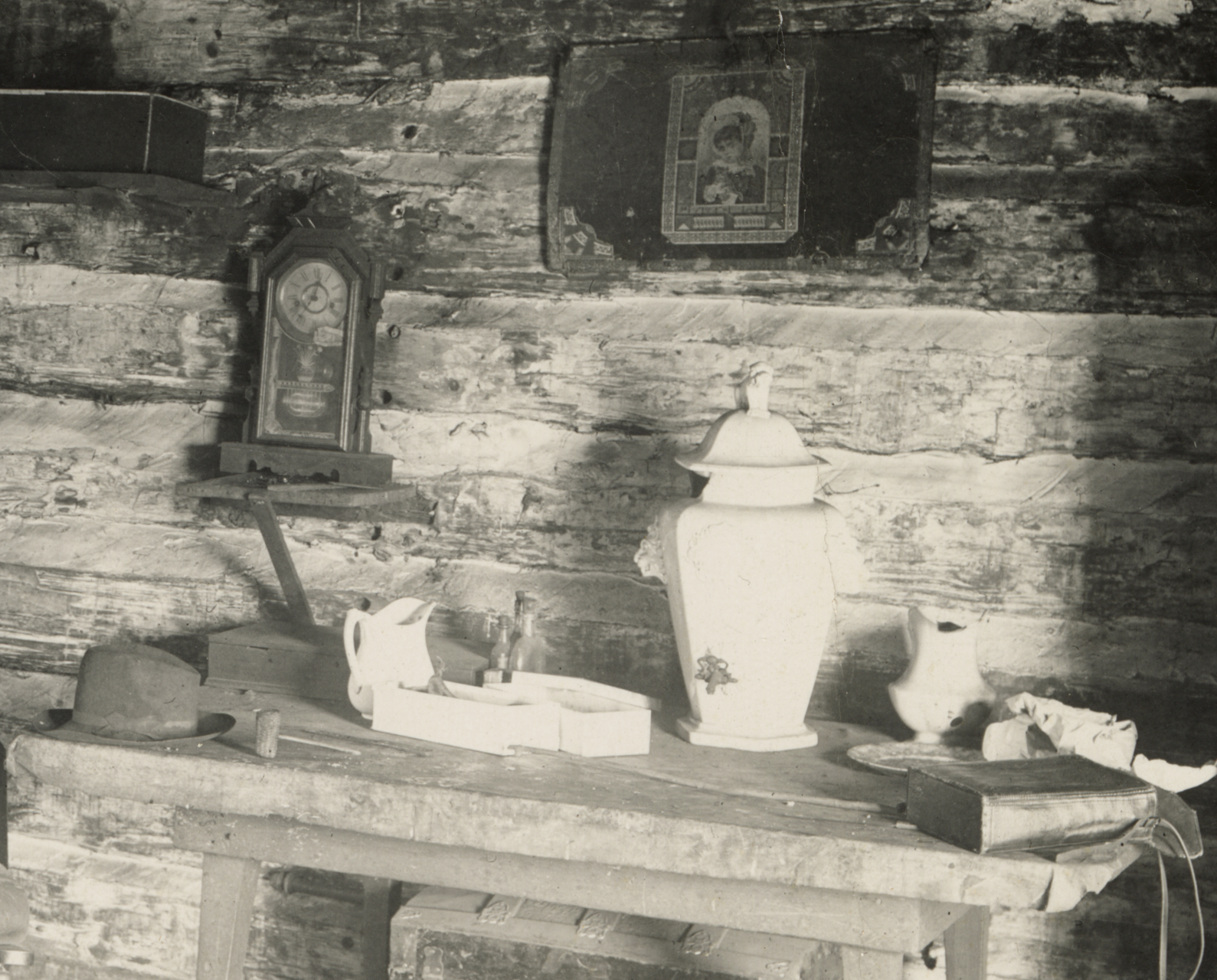
The combination of symbolic and practical value was especially evident in Alfred’s most significant purchase from the sale: a large mahogany bed that cast an imposing shadow in the relatively modest space of the cabin.62 Like Alfred’s other purchases, this bed both improved the conditions of his daily life in the cabin and made a symbolic claim of ownership over the Jackson estate. The provenance of the bed emphasized its meaning for Alfred. It was one of eight identical pieces that Sarah Yorke Jackson purchased to furnish the mansion’s bedrooms in 1835 (fig. 4).63 When Andrew Jackson died at the estate ten years later, he took his last breath in a mahogany bed that matched the one Alfred installed in his own home.64
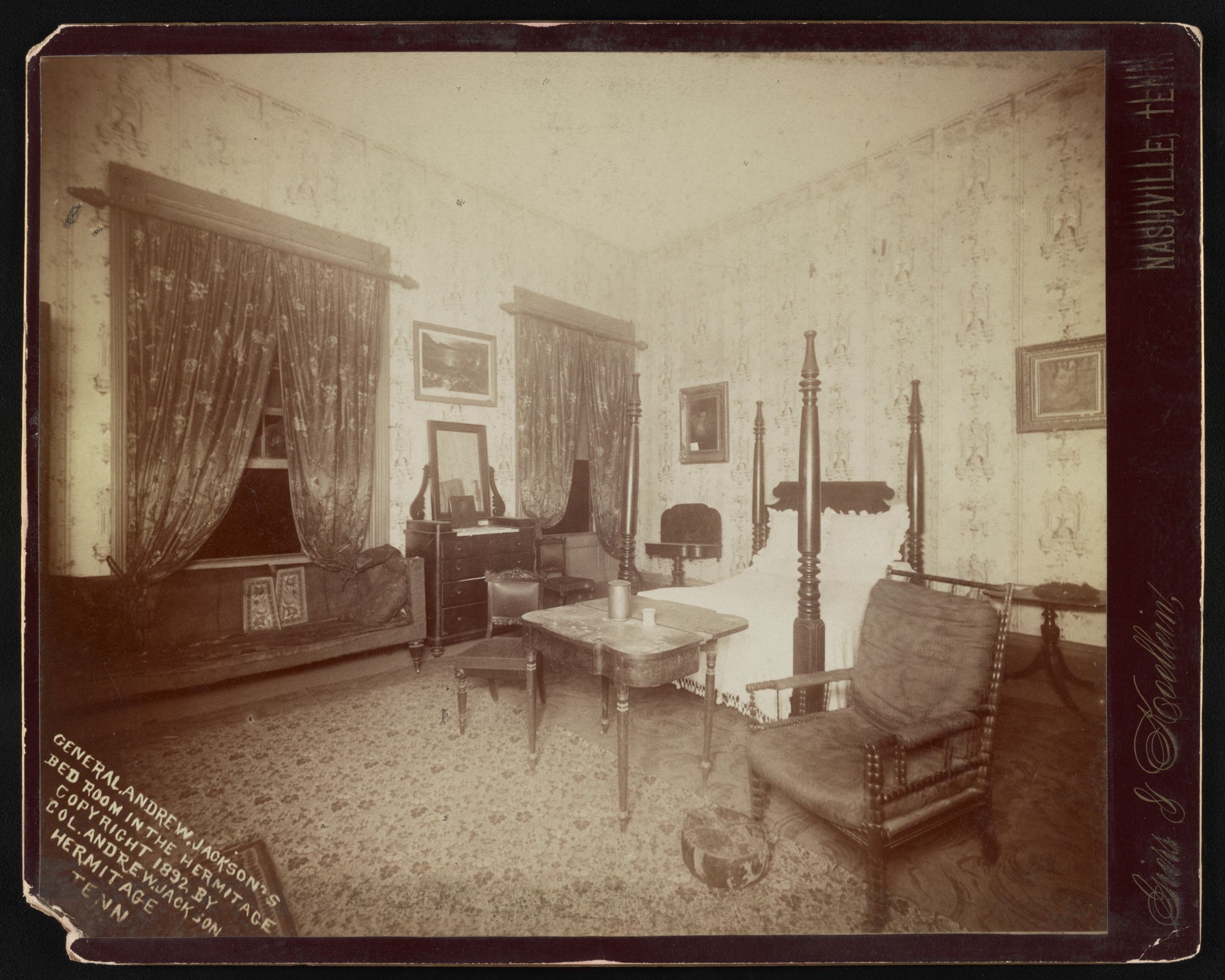
Purchasing these selections from the estate sale did more than provide Alfred and Gracy with new sources of comfort as they aged. The relocation of these items from the Hermitage mansion to their humble cabin demonstrated a material redistribution of power on the plantation that resembled the radical political changes underway across the Reconstruction South, as formerly enslaved people challenged the antebellum ideas of property rights.65 If the Hermitage promised visitors a recreation of the Jackson family home during the late 1830s, they saw something very different when they peered into Alfred’s cabin during the last years of his life.66 In a scene that was unimaginable before emancipation, Alfred welcomed visitors from the carved mahogany grandeur of his former enslaver’s bed.
Alfred and Gracy’s purchases at the 1867 sale complicate early accounts of the Hermitage’s preservation, which commended Alfred for his stewardship of the historic site. While Alfred helped restore the home of his former enslavers, going so far as to ensure the appropriate placement of family heirlooms in the mansion, his preservationist instincts only went so far. Alfred knew he possessed items that would be valuable to the LHA, particularly the Jackson family heirlooms he purchased in the 1867 sale, but these items remained in his cabin until his death.67 Alfred’s heirs deeded his mahogany bed to the LHA in 1902, but even upon its return to the mansion house, this object retained physical traces of its many years in Alfred’s cabin: Alfred had sawed the feet off his bed so that it would fit in his low-ceilinged cabin.68 The different height of Alfred’s bed compared to the other beds on display would have been evident to visitors touring the mansion in the early twentieth century—just as it is today. Despite all his efforts to help preserve Jackson’s home and legacy, Alfred’s permanent modification of this bed suggests that the stories he told about his former enslaver served his own needs as a free man.
§
But did Alfred see his own life in these terms? Many visitors to the Hermitage in the late nineteenth century came away with a sense that Alfred was dedicated to protecting the memory of his former enslaver above all else. One early twentieth-century historian went so far as to describe Alfred’s relationship to Jackson as one of “idolatrous veneration.”69 Alfred’s efforts to interpret and preserve the property where he had lived and labored for his entire life provided many with sufficient evidence to support this view.
While visitors to the Hermitage during Alfred’s lifetime heard the stories he told, few seemed to ask why he told them, perhaps because the myth of the Lost Cause supplied such a ready and satisfying answer. As historian Jennifer Morgan writes, “One-dimensionality is part of the afterlife of slavery, a part of the ongoing problem of racism and racial hierarchies.”70 Early chronicles of the Hermitage thus characterized Alfred as a relic in his own right, a historical possession of the Jackson family persisting into the present because he was unable or unwilling to leave slavery behind.
In much of the documentary record, Alfred continues to appear in mythic soft focus, yet the sharp grain of his domestic portrait invites another interpretive strategy. The visual and material record complicates the romantic portrayals of his enslavement, suggesting instead that Alfred’s perspective on Jackson’s legacy was more complex than he let on. Peeking inside Alfred’s home challenges simple assumptions about his motives and demands that we ask more complicated questions about what the Hermitage may have meant to him.
Alfred’s ability to serve as an authority on the Jackson family afforded him a kind of security available to few other late nineteenth-century Southerners of any race: a legal guarantee that he could never be forced to leave his cabin. After the establishment of the Hermitage as a museum in 1889, the Tennessee State Legislature resolved that Alfred could remain living on site “until he is called to meet his master on the other side of the river and rest with him under the shade of the trees.”71 This legislative resolution afforded Alfred a strange status. On the one hand, it reinforced the idea that long after his emancipation, Alfred remained in a kind of spiritual slavery—bound to commemorate his enslaver, even after his death. As one observer explained in 1901, “When the Hermitage was transferred to the custody of the Ladies Hermitage Association, ‘Uncle Alfred,’ by legislative request, went with it.”72 But seeing the legislature’s decree as virtual re-enslavement misses the freedom and security that Alfred had managed to achieve. The Hermitage was not a property that Alfred could sell or pass on to any descendants, but it was—by legal decree—his home.
In addition to the material record, a few textual sources support the interpretation that Alfred’s own worldview may not have aligned neatly with the public persona he developed for his tours (fig. 5). One 1891 article suggested as much when it noted, “The tourist is fortunate who visits the Hermitage when there are no other sight-seers about, and thus has an opportunity to talk to the old man after he has completed his stereotyped narration.”73 Alfred’s own acknowledgement of this gap is documented in a 1900 memoir, wherein the author recalled a long-ago conversation with a still-enslaved Alfred who sharply challenged the notion that he enjoyed his bondage. “You white folks have easy times don’t you? . . . you have liberty to come and go as you will,” Alfred remarked.74 When the Northern visitor argued that “freedom had its burdens as well as slavery,” Alfred ended the exchange with a single question: “how would you like to be a slave?”75 In another instance, Alfred reportedly acknowledged the artificiality of the social role he performed: “Folks has got a right to think what dey please, but when dey tells what dey think they gets ‘emselves in trouble.”76 Even with the limitations of secondhand recollections offered in exaggerated dialect, here we see a glimpse of Alfred’s perspective on the terms of his self-presentation.
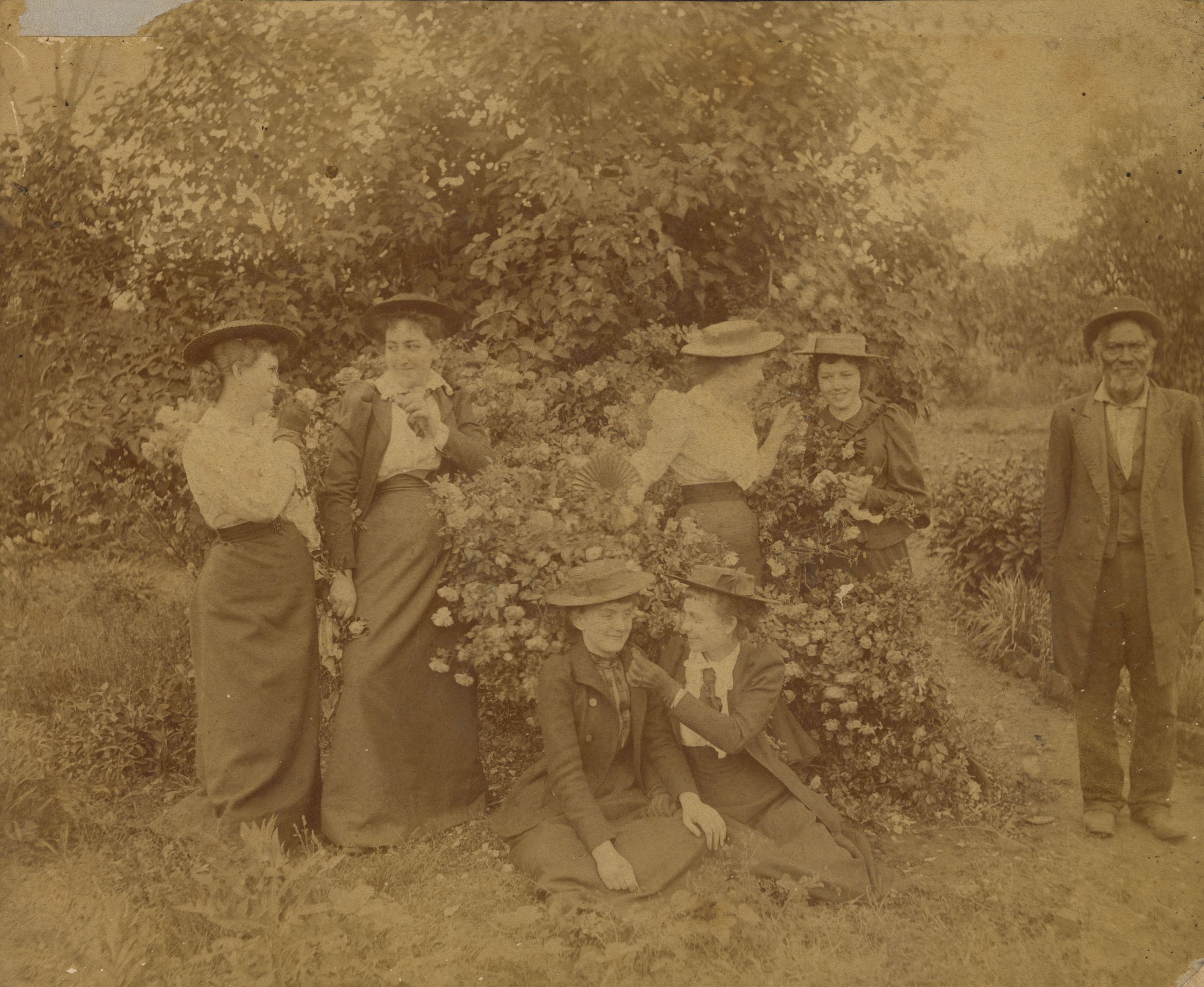
Alfred’s more candid observations might invite us to see his life in two simultaneous registers, a public-facing performance of a reductive caricature underpinned by a critical perspective kept largely out of sight. Such a view suggests a quiet undercurrent of complexity running underneath even the most benign photographs of Alfred posing with tourists chasing the material traces of the “people’s president.” But what such a bifurcated view misses are the ways that even Alfred’s most effusive portrayals of his former enslavers could also reveal the internal contradictions of the Lost Cause myth. Alfred was not, nor had he ever been, anyone’s possession; his active role in burnishing Jackson’s reputation suggests another dynamic altogether. While some observers saw Alfred as a relic, a trace of a distant past that continued to exist in the present, his stories of Jackson’s private life asserted his authority over the legacy of a national hero.
By surrounding himself with items he purchased from the Jackson family and then reassembled in a cabin where he had once been enslaved, Alfred embraced both change and continuity in ways that can be complicated and even uncomfortable to untangle. As the longest living resident of the Hermitage plantation, he used stories of the past to assert his authority over the way visitors saw this space and his role in it. While Alfred’s stories about Andrew Jackson could reinforce visitors’ racist expectations, his physical transformation of the cabin challenged attempts to write him off as a simplified archetype. To dispute romantic depictions of slavery produced in the late nineteenth century, subsequent generations of activists and scholars have focused on powerful stories of Black Southerners who publicly, vocally, and valiantly confronted their categorization in these terms. But Alfred reminds us that making and laying claim to the Hermitage as his home was its own challenge to mythic oversimplification. When Alfred posed for his domestic portrait photograph in 1890, he showed how he had used his mastery of two intersecting myths—Andrew Jackson as a national hero and his own portrayal as a faithful slave—to claim a place for himself in a changing world.
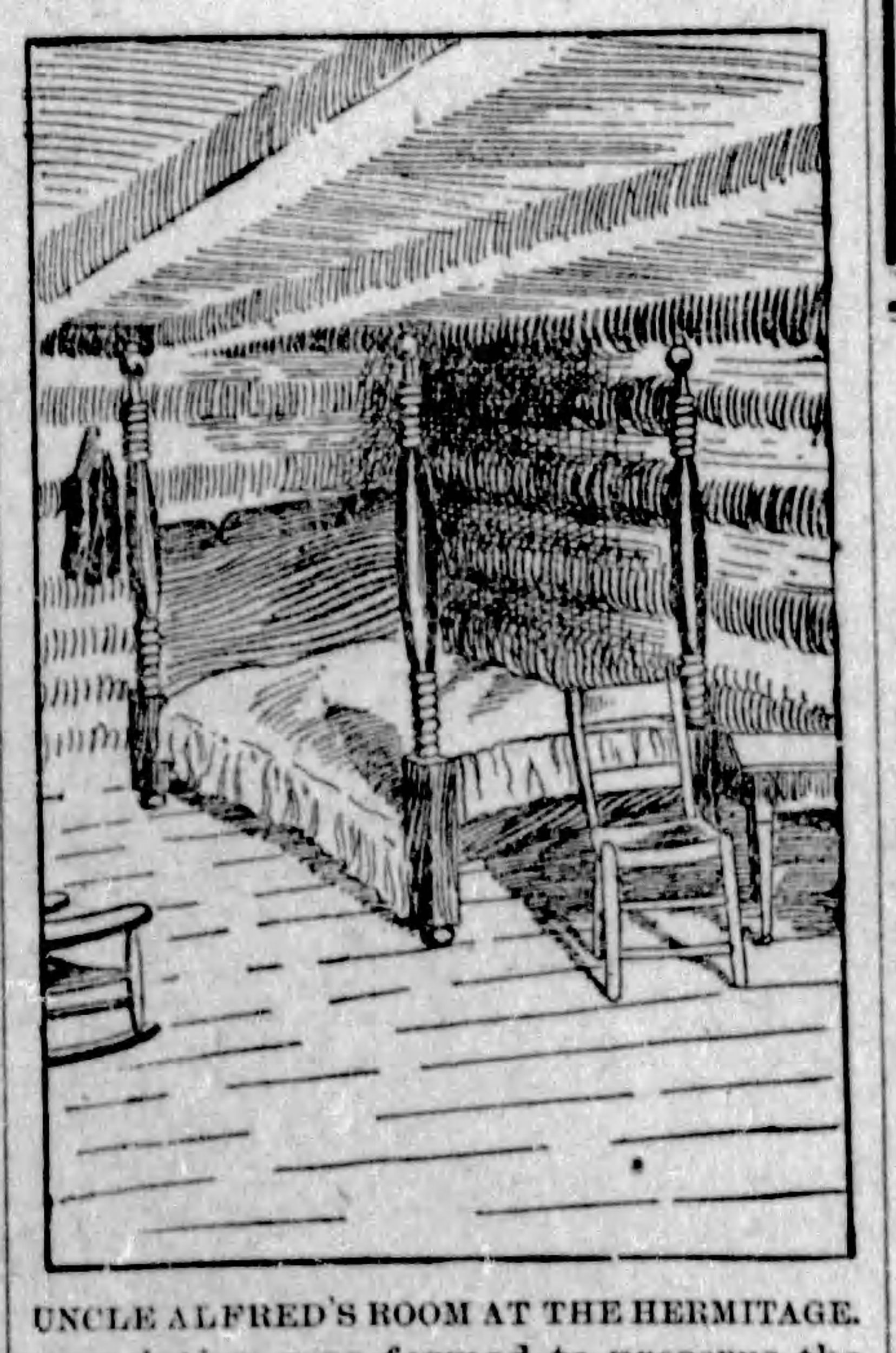
When Alfred died in October 1901, syndicated reports from Nashville hailed him as “Faithful Old Uncle Alfred, Guardian of the Hermitage,” and, evoking the perverse familial logic of the Lost Cause, as the “Last of the Jacksons.”77 At least ten newspapers accompanied this story with an illustration that evoked Vaughn’s photograph of Alfred in his cabin, but in this new image, Alfred was notably absent (fig. 6). In 1901, photographer A. J. Thuss returned to Alfred’s cabin to photograph a pair of new images with the same perspective as the original. The image that served as a reference photo for the illustration accompanying his obituary showed the cabin just as Alfred had left it, with his cane and jacket hanging from a hook on the wall.78 The newspaper’s rendering of this photograph emphasizes Alfred’s absence by cropping out most of the cabin to help viewers focus on the poignant empty chair pushed up against Alfred’s bed.
Alfred Jackson’s transformation into “faithful old Uncle Alfred” might seem complete were it not for the bed dominating this illustrated scene. To be clear, the rendering of Alfred’s bed offered no definitive statement of his motives or interior life, nor was it a sign that the artist-reporter had any intention of undermining the portrayal of Alfred presented in the brief article it accompanied. Yet in deciding to render Alfred through his possessions, newspapers from California to Florida portrayed Alfred’s claim on the Hermitage in material terms. Alfred’s cabin, and the items he assembled in it, were the tools Alfred used to take control of his own life and story in the best way he could. But doing so required a certain amount of contortion to fit the role that visitors traveling to the Hermitage, the self-proclaimed “Mecca of Democracy,” expected him to inhabit. Alfred was not reducible to his representation in national newspapers, nor was he merely the stereotyped persona he inhabited on his tours of the mansion. At the same time, Alfred’s challenges to these reductive visions took personal and idiosyncratic forms that afforded Alfred and his family some social stability and mobility without exploding the myth of the faithful slave or the nineteenth-century visions of Jackson as a heroic symbol of national virtue.
In the last years of Alfred’s life, visitors often reported his desire to be buried at the Hermitage, near Jackson’s tomb, and after his death in 1901, the LHA and Alfred’s family granted this wish. Alfred’s obituaries used this fact to establish, once and for all, that Alfred wished to position himself as a faithful slave of the Jacksons—even in his afterlife. Alfred’s careful efforts to assert a material and symbolic claim to some portion of the Hermitage could also invite us to see the funeral that Alfred’s family held in the Hermitage’s grand entry hall, and his internment alongside a tomb that he had displayed to tourists for years, as Alfred’s final reclamation of the Hermitage as the home where he lived as freely as he could.
https://doi.org/10.24926/24716839.21410
Notes
The authors would like to thank to Tony Guzzi, Rachael Willis, and Pamela Miner of the Andrew Jackson Foundation for research and image support. We have also appreciated the counsel of Cynthia Greenlee, Kyera Singleton, Alex Olson, Ben Wright, and the members of our Public History writing group: Elijah Gaddis, John Garrison Marks, Jamie Kirby, and Stephen Mandravelis.
- Archaeological excavations at the Hermitage have yielded more than eight hundred thousand artifacts that illuminate the lives of the plantation’s Black residents. See Whitney Battle-Baptiste, Black Feminist Archaeology (Left Coast, 2011); Jillian E. Galle, “Designing Women: Measuring Acquisition and Access at the Hermitage Plantation,” in Engendering African American Archaeology: A Southern Perspective, ed. Jillian E. Galle and Amy L. Young (University of Tennessee Press, 2000); and Larry McKee, “The Archaeological Study of Slavery and Plantation Life in Tennessee,” Tennessee Historical Quarterly 59, no. 3 (2000): 188–203. ↵
- Alfred reported that he was born in one of the cabins on the grounds of the Hermitage in 1803. Current interpretative materials at the site state that Alfred was born “around 1812.” “Gen. Andrew Jackson: Old Times at the Hermitage,” Western Sentinel (Winston Salem, NC), December 11, 1890; “Alfred Jackson,” Andrew Jackson’s Hermitage, accessed February 11, 2024, https://thehermitage.com/learn/slavery/alfred-jackson. ↵
- While many accounts of Alfred’s life at the Hermitage identify “Alfred’s cabin” (see fig. 1) as the site of his birth, the start of Alfred’s occupancy of the cabin is unknown. Alfred and Gracy may have lived in a brick triplex on the plantation grounds until its roof blew off in 1870. Tony Guzzi, chief experience officer at Andrew Jackson’s Hermitage, to the authors, August 28, 2026. ↵
- See Marc Cheathem, Andrew Jackson: Southerner (Louisiana State University Press, 2013); John Meacham, Andrew Jackson, American Lion (Random House, 2008); and Dawn Peterson, Indians in the Family: Adoption and the Politics of Antebellum Expansion (Harvard University Press, 2018). ↵
- Daniel Feller, “Andrew Jackson’s Shifting Legacy,” History Now 22 (Winter 2009), https://www.gilderlehrman.org/history-resources/essays/andrew-jacksons-shifting-legacy. ↵
- Washington McCartney, “Eulogy {On the Death of Andrew Jackson}” (1845), in John William Ward, Andrew Jackson, Symbol for an Age (Oxford University Press, 1962), 1; Michael Fellman, “The Earthbound Eagle: Andrew Jackson and the American Pantheon,” American Studies 12 (1971): 67–76. ↵
- Danielle M. Ullrich, “The Preservation of Andrew Jackson’s Hermitage, 1856–1889,” Tennessee Historical Quarterly 76, no. 4 (2017): 349. On Confederates using the American Revolution as their own founding myth, see Anne Sarah Rubin, A Shattered Nation: The Rise and Fall of the Confederacy, 1861–1868 (University of North Carolina Press, 2005), 14–15. ↵
- Ladies’ Hermitage Association, “An Appeal to the Public” (1889), reproduced in Mary C. Dorris, Preservation of the Hermitage, 1889–1915: Annals, History, and Stories; The Acquisition, Restoration, and Care of the Home of General Andrew Jackson by the Ladies’ Hermitage Association for over a Quarter of a Century (Ladies’ Hermitage Association, 1915), 52–54. ↵
- “Jackson’s Old Servants,” Northwest Enterprise (Anacortes, Washington Territory), December 2, 1882. ↵
- “Uncle Alfred Jackson,” Courier Journal (Louisville, KY), December 6, 1891. ↵
- “Old Hickory’s Hermitage,” Savannah Morning News, April 9, 1887. ↵
- Harry S. Vaughn, a young white Nashville student and photography enthusiast, is identified in several extant prints of the photograph. Andrew Jackson Foundation Collections (hereafter AJF), Nashville, TN, inv. nos. P0238.02C, P0238.02B, P0238.02A. ↵
- For example, AJF, inv. no. P0238.02B. ↵
- See also Paul Jennings, A Colored Man’s Reminiscences of James Madison (George Beadle, 1865), preface. ↵
- “Two of ‘Old Hickory’s’ Slaves,” Freeland Tribe (PA), August 15, 1889. ↵
- Mark Cheathem, “Andrew Jackson, Slavery, and Historians,” History Compass 9, no. 4 (2011): 326–38. ↵
- “One Hundred Years,” Nashville Tennessean, April 1, 1894. ↵
- “Jackson’s Old Servants.” ↵
- For more on the Lost Cause, see W. Fitzhugh Brundage, The Southern Past: A Clash of Race and Memory (2005; Belknap Press, 2008); Gary W. Gallagher and Alan T. Nolan, The Myth of the Lost Cause and Civil War History (Indiana University Press, 2000); and Clint Smith, How the Word Is Passed: A Reckoning with the History of Slavery Across America (Little, Brown, 2021). ↵
- Ulrich Bonnell Phillips, American Negro Slavery (D. Appleton and Company, 1918), 429. ↵
- Dorris, Preservation of the Hermitage, 116, 123. ↵
- Battle-Baptiste, Black Feminist Archaeology, 78, 83–84; Cheathem, “Andrew Jackson, Slavery, and Historians,” 327. ↵
- Stephanie M. H. Camp, Closer to Freedom: Enslaved Women and Everyday Resistance in the Plantation South (University of North Carolina Press, 2004); Thavolia Glymph, Out of the House of Bondage: The Transformation of the Plantation Household (Cambridge University Press, 2008). ↵
- “Advertisement for Runaway Slave,” in The Papers of Andrew Jackson, vol. 2, 1804–1813, ed. Harold D. Moser, Sharon MacPherson, and Charles F. Bryan Jr. (University of Tennessee Press, 1984), 40–41. ↵
- Andrew Jackson, quoted in Matthew Warshauer, “Andrew Jackson: Chivalric Slave Master,” Tennessee Historical Quarterly 65 no. 3 (2006): 209. ↵
- Jackson, quoted in Warshauer, “Andrew Jackson,” 209. ↵
- Warshauer, “Andrew Jackson,” 203. ↵
- Andrew Jackson, Last Will and Testament, June 7, 1843, box 9, folder 1, Andrew Jackson Collection, 1788–1942, Tennessee State Library & Archives, Nashville. ↵
- Accounts of Alfred’s tours appear in multiple newspapers of the time. See “Old Hickory’s Hermitage”; “Gen. Andrew Jackson: Old Times at the Hermitage,” Western Sentinel (Winston-Salem, NC), December 11, 1890; “Items of Interest,” Morning News (Savannah, GA), May 14, 1892; Dorris, Preservation of the Hermitage, 129–35. ↵
- “Uncle Alfred, The Body Servant of Old Hickory,” Commercial Appeal (Memphis, TN), May 10, 1896. ↵
- Dorris, Preservation of the Hermitage, 117–18. ↵
- Stanley F. Horn, The Hermitage: Home of Old Hickory (Greenberg, 1950), 18, 28. ↵
- Dorris, Preservation of the Hermitage, 55. ↵
- George Yenowine, “Andrew Jackson: Letter Descriptive of the New Orleans Hero’s Old Home,” Evening Journal (Wilmington, DE), September 28, 1888. ↵
- Dorris, Preservation of the Hermitage, 1–14, 25–29. There are numerous early histories of the MVLA. For a more recent scholarly perspective, see Lydia Mattice Brandt, First in the Homes of His Countrymen: Mount Vernon in the American Imagination (University of Virginia Press, 2016). ↵
- Ladies’ Hermitage Association, “Appeal to the Public,” 52–54. ↵
- In 1889, the LHA pledged $17,500 to purchase five hundred “relics, bric-a-brac and furniture of Gen Jackson” from Amy Rich Jackson and Andrew Jackson III, who continued to live with these items at the Hermitage for the next four years. After the LHA failed to secure the funds, Amy and Andrew III moved out, emptying the house of family memorabilia and furniture, displaying these items at an 1893 exhibition in Cincinnati. “Andrew Jackson’s Relics,” Yorktown Enquirer, June 15, 1892; Dorris, Preservation of theHermitage, 20; Horn, Hermitage, 53–55. ↵
- A March 1900 affidavit from Andrew Jackson III and his sister Rachel Jackson Lawrence attests that the LHA was purchasing “identical pieces of furniture owned and used by General Jackson during his lifetime.” Dorris, Preservation of the Hermitage, 58. For the role of relics in the American national imagination, see Matthew Dennis, American Relics and the Politics of Public Memory (University of Massachusetts Press, 2023); Theresa Barnett, Sacred Relics: Pieces of the Past in Nineteenth-Century America (University of Chicago Press, 2013). ↵
- Ullrich, “Preservation of the Hermitage,” 371n106. ↵
- “Andrew Jackson’s Servant: Death of the Last of the Servitors at the Tennessee Hermitage,” Washington Times, September 15, 1901; Dorris, Preservation of the Hermitage, 132–35. ↵
- Horn, Hermitage, 55–56. ↵
- Dorris, Preservation of the Hermitage, 138. ↵
- “A Picturesque Character,” Columbia Herald (TN), September 13, 1901; Horn, Hermitage, 53. ↵
- The LHA had made more than five hundred dollars from the sale of souvenirs by 1902. “Ladies’ Hermitage Association,” Lost Cause: A Confederate War Record 6, no. 4 (1902): 152. ↵
- “Andrew Jackson’s Servant,” Washington Times, September 15, 1901. ↵
- Dorris, Preservation of the Hermitage, 130. ↵
- See Jodi A. Barnes, ed., The Materiality of Freedom: Archaeologies of Postemancipation Life (University of South Carolina Press, 2011). ↵
- Whitney Nell Stewart, This Is Our Home: Slavery and Struggle on Southern Plantations (University of North Carolina Press, 2023). ↵
- Battle-Baptiste, Black Feminist Archaeology, 100. ↵
- Larry McKee, “Consistency and Variation in Slave Housing at Andrew Jackson’s Hermitage Plantation,” paper presented at the conference “Housing Slavery in the Age of Jackson: Comparative Perspectives,” Charlottesville, VA, October 1998, 10; quoted in Warshauer, “Andrew Jackson,” 219. ↵
- Stewart, This Is Our Home, 2. ↵
- Katherine Coman, “The Negro as a Peasant Farmer,” Publications of the American Statistical Association 9, no. 66 (1904): 45. ↵
- Coman, “Negro as a Peasant Farmer,” 45. ↵
- Ruben F. Kugler, “U. B. Phillips’ Use of Sources,” Journal of Negro History 47, no. 3 (1962): 153–68. ↵
- For a discussion of the acquisition and ownership of movable property by enslaved people, see Phillip D. Morgan, “The Ownership of Property by Slaves in the Mid-Nineteenth-Century Low Country,” Journal of Southern History 49, no. 3 (1983): 413–14. ↵
- Giuliana Perone, Nothing More Than Freedom (Cambridge University Press, 2023), 35–72. ↵
- Richard W. Griffin, “Problems of the Southern Cotton Planters after the War,” Georgia Historical Quarterly 39, no. 2 (1955): 109. ↵
- Report of Sale of Personal Property for Andrew Jackson Jr., October 15, 1867, original source unknown, copy in Research Files, AJF. ↵
- At least seventeen lots of items were purchased by seven people formerly enslaved by the Jacksons during the 1867 sale. “Purchases by former Slaves at Andrew Jackson Estate Sale, 1867,” compiled by Pamela Miner, former Vice President, Collections, AJF, correspondence with authors, February 2, 2024. This document draws on the Report of Sale of Personal Property for Andrew Jackson Jr., October 15, 1867. On Black Southerners acquiring “movable property” during Reconstruction, see Loren Schweninger, Black Property Owners in the South, 1790–1915 (University of Illinois Press), 151–59. ↵
- Dorris, Preservation of the Hermitage, 124–26; Galle, “Designing Women,” 39–72. ↵
- AJF, inv. no. P0238.02B. For possible corroboration, see Horn, Hermitage, 59. ↵
- Sarah Yorke Jackson purchased the other five mahogany beds included in this sale. Alfred paid $6.50 for his bed, a significant sum for an auction where many of the items cost one dollar or less. Report of Sale of Personal Property for Andrew Jackson Jr., October 15, 1867. ↵
- Andrew Jackson to Sarah York, April 14, 1835, and bill for house furnishings, January 2, 1836, both reproduced in Mary French Caldwell, Andrew Jackson’s Hermitage (Ladies’ Hermitage Association, 1933), 93. For an account of the fire and rebuilding process, see Horn, Hermitage, 26–37. By 1963, six of the eight original mahogany beds were on display in the mansion. Dorris, Preservation of the Hermitage, 50. ↵
- In 1900, Jackson’s descendants identified the former president’s newly restored bedroom as “complete as it was the day he died.” Furniture in this room included a mahogany bed from the set purchased in 1836. Rachel Jackson Lawrence and Col. Andrew Jackson, affidavit, March 13, 1900, reprinted in Dorris, Preservation of the Hermitage, 58. ↵
- Dylan Penningroth, The Claims of Kinfolk: African-American Property and Community in the Nineteenth Century (University of North Carolina Press, 2003), 152. ↵
- Some tours of the Hermitage included visits to Alfred’s cabin, particularly once he was confined to his bed in his final years. Dorris, Preservation of the Hermitage, 148; Horn, Hermitage, 85. ↵
- Lewis Lyerson, Nellie Lyerson, Augustus Bradley, and Kate Bradley, “Letter Deeding Contents of Alfred Jackson’s Cabin,” June 19, 1902, Accession Records, AJF. ↵
- In 2026, visitors to Andrew Jackson’s Hermitage can see all eight beds on display. Alfred’s cabin features a replica bed, while the bed he purchased in 1867 is positioned in the room now interpreted as “Little Rachel’s Room” on the second floor of the mansion. ↵
- Horn, Hermitage, 95. ↵
- Jennifer L. Morgan, “Q&A with Jennifer Morgan, Author of Reckoning with Slavery,” Duke University Press, June 11, 2021, https://dukeupress.wordpress.com/2021/06/11/qa-with-jennifer-morgan-author-of-reckoning-with-slavery. ↵
- Senate Joint Resolution No. 14, April 3, 1889, in Acts of the State of Tennessee Passed by the Forty-Sixth General Assembly, 1889 (Marshall and Bruce, 1889), 515; Caldwell, Andrew Jackson’s Hermitage, 110. ↵
- “Andrew Jackson’s Servant,” Washington Times, September 15, 1901; Caldwell, Andrew Jackson’s Hermitage, 111. ↵
- “Uncle Alfred Jackson.” ↵
- Roeliff Brinkerhoff, Recollections of a Lifetime (Robert Clarke Company, 1900), 60–61. ↵
- Brinkerhoff, Recollections of a Lifetime, 60–61. ↵
- Dorris, Preservation of the Hermitage, 145. Documentation of Alfred’s tours in the popular press generally applies the same broad tropes of dialect familiar in works of plantation fiction from this era. ↵
- “Last of the Jacksons,” Muncie Daily Star (IN), October 22, 1901; Kenosha News (WI), Sidney Daily News (OH), Daily Sentinel (Rome, GA), October 23, 1901; Marion Star (OH), October 24, 1901; Wilkes-Barre Leader Times (PA), Shelby County Democrat (OH), Florida Star (Titusville, FL), October 25, 1901; Vacaville Reporter (CA), Atchison Daily Globe (KS), November 1, 1901. ↵
- The first of these images shows three of Alfred’s descendants (his son Augustus Bradley, plus an unidentified granddaughter and great-granddaughter) sitting in the two chairs that are featured in the original photo. The second image shows the same scene with no people at all but with Alfred’s jacket and cane hanging from nails on the wall. AJF, inv. nos. P0130.02, P0238.01A. ↵
About the Author(s): Whitney Nell Stewart is Executive Director of the Coastal Georgia Historical Society. Katherine J. Lennard is the Frockt Family Chair and Associate Professor of History at Western Kentucky University.