

Artistic Interpretations, Rooted in Connecticut’s History in Framing American Democracy: Radical Roots at The Wadsworth, Hartford, Connecticut





PDF: Monroe and Tycz, Artistic Interpretations
Exploring Our Roots
As The Wadsworth contemplated its role in commemorating the nation’s founding in anticipation of the semiquincentennial, we looked back to our origins as the oldest public art museum in the United States. Founded in 1842 and opened in 1844, the museum has collected and championed American art from its beginnings, displaying grand history paintings and awe-inspiring landscapes by both established and emerging artists. To consider the current commemorative moment and the national discourse around American art and history, our curatorial approach began by reexamining Daniel Wadsworth’s vision for creating a public art museum. When Wadsworth established this museum, he reflected on his relationship to the foundational histories of his family, of Connecticut, and of the United States. In 2026, we looked anew at Connecticut’s unique contributions to establishing American democracy, which, in many respects, parallel our institution’s role in fostering an American artistic identity in the nineteenth century.
The origin story of The Wadsworth intersects with the career of one of the nation’s most celebrated painters, Frederic Edwin Church (1826–1900). Born in Hartford on May 4, 1826, Church’s artistic path was nurtured by the city, its patrons, and this museum. Elevating awareness of his formative years was The Wadsworth’s singular way of contributing to the bicentennial of Church’s birth in 2026. As colleagues, nationally and internationally, reflected on his legacy, who better to explore the true roots of his career? It was Daniel Wadsworth who introduced Church to the preeminent painter Thomas Cole (1801–1848), setting in motion the younger artist’s long and distinctive career. With renewed interest, we explored the museum’s archives. In reviewing our earliest financial documents, subscriber lists, and visitors’ logs, the connections between the Wadsworth and Church families were reaffirmed.1 One new discovery related to Church’s biography was a listing we found for “F. E. Church ticket for self and two friends” in an 1846 visitor log, the same year in which he completed some of his first notable paintings.2 Indeed, following his mentorship with Cole in Hudson, New York, Church returned to Hartford in 1846 and began painting his first significant landscapes. He was already attuned to the symbolic power of landscape painting, following Cole’s advice, but for Church, personal memory and ancestry were also integral to his earliest compositions. Notably, he chose Connecticut scenery and landmarks, several of which were on view in the exhibition.
In Framing American Democracy: Radical Roots, we grounded our core concept in three of Church’s early Connecticut landscapes.3 In addition to The Wadsworth’s Reverend Thomas Hooker and Company Journeying Through the Wilderness from Plymouth to Hartford, in 1636 (1846; fig.1), we exhibited West Rock, New Haven (1849) and The Charter Oak at Hartford (c. 1846), both generously lent to The Wadsworth from local Connecticut institutions: the New Britain Museum of American Art and the Florence Griswold Museum in Old Lyme, respectively.4 Taken together, this trilogy permitted us to explore how stories from Connecticut’s early Puritan history about its engagement with radical thought and actions in pursuit of self-governance and resistance to royal authority were revived and revisited in the nineteenth century as the young nation sought to understand and write its origin story.
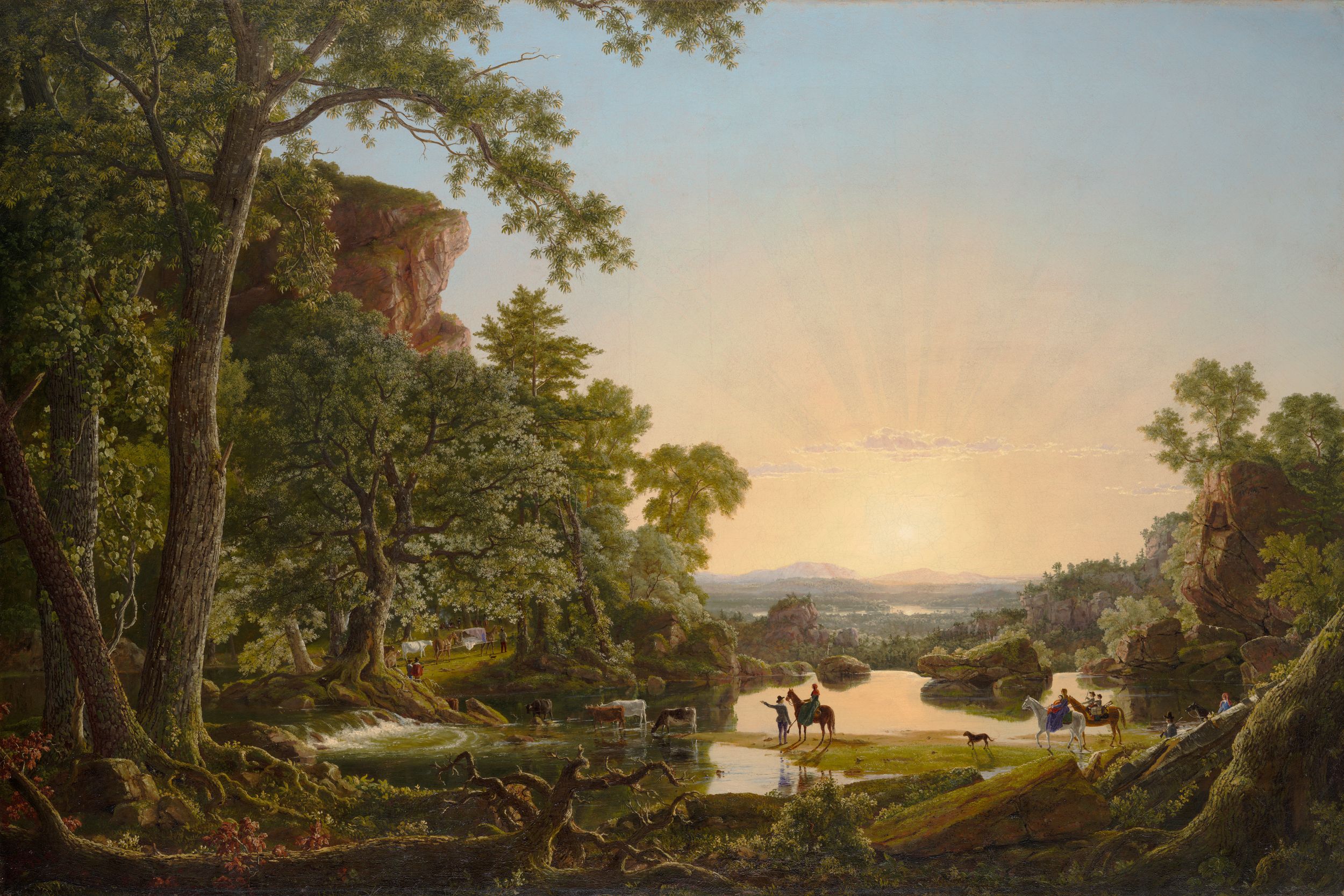
It is important to note that Church’s Hooker and Company was one of the paintings on view at The Wadsworth in its initial decade as a museum. One of Church’s first major paintings, completed when the artist was just twenty years old, the canvas presents Reverend Thomas Hooker (1586–1647) and his Puritan compatriots as if they are traveling to a promised land. Church descended from one member of Hooker’s party, Richard Church (d. 1667), and therefore the subject is closely tied to the Church family legacy and the early story of Hartford.
We need only look to landscapes by Church, like Hooker and Company, to address the question of why and how a nation remembers. In the painting, Church painted knotty branches and roots of a blasted trunk in the foreground to direct the viewers’ attention to the peaceful procession that was passing through the rustic scene. Hooker, a radical Puritan preacher, leads his band of followers, on foot and horseback, as they traverse the wilderness. Seeking greater autonomy, they had left the Massachusetts Bay Colony in Newtown (now Cambridge) to settle along the Connecticut River in an area that they also named Newtown, soon renamed Hartford.5 Hooker had only been in Massachusetts for three years before he set out with his companions to establish a society more aligned to his ideals. He presented his pioneering beliefs about governance in a sermon he offered to his Hartford congregation two years later, encapsulated by the now famous line: “The foundation of authority is laid firstly in the free consent of people.”6 This sermon was rediscovered in the mid-nineteenth century, leading historians at the time to theorize that the text had influenced the writing of the Fundamental Orders of Connecticut Colony (1639), a foundational document often described as the first written constitution of its kind. It promised a pioneering form of self-representative government, in which the consent of the people replaced the role of a monarch.7
In the exhibition, we also considered an array of artistic interpretations and material culture related to Connecticut’s origins. While the exhibition originated in the consideration of a nineteenth-century vision of a Puritan past, as interpreted through the eyes of Connecticut’s cultural elite and expressed through the brush of Frederic Church, our curatorial approach integrated and presented a dialogue between a variety of objects to support, reveal, embody, and complicate our interpretation of Connecticut’s history and thus its place in the development of American historical narratives. Therefore, Radical Roots explored and nuanced the idea that American democracy grew out of Connecticut’s early history by juxtaposing Church’s nineteenth-century interest in Puritan history with objects and relics that preserve historical memory across the centuries—including sculpture, furniture, daguerreotypes, costume and textiles, pottery and firearms, books, prints, letters, and archival documents. This dialogue revealed the myriad perspectives that help to shape our understanding of the development of history, art, and culture in Connecticut and its ties to the national story.
Nature’s Symbolic Power
Returning to Church’s Hooker and Company (see fig. 1), we notice that the focal point is Hooker’s outstretched hand, directing our eye to a tree with a rounded canopy on the left-hand side of the canvas. This tree has long been interpreted as representing Connecticut’s famous Charter Oak. Church painted the prominent oak multiple times, including as a standalone picture in the same year, also on display in Radical Roots. He had sketched the fabled tree—which stood blocks away from his family home—firsthand, along with other topographical views around Hartford, including a view of The Wadsworth’s building.
Local Native Americans—the Wangunk, Saukiog, Poquonock, and Tunxis peoples—had viewed the ancient white oak as an important part of the landscape long before the arrival of European settlers, using it as a meeting place.8 In the 1680s, the tree gained its title of Charter Oak when King James II sent royal authorities to revoke the Royal Charter of the Colony of Connecticut, which had been granted in 1662 by his predecessor, King Charles II. When the royal governor Sir Edmund Andros arrived to confiscate the 1662 royal charter on the eve of October 31, 1687, he was met with resistance from Hartford’s representatives. As the candles in the meeting house were extinguished, Captain Joseph Wadsworth absconded with the charter into the night. Fleeing to the Wyllys estate, Wadsworth hid the charter in the hollow of the well-known local oak, preserving the Connecticut Colony’s right to self-governance. From this point, the Charter Oak became a symbol of Connecticut’s defense of liberty and defiance of royal authority. Well into the nineteenth century, the tree was a famous landmark in Hartford—it remained the site of important political meetings, was a mandatory stop for tourists, and was celebrated by artists and poets. Daniel Wadsworth became fascinated by the Charter Oak story, and his family’s ties to the tale through the heroic actions of Captain Joseph Wadsworth increased its personal significance to our founder.
In the exhibition, the section dedicated to the Charter Oak was positioned at the heart of the space (fig. 2). Church’s Charter Oak painting was displayed here alongside a wide range of objects, artworks, and a large-scale replica of the charter of 1662. Exhibiting art and objects made during the tree’s lifetime as well as commemorative works made after its fall allowed us to present a reflection on its long history as a symbol of liberty and resilience in Connecticut. Church’s painting shows the robust tree with a thick canopy, full of promise and pride, bathed by a warm, glowing light. Across the gallery, we displayed an homage to the tree by Charles de Wolf Brownell (1822–1909), painted a year after its tragic fall in a storm on August 21, 1856, in an elaborate frame carved from the tree’s wood. The Charter Oak’s demise was reported in newspapers across the nation, and in Hartford it was mourned publicly as well as commemorated in art and literature. People from the city and around the country clamored to obtain a relic of the famous oak.
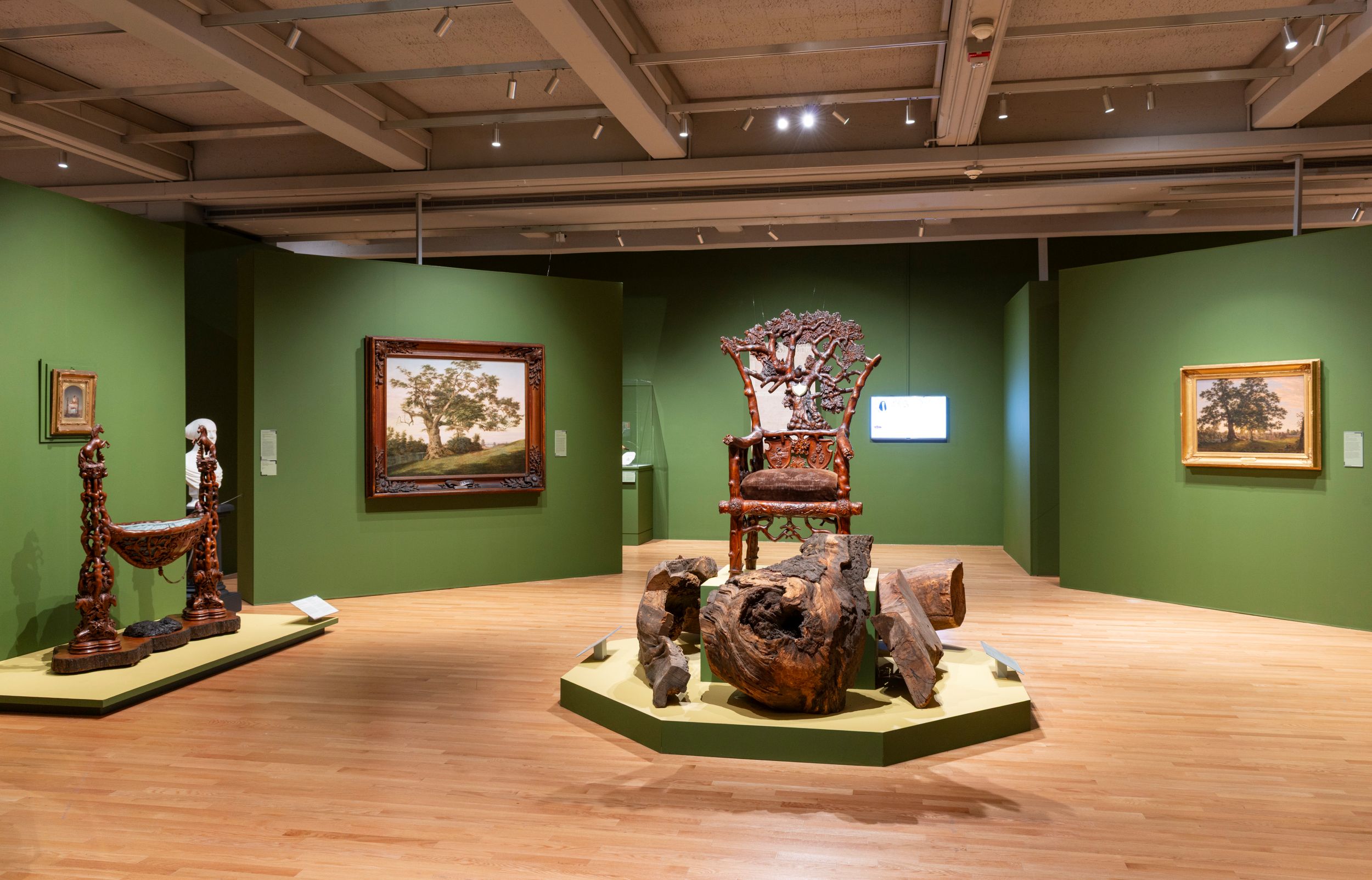
Samuel and Elizabeth Colt, two of Hartford’s most prominent industrialists, were among these collectors of Charter Oak remnants. Trying to tie their family legacy to the Charter Oak’s history, the Colts acquired large logs as well as a cradle and throne-like chair elaborately carved from the tree. These surviving pieces of the Charter Oak from the Colt collection were displayed in the exhibition alongside contextualizing and documentary evidence from our archives and special collections.9 We expanded the exhibition narrative by also considering the national reach of the Colt firearms industry, which armed both sides during the Civil War and facilitated the pursuit of Manifest Destiny, tying Connecticut to the national stage. The exhibition allowed us to present the complexities of the Colt family legacy: While they were pioneering industrialists in Hartford and leading supporters of local art and culture, their manufactures also had enduring ramifications that affected Native Americans and altered the natural landscape—that same national landscape that had been celebrated by Church and other painters for decades.
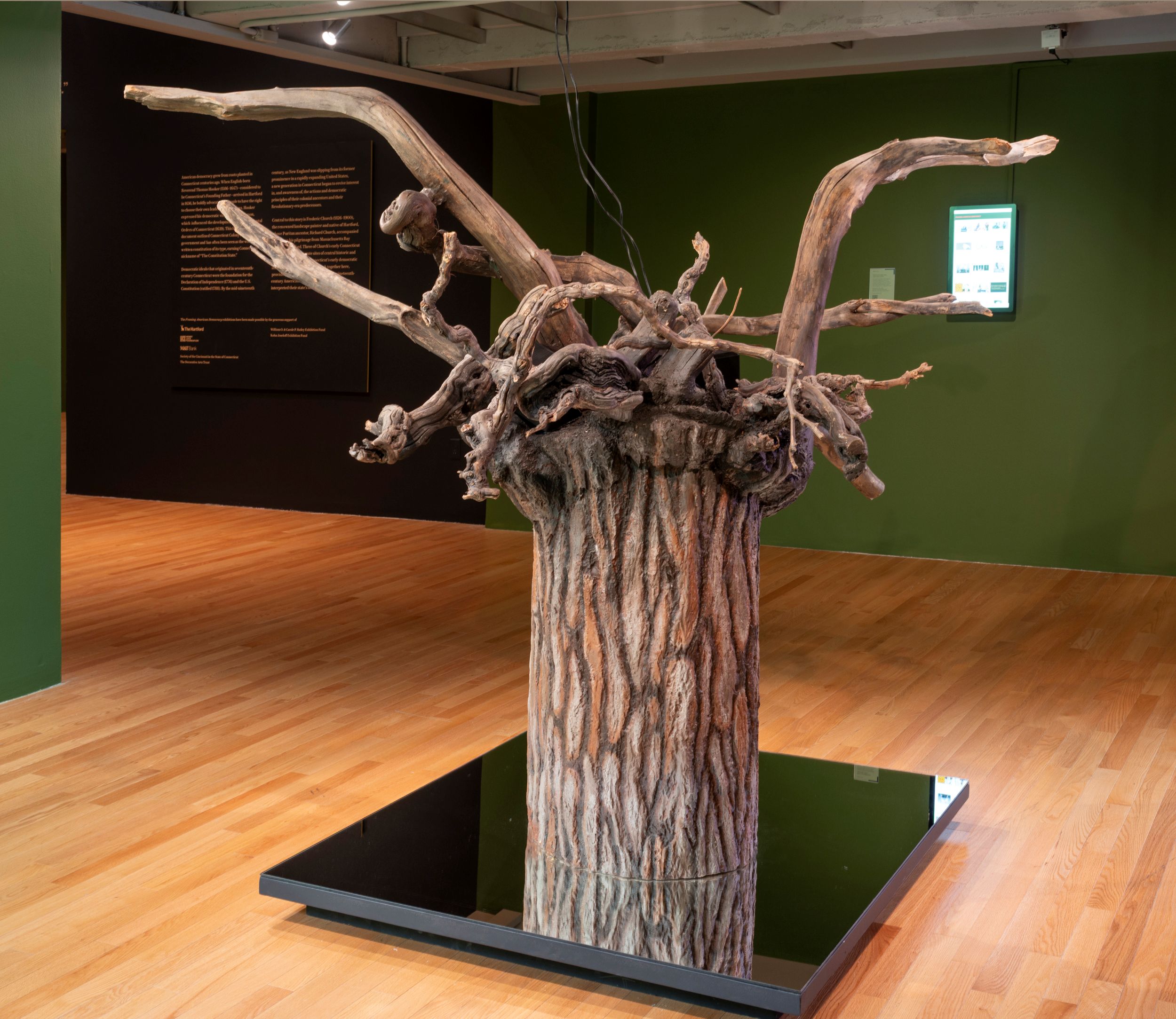
While the Charter Oak tree has long served as a symbol of liberty and self-governance in Connecticut, The Wadsworth also showed different arboreal symbolism. Unrelated to the Charter Oak, the installation Direction Through Indirection (2002) by Sam Durant (b. 1961) was displayed as a counterpoint in an interpretive space adjacent to the exhibition (fig. 3). With roots emerging skyward from an inverted trunk, the installation—which also featured a layered soundtrack of blues, gospel, and hip hop, including Billie Holiday’s “Strange Fruit”—provided an alternate view of the symbolism of trees. In contrast to trees’ resonance as motifs of freedom and legacy on display in Radical Roots, Durant foregrounds their longstanding associations with painful histories of racial violence, particularly lynching. As a contrast to Church’s landscapes, this installation offered a more contemporary perspective, asking our visitors to contemplate how nature can be beautiful but also manipulated for harm.
Place and Personal Memory
The Wadsworth museum stands on the site of the Wadsworth family home, a place where influential figures in the American Revolution—Alexander Hamilton, the Marquis de Lafayette, the Comte de Rochambeau, and George Washington—met with Daniel Wadsworth’s father, Jeremiah. Colonel Jeremiah Wadsworth (1743–1804), a prominent figure in the American Revolution, served as the commissary general of the Continental Army.10 Daniel witnessed his father’s statesmanship firsthand, traveled abroad with him on diplomatic missions on behalf of the new nation, and was deeply influenced by his father’s patriotic generation. Coming of age following the Revolutionary War, Daniel sought not only to preserve his family’s long history and connections to the founding of Connecticut and the nation but also to honor that previous generation’s legacy by creating a civic space for the public to appreciate and elevate the development of American art and artists.
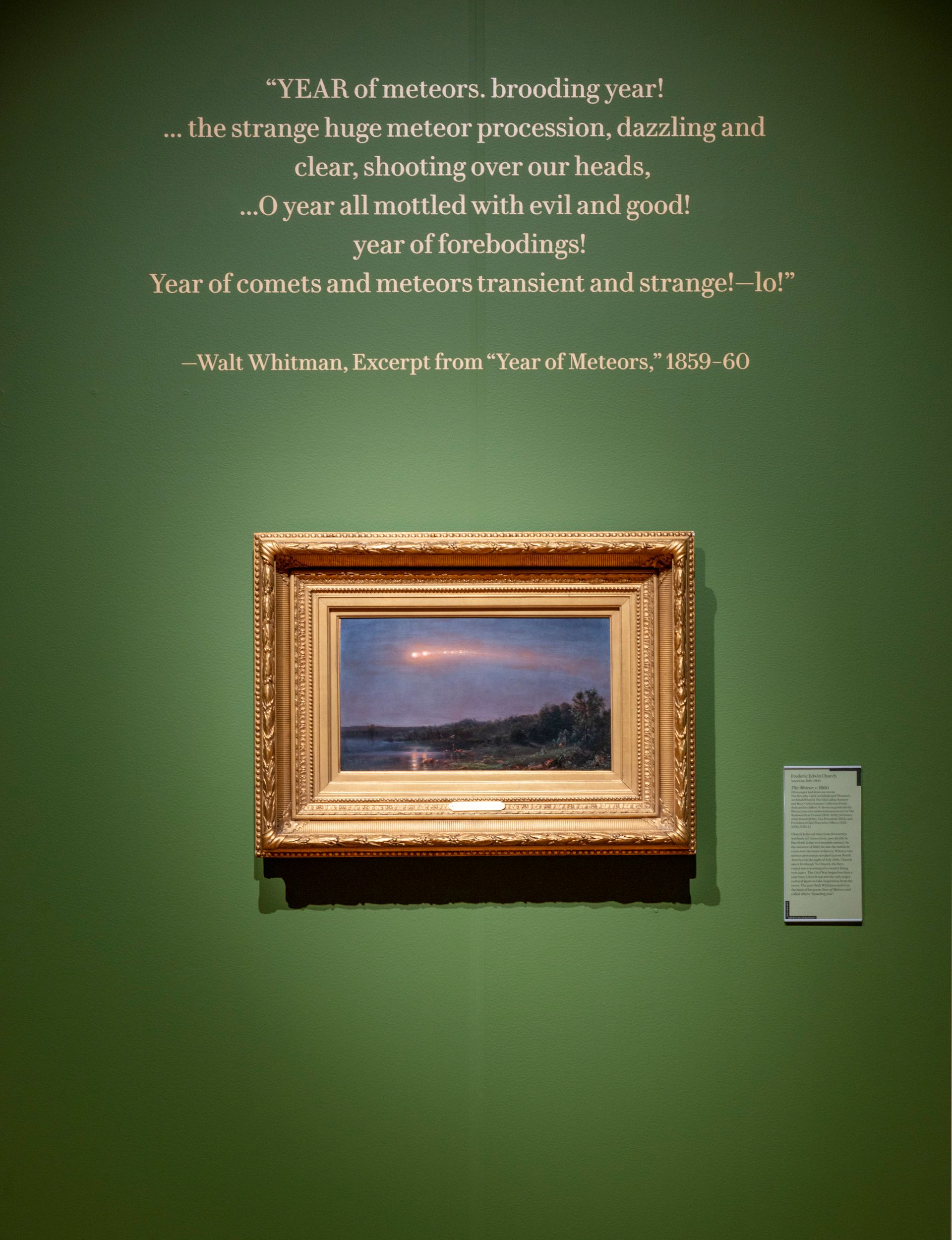
The significant visionary beginnings of The Wadsworth as a site dedicated to celebrating and preserving art for generations of the American public continue to shape its collections nearly 185 years later. Toward the end of the exhibition, Church’s The Meteor (c. 1860; fig. 4), which was acquired in 2025, expanded the narrative and historic arc of Radical Roots. In this magnificent small-scale work, Church captured an actual celestial phenomenon—an ominous procession of meteors—that he had witnessed firsthand. For Church, the event had symbolic overtones as a warning of national catastrophe as tensions about slavery threatened to tear the country apart. The inclusion of this antebellum painting, made after his first landscapes, revealed how his early interest in protecting democracy remained strong decades later. He excelled in giving visual form to the mood and emotion of the nation as he witnessed noteworthy events in American history. This new Church acquisition further reflects a commitment by The Wadsworth to celebrating his legacy, while deepening holdings of works by American artists with significant ties to the museum’s history and the city of Hartford.
The exhibition Framing American Democracy: Radical Roots at The Wadsworth offered us the opportunity to reintroduce the museum’s foundational story as one linked to its collections, particularly those that reflect on the early establishment of Connecticut and the United States. The exhibition began by exploring how the seeds of Church’s compositions were first planted within the walls of this museum and subsequently shaped by the institution’s local roots and community. Church’s landscapes ultimately expanded beyond this origin story, but they continue to invite reflection on the intersection of American landscape, identity, and history. As visitors proceeded through the exhibition, they encountered objects grounded in key moments in the nation’s history and could pause to consider both Connecticut’s role in and its citizens’ experience of these events—from westward expansion and the Civil War to the 1876 Centennial, which sparked an era of Colonial Revival that endured through the First World War and the Great Depression. The thoughtful reactions and responses we have received to Radical Roots voiced appreciation for how the exhibition prompted visitors to consider how Connecticut artists and makers throughout its history have shaped our understanding of the past and invited questions about how to hold that history accountable in the present. Viewing art and objects through a local lens let The Wadsworth provide a focused perspective that brought greater awareness to history while resonating with a broader discussion about American identity.
Cite this article: Erin Monroe and Katherine M. Tycz, “Artistic Interpretations, Rooted in Connecticut’s History in Framing American Democracy: Radical Roots at The Wadsworth, Hartford, Connecticut,” in “The Art History of the 250th Anniversary,” In the Round, edited by K. L. H. Wells, Panorama: Journal of the Association of Historians of American Art 12, no. 2 (Fall 2026), https://doi.org/10.24926/24716839.21468.
Notes
- Frederic Church’s father, Joseph, was among the dedicated group of supporters who worked together and donated funds to construct The Wadsworth building and establish a gallery of fine arts. His signature is recorded in Wadsworth Atheneum Subscription Book, early 1840s, Early Museum Records, RG0_3_B1_F2, The Wadsworth Archives, Hartford, CT. ↵
- Book of Ticket Holders to the Wadsworth Gallery and Statuary Room, 1840s–80s, Early Museum Records, RG0_3_B1_F8, The Wadsworth Archives. ↵
- Radical Roots was one of three curatorial projects on view under the wider aegis of The Wadsworth’s Framing American Democracy exhibitions that marked the 250th anniversary of the United States. This initiative also included Framing American Democracy: Contemporary Arts Reflect as well as the Amistad Center for Art & Culture’s Framing American Democracy: Rebel | Revolt | Resist. ↵
- The title of the Hooker painting is presented as it was when Church first exhibited it in 1846. However, Hooker and his companions departed from a settlement in what is now Cambridge, MA, rather than Plymouth. The other two paintings are West Rock, New Haven, 1849, oil on canvas, New Britain Museum of American Art, John Butler Talcott Fund, 1950.10; The Charter Oak at Hartford, c. 1846, oil on canvas mounted on masonite, Florence Griswold Museum, Gift of The Hartford Steam Boiler Inspection and Insurance Company, 2002.1.29. ↵
- The town was likely named after the town of Hertford, England, from which the Reverend Samuel Stone had hailed. The spelling difference reflects the contemporary pronunciation of the settlers. See A. G. Davis, “The Hertfordshire Background to Settlements in the Connecticut Valley,” Hertfordshire in History: Papers Presented to Lionel Munby (Hertfordshire Publications, 2004), 135. ↵
- The Reverend Thomas Hooker, sermon given in Hartford, CT, on May 31, 1638. The sermon was recorded in shorthand by Henry Wolcott Jr. in his notebook preserved at the Connecticut Museum of History and Culture, Hartford, CT, MS 88655. ↵
- The Fundamental Orders governed Connecticut Colony from 1639 to 1662. While they offered a more expansive form of self-representation at the time, it was still limited in nature by today’s standards; voting was limited to free men, but there was no religious test required to vote. ↵
- These Native American peoples were discussed in the exhibition on interpretive labels and panels. The Wadsworth also collaborated with Gary O’Neil / Red Oak (b. 1953), contemporary Wangunk potter and elder, on the inclusion of his artwork in the exhibition. For more on the Indigenous history of the Charter Oak and further interpretation of the symbolism in Church’s Hooker and Company, see Joseph Mizhakiiyaasige Zordan, “Where It Begins: Landscape and Ancestral Remembrance,” in Frederic Church: Global Artist, ed. Tim Barringer, Elizabeth Mankin Kornhauser, and Jennifer Raab (Yale University Press, 2026). ↵
- These objects and documents entered The Wadsworth’s collection through the 1905 bequest of Elizabeth Colt’s collection. The archival documents provide evidence of the objects’ authenticity through the written documentation of Isaac W. Stuart (1809–1861), who owned the property on which the tree stood and who aided Samuel Colt in acquiring the furniture made from the Charter Oak. ↵
- Jeremiah Wadsworth was appointed commissary general of the Continental Army; he had previously been appointed commissary of the Connecticut militia before being promoted to the same position in the Continental Army’s eastern division. Joel Lang, “Jeremiah Wadsworth, ‘Foremost in every enterprise,’” Connecticut History.org, accessed July 9. 2026, https://connecticuthistory.org/jeremiah-wadsworth. ↵
About the Author(s): Erin Monroe is the Krieble Curator of American Paintings and Sculpture, and Katherine Tycz is the Richard Koopman Associate Curator for Decorative Arts, both at The Wadsworth, Hartford, CT.