

“Remember the ladies”: Writing Women’s Art History in 1776 and 2026





PDF: Bellion, Remember the Ladies
“Remember the ladies,” Abigail Adams famously urged her husband in March 1776, four months before John Adams signed the Declaration of Independence. “If perticuliar care and attention is not paid to the Laidies we are determined to foment a Rebelion, and will not hold ourselves bound by any Laws in which we have no voice, or Representation.”1 Although “the ladies” found many ways to make their voices heard within the political culture of the American Revolution, they were not acknowledged in the Declaration and did not obtain voting rights in the federal Constitution that followed. Today, women’s rights, secured through constant effort since 1776, are once again threatened.
How, then—250 years removed from the American Revolution and in the precarity of our current political moment—are scholars approaching the writing of eighteenth-century women’s history as artists, subjects, and patrons? How, in other words, is art history rising to meet this moment?
For my part, I invite you to consider Rachel Brewer Peale (1744–1790), the first wife of the artist and museum proprietor Charles Willson Peale (1741–1827). Their marriage spanned the Revolutionary period, from 1762 to Rachel’s death in 1790. Charles painted about ten portraits of Rachel (about half are extant), rendering her one of the most visible women in the art of her day. Paradoxically, though, any documents Rachel may have written have been lost or destroyed.
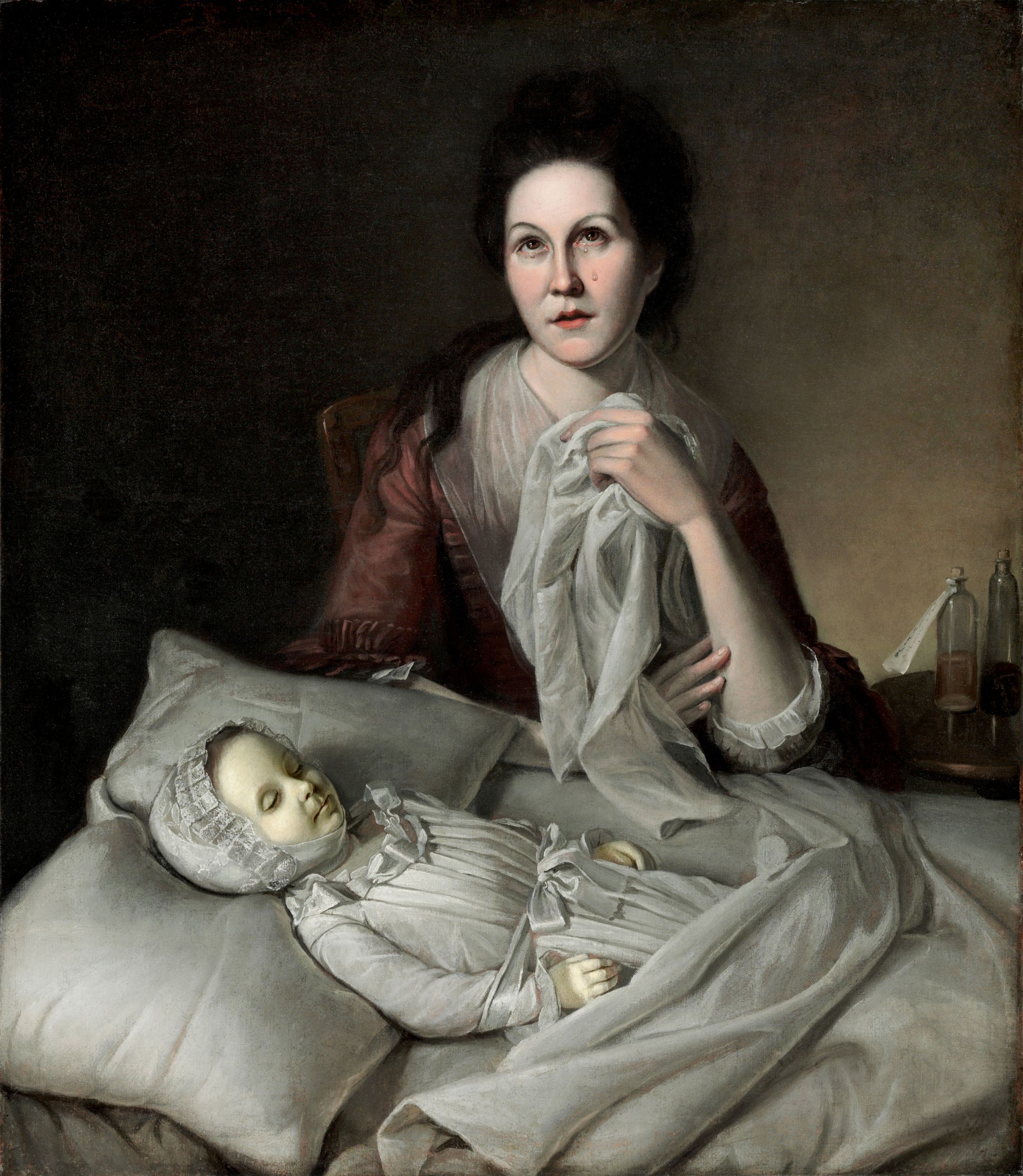
What did Rachel write? And why does this question matter in 2026? By looking at Mrs. Peale Lamenting the Death of Her Child, which John Adams was among the first to see and describe in 1776, we can discern some of the challenges of researching and writing women’s history amid past and present conundrums of representation and loss, silence and voice (fig. 1).2
Ironically, the losses are easier to see, because these are the phenomena that often make the news. And there have been many such instances of silencing lately. The March 2025 executive order “Restoring Truth and Sanity to American History” was among the first measures to assail women’s history, museums, and public monuments for supposedly perpetuating “a false reconstruction” of the American past.3 Then a host of words and phrases, many associated with gender studies and diversity efforts, began disappearing from federal websites, including “assigned female at birth,” “breastfeed,” “feminism,” “pregnant people,” and even simply the word “women.” Many critics rightfully observed the Orwellian nature of these tactics, and the New York Times highlighted the ways that deletions from websites have tried to render transgender and queer people doubly invisible.4 Black history has also been forcefully targeted: At the installation titled “Freedom and Slavery in the Making of a New Nation” at the President’s House site in Philadelphia, panels memorializing the nine men and women of African descent who were enslaved by George Washington—including Oney (or Ona) Judge, a seamstress who self-emancipated, and Moll, a nurse who did not—have been replaced by revised texts that have been critiqued for downplaying Washington’s commitment to slavery.5 There are many other examples; the term “removal” now signifies far too many alarming things.
Together, these actions challenge us to move forward in the face of institutionalized erasure, censure, and state violence. Fortunately, there are plenty of curators and scholars working to amplify the voices of women and the presence of women artists. Notable exhibitions in the United States in 2026 have included Ruth Asawa: A Retrospective at the Museum of Modern Art, New York; Edmonia Lewis: Said in Stone at the Peabody Essex Museum, Salem, Massachusetts; and Dear America: Artists Explore the American Experience at the National Gallery of Art in Washington, DC, which includes work by Dorothea Lange, Carrie Mae Weems, and Tonita Peña. This year also brings exhibitions of Pueblo pottery at the National Museum of Women in the Arts in Washington, DC; Abstract Expressionists at the Speed Art Museum, Louisville, Kentucky; and Grandma Moses at the Smithsonian American Art Museum, also in Washington. We should further be encouraged by the sheer number of recent publications on women and art, such as Thinking Women and Art in the Long Eighteenth Century, co-edited by Mechtild Fend, Jennifer Germann, and Melissa Hyde.6 Phillis Wheatley Peters, who was emancipated in November 1773 following the publication of her book Poems on Various Subjects, Religious and Moral, has been an especially robust subject of cultural scholarship (and has been memorialized by a new stamp based on a painting by Kerry James Marshall).7 Collectively, this research should inspire us to persist, as we must continue to say: to move forward with the vital work of remembering women’s histories.
In the case of Rachel Brewer Peale, this has meant reckoning with evidence of forgetting and marginalization. In contrast to several portraits of Rachel, not a single document in her hand has survived. She could read and write: Her husband, a voluminous diarist, took note of the dates when he wrote to Rachel and received letters from her. Nor has any correspondence from his two later wives been located. It has been presumed that Charles disposed of his wives’ papers after their deaths; he sought to control his own narrative, as his many self-portraits attest, and he may have deemed spousal letters too intimate to risk preserving.
In the secondary literature, Rachel has figured mainly as a devoted wife and mother: She had eleven children, six of whom died in childhood. Four additional white children lived with the family. The other white women of her household, many of whom are visible in Charles’s group portrait The Peale Family (1771–73, 1809), have been characterized in stereotypically gendered ways.8 These women and their extended families also enslaved more men and women of African descent than scholars have understood to date, including Lidya (surname unknown), whose name appears only once in the vast Peale scholarship, and Lucy (later Phillis Jackson Williams), the mother of the silhouette artist Moses Williams (c. 1777–c. 1830).9
Reconstructing these stories requires a familiar methodology of marking and parsing archival absences.10 But the painting that Charles called Mrs. Peale Lamenting the Death of Her Child (see fig. 1) also offers a unique way into this work of historical recovery. Known also as Rachel Weeping, it was subject to decades of repainting, accidental damage, and restoration. Many hands have retouched this canvas over the years, seeking, however incongruously, to resuscitate a work of art that is fundamentally about death.
The painting has a complicated history, but the short version goes something like this: It originated as a portrait of a deceased infant, Margaret Van Bordley Peale, in 1772. Four years later, Peale stitched another canvas atop and added his grieving wife. About 1820, he repaired damages and repainted sections, including Rachel’s face. Peale descendants later chronicled a series of flakings, water damage, cleanings, inpaintings, and overpaintings that stressed the support and altered the picture’s appearance. At one point, Rachel’s tears were completely stippled over—and later revealed again. A conservator in the 1960s described the picture, both uncannily and appropriately, as “a ghost of what Charles Willson Peale must have painted.”11
None of this labor is evident to those who see the painting today at the Philadelphia Art Museum, where it has been expertly treated. Nevertheless, Rachel Weeping holds within itself this complex memory of subtractions, additions, and repair. It is a painting, fundamentally, of and about loss and recovery—narratively, visually, and materially. And here resides a fulsome invitation. However unintentionally, the painting’s material record offers an analogue for the woman portrayed, a point of departure for recovering an individual whose personal history is also one of startling images and erasures.
Why do such histories of visibility and invisibility—artistic, archival, and historical—matter amid the broader commemorations and commotions of 2026? A few months ago, I was interviewed by a high school student for an Advanced Placement research project about the underrepresentation of women in American art history. We had a rich discussion about the nineteenth-century women artists of the Peale family. And when this bright student asked how she could help advance research on female artists, I realized how much more I should be doing in the classroom to encourage such work. I always include Charles Willson Peale in my survey courses of American art history—yet I discuss his descendants, including the female artists, far too seldom.
We need to remember the ladies, then, not because of Abigail Adams and a famous quip from 1776, but for the sake of new generations and the histories they will write. This coming academic year, Sarah Miriam, Margaretta, and Anna Claypoole Peale will feature prominently in my classes alongside the well-known male artists of the family: Charles Willson, Raphaelle, and Rembrandt.12 So will Rachel Brewer Peale, and the many other woman who made their art and lives possible.
Cite this article: Wendy Bellion, “‘Remember the ladies’: Writing Women’s Art History in 1776 and 2026,” in “The Art History of the 250th Anniversary,” In the Round, edited by K. L. H. Wells, Panorama: Journal of the Association of Historians of American Art 12, no. 2 (Fall 2026), https://doi.org/10.24926/24716839.21487.
Notes
- Abigail Adams to John Adams, March 31, 1776, Founders Online, National Archives, accessed September 15, 2026, https://founders.archives.gov/documents/Adams/04-01-02-0241. Originally published in The Adams Papers: Adams Family Correspondence, vol. 1, December 1761 – May 1776, ed. Lyman H. Butterfield (Harvard University Press, 1963), 369–71. ↵
- This essay is drawn from my forthcoming book, Rachel Weeping: Love and Loss in Revolutionary America. ↵
- Exec. Order No. 14253, “Restoring Truth and Sanity to American History,” March 27, 2025, https://www.whitehouse.gov/presidential-actions/2025/03/restoring-truth-and-sanity-to-american-history. ↵
- “These Words Are Disappearing in the New Trump Administration,” New York Times, March 7, 2025. ↵
- Carmen Russell-Sluchansky, “Trump Administration Replaces Philly President’s House Slavery Exhibit ‘under the cover of darkness’ after Monthslong Legal Battle,” WHYY, July 15, 2026, https://whyy.org/articles/presidents-house-slavery-trump-exhibit-philadelphia-replaced. ↵
- Mechtild Fend, Jennifer Germann, and Melissa Hyde, eds., Thinking Women and Art in the Long Eighteenth Century: Strategic Reinterpretations (Routledge, 2025). ↵
- See, for example, David Waldstreicher, The Odyssey of Phillis Wheatley: A Poet’s Journeys Through American Slavery and Independence (Farrar, Straus and Giroux, 2023). ↵
- New-York Historical, inv. no. 1867.298. ↵
- Peale’s purchase of an enslaved woman in 1764 is mentioned (though Lidya is not named) in David Ward, Charles Willson Peale and Selfhood in the Early Republic (University of California Press, 2004), 23. Lucy and her spouse, Scarborough, who was also enslaved by the Peales, changed their names to Phillis Jackson Williams and John Williams upon their manumission in the 1780s. The Williams family, including the silhouette artist Moses Williams, has been the subject of important new research: Gwendolyn Dubois Shaw, “‘Interesting Characters by the Lines of their Faces’: Moses Williams’s Profile Portrait Silhouettes of Native Americans,” in Black Out: Silhouettes Now and Then, ed. Asma Naeem (National Portrait Gallery, Smithsonian Institution, 2018), 60–73; Gwendolyn Dubois Shaw, “Profiling Moses Williams: Silhouettes and Race in the Early Republic,” in The Art of Remembering: Essays on African American Art and History (Duke University Press, 2024); and Ellen Fernandez Sacco, “Not Yet Completely Free: Gradual Emancipation and the Family of Moses Williams, Philadelphia, 1776–1833,” Journal of the Afro-American Historical and Genealogical Society 43 (2025): 85–103. ↵
- See, for example, Tiya Miles, All That She Carried: The Journey of Ashley’s Sack, a Black Family Keepsake (Random House, 2021). For a historiographical reflection, see Susan Branson, “From Daughters of Liberty to Women of the Republic: American Women in the Era of the American Revolution,” in The Practice of US Women’s History: Narratives, Intersections, and Dialogues, ed. S. J. Kleinberg, Eileen Boris, and Vicki Ruiz (Rutgers University Press, 2019), 50–66. ↵
- Caroline K. Keck to Charles Coleman Sellers, November 14, 1967, Charles Coleman Sellers Collection, c. 1940–78, Mss. Ms. Coll. 3, series I: CWP Portraits, folder “Rachel Weeping. Restoration #2,” American Philosophical Society, Philadelphia. The conservation history of Rachel Weeping is detailed in correspondence of the Sellers Collection. ↵
- For further reading, see Anne Sue Hirshhorn, “Anna Claypoole, Margaretta, and Sarah Miriam Peale: Modes of Accomplishment and Fortune,” in The Peale Family: Creation of a Legacy, ed. Lillian B. Miller (National Portrait Gallery, Smithsonian Institution, 1996), 220–47. ↵
About the Author(s): Wendy Bellion is the Sewell C. Biggs Chair in American Art History at the University of Delaware.