

Hunter Museum Mixes Old and New





PDF: Makrandi and Nye, Hunter Museum Mixes Old and New
In Chattanooga, Tennessee, the Hunter Museum of American Art’s practice of exhibiting objects from its permanent collection across different eras, grouped by similar themes, has produced striking juxtapositions. In the decorative arts gallery, a glass sculpture by Beth Lipman (b. 1971) titled Flowers, Bread, Chalice and Sticks (2012) is on view beside a classic still life by Severin Roesen (1815–1872), Nature’s Bounty (1852–54) (fig. 1). Visitors are often drawn first to Lipman’s installation, and from there they encounter a conversation between styles and decades that allows them to explore the enduring influence of early American art on contemporary life.
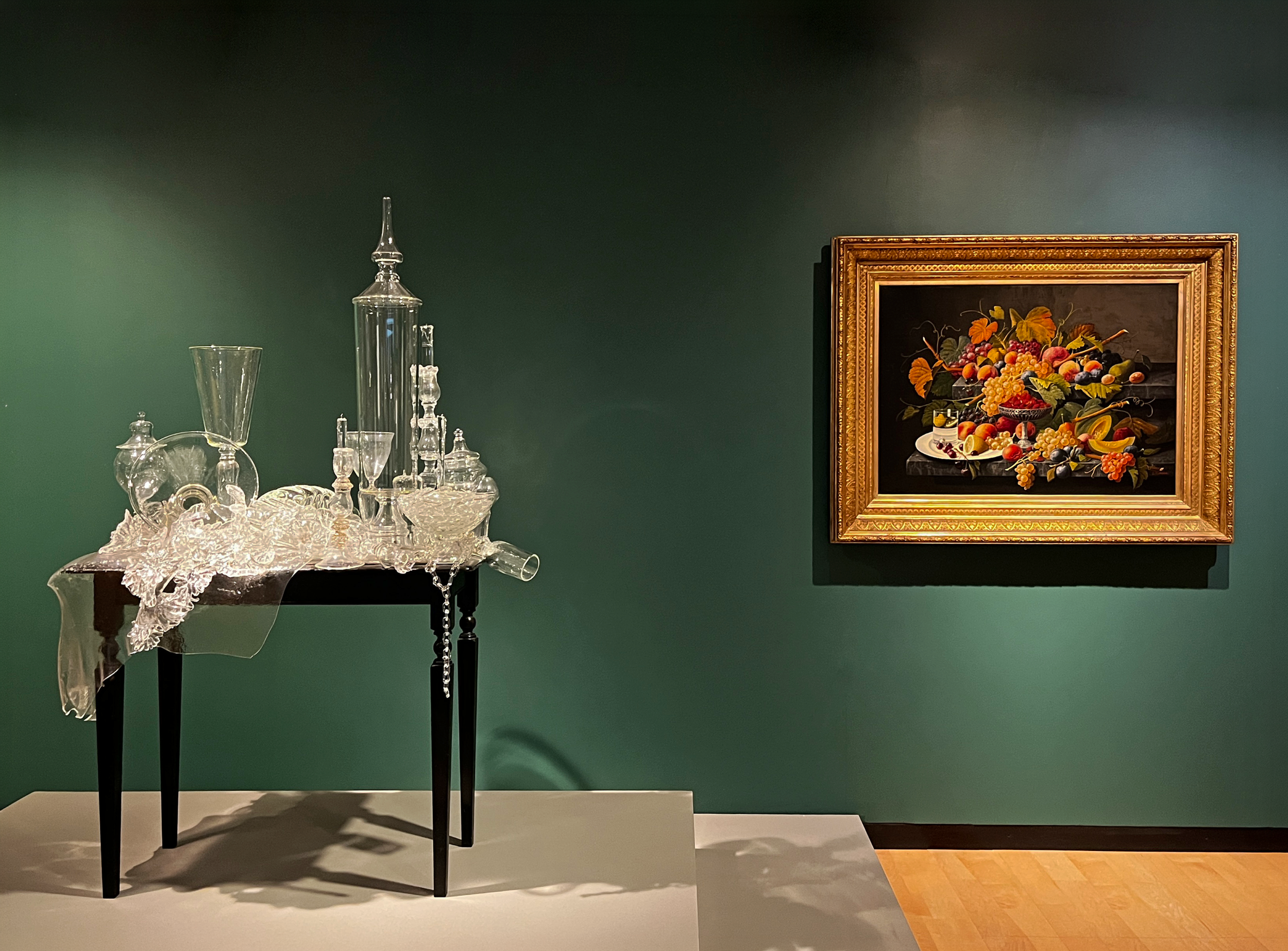
In addition to Lipman, the gallery highlights other historical and contemporary women artists. It currently features the work of pressed-glass sculptor Amber Cowan alongside that of Maria Longworth Nichols Storer, the founder of Rookwood Pottery. These pairings are complemented by classic decorative arts pieces by Tiffany and Company and John La Farge. This approach of blending the historical and the contemporary has helped us grow our audience in both areas while amplifying female voices.
Another space where we have experimented successfully with this approach is the early American portrait gallery. While the permanent collection is rich in historical portraiture, including works by Thomas Sully, Ammi Phillips, and Rembrandt Peale, depictions of and by more diverse early Americans are lacking. To address this imbalance, the Hunter Museum has drawn on works from its significant contemporary art collection and its partnership with the Art Bridges Foundation. The portrait gallery now features striking works by Glenn Ligon, Fabiola Jean-Louis, David Driskell, and Barkley Hendricks that directly address the disparity in the preservation of works by artists of color. Through the juxtapositions, visitors are immediately part of the conversation about who has been left out of art history and why. With grant-funded support from the Art Bridges Foundation, the museum has also created a digital interactive experience based on this gallery, allowing visitors to create self-portraits that can then be viewed and shared online.
A perusal of our nineteen permanent-collection galleries that have adopted this approach highlights the Hunter Museum of American Art’s prioritization of previously overlooked communities of artists to tell a more complete story of American art. Acquisition funds over the last two decades have focused on women artists, artists of color, new media, and historically underrepresented early American makers. The mixing of historical with contemporary has helped us remain relevant to our guests while illustrating important connections fundamental to the art of the United States.
Cite this article: Nandini Makrandi and Lauren Nye, “Hunter Museum Mixes Old and New,” in “In the Galleries,” edited by Elizabeth McGoey and Sara Picard, Panorama: Journal of the Association of Historians of American Art 12, no. 1 (Spring 2026), https://doi.org/10.24926/24716839.21033.
About the Author(s): Nandini Makrandi is the chief curator and Lauren Nye is an associate curator of the Hunter Museum of American Art, Chattanooga, TN.