

Queer Localities: Space, Class, and Desire in Thomas Painter’s Visual Archive





PDF: Del Dago, Queer Localities
The following essay contains artistic depictions of sexual activity.
Thomas Painter (1905–1978) was a key informant for the American sexologist Alfred Kinsey and a prolific yet largely overlooked documentarian of mid-twentieth-century queer life. Beginning in the 1930s, he turned his benevolent interest toward New York’s urban proletariat, forming relationships with men whose laboring bodies and straightforward manner he idealized. Across thousands of photographs, drawings, journals, and autobiographical writings produced between the 1930s and 1970s, Painter assembled an extensive visual and written record of encounters with working-class men in New York, San Francisco, Puerto Rico, and elsewhere.1 Preserved today at the Kinsey Institute at Indiana University Bloomington, his archive offers a rare view of queer social worlds that left few conventional documentary traces.
Painter’s archive was not an incidental accumulation of personal materials. His practice of documentation developed into a sustained and highly structured project, shaped in part through his relationship with Kinsey. While Painter had already begun recording his experiences before their collaboration, Kinsey encouraged him to produce and record detailed accounts of his sexual life, and Painter came to understand his work as a form of contribution to scientific research.2 He positioned himself as an unofficial collaborator and amateur ethnographer, documenting not only his experiences but also the environments and social types he encountered. Painter’s images and writings thus occupy an ambiguous space between personal record, erotic production, and quasi-scientific observation. Although there is no evidence that these writings and images were publicly or widely exhibited, they circulated within a research context at the Kinsey Institute and were understood by Painter as empirical material for the study of sexuality.3 Taken together, Painter’s archive suggests a deliberate effort to document, organize, and preserve a world of queer social relations for future study and interpretation, one that he understood to be ephemeral and at risk of disappearance.
Rather than providing a representative portrait of gay life, however, Painter’s work reveals how queer desire was structured through encounters shaped by class difference, spatial contingency, and unequal conditions of visibility. His work documents the spaces in which working-class male bodies became visible and accessible while also exposing the eroticized fantasies through which an upper-middle-class observer interpreted those encounters. Painter’s encounters with working-class men were often structured by economic exchange, and his control over the camera and the archive positioned him as both observer and author of their representation. The resulting images and records must therefore be read not solely as documentation but also as products of asymmetrical relationships that shaped what could be recorded and remembered.
The scarcity of sources like Painter’s archive reflects broader patterns of exclusion in how queer history has been preserved. As the public historian Hugh Ryan demonstrates in When Brooklyn Was Queer, working-class and racialized queer communities rarely produced the kinds of materials (namely published writing, preserved correspondence, organizational records) from which conventional archives are built.4 Economic precarity, movement, and the simple lack of storage space meant that the everyday lives and sexual cultures of these populations left few documentary traces. This archival gap obscures the existence and organization of working-class queer worlds. As scholars such as Ryan show, these worlds operated through spatial practices rather than stable institutions and through fleeting connections rather than documented associations.5 Painter’s obsessive documentation of working-class bodies and sexual encounters thus constitutes one of the few sustained visual records of non-elite queer culture from this period. This is not because such culture was rare but because it was seldom preserved.
Painter’s archive has received limited scholarly attention. Yuriy Zikratyy’s 2013 dissertation, “Cross-Class Escape and the Erotics of ‘Proletarian’ Masculinity in Thomas Painter’s Sexual Record and Visual Archive,” remains one of the few extended treatments of Painter’s work. Zikratyy focuses extensively on Painter’s sexual records and the dynamics of cross-class desire, analyzing how Painter’s middle-class subjectivity was constructed and challenged through eroticized encounters with working-class men.6 My research builds from Zikratyy’s foundational work to foreground the spatial and geographic dimensions of Painter’s practice and situate his visual work within art-historical traditions of representing the male body. Where Zikratyy examines Painter’s textual and visual construction of class difference, I trace how Painter’s understanding of masculinity, labor, and desire were shaped by a sequence of spatial encounters. In doing this, I posit that his work participated in established visual strategies for representing same-sex desire while adapting them to document and fantasize about working-class masculinity.
In this essay, I argue that Painter constructed an ideal of working-class masculinity as authentically “natural” through three interconnected spatial practices that each reworked his understanding of masculinity, leisure, and desire. Unlike the more widely recognized homoerotic productions of figures such as Tom of Finland (1920–1991) or Bob Mizer (1922–1992), which often relied on stylized or studio-based representations of the male body, Painter’s work emerged from sustained engagement with specific social environments.7 Beginning with his experiences at Coney Island, where he encountered working-class and immigrant men in a densely populated site of public leisure, Painter learned to associate masculine authenticity with laboring bodies temporarily freed from work and clothing. He translated these experiences into drawings and watercolors set in imagined Arcadian landscapes, where the constraints of class, surveillance, and negotiation also appeared to dissolve altogether. Finally, he sought to restage these encounters through private leisure photography, using rivers and outdoor excursions to produce scenes of masculine ease under more controlled conditions. Together, these three localities illuminate how one upper-middle-class gay man imagined the spatial dimensions of queer desire while documenting what he called the “urban proletariat.”8 Yet they also reveal a major contradiction: Painter idealized working-class masculinity as natural and authentic precisely because it resulted from labor, even as his fantasies depended on imagining these men freed from the very conditions that produced their bodies. Tracing this progression reveals both the documentary value of Painter’s archive and its participation in class-inflected fantasies about masculine authenticity.
Coney Island and the Discovery of Working-Class Masculinity
Coney Island occupies a foundational place in Painter’s visual and written record, not only as a recurring site but also as the location where he first articulated a connection between working-class masculinity, leisure, and erotic possibility. Throughout the 1940s and 1950s, Painter visited the beach almost every summer weekend, with his camera in hand, drawn by what he described as its “atmosphere of sex, delinquency, sex, sordidness, and sex.”9 Coney Island was not simply a backdrop for cruising. It was a historically specific environment in which laboring bodies became publicly visible under conditions that temporarily loosened social constraint.
Recent scholarship on New York’s queer geography helps clarify why this space mattered. As Ryan shows, Coney Island functioned as a shifting site of queer connection, whose meaning changed across decades shaped by transit, immigration, and patterns of leisure rather than by fixed neighborhood identity.10 He documents how Coney Island attracted working-class immigrants (particularly Italian, Irish, and later Puerto Rican populations) whose presence created density, anonymity, and erotic possibility. The beach became a regular site of queer encounter not through organization but through accessibility via cheap subway fares, physical exposure through swimsuits and minimal clothing, and a carnivalesque atmosphere.11 Painter’s photographs record moments of contact made possible by these conditions—the spectacle of exposed bodies and the loosening of surveillance that came with crowds. His encounters here should be understood not as evidence of an absence of queer worlds but as participation in a dispersed and often ephemeral form of queer sociality that left few conventional archival traces.
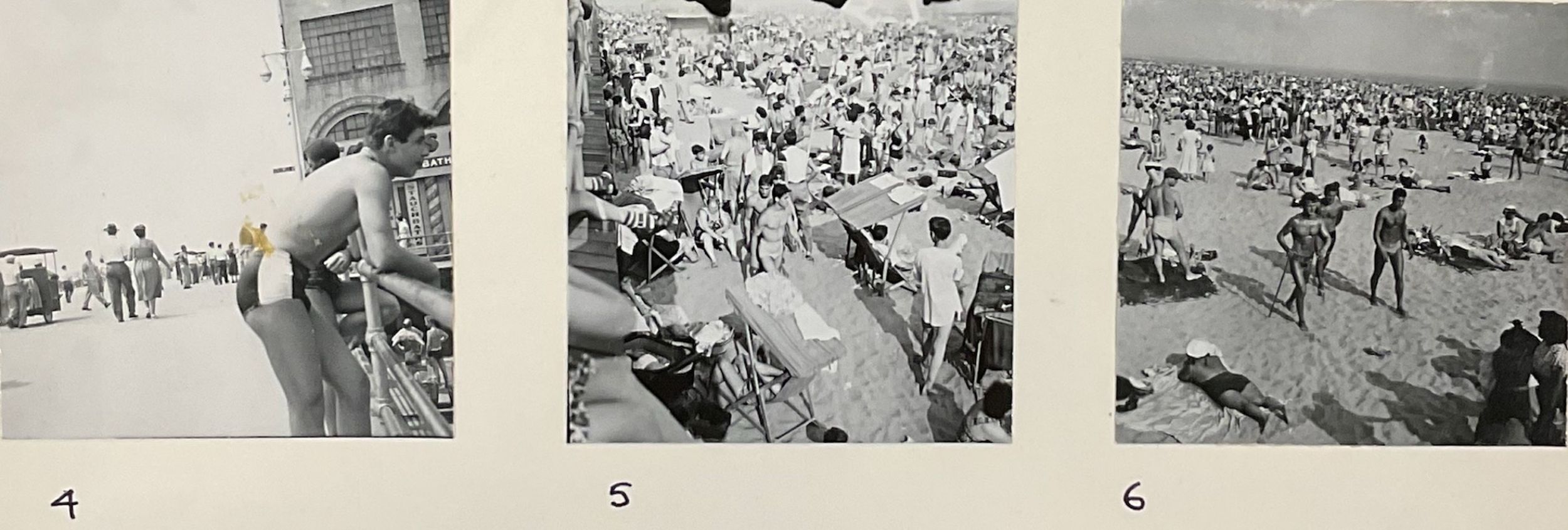
The photographs Painter took at Coney Island between 1945 and 1960 reveal his fascination with what he termed “sartorial emancipation.”12 He used this phrase to describe the adoption of a dress style that facilitated cross-class identification, enabling individuals to distance themselves from bourgeois norms and embody alternative, often working-class, forms of gender and sexual expression. Young men in tight swimsuits, shirtless laborers, and groups of Italian and Puerto Rican immigrants reclining on towels appear repeatedly throughout the archive and best embody this notion. In the left-hand image with the number 4 (fig. 1), a young man in a fitted swimsuit stands in profile, leaning forward against a railing. His posture is relaxed but self-aware, with his hips angled, shoulders forward, and gaze directed off frame. The background suggests a boardwalk, with other figures receding into the distance. In the middle image with the number 5 (see fig. 1), we observe a densely packed beach scene from a slightly elevated angle. Men in swimsuits dominate the foreground; towels, folding chairs, umbrellas, and bare sand create a textured, almost chaotic pattern. The photograph feels energetic and sensual: bodies overlap, brush past one another, and move in proximity, creating a visual field of figural abundance. In the third image of this trio, labeled with the number 6 (see fig. 1), Painter represents a wide beach view with groups of men standing, walking, or reclining on towels. Several muscular figures stand upright, their poses casual yet performative, as if aware of being seen. Across all three photographs, the male body is central—not idealized in a studio sense but observed in a lived and public space.13 Figures overlap and crowd the frame, producing a sense of abundance that is both social and erotic. Painter’s attention to posture, musculature, and bodily ease suggests desire, yet the camera maintains observational distance.
What made Coney Island significant was its character as the “slum New York transported to the sea front,” according to one contemporary observer.14 Here was a democratic space where, as an Italian immigrant put it in 1925, “the garments of Puritanism are given a kick that sends them flying before the winds.”15 The proximity of nearly naked bodies, the mixing of ethnic groups, and the carnivalesque atmosphere all contributed to what Painter experienced as a liberation from middle-class conventions about propriety and bodily display. The American historian George Chauncey notes that “homosexuals frequented and occasionally made sexual contacts at most of the baths at Coney Island, including one where professional male models, bodybuilders, and their admirers gathered in the 1930s, and another where gay men could do little more than enjoy the company of ‘tough’ working-class boys and young men.”16 Yet this was also a space of risk: There are documented instances where Painter was rebuffed, threatened, and physically attacked when his propositions were unwelcome, reminding us that the beach and the city was never simply free and liberatory but remained a contested terrain where class and sexual difference intersected unpredictably.17
Painter’s relationship to this space was largely voyeuristic. Coming from an affluent background yet largely depending on his own finances throughout adulthood created an awkwardness surrounding the question of which social spaces made him feel comfortable or accepted. Despite his recurring fantasy of becoming “an accepted buddy and peer,” he primarily operated as an observer.18 The “sneak snaps” he took with his portable Ansco camera captured men unaware, turning them into objects of study and desire.19 These images share formal qualities with ethnographic documentation in their attention to bodily type and behavior, yet Painter’s intent diverged sharply from reformist traditions of social photography. Where Progressive-era photographers documented raggedness as evidence of poverty requiring intervention, Painter eroticized bodily visibility as a sign of vitality and authenticity. From this perspective, his photographic practice shares similarities with the history of street photography and individuals like Garry Winogrand (1928–1984) who produced prolific series of photos documenting quick, everyday moments in postwar American life.20 For photographers like Painter working around the mid-twentieth century, Coney Island offered a rare environment where same-gender looking could happen openly, even if it remained coded. His camera, furthermore, enabled prolonged looking without direct engagement, producing an archive structured by desire but limited by distance.
Arcadian Fantasy and the Naturalization of Masculinity
If Coney Island represented the reality of urban working-class leisure, the natural settings in Painter’s drawings and sketches function as utopian spaces where men exist free from social constraint. Yet this turn toward idealized nature was hardly unique to Painter. His sketches and watercolors from the 1940s that depict male figures in pastoral and wilderness settings (sailors heading toward mountainous islands, groups of men in Western landscapes, muscular figures posed on hillsides) participate in a long art-historical tradition of Arcadian imagery. Although Painter strangely described these images as representations of “nothing,” they draw on a tradition where idealized natural settings position figures “outside culture” in landscapes untouched by modernity, social hierarchy, or historical specificity.21 This Arcadian idyll served as a convention that allowed artists to represent the male nude and male-male intimacy through the formal language of the classical pastoral, using idealized nature as both subject matter and alibi.
This tradition has particular significance for representing same-gender desire. As Jonathan Katz and André Dombrowski demonstrate in their analysis of the images of male bathers by Frédéric Bazille (1841–1870), the Arcadian landscape offered queer artists a framework for depicting homosocial and homoerotic content while deflecting attention through classical reference and formal composition.22 In the American context, Swimming (1884–85) by Thomas Eakins (1844–1916) positioned nude male bodies in an idealized natural setting, using the rhetoric of healthy outdoor recreation to justify the display of same-gender desire. Michael Hatt’s analysis of both Eakins and the British painter Henry Scott Tuke (1858–1929) shows how turn-of-the-century artists deployed Arcadian conventions to create images of male bodies in nature that could circulate as both respectable art and covert erotica.23 Photographs of Sicilian youths posed as classical figures in Mediterranean landscapes by Wilhelm von Gloeden (1856–1931) extended this tradition into photography, demonstrating how Arcadian imagery could traverse media. These precedents established a visual vocabulary that Painter would adapt to his particular interest in working-class American masculinity.
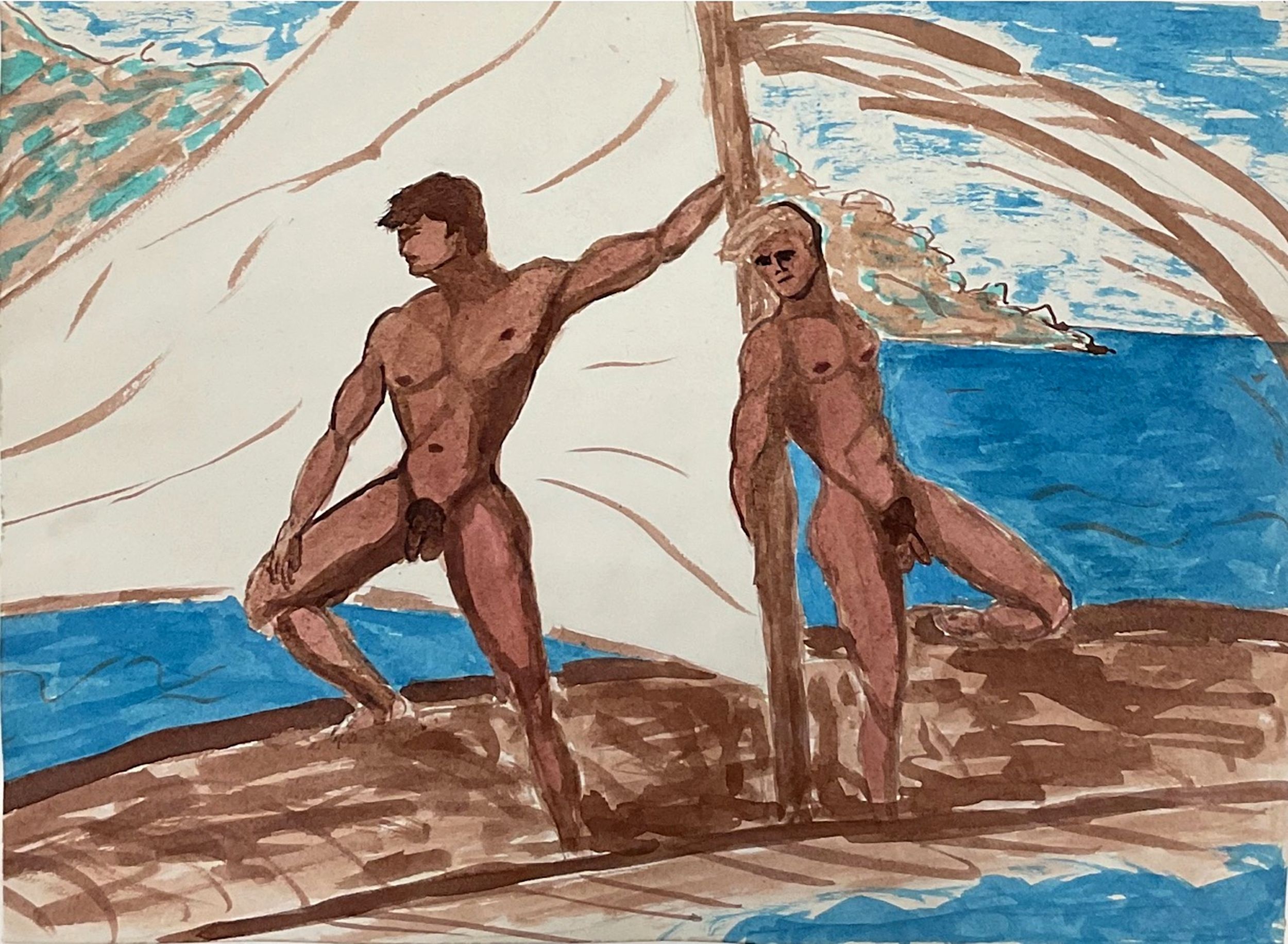
In a watercolor by Painter dating from October 1945, we see an example of his experimentation with new mediums and the placement of bodies in classical landscapes or idyllist spaces (fig. 2). Here, two nude male figures are poised on a small, improvised sailing vessel. A billowing white sail, loosely defined with pale washes and spare contour lines, rises behind and between the men, catching the wind. The sail functions almost like a backdrop or stage prop, setting the figures into relief. Both bodies are painted in warm browns and pinks, their nudity matter of fact and unidealized, integrated naturally into the scene rather than staged for display. In the distance, an island with a mountainous silhouette rises from the sea, sketched in muted earth tones and greens. The scene recalls classical idylls while remaining provisional in execution. The bodies are integrated into the landscape rather than isolated as objects of display. Yet nature here does specific work; it plays with the markers of labor, ethnicity, and urban modernity that characterize Painter’s Coney Island photographs, allowing the masculine bodies to appear timeless and unburdened. What had been contingent and observable at Coney Island is here reimagined as natural and inevitable. The move from documentation to fantasy allowed for the creation of a space seemingly liberated from social constraint. Nature operates as an active element in this transformation, functioning not as mere backdrop but as an ideological force that naturalizes same-gender desire by positioning it outside culture and history.
Painter’s friendship with the American artist Edward Melcarth (1914–1973) deepened this turn to nature and Arcadian fantasy. Living together in the late 1940s and early 1950s, the two shared an investment in outdoor life and physical culture as alternatives to bourgeois domesticity. From 1945 to 1952, Painter resided at Melcarth’s studio at 1364 Sixth Avenue in New York, a space he described as operating like “a communal enterprise” where artists, models, sailors, hustlers, and various hangers-on circulated freely.24 Melcarth’s work celebrated working-class male bodies in natural and urban settings, framing laboring masculinity as both an aesthetic and moral value. The shared apartment became a site for weekly drawing sessions where members of their queer artistic circle gathered to sketch and sculpt nude male models. Here, the pretense of artistic practice provided cover for sexual possibility, and the collective nature of these gatherings normalized the presence of naked working-class men in middle-class homosexual spaces. Under Melcarth’s tutelage, Painter learned to see natural and imagined settings not just as backgrounds but as active elements in the construction of masculine identity.
In a sketch from around 1946 to 1948 (fig. 3), Painter explicitly acknowledges borrowing elements from one of Melcarth’s drawings. The resulting composition is friezelike rather than chaotic. Paired figures occupy the picture plane alongside horses and minimal camping equipment, combining classical compositional logic with American frontier iconography. In describing this work, Painter wrote on the back of it: “More camping. The figure on the extreme left is from one of Edward’s drawings. Horses thanks to the National Geographic again.”25 The tattooed body carries class markers into the supposedly timeless space of Arcadia, revealing that even in fantasy, Painter could not fully extract working-class masculinity from the conditions that produced it.26 The landscape functions as a fantasy space in which laboring bodies can exist outside surveillance and risk, yet the signs of work remain inscribed on their forms. These imagined environments extend Painter’s effort to naturalize a masculinity first encountered at Coney Island by displacing historically situated bodies into scenes of apparent inevitability.
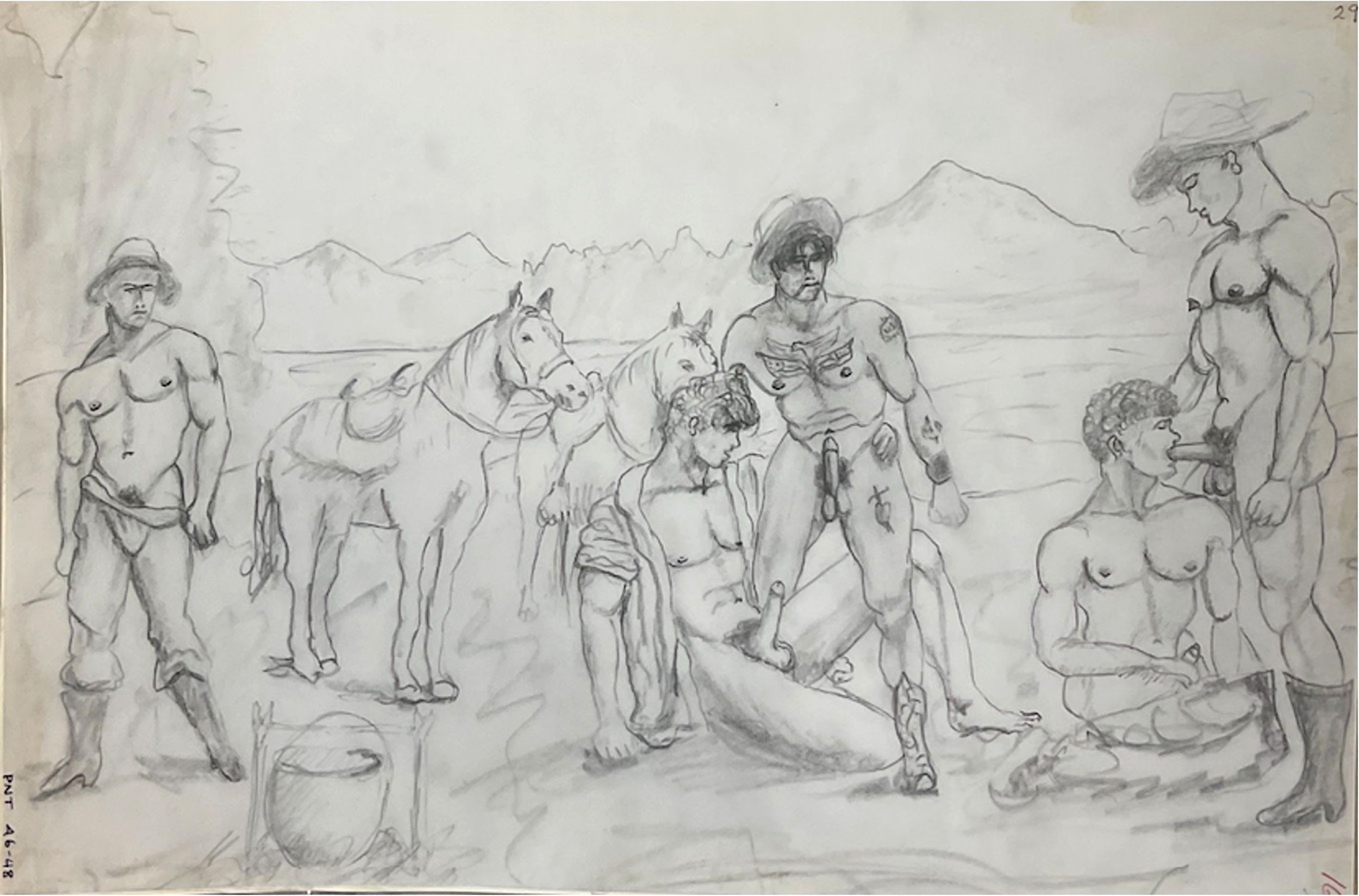
This exploration of specific kinds of natural settings, both observed and imagined, extends Painter’s investigation of spaces where masculine bodies could exist with freedom. If his previous photographs from Coney Island examined the beach as a site where working-class men claimed leisure and physical expression within urban modernity, his nature drawings reveal how wilderness (land separate from human development and activity) functioned as an alternative site of desire. The artist’s move from documentation to fantasy, from camera to pencil, allowed for the creation of spaces liberated from social constraint. Here, in Western plains and pastoral landscapes, men exist in complete nudity, their bodies unmediated by the conventions of beachwear or recreational activity.27 Painter adapts this fantasy to his particular erotics of class, imagining working-class men teaching other working-class men the “mysteries of nature” that upper-middle-class men like himself could only observe.
These natural settings operate as utopian spaces in the fullest sense: places that exist outside the ordinary structures of American life yet are constructed from its iconic imagery. By merging classical aesthetics of the idealized male nude with the mythology of the American frontier, the artist created a visual vocabulary for expressing desires that had no sanctioned place in contemporary culture. The drawings’ status as “nothing,” as Painter himself suggested, speaks to their existence outside conventional frameworks of meaning and purpose. Yet in depicting these scenes of masculine beauty and intimacy set against mountains, water, and open skies, they articulated something else: a vision of male community and freedom that could only be imagined, sketched into being on paper.
Staging Masculinity in the Great Outdoors
Bridging the public spectacle of Coney Island and the utopian fantasies of his drawings, Painter also developed a photographic practice centered on “men in leisure.” Such images document moments when his subjects existed outside the demands of labor or social expectation. In rivers and quiet outdoor settings, Painter’s camera captured bodies at rest, revealing the quality of masculine ease that leisure made possible.
The class dynamics of these excursions are crucial. As Painter acknowledged in his correspondence with Kinsey, most of his photographic subjects (immigrants, merchants, hustlers, day laborers) could not afford the kind of outdoor recreation he organized. Painter would pay men to accompany him on these trips, effectively purchasing both their time and their willingness to be photographed nude or seminude in natural settings.28 This economic transaction structured the images’ production in ways that complicate any reading of them as documenting authentic leisure. This leisure was purchased, staged, and directed by someone whose class position allowed him to organize such excursions. Where Impressionist paintings of bourgeois leisure celebrated a class’s right to recreation (as Paul Smith and Linda Nochlin have shown in their analyses of George Seurat and other painters of modern life), Painter’s photographs document a form of leisure that working-class men performed for an upper-middle-class patron’s camera.29
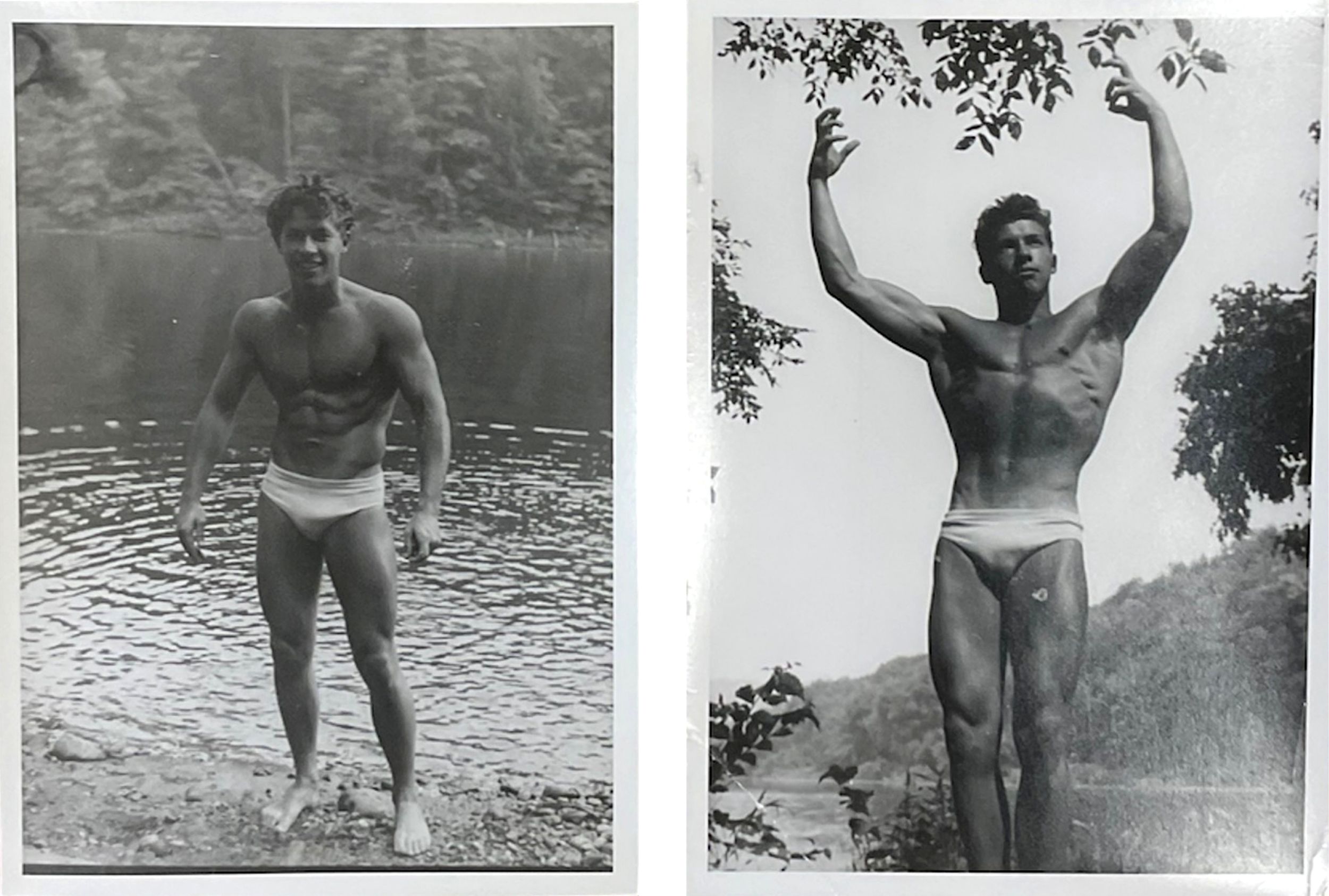
One set of photographs shows a young man emerging from a lake or river, water still clinging to his skin, standing in white briefs against a natural backdrop (fig. 4). His posture is calculated, with his muscular torso facing the camera on the left-hand side and his arms held up above his head in a godlike pose that emphasizes his physique on the right. What distinguishes these images from Painter’s Coney Island documentation is their intimate scale and the evident relationship between the photographer and the subject. This man knew he was being photographed. He consented to Painter’s presence, accepted his camera as part of the encounter. Yet the image suggests something beyond mere transaction.
The leisure setting in such photographs strip away markers of class and occupation that would have been visible in urban contexts. Without work clothes or city streets to contextualize them, these bodies became what Painter sought: representations of honest and unguarded masculinity. The natural settings allowed him to frame working-class men’s bodies in ways that emphasized their beauty without documentary weight. This pattern reveals how leisure itself became a commodity in Painter’s photographic practice. The beach picnics, river trips, and outdoor adventures represented luxuries made possible by Painter’s middle-class resources. His camera captured moments of ease and pleasure that he had purchased, even if he interpreted them as revealing truths about working-class masculine vitality.
Later in life, Painter had a growing interest in what he considered the real interpretation of male beauty, found not in studied poses but in the unguarded moments between them. Another photograph exemplifies this effort: A nude man reclines on a sandy shore, pipe in mouth, using his clothes as a makeshift towel beneath him (fig. 5). His left leg extends toward the water in a gesture that suggests both relaxation and proprietorship over the space he occupies. The composition emphasizes his comfort in his own nakedness, the ease with which he inhabits the rocky landscape. The reclining smoker seems genuinely absorbed in his moment of leisure, his awareness of the camera not disrupting his repose but incorporated into it. The shot captures what appears to be a private moment while acknowledging the photographer’s role in creating the conditions for that moment to occur.
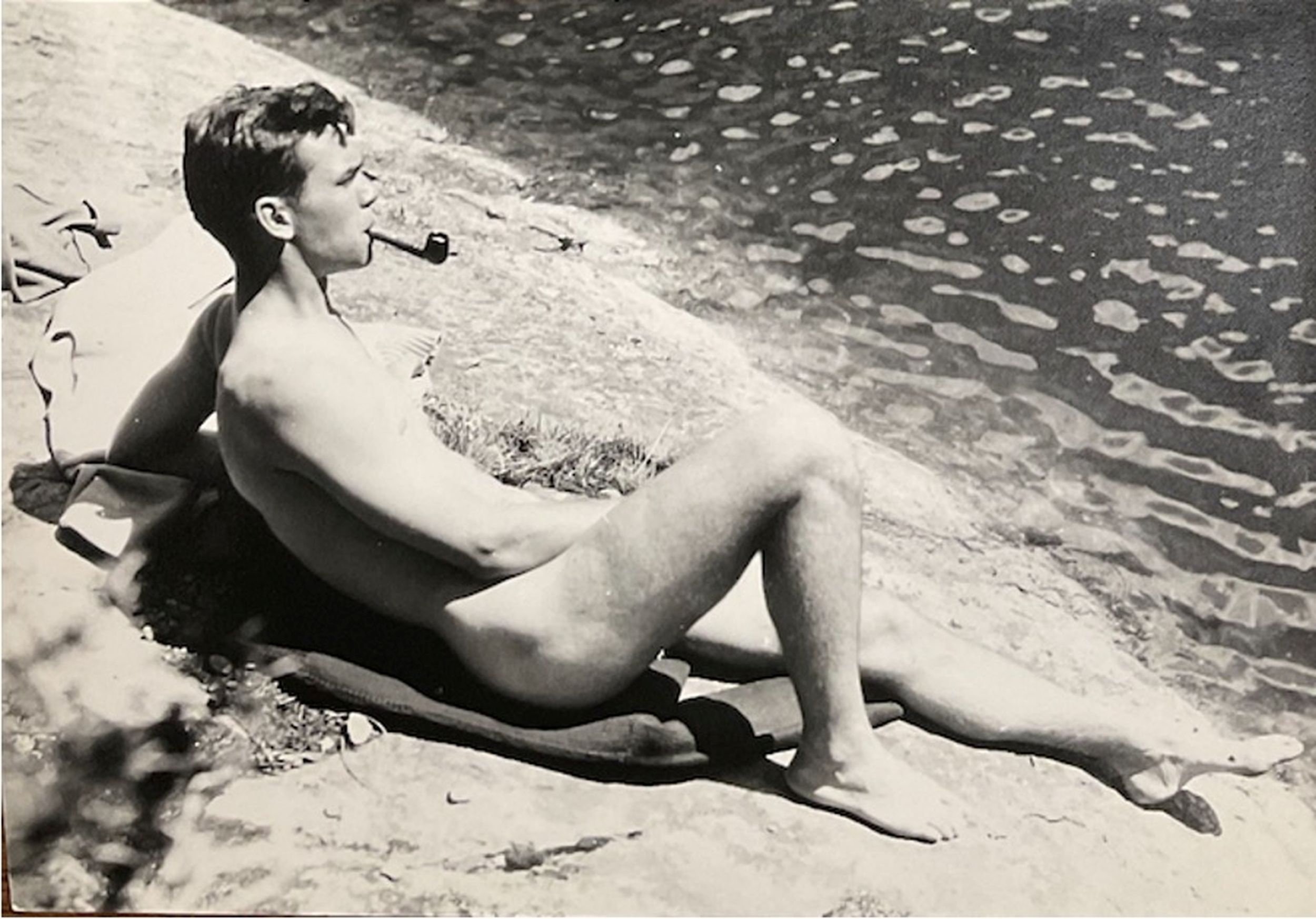
The resulting images occupy an ambiguous space between documentation and desire. They present themselves as natural, uncontrived records of men at ease, yet their every element was orchestrated by the photographer who selected the location, suggested the activities, and directed the camera’s gaze. The men’s “unguarded” ease was produced through Painter’s careful arrangement of circumstances that would allow such ease to appear. In this sense, the photographs reveal as much about Painter’s fantasy of unmediated access to working-class masculine authenticity as they do about the men themselves.
Still, these images preserve something valuable: evidence of how working-class men in mid-century America negotiated their own relationships to leisure, to their bodies, and to the camera. Some subjects clearly performed for Painter, flexing or posing in ways that demonstrated awareness of the conventions of physique photography (see fig. 4). Others seemed genuinely absorbed in the pleasures of swimming, sunbathing, or smoking. Many photographs suggest a third possibility: that these men found ways to enjoy the excursions and the attention while remaining aware of the transaction that structured them, creating a complex interplay between performance and genuine experience.
Constructing Queer Masculinity through Space
Painter’s visual archive documents a specific historical formation: the construction of working-class masculinity as naturally authentic by an upper-middle-class observer in mid-twentieth-century America. His resulting work—in contexts ranging from Coney Island’s public beach, to Arcadian fantasy, to staged private leisure—reveals the spatial logic of this construction. Yet each spatial practice contained its own contradictions. Coney Island offered observation without engagement. Arcadian fantasy achieved timelessness only through invention. Private leisure required payment and performance, making visible the very transactions it sought to naturalize.
This body of work must be understood in relation to broader shifts in class, immigration, and masculinity at mid-century. The 1940s and 1950s saw massive demographic changes in New York as Puerto Rican migration increased, Italian and Irish immigrant communities consolidated or dispersed, and deindustrialization began to transform the urban economy.30 Painter’s obsessive documentation of working-class and immigrant masculinity coincided with anxieties about these changes, anxieties that manifested in his idealization of laboring bodies as repositories of authentic masculinity threatened by postwar affluence, suburbanization, and shifting gender norms. His fantasy of natural working-class masculinity participated in broader mid-century discourses that positioned working-class men as more genuine, more physical, more essentially masculine than their middle-class counterparts. Yet unlike the social-scientific studies or popular representations that circulated these ideas, Painter’s archive emerged from sustained erotic investment in working-class bodies, establishing personal relationships within the spaces where they became visible.
What distinguishes Painter from artists like Tom of Finland or Bob Mizer is precisely this movement between documentation and fantasy. Tom of Finland created purely invented scenarios of hypermasculine working-class and military men, fantasies untethered from observational basis. Mizer’s Physique Pictorial constructed elaborate alibis (classical poses, athletic documentation, artistic study) for the display of male bodies, but these images rarely claimed to document actual social worlds. Painter, by contrast, began with documentation. His Coney Island photographs record actual working-class leisure at a specific historical site. His drawings then translated these observations into Arcadian fantasy, and his private leisure photographs attempted to restage the documentary within controlled scenarios. This movement from observation to invention and back to staged documentation reveals both the documentary impulse and the fantasy that structured his practice. He needed to believe he was discovering something real (working-class masculinity, a natural ease in laboring bodies), even as his artistic production increasingly depended on invention, payment, and direction.
This raises difficult questions about the archive itself. The photographs, drawings, and writings belong to Painter in the most literal sense: He created them, preserved them, and eventually donated them to the Kinsey Institute. Yet the archive also documents the lives, bodies, and sexual cultures of hundreds of working-class men, most of whom remain anonymous and had no control over how their images would be preserved or interpreted. Painter’s cruising produced encounters that these men may have experienced very differently than he did. For Painter, it created an archive of discovered authenticity, of working-class masculinity revealed through observation and fantasy. For the pictured men themselves, it may have meant quick money, momentary pleasure, unwanted attention, or simply another transaction in lives structured by economic precarity.
We must therefore approach Painter’s archive with careful attention to both its documentary value and its limitations. As one of the few sustained visual records of non-elite queer culture from this period, it provides irreplaceable evidence of how working-class and immigrant men navigated same-gender desire and participated in sexual economies. Yet it also documents the power dynamics inherent in cross-class looking, the fantasies that middle-class gay men projected onto working-class bodies, and the transactions through which images of marginalized populations entered archives. The archive preserves working-class queer life, yet it does so through a gaze structured by class privilege, erotic fantasy, and unequal control over who documents and who is documented. Painter’s work maps a geography of desire that reveals both the possibilities and the limits of cross-class intimacy in mid-twentieth-century America. His localities found in the public beach, imagined landscape, and staged nature traces the spatial forms that queer desire took when it crossed boundaries of class, even as they reveal the fantasies and transactions that crossing required.
Cite this article: Alex Del Dago, “Queer Localities: Space, Class, and Desire in Thomas Painter’s Visual Archive,” Panorama: Journal of the Association of Historians of American Art 12, no. 1 (Spring 2026), https://doi.org/10.24926/24716839.20907.
Notes
- Born into an upper-middle-class New York family, Painter was educated at Yale and raised with ideals of social service and personal discipline. His archive comprises over two thousand photographs, drawings, and more than thirty volumes of writing. ↵
- Henry L. Minton, Departing from Deviance: A History of Homosexual Rights and Emancipatory Science in America (University of Chicago Press, 2002), 176. ↵
- Some materials, such as the scrapbooks Painter donated in the early 1940s, were assembled with potential publication and future readership in mind, while most retained the immediacy of private documentation or erotic fantasy. Painter ultimately ensured the preservation of this material through its deposit at the Kinsey Institute, where it has been maintained as a resource for research. ↵
- Hugh Ryan, When Brooklyn Was Queer (St. Martin’s Press, 2019), 21–22. This is one of only a handful of published books to discuss and analyze the life and work of Painter. Others include Minton, Departing from Deviance; and Barry Reay, New York Hustlers: Masculinity and Sex in Modern America (Manchester University Press, 2010). ↵
- Helpful earlier scholarship on the intersections of queer life and its relationship to space, geography, and location include David Bell and Gill Valentine, Mapping Desire: Geographies of Sexualities (Routledge, 1995); Aaron Betsky, Queer Space: Architecture and Same-Sex Desire (William Morrow, 1997); and Gordon Brent Ingram, Anne-Marie Bouthillette, and Yolanda Retter, Queers in Space: Communities, Public Places, Sites of Resistance (Bay, 1997). ↵
- Yuriy Zikratyy, “Cross-Class Escape and the Erotics of ‘Proletarian’ Masculinity in Thomas Painter’s Sexual Record and Visual Archive” (PhD diss., Concordia University, 2013). ↵
- Kinsey’s collaboration with Painter formed part of a broader network of relationships with producers of homoerotic visual material. Kinsey also maintained a close working relationship with Mizer, from whom he acquired photographs, physique magazines, and personal histories, underscoring the importance of such materials to his research. Minton, Departing from Deviance, 173. ↵
- Zikratyy, “Cross-Class Escape,” 8. ↵
- Painter to Kinsey, September 9, 1951, Thomas N. Painter Collection, box 1, series II, C.1., folder 8, Kinsey Institute, Indiana University, Bloomington (hereafter “Painter Collection”). ↵
- Ryan, When Brooklyn Was Queer, 104–7. ↵
- Michael Immerso, Coney Island: The People’s Playground (Rutgers University Press, 2002), 8. ↵
- Zikratyy, “Cross-Class Escape,” 159. ↵
- Painter had the following descriptive captions about these three images: “4 is a brown young Italian who chanced to stand by me and hence got his picture taken. He was quite luscious. 5 shows two handsome {youths} strolling {through} the crowd. These pictures do none of the subjects justice but suggest their appeal. 6. Is one of those very conceited, objectionable, exhibitionist muscle boys, glistening with oil. He is about to speak to a couple of girls, who snubbed him completely. Note the very short, “leopard skin” shorts. His companion also is in leopard skin.” Quotations taken from the back of a series of candid photographs that Painter shot in July 1950. Painter Collection, box 30, series IV, D.1.b, folder 6. ↵
- The “contemporary observer” referenced here is the British journalist Sir Percival Phillips, writing for London’s Daily Mail; Immerso, Coney Island, 127. ↵
- Giuseppe Cautela, “Coney,” American Mercury 6, no. 23 (1925): 283. ↵
- George Chauncey, Gay New York: Gender, Urban Culture, and the Makings of the Gay Male World, 1890–1940 (Basic Books, 1994), 210–11. ↵
- Ryan, When Brooklyn Was Queer, 251–52. ↵
- Painter to Kinsey, September 5, 1953, Painter Collection, box 2, series II, D.2., folder 10. ↵
- Zikratyy, “Cross-Class Escape,” 190. ↵
- Winogrand’s series titled Women Are Beautiful is a candid street-level exploration of women in public spaces during the 1960s and ’70s, capturing shifting gender roles with a mix of admiration and curiosity. He produced thousands of photographs that centralize unposed encounters, similar to Painter’s practice. Garry Winogrand and Helen Gary Bishop, Women Are Beautiful (Farrar, Straus & Giroux, 1975). ↵
- Written on the back of a watercolor sketch by Painter. Artwork from Painter Collection, box 20, series IV C. ↵
- Jonathan D. Katz and André Dombrowski, “Painting the Prototype: The (Homo)Sexuality of Bazille’s Summer Scene,” in A Companion to Impressionism, ed. André Dombrowski (John Wiley & Sons, 2021). ↵
- Michael Hatt, “‘Muscles, Morals, Mind’: The Male Body in Thomas Eakins’ Salutat,” in The Body Imaged, ed. Kathleen Adler and Marcia Pointon (Cambridge University Press, 1993), 57–69; Michael Hatt, “A Great Sight: Henry Scott Tuke and His Models,” in Model and Supermodel: The Artist’s Model in British Art and Culture, ed. Martin Postle, Jane Desmarais, and William Vaughan (Manchester University Press, 2006), 75–88. ↵
- Zikratyy, “Cross-Class Escape,” 181–82. ↵
- Artwork and description from Painter Collection, box 22, series IV C. ↵
- As Samuel Steward documents, tattoos in this period were strongly associated with working-class and military masculinity, marking bodies as laboring, rough, and outside bourgeois respectability. See Samuel Steward, Bad Boys and Tough Tattoos: A Social History of the Tattoo with Gangs, Sailors, and Street-Corner Punks, 1950–1965 (Haworth, 1990). ↵
- This fantasy of the West as a space of natural male-male sexuality has deep roots in American culture, from Walt Whitman’s democratic vistas to mid-century physique photography’s obsession with cowboys and ranch hands. ↵
- Ryan, When Brooklyn Was Queer, 250. ↵
- Paul Smith, Seurat and the Avant-Garde (Yale University Press, 1997); and Linda Nochlin, “Seurat’s La Grande Jatte: An Anti-Utopian Allegory,” Art Institute of Chicago Museum Studies 14, no. 2 (1989): 133–53. ↵
- Edgardo Meléndez, The “Puerto Rican Problem” in Postwar New York City (Rutgers University Press, 2022). For more on deindustrialization in New York and the changing urban landscape it created, see Aaron Shkuda, The Lofts of SoHo: Gentrification, Art, and Industry in New York, 1950–1980 (University of Chicago Press, 2016). ↵
About the Author(s): Alex Del Dago is a PhD candidate in Art & Architectural History at the University of Virginia.