

Singing in Unison, Part 13: Homage to Meyer Schapiro





PDF: Rachleff, review of Singing in Unison
Curated by: Phong H. Bui, cofounder, publisher, and artistic director, The Brooklyn Rail
Exhibition schedule: Brattleboro Museum and Art Center, VT, November 15, 2025–February 15, 2026
Scanning the art of his time, the great twentieth-century art historian and professor Meyer Schapiro (1904–1996) observed “that the arts have become more deeply personal . . . artists are willing to search further and to risk experiments or inventions which in the past would have been inconceivable because of fixed ideas of the laws and boundaries of the arts.”1 Schapiro’s analysis of postwar art’s aesthetics avoids disciplinary specificity and hierarchical distinctions. He engages art and society as multidirectional, without a fixed essence. A dialectical materialist, he was close to the leading socialist thinkers of his time, including Russian revolutionary Leon Trotsky, Frankfurt School theorists Theodor Adorno and Walter Benjamin, and philosopher John Dewey. Although Schapiro’s expertise was in medieval European art and architecture, he took seriously the art of his time. Indeed, he seemed to prefer the company of artists to the university community. Schapiro lived in Greenwich Village in New York, seven miles south of Columbia University’s campus, where he taught. From 1936 through 1952, Schapiro lectured on modernism at the New School for Social Research, and artists flocked to him; he even hired painter Jane Freilicher to ensure that artists could gain entry to his talks.2 “Only a mind opened to the qualities of things,” Schapiro advised, “with a habit of discrimination, sensitized by experience and responsive to new forms and ideas, will be prepared for the enjoyment of this art.”3
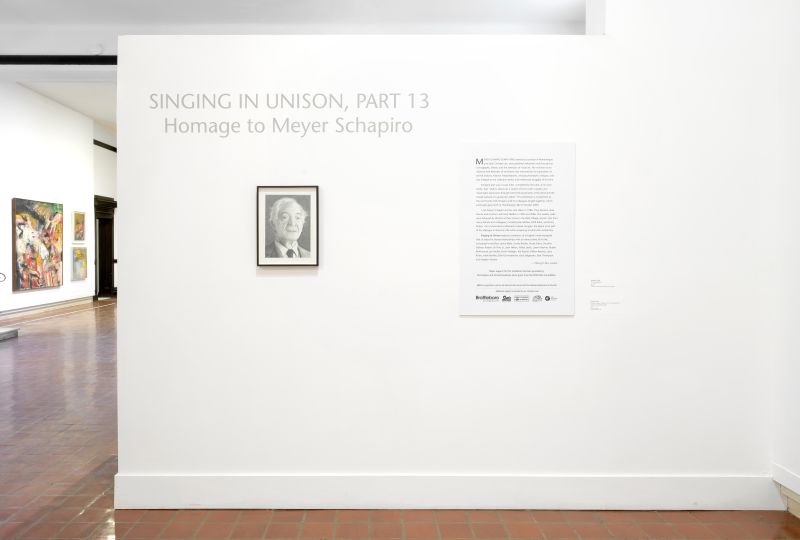
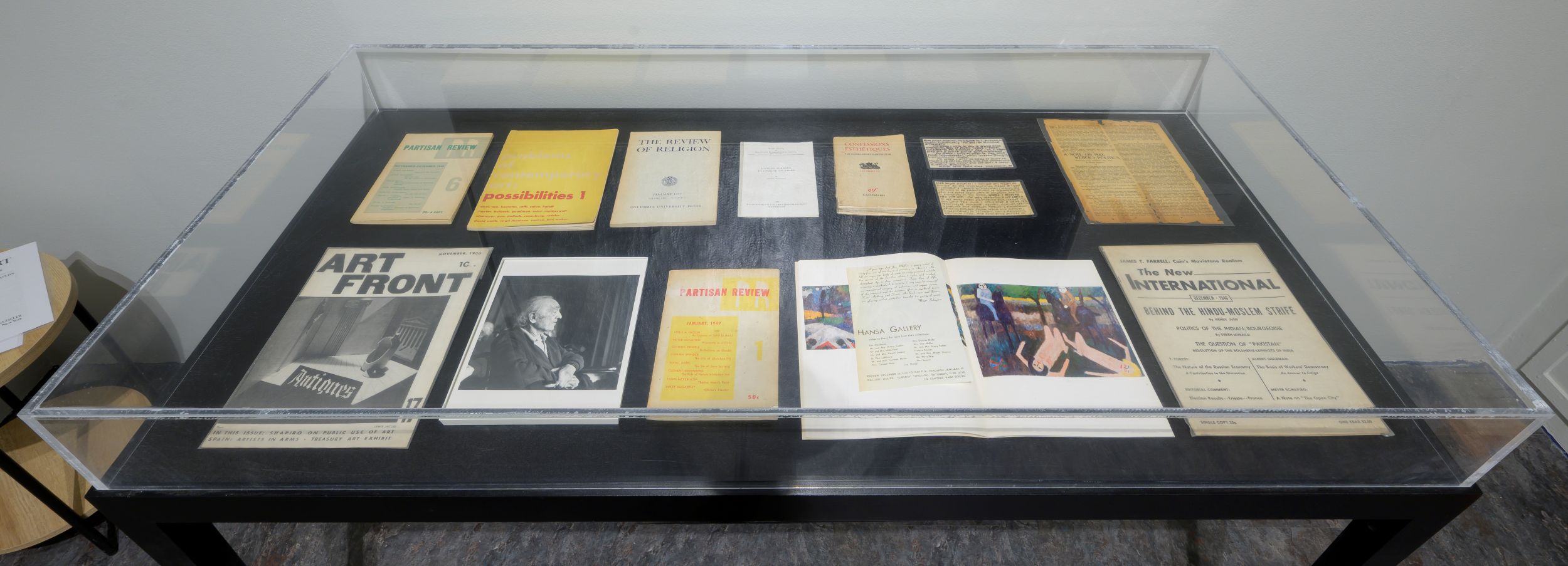
Artist, curator, and publisher of the Brooklyn Rail Phong H. Bui provided precisely this opportunity in Singing in Unison, Part 13: Homage to Meyer Schapiro, an exhibition held at the Brattleboro Museum and Art Center in Vermont last year (fig. 1). As part of Bui’s project to foster cultural dialogue, the show was installed in three galleries without thematic categorization. A mix of better-known artists were on display alongside artists who should be better known. The selection included works by Schapiro’s art history students Robert Motherwell and Lucas Samaras, artists of his generation and of the next, and successors of Abstract Expressionism. Viewers were entrusted to explore each artwork and notice stylistic affinities on their own. A reference room included Schapiro’s publications and first-edition periodicals that revealed connections between the artists and the art historian (fig. 2). In total, there were forty-one works by thirty artists, all of whom Schapiro knew, admired, and in some cases collected.
This capacious range reflects Schapiro’s curiosity. But his respect for living artists did not mean Schapiro liked everything he saw. “I met [Schapiro] when I was about 23 or 24 years old,” painter Gandy Brodie (1924–1975) recalled in 1965, reflecting on the late 1940s, “and his first reaction to me was very negative, at least I thought it was negative because I brought him three paintings to look at, of which he liked only one, and that in a kind of condescending way.”4 Initial disappointment aside, the two became close, a friendship that ended only with Brodie’s untimely death in 1975. Bui selected one of Brodie’s finest paintings for the exhibition, Butcher Boy from 1957, made when the artist was living in Florence (fig. 3). A solitary stolid young man, attired in a white coat and apron punctuated by blood-red stains, stands centrally before a painted sign above his head, which announces “Non Alla Guerra” (no to war). Brodie outlined the boy’s face in black; his visage is drawn, not modeled. He stares directly at the viewer, impassive. But more striking than the boy or the antiwar message is the quality and energy of the paint itself. Vigorous, short strokes of black, gray, blue, and white form the background, a mass of short lines that move in all directions. Areas of contrast burst forward, orange and red at the bottom, a hot flash of light. The white apron and shirt are thickly built up with contrasting shadows in gray, yellow, and brown. The figure and the background are treated with equal intensity. The tension between pulsating paint and the stillness of the subject gives the painting its commanding verve.
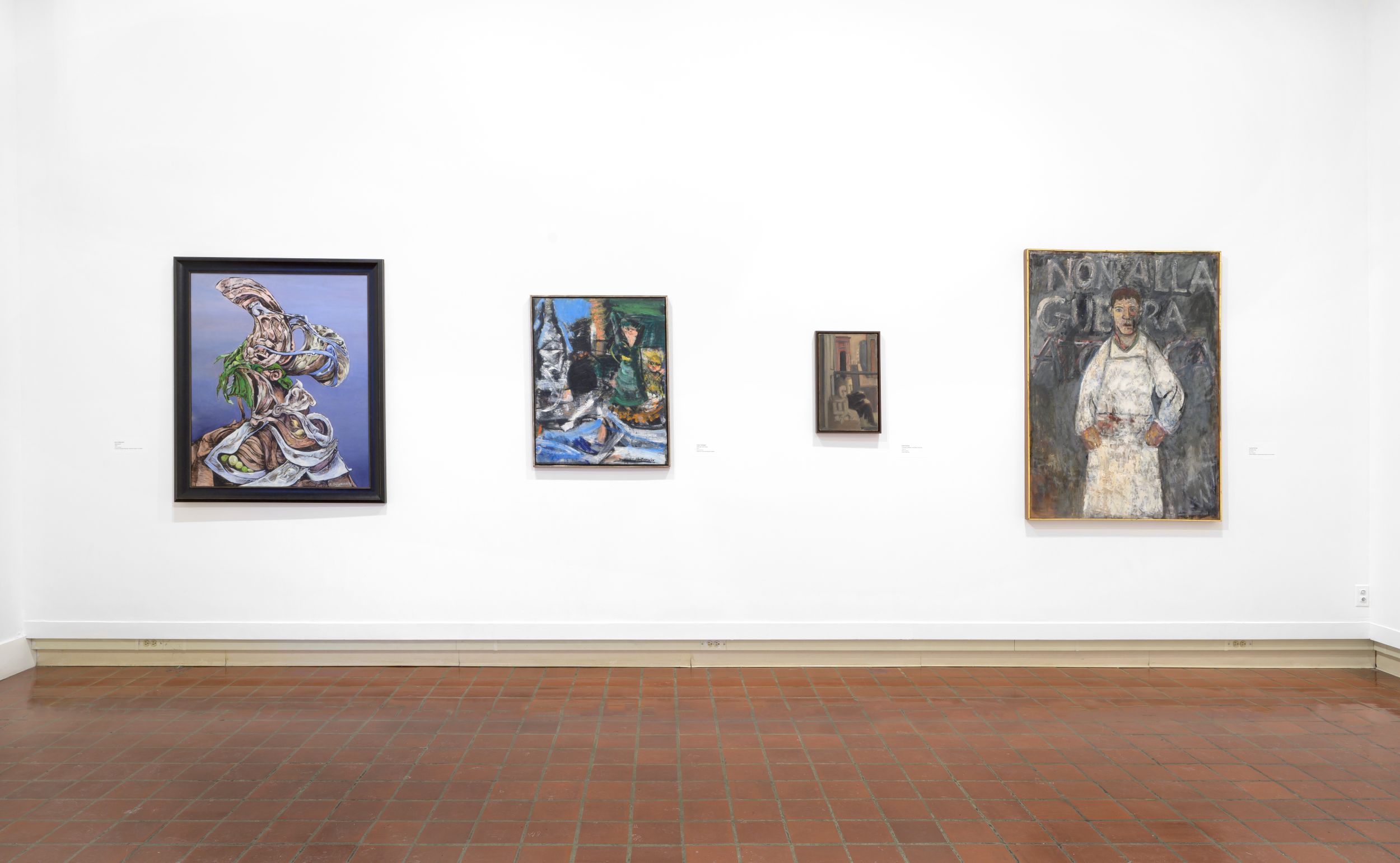
Another artist that Schapiro befriended was the Surrealist Kurt Seligmann (1900–1962). In 1944 they collaborated on six etchings in the portfolio The Myth of Oedipus, published by Kirk Askew of the Durlacher Brothers. Bui borrowed Seligmann’s Manticore from 1958, representing a human-animal figure transformed into a sinewy form that mixes flora and tissue (see fig. 3). The background is a spectrum of pink to blue, resembling dusk during winter. It is an arresting image, technically masterful—the paint is meticulously controlled, reminiscent of the old masters and entirely different from Brodie’s thick impasto. Yet, like the figure in Brodie’s painting, the Manticore registers as a singular image.
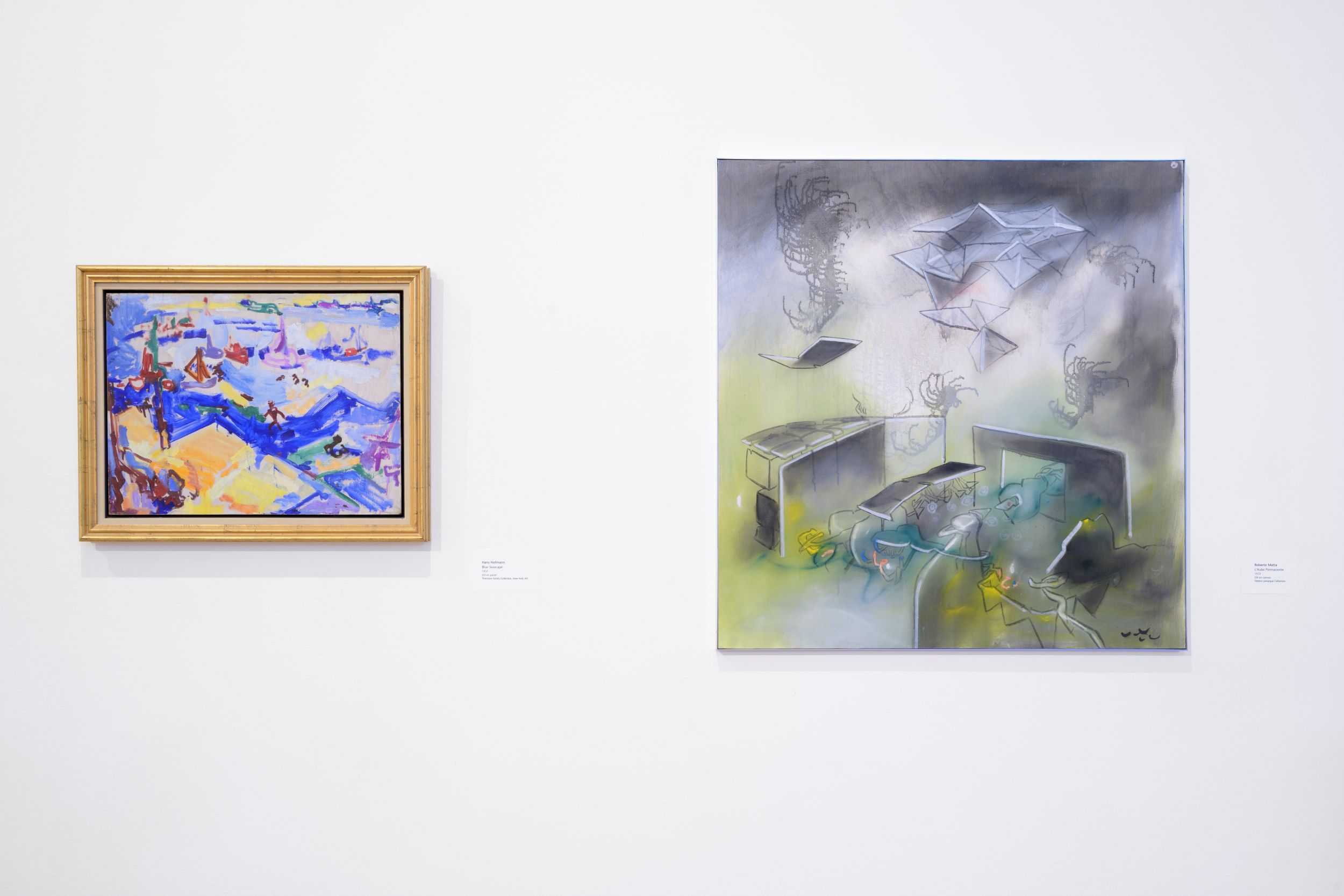
Brodie and Seligmann represent the dialectic between control and abandon in artwork from the mid-twentieth century. An artist who synthesized these tendencies was the Chilean-born Surrealist Roberto Matta (1911–2002). Installed opposite Manticore is Matta’s L’Aube Permanente (The permanent dawn) from 1972, made when the artist was involved with the Unidad Popular (Popular Unity) government of Salvador Allende in Chile (fig. 4). Blue-black areas and vivid yellow paint, some stained into the canvas, some brushed atop it, coexist with interconnected triangles outlined in white and gray that float at the surface. Hovering like an underwater scene are crustacean-like creatures. They drift into the picture as if from another painting. The viewer is in a generative space: less calculated than Seligmann and Brodie, yet related by virtue of their inclusion. According to Bui, Matta mastered the use of thin washes on canvas, where “accidental images” were elaborated on and “the spilling suggests some larger forms which at the same time give birth to the smaller and more elaborate biomorphic shapes.”5
In 1950 Schapiro collaborated with Clement Greenberg on a group show at the Kootz Gallery that included Larry Rivers (1923–2002), whose work introduced a conceptual approach to figuration. Bui secured the fantastic Double Nude from 1957, which exudes psychological intensity. The American flag morphs into patterns that depart from blue, red, and white. Rivers’s colors become a bed on which lie two female nudes, incomplete, possibly the same model painted twice. The left figure curves toward the right, her arm crossing over her companion’s midsection as she stares directly at the viewer.
A completely different approach to the figure, equally intense, was shown nearby: two paintings by Jan Müller (1922–1958), the 1955 Untitled (Provence Landscape) and Phantom Riders (Study for The Search for the Unicorn) from 1957, made just before the artist’s death. Müller, whose family fled Nazi Germany, spent his youth in escape, traveling through Switzerland and France before finding safety in New York. The two paintings allude to his experiences via medieval myths, biblical parables, and Germanic legends—stories that feature heroic quests, mythical creatures, and symbolic journeys. Schapiro appreciated the literary references and collected Müller’s work. In 1957 Schapiro might have been thinking of Müller when he wrote, “The artist’s freedom of choice in both subject and form opens the way to endless reactions against existing styles.”6 In essence, he believed that an artist must find the subject true to themselves no matter what is popular.
The artist Bob Thompson (1937–1966) picked up where Müller left off, but instead of literature, he drew from the European Renaissance to express African American themes. At the artist-run Delancey Street Museum, Thompson had his first solo exhibition in New York, from which Schapiro purchased Triptych, painted on the backside of a bureau drawer, included in Bui’s show. Triptych contains overt echoes of Müller’s paintings, replete with lollipop trees and frolicking couples, but in a darker palette, punctuated by glorious areas of aquamarine blue, bright yellow, and different hues of green. The three paintings incorporate dark figures among the shadows. “I met Bob Thompson in 1960 at his first show at the Delancey Street Gallery,” Schapiro wrote, noting that the panel he purchased “was inspired, I think, by the work of Jan Müller, but had already a decided personal quality and showed his exceptional gift of color.”7
Schapiro also supported women artists. The exhibition included a gestural, nearly abstract painting of dolls from 1955 by Grace Hartigan (1922–2008; see fig. 3) and paintings based on Provincetown views by Ethel Schwabacher (1903–1984) and Janice Biala (1903–2000). Biala’s paintings are especially revelatory. Her Hillside (Provincetown) from 1958 is an abstract rendering of the Atlantic coast’s colors—browns, greens, and blues punctuated by purple and even a dash of pink. Biala’s work feels like the beach; it hovers between atmosphere and earth. Bui also selected a Biala painting made a decade later, Absorbent, a larger canvas in three sections of blue, pink, and white. It is also abstract but suggests an apartment with a ceiling fan and cabinets. Tucked into a smaller gallery was Dorothy Dehner’s (1901–1904) magnificent tabletop bronze sculpture Siena #1 from 1962, with spheres, triangles, squares, and rectangles forming a semicircle.
Between 1950 and 1967, gallerist Betty Parsons regularly exhibited Bay City, Texas–based artist Forrest Bess (1911–1977), and Schapiro attended the shows. “Each year, for a number of years,” he told James Thompson and Susan Raines, “I would buy one for Lillian’s [his wife] birthday, so we have quite a collection. A poetic person, who wrote little texts to go with his painting.”8 The exhibition included an untitled green, white, and black geometric painting by Bess, “just large enough to be the size of a big head,” as Schapiro analogized, a fitting scale for an artist who painted the visions that lived in his mind.9 The painting was installed high up on the wall, stacked above Loren MacIver’s (1909–1998) Green Votive Lights (1946), a serial painting that anticipated Pop Art with five symmetrical rows, each containing fourteen green votive candles, painted to scale, all lit. Bess’s diminutive painting holds its own, however, hovering over the wall like an icon.
Schapiro cofounded the short-lived publications Marxist Quarterly and later Dissent. He took part in the left-wing coalition Popular Front along with artists Stuart Davis, Philip Guston, and Mark Rothko (see fig. 3), all of whom were included in the exhibition. Davis edited Art Front, and in 1936 Schapiro wrote two essays for it: “The Social Bases of Art,” which outlined an art-historical methodology for incorporating social, historical, and psychological context; and the forceful, “Race, Nationality and Art,” in which Schapiro distilled far-right nationalism’s corruption of the social compact in Europe and in the United States. He argued that “the pretense of peoples [is] that they are eternally different from and superior to others and are therefore justified in oppressing them,” and this animates the far right’s opposition to cultural pluralism. Nationalism was (and is) premised on monoculture. He averred that “racial theories of fascism call constantly on the traditions of art; its chief emblems are drawn from ancient motifs of ornament”—the swastika being a central example—and this distortion of culture is the ostensible justification for racial superiority. The fascist position leads inexorably toward injustice, because in its conception, “the great national art can issue only from those who really belong to the nation,” and “Immigration of foreigners, mixture of peoples, dilutes the national strain and leads to inferior hybrid arts” due to “alien influences.”10 Schapiro’s liberal imagination saw difference as the key ingredient for vitality. This explains why he refused to prefer one mode of expression over another and why Bui’s curatorial logic—following Schapiro’s lead—juxtaposed what appear like vastly different styles. At their root, the artists responded to their shared social context.
Bui met Meyer and his wife, Lillian Milgram Schapiro, in 1986 when Bui was a graduate student at the New York Studio School in Greenwich Village. He had been asked to retrieve an artwork owned by Schapiro for an exhibition at the school. Upon arrival at Schapiro’s townhouse, where art hung salon style throughout, Bui was invited into an arrangement of informal, independent study. According to Will Corwin’s perceptive profile, “Bui would borrow, read and discuss a different classic,” selected by Schapiro, for each visit, and their friendship blossomed.11 Schapiro’s life became Bui’s model: to be curious about the past, to be awake to all that is produced in your time—and to found publications that reflect your worldview. It is a “positive” concept of liberty, the scholar C. Oliver O’Donnell explains, that equates Marxist ideas about freedom “with the active power of self-realization and self-determination.”12 Of course poverty and injustice impede freedom to live the self-actualized life, and part of Schapiro’s scholarship and activism supported the conditions to make self-actualization possible. This was why Schapiro connected with Bui, new to New York City, broke and living on a stipend. It is why so many people involved in the arts across styles and polemics found an alliance with Schapiro.
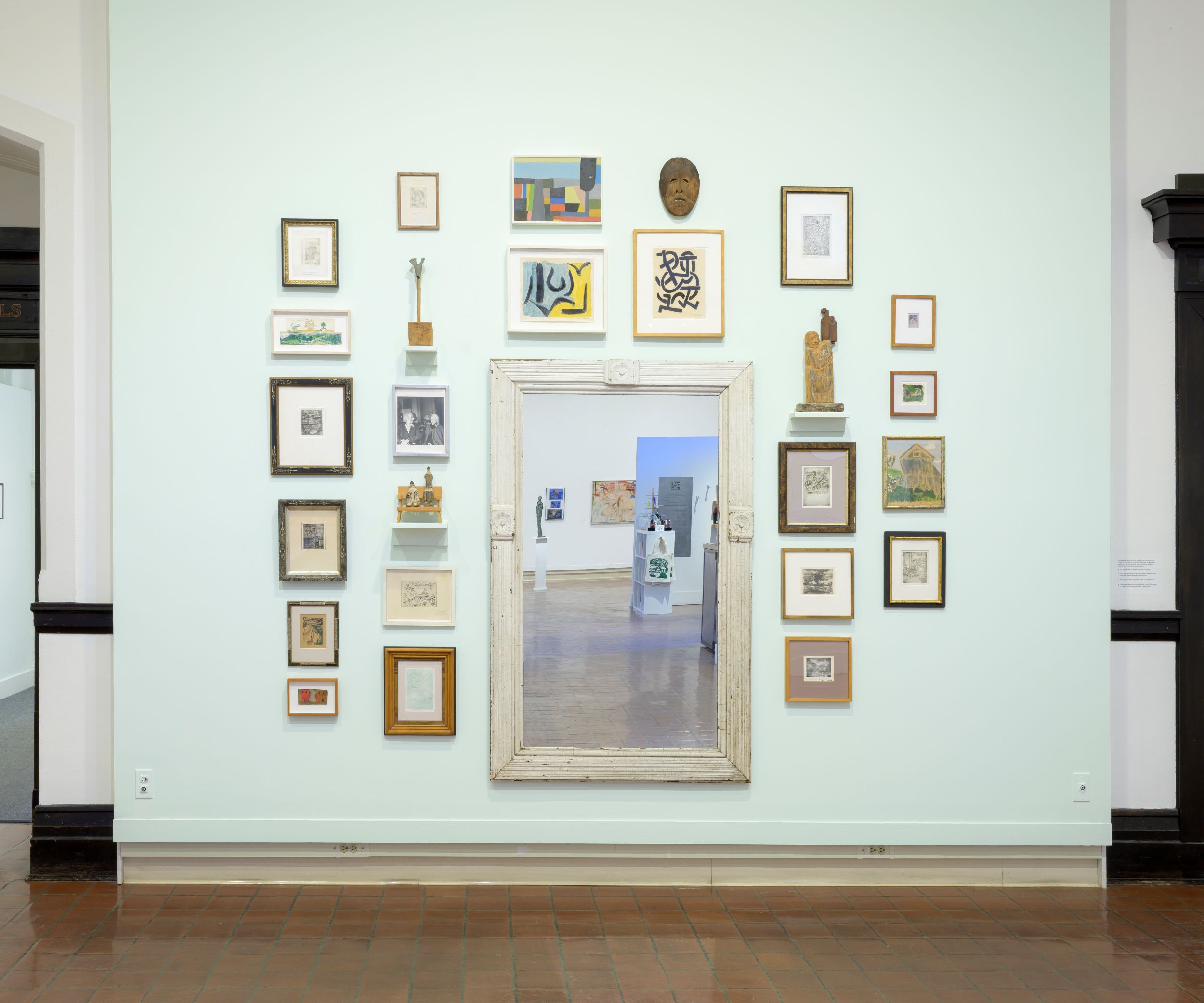
Perhaps Bui’s strongest claim as custodian of Schapiro’s legacy was evident in the middle of the exhibition: a recreated shrine to Schapiro from his Brooklyn apartment (fig. 5). In the center was a mirror and surrounding it were a wooden mask originally gifted to Schapiro from André Breton; a handcrafted wooden bench and two figurines, a gift to Schapiro from Frida Kahlo and Diego Rivera; and a small painting of a barn by Lillian Schapiro. Everything else, twenty drawings and paintings and two sculptures, were made by Schapiro: careful renderings of artworks Schapiro saw in European museums and churches, self-portraits, abstract designs, carved wooden figures, and a 1954 drawing—possibly depicting Saint Peter’s Basilica from a perch along the Tiber River and dedicated “for my dear friend Phong Bui, Meyer Schapiro.” Singing in Unison, Part 13: Homage to Meyer Schapiro represents the twentieth century’s crosscurrents and friendships. Bui’s anti-hierarchal installation compels the viewer to explore art as Schapiro did, in “contemplativeness and communion with the work of another human being,” which reminds us that unity is possible.13 From difference we produce harmony.
July 7, 2026: An earlier version of this article misspelled one instance of Phong H. Bui’s name.
Cite this article: Melissa Rachleff, review of Singing in Unison, Part 13: Homage to Meyer Schapiro, Brattleboro Museum and Art Center, Panorama: Journal of the Association of Historians of American Art 12, no. 1 (Spring 2026), https://doi.org/10.24926/24716839.20962.
Notes
- Meyer Schapiro, “The Liberating Quality of Avant-Garde Art,” in Art in America 1945–1970: Writing from the Age of Abstract Expressionism, Pop Art and Minimalism, ed. Jed Perl (Library of America, 2014), 435–36. Originally published in Art News 56, no. 4 (1957): 36–42. ↵
- James Thompson, Susan Raines, and Meyer Schapiro, “A Visit with Meyer Schapiro (August 1991),” Oxford Art Journal 17, no. 1 (1994): 6. ↵
- Schapiro, “Liberating Quality of Avant-Garde Art,” 445. ↵
- Gandy Brodie, oral history interview with Dorothy Seckler, September 6, 1965, Archives of American Art, Smithsonian Institution, Washington, DC, https://www.aaa.si.edu/download_pdf_transcript/ajax?record_id=edanmdm-AAADCD_oh_214091. ↵
- Phong H. Bui, “Matta, 1912–2002,” Brooklyn Rail (Winter 2003), https://brooklynrail.org/2003/12/art/matta-19122002. ↵
- Schapiro, “Liberating Quality of the Avant-Garde,” 447. ↵
- Meyer Schapiro, “Survey: Comments Regarding Bob Thompson between 1966 May 30 and 1996,” Bob Thompson papers, 1949–2005, Archives of American Art, Smithsonian Institution, Washington, DC, https://www.aaa.si.edu/collections/items/detail/survey-comments-regarding-bob-thompson-8954. ↵
- Thompson, Raines, and Schapiro, “Visit with Meyer Schapiro,” 5. ↵
- Thompson, Raines and Schapiro, “Visit with Meyer Schapiro,” 5. ↵
- Meyer Schapiro, “Race, Nationality and Art,” Art Front 2, no. 4 (1936): 10. ↵
- Will Corwin, “Profile: Phong Bui,” Art Papers 38, no. 6 (2014), https://www.artpapers.org/profile-phong-bui. ↵
- C. Oliver O’Donnell, “1961: Debating Berenson with Berlin: Two Concepts of Art-Historical Liberty,” in Meyer Schapiro’s Critical Debates: Art Through a Modern American Mind (Pennsylvania State University Press, 2019), 132. ↵
- Schapiro, “Liberating Quality of the Avant-Garde,” 445. ↵
About the Author(s): Melissa Rachleff is a clinical professor and director of the Visual Arts Administration MA Program at New York University’s Steinhardt School.