

Voices in Aerosol: Youth Culture, Institutional Attunement, and Graffiti in Urban Mexico





PDF: Guerrero-Hernandez, review of Voices in Aerosol
Voices in Aerosol: Youth Culture, Institutional Attunement, and Graffiti in Urban Mexico
By Caitlin Frances Bruce
University of Texas Press, 2024. 280 pp.; 32 color illus.; 67 b/w illus. Hardcover: $65.00 (ISBN: 9781477327678)
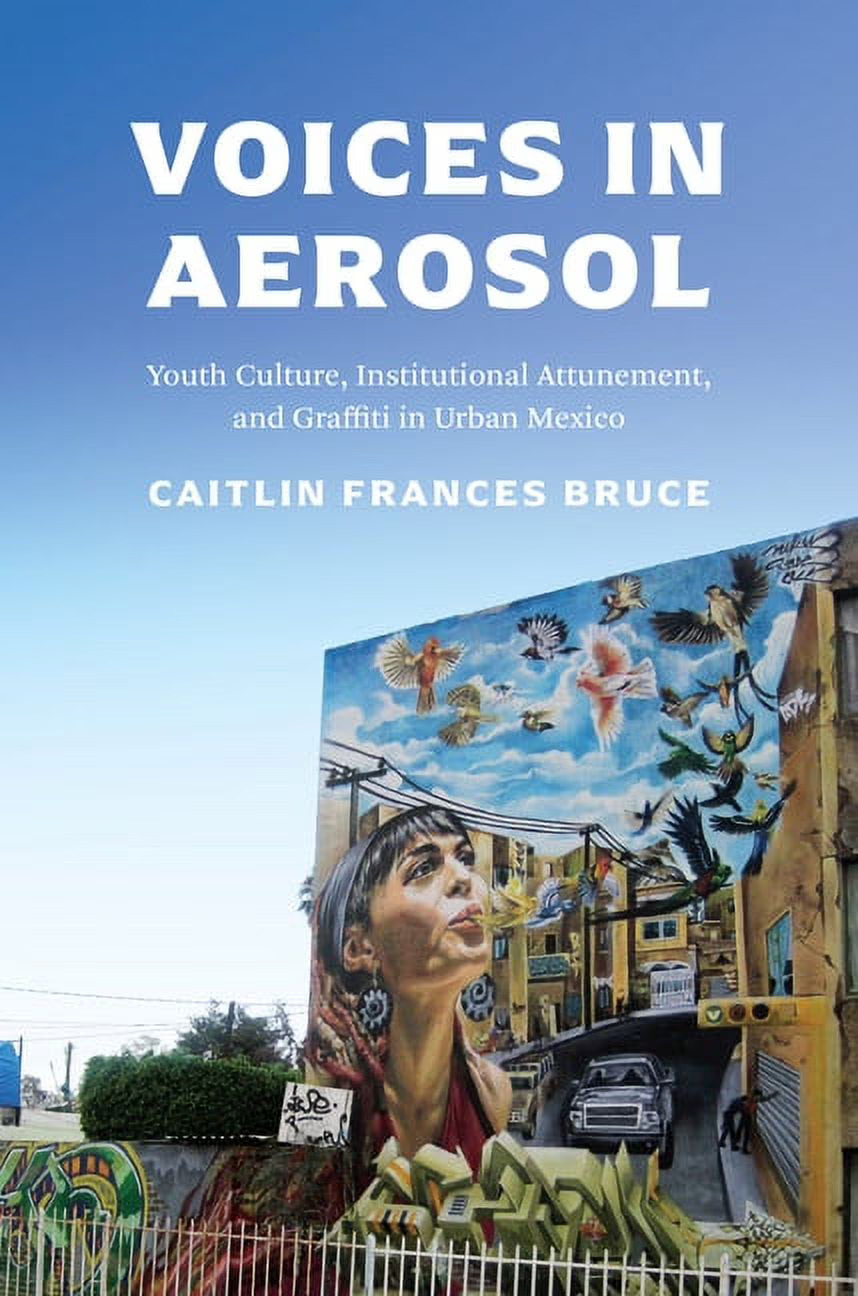 Caitlin Frances Bruce’s Voices in Aerosol: Youth Culture, Institutional Attunement, and Graffiti in Urban Mexico is perhaps the first English-language long study of contemporary graffiti in León, a city in Guanajuato, a state in central Mexico. As a scholar in communication studies and rhetoric, Bruce distances herself from the visual analysis usual in art history. She proposes instead to “draw on sonic cultures to understand visual practices” and focus on “attunement,” that is, a series of communication processes by which distinct agents attempt to “tune into each other” (4). In this sense, the book invites us to enrich and adopt new approaches for the analysis of street art in art history and visual culture. While images take a secondary role, testimonies and media come to the fore to account for “institutional attunement,” which Bruce defines as “the ways that cultural practitioners and institutions of various sorts (media, education, government, cultural) navigate and seek to produce frequencies for recognition, shared vibrations, audibility, and attention but also relegate certain voices to noise, static, or interference” (4).
The author deals with three questions in her book around “institutional attunement”: “How do institutions change and young people transform as they tune into each other’s expectations and values? How do these processes of attunement shape what counts as voice and how voice is heard? What happens when the state becomes the primary sponsor for a formerly subcultural practice?” (4). With this aim, Bruce unfolds a rhetorical ethnography—namely, a qualitative research method combining participant interviews and observation with rhetorical analysis of discourses—to study the graffiti writers’ communicative practices.
The period covered spans the mid-1990s to 2018. It corresponds to the years leading up to the consolidation of the conservative National Action Party (PAN) as the most important force in Guanajuato at the time of the implementation of the North American Free Trade Agreement (NAFTA) through the last year before the arrival of Manuel Pérez Obrador’s leftist and progressive policies at the national level. Moving in chronological order, Bruce presents a continuous increase of “institutional attunement,” according to which we move from policies against graffiti to programs interested in co-opting the youth through nostalgic references and professionalization. The book structures its content through metaphors of attunement, including frisson, noise, harmonization, amplification, and resonance.
In the first chapter, Bruce mainly discusses the gatherings known as Tagger Wednesdays, which began in 2000 as an alternative and collective response to PAN’s Citizen Wednesdays. The latter are recurring municipal programs that aim to bring government closer to the people and address needs directly, from processing paperwork to medical care and low-cost basic food items, and end up “reducing politics to individualized service delivery rather than collective mobilization” (33). For its part, Bruce argues, Tagger Wednesdays, which ended in late 2001, made the “writers” (the term for graffiti artists) visible, offering an “aesthetics of refusal that remapped the city by voicing frisson” (23) and allowed them to meet publicly, “building collective energies and capacities” (51). Tagger Wednesday gatherings imagined a fluid model of voice based on the assumption of graffiti as a collective process.
Surprisingly, this chapter presents a rather pacific, if not homogenous, image and account of the writers, which the following chapters go on to complicate. As scholars of street art know, there are harsh competition and adversarial stances among writers. Ethnographic and visual analysis reveals striking differences in the use and selection of styles, lettering, and messages, as well as different connections and senses of belonging to the sites. An interesting note in this chapter is the recognition of the strong influence that graffiti from California had in León as well as “cholo writing” (that is, the style created by the Latino gangs in Los Angeles). This link to California points to an area worthy of further research on street art in the United States: the dialogues across the border, the role of NAFTA, and the influence and reappropriation of graffiti (and muralism) in and from the West Coast. These considerations would perhaps complicate the discourses and references surrounding Chicano graffiti from the 1980s or earlier.
Chapter 2 focuses on the media’s attunement with the implementation, between 2001 and 2002, of a zero-tolerance policy promulgated by Rudolph Giuliani’s consulting firm in Mexico as well as Colombia and Brazil. This “global” policy, implemented in León and supported by the media, promoted the understanding of graffiti as a form of contamination and an attack on civility and common sense. Bruce reminds us that Periódico A.M., one of León’s most recognized newspapers, compared the graffiti found in Boulevard López Mateos to “the panorama of any avenue in the New York neighborhood of the Bronx” (63). According to Bruce, the media intended to create a “public attunement to writers as ‘other than’ citizens” by decontextualizing photographs of graffiti and its writers and presenting the pictures as supposed documentation of violent gangs and drug addiction (54). Bruce proposes that the writers, in conjunction with the collective called Youths Coordinated against Authoritarianism (Jóvenes Coordinados contra el Autoritarismo, JOCOCA), responded by developing an “oppositional attunement,” consisting of protests, concerts, and publications (zines included) that rejected the abjection promoted by the media while intending to tune “citizens, media, and institutional authorities into their experience of Mexico’s ‘democratic transition’” (56). Bruce ends the chapter by suggesting that the youth’s oppositional attunement can be regarded as a practice of parrhesia and a “fecund mode of tuning into a global situation and forms of collective belonging and action” (82) and, I add, antagonism, which one expects would be highlighted in the following chapters.
While this second chapter deals with a very short period, chapter 3, titled “Harmonization,” covers a longer period from 1997 to 2011 to discuss “three moments of harmonization and experimentation in institutional attunement to the idea of convivencia” (86). Bruce initially describes convivencia as a “social coexistence” and immediately thereafter as a “social harmony” and an “active tolerance” (87). There are great differences between those descriptions (and others in the book) that any Spanish speaker would recognize in the uses of the very same word, since Spanish is a very contextual language. In her use of testimonies and references to policies in other places and times (for instance, early 1990s Bogotá under the Antanas Mockus administration), Bruce appears to gloss over the nuances and significant differences that can alter the understanding of the dynamics, limits, and possibilities of attunement as well as the possible “models of convivencia” that can be identified throughout the chapter.
A more careful analysis of the various senses and understandings of convivencia is required to reinforce the ethnographic account and analysis of the several types of attunements, including institutional attunements, that emerge across several voices in the period. This is especially critical since chapter 3 covers a period of more than a decade, in which León, like many other cities in Latin America and the United States in the early twenty-first century, went through significant transformations in terms of globalization, social organization, and mobilization. During this time, when at least three different generations of writers (and street artists) were active, the identification and relationship between the people, the city of León, and the work of writers there, were undoubtedly affected by the Integrated Transportation System, inaugurated in 2003, and the bike-lane system, both of which, it is worth mentioning, emulated systems inaugurated in Bogotá years before. Also noteworthy, the transportation system in Bogotá soon revealed the limitations of the understanding and policies of convivencia, as well as attunements that the Mockus administrations (inspired by Jürgen Habermas’s theory of communicative action) pretended to promote and enact, nurturing critical changes in practices, aims, and strategies of attunement—and fomenting a decided antagonism in the following years.
In contrast, the fourth chapter focuses on the Youth Institute’s City of Murals program, which ran between 2010 and 2012. This is perhaps the chapter that falls closer to a standard book on muralism in Mexico, since it includes more illustrations and finally refers to the postrevolutionary Mexican school of muralism. The latter was evidently referential for a program pursuing the social acceptance of writers and their alignment with conventional and already legitimized forms of street art, at times labeled “artistic graffiti.” The chapter explores the program’s aims and accounts for various voices among the artists, including some critical stances. Certain critics understood the program as a way of co-opting graffiti and attuning writers’ work to a largely conservative audience and an equally conservative media. In this chapter, Bruce discusses specific cases—the Homage to the Three Giants, the Cine de Oro murals, and the murals of Catrinas—paying particular heed to their creators’ and the public’s responses in the media.
A critical limitation of this chapter is the author’s assumption of a relatively smooth conceptual and historical transition from writers to muralists. While a person can be both a writer and a muralist, writing and muralism are not interchangeable. Neither is it the case that the new legitimation of murals and muralists is a legitimation of writing and graffiti. A more nuanced approach is needed, even if the emphasis for Bruce is on “institutional attunement.”
A fifth chapter follows a similar trend by discussing the Muraleón program (2016–18). The author introduces the term “urban art,” which widens the discussion’s scope and again requires a more nuanced and analytical approach. Bruce argues that this new program was intended to attune “society and writers to positive frequencies for the good life,” by emphasizing individual entrepreneurial approaches to urban art and by using color therapy as a politics of attunement politics “to promote an image of social harmony within a larger rhetorical ecology of neoliberal state restraint” (215). It is worth noting that this program, like many other urban art programs around the world, exemplifies neoliberal policies of gentrification, the taming of collective memory, and the neutralization of antagonism.
Surprisingly, the conclusion of the book introduces, under the title “León as Global Example,” new material, apparently intending to fulfill the book’s promise of thinking about graffiti globally. I find this problematic given the fact that the author’s references to graffiti and street art beyond León in the previous chapters is scant, including consideration of other cities in Mexico. There are just a few conventional references to 1980s New York graffiti. In the conclusion, Bruce presents the Hemispheric Conversations Urban Art Project, a university project she leads that aims “to promote graffiti and street art’s possibilities as a vehicle for public voice” (207). In the context of that project, Bruce invited writers from León, Chicago, and Pittsburgh to paint in Pittsburgh in 2017. She reflects on how some of the artist’s attunement strategies unfolded. I was left wondering if this attunement is itself an example of institutional attunement. This final part of the book, it seems, is less about the conclusions of her study of institutional attunement and the impact it may have had after 2018 in León and more an invitation to consider and contrast strategies of attunements in the works of a few Leonese artists and some Chicago and Pittsburgh artists “across the border.”
The book’s strength lies in redirecting the focus of urban art studies toward the ways practitioners and institutions seek to attune—or, perhaps more precisely, align—graffiti with political and neoliberal agendas. In this direction, the last part of Voices in Aerosol may be read as a timely invitation to develop comparative ethnographical studies that consider street art and institutional attunements within different conservative contexts across both sides of the border today. On the US side, think, for instance, of murals celebrating Basque tradition and heritage in the West, which clearly contrast with the more politicized Chicano murals in California and the Mexican and African American murals in Chicago. Think also of how institutions, including universities in the West, co-opt Native American artists to produce murals with a blatant institutional attunement that silences the long history of violence on Native communities. Or finally, think of the way the city of Reno, where I teach in Nevada, showcases hundreds of murals that hardly touch upon political and social issues, blandly existing next to casinos, fentanyl peddlers, unhoused communities, and sex work.
Cite this article: Juan Carlos Guerrero-Hernández, review of Voices in Aerosol: Youth Culture, Institutional Attunement, and Graffiti in Urban Mexico by Caitlin Frances Bruce, Panorama: Journal of the Association of Historians of American Art 12, no. 1 (Spring 2026), https://doi.org/10.24926/24716839.20970.
About the Author(s): Juan Carlos Guerrero-Hernández is assistant professor in Art History and Visual Culture at the University of Nevada, Reno.