

Threading the Needle: Secondhand Patriotism and Vernacular Art





PDF: Nowicki and Randall, Threading the Needle
Rather than feeling patriotic, it felt like I had just visited an early American garage sale. Reminded me of my grandmothers living room.
There were a few good things, but most seemed like a yard sale find, and not the most important things to show for America.
These comments were made by visitors to the exhibition America 250: Common Threads, held from March 14 to July 27, 2026, at Crystal Bridges Museum of American Art in Bentonville, Arkansas. Perhaps these survey respondents knew that many objects in the exhibition previously lived out on the lawn, from whirligigs to the Flag Gate (c. 1876), the iconic painted gate in the collection of the American Folk Art Museum, New York. Or maybe they sensed a yard sale, with its threats to “the most important things to show for America,” because the exhibition foregrounded vernacular acts of commemoration: popular do-it-yourself practices like tinsel painting and whittling, collective domestic crafts such as quilting, and works by self-taught painters, like Ralph Fasanella and Mose Tolliver. As curators of the exhibition, we understand “vernacular” as a term that connects craft traditions, self-taught art, and popular culture through their shared friction with official commemorative gestures, drawing on Kobena Mercer’s use of “vernacular” to target the “entangled space in which ‘popular’ and ‘official’ world-views are constantly antagonized in shifting patterns of authority.”1
Vernacular art gave us hope and political leeway in a daunting situation. With less than a year to prepare, we created a semiquincentennial exhibition that was required to be “celebratory” and “patriotic” while also serving a politically fatigued and polarized community. Kenneth Ames has warned curators about the political flexibility of folk art, asking, “Is folk art a way to say reactionary things and still keep liberal company?”2 In Arkansas in 2026, we sought to expand and reverse Ames’s question, asking if vernacular art can say radical things while keeping politically diverse, often reactionary company. In this discussion, we trace the political work of vernacular objects across three sites identified by our favorite survey respondents: the estate sale, the yard, and grandmother’s living room. Not by chance, these sites map to arenas for political articulation that are often excluded from American art museums: commercial material culture, folk and self-taught art, and women’s work.
The Estate Sale
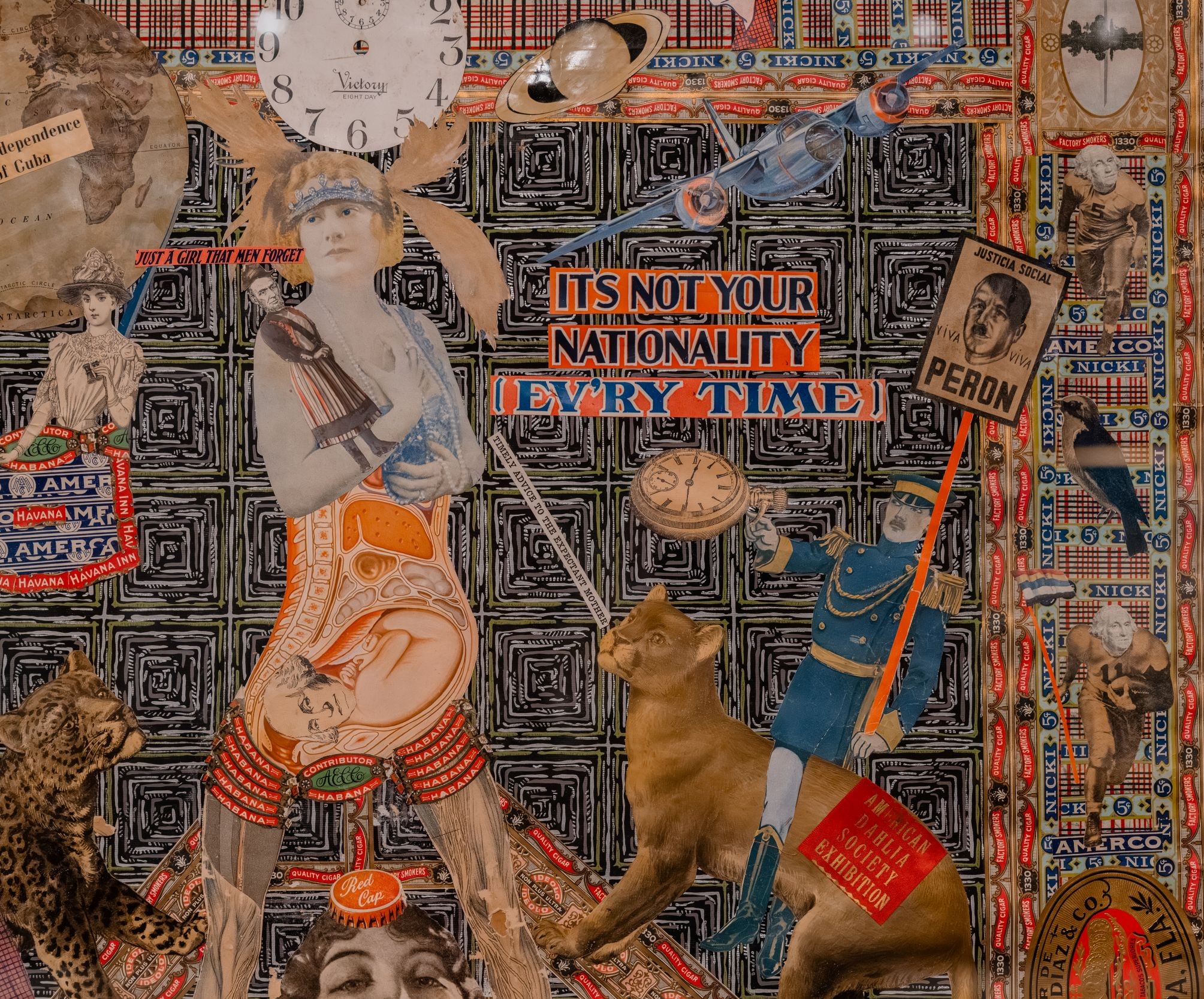
The work of Felipe Jesus Consalvos (1891–c. 1960s) was introduced to the world via a Philadelphia garage sale.3 His collage shown in America 250: Common Threads is packed with household ephemera, like wallpaper samples, Washington Monument trade cards, and cutouts of sporty George Washingtons guarding the border (fig. 1). The central figure—half showgirl, half anatomical illustration—carries the first president in utero, reminding the United States of its infancy. Fetus Washington is nearly ready to be born from a Cuban cigar trademark, forms of advertisement that Consalvos handled daily as a cigar roller. Magazine clippings are assembled to promise “timely advice for the expectant mother” and proclaim, “It’s not your nationality ev’ry time.” Here, advertising not only furnishes national memory but also scrambles it when sufficiently multiplied.
To this end, the exhibition opened with a floor-to-ceiling cabinet of George Washington souvenirs purchased on eBay (fig. 2). Soap, cookie cutters, perfume bottles, and tobacco tins survey the obsessive impulse to offer up the first president’s image for consumption. Under the gaze of hundreds of Washingtons in wallpaper resurrected from a nineteenth-century fragment, the exhibition section titled “Washington Mania” foregrounded how nation building happens on the level of home economics. The shock and humor of souvenirs in extreme quantities provided political wiggle room: The room could be both tribute and punchline. Taking after Consalvos, the criticality of the display came not from negating Washington’s image but from overplaying it to stage the affective pull of nationalism.
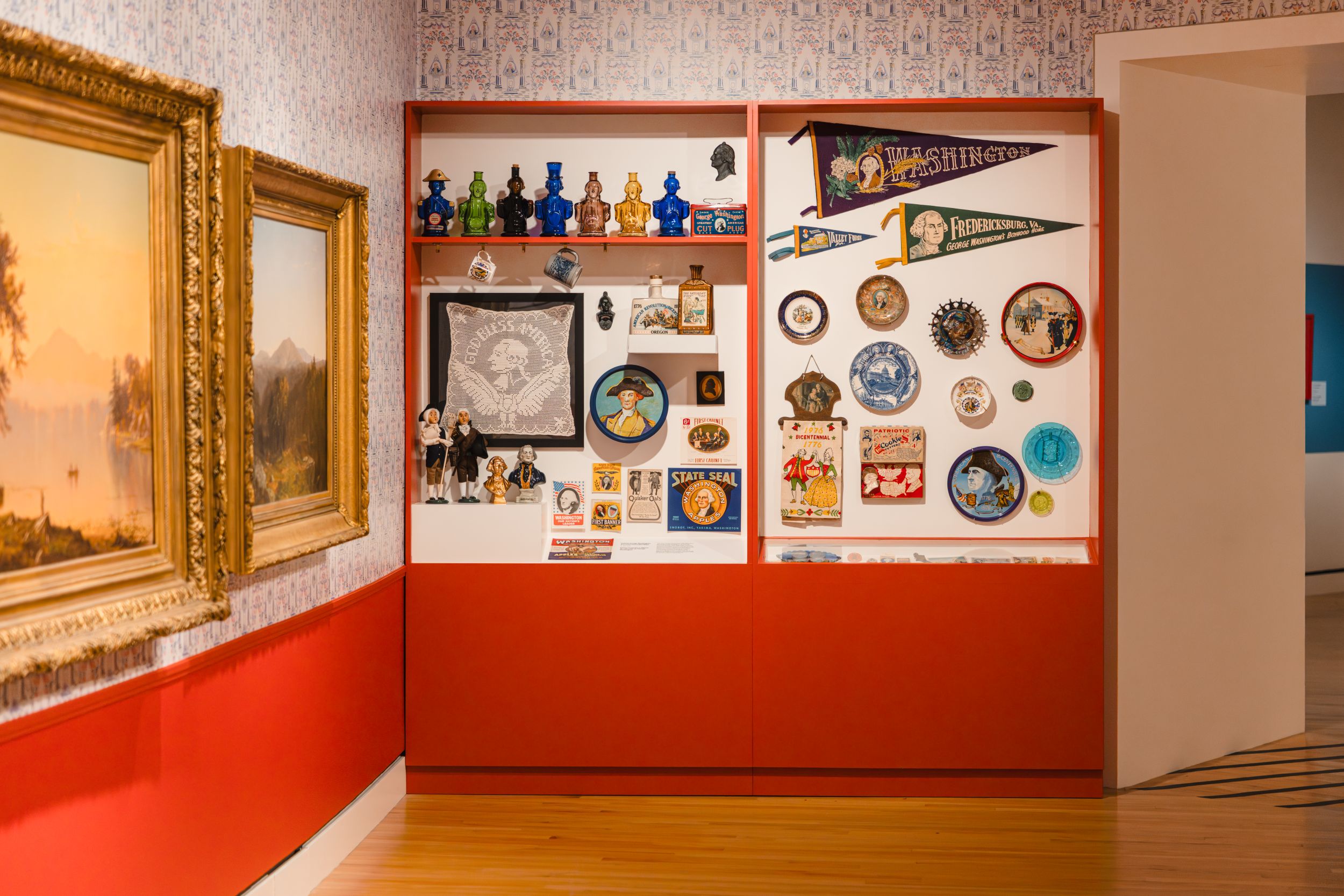
We displayed mass-produced Washingtoniana alongside amateur and professional portraits and landscape paintings of sites like Mount Washington, which overwrite land with US national memory. In offering this range of images, we responded to feedback from teachers of kindergarten through high school about how a semiquincentennial exhibition could serve educators on the frontlines of narrating the past with ongoing state interventions. Several teachers had told us that Charles Wilson Peale’s portrait of George Washington so closely resembled the imagery in their textbooks that stranger, less official portraits would better grab students’ attention.4 Pluralizing Washington became urgent due to recent restrictions of Arkansas’s public education system, including House Bill 1705 (2025), which requires social studies curricula to emphasize “the founding fathers and . . . how their religious and moral beliefs influenced the founding documents of the United States.”5 The institutional guidelines we received as curators—that the exhibition should highlight Washington and the Declaration of Independence—compelled us to confront the terms on which the founding fathers and their document-babies are celebrated.
The Yard
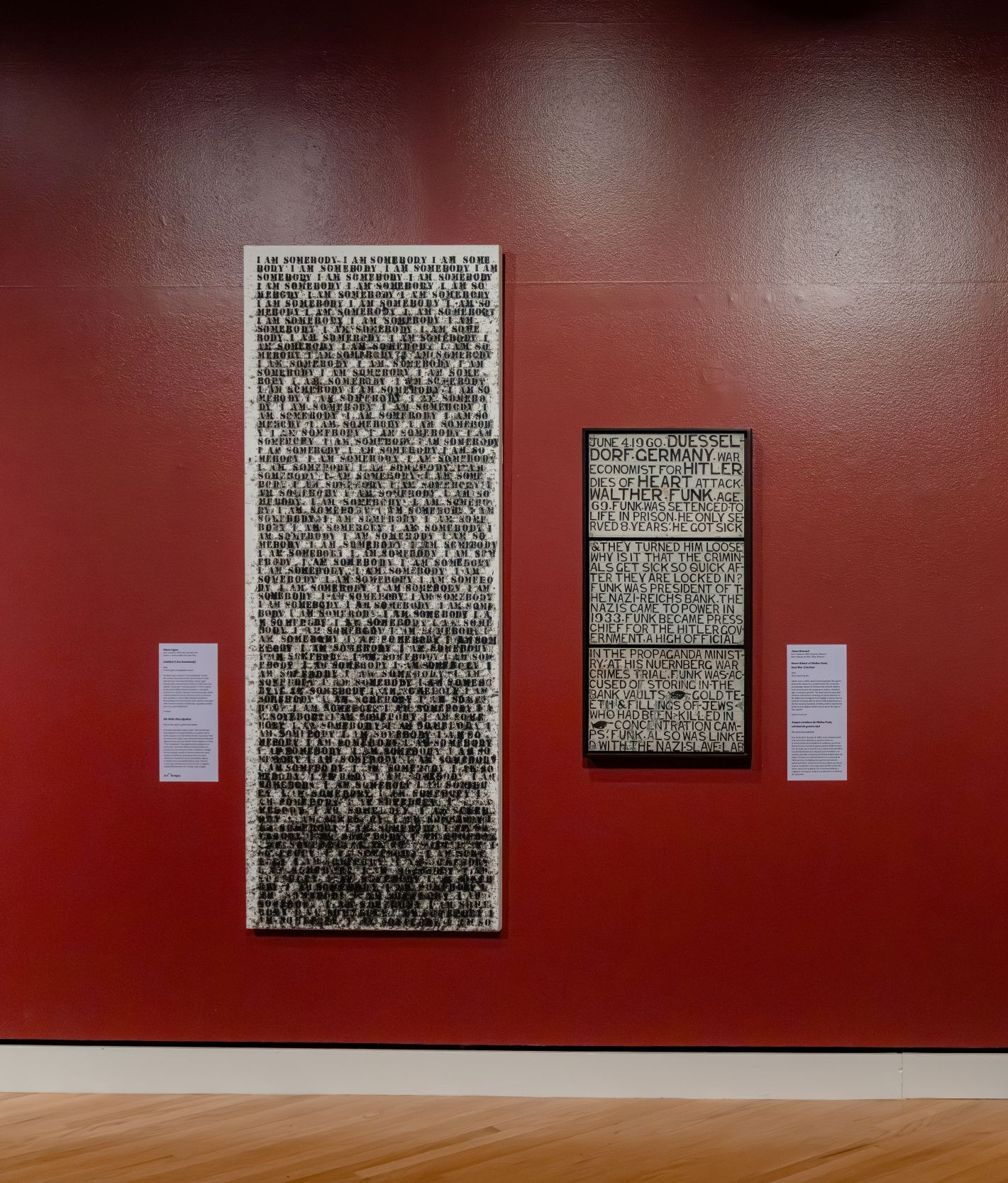
The second portion of the exhibition tracked how artists have mobilized the rhetorical form of a declaration in order to participate in political community. In 1960, Jesse Howard (1885–1983) expanded his Missouri yard installation by painting tin signs announcing the death of the Nazi war criminal Walther Funk (fig. 3). Pointing fingers drive home Howard’s accusation that Adolf Hitler’s Minister of Economics died too painlessly. These pointing icons, in tandem with the work’s vertical composition, cast the signs as a giant declarative newspaper column, making his viewers into a public tasked with critically consuming media.
Adjacent to Howard’s work in the exhibition hung a painting by Glenn Ligon (b. 1960), who used a black oil stick to push the words “I Am Somebody” through a stencil over and over across a reclaimed door. The phrase comes from a poem by civil rights activist the Reverend William Holmes Borders, which was popularized by Jesse Jackson in the 1970s. Ligon’s use of the stencil, the ubiquitous material of protest signage, to repeatedly smear black text, articulates his declaration that Black presence is impressed literally through the vernacular. Ligon’s door painting models how Black thinkers make do when doors are closed to them, while also reminding viewers that legibility is a privilege. Reading Ligon on Howard’s terms—the yard, the sign—we can imagine Ligon’s door restored to its role as a threshold between the house and the front yard, between one’s interiority and one’s social inscription as a political subject. In the work, the text and background become indistinguishable near its base, where the door would have met the stoop. Pairing Howard and Ligon reveals that vernacular techniques enabled some of the most radical statements in the exhibition by confronting questions of positionality.
The Living Room
In the center of the exhibition, as if crossing into a busy household’s living room, visitors could engage with skilled sewers to discuss and watch how quilts are made. Quilters-in-residence from local guilds pieced and quilted thousands of blocks made by K–12 students in a near-constant live demonstration that took inspiration from bicentennial album quilts while attempting to maximize contradictions.6 With no curatorial control over the quilts’ design or content, we trusted that the most radical thing we could say was nothing at all. In one resulting quilt, squares with anti-ICE messages enclose a capybara wearing an “America 250” T-shirt. In another, a dinosaur makes a cheeky appearance within rows of Christian crosses. Couched in the familiar materiality and gendered mediators of “grandmother’s living room” (as one survey respondent put it), these community quilts were among the most direct statements of dissent in the exhibition. One possible reason for this is that quilting’s vernacular immediacy allowed us to cover hotly political content. Another is that conversations between people, from visitors to quilters to students, may go further in opening political dialogue than an institutional voice can.
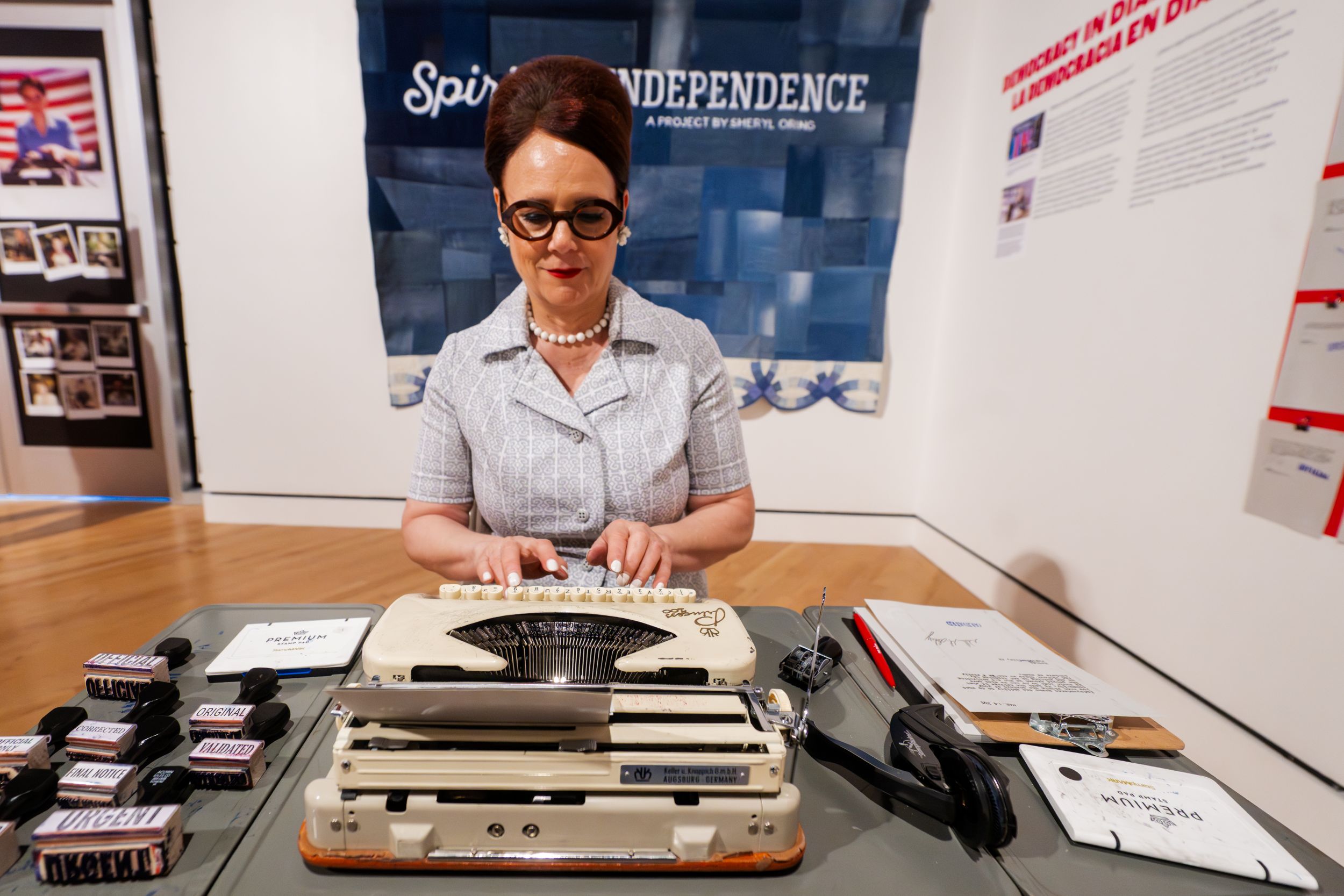
Quoting the broader public—not the museum, not even an artist—permitted us to display prints reading “Free Palestine” and “Insurance should be a public good.” These blurbs came from people who sat down with Sheryl Oring (b. 1965) during her 2018 and 2024 performances and dictated what they wished to say to the future president while she typed. Oring then enlarged and printed anonymous excerpts in a grayscale, typewriter-inspired font, inviting viewers to feel at home with radical messages from earlier participants. In our galleries, she performed her new work Spirit of Independence (fig. 4). At her typing desk in a vintage skirt suit with a crisply hairsprayed updo, Oring asked participants, “What does independence mean to you?” Her choice to perform secretarial aesthetics ensured that she came across not as a divisive debater or a sneaky news reporter but as a nonthreatening femme-coded laborer determined to listen objectively. Oring’s reclamation of the secretary as documentarian has amplified her politics throughout her career. As she states, “I am still doing the same work that I wanted to do as a journalist many years ago . . . by taking on roles that have increasing power within institutions,” such as faculty, chair, dean, and board member.7 She continues to model how to take a seat and listen, skills that so many powerful offices continue to lack. Oring and the quilters both collated public discourse through everyday forms of women’s labor, drawing out their archival and political capacities.
Women’s craft practices can be risky and at risk during national anniversaries. Quilts in 1976 were double agents, affording both feminist disruptions of the American art canon and nationalist fantasies of cozy, unifying Americana.8 A quilt-heavy semiquincentennial might stoke nostalgia and burn it as fuel for bringing women’s domestic craft into the frame. But this move still leaves a residue of Americana that sometimes overlays the politics of individual objects. Take the final exhibition gallery, which featured a show quilt of crazy-pieced stars made by one or more members of the McAllister family in Barnstead, New Hampshire, at the turn of the twentieth century (fig. 5). Nearby, an enormous doily by 2024 Benton County Fair winner Erin Holder (b. 1989) was displayed, thanks to the University of Arkansas Extension Homemakers Council. There is no reason that either object has much to do with Americanness; the McAllisters’ stars do not even match the five-sided ones on the flag. We paired the show quilt and prize-winning doily to pinpoint when textiles become objects of civic participation through public display or communal making. Yet in 2026, as in 1976, the quilt may be received as a patriotic form by virtue of its medium, conscripted to a canon of American folk art invested in nation building since the early twentieth century.9 It may be impossible to detach quilts from this framework in an exhibition premised on the nation, with walls painted in shades of red, white, and blue.
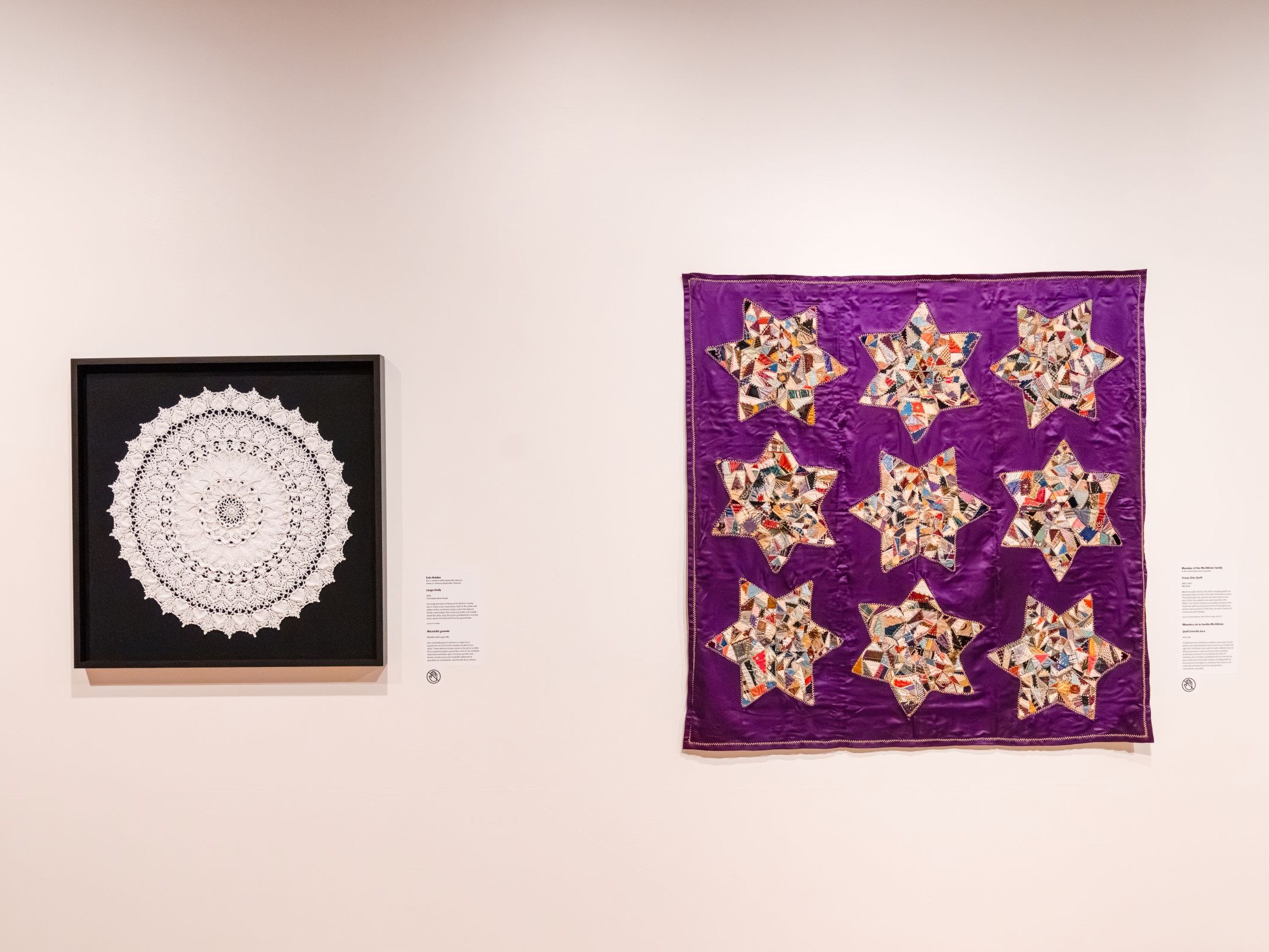
Aware of the nationalist currents of folk art as a curatorial and historiographic project, today we might instead recruit the McAllisters’ quilt to the category of craft. Perhaps the most strategic uses of craft during the semiquincentennial, including Craft in America’s initiative Handwork 2026 and the Renwick Gallery’s State Fairs: Growing American Craft, mobilize the ability of vernacular craft to sponge up some of the tropes associated with folk art during the bicentennial and earlier: ingenuity, authenticity, tradition, and community belonging. The overlap of the craft/folk Venn diagram can push forward a nonhierarchical curatorial politics while hitting nostalgic notes of Americana. Still, if craft operates as the new folk, we might also take a warning from the historiography of folk art and avoid overloading vernacular objects with the task of saying something about the nation or risk missing artists’ deeper political imaginations. Especially at Crystal Bridges, a museum dedicated to “celebrating the American spirit,” we must attend to the nation as a force in everyday life while remembering Consalvos’s collaged advice: “It’s not your nationality ev’ry time.”
Cite this article: Ella Nowicki and Larissa Randall, “Threading the Needle: Secondhand Patriotism and Vernacular Art,” in “The Art History of the 250th Anniversary,” In the Round, edited by K. L. H. Wells, Panorama: Journal of the Association of Historians of American Art 12, no. 2 (Fall 2026),https://doi.org/10.24926/24716839.21513.
Notes
- Kobena Mercer, Pop Art and Vernacular Cultures (Institute of International Visual Arts, 2007), 10. ↵
- Kenneth Ames, “Folk Art and Cultural Values,” in Common Ground/Uncommon Vision, (Milwaukee Art Museum, 1993), 90. ↵
- An anonymous collector purchased approximately eight hundred works by Consalvos through a garage sale held by Helena Martí, Consalvos’s great-niece, in West Philadelphia in 1983. Fleisher/Ollman Gallery began releasing the collages for sale in 2004. Brendan Greaves, “‘Dream the Rest’: On the Mystery and Vernacular Modernism of Felipe Jesus Consalvos, Cubamerican ‘Cigarmaker, Creator, Healer, & Man’” (MA thesis, University of North Carolina at Chapel Hill, 2008), 33–42. ↵
- These conversations about Peale’s George Washington (c. 1780–82) in the Crystal Bridges collection, inv. no. 2010.70, occurred at the America 250 Teacher Convening, Crystal Bridges Museum of American Art, May 3, 2025. ↵
- Arkansas House Bill, April 8, 2025, https://arkleg.state.ar.us/Home/FTPDocument?path=%2FBills%2F2025R%2FPublic%2FHB1705.pdf. ↵
- Basil Kincaid designed the student quilt kits. We thank the participating guilds: Bella Vista Calico Cut-Ups, Dogwood Quilters Guild, Northwest Arkansas Modern Quilt Guild, Pieces ’N Patches Quilt Club, and Q.U.I.L.T. Guild of Northwest Arkansas. ↵
- Sheryl Oring, interviewed by Corey Dzenko, “Creating an Archive of Our Times: An Interview with Sheryl Oring,” in I Wish That I Had Spoken Only of It All (Monmouth University, 2024), 12. ↵
- Janet Catherine Berlo, “‘Acts of Pride, Desperation, and Necessity’: Aesthetics, Social History, and American Quilts,” in Wild by Design: Two Hundred Years of Innovation and Artistry in American Quilts, ed. Janet Berlo and Patricia Crews (University of Washington Press, 2003), 6–9. ↵
- Here we refer to the trajectory of folk art in American art collections and modernist circles. See Lynne Cooke, “Boundary Trouble: Navigating Margin and Mainstream,” in Outliers and American Vanguard Art (National Gallery of Art, 2018), 7–12. On attempts to account for folk art beyond the national, see John Michael Vlach, “American Folk Art: Questions and Quandaries,” Winterthur Portfolio 15, no. 4 (1980): 345. Vlach laments 1970s scholarship’s continued “reliance on populist declarations” of the 1930s. ↵
About the Author(s): Ella Nowicki is a PhD student in the history of art at Yale University and was the 2025–26 Windgate curatorial fellow at Crystal Bridges Museum of American Art. Larissa Randall is the associate curator of American art at Crystal Bridges Museum of American Art.