

Copy–Paste Nationalism: Model Monuments in North Korea and Beyond





PDF: Bergendorff, Copy–Paste Nationalism
In anticipation of the 250th anniversary of the United States’ Declaration of Independence, an array of events, performances, and monuments were proposed by the federal government. The two projects that have received the most attention are familiar monumental forms: the United States Triumphal Arch and the National Garden of American Heroes. The proposed arch would occupy the intersection of Memorial Drive and the George Washington Memorial Parkway, while the sculpture garden would be developed in West Potomac Park, significantly reshaping the Capitol’s monumental core.1 American architects, art historians, preservationists, and politicians have all voiced concerns about these two memorial projects, from the projected costs to the disruption of historic views of Washington, DC.
As a scholar of international memorial politics, I see the proposed monuments in honor of the Semiquincentennial as an interesting opportunity to reflect critically on the persistence of conventional monumental forms around the world. My interest in formulaic monument production is driven by my primary research on North Korean art studios. For decades, foreign nations commissioned and imported memorial sites from North Korea, partaking in what I describe as copy–paste nationalism. I employ this term to describe a broader global tendency to recycle monumental expressions with limited nuance, adaptation, or critical reflection on the current moment, the involved people, or the specific time in history being commemorated. While the proposed triumphal arch and garden of national heroes in Washington are decidedly different from North Korean–designed monuments, what both case studies demonstrate is the appeal of erecting internationally recognizable monumental designs to easily meet nationalistic and ideological needs.
While the commemorative designs remain similar across contexts, the motivations of different nations partaking in copy–paste nationalism vary. By taking this opportunity to comparatively discuss US and North Korean memorial culture, I aim to illuminate some of the various reasons nations around the world have chosen to replicate established nationalistic monuments, selecting from a narrow set of forms such as arches, obelisks, and heroic statuary gardens. In my experience teaching memorial politics, comparative approaches are often valuable in providing students with a broader range of concepts and examples for discussion, as well as a deeper understanding of the historical and cultural nuances that inform memory practices across geographies. In the sections that follow, I briefly detail the important role of replication in North Korean memorial culture, the reasons foreign nations chose to import North Korean monumental edifices, and how the proposed monuments for the 250th United States anniversary are part of the rising appeal of copy–paste nationalism globally.
Models and Miniatures: Architectures of Anticipation
Modeling and replication have historically played a central role in North Korean memorial culture. Following the Korean War, North Korean leadership rebuilt Pyongyang using standardized architectural designs while also drawing inspiration from landmarks across the globe for its monuments.2 Before any monuments were constructed, blueprints, models, and maquettes played an important role in creating anticipation and demonstrating political control. Eventually, the full-scale monuments in Pyongyang even became models that North Korean art studios copied and adapted in capital cities across Africa and the Middle East.
To fully understand North Korean memorial culture, we must examine two of Pyongyang’s most important monuments built in honor of North Korean leader Kim Il Sung’s seventieth birthday in 1982. For the occasion, then-heir Kim Jong Il proposed two monumental additions to the skyline: Juche Tower, a soaring obelisk topped with a mosaic eternal flame, and the Arch of Triumph, a neoclassical edifice straddling one of the city’s main intersections in celebration of the nation’s military prowess. The unveiling of the new landmarks was set to coincide with an elaborate two-day schedule of birthday events, including a celebration with foreign dignitaries, robust parades, multiple exhibitions, and other large-scale mass performances. With a tight construction timeline of only two years, North Korean leadership sought to project a carefully planned vision for the monumental center of Pyongyang.
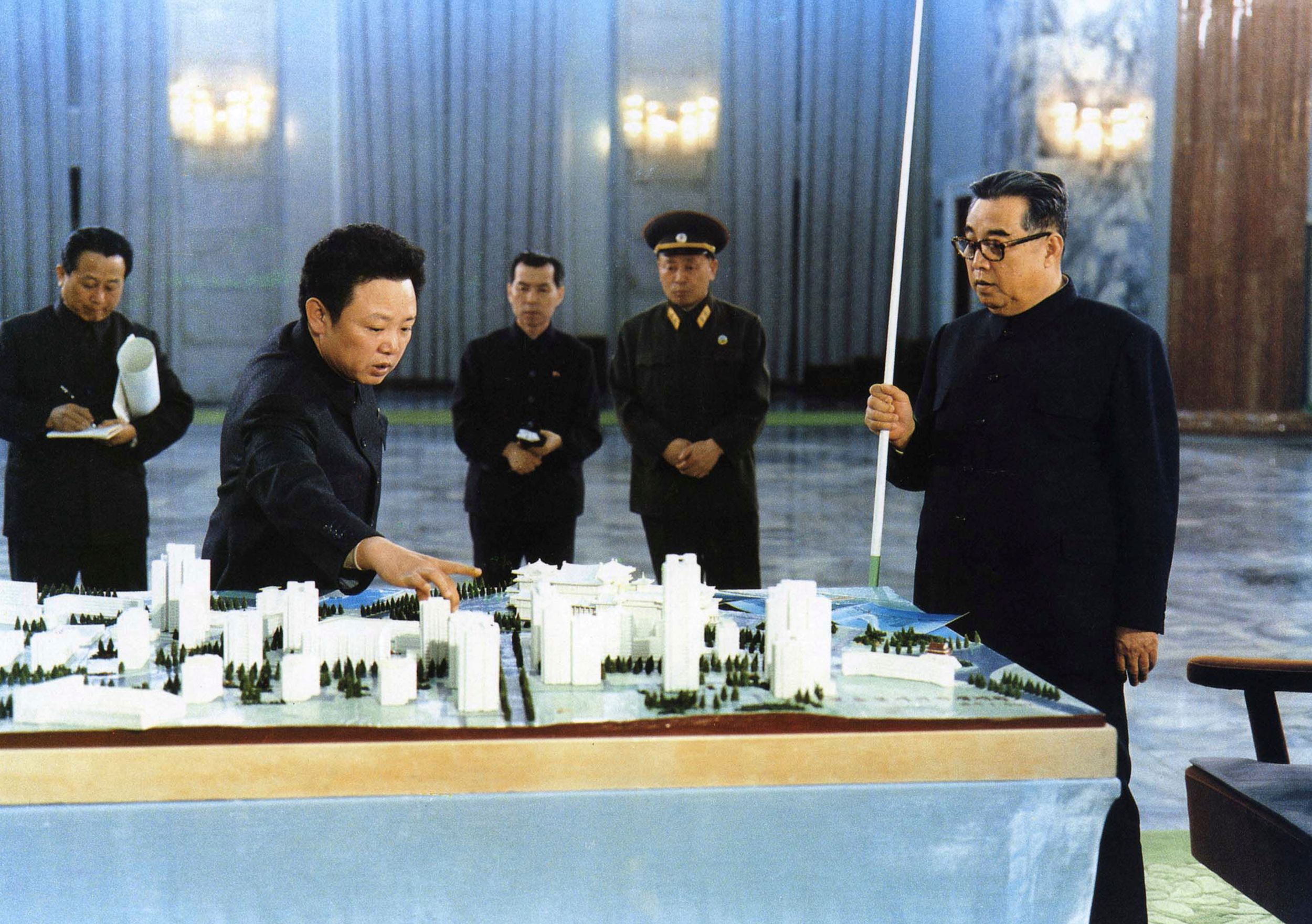
Leading up to the celebration, miniature models of Juche Tower and the Arch of Triumph were used to visually will the structures into existence and demonstrate control over the cityscape. As architects battled against time limitations, Kim Il Sung and Kim Jong Il were carefully photographed overseeing miniature versions of the monuments in a model city of Pyongyang (fig. 1).3 The model metropolis was even replicated in an ink painting by Chung Young-man, showing Kim Jong Il joyfully presenting architectural plans for Pyongyang to his father, Kim Il Sung, before a table of architectural models that include the Arch of Triumph and Juche Tower. The Kim dynasty sought to enact command over the shrunken cityscape in line with literary scholar Susan Stewart’s assertion that the miniature “presents the desiring subject with an illusion of mastery, of time into space and heterogeneity into order.”4
Models have also played an important role in familiarizing the US public with the currently proposed monumental additions. The Triumphal Arch was first publicly presented as a petite hand-held maquette at an October 2025 fundraising event in the White House.5 In 2026, news coverage of the Great American State Fair highlighted a large-scale mock version of the arch temporarily erected on the National Mall. In the absence of the proposed national monument, its miniature and temporary forms serve as visual stand-ins and as architectures of anticipation, seeking to naturalize the arrival of the full-scale arch despite time constraints, criticism, and challenges with building approvals. Similarly, the National Garden of American Heroes only exists as two-dimensional renderings generated by its foundation, showing visitors strolling through the waterfront park among bronze statues with the proposed Triumphal Arch in the backdrop.6 As July Fourth has come and gone, these models produced using plastic, plywood, and digital tools seek to suggest inevitability even amid uncertainty.
Despite being highly nationalistic, the Pyongyang Arch of Triumph and Juche Tower, as well as the proposed US Triumphal Arch, are modeled after well-known international monuments. The architectural form of the arch, as we know, is not unique to North Korea nor the United States. Its origins trace back to ancient Rome, with notable examples also found in Saint Petersburg, London, Berlin, New York, and New Delhi. In Roman tradition, triumphal arches served as imperial monuments to commemorate military victories and deify emperors.7 Likewise, Kim Il Sung is considered deified for his revolutionary efforts. In a surface-level attempt to adapt the arch to the North Korean context, its design incorporates motifs such as lyrics from a revolutionary song and seventy azalea carvings celebrating Kim’s life. Although modeled after the famous Parisian Arc de Triomphe, the North Korean arch is a very intentional thirty-three feet taller than its French counterpart. In North Korea, the scale and quantity of a monument are directly related to how effectively it demonstrates the nation’s ideology and loyalty to the leader. To put it plainly, “more is more” within the North Korean commemorative framework.8
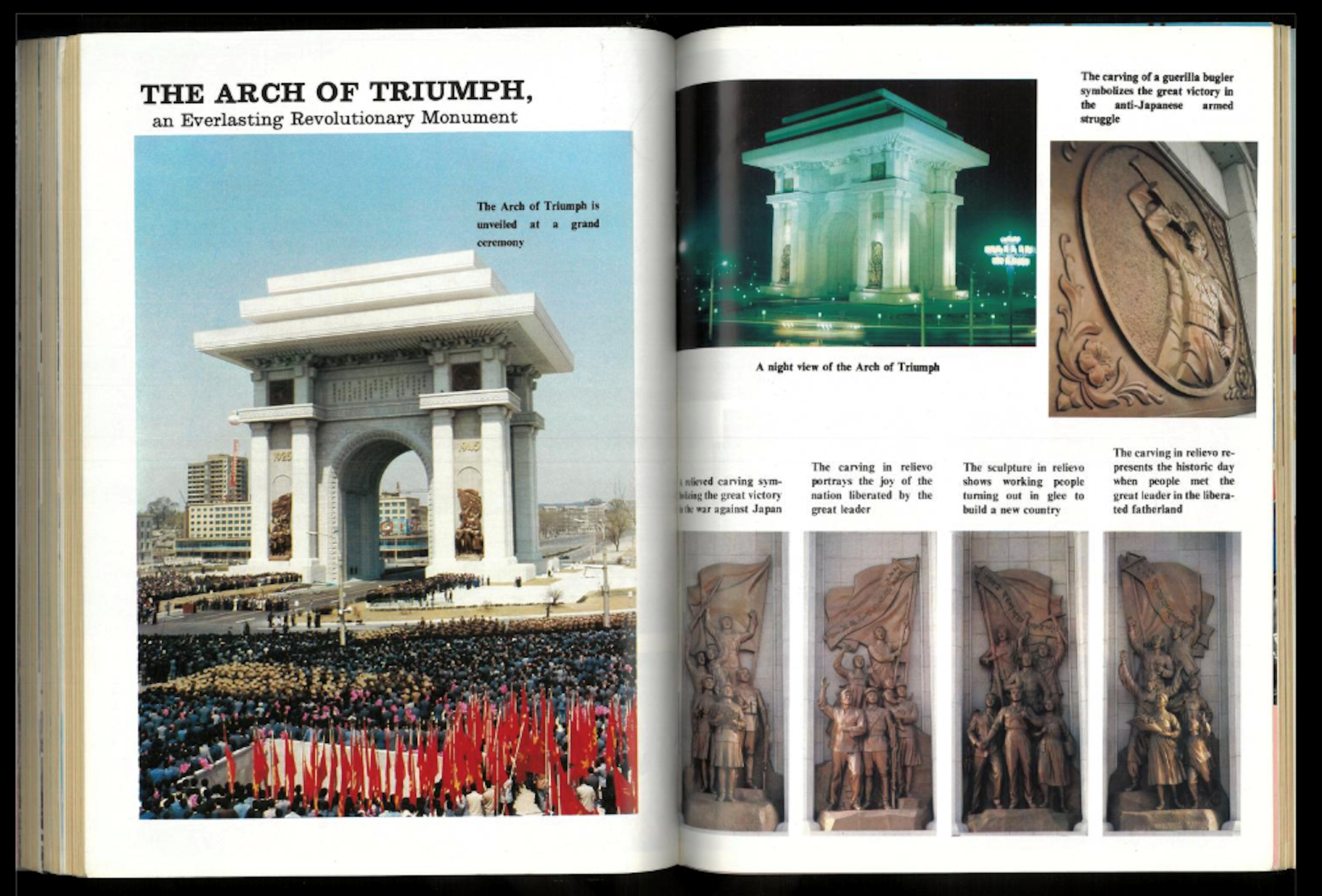
Similar to the arch, Juche Tower copies the visual language of antiquity, using an obelisk-style design originating in Egypt. Ancient pharaohs erected obelisks to honor gods and project their own power.9 However, despite drawing from these ancient forms, North Korean leadership considers Juche Tower to have the highest level of national character due to its ideological significance. Named after the national ideology of Juche, or self-reliance, the tower consists of a purported 25,550 granite blocks, each representing a day in Kim Il Sung’s life.10 North Korean media actively framed the Arch of Triumph and Juche Tower as “great monuments” of the time, uniquely North Korean and revolutionary in nature (fig. 2).11 The monumental landscape of North Korea regularly replicated globally recognizable commemorative forms, thinly veiled with state ideology. Although characterizing the Arch of Triumph and Juche Tower as distinctly North Korean might be at odds with the broader history of arches and obelisks, their celebration as deeply nationalistic forms illuminates how a narrow pool of accepted commemorative expressions has been deployed globally, with great success, to meet different ideological agendas. For example, while the Arch of Triumph in Pyongyang is decorated with azalea flowers and a revolutionary hymn, the proposed United States Triumphal Arch features a winged Lady Liberty and gold-lacquered eagles.
Replicated Forms of Remembrance
The monuments of Pyongyang have, in turn, served as models and blueprints for memorials erected around the world. North Korean art studios specialize in the design, construction, and export of nationalistic sculptures, commissioned by other nations to create monuments abroad. Key examples are located in Egypt, Namibia, Botswana, and Zimbabwe. North Korea’s memorial export enterprise highlights something characteristic across many contemporary memorial landscapes: the desire for sameness and formulaic familiarity. The primary studios responsible for designing and constructing memorial sites abroad are Mansudae Overseas Projects and Paekho Trading Corporation.12 Mansudae Art Studios was established in the late 1950s, with its international division created in the 1970s. Mansudae Overseas Projects has collaborated on numerous museums and heroic sculpture gardens commemorating foreign leaders and fallen soldiers. Since 1970, Paekho Trading Corporation has marketed North Korean artistic labor for panoramic museum projects. While each art studio has its own unique specializations, both adopted the same business strategy: redeploying North Korea’s formulaic, and often militaristic, memorial sites and superficially adapting them to meet the needs of importing countries.
North Korean art studios developed catalogues and pamphlets of ready-made museums, monuments, and statuary figures for sale to interested foreign governments. Artists and architects disseminated such materials at international conferences and events. Monumental artworks were also advertised in foreign-language publications, such as Korea Today and Foreign Trade in the DPRK. Other commissions stemmed from diplomatic visits to Pyongyang. For instance, following Egyptian president Hosni Mubarak’s 1983 visit to Pyongyang, he requested his own version of the North Korean Daejeon Liberation Panorama, located in the Victorious Fatherland Liberation War Museum in Pyongyang. Through these commissions, North Korean museums and monuments became blueprints that could be continually replicated in pursuit of generalized nationalism.
North Korean overseas art studios have built, designed, or renovated museums, monuments, and public sculptures in nearly thirty foreign countries. This memorial export model served as an essential and strategic part of the nation’s international diplomacy agenda. The reiterative monuments created by North Korean art studios are often imbued with revolutionary and anti-imperial meaning. Such messaging appealed to many postcolonial nations tasked with replacing memorial landscapes tied to the prior colonial era. Other commissioning nations were drawn to the way that idealized socialist-realist statues of North Korean leaders and heroes convey a singular, authoritative message. North Korean sculptures leave little room for ambiguity, telling the public exactly who to celebrate and what ideals to uphold.
The export of national monuments by North Korea reveals how standardized and globalized monumentality has become. By the early 2000s, word had spread of the speed and ease of importing national monuments and museums from North Korea. Between 2001 and 2014, Mansudae Overseas Projects revamped Namibia’s entire memorial infrastructure. After gaining independence in 1990, the new Namibian government was forced to contend with an inherited colonial monumental landscape. In response, the government hired Mansudae Overseas Projects to design and build multiple national sites, including Heroes’ Acre Complex, the Genocide Memorial, the Independence Museum, the Namibian state house, and even a munitions factory. In particular, Heroes’ Acre, located on the outskirts of Windhoek, copies many elements from the North Korean memorial lexicon, including a central obelisk and a revolutionary hero lunging into action. Mansudae Overseas Studios has also developed figurative sculpture gardens and memorial complexes honoring national figures in Zimbabwe (1982) and Botswana (2005). While the display of civic and mythical hero statues dates back to antiquity, North Korean art studios have neatly identified the gestures, expressions, and statuary formations necessary to convey authority and evoke national pride.
The reasons behind the popularity of North Korean copy–paste monuments abroad are threefold. First, many postcolonial nations wanted to rapidly replace colonial monuments, making North Korean ready-made monuments a quick and seductive alternative.13 Second, North Korean art studios often offered competitive pricing to foster diplomatic relationships and align nationalisms. Third, and perhaps most important, the idealized realism of North Korean monuments provides a clear, unified narrative, which is especially valuable in contexts where historical events are disputed. Such monumental forms provide legitimacy and legacy, qualities particularly appealing to both young and divided nations. Beyond the North Korean case study, these common incentives seem to drive the global phenomenon of repetitive monumental building.
Copy–Paste Nationalism
Major cities across the globe contain similar formulaic monuments, from triumphant arches to heroic sculpture gardens, highlighting the narrow confines of nationalistic memory production. The North Korean conceptualization of full-scale monuments as models to be replicated has contributed to the rise of copy–paste nationalism. Decades ago, North Korean art studios recognized the ever-present demand for generic national monuments and museums. The desire for such monuments highlights a widespread willingness to adopt the same repetitive, outsourced models of commemoration. The global import, export, and copying of commemorative forms suggest that monuments have become a mundane requirement of nation-state building, another item on the checklist of required hallmarks for statehood.
In the United States, the current administration has argued that the proposed arch should be added to Washington, DC’s monumental core because many other cities feature similar arches, and the US Capitol should not be without its own. Erecting a monumental arch may simply aim to fill a perceived absence. However, in doing so, it becomes yet another iteration of banal copy–paste nationalism, neglecting to communicate something particularly unique about American history or the semiquincentennial anniversary. The motivations behind these types of derivative memorial projects vary from nation to nation. However, they are often underlaid by a desire for conformity, an effort to obscure domestic division, or an attempt to exert control via the built environment. Whatever impulses may lurk beneath the surface, the resulting monuments serve as highly visible testaments to copy–paste nationalism’s powerful allure.
Cite this article: Karlee Bergendorff, “Copy–Paste Nationalism: Model Monuments in North Korea and Beyond,” in “The Art History of the 250th Anniversary,” In the Round, edited by K. L. H. Wells, Panorama: Journal of the Association of Historians of American Art 12, no. 2 (Fall 2026), https://doi.org/10.24926/24716839.21491.
Notes
- National Park Service, “Triumphal Arch at Memorial Circle,” Planning, Environment and Public Comment (PEPC), accessed August 24, 2026, https://parkplanning.nps.gov/projectHome.cfm?projectId=136973. ↵
- For more on standardized architecture, see Myengsoo Seo, “Rethinking the Characteristics of North Korea’s Architecture and Construction Culture during Its 1950s Post-War Recovery,” Korea Journal 61, no. 2 (2021): 267. ↵
- The decision-making process behind the monuments is carefully outlined in Kim Jong Il: Biography (Foreign Languages Publishing House, 2006), 2:169–83. ↵
- Susan Stewart, On Longing: Narratives of the Miniature, the Gigantic, the Souvenir, the Collection (Duke University Press, 1993), 172. ↵
- Betsy Klein, “Developer in Chief Donald Trump Envisions New Arch in Washington, DC,” CNN, October 15, 2025, https://www.cnn.com/2025/10/15/politics/trump-envisions-new-arch-near-washington-dc. ↵
- While not officially approved, this fundraising brochure includes AI-generated renderings of the proposed National Garden of American Heroes. See, The National Garden of American Heroes Foundation: Pledge Agreement,” May 2026, Democracy Forward, https://democracyforward.org/wp-content/uploads/2026/05/FINAL-THE-NATIONAL-GARDEN-OF-AMERICAN-HEROES-FOUNDATION.pdf. ↵
- For a more nuanced discussion of Roman arches, see Kimberly Cassibry, “Reception of the Roman Arch Monument,” American Journal of Archaeology 122, no. 2 (2018): 245–75. ↵
- In his writings, Kim Jong Il states, “The magnificence of grand monuments is expressed . . . through unusually large size and vast numerical quantity.” See Kim Jong Il, On Architecture (Workers’ Party of Korea Publishing House, 1991), 38–39. ↵
- For further information on the history and cultural meaning of Egyptian obelisks, see Brian A. Curran, “Obelisks in Ancient Egypt,” in Encyclopedia of the History of Science, Technology, and Medicine in Non‑Western Cultures, ed. Helaine Selin (Springer Netherlands, 2016), 3419–35; and Chris Elliott, Needles from the Nile: Obelisks and the Past as Property (Liverpool University Press, 2022). ↵
- Peter Noever, Flowers for Kim Il Sung: Art and Architecture from the Democratic People’s Republic of Korea (MAK–Austrian Museum of Applied Arts, 2010), 31. ↵
- See “Great Monuments of Our Age,” Korea Today, no. 309 (June 1982): 56–57; and “Arch of Triumph: Everlasting Revolutionary Monument,” Korea Today, no. 313 (October 1982): 36–88. ↵
- Since 2017, international sanctions have limited the monumental exports of Mansudae Overseas Projects and Paekho Trading Corporation. See United Nations Security Council, Resolution 2371 (2017), S/RES/2371, August 5, 2017. ↵
- Felwine Sarr discusses the seduction of completed forms as the importation of ready-made institutions that are not created with the needs of individual countries, cities, and their people in mind. While he does not explicitly discuss monuments in his book, I have taken much inspiration from his concept of “completed forms.” Felwine Sarr, Afrotopia (University of Minnesota Press, 2019), 96. ↵
About the Author(s): Karlee Bergendorff is a bridge-to-faculty postdoctoral fellow in art history at the University of Texas, San Antonio.