

Call and Response: DEIA Tensions in Scholarship, Practice, and National Identity





PDF: Navaroli and Simmons, Call and Response
Introduction
Contributors
Alexandra Nicome, Confluence: Situating New Beginnings in the Work of Seitu K. Jones
Matthew Villar Miranda, With Unvarnished Eyes: Indexing Radical Pedagogy in Stephanie Syjuco’s Present Tense (Roll Call) at BAMPFA
Ashleigh Dior Coren, Museum Studies Pedagogy as Noncompliance in an Era of Federal Censorship
Aja Roache, HBCU Art Survival in the Wake of Federal Cuts
Zoe Hume, Navigating Archival Silences Through Art
Kamau Pope, The #CharlestonStrong Machine
As we critically imagine new ways to think and write about visual art, as we make spaces for dialogue across boundaries, we engage a process of cultural transformation that will ultimately create a revolution in vision.
—bell hooks, Art on My Mind
This Colloquium poses an opportunity to be candid with both Panorama’s editors and one another—to ask not just “why” but “how” decisions are made regarding the validation of American art scholarship during a decade of increased sociopolitical individualism, systemic delusion, and Western solipsism. Who draws the boundaries on the field’s production, consumption, and marketing? Is Panorama an informed force for change or is it part of a larger system still plagued by inequity? For two years, we have served Panorama as the Manager of DEI / Digital Art History and as the Section Editor for Exhibition Reviews, respectively. During our tenure, we have been inspired by the work of our colleagues but also challenged by the field’s latent, and sometimes explicit, hierarchies. As Black scholars whose personal and professional experiences have been shaped by exclusion, we consider how researchers can productively engage with discomfort. Specifically, how can we use this moment of national reflection to lean into issues of fragmentation, alienation, pessimism, and unease? How can exploring uncomfortable subjects—historic silences, lingering distortions, and present realities—better position scholarship for an informed and inclusive future?
Revolution, whether in nation building or within the walls of cultural institutions, is complex, contentious, and transformative. Two hundred and fifty years after the signing of the Declaration of Independence, we find ourselves lingering—suspended between commemoration and critique, between the official story and the lives that official narratives have never quite managed to absorb. To mark this anniversary is to read between the lines: to ask not only what has been written into the history of American art, but what has been flattened, folded, and assimilated into a story that was never constructed to be malleable enough to carry our multiplicities.
The language of national celebration has always demanded a kind of consolidation. To belong, one must cohere. To be legible within the dominant narrative of American identity, communities, traditions, and histories have long been pressured—both covertly and violently—to surrender their particularity at the door. Assimilation, in this sense, is not simply a social process; it is an aesthetic and institutional one. It shapes what enters the museum, what gets written into the archive, what is deemed worthy of scholarly attention, and what quietly disappears. The result is a visual culture that reflects not the plurality of American experience but the myopia of the institutions entrusted to maintain and preserve it.
That myopia is self-reinforcing. When tradition mistakes its own limitations for standards of excellence, it produces a kind of reward for stagnation—a system that valorizes the familiar, marginalizes the dissonant, and calls that process objectivity. For scholars working across communities that historically have been collected rather than consulted, represented rather than centered, the demand to establish oneself through expertise carries a particular irony. Connoisseurship, as it has been practiced within predominantly white institutions, has often functioned less as a measure of knowledge than as a mechanism of exclusion—determining not only whose objects matter but whose ways of knowing are permitted to matter alongside them.
Planar Mountain
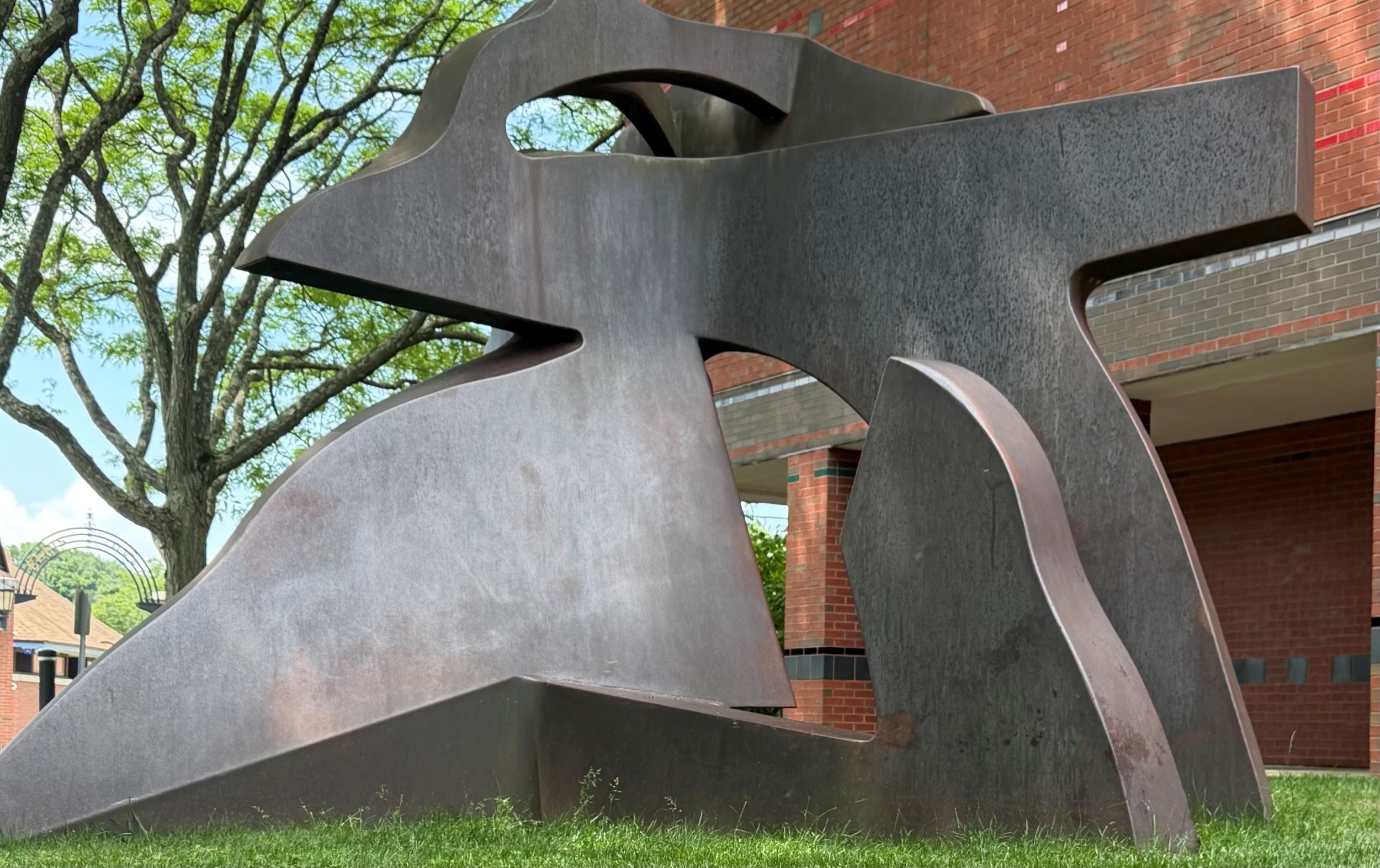
Richard Hunt was the single-most prolific American public artist of the twentieth century, with more than 160 public sculptures completed over the course of his seven-decade career. In 1955, a then-nineteen-year-old Hunt attended the funeral of Emmett Till, looked into the open casket, and witnessed the face of a child from his community, five years his junior, distorted beyond recognition. The distortion and mutilation he witnessed that day, the horror of the afterlife of the American Antebellum, so deeply impacted Hunt that he taught himself how to weld metal that summer and began his abstractive sculpture practice. Planar Mountain is a site-specific work at Tufts University’s lower campus in Somerville, a city directly northwest of Boston that was colonized in the mid-1600s by European settlers. Less than a half mile away is present-day Powder House Square, cited as a location of one of the first British hostilities of the Revolutionary War. In the year 2026, as federal propaganda pressures communities to “celebrate” 250 years of America, public art installed on land that will always predate the nation serves as both reminder and encouragement to recognize the gravity of place on our lives. As centuries of memories condense upon themselves, this Colloquium charges our editors, contributors, and readers alike with the obligation to recognize our temporal placement within the landscape of the fictitiously dominant American identity.
This is where the question of collectivity becomes most urgent, and most fraught. American art history has frequently approached marginalized communities through the lens of the group: as movements, traditions, or demographic categories rather than as constellations of irreducibly individual voices. In the effort to recover what has been excluded, scholarship risks reproducing the very flattening it seeks to undo—assimilating difference into legibility, particularity into representation. How do we hold space for the individual within narratives of collectivity? How do we honor the specificity of a body, a practice, a local history, without conscripting it into a symbol that serves the story we already need to tell?
These questions do not resolve neatly, and this Colloquium does not ask them to. We are interested instead in the spaces between—between the individual and the collective, between assimilation and resistance, between the archive’s silences and the knowledge that survived outside it. To sit with those spaces, to resist the pressure to consolidate them into comfortable conclusions, is itself a critical act.
As guest editors for this Colloquium, we asked contributors, scholars of color from a variety of professional backgrounds, to personally and critically engage with themes of uncertainty, hybridity, and resistance in American art. Alexandra Nicome and Matthew Villar Miranda interrogate the installations of contemporary artists Seitu K. Jones and Stephanie Syjuco, respectively, drawing connections to environmental and institutional decay and severing assumptions associated with art making for public spaces. Focusing on pedagogical practice, Ashleigh Coren questions the role of museum studies curricula in an age of increased institutional scrutiny, and Aja Roache situates the history of an HBCU (Historically Black College/University) currently under threat by legislative restructuring. In her contribution, Zoe Hume details how interpreting historical archives can serve as a model for addressing Black erasure in local communities. Finally, Kamau Pope provides an activist-centered call to action for performance-based practice in the regional South.
These essays reflect lived experiences, embodied knowledges, and, in some instances, internalized frustrations. We are grateful to the contributors for their willingness to share these vulnerabilities and to Panorama for the opportunity to present these complex dialogues across both the spring and fall 2026 colloquia. It is essential that Panorama continues to allow scholars and practitioners to ask the proverbial tough questions and constructively agitate—within the discipline and the journal itself—the fragmented lenses of visual culture.
Cite this article: Keidra Daniels Navaroli and Frederica Simmons, introduction to “Call and Response: DEIA Tensions in Scholarship, Practice, and National Identity,” Colloquium, edited by Keidra Daniels Navaroli and Frederica Simmons, Panorama: Journal of the Association of Historians of American Art 12, no. 1 (Spring 2026), https://doi.org/10.24926/24716839.20989.
About the Author(s): Keidra Daniels Navaroli is Manager of Diversity, Equity, Inclusion and Digital Art History at Panorama. Frederica Simmons is an Exhibition Reviews editor at Panorama.